REVIEW 3 major objections 6 minor 6 cited by
Semantics-Guided Diffusion for Deep Joint Source-Channel Coding in Wireless Image Transmission
T0 review · 3 major / 6 minor · reviewed 2026-08-10 · deepseek-v4-flash
Pith's one-line read SGD-JSCC transmits a text caption or edge map alongside deep joint source–channel coded image features and uses a semantics-guided diffusion model to denoise the channel output, claiming perceptual gains over prior DeepJSCC schemes at SNR…
desk verdict A solid, referee-worthy JSCC-diffusion paper whose main edge-guided results hold up; the free-text side channel fails at the low-SNR regime where text guidance is claimed to shine, but that flaw mostly hits an ablation, not the headline comparison. read the letter →
The pith
A machine-rendered reading of the paper's core claim, the machinery that carries it, and where it could break.
The reading
What carries the argument
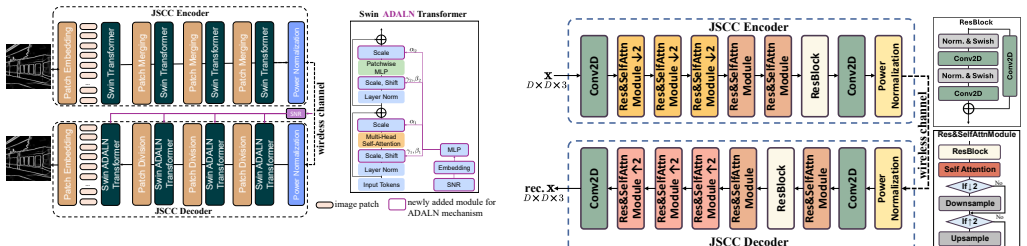
The mechanism that carries the argument is the placement and conditioning of the diffusion denoiser. Instead of refining the decoder output, the denoiser operates on the equalized channel output before the JSCC decoder, viewing the channel output as one intermediate noisy state in a variance-preserving forward diffusion with a continuous sigmoid noise schedule; the denoiser predicts the clean latent from that state. Conditioning comes from semantic side information: text embeddings serve as keys and values in cross-attention layers, while edge maps enter through a frozen copy of the base network plus a zero-initialized linear fusion branch. The same diffusion schedule is used for channel adaptation: a learned estimator maps the received signal to the equivalent SNR and phase, the inverse schedule maps SNR to a continuous starting timestep, and the fast-fading extension equalizes per-symbol noise levels by adding noise to over-clean elements, then updates only elements whose noise level is above the next target level.
What would settle it
Run SGD-JSCC at SNR = −15 dB while transmitting the text caption through the same fading channel, or at a finite rate, rather than assuming perfect delivery, and compare the text-guided variant against the edge-map-only and unconditional variants on LPIPS, FID, and CLIP score; if the text-guided gains disappear or reverse, the semantics-guidance claim at extreme low SNR collapses.
Extended reading notes
Core claim
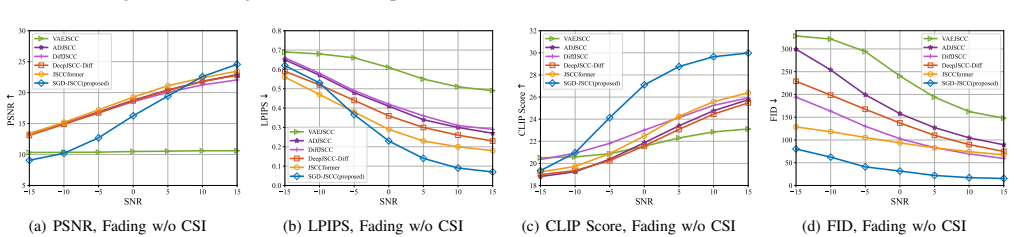
SGD-JSCC's core discovery is that the channel noise can be matched to the forward noise of a diffusion model and removed under semantic guidance, so that the JSCC encoder and decoder can be trained once for one channel state while the diffusion denoiser absorbs all channel variation. Two semantic modalities are supported: coarse text descriptions, extracted by an image-captioning model and injected through cross-attention, and fine edge maps, transmitted through a dedicated JSCC encoder and injected through a zero-initialized structural-control branch. In slow fading, the receiver estimates the instantaneous SNR and phase directly from the normalized channel output, converts the estimated SNR to a continuous noise level via the inverse scheduling function, and starts denoising at the matched timestep, eliminating pilot-based channel estimation. In fast fading, a water-filling-inspired procedure adds carefully chosen Gaussian noise to cleaner symbols to equalize their noise levels to the diffusion schedule, so a denoiser trained under AWGN can be applied without retraining. The reported result is that this scheme outperforms ADJSCC, JSCCformer, DeepJSCC-Diff, JSCCDiff, and a non-diffusion VAE variant on LPIPS, FID, and CLIP score over the tested conditions, with visual examples showing semantic content such as a bear in grass preserved at −10 dB where unconditional denoising reconstructs an unidentified animal.
Load-bearing premise
The load-bearing premise is that the text description reaches the receiver perfectly and costs no channel resources; if that side channel is noisy or rate-limited, the text-guided gains reported at very low SNR may not be achievable in practice.
Editorial extensions
If this is right
- In slow fading, the system can operate without pilot transmissions: SNR and phase are estimated from the received latent, and the paper reports these estimates are accurate enough that reconstruction quality is nearly the same with and without receiver SNR knowledge.
- The JSCC encoder–decoder is channel-agnostic: once trained under a fixed AWGN SNR, it can be reused across channel conditions and semantic metrics, with only the diffusion denoiser and guidance modules tailored.
- In fast fading, a diffusion denoiser trained for AWGN can be applied without fine-tuning via the water-filling update rule, and the paper reports only a slight performance decline as fading block length increases from 1 to 1024.
- Masking parts of the latent feature during diffusion training enables rate-adaptive transmission, where dropping the lowest-L2-norm tokens degrades quality less than random dropping, suggesting an importance-based resource allocation rule.
- The semantic side information is what preserves meaning at extreme low SNR: at −15 dB the scheme retains recognizable objects, whereas conventional DeepJSCC baselines lose semantics even when their PSNR is higher.
Reading between the lines
- The paper's text-based variant assumes the caption is received perfectly and costs nothing; transmitting the caption through the same channel at finite rate is a testable extension that would reveal whether the reported low-SNR gains survive when the guidance itself is noisy.
- Because the diffusion prior is trained on open-domain image–text data, the receiver can generate content that is plausible but absent from the source; a natural next evaluation is to measure object-level consistency, not just global perceptual scores, between the reconstruction and the original.
- The continuous noise-level matching and water-filling update are channel-agnostic in principle; the paper targets point-to-point image links, but the same mechanism is a plausible starting point for MIMO, OFDM, or non-image modalities, which the paper does not test.
Signed reviews
Editorial analysis
A structured set of objections, weighed in public.
Referee Report
Summary. The paper proposes SGD-JSCC, a deep joint source-channel coding scheme in which a diffusion model is used to denoise the JSCC channel output before decoding, guided by semantic side information in the form of either a text description or an edge map. For slow fading channels the scheme estimates the instantaneous SNR and phase directly from the equalized channel output, so that the diffusion starting step is matched continuously to the channel state without pilot overhead; for fast fading channels it introduces a water-filling-inspired denoising procedure that equalizes per-symbol noise levels so that a DM trained under AWGN can be applied without fine-tuning. The numerical section compares SGD-JSCC with ADJSCC, JSCCformer, DeepJSCC-Diff, JSCCDiff, and VAEJSCC on COCO2017 and Kodak, reporting gains in perceptual metrics (LPIPS, FID, CLIP) at low SNR, and includes ablations of text versus edge-map guidance, blind CSI estimation accuracy, masking strategies, and fast-fading behavior.
Significance. If the reported results hold, the paper makes a useful step toward making diffusion-based JSCC practical: the continuous step-matching formulation (Eq. (20)) is a clean, parameter-free mapping from SNR to diffusion noise level, and the water-filling extension in Section VI is an interesting training-free way to reuse a slow-fading DM in fast-fading channels. The manuscript also contains extensive comparisons and ablations, and the authors promise public code and checkpoints, which would facilitate reproducibility. The main limitation is that the text-guidance variant assumes an ideal, cost-free side channel at exactly the low-SNR regime where the paper claims its largest perceptual gains; this assumption is capacity-infeasible at SNR = -15 dB and needs to be reframed as an upper bound or accompanied by an evaluated transmission scheme. The edge-map variant is within the rate budget but its reliability at very low SNR is not directly measured.
major comments (3)
- [Section IV-A, footnote 2] The perfect, cost-free text side channel is capacity-infeasible in the regime the paper highlights. For a 128x128x3 image at CBR = 1/20, the system has roughly 2,458 complex channel symbols in total. At SNR = -15 dB, the Shannon capacity is approximately 0.045 bits per complex dimension, giving about 110 bits per image for the whole transmission. A typical 50-character BLIP2 caption (~400 bits) would require on the order of 8,900 channel uses, more than three times the entire CBR budget. Since Fig. 15 attributes the best low-SNR CLIP/FID performance to text guidance, those specific gains are not deployable at -15 dB. The footnote's appeal to 'specialized DeepJSCC techniques' is not backed by a scheme, simulation, or capacity analysis. Please either count the text overhead in the CBR and evaluate with corrupted text reception, or present the text-guided results explicitly as an upper bound and make the edge-map-guided variant the primary deployment claim.
- [Section VII-C1 and Fig. 15] The reliability of the decoded edge map at very low SNR is not measured, even though edge-map guidance is the variant used in the main -15 dB comparisons (footnote 6). The only edge-map reconstruction example, Fig. 16, is shown at SNR = -10 dB, and the paper itself states in Section VII-C1 that edge-map transmission errors can mislead the diffusion model and degrade performance at high SNR. Without a quantitative evaluation of decoded edge-map fidelity at -15 dB (e.g., BCE/Dice on the COCO validation set) or an ablation that compares ground-truth edge guidance with decoded edge guidance, the claim that semantic guidance is responsible for the -15 dB perceptual gains is not fully supported. Please add such measurements or soften the corresponding claims.
- [Section VII, Performance Metrics and Fig. 15] The use of CLIP score as a reconstruction metric is biased in favor of the text-guided variant because the receiver has access to the ground-truth caption. A text-conditioned diffusion model can obtain a high CLIP score by producing any image that is semantically consistent with the caption, including hallucinated content that the paper itself acknowledges can occur (Section VII-C1). The FID metric has a related realism bias. To support the perceptual-quality claims fairly, please report reconstruction-oriented metrics (LPIPS with the decoded edge map, or a faithfulness metric that penalizes caption-consistent but content-incorrect reconstructions) alongside CLIP/FID, and discuss the bias explicitly.
minor comments (6)
- [Section II-C and Section VII-A] The benchmark naming is inconsistent: the text alternates between 'DeepJSCC-Diff', 'JSCCDiff', and 'DiffJSCC' for what appear to be the same or closely related baselines; please align the names in the text, figures, and table captions.
- [Section VII-A] The sentence 'The ADJSCC scheme refers to the DeepJSCC architecture in [14]' appears to cite the wrong reference, since ADJSCC is introduced in [16]; please correct the citation.
- [Section IV-B and Fig. 2] The text says the edge-map JSCC model uses a ViT architecture, while Fig. 2 is labeled 'Swin Transformer'; please clarify which architecture is actually used.
- [Eq. (16)] As typeset, the noise coefficient in Eq. (16) appears to contain an extra factor; please verify that it matches the standard variance-preserving conditional distribution q(ft|fs).
- [Table I] Table I mixes layer architecture with training hyperparameters (batch size, epochs, optimizer); please separate the network specification from the training configuration.
- [Abstract and Section VI] The abstract and introduction emphasize 'no additional pilot transmissions for channel estimation', but the fast-fading extension in Section VI assumes perfect CSI at the receiver; please state this assumption explicitly in the contributions and conclusions.
Circularity Check
No significant circularity: the step-matching rule is a parameter-free mapping from the channel model to the diffusion noise schedule, and the trained modules are not reused as the reported performance targets.
full rationale
The paper's claimed derivation chain is self-contained rather than circular. The central step-matching rule in Eq. (20) maps the equalized channel output's signal level alpha = |h|^2/(|h|^2 + sigma^2) to a diffusion noise level beta = sigma^2/(sigma^2 + |h|^2) by direct comparison of the channel conditional distribution in Eq. (9) with the variance-preserving forward diffusion process in Eq. (15); the sigmoid schedule S(t) is a separately chosen hyperparameterized function, and the diffusion model is trained (Algorithm 1) to predict the clean latent f0 from noisy features, not to optimize the reported PSNR, LPIPS, FID, or CLIP targets. The SNR and phase estimators are trained auxiliary modules whose outputs feed the step matcher, but their outputs are not renamed as reconstruction predictions; their accuracy and sensitivity are separately measured in Fig. 17. Semantic side information (BLIP2 text or MuGE edge map) is an input to the conditional diffusion model, and the main benchmark comparisons use the edge-map variant with its transmission cost counted inside the CBR budget, so no fitted value of the target metric is used as a prediction. The only self-citation that could be noted, reference [51] to the authors' own arXiv version, is used for 'more results on SNR estimation errors' and is not load-bearing. Footnote 2's assumption that text is transmitted perfectly is a deployability limitation at very low SNR, not a circular step, because the text-guided results are presented as an ablation and the main low-SNR claims use edge-map guidance. No equation or fitted parameter reduces the reported results to the inputs by construction.
Assumptions & free parameters
free parameters (4)
- Sigmoid noise schedule shape (e, g, tau) =
e=3, g=0, tau=0.7
- Classifier-free guidance scalar =
4.5
- Guidance scalar =
0.3
- GAN loss weight lambda =
not reported
assumptions (5)
- domain assumption The wireless channel after equalization is exactly a variance-preserving Gaussian corruption of the JSCC latent feature, matching the DM forward process (Eq. 9 equals Eq. 15).
- domain assumption The DM trained on a fixed JSCC encoder at SNR=10 dB generalizes to other SNRs and to the COCO test distribution.
- domain assumption Text descriptions can be transmitted to the receiver perfectly at negligible cost.
- domain assumption Edge map side information can be transmitted with sufficient fidelity within 1/24 of the total CBR.
- standard math Diffusion theory: DDIM-type deterministic reverse sampling with sigma=0 reconstructs the clean latent (Eq. 17 with sigma_{s,t}=0).
Cite this review
Pith. "Pith review of Semantics-Guided Diffusion for Deep Joint Source-Channel Coding in Wireless Image Transmission." pith.science (2026). https://pith.science/paper/7IDQ52UG
@misc{pith2026250101138,
  author       = {Pith},
  title        = {Pith review of: Semantics-Guided Diffusion for Deep Joint Source-Channel Coding in Wireless Image Transmission},
  year         = {2026},
  howpublished = {\url{https://pith.science/paper/7IDQ52UG}},
  note         = {Machine review of arXiv:2501.01138}
}
read the original abstract
Joint source-channel coding (JSCC) offers a promising avenue for enhancing transmission efficiency by jointly incorporating source and channel statistics into the system design. A key advancement in this area is the deep joint source and channel coding (DeepJSCC) technique that designs a direct mapping of input signals to channel symbols parameterized by a neural network, which can be trained for arbitrary channel models and semantic quality metrics. This paper advances the DeepJSCC framework toward a semantics-aligned, high-fidelity transmission approach, called semantics-guided diffusion DeepJSCC (SGD-JSCC). Existing schemes that integrate diffusion models (DMs) with JSCC face challenges in transforming random generation into accurate reconstruction and adapting to varying channel conditions. SGD-JSCC incorporates two key innovations: (1) utilizing some inherent information that contributes to the semantics of an image, such as text description or edge map, to guide the diffusion denoising process; and (2) enabling seamless adaptability to varying channel conditions with the help of a semantics-guided DM for channel denoising. The DM is guided by diverse semantic information and integrates seamlessly with DeepJSCC. In a slow fading channel, SGD-JSCC dynamically adapts to the instantaneous signal-to-noise ratio (SNR) directly estimated from the channel output, thereby eliminating the need for additional pilot transmissions for channel estimation. In a fast fading channel, we introduce a training-free denoising strategy, allowing SGD-JSCC to effectively adjust to fluctuations in channel gains. Numerical results demonstrate that, guided by semantic information and leveraging the powerful DM, our method outperforms existing DeepJSCC schemes, delivering satisfactory reconstruction performance even at extremely poor channel conditions.
Figures


Figures from the paper (15 more)




Forward citations
Cited by 6 Pith papers
-
Rethinking Multi-User Communication in Semantic Domain: Enhanced OMDMA by Shuffle-Based Orthogonalization and Diffusion Denoising
Randomly permuting each user's JSCC features turns multi-user interference into roughly Gaussian noise, letting a single pretrained encoder and diffusion denoiser serve all users.
-
Token-Domain Multiple Access: Exploiting Semantic Orthogonality for Collision Mitigation
ToDMA lets uncoordinated devices share a token codebook and transmit non-orthogonally, then uses a pretrained transformer to repair token collisions from context.
-
Mixture of Semantics Transmission for Generative AI-Enabled Semantic Communication Systems
A semantic communication system that transmits image ROIs at high fidelity and transmits the background as text, reconstructing the image with a diffusion model.
-
ToDMA: Large Model-Driven Massive Token Communications for Semantic Multiple Access
ToDMA lets many devices share one wireless channel by transmitting token indices from a common codebook, recovering collisions with compressed sensing and masked-token prediction from pretrained models.
-
Visual Fidelity Index for Generative Semantic Communications with Critical Information Embedding
The paper introduces GVIF, a mutual-information-based metric for visual fidelity in generative semantic communication, and uses it to adaptively select critical image features and compression levels for wireless transmission.
-
Censored Sampling for Topology Design: Guiding Diffusion with Human Preferences
Guiding a pretrained topology-diffusion generator with human-preference reward classifiers is claimed to suppress floating-material and boundary-violation failure modes without retraining the generator.
Reference graph
Works this paper leans on
-
[1]
Beyond transmitting bits: Context, semantics, and task-oriented communications,
D. G ¨und¨uz, Z. Qin, I. E. Aguerri, H. S. Dhillon, Z. Yang, A. Yener, K. K. Wong, and C.-B. Chae, “Beyond transmitting bits: Context, semantics, and task-oriented communications,” IEEE Journal on Selected Areas in Communications, vol. 41, no. 1, pp. 5–41, 2023
work page 2023
-
[2]
Deep joint source- channel coding for wireless image transmission,
E. Bourtsoulatze, D. B. Kurka, and D. G ¨und¨uz, “Deep joint source- channel coding for wireless image transmission,” IEEE Trans. Cogn. Commun. Netw., vol. 5, no. 3, pp. 567–579, 2019
2019
-
[3]
Joint source–channel coding: Fundamentals and recent progress in practical designs,
D. G ¨und¨uz, M. A. Wigger, T.-Y . Tung, P. Zhang, and Y . Xiao, “Joint source–channel coding: Fundamentals and recent progress in practical designs,” Proceedings of the IEEE , 2024
2024
-
[4]
Nonlinear transform source-channel coding for semantic communications,
J. Dai, S. Wang, K. Tan, Z. Si, X. Qin, K. Niu, and P. Zhang, “Nonlinear transform source-channel coding for semantic communications,” IEEE J. Sel. Areas Commun. , vol. 40, no. 8, pp. 2300–2316, 2022
2022
-
[5]
Transformer-aided wireless image transmission with channel feedback,
H. Wu, Y . Shao, E. Ozfatura, K. Mikolajczyk, and D. G ¨und¨uz, “Transformer-aided wireless image transmission with channel feedback,” IEEE Trans. Wireless Commun. , early access, 2024
work page 2024
-
[6]
Deep joint source-channel coding for adaptive image transmission over MIMO channels,
H. Wu, Y . Shao, C. Bian, K. Mikolajczyk, and D. G ¨und¨uz, “Deep joint source-channel coding for adaptive image transmission over MIMO channels,” IEEE Trans. Wireless Commun. , 2024
work page 2024
-
[7]
Deep joint source channel coding for wireless image transmission with OFDM,
M. Yang, C. Bian, and H.-S. Kim, “Deep joint source channel coding for wireless image transmission with OFDM,” in Proc. IEEE International Conference on Communications(ICC) , pp. 1–6, 2021
work page 2021
-
[8]
Channel-adaptive wireless image transmission with OFDM,
H. Wu, Y . Shao, K. Mikolajczyk, and D. G ¨und¨uz, “Channel-adaptive wireless image transmission with OFDM,” IEEE Wireless Commun. Lett., vol. 11, no. 11, pp. 2400–2404, 2022
work page 2022
Show all 51 references
-
[9]
Process- and-forward: Deep joint source-channel coding over cooperative relay networks,
C. Bian, Y . Shao, H. Wu, E. Ozfatura, and D. Gunduz, “Process- and-forward: Deep joint source-channel coding over cooperative relay networks,” [Online]. Available: https://arxiv.org/abs/2403.10613, 2024
2024 arXiv
-
[10]
Distributed deep joint source-channel coding over a multiple access channel,
S. F. Yilmaz, C. Karamanlı, and D. G ¨und¨uz, “Distributed deep joint source-channel coding over a multiple access channel,” in Prof. IEEE Int’l Conf. on Comms. (ICC) , pp. 1400–1405, 2023
2023
-
[11]
Model division multiple access for semantic communications,
P. Zhang, X. Xu, C. Dong, K. Niu, H. Liang, Z. Liang, X. Qin, M. Sun, H. Chen, N. Ma, et al. , “Model division multiple access for semantic communications,” Frontiers of Information Technology & Electronic Engineering, vol. 24, no. 6, pp. 801–812, 2023
2023
-
[12]
Deepjscc- q: Constellation constrained deep joint source-channel coding,
T.-Y . Tung, D. B. Kurka, M. Jankowski, and D. G ¨und¨uz, “Deepjscc- q: Constellation constrained deep joint source-channel coding,” IEEE J. Sel. Areas Inf. Theory , vol. 3, no. 4, pp. 720–731, 2022
2022
-
[13]
Joint coding-modulation for digital semantic communications via variational autoencoder,
Y . Bo, Y . Duan, S. Shao, and M. Tao, “Joint coding-modulation for digital semantic communications via variational autoencoder,” IEEE Transactions on Communications, vol. 72, no. 9, pp. 5626–5640, 2024
2024
-
[14]
Generative joint source-channel coding for semantic image transmission,
E. Erdemir, T.-Y . Tung, P. L. Dragotti, and D. G¨und¨uz, “Generative joint source-channel coding for semantic image transmission,” IEEE J. Sel. Areas Commun., vol. 41, no. 8, pp. 2645–2657, 2023
2023
-
[15]
CDDM: Channel denoising diffusion models for wireless semantic communications,
T. Wu, Z. Chen, D. He, L. Qian, Y . Xu, M. Tao, and W. Zhang, “CDDM: Channel denoising diffusion models for wireless semantic communications,” IEEE Trans. Wireless Commun. , 2024
2024
-
[16]
Wireless image transmission using deep source channel coding with attention modules,
J. Xu, B. Ai, W. Chen, A. Yang, P. Sun, and M. Rodrigues, “Wireless image transmission using deep source channel coding with attention modules,” IEEE Trans. Circuits Syst. Video Technol. , vol. 32, no. 4, pp. 2315–2328, 2021
2021
-
[17]
Denoising diffusion probabilistic models,
J. Ho, A. Jain, and P. Abbeel, “Denoising diffusion probabilistic models,” Proc. Adv. in Neural Inf. Proc. Sys. (NeurIPS) , pp. 6840–6851, 2020
2020
-
[18]
Diffusion models beat gans on image synthesis,
P. Dhariwal and A. Nichol, “Diffusion models beat gans on image synthesis,” Proc. Advances in Neural Information Processing Systems (NeurIPS), vol. 34, pp. 8780–8794, 2021
2021
-
[19]
High- resolution image synthesis with latent diffusion models,
R. Rombach, A. Blattmann, D. Lorenz, P. Esser, and B. Ommer, “High- resolution image synthesis with latent diffusion models,” in IEEE/CVF Conf. Comp. Vision and Pattern Recog. (CVPR), pp. 10684–10695, 2022
2022
-
[20]
Pixart-δ: Fast and controllable image generation with latent consistency models,
J. Chen, Y . Wu, S. Luo, E. Xie, S. Paul, P. Luo, H. Zhao, and Z. Li, “Pixart-δ: Fast and controllable image generation with latent consistency models,” [Online]. Available: https://arxiv.org/abs/2401.05252, 2024
2024 arXiv
-
[21]
Adding conditional control to text-to-image diffusion models,
L. Zhang, A. Rao, and M. Agrawala, “Adding conditional control to text-to-image diffusion models,” in Proc. IEEE/CVF International Conference on Computer Vision (ICCV) , pp. 3836–3847, 2023
2023
-
[22]
Text+ sketch: Image compression at ultra low rates,
E. Lei, Y . B. Uslu, H. Hassani, and S. S. Bidokhti, “Text+ sketch: Image compression at ultra low rates,” [Online]. Available: https://arxiv.org/abs/2307.01944, 2023
2023 arXiv
-
[23]
Latency-aware generative semantic communications with pre-trained diffusion models,
L. Qiao, M. Mashhadi, Z. Gao, C. H. Foh, P. Xiao, and M. Bennis, “Latency-aware generative semantic communications with pre-trained diffusion models,” [Online]: https://arxiv.org/abs/2403.17256, 2024
2024 arXiv
-
[24]
Fast-gsc: Fast and adaptive semantic transmis- sion for generative semantic communication,
Y . Wang, W. Yang, Z. Xiong, Y . Zhao, S. Mao, T. Q. Quek, and H. V . Poor, “Fast-gsc: Fast and adaptive semantic transmis- sion for generative semantic communication,” [Online]. Available: https://arxiv.org/abs/2407.15395, 2024
2024
-
[25]
Diff-go: Diffusion goal-oriented communications to achieve ultra-high spectrum efficiency,
A. Wijesinghe, S. Zhang, S. Wanninayaka, W. Wang, and Z. Ding, “Diff-go: Diffusion goal-oriented communications to achieve ultra-high spectrum efficiency,” [Online]: https://arxiv.org/abs/2312.02984, 2023
2023 arXiv
-
[26]
Lossy image compression with conditional diffusion models,
R. Yang and S. Mandt, “Lossy image compression with conditional diffusion models,” Proc. Advances in Neural Information Processing Systems (NeurIPS), Vancouver, Canada, 2024
2024
-
[27]
A hybrid wireless image transmission scheme with diffusion,
X. Niu, X. Wang, D. G ¨und¨uz, B. Bai, W. Chen, and G. Zhou, “A hybrid wireless image transmission scheme with diffusion,” in IEEE Int’l Wrks. on Sig. Proc. Adv. in Wireless Comms. (SPAWC) , pp. 86–90, 2023
2023
-
[28]
High perceptual quality wireless image delivery with denoising diffusion models,
S. F. Yilmaz, X. Niu, B. Bai, W. Han, L. Deng, and D. Gunduz, “High perceptual quality wireless image delivery with denoising diffusion models,” [Online]. Available: https://arxiv.org/abs/2309.15889, 2023
2023 arXiv
-
[29]
Commin: Semantic image communications as an inverse problem with inn-guided diffusion models,
J. Chen, D. You, D. G ¨und¨uz, and P. L. Dragotti, “Commin: Semantic image communications as an inverse problem with inn-guided diffusion models,” in IEEE Int’l Conf. on Acous., Speech and Sig. Proc. (ICASSP), pp. 6675–6679, Seoul, Korea, 2024
2024
-
[30]
Diffusion-aided joint source channel coding for high realism wireless image transmission,
M. Yang, B. Liu, B. Wang, and H.-S. Kim, “Diffusion-aided joint source channel coding for high realism wireless image transmission,” arXiv preprint arXiv:2404.17736, 2024
2024 arXiv
-
[31]
Latent diffusion model-enabled real-time semantic communication consider- ing semantic ambiguities and channel noises,
J. Pei, F. Cheng, P. Wang, H. Tabassum, and D. Shi, “Latent diffusion model-enabled real-time semantic communication consider- ing semantic ambiguities and channel noises,” [Online]. Available: https://arxiv.org/abs/2406.06644, 2024
2024 arXiv
-
[32]
Hybrid digital-analog semantic communications,
H. Xie, Z. Qin, Z. Han, and K. B. Letaief, “Hybrid digital-analog semantic communications,” arXiv preprint arXiv:2405.12580 , 2024
2024 arXiv
-
[33]
Diffusion- driven semantic communication for generative models with bandwidth constraints,
L. Guo, W. Chen, Y . Sun, B. Ai, N. Pappas, and T. Quek, “Diffusion- driven semantic communication for generative models with bandwidth constraints,” [Online], https://arxiv.org/abs/2407.18468, 2024
2024 arXiv
-
[34]
Diffcom: Channel received signal is a natural condition to guide diffusion posterior sampling,
S. Wang, J. Dai, K. Tan, X. Qin, K. Niu, and P. Zhang, “Diffcom: Channel received signal is a natural condition to guide diffusion posterior sampling,” [Online]. Available: https://arxiv.org/abs/2406.07390, 2024
2024 arXiv
-
[35]
Extreme generative image compression by learning text embedding from diffusion models,
Z. Pan, X. Zhou, and H. Tian, “Extreme generative image compression by learning text embedding from diffusion models,” [Online]. Available: https://arxiv.org/abs/2211.07793, 2022
2022 arXiv
-
[36]
Towards image compression with perfect realism at ultra-low bitrates,
M. Careil, M. J. Muckley, J. Verbeek, and S. Lathuili `ere, “Towards image compression with perfect realism at ultra-low bitrates,” in in Proc. International Conference on Learning Representations (ICLR) , 2023
2023
-
[37]
Blip-2: Bootstrapping language- image pre-training with frozen image encoders and large language models,
J. Li, D. Li, S. Savarese, and S. Hoi, “Blip-2: Bootstrapping language- image pre-training with frozen image encoders and large language models,” in Proc. International conference on machine learning(ICML) , pp. 19730–19742, Honolulu, USA, 2023
2023
-
[38]
Muge: Multiple granularity edge detection,
C. Zhou, Y . Huang, M. Pu, Q. Guan, R. Deng, and H. Ling, “Muge: Multiple granularity edge detection,” in IEEE/CVF Conf. on Computer Vision and Pattern Recog. (CVPR) , pp. 25952–25962, 2024
2024
-
[39]
Denoising diffusion implicit models,
J. Song, C. Meng, and S. Ermon, “Denoising diffusion implicit models,” [Online]. Available: https://arxiv.org/abs/2010.02502, 2020
2010 arXiv
-
[40]
On the importance of noise scheduling for diffusion models,
T. Chen, “On the importance of noise scheduling for diffusion models,” [Online]. Available: https://arxiv.org/abs/2301.10972, 2023
2023 arXiv
-
[41]
Scalable diffusion models with transformers,
W. Peebles and S. Xie, “Scalable diffusion models with transformers,” in Proc. IEEE/CVF International Conference on Computer Vision (CVPR), pp. 4195–4205, 2023
2023
-
[42]
Pixart- α: Fast training of diffusion trans- former for photorealistic text-to-image synthesis,
J. Chen, J. Yu, C. Ge, L. Yao, E. Xie, Y . Wu, Z. Wang, J. Kwok, P. Luo, H. Lu, et al. , “Pixart- α: Fast training of diffusion trans- former for photorealistic text-to-image synthesis,” [Online]. Available: https://arxiv.org/abs/2310.00426, 2023
-
[43]
MDTv2: Masked Diffu- sion Transformer is a Strong Image Synthesizer,
S. Gao, P. Zhou, M.-M. Cheng, and S. Yan, “MDTv2: Masked Diffu- sion Transformer is a Strong Image Synthesizer,” [Online]. Available: https://arxiv.org/abs/2303.14389, 2023
2023 arXiv
-
[44]
An snr estimation technique based on deep learning,
K. Yang, Z. Huang, X. Wang, and F. Wang, “An snr estimation technique based on deep learning,” Electronics, vol. 8, no. 10, p. 1139, 2019
2019
-
[45]
Segment anything,
A. Kirillov, E. Mintun, N. Ravi, H. Mao, C. Rolland, L. Gustafson, T. Xiao, S. Whitehead, A. C. Berg, W.-Y . Lo,et al., “Segment anything,” in in Proc. IEEE/CVF International Conference on Computer Vision (CVPR), pp. 4015–4026, 2023
2023
-
[46]
Journeydb: A benchmark for generative image understanding,
K. Sun, J. Pan, Y . Ge, H. Li, H. Duan, X. Wu, R. Zhang, A. Zhou, Z. Qin, Y . Wang, et al. , “Journeydb: A benchmark for generative image understanding,” Proc. Advances in Neural Information Processing Systems (NeurIPS), vol. 36, Vancouver, Canada, 2024
2024
-
[47]
Conceptual 12m: Pushing web-scale image-text pre-training to recognize long-tail visual concepts,
S. Changpinyo, P. Sharma, N. Ding, and R. Soricut, “Conceptual 12m: Pushing web-scale image-text pre-training to recognize long-tail visual concepts,” in IEEE/CVF Conf. on Computer Vision and Pattern Recog. (CVPR), pp. 3558–3568, 2021
2021
-
[48]
Datacomp: In search of the next generation of multimodal datasets,
S. Y . Gadre, G. Ilharco, A. Fang, J. Hayase, G. Smyrnis, T. Nguyen, R. Marten, M. Wortsman, D. Ghosh, J. Zhang, et al. , “Datacomp: In search of the next generation of multimodal datasets,” Advances in Neural Inf. Proc. Systems (NeurIPS) , vol. 36, 2024
2024
-
[49]
Celebv-hq: A large-scale video facial attributes dataset,
H. Zhu, W. Wu, W. Zhu, L. Jiang, S. Tang, L. Zhang, Z. Liu, and C. C. Loy, “Celebv-hq: A large-scale video facial attributes dataset,” in European Conf. on Comp. Vision (ECCV) , pp. 650–667, 2022
2022
-
[50]
Microsoft coco: Common objects in context,
T.-Y . Lin, M. Maire, S. Belongie, J. Hays, P. Perona, D. Ramanan, P. Doll´ar, and L. Zitnick, “Microsoft coco: Common objects in context,” in European Conf. on Comp. Vision (ECCV) , pp. 740–755, 2014
2014
-
[51]
Semantics- guided diffusion for deep joint source-channel coding in wireless image transmission,
M. Zhang, H. Wu, G. Zhu, R. Jin, X. Chen, and D. G ¨und¨uz, “Semantics- guided diffusion for deep joint source-channel coding in wireless image transmission,” arXiv preprint arXiv:2501.01138 , 2025
2025 arXiv
Reviewed August 10, 2026 · model on record in the stance chip above.
Discussion (0). Continue with ORCID to comment.