REVIEW 4 major objections 5 minor 2 cited by
Semantic Segmentation Prior for Diffusion-Based Real-World Super-Resolution
T0 review · 4 major / 5 minor · reviewed 2026-08-11 · deepseek-v4-flash
Pith's one-line read This paper claims that conditioning a diffusion super-resolution model on a pixel-level segmentation mask that is jointly refined by a separate segmentation diffusion model produces more semantically faithful restorations than text-prompt…
desk verdict Genuine dual-diffusion mutual-refinement design, but the semantic-fidelity evaluation is circular and the no-reference gains are mixed, so treat as promising work in progress. read the letter →
The pith
A machine-rendered reading of the paper's core claim, the machinery that carries it, and where it could break.
The reading
What carries the argument
The central object is the Dual-Modality Bridge (DMB), a module that sits between two diffusion models operating in different modalities—image latents and discrete segmentation masks. At each time step $t$, DMB's ImgAided component extracts updated image features from the super-resolution latent $Z_t$ and feeds them into the segmentation denoiser, while its Seg Controller extracts refined segmentation features from the mask state $S_t$ and feeds them into the image denoiser. This bidirectional information flow is what lets the two tasks mutually refine each other during reverse diffusion; without it, a static segmentation prediction (e.g., from SegFormer) is too inaccurate on heavily degraded inputs to guide restoration.
What would settle it
Run a human study where annotators label semantic errors in the restored images (e.g., hydrant-like textures where a person should be) for SegSR and SeeSR outputs. If SegSR does not show lower human-judged semantic error rates than SeeSR on the same inputs, the paper's central claim that pixel-level segmentation control improves semantic fidelity over text prompts is not supported.
Extended reading notes
Core claim
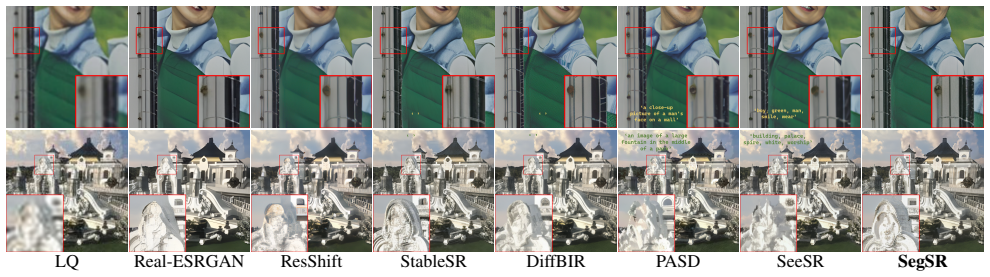
SegSR's central discovery is that a semantic segmentation prior can be made useful for diffusion-based super-resolution if it is jointly refined rather than computed once from the degraded input. The super-resolution branch (SRDM), built on StableDiffusion, receives an updated segmentation condition at every reverse step; the segmentation branch (SegDM), a discrete diffusion model, receives updated image information from the super-resolution branch. The Dual-Modality Bridge (DMB) carries this two-way information flow. The paper shows that this joint refinement progressively corrects segmentation errors (e.g., a rock region mislabeled as 'animal') and simultaneously prevents semantic mistakes in the restored image (e.g., a building rendered with mountain texture). As a result, the restored images preserve semantic structures more faithfully than methods that rely on implicit localization through text-prompt cross-attention.
Load-bearing premise
The whole method assumes the pseudo-labels produced by X-Decoder on high-quality images are a correct ground truth for what objects actually are.
Editorial extensions
If this is right
- Replacing text-prompt conditioning with pixel-level segmentation control removes the two failure modes the paper identifies: missed salient objects and spatial ambiguity from competing prompts.
- Jointly refining the segmentation mask during diffusion makes high-quality image information available to the segmentation model, so the mask improves as restoration progresses rather than being frozen at the initial degraded estimate.
- Because the segmentation branch uses a discrete diffusion model, SegSR inherits distribution-level modeling of masks, allowing it to correct even large mislabeled regions rather than merely smoothing an initial prediction.
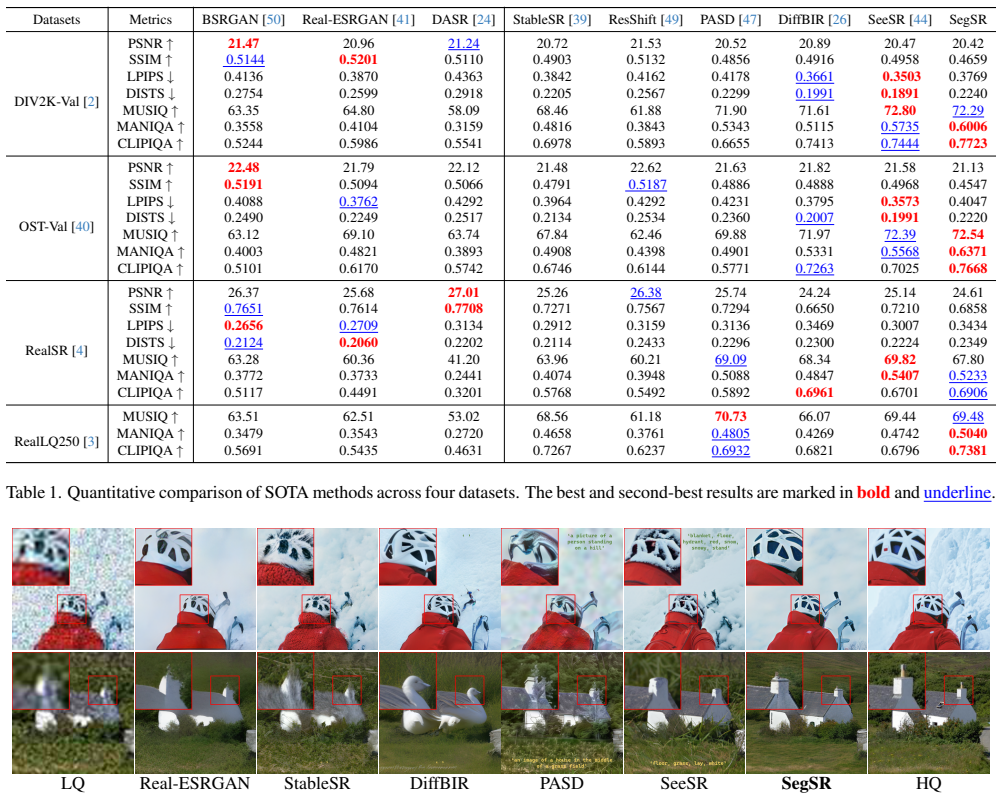
- On no-reference quality metrics (MANIQA, CLIPIQA, MUSIQ) and on the semantic-accuracy metric ACC, SegSR reports consistent gains over SeeSR and other diffusion baselines on both synthetic and real-world benchmarks.
Reading between the lines
- A testable extension is to let a user edit the initial segmentation mask before or during denoising; since the mask is an explicit control condition, SegSR would give interactive control over which semantic content to restore, unlike prompt-based methods.
- Because the mutual-refinement idea is not specific to super-resolution, the same dual-diffusion design could be applied to other inverse problems where a semantic map and a high-quality image are jointly inferable, such as deblurring, dehazing, or inpainting.
- The paper's semantic-accuracy metric (ACC) is measured with X-Decoder on the output against X-Decoder on the high-quality reference; since X-Decoder also generates the training ground truth, the reported semantic gains may partly reflect agreement with X-Decoder's label space. A human-annotated semantic-error study would tell whether the improvement is perceptual as well as machine-measured.
Signed reviews
Editorial analysis
A structured set of objections, weighed in public.
Referee Report
Summary. The paper proposes SegSR, a real-world super-resolution framework that conditions a StableDiffusion-based super-resolution branch on semantic segmentation masks produced by a discrete diffusion segmentation branch, with a Dual-Modality Bridge (DMB) exchanging information between the two branches at each reverse-diffusion step. The central claim is that adding pixel-level semantic control and mutually refining the segmentation and image restoration avoids the recognition failures and semantic ambiguities of prompt-based methods such as SeeSR and PASD, thereby preserving semantic structures more effectively. Experiments are reported on DIV2K-Val, OST-Val, RealSR, and RealLQ250, with comparisons against eight baselines and an ablation table, plus qualitative figures.
Significance. The idea of jointly refining segmentation and super-resolution within a dual-diffusion framework is timely and potentially useful for the Real-ISR community. The paper provides extensive comparisons and a clear conceptual motivation, and the ablation table shows monotonic ACC improvements when SegFormer, SegDM, and DMB are added. However, the central semantic-preservation claim is currently supported only by an evaluation that is circular with respect to the training labels, and the quantitative comparisons are not consistent across datasets. If validated with an independent semantic-fidelity evaluation, the framework would be a meaningful step beyond text-prompt-only conditioning, but that validation is not yet present.
major comments (4)
- [§4.1, §4.3, Table 2] The semantic-preservation claim is evaluated entirely within X-Decoder's pseudo-label space. Section 4.1 states that ground-truth segmentation masks for training are obtained from X-Decoder, and Table 2 defines ACC as the accuracy of X-Decoder predictions on restoration results against X-Decoder predictions on HQ images. SegSR is therefore trained to reproduce X-Decoder's label space, and ACC rewards any method that shares X-Decoder's biases. Exp. (5), the 'upper bound,' also uses X-Decoder on HQ, so the entire semantic argument is contained within one model's predictions. I request an independent semantic evaluation: human-rated semantic faithfulness, human-annotated masks on a sample, or a different open-vocabulary segmentation model that was not used in training.
- [Table 1] Table 1 does not support the claim of strong no-reference performance on real-world data. On RealSR, SegSR scores MUSIQ 67.80, MANIQA 0.5233, and CLIPIQA 0.6906, while SeeSR scores 69.82, 0.5407, and 0.6701, and PASD scores 69.09, 0.5088, and 0.5892; SegSR is not consistently better than several baselines on two of the three metrics. The text in Section 4.2 should be tempered or supported by statistical tests across datasets.
- [Table 2, §4.3] No error bars or significance tests are reported for the ablations, and the differences supporting the contribution of DMB are small and mixed on several metrics: on DIV2K-Val, MUSIQ decreases from 72.40 in Exp. (3) to 72.29 in Exp. (4), while MANIQA increases from 0.5840 to 0.6006 and ACC from 0.7009 to 0.7116. Diffusion sampling is stochastic, so bootstrapped confidence intervals or multiple-seed results are necessary to establish that the SegDM and DMB improvements are not noise.
- [§3.3] The Dual-Modality Bridge is central to the method but is not specified in the main text: Section 3.3 only states that DMB consists of a Seg Controller and an ImgAided component, and defers details to the supplementary material. Without architecture details, input/output dimensions, and the conditioning mechanism, the method cannot be reproduced from the paper. Please move the DMB specification into the main text or provide an appendix within the manuscript.
minor comments (5)
- [§1] In the Introduction, 'balance perceptual quality with fidelity perversion' should likely read 'fidelity preservation' or 'fidelity'; as written it is contradictory.
- [Figure 5] The caption contains the typo 'lease zoom in for details' (should be 'Please').
- [References] Reference [33] is listed as appearing in 'MACCAI'; the correct venue is MICCAI.
- [§3.3] The notation for the DMB conditions (I_t, C_t) and the LQ embeddings (Z_lq, F_lq) is introduced only in Figure 3; the text should define these symbols when they first appear in Section 3.3.
- [§2] In Related Work, the stray text 'diffusion-2-1' appears after the StableDiffusion footnote; this looks like a leftover fragment and should be removed.
Circularity Check
Semantic-fidelity claim rests on a circular evaluation: the ACC metric uses X-Decoder on HQ images as ground truth, and the same X-Decoder model produced the semantic pseudo-labels used to train SegDM.
-
self definitional
[Section 4.1 (Training Datasets) and Section 4.3 (Ablation Studies, Table 2)]
"For semantic segmentation training, the ground truth segmentation masks are obtained from the pretrained open vocabulary segmentation model, X-Decoder [55]. ... The ACC metric represents the accuracy of semantic segmentation predictions by X-Decoder on the restoration results from SRDM, using the predictions on HQ images as the ground truth mask."
The segmentation branch is trained to reproduce X-Decoder pseudo-labels on HQ images, and the only quantitative semantic-fidelity metric, ACC, measures agreement between X-Decoder on the restored image and X-Decoder on the HQ image. Semantic correctness is therefore operationalized as consistency with the same model that generated the training target. If X-Decoder has systematic biases or misses objects, SegDM is optimized to reproduce those errors, and ACC rewards any method that learns X-Decoder's label space rather than true semantic content. No independent segmentation ground truth or human semantic evaluation is reported.
-
self definitional
[Section 4.3, Exp. (5)]
"In Exp. (5), we use X-decoder [55] to perform segmentation prediction on the HQ images. ... Notably, in both quantitative and qualitative results for semantic segmentation prediction and image restoration, our method closely approximates the performance of Exp. (5)."
The claimed upper bound is defined by feeding SRDM the X-Decoder mask computed from the HQ image, which is exactly the source of the training pseudo-labels. Approaching Exp. (5) therefore demonstrates that SegSR reproduces X-Decoder's label assignments, not that the restored image is semantically correct in an independent sense. The 'upper bound' is internal to the X-Decoder label space, so it cannot validate the claim that semantic structures are preserved against true semantics.
full rationale
The dual-diffusion architecture and the Dual-Modality Bridge are genuine methodological contributions, and the photorealism metrics (MANIQA, MUSIQ, CLIPIQA) are independent of the circularity. However, the paper's central claim of 'preserving semantic structures more effectively' is quantitatively supported only by the ACC metric in Table 2, and that metric's ground truth is X-Decoder on HQ images while the training pseudo-labels also come from X-Decoder on HQ images. This makes the semantic-fidelity evaluation self-referential: the model is trained to imitate X-Decoder, and then scored on how well it imitates X-Decoder. The Exp. (5) upper bound is similarly contained within the same pseudo-label space. No human study or external segmentation benchmark is used, and the comparison against SOTA methods in Table 1 does not include ACC, leaving the headline semantic advantage supported mainly by selected qualitative examples. This is a real but partial circularity, so the score is 5 rather than higher.
Assumptions & free parameters
free parameters (1)
- Semantic class set size =
34
assumptions (5)
- domain assumption Pretrained StableDiffusion (v2.1) provides a strong natural image prior suitable for SR refinement.
- domain assumption The Real-ESRGAN/SeeSR degradation pipeline approximates real-world degradation distributions.
- ad hoc to paper X-Decoder's semantic pseudo-labels on HQ images are reliable ground truth for segmentation.
- domain assumption The 34-class label set suffices for the salient semantics in the test images.
- standard math Standard diffusion forward and reverse processes as defined in DDPM and multinomial diffusion hold.
invented entities (1)
-
Dual-Modality Bridge (DMB)
independent evidence
Cite this review
Pith. "Pith review of Semantic Segmentation Prior for Diffusion-Based Real-World Super-Resolution." pith.science (2026). https://pith.science/paper/7IOXLHXN
@misc{pith2026241202960,
  author       = {Pith},
  title        = {Pith review of: Semantic Segmentation Prior for Diffusion-Based Real-World Super-Resolution},
  year         = {2026},
  howpublished = {\url{https://pith.science/paper/7IOXLHXN}},
  note         = {Machine review of arXiv:2412.02960}
}
read the original abstract
Real-world image super-resolution (Real-ISR) has achieved a remarkable leap by leveraging large-scale text-to-image models, enabling realistic image restoration from given recognition textual prompts. However, these methods sometimes fail to recognize some salient objects, resulting in inaccurate semantic restoration in these regions. Additionally, the same region may have a strong response to more than one prompt and it will lead to semantic ambiguity for image super-resolution. To alleviate the above two issues, in this paper, we propose to consider semantic segmentation as an additional control condition into diffusion-based image super-resolution. Compared to textual prompt conditions, semantic segmentation enables a more comprehensive perception of salient objects within an image by assigning class labels to each pixel. It also mitigates the risks of semantic ambiguities by explicitly allocating objects to their respective spatial regions. In practice, inspired by the fact that image super-resolution and segmentation can benefit each other, we propose SegSR which introduces a dual-diffusion framework to facilitate interaction between the image super-resolution and segmentation diffusion models. Specifically, we develop a Dual-Modality Bridge module to enable updated information flow between these two diffusion models, achieving mutual benefit during the reverse diffusion process. Extensive experiments show that SegSR can generate realistic images while preserving semantic structures more effectively.
Figures


Figures from the paper (3 more)

Forward citations
Cited by 2 Pith papers
-
Semantic-Guided Cross-Sensor Super Resolution of Remote Sensing Images: A Gated Dual Conditioning Flow Matching Model
A gated dual-conditioning flow-matching model achieves 10 m→2 m cross-sensor super-resolution with a 38% FID reduction over the best baseline on a rare-landform (retrogressive thaw slump) benchmark.
-
MicroZoom: Structure-Preserving Detail Synthesis at Extreme Scale
A cascaded, segmentation-conditioned, per-instance diffusion method synthesizes globally coherent gigapixel microscopic detail from a phone photo and sparse microscope references at up to 350×.
Reference graph
Works this paper leans on
-
[1]
Semantic segmentation guided real-world super-resolution
Andreas Aakerberg, Anders S Johansen, Kamal Nasrollahi, and Thomas B Moeslund. Semantic segmentation guided real-world super-resolution. In CVPR, 2022. 3
work page 2022
-
[2]
Ntire 2017 challenge on single image super-resolution: Dataset and study
Eirikur Agustsson and Radu Timofte. Ntire 2017 challenge on single image super-resolution: Dataset and study. In CVPRW, 2017. 6
work page 2017
-
[3]
Dream- clear: High-capacity real-world image restoration with privacy-safe dataset curation
Yuang Ai, Xiaoqiang Zhou, Huaibo Huang, Xiaotian Han, Zhengyu Chen, Quanzeng You, and Hongxia Yang. Dream- clear: High-capacity real-world image restoration with privacy-safe dataset curation. In NIPS, 2024. 6, 7
work page 2024
-
[4]
Toward real-world single image super-resolution: A new benchmark and a new model
Jianrui Cai, Hui Zeng, Hongwei Yong, Zisheng Cao, and Lei Zhang. Toward real-world single image super-resolution: A new benchmark and a new model. In ICCV, 2019. 6, 7, 8
work page 2019
-
[5]
Activating more pixels in image super- resolution transformer
Xiangyu Chen, Xintao Wang, Jiantao Zhou, Yu Qiao, and Chao Dong. Activating more pixels in image super- resolution transformer. In CVPR, 2023. 1
work page 2023
-
[6]
Diffusion models beat gans on image synthesis
Prafulla Dhariwal and Alexander Nichol. Diffusion models beat gans on image synthesis. NIPS, 2021. 1, 2
work page 2021
-
[7]
Image quality assessment: Unifying structure and texture similarity
Keyan Ding, Kede Ma, Shiqi Wang, and Eero P Simoncelli. Image quality assessment: Unifying structure and texture similarity. TPAMI, 2020. 6
work page 2020
-
[8]
Image super-resolution using deep convolutional net- works
Chao Dong, Chen Change Loy, Kaiming He, and Xiaoou Tang. Image super-resolution using deep convolutional net- works. TPAMI, 2015. 1
work page 2015
Show all 56 references
-
[9]
Adadiffsr: Adaptive region-aware dynamic acceleration diffusion model for real-world image super-resolution
Yuanting Fan, Chengxu Liu, Nengzhong Yin, Changlong Gao, and Xueming Qian. Adadiffsr: Adaptive region-aware dynamic acceleration diffusion model for real-world image super-resolution. ECCV, 2024. 1
2024
-
[10]
Generative adversarial networks
Ian Goodfellow, Jean Pouget-Abadie, Mehdi Mirza, Bing Xu, David Warde-Farley, Sherjil Ozair, Aaron Courville, and Yoshua Bengio. Generative adversarial networks. CACM,
-
[11]
Div8k: Diverse 8k resolution image dataset
Shuhang Gu, Andreas Lugmayr, Martin Danelljan, Manuel Fritsche, Julien Lamour, and Radu Timofte. Div8k: Diverse 8k resolution image dataset. In ICCVW, 2019. 6
2019
-
[12]
Segnext: Rethinking convolutional attention design for semantic segmentation
Meng-Hao Guo, Cheng-Ze Lu, Qibin Hou, Zhengning Liu, Ming-Ming Cheng, and Shi-Min Hu. Segnext: Rethinking convolutional attention design for semantic segmentation. NIPS, 2022. 2
2022
-
[13]
Denoising diffu- sion probabilistic models
Jonathan Ho, Ajay Jain, and Pieter Abbeel. Denoising diffu- sion probabilistic models. NIPS, 2020. 1, 2
2020
-
[14]
Argmax flows and multinomial dif- fusion: Learning categorical distributions
Emiel Hoogeboom, Didrik Nielsen, Priyank Jaini, Patrick Forr´e, and Max Welling. Argmax flows and multinomial dif- fusion: Learning categorical distributions. NIPS, 2021. 2
2021
-
[15]
A style-based generator architecture for generative adversarial networks
Tero Karras, Samuli Laine, and Timo Aila. A style-based generator architecture for generative adversarial networks. In CVPR, 2019. 6
2019
-
[16]
Imagic: Text-based real image editing with diffusion models
Bahjat Kawar, Shiran Zada, Oran Lang, Omer Tov, Huiwen Chang, Tali Dekel, Inbar Mosseri, and Michal Irani. Imagic: Text-based real image editing with diffusion models. In CVPR, 2023. 2
2023
-
[17]
Musiq: Multi-scale image quality transformer
Junjie Ke, Qifei Wang, Yilin Wang, Peyman Milanfar, and Feng Yang. Musiq: Multi-scale image quality transformer. In ICCV, 2021. 6
2021
-
[18]
Accurate image super-resolution using very deep convolutional net- works
Jiwon Kim, Jung Kwon Lee, and Kyoung Mu Lee. Accurate image super-resolution using very deep convolutional net- works. In CVPR, 2016. 1
2016
-
[19]
Segment any- thing
Alexander Kirillov, Eric Mintun, Nikhila Ravi, Hanzi Mao, Chloe Rolland, Laura Gustafson, Tete Xiao, Spencer White- head, Alexander C Berg, Wan-Yen Lo, et al. Segment any- thing. In ICCV, 2023. 3
2023
-
[20]
Denoising diffu- sion semantic segmentation with mask prior modeling.arXiv preprint arXiv:2306.01721, 2023
Zeqiang Lai, Yuchen Duan, Jifeng Dai, Ziheng Li, Ying Fu, Hongsheng Li, Yu Qiao, and Wenhai Wang. Denoising diffu- sion semantic segmentation with mask prior modeling.arXiv preprint arXiv:2306.01721, 2023. 2, 5
2023 arXiv
-
[21]
Srdiff: Single image super-resolution with diffusion probabilistic models
Haoying Li, Yifan Yang, Meng Chang, Shiqi Chen, Huajun Feng, Zhihai Xu, Qi Li, and Yueting Chen. Srdiff: Single image super-resolution with diffusion probabilistic models. Neurocomputing, 2022. 2
2022
-
[22]
Blip: Bootstrapping language-image pre-training for unified vision-language understanding and generation
Junnan Li, Dongxu Li, Caiming Xiong, and Steven Hoi. Blip: Bootstrapping language-image pre-training for unified vision-language understanding and generation. In ICCV,
-
[23]
Blip-2: Bootstrapping language-image pre-training with frozen image encoders and large language models
Junnan Li, Dongxu Li, Silvio Savarese, and Steven Hoi. Blip-2: Bootstrapping language-image pre-training with frozen image encoders and large language models. In ICML,
-
[24]
Efficient and degradation-adaptive network for real-world image super- resolution
Jie Liang, Hui Zeng, and Lei Zhang. Efficient and degradation-adaptive network for real-world image super- resolution. In ECCV, 2022. 6, 7
2022
-
[25]
Efficient and degradation-adaptive network for real-world image super- resolution
Jie Liang, Hui Zeng, and Lei Zhang. Efficient and degradation-adaptive network for real-world image super- resolution. In ECCV, 2022. 1
2022
-
[26]
Diff- bir: Towards blind image restoration with generative diffu- sion prior
Xinqi Lin, Jingwen He, Ziyan Chen, Zhaoyang Lyu, Bo Dai, Fanghua Yu, Wanli Ouyang, Yu Qiao, and Chao Dong. Diff- bir: Towards blind image restoration with generative diffu- sion prior. arXiv preprint arXiv:2308.15070, 2023. 1, 2, 6, 7
2023 arXiv
-
[27]
Visual instruction tuning
Haotian Liu, Chunyuan Li, Qingyang Wu, and Yong Jae Lee. Visual instruction tuning. NIPS, 36, 2024. 2
2024
-
[28]
Transformer for single image super-resolution
Zhisheng Lu, Juncheng Li, Hong Liu, Chaoyan Huang, Lin- lin Zhang, and Tieyong Zeng. Transformer for single image super-resolution. In CVPR, 2022. 1
2022
-
[29]
Content-aware local gan for photo-realistic super-resolution
JoonKyu Park, Sanghyun Son, and Kyoung Mu Lee. Content-aware local gan for photo-realistic super-resolution. In ICCV, 2023. 1
2023
-
[30]
Spire: Semantic prompt-driven image restoration
Chenyang Qi, Zhengzhong Tu, Keren Ye, Mauricio Delbra- cio, Peyman Milanfar, Qifeng Chen, and Hossein Talebi. Spire: Semantic prompt-driven image restoration. ECCV,
-
[31]
Xpsr: Cross-modal priors for diffusion-based image super-resolution
Yunpeng Qu, Kun Yuan, Kai Zhao, Qizhi Xie, Jinhua Hao, Ming Sun, and Chao Zhou. Xpsr: Cross-modal priors for diffusion-based image super-resolution. ECCV, 2024. 1, 2, 7
2024
-
[32]
High-resolution image syn- thesis with latent diffusion models
Robin Rombach, Andreas Blattmann, Dominik Lorenz, Patrick Esser, and Bj¨orn Ommer. High-resolution image syn- thesis with latent diffusion models. In CVPR, 2022. 1, 2, 5
2022
-
[33]
U-net: Convolutional networks for biomedical image segmentation
Olaf Ronneberger, Philipp Fischer, and Thomas Brox. U-net: Convolutional networks for biomedical image segmentation. In MACCAI, 2015. 5 9
2015
-
[34]
Image super- resolution via iterative refinement
Chitwan Saharia, Jonathan Ho, William Chan, Tim Sali- mans, David J Fleet, and Mohammad Norouzi. Image super- resolution via iterative refinement. TPAMI, 2022. 2
2022
-
[35]
Denoising diffusion implicit models
Jiaming Song, Chenlin Meng, and Stefano Ermon. Denoising diffusion implicit models. arXiv preprint arXiv:2010.02502, 2020. 2
2010 arXiv
-
[36]
Ntire 2017 challenge on single image super-resolution: Methods and results
Radu Timofte, Eirikur Agustsson, Luc Van Gool, Ming- Hsuan Yang, and Lei Zhang. Ntire 2017 challenge on single image super-resolution: Methods and results. In CVPRW,
2017
-
[37]
Sam- diffsr: Structure-modulated diffusion model for image super- resolution
Chengcheng Wang, Zhiwei Hao, Yehui Tang, Jianyuan Guo, Yujie Yang, Kai Han, and Yunhe Wang. Sam- diffsr: Structure-modulated diffusion model for image super- resolution. arXiv preprint arXiv:2402.17133, 2024. 3
2024 arXiv
-
[38]
Ex- ploring clip for assessing the look and feel of images
Jianyi Wang, Kelvin CK Chan, and Chen Change Loy. Ex- ploring clip for assessing the look and feel of images. In AAAI, 2023. 7
2023
-
[39]
Exploiting diffusion prior for real-world image super-resolution
Jianyi Wang, Zongsheng Yue, Shangchen Zhou, Kelvin CK Chan, and Chen Change Loy. Exploiting diffusion prior for real-world image super-resolution. IJCV, 2024. 1, 2, 6, 7
2024
-
[40]
Recovering realistic texture in image super-resolution by deep spatial feature transform
Xintao Wang, Ke Yu, Chao Dong, and Chen Change Loy. Recovering realistic texture in image super-resolution by deep spatial feature transform. In CVPR, 2018. 2, 6
2018
-
[41]
Real-esrgan: Training real-world blind super-resolution with pure synthetic data
Xintao Wang, Liangbin Xie, Chao Dong, and Ying Shan. Real-esrgan: Training real-world blind super-resolution with pure synthetic data. In ICCVW, 2021. 1, 2, 6, 7
2021
-
[42]
Image quality assessment: from error visibility to structural similarity
Zhou Wang, Alan C Bovik, Hamid R Sheikh, and Eero P Simoncelli. Image quality assessment: from error visibility to structural similarity. TIP, 2004. 6
2004
-
[43]
Component divide-and-conquer for real-world image super-resolution
Pengxu Wei, Ziwei Xie, Hannan Lu, Zongyuan Zhan, Qix- iang Ye, Wangmeng Zuo, and Liang Lin. Component divide-and-conquer for real-world image super-resolution. In ECCV, 2020. 6
2020
-
[44]
Seesr: Towards semantics-aware real-world image super-resolution
Rongyuan Wu, Tao Yang, Lingchen Sun, Zhengqiang Zhang, Shuai Li, and Lei Zhang. Seesr: Towards semantics-aware real-world image super-resolution. In CVPR, 2024. 1, 2, 3, 6, 7
2024
-
[45]
Segformer: Simple and ef- ficient design for semantic segmentation with transformers
Enze Xie, Wenhai Wang, Zhiding Yu, Anima Anandkumar, Jose M Alvarez, and Ping Luo. Segformer: Simple and ef- ficient design for semantic segmentation with transformers. NIPS, 2021. 2, 4
2021
-
[46]
Maniqa: Multi-dimension attention network for no-reference image quality assessment
Sidi Yang, Tianhe Wu, Shuwei Shi, Shanshan Lao, Yuan Gong, Mingdeng Cao, Jiahao Wang, and Yujiu Yang. Maniqa: Multi-dimension attention network for no-reference image quality assessment. In CVPR, 2022. 6
2022
-
[47]
Pixel-aware stable diffusion for realistic image super-resolution and personalized stylization
Tao Yang, Rongyuan Wu, Peiran Ren, Xuansong Xie, and Lei Zhang. Pixel-aware stable diffusion for realistic image super-resolution and personalized stylization. ECCV, 2024. 1, 2, 3, 6, 7
2024
-
[48]
Scaling up to excellence: Practicing model scaling for photo- realistic image restoration in the wild
Fanghua Yu, Jinjin Gu, Zheyuan Li, Jinfan Hu, Xiangtao Kong, Xintao Wang, Jingwen He, Yu Qiao, and Chao Dong. Scaling up to excellence: Practicing model scaling for photo- realistic image restoration in the wild. In CVPR, 2024. 1, 2, 7
2024
-
[49]
Resshift: Efficient diffusion model for image super- resolution by residual shifting
Zongsheng Yue, Jianyi Wang, and Chen Change Loy. Resshift: Efficient diffusion model for image super- resolution by residual shifting. NIPS, 2024. 2, 6, 7
2024
-
[50]
Designing a practical degradation model for deep blind image super-resolution
Kai Zhang, Jingyun Liang, Luc Van Gool, and Radu Timo- fte. Designing a practical degradation model for deep blind image super-resolution. In ICCV, 2021. 1, 2, 6, 7
2021
-
[51]
Adding conditional control to text-to-image diffusion models
Lvmin Zhang, Anyi Rao, and Maneesh Agrawala. Adding conditional control to text-to-image diffusion models. In ICCV, 2023. 2
2023
-
[52]
The unreasonable effectiveness of deep features as a perceptual metric
Richard Zhang, Phillip Isola, Alexei A Efros, Eli Shechtman, and Oliver Wang. The unreasonable effectiveness of deep features as a perceptual metric. In CVPR, 2018. 6
2018
-
[53]
Efficient long-range attention network for image super- resolution
Xindong Zhang, Hui Zeng, Shi Guo, and Lei Zhang. Efficient long-range attention network for image super- resolution. In ECCV, 2022. 1
2022
-
[54]
Recognize anything: A strong image tagging model
Youcai Zhang, Xinyu Huang, Jinyu Ma, Zhaoyang Li, Zhaochuan Luo, Yanchun Xie, Yuzhuo Qin, Tong Luo, Yaqian Li, Shilong Liu, et al. Recognize anything: A strong image tagging model. In CVPR, 2024. 1, 2
2024
-
[55]
Generalized decoding for pixel, image, and language
Xueyan Zou, Zi-Yi Dou, Jianwei Yang, Zhe Gan, Linjie Li, Chunyuan Li, Xiyang Dai, Harkirat Behl, Jianfeng Wang, Lu Yuan, et al. Generalized decoding for pixel, image, and language. In CVPR, 2023. 2, 6, 8
2023
-
[56]
Segment everything everywhere all at once
Xueyan Zou, Jianwei Yang, Hao Zhang, Feng Li, Linjie Li, Jianfeng Wang, Lijuan Wang, Jianfeng Gao, and Yong Jae Lee. Segment everything everywhere all at once. NIPS, 36,
Reviewed August 11, 2026 · model on record in the stance chip above.
Discussion (0). Continue with ORCID to comment.