REVIEW 4 major objections 4 minor 77 references
LongSplat: Robust Unposed 3D Gaussian Splatting for Casual Long Videos
T0 review · 4 major / 4 minor · reviewed 2026-08-05 · deepseek-v4-flash
Pith's one-line read LongSplat claims that jointly optimizing camera poses and octree-anchored 3D Gaussians, seeded by MASt3R priors, makes novel view synthesis from casual long videos robust where drift, bad geometry initialization, and memory limits break pri
desk verdict Strong NVS results on the hardest long-video benchmarks, but the pose-SOTA claim is overstated and the COLMAP-as-ground-truth evaluation needs fixing. read the letter →
The pith
A machine-rendered reading of the paper's core claim, the machinery that carries it, and where it could break.
The reading
What carries the argument
The load-bearing mechanism is the octree-anchored 3D Gaussian representation coupled with incremental joint optimization. Where Scaffold-GS places anchors on a fixed-resolution voxel grid seeded by SfM points, LongSplat builds anchors directly from MASt3R's dense point clouds through density-guided octree subdivision: voxels above a split threshold divide into eight children, voxels below a prune threshold are removed, and each anchor's spatial scale tracks its voxel size, so sparse regions get coarse anchors and detailed regions get fine ones. Pose estimation rides on the same priors: 2D-3D correspondences from MASt3R are solved by PnP with RANSAC, refined photometrically against the render
What would settle it
Take a long handheld sequence with independent ground-truth trajectories, for instance from a LiDAR-equipped phone, that contains long featureless or reflective stretches; run LongSplat and compare per-frame RPE and ATE. If pose error jumps sharply exactly where MASt3R's depth or correspondences are provably wrong, the claim that the joint optimization corrects the prior's failures is refuted. A cheaper check: re-render after rescaling MASt3R's depth to LiDAR depth; if quality gains vanish with the corrected prior, the prior, not the pipeline, is doing the work.
Extended reading notes
Core claim
LongSplat's central claim is that unposed novel view synthesis for casual long videos can be made robust by coupling pose estimation and scene reconstruction into one incremental process, rather than relying on a separate SfM or foundation-model front-end. The pipeline opens with MASt3R's global alignment to obtain initial poses and per-frame dense point clouds, which it converts into octree anchors whose voxel size adapts to local point density (splitting where density is high, pruning where low), an SfM-free initialization that removes redundant anchors and keeps the model around 101 MB on the Free dataset. Each new frame's pose is first solved by PnP on MASt3R correspondences back-project
Load-bearing premise
MASt3R's per-frame dense point clouds, aligned depth, and 2D correspondences must be reliable enough to anchor initialization, depth-scale alignment, anchor unprojection, and the depth supervision loss; where that learned prior fails, in textureless, occluded, or specular regions, the errors flow directly into the octree anchors and the pose estimates the joint optimization is meant to fix.
Editorial extensions
If this is right
- If the reported numbers hold, unposed novel view synthesis becomes practical for consumer video: no SfM preprocessing, no pose front-end, and no out-of-memory failures on sequences of hundreds to thousands of frames.
- The octree anchor design ties memory to observed geometry rather than frame count, so per-scene model size stays roughly constant as videos grow instead of exploding with resolution or duration.
- Pose accuracy at ATE 0.004 and RPEt 0.028 on Free means the estimated trajectories are precise enough to be usable as camera paths themselves, for applications like stabilization or video-to-3D conversion, not merely as hidden scaffolding.
- Rendering at 281.71 FPS after about one hour of training on a single RTX 4090 makes the output immediately interactively usable, a regime prior unposed long-video methods (LocalRF at 1.17 FPS) could not reach.
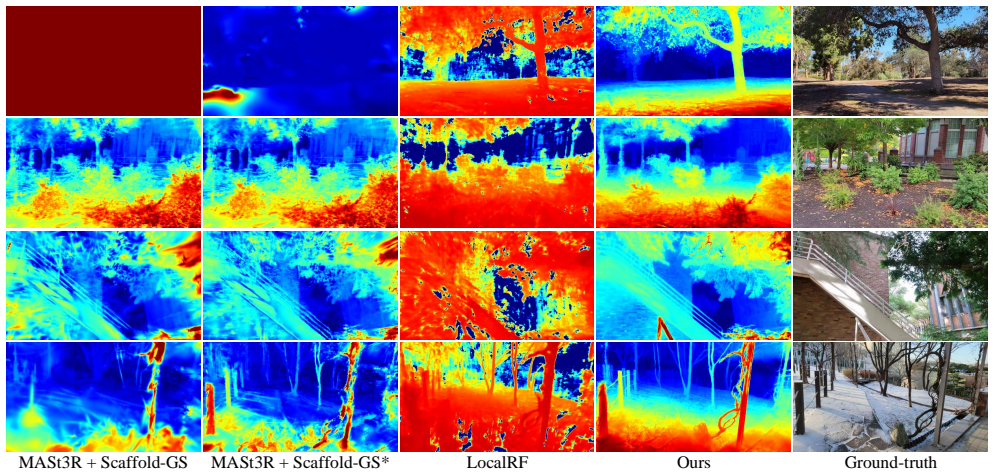
- Depth plus reprojection supervision keeps newly revealed regions, where multi-view coverage is thin, well-constrained, which is likely why the method does not fragment on the Hike sequences where LocalRF visibly degrades.
Reading between the lines
- Editorial inference: the visibility-IoU window selection effectively performs keyframe selection inside the optimizer, so it could be extracted as a standalone covisibility-based frame-scheduling rule for other incremental reconstruction or mapping pipelines.
- Editorial inference: because the whole system leans on MASt3R for depth, correspondences, and the intrinsics fallback, the gains should transfer to other learned matching backbones; swapping in a metric-depth or LiDAR-depth source would directly test whether the octree plus joint-optimization machinery, rather than the prior itself, drives the improvement.
- Editorial inference: the stated static-scene and fixed-intrinsics limitations suggest the natural next stress test is a zooming or dynamic handheld video, where the per-frame scale-aligning depth ratio and the anchor-update rule would face focal-length changes and motion breaks.
- Editorial inference: on sequences where COLMAP itself fails, pose accuracy can only be checked against independent ground truth such as LiDAR-tracked phones; such a test would confirm the trajectory claims precisely where the paper's reference poses are known to be noisy.
Editorial analysis
A structured set of objections, weighed in public.
Referee Report
Summary. The paper proposes LongSplat, an unposed 3D Gaussian Splatting framework for novel view synthesis and camera pose estimation from casually captured long videos. The method proceeds incrementally: MASt3R provides per-frame dense point clouds, aligned depth, and 2D correspondences; octree anchors are formed from the point clouds; poses for new frames are initialized by PnP+RANSAC and refined photometrically; then local and global optimization jointly refine poses and Gaussians using photometric, depth, and reprojection losses. Experiments on Tanks and Temples, Free, and Hike report strong rendering quality, pose accuracy, training time, and memory usage compared to several baselines.
Significance. If the claims hold, LongSplat is a useful step toward practical unposed NVS on long casual videos: it combines learned 3D priors with explicit pose optimization and an adaptive anchor representation, and the reported rendering and efficiency numbers are substantially better than several prior unposed methods on the Free and Hike datasets. The per-scene tables and ablations are valuable, and the incremental formulation is clearly described. However, the paper's headline claim of 'consistently outperforms' and its pose-accuracy SOTA claim are not fully supported by the reported comparisons, so the significance is conditional on those points being resolved.
major comments (4)
- [§4.2 and Supplementary Table 11] HT-3DGS is absent from all main tables, yet Supp. Table 11 shows that on Tanks and Temples HT-3DGS achieves PSNR 33.53, SSIM 0.96, LPIPS 0.07, beating LongSplat's 32.83/0.94/0.08. This directly contradicts the abstract and conclusion claim of 'consistently outperforms' and 'state-of-the-art'. HT-3DGS must be included in the main comparison tables and the claim qualified according to regime (e.g., long casual videos where HT-3DGS OOMs).
- [§4.1, App. B.3, Tables 10 and 13] Pose accuracy on Hike is evaluated only on 6 'stable' sequences, while the hardest sequences (forest3, garden2, playground) are excluded because COLMAP fails; Table 13 shows COLMAP produces no reconstruction for these scenes. Using COLMAP poses as ground truth in precisely the regime where COLMAP is unreliable leaves the pose-accuracy SOTA claim unverified in the target setting. On Free, no independent pose reference is provided, and ATE differences (0.004 vs. 0.008) are near the scale of COLMAP noise. The paper should either provide an independent pose source or clearly limit the pose claim.
- [§3.2–3.3, Eqs. (8)–(13)] MASt3R supplies the initial point cloud (Sec. 3.2), the aligned depth used for scale alignment (Eq. 10), the depth supervision (Eq. 13), and the unprojected anchor points (Eq. 11). The method is therefore not independent of MASt3R's accuracy; a failure of MASt3R depth or correspondences propagates directly into the anchors and the depth loss. The paper should include a sensitivity analysis (e.g., corrupting or replacing MASt3R depth, or ablating the depth loss) and discuss what 'robust' means when the prior is inaccurate.
- [App. B.2, Table 13] The text states that LongSplat 'consistently outperforms COLMAP' on Hike, but Table 13 shows COLMAP with known poses beats LongSplat on forest2 (28.35 vs. 27.87) and university2 (27.25 vs. 26.82). Since COLMAP is the motivating failure case, this comparison should be reported honestly and the claim adjusted. The average is better for LongSplat, but 'consistently' is not supported.
minor comments (4)
- [Abstract / Table 11] The wording 'HT-3DGS runs only on T&T (33.53 dB), but falls to 13.75 dB on Free' is internally inconsistent because Table 11 reports a Free result for HT-3DGS. Reword to say HT-3DGS produces very low quality on Free and OOMs on Hike.
- [Algorithm 1] The pseudo-code line 'fallback to t' is vague. The text describes a fallback that re-optimizes all past frames globally, but the algorithm should specify which iterations are re-run and how PnP is retried.
- [Tables 13/16] Several captions and table headers contain typos ('Qualtitative', 'na¨ıve') and inconsistent use of 'PSNR↑' symbols. Please copyedit the supplementary material.
- [§4.3, Table 6] The visibility-adapted window is a central design choice, but the IoU threshold τ is not ablated and the selection rule ('iteratively removing the earliest frame') is described only qualitatively. A short sensitivity experiment or a precise pseudocode statement would help reproducibility.
Circularity Check
No significant circularity; LongSplat uses MASt3R as a learned geometric prior but re-estimates poses, depth, and anchors through photometric and reprojection optimization, so no prediction reduces to its input by construction.
full rationale
The derivation chain is not circular. LongSplat initializes anchors and pose hypotheses from MASt3R (Sec. 3.2, Eq. 8), but the final camera poses are obtained by PnP+RANSAC followed by photometric refinement against the current 3DGS render (Eq. 9) and joint global/local optimization (Sec. 3.4); they are not copies of MASt3R poses. The depth-scale factor in Eq. 10 is a per-frame least-squares scalar computed from the current rendered depth and MASt3R's aligned depth; the depth loss in Eq. 13 therefore constrains the rendered depth to the one-dimensional space spanned by the MASt3R depth vector, a genuine soft regularizer rather than an identity. Anchor unprojection (Eq. 11) inserts MASt3R-depth points into the octree, but those anchors are subsequently trained under multi-view photometric and reprojection losses (Eqs. 14-15), and ablations (Tables 5, 7, 12; Fig. 14) show that removing these components materially changes results, so the output is not a relabeling of the prior. The paper's self-citations appear only in related work and implementation credits; no load-bearing claim relies on an unpublished or author-specific uniqueness theorem. The pose-evaluation limitation acknowledged in App. B.3 ('COLMAP poses are noisy on several Hike videos, so we use the 6 stable sequences') and the use of COLMAP as ground truth on Free are legitimate benchmark-validity concerns that should be weighed as correctness risk, but they do not make the pose estimates equal to COLMAP by construction, so they do not constitute circularity.
Assumptions & free parameters
free parameters (4)
- initial voxel size ε₀ =
0.1
- octree split/prune density thresholds τ_split, τ_prune =
10 and 5 initially, increasing with depth
- visibility IoU threshold τ =
0.2
- loss weights λ_depth, λ_reprojection =
not reported
assumptions (4)
- domain assumption MASt3R provides sufficiently accurate per-frame dense point clouds, correspondences, and aligned depths for the target scenes.
- domain assumption Scenes are static with fixed camera intrinsics.
- domain assumption Anchor-based 3DGS with MLP-decoded Gaussian attributes can fit the target scenes.
- domain assumption COLMAP poses are a valid ground truth for evaluating pose accuracy.
Cite this review
Pith. "Pith review of LongSplat: Robust Unposed 3D Gaussian Splatting for Casual Long Videos." pith.science (2026). https://pith.science/paper/7JEEMJZ3
@misc{pith2026250814041,
  author       = {Pith},
  title        = {Pith review of: LongSplat: Robust Unposed 3D Gaussian Splatting for Casual Long Videos},
  year         = {2026},
  howpublished = {\url{https://pith.science/paper/7JEEMJZ3}},
  note         = {Machine review of arXiv:2508.14041}
}
read the original abstract
LongSplat addresses critical challenges in novel view synthesis (NVS) from casually captured long videos characterized by irregular camera motion, unknown camera poses, and expansive scenes. Current methods often suffer from pose drift, inaccurate geometry initialization, and severe memory limitations. To address these issues, we introduce LongSplat, a robust unposed 3D Gaussian Splatting framework featuring: (1) Incremental Joint Optimization that concurrently optimizes camera poses and 3D Gaussians to avoid local minima and ensure global consistency; (2) a robust Pose Estimation Module leveraging learned 3D priors; and (3) an efficient Octree Anchor Formation mechanism that converts dense point clouds into anchors based on spatial density. Extensive experiments on challenging benchmarks demonstrate that LongSplat achieves state-of-the-art results, substantially improving rendering quality, pose accuracy, and computational efficiency compared to prior approaches. Project page: https://linjohnss.github.io/longsplat/
Figures


Figures from the paper (16 more)



Reference graph
Works this paper leans on
-
[1]
Hyperreel: High-fidelity 6-dof video with ray- conditioned sampling
Benjamin Attal, Jia-Bin Huang, Christian Richardt, Michael Zollh¨ofer, Johannes Kopf, Matthew O’Toole, and Changil Kim. Hyperreel: High-fidelity 6-dof video with ray- conditioned sampling. In CVPR, 2023. 2
work page 2023
-
[2]
Mip-nerf: A multiscale representation for anti-aliasing neural radiance fields
Jonathan T Barron, Ben Mildenhall, Matthew Tancik, Peter Hedman, Ricardo Martin-Brualla, and Pratul P Srinivasan. Mip-nerf: A multiscale representation for anti-aliasing neural radiance fields. In ICCV, 2021. 2
work page 2021
-
[3]
Mip-nerf 360: Unbounded anti-aliased neural radiance fields
Jonathan T Barron, Ben Mildenhall, Dor Verbin, Pratul P Srinivasan, and Peter Hedman. Mip-nerf 360: Unbounded anti-aliased neural radiance fields. In CVPR, 2022
work page 2022
-
[4]
Zip-nerf: Anti-aliased grid-based neural radiance fields
Jonathan T Barron, Ben Mildenhall, Dor Verbin, Pratul P Srinivasan, and Peter Hedman. Zip-nerf: Anti-aliased grid-based neural radiance fields. arXiv preprint arXiv:2304.06706, 2023. 2
arXiv 2023
-
[5]
Nope-nerf: Optimising neural radiance field with no pose prior
Wenjing Bian, Zirui Wang, Kejie Li, Jia-Wang Bian, and Vic- tor Adrian Prisacariu. Nope-nerf: Optimising neural radiance field with no pose prior. In CVPR, 2023. 2, 6, 7, 8, 15, 18
work page 2023
-
[6]
Unstructured lumigraph render- ing
Chris Buehler, Michael Bosse, Leonard McMillan, Steven Gortler, and Michael Cohen. Unstructured lumigraph render- ing. In SIGGRAPH, 2001. 2
work page 2001
-
[7]
Bo-Yu Chen, Wei-Chen Chiu, and Yu-Lun Liu. Improving robustness for joint optimization of camera pose and decom- posed low-rank tensorial radiance fields. In AAAI, 2024. 2
work page 2024
-
[8]
View interpolation for image synthesis
Shenchang Eric Chen and Lance Williams. View interpolation for image synthesis. In SIGGRAPH, 1993. 2
work page 1993
Show all 77 references
-
[9]
Lu-nerf: Scene and pose estimation by synchronizing local unposed nerfs
Zezhou Cheng, Carlos Esteves, Varun Jampani, Abhishek Kar, Subhransu Maji, and Ameesh Makadia. Lu-nerf: Scene and pose estimation by synchronizing local unposed nerfs. arXiv preprint arXiv:2306.05410, 2023. 2
2023 arXiv
-
[10]
Garf: Gaussian activated radiance fields for high fidelity reconstruction and pose estimation
Shin-Fang Chng, Sameera Ramasinghe, Jamie Sherrah, and Simon Lucey. Garf: Gaussian activated radiance fields for high fidelity reconstruction and pose estimation. arXiv e- prints, 2022. 2
2022
-
[11]
Videolifter: Lifting videos to 3d with fast hierarchical stereo alignment, 2025
Wenyan Cong, Kevin Wang, Jiahui Lei, Colton Stearns, Yuan- hao Cai, Dilin Wang, Rakesh Ranjan, Matt Feiszli, Leonidas Guibas, Zhangyang Wang, Weiyao Wang, and Zhiwen Fan. Videolifter: Lifting videos to 3d with fast hierarchical stereo alignment, 2025. 2
2025
-
[12]
Mod- eling and rendering architecture from photographs: A hybrid geometry-and image-based approach
Paul E Debevec, Camillo J Taylor, and Jitendra Malik. Mod- eling and rendering architecture from photographs: A hybrid geometry-and image-based approach. In SIGGRAPH, 1996. 2
1996
-
[13]
Spec- tromotion: Dynamic 3d reconstruction of specular scenes
Cheng-De Fan, Chen-Wei Chang, Yi-Ruei Liu, Jie-Ying Lee, Jiun-Long Huang, Yu-Chee Tseng, and Yu-Lun Liu. Spec- tromotion: Dynamic 3d reconstruction of specular scenes. In CVPR, 2025. 2
2025
-
[14]
Colmap-free 3d gaussian splatting
Yang Fu, Sifei Liu, Amey Kulkarni, Jan Kautz, Alexei A Efros, and Xiaolong Wang. Colmap-free 3d gaussian splatting. In CVPR, 2024. 2, 6, 7, 8, 14, 15, 17, 18
2024
-
[15]
Fastnerf: High-fidelity neural rendering at 200fps
Stephan J Garbin, Marek Kowalski, Matthew Johnson, Jamie Shotton, and Julien Valentin. Fastnerf: High-fidelity neural rendering at 200fps. In ICCV, 2021. 2
2021
-
[16]
Multiple view geom- etry in computer vision
Richard Hartley and Andrew Zisserman. Multiple view geom- etry in computer vision. 2003. 2
2003
-
[17]
Automatic photo pop-up
Derek Hoiem, Alexei A Efros, and Martial Hebert. Automatic photo pop-up. In ACM SIGGRAPH 2005 Papers, 2005. 2
2005
-
[18]
Tour into the picture: using a spidery mesh interface to make animation from a single image
Youichi Horry, Ken-Ichi Anjyo, and Kiyoshi Arai. Tour into the picture: using a spidery mesh interface to make animation from a single image. In Proceedings of the 24th annual conference on Computer graphics and interactive techniques,
-
[19]
3d gaussian splatting with grouped uncertainty for unconstrained images
Hao-Yu Hou, Chia-Chi Hsu, Yu-Chen Huang, Mu-Yi Shen, Wei-Fang Sun, Cheng Sun, Chia-Che Chang, Yu-Lun Liu, and Chun-Yi Lee. 3d gaussian splatting with grouped uncertainty for unconstrained images. In ICASSP, 2025. 2
2025
-
[20]
Worldsheet: Wrapping the world in a 3d sheet for view syn- thesis from a single image
Ronghang Hu, Nikhila Ravi, Alex Berg, and Deepak Pathak. Worldsheet: Wrapping the world in a 3d sheet for view syn- thesis from a single image. In ICCV, 2020. 2
2020
-
[21]
Sfm-free 3d gaussian splatting via hierarchical training
Bo Ji and Angela Yao. Sfm-free 3d gaussian splatting via hierarchical training. arXiv preprint arXiv:2412.01553, 2024. 2
2024 arXiv
-
[22]
3d gaussian splatting for real-time radiance field rendering
Bernhard Kerbl, Georgios Kopanas, Thomas Leimk¨uhler, and George Drettakis. 3d gaussian splatting for real-time radiance field rendering. ACM TOG, 2023. 2, 3, 6, 7, 15
2023
-
[23]
A hierarchical 3d gaussian representation for real-time ren- dering of very large datasets
Bernhard Kerbl, Andreas Meuleman, Georgios Kopanas, Michael Wimmer, Alexandre Lanvin, and George Drettakis. A hierarchical 3d gaussian representation for real-time ren- dering of very large datasets. ACM TOG, 2024. 3
2024
-
[24]
Infonerf: Ray entropy minimization for few-shot neural volume rendering
Mijeong Kim, Seonguk Seo, and Bohyung Han. Infonerf: Ray entropy minimization for few-shot neural volume rendering. In CVPR, 2022. 2
2022
-
[25]
Tanks and temples: Benchmarking large-scale scene reconstruction
Arno Knapitsch, Jaesik Park, Qian-Yi Zhou, and Vladlen Koltun. Tanks and temples: Benchmarking large-scale scene reconstruction. ACM TOG, 2017. 6, 7, 15, 18
2017
-
[26]
Cohen, and Richard Szeliski
Johannes Kopf, Michael F. Cohen, and Richard Szeliski. First- person hyper-lapse videos. ACM TOG, 2014. 2
2014
-
[27]
Ground- ing image matching in 3d with mast3r
Vincent Leroy, Yohann Cabon, and J´erˆome Revaud. Ground- ing image matching in 3d with mast3r. In ECCV, 2024. 2, 3, 5, 6, 7, 8, 14, 15, 18, 19, 20
2024
-
[28]
Virtual view synthesis using backward depth warping algorithm
Du-Hsiu Li, Hsueh-Ming Hang, and Yu-Lun Liu. Virtual view synthesis using backward depth warping algorithm. In PCS, 2013. 2
2013
-
[29]
Mine: Towards continuous depth mpi with nerf for novel view synthesis
Jiaxin Li, Zijian Feng, Qi She, Henghui Ding, Changhu Wang, and Gim Hee Lee. Mine: Towards continuous depth mpi with nerf for novel view synthesis. In ICCV, 2021. 2
2021
-
[30]
Genrc: Generative 3d room completion from sparse image collections
Ming-Feng Li, Yueh-Feng Ku, Hong-Xuan Yen, Chi Liu, Yu- Lun Liu, Albert YC Chen, Cheng-Hao Kuo, and Min Sun. Genrc: Generative 3d room completion from sparse image collections. In ECCV, 2024. 3
2024
-
[31]
Barf: Bundle-adjusting neural radiance fields
Chen-Hsuan Lin, Wei-Chiu Ma, Antonio Torralba, and Simon Lucey. Barf: Bundle-adjusting neural radiance fields. In ICCV, 2021. 2 9
2021
-
[32]
Frugalnerf: Fast conver- gence for few-shot novel view synthesis without learned pri- ors
Chin-Yang Lin, Chung-Ho Wu, Chang-Han Yeh, Shih-Han Yen, Cheng Sun, and Yu-Lun Liu. Frugalnerf: Fast conver- gence for few-shot novel view synthesis without learned pri- ors. CVPR, 2025. 2
2025
-
[33]
Vastgaussian: Vast 3d gaussians for large scene reconstruction
Jiaqi Lin, Zhihao Li, Xiao Tang, Jianzhuang Liu, Shiyong Liu, Jiayue Liu, Yangdi Lu, Xiaofei Wu, Songcen Xu, Youliang Yan, et al. Vastgaussian: Vast 3d gaussians for large scene reconstruction. In CVPR, 2024. 3
2024
-
[34]
Neural sparse voxel fields
Lingjie Liu, Jiatao Gu, Kyaw Zaw Lin, Tat-Seng Chua, and Christian Theobalt. Neural sparse voxel fields. In NeurIPS,
-
[35]
Robust dynamic radiance fields
Yu-Lun Liu, Chen Gao, Andreas Meuleman, Hung-Yu Tseng, Ayush Saraf, Changil Kim, Yung-Yu Chuang, Johannes Kopf, and Jia-Bin Huang. Robust dynamic radiance fields. InCVPR,
-
[36]
Scaffold-gs: Structured 3d gaussians for view-adaptive rendering
Tao Lu, Mulin Yu, Linning Xu, Yuanbo Xiangli, Limin Wang, Dahua Lin, and Bo Dai. Scaffold-gs: Structured 3d gaussians for view-adaptive rendering. In CVPR, 2024. 2, 3, 4, 6, 7, 8, 14, 15, 18, 19, 20
2024
-
[37]
Dynamic 3d gaussians: Tracking by persistent dynamic view synthesis
Jonathon Luiten, Georgios Kopanas, Bastian Leibe, and Deva Ramanan. Dynamic 3d gaussians: Tracking by persistent dynamic view synthesis. arXiv preprint arXiv:2308.09713,
-
[38]
Humannerf-se: A simple yet effective approach to animate humannerf with diverse poses
Caoyuan Ma, Yu-Lun Liu, Zhixiang Wang, Wu Liu, Xinchen Liu, and Zheng Wang. Humannerf-se: A simple yet effective approach to animate humannerf with diverse poses. In CVPR,
-
[39]
Progressively optimized local radiance fields for robust view synthesis
Andreas Meuleman, Yu-Lun Liu, Chen Gao, Jia-Bin Huang, Changil Kim, Min H Kim, and Johannes Kopf. Progressively optimized local radiance fields for robust view synthesis. In CVPR, 2023. 2, 3, 6, 7, 8, 14, 15, 18, 19, 20
2023
-
[40]
Nerf: Representing scenes as neural radiance fields for view synthe- sis
Ben Mildenhall, Pratul P Srinivasan, Matthew Tancik, Jonathan T Barron, Ravi Ramamoorthi, and Ren Ng. Nerf: Representing scenes as neural radiance fields for view synthe- sis. Communications of the ACM, 2021. 2
2021
-
[41]
Instant neural graphics primitives with a multiresolu- tion hash encoding
Thomas M¨uller, Alex Evans, Christoph Schied, and Alexander Keller. Instant neural graphics primitives with a multiresolu- tion hash encoding. ACM TOG, 2022. 2
2022
-
[42]
Orb-slam: a versatile and accurate monocular slam system
Raul Mur-Artal, Jose Maria Martinez Montiel, and Juan D Tardos. Orb-slam: a versatile and accurate monocular slam system. IEEE transactions on robotics, 2015. 2
2015
-
[43]
Reg- nerf: Regularizing neural radiance fields for view synthesis from sparse inputs
Michael Niemeyer, Jonathan T Barron, Ben Mildenhall, Mehdi SM Sajjadi, Andreas Geiger, and Noha Radwan. Reg- nerf: Regularizing neural radiance fields for view synthesis from sparse inputs. In CVPR, 2022. 2
2022
-
[44]
Ct-nerf: Incremental optimizing neural radiance field and poses with complex trajectory.arXiv preprint arXiv:2404.13896, 2024
Yunlong Ran, Yanxu Li, Qi Ye, Yuchi Huo, Zechun Bai, Jia- hao Sun, and Jiming Chen. Ct-nerf: Incremental optimizing neural radiance field and poses with complex trajectory.arXiv preprint arXiv:2404.13896, 2024. 2
2024 arXiv
-
[45]
Kilonerf: Speeding up neural radiance fields with thousands of tiny mlps
Christian Reiser, Songyou Peng, Yiyi Liao, and Andreas Geiger. Kilonerf: Speeding up neural radiance fields with thousands of tiny mlps. In ICCV, 2021. 2
2021
-
[46]
Com- mon objects in 3d: Large-scale learning and evaluation of real-life 3d category reconstruction
Jeremy Reizenstein, Roman Shapovalov, Philipp Henzler, Luca Sbordone, Patrick Labatut, and David Novotny. Com- mon objects in 3d: Large-scale learning and evaluation of real-life 3d category reconstruction. In ICCV, 2021. 12, 13
2021
-
[47]
Octree-gs: Towards consistent real-time rendering with lod-structured 3d gaussians
Kerui Ren, Lihan Jiang, Tao Lu, Mulin Yu, Linning Xu, Zhangkai Ni, and Bo Dai. Octree-gs: Towards consistent real-time rendering with lod-structured 3d gaussians. arXiv preprint arXiv:2403.17898, 2024. 3
2024 arXiv
-
[48]
Free view synthesis
Gernot Riegler and Vladlen Koltun. Free view synthesis. In ECCV, 2020. 2
2020
-
[49]
Stable view synthesis
Gernot Riegler and Vladlen Koltun. Stable view synthesis. In CVPR, 2021. 2
2021
-
[50]
Plenoxels: Radiance fields without neural networks
Sara Fridovich-Keil and Alex Yu, Matthew Tancik, Qinhong Chen, Benjamin Recht, and Angjoo Kanazawa. Plenoxels: Radiance fields without neural networks. In CVPR, 2022. 2
2022
-
[51]
Structure- from-motion revisited
Johannes L Schonberger and Jan-Michael Frahm. Structure- from-motion revisited. In CVPR, 2016. 1, 2, 6
2016
-
[52]
Driveenv-nerf: Exploration of a nerf-based autonomous driving environment for real-world performance validation
Mu-Yi Shen, Chia-Chi Hsu, Hao-Yu Hou, Yu-Chen Huang, Wei-Fang Sun, Chia-Che Chang, Yu-Lun Liu, and Chun-Yi Lee. Driveenv-nerf: Exploration of a nerf-based autonomous driving environment for real-world performance validation. arXiv preprint arXiv:2403.15791, 2024. 2
2024 arXiv
-
[53]
Boostmvsnerfs: Boosting mvs-based nerfs to generalizable view synthesis in large-scale scenes
Chih-Hai Su, Chih-Yao Hu, Shr-Ruei Tsai, Jie-Ying Lee, Chin-Yang Lin, and Yu-Lun Liu. Boostmvsnerfs: Boosting mvs-based nerfs to generalizable view synthesis in large-scale scenes. In ACM SIGGRAPH 2024 Conference Papers, 2024. 3
2024
-
[54]
Direct voxel grid optimization: Super-fast convergence for radiance fields reconstruction
Cheng Sun, Min Sun, and Hwann-Tzong Chen. Direct voxel grid optimization: Super-fast convergence for radiance fields reconstruction. In CVPR, 2022. 2
2022
-
[55]
Fed3dgs: Scalable 3d gaussian splatting with federated learning
Teppei Suzuki. Fed3dgs: Scalable 3d gaussian splatting with federated learning. arXiv preprint arXiv:2403.11460, 2024. 3
2024 arXiv
-
[56]
Vi- sual slam algorithms: A survey from 2010 to 2016
Takafumi Taketomi, Hideaki Uchiyama, and Sei Ikeda. Vi- sual slam algorithms: A survey from 2010 to 2016. IPSJ Transactions on Computer Vision and Applications, 2017. 2
2010
-
[57]
Block-nerf: Scalable large scene neural view synthesis
Matthew Tancik, Vincent Casser, Xinchen Yan, Sabeek Prad- han, Ben Mildenhall, Pratul P Srinivasan, Jonathan T Barron, and Henrik Kretzschmar. Block-nerf: Scalable large scene neural view synthesis. In CVPR, 2022. 3
2022
-
[58]
Single-view view synthe- sis with multiplane images
Richard Tucker and Noah Snavely. Single-view view synthe- sis with multiplane images. In CVPR, 2020. 2
2020
-
[59]
Ref-nerf: Struc- tured view-dependent appearance for neural radiance fields
Dor Verbin, Peter Hedman, Ben Mildenhall, Todd Zickler, Jonathan T Barron, and Pratul P Srinivasan. Ref-nerf: Struc- tured view-dependent appearance for neural radiance fields. In CVPR, 2022. 2
2022
-
[60]
3d reconstruction with spatial memory
Hengyi Wang and Lourdes Agapito. 3d reconstruction with spatial memory. arXiv preprint arXiv:2408.16061, 2024. 3
2024 arXiv
-
[61]
F2- nerf: Fast neural radiance field training with free camera trajectories
Peng Wang, Yuan Liu, Zhaoxi Chen, Lingjie Liu, Ziwei Liu, Taku Komura, Christian Theobalt, and Wenping Wang. F2- nerf: Fast neural radiance field training with free camera trajectories. In CVPR, 2023. 6, 7, 8, 15, 17, 18
2023
-
[62]
Continuous 3d perception model with persistent state
Qianqian Wang, Yifei Zhang, Aleksander Holynski, Alexei A Efros, and Angjoo Kanazawa. Continuous 3d perception model with persistent state. arXiv preprint arXiv:2501.12387,
-
[63]
Dust3r: Geometric 3d vision made easy
Shuzhe Wang, Vincent Leroy, Yohann Cabon, Boris Chidlovskii, and Jerome Revaud. Dust3r: Geometric 3d vision made easy. In CVPR, 2024. 3
2024
-
[64]
Image quality assessment: from error visibility to structural similarity
Zhou Wang, Alan C Bovik, Hamid R Sheikh, and Eero P Simoncelli. Image quality assessment: from error visibility to structural similarity. IEEE TIP, 2004. 6 10
2004
-
[65]
NeRF −−: Neural radiance fields without known camera parameters
Zirui Wang, Shangzhe Wu, Weidi Xie, Min Chen, and Victor Adrian Prisacariu. NeRF −−: Neural radiance fields without known camera parameters. arXiv preprint arXiv:2102.07064, 2021. 2
2021 arXiv
-
[66]
Sin- erf: Sinusoidal neural radiance fields for joint pose estimation and scene reconstruction
Yitong Xia, Hao Tang, Radu Timofte, and Luc Van Gool. Sin- erf: Sinusoidal neural radiance fields for joint pose estimation and scene reconstruction. 2022. 2
2022
-
[67]
Sinnerf: Training neural radiance fields on complex scenes from a single image
Dejia Xu, Yifan Jiang, Peihao Wang, Zhiwen Fan, Humphrey Shi, and Zhangyang Wang. Sinnerf: Training neural radiance fields on complex scenes from a single image. InECCV, 2022. 2
2022
-
[68]
Point-nerf: Point- based neural radiance fields
Qiangeng Xu, Zexiang Xu, Julien Philip, Sai Bi, Zhixin Shu, Kalyan Sunkavalli, and Ulrich Neumann. Point-nerf: Point- based neural radiance fields. In CVPR, 2022. 2
2022
-
[69]
Freenerf: Im- proving few-shot neural rendering with free frequency regu- larization
Jiawei Yang, Marco Pavone, and Yue Wang. Freenerf: Im- proving few-shot neural rendering with free frequency regu- larization. In CVPR, 2023. 2
2023
-
[70]
Fast3r: Towards 3d reconstruction of 1000+ images in one forward pass
Jianing Yang, Alexander Sax, Kevin J Liang, Mikael Henaff, Hao Tang, Ang Cao, Joyce Chai, Franziska Meier, and Matt Feiszli. Fast3r: Towards 3d reconstruction of 1000+ images in one forward pass. arXiv preprint arXiv:2501.13928, 2025. 3
2025 arXiv
-
[71]
inerf: Inverting neural radiance fields for pose estimation
Lin Yen-Chen, Pete Florence, Jonathan T Barron, Alberto Rodriguez, Phillip Isola, and Tsung-Yi Lin. inerf: Inverting neural radiance fields for pose estimation. In IROS, 2021. 2
2021
-
[72]
Plenoctrees for real-time rendering of neural radiance fields
Alex Yu, Ruilong Li, Matthew Tancik, Hao Li, Ren Ng, and Angjoo Kanazawa. Plenoctrees for real-time rendering of neural radiance fields. In ICCV, 2021. 2
2021
-
[73]
Cat-3dgs: A context-adaptive triplane approach to rate- distortion-optimized 3dgs compression
Yu-Ting Zhan, Cheng-Yuan Ho, Hebi Yang, Yi-Hsin Chen, Jui Chiu Chiang, Yu-Lun Liu, and Wen-Hsiao Peng. Cat-3dgs: A context-adaptive triplane approach to rate- distortion-optimized 3dgs compression. arXiv preprint arXiv:2503.00357, 2025. 2
2025 arXiv
-
[74]
Nerf++: Analyzing and improving neural radiance fields
Kai Zhang, Gernot Riegler, Noah Snavely, and Vladlen Koltun. Nerf++: Analyzing and improving neural radiance fields. arXiv:2010.07492, 2020. 2
2010 arXiv
-
[75]
Differentiable point-based radiance fields for efficient view synthesis
Qiang Zhang, Seung-Hwan Baek, Szymon Rusinkiewicz, and Felix Heide. Differentiable point-based radiance fields for efficient view synthesis. InSIGGRAPH Asia 2022 Conference Papers, 2022. 2
2022
-
[76]
The unreasonable effectiveness of deep features as a perceptual metric
Richard Zhang, Phillip Isola, Alexei A Efros, Eli Shechtman, and Oliver Wang. The unreasonable effectiveness of deep features as a perceptual metric. In CVPR, 2018. 6
2018
-
[77]
Stereo magnification: Learning view syn- thesis using multiplane images
Tinghui Zhou, Richard Tucker, John Flynn, Graham Fyffe, and Noah Snavely. Stereo magnification: Learning view syn- thesis using multiplane images. 2018. 2 11 A. Implementation Details We implement LongSplat using PyTorch. Our rendering and 3D Gaussian updates are accelerated u...
2018
Reviewed August 5, 2026 · model on record in the stance chip above.
Discussion (0). Sign in to comment.