REVIEW 1 major objections 31 references
A folded Fabry-Perot cavity with dielectric mirrors at near-45° incidence supplies the required polarization phase shift without transmissive intracavity optics.
Reviewed by Pith at T0; open to challenge. T0 means a machine referee read the full paper against a public rubric. the ladder, T0–T4 →
T0 review · grok-4.3
2026-07-02 07:03 UTC pith:7JHH2MNT
load-bearing objection The paper shows a folded cavity with measured phase-shifting mirrors at 45° for axion polarimetry, but the sensitivity projections hinge on unmeasured birefringence and jitter terms. the 1 major comments →
Axion Polarimetric Experiment (APE)
The pith
A machine-rendered reading of the paper's core claim, the machinery that carries it, and where it could break.
Core claim
A folded Fabry-Perot cavity employing dielectric phase-shifting mirrors at near-45° incidence can provide the required Δφ ≃ π/2 while avoiding transmissive intracavity optics, enabling design-level sensitivity projections for g_aγγ via heterodyne polarimetric readout and an explicitly stated noise model.
What carries the argument
Dielectric phase-shifting mirrors at near-45° incidence that produce a reflection-phase difference Δφ ≡ φ_s − φ_p ≃ π/2 between s and p polarizations.
Load-bearing premise
Full-system birefringence noise and angular-jitter coupling can be controlled at levels consistent with the stated noise model.
What would settle it
Measurement of the realized birefringence noise spectrum and angular-jitter coupling in the completed folded cavity to determine whether they remain below the thresholds assumed in the noise model.
If this is right
- The cavity can reach higher finesse than designs that insert transmissive quarter-wave plates.
- Heterodyne polarimetric readout combined with the stated noise model yields concrete target sensitivities for g_aγγ.
- All intracavity elements remain reflective, removing absorption and scattering losses from transmissive optics.
- The same mirror-coating approach supplies both the phase shift and the high reflectivity needed for cavity enhancement.
Where Pith is reading between the lines
- The same reflective phase-shift approach could be tested in other polarization-sensitive cavity experiments that currently tolerate transmissive wave plates.
- If the noise model holds, the configuration would allow longer integration times without loss-induced power limits.
- Angular-jitter requirements derived from the noise model provide a quantitative target for future mechanical stabilization tests.
Editorial analysis
A structured set of objections, weighed in public.
Referee Report
Summary. The manuscript describes the Axion Polarimetric Experiment (APE) as a cavity-enhanced polarimeter for ultralight axion dark matter. It proposes using a folded Fabry-Perot cavity with dielectric phase-shifting mirrors at near-45° incidence to provide Δφ ≃ π/2, acting as reflective quarter-wave plates to avoid transmissive intracavity optics. The paper reports on the coating design, optimization, and experimental measurements of the mirrors' phase shift and loss. It then uses a heterodyne polarimetric readout together with an explicitly stated noise model to present design-level sensitivity projections for g_aγγ, while noting that full-system birefringence noise and angular-jitter coupling have not yet been measured.
Significance. Should the noise assumptions hold, the reflective quarter-wave plate approach could enable significantly higher cavity finesse than transmissive alternatives, leading to improved sensitivity in axion polarimetry experiments. The component-level measurements provide a solid foundation for the mirror design.
major comments (1)
- [Abstract] Abstract: The sensitivity projections rest on a noise model that assumes birefringence noise and angular-jitter coupling can be held to the levels required for the quoted target reach, yet the manuscript explicitly states these full-system effects 'remain to be measured.' This assumption is load-bearing for the central claim that the configuration enables the projected g_aγγ sensitivity.
Simulated Author's Rebuttal
We thank the referee for their careful review and for recognizing the potential of the reflective quarter-wave plate approach as well as the value of the component-level measurements. We address the single major comment below.
read point-by-point responses
-
Referee: [Abstract] Abstract: The sensitivity projections rest on a noise model that assumes birefringence noise and angular-jitter coupling can be held to the levels required for the quoted target reach, yet the manuscript explicitly states these full-system effects 'remain to be measured.' This assumption is load-bearing for the central claim that the configuration enables the projected g_aγγ sensitivity.
Authors: We agree that the quoted sensitivity projections are conditional on the noise model holding for the full system, and that birefringence noise and angular-jitter coupling have not yet been measured at the required level. The manuscript already states this limitation explicitly in the abstract and in the body text, framing the projections as design-level targets rather than demonstrated performance. To strengthen clarity, we will revise the abstract and the sensitivity section to emphasize more directly that the reach assumes the stated noise levels can be achieved and to outline the planned experimental validation of these assumptions. This revision will make the conditional nature of the central claim unambiguous without altering the technical content of the noise model or projections themselves. revision: yes
Circularity Check
No circularity: projections rest on explicitly stated noise model and unmeasured assumptions
full rationale
The derivation presents mirror coating measurements and an explicitly stated noise model to produce design-level sensitivity projections, while the abstract directly flags that full-system birefringence noise and angular-jitter coupling remain to be measured. No load-bearing step reduces by the paper's equations to a fitted parameter renamed as prediction, no self-citation chain justifies the central premise, and the cavity phase-shift claim is supported by presented measurements rather than by definition or prior self-work. The result is therefore self-contained against external benchmarks.
Axiom & Free-Parameter Ledger
read the original abstract
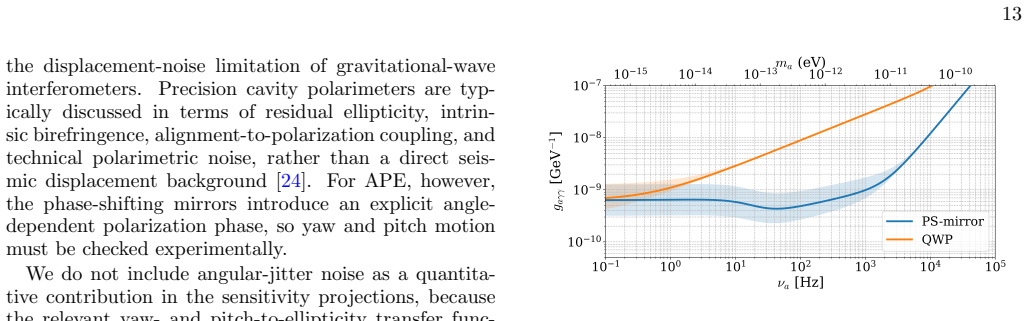
We present the Axion Polarimetric Experiment (APE), a cavity-enhanced polarimeter designed to search for ultralight axion and axion-like-particle dark matter through a time-dependent rotation of the linear polarization of laser light. In cavity-based schemes, intracavity quarter-wave plates can restore coherent buildup of the axion-induced orthogonal polarization, but their transmissive loss limits the achievable finesse. To avoid transmissive intracavity optics, we propose a folded Fabry-Perot cavity that employs dielectric phase-shifting mirrors. At an incidence angle near $45^\circ$, these mirrors provide a reflection-phase difference $\Delta\phi \equiv \phi_s-\phi_p \simeq \pi/2$ between $s$ and $p$ polarizations and therefore act as reflective quarter-wave plates. We present the coating design, thickness optimization, and measurements of the phase shift and optical loss of the phase-shifting mirrors. Using a heterodyne polarimetric readout and an explicitly stated noise model, we derive design-level sensitivity projections for the axion-photon coupling $g_{a\gamma\gamma}$. These projections should be interpreted as target sensitivities for the proposed cavity configuration, since the full-system birefringence noise and angular-jitter coupling remain to be measured.
Figures



Reference graph
Works this paper leans on
-
[1]
Layer geometry, phase thickness, and wave admittance A dielectric multilayer mirror consists of alternating high- and low-index layers, (n H , nL), deposited between an incident medium of refractive indexn0 and a substrate of refractive indexn s. For a layerjwith refractive indexn j and physical thicknessd j, the propagation angle inside the layer fol- lo...
-
[2]
Characteristic-matrix method For each polarizationq∈ {s, p}, a single layer is rep- resented by the characteristic matrix M(q) j = cosδ j isinδ j/Y (q) j iY (q) j sinδ j cosδ j ! ,(A5) which relates the tangential fields on the two sides of the layer [27]. For a stack ofNlayers, numbered from the incident medium toward the substrate, the total charac- ter...
-
[3]
R. D. Peccei and Helen R. Quinn. CP conservation in the presence of pseudoparticles.Phys. Rev. Lett., 38:1440– 1443, Jun 1977
work page 1977
-
[4]
F. Wilczek. Problem of strongpandtinvariance in the presence of instantons.Phys. Rev. Lett., 40:279–282, Jan 1978
work page 1978
-
[5]
Axions In String The- ory.JHEP, 06:051, 2006
Peter Svrcek and Edward Witten. Axions In String The- ory.JHEP, 06:051, 2006
work page 2006
-
[6]
Peter W. Graham and Surjeet Rajendran. New observ- ables for direct detection of axion dark matter.Phys. Rev. D, 88:035023, Aug 2013
work page 2013
-
[7]
D. S. Akerib et al. The Large Underground Xenon (LUX) Experiment.Nucl. Instrum. Meth. A, 704:111–126, 2013
work page 2013
-
[8]
E. Aprile et al. Dark Matter Search Results from a One Ton-Year Exposure of XENON1T.Phys. Rev. Lett., 121(11):111302, 2018
work page 2018
-
[9]
First Results of the Laser- Interferometric Detector for Axions (LIDA).Phys
Joscha Heinze, Alex Gill, Artemiy Dmitriev, Jiri Smetana, Tianliang Yan, Vincent Boyer, Denis Mar- tynov, and Matthew Evans. First Results of the Laser- Interferometric Detector for Axions (LIDA).Phys. Rev. Lett., 132(19):191002, 2024
work page 2024
-
[10]
First results of axion dark matter search with DANCE
Yuka Oshima, Hiroki Fujimoto, Jun’ya Kume, Soichiro Morisaki, Koji Nagano, Tomohiro Fujita, Ippei Obata, Atsushi Nishizawa, Yuta Michimura, and Masaki Ando. First results of axion dark matter search with DANCE. Phys. Rev. D, 108(7):072005, 2023
work page 2023
-
[11]
Swadha Pandey, Evan D. Hall, and Matthew Evans. First results from the axion dark-matter birefringent cavity (adbc) experiment.Phys. Rev. Lett., 133:111003, 2024
work page 2024
-
[12]
E. Zavattini, G. Zavattini, G. Ruoso, G. Raiteri, E. Po- lacco, E. Milotti, V. Lozza, M. Karuza, U. Gastaldi, G. Di Domenico, F. Della Valle, R. Cimino, S. Caru- sotto, G. Cantatore, and M. Bregant. New pvlas results and limits on magnetically induced optical rotation and ellipticity in vacuum.Phys. Rev. D, 77:032006, Feb 2008
work page 2008
-
[13]
Searches for ultralight vector and axion dark matter with KAGRA
Yuta Michimura et al. Searches for ultralight vector and axion dark matter with KAGRA. In29th International Symposium on Particles, String and Cosmology, 1 2025
work page 2025
-
[14]
Ultralight dark matter searches with KAGRA gravitational wave tele- scope.J
Yuta Michimura, Tomohiro Fujita, Jun’ya Kume, Soichiro Morisaki, Koji Nagano, Hiromasa Nakatsuka, Atsushi Nishizawa, and Ippei Obata. Ultralight dark matter searches with KAGRA gravitational wave tele- scope.J. Phys. Conf. Ser., 2156(1):012071, 2021
work page 2021
-
[15]
G¨ ottel, Aldo Ejlli, Kanioar Karan, Sander M
Alexandre S. G¨ ottel, Aldo Ejlli, Kanioar Karan, Sander M. Vermeulen, Lorenzo Aiello, Vivien Raymond, and Hartmut Grote. Searching for Scalar Field Dark Mat- ter with LIGO.Phys. Rev. Lett., 133(10):101001, 2024
work page 2024
-
[16]
The LIGO Scientific Collaboration and the Virgo Col- laboration and the KAGRA Collaboration. Direct multi- model dark-matter search with gravitational-wave inter- ferometers using data from the first part of the fourth LIGO-Virgo-KAGRA observing run. 10 2025
work page 2025
-
[17]
Daniel C. Brotherton et al. Any Light Particle Searches with ALPS II: first science results. 12 2025
work page 2025
-
[18]
Aaron D. Spector et al. Any Light Particle Searches with ALPS II: first science campaign. 1 2026
work page 2026
- [19]
-
[20]
Axion Polarimetric Experiment (APE).PoS, COSMICWISPers2024:059, 2025
Qazal Rokn, Laura Roberts, Aldo Ejlli, and Guido Mueller. Axion Polarimetric Experiment (APE).PoS, COSMICWISPers2024:059, 2025
work page 2025
-
[21]
Alessandro Mirizzi, Georg G. Raffelt, and Pasquale D. Serpico. Photon-axion conversion in intergalactic mag- netic fields and cosmological consequences.Lect. Notes Phys., 741:115–134, 2008
work page 2008
-
[22]
A novel determination of the local dark matter density.JCAP, 08:004, 2010
Riccardo Catena and Piero Ullio. A novel determination of the local dark matter density.JCAP, 08:004, 2010
work page 2010
-
[23]
Pablo F. de Salas and Axel Widmark. Dark matter lo- cal density determination: recent observations and future prospects.Rept. Prog. Phys., 84(10):104901, 2021
work page 2021
-
[24]
R. W. P. Drever, J. L. Hall, F. V. Kowalski, J. Hough, G. M. Ford, A. J. Munley, and H. Ward. Laser phase and frequency stabilization using an optical resonator.Appl. Phys. B, 31(2):97–105, 1983
work page 1983
-
[25]
Eric D. Black. An introduction to Pound–Drever–Hall laser frequency stabilization.Am. J. Phys., 69(1):79, 2001
work page 2001
-
[26]
The pvlas experiment: A 25 year effort to measure vacuum magnetic birefringence
A Ejlli, F Della Valle, U Gastaldi, G Messineo, R Pengo, G Ruoso, and G Zavattini. The pvlas experiment: A 25 year effort to measure vacuum magnetic birefringence. Physics Reports, 871:1–74, 2020
work page 2020
-
[27]
Garrett D. Cole, Wei Zhang, Michael J. Martin, Jun Ye, and Markus Aspelmeyer. Tenfold reduction of brownian noise in high-reflectivity optical coatings.Nature Pho- tonics, 7(8):644–650, 2013
work page 2013
-
[28]
Yu-Pei Zhang, Shi-Xiang Yang, Wen-Hai Tan, Cheng- Gang Shao, Yiqiu Ma, and Shan-Qing Yang. Brown- ian thermal birefringent noise due to the nondiagonal anisotropic photoelastic effect in multilayer coated mir- rors.Physical Review D, 110(2):022009, 2024
work page 2024
-
[29]
Pochi Yeh.Optical Waves in Layered Media. John Wiley and Sons, 1988
work page 1988
-
[30]
Rayleigh-scattering calculations for the terrestrial atmosphere.Appl
Anthony Bucholtz. Rayleigh-scattering calculations for the terrestrial atmosphere.Appl. Opt., 34(15):2765–2773, May 1995
work page 1995
-
[31]
Philip E. Ciddor. Refractive index of air: new equations for the visible and near infrared.Appl. Opt., 35(9):1566– 1573, Mar 1996
work page 1996
discussion (0)
Sign in with ORCID, Apple, or X to comment. Anyone can read and Pith papers without signing in.