PF-Trans: Physics-Embedded Frequency-Aware Transformer for Spectral Reconstruction
Pith reviewed 2026-06-27 14:00 UTC · model grok-4.3
The pith
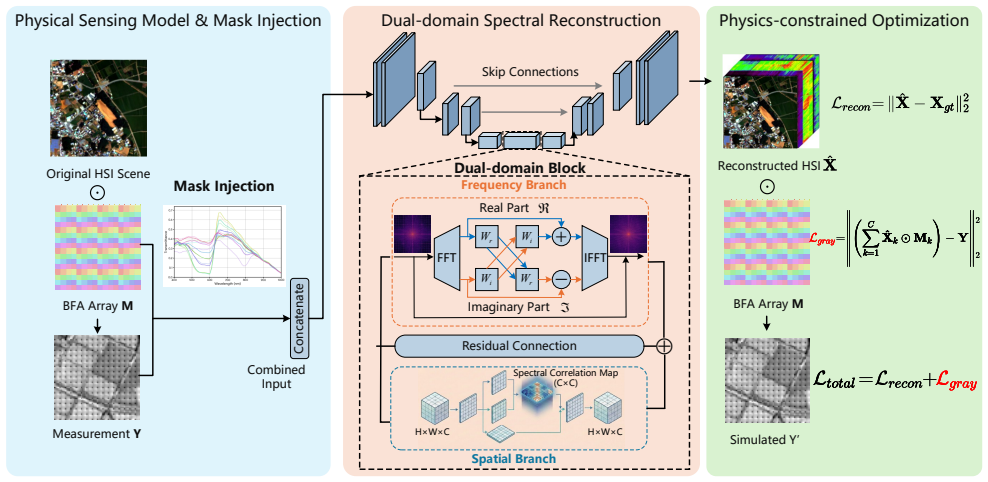
Embedding the physical mask model and adding a parallel FFT branch lets a transformer suppress frequency aliasing in broadband filter array spectral reconstruction.
A machine-rendered reading of the paper's core claim, the machinery that carries it, and where it could break.
Core claim
The central claim is that explicitly integrating the physical sensing model through mask injection and a gray-scale consistency loss, combined with a Dual-domain Block featuring a parallel Fast Fourier Transform branch, enables the network to perceive and suppress aliasing artifacts in the frequency domain for high-fidelity spectral reconstruction from broadband filter array data.
What carries the argument
The Dual-domain Block with a parallel FFT branch, operating together with mask injection and gray-scale consistency loss to address global frequency-specific degradations from the mask structure.
If this is right
- Reconstructed spectra preserve physical consistency with the original sensing model across multiple remote sensing datasets.
- Frequency-domain processing reduces aliasing artifacts that spatial denoising alone leaves behind.
- The method scales to varied broadband filter array configurations while maintaining higher PSNR than prior networks.
- Spectral fidelity improves in scenes where mask modulation creates non-local frequency interference.
Where Pith is reading between the lines
- The same dual-domain structure could be tested on other snapshot imaging systems that use coded masks or filters.
- Controlled experiments with synthetic aliasing patterns of known frequency content would isolate whether the FFT branch targets mask-specific effects.
- Extending the gray-scale consistency loss to additional physical constraints might further constrain solutions under changing illumination.
Load-bearing premise
The mask injection, gray-scale consistency loss, and parallel FFT branch will specifically suppress the global frequency degradations caused by the mask structure instead of providing only general spatial denoising gains.
What would settle it
An ablation study on datasets with documented strong mask-induced aliasing that shows no measurable performance drop when the FFT branch or mask injection is removed would indicate the frequency and physics components are not the active mechanism.
Figures

read the original abstract
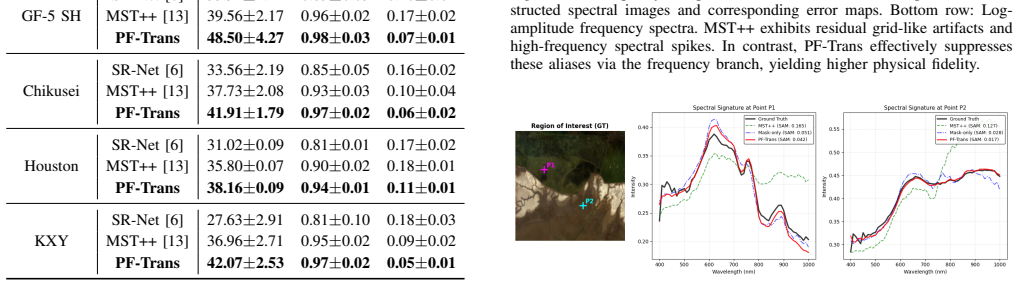
Snapshot Broadband Filter Array (BFA) imaging provides high light throughput for spectral reconstruction but introduces severe spectral aliasing due to complex modulation. Current deep learning approaches, limited to spatial denoising, often fail to address the global frequency-specific degradations caused by the mask structure. To address this, we propose a Physics-embedded Frequency-aware Transformer (PF-Trans) for high-fidelity remote sensing spectral reconstruction. Our method explicitly integrates the physical sensing model through mask injection and a gray-scale consistency loss to ensure physical fidelity. Furthermore, we introduce a Dual-domain Block with a parallel Fast Fourier Transform (FFT) branch, enabling the network to perceive and suppress aliasing artifacts in the frequency domain. Extensive experiments on multiple datasets demonstrate that PF-Trans achieves state-of-the-art performance, achieving a Peak Signal-to-Noise Ratio (PSNR) of up to 48.50 dB on the GF-5 Shanghai dataset, significantly outperforming comparison methods.
Editorial analysis
A structured set of objections, weighed in public.
Referee Report
Summary. The paper proposes PF-Trans, a transformer architecture for spectral reconstruction from snapshot broadband filter array (BFA) imaging. It embeds the physical sensing model via mask injection and a gray-scale consistency loss, and introduces a Dual-domain Block containing a parallel FFT branch to perceive and suppress mask-induced frequency aliasing. The central claim is that these components yield state-of-the-art performance, with a reported peak PSNR of 48.50 dB on the GF-5 Shanghai dataset, outperforming prior methods that are limited to spatial denoising.
Significance. If the frequency-domain mechanism demonstrably targets mask-specific aliasing rather than providing generic denoising gains, the approach could meaningfully advance physics-informed reconstruction for remote-sensing hyperspectral tasks. The explicit integration of the sensing model and dual-domain processing are positive design choices that align with the problem physics.
major comments (2)
- [Abstract / Experiments] The abstract reports SOTA PSNR numbers but supplies no experimental protocol, baseline implementations, dataset splits, error bars, or ablation tables. Without these, the claim that the Dual-domain Block specifically suppresses global frequency aliasing (rather than generic spatial improvement) cannot be evaluated.
- [Dual-domain Block description] The central mechanistic claim—that mask injection plus the parallel FFT branch targets mask-structure aliasing—is plausible but load-bearing; the manuscript must show (via controlled ablations or frequency-domain visualizations) that removing the FFT branch degrades performance precisely on the aliasing artifacts rather than uniformly.
minor comments (2)
- [Method] Notation for the gray-scale consistency loss and the mask-injection operation should be defined with explicit equations rather than descriptive text.
- [Abstract] Dataset names (e.g., GF-5 Shanghai) and comparison methods should be cited with references in the abstract or early introduction.
Simulated Author's Rebuttal
We thank the referee for the constructive comments. We address each major comment below.
read point-by-point responses
-
Referee: [Abstract / Experiments] The abstract reports SOTA PSNR numbers but supplies no experimental protocol, baseline implementations, dataset splits, error bars, or ablation tables. Without these, the claim that the Dual-domain Block specifically suppresses global frequency aliasing (rather than generic spatial improvement) cannot be evaluated.
Authors: The full manuscript provides the experimental protocol, baseline details, dataset splits, and ablation tables in the Experiments section. The abstract is intentionally concise, but we agree additional context would strengthen it. We will revise the abstract to reference the evaluation protocol and note that ablations support the frequency-aware improvements. revision: partial
-
Referee: [Dual-domain Block description] The central mechanistic claim—that mask injection plus the parallel FFT branch targets mask-structure aliasing—is plausible but load-bearing; the manuscript must show (via controlled ablations or frequency-domain visualizations) that removing the FFT branch degrades performance precisely on the aliasing artifacts rather than uniformly.
Authors: The manuscript already contains controlled ablations of the Dual-domain Block. To more directly demonstrate the frequency-specific effect on mask-induced aliasing, we will add frequency-domain visualizations in the revision. revision: yes
Circularity Check
No circularity detected; derivation chain not present in text
full rationale
The provided abstract and context contain no equations, fitting procedures, self-citations, or derivation steps. The method is described at a high level (mask injection, gray-scale loss, FFT branch) without any reduction of outputs to inputs by construction. No load-bearing claims reduce to self-definition or fitted renamings. This is the expected non-finding for an abstract-only view; the architecture description is consistent with an empirical claim rather than a closed derivation.
Axiom & Free-Parameter Ledger
Reference graph
Works this paper leans on
-
[1]
Deep learning for hyperspectral image classification: an overview,
S. Li, W. Song, L. Fang, Y . Chen, P. Ghamisi, and J. A. Benedik- tsson, “Deep learning for hyperspectral image classification: an overview,”IEEE Transactions on Geoscience and Remote Sensing, vol. 57, no. 9, pp. 6690–6709, 2019
2019
-
[2]
Deep feature fusion via two- stream convolutional neural network for hyperspectral image classification,
X. Li, M. Ding, and A. Pi ˇzurica, “Deep feature fusion via two- stream convolutional neural network for hyperspectral image classification,”IEEE Transactions on Geoscience and Remote Sensing, vol. 58, no. 4, pp. 2615–2629, 2020
2020
-
[3]
An end-to-end framework for joint denoising and classification of hyperspectral images,
X. Li, M. Ding, Y . Gu, and A. Pi ˇzurica, “An end-to-end framework for joint denoising and classification of hyperspectral images,”IEEE Transactions on Neural Networks and Learning Systems, vol. 34, no. 7, pp. 3269–3283, 2023
2023
-
[4]
Hemisphere harmonics basis: A universal approach to remote sensing brdf approximation,
Z. Qin, X. Li, and Y . Gu, “Hemisphere harmonics basis: A universal approach to remote sensing brdf approximation,”IEEE Transactions on Geoscience and Remote Sensing, 2024
2024
-
[5]
Single disperser design for coded aperture snapshot spectral imaging,
A. Wagadarikar, R. John, R. Willett, and D. Brady, “Single disperser design for coded aperture snapshot spectral imaging,” Applied Optics, vol. 47, no. 10, pp. B44–B51, 2008
2008
-
[6]
A broadband hyperspectral image sensor with high spatio-temporal resolution,
L. Bianet al., “A broadband hyperspectral image sensor with high spatio-temporal resolution,”Nature, 2024
2024
-
[7]
Structured compressed sensing: From theory to applications,
M. F. Duarte and Y . C. Eldar, “Structured compressed sensing: From theory to applications,”IEEE Transactions on Signal Processing, vol. 59, no. 9, pp. 4053–4085, 2011
2011
-
[8]
Hscnn+: Advanced cnn-based hyperspectral recovery from rgb images,
Z. Shi, C. Chen, Z. Xiong, D. Liu, and F. Wu, “Hscnn+: Advanced cnn-based hyperspectral recovery from rgb images,” inProceedings of the IEEE Conference on Computer Vision and Pattern Recognition Workshops, 2018, pp. 939–947
2018
-
[9]
Recon- structing spectral images from rgb-images using a convolutional neural network,
T. Stiebel, S. Koppers, P. Seltsam, and D. Merhof, “Recon- structing spectral images from rgb-images using a convolutional neural network,” inProceedings of the IEEE Conference on Computer Vision and Pattern Recognition Workshops, 2018, pp. 948–956
2018
-
[10]
Cnn- based hyperspectral image recovery from spectrally undersam- pled projections,
Z. Xiong, Z. Shi, H. Li, L. Wang, D. Liu, and F. Wu, “Cnn- based hyperspectral image recovery from spectrally undersam- pled projections,” inProceedings of the IEEE International Conference on Computer Vision Workshops, 2017, pp. 518–525
2017
-
[11]
Spectral reconstruc- tion network from multispectral images to hyperspectral images: A multitemporal case,
T. Li, T. Liu, Y . Wang, X. Li, and Y . Gu, “Spectral reconstruc- tion network from multispectral images to hyperspectral images: A multitemporal case,”IEEE Transactions on Geoscience and Remote Sensing, vol. 60, pp. 1–16, 2022
2022
-
[12]
Multi-sensor multispectral reconstruction framework based on projection and reconstruction,
T. Li, T. Liu, X. Li, Y . Gu, Y . Wang, and Y . Chen, “Multi-sensor multispectral reconstruction framework based on projection and reconstruction,”Science China Information Sciences, 2024
2024
-
[13]
Mst++: Multi-stage spectral-wise transformer for efficient spectral reconstruction,
Y . Cai, J. Lin, Z. Lin, H. Wang, Y . Zhang, H. Pfister, R. Timofte, and L. Van Gool, “Mst++: Multi-stage spectral-wise transformer for efficient spectral reconstruction,” inProceedings of the IEEE/CVF Conference on Computer Vision and Pattern Recog- nition, 2022, pp. 745–755
2022
-
[14]
Pixel-aware deep function-mixture network for spec- tral super-resolution,
L. Zhang, Z. Lang, P. Wang, W. Wei, S. Liao, L. Shao, and Y . Zhang, “Pixel-aware deep function-mixture network for spec- tral super-resolution,” inProceedings of the AAAI Conference on Artificial Intelligence, vol. 34, no. 07, 2020, pp. 12 976–12 983
2020
-
[15]
Multi- scale selective feedback network with dual loss for real image denoising,
X. Hu, Y . Cai, Z. Liu, H. Wang, and Y . Zhang, “Multi- scale selective feedback network with dual loss for real image denoising,” inProceedings of the International Joint Conference on Artificial Intelligence (IJCAI), 2021
2021
discussion (0)
Sign in with ORCID, Apple, or X to comment. Anyone can read and Pith papers without signing in.