Thermal Tides in Rotating Hot Jupiters
Pith reviewed 2026-05-25 16:40 UTC · model grok-4.3
The pith
Resonances with g-, r-, and inertial modes enhance the tidal torque from thermal tides in rotating hot Jupiters.
A machine-rendered reading of the paper's core claim, the machinery that carries it, and where it could break.
Core claim
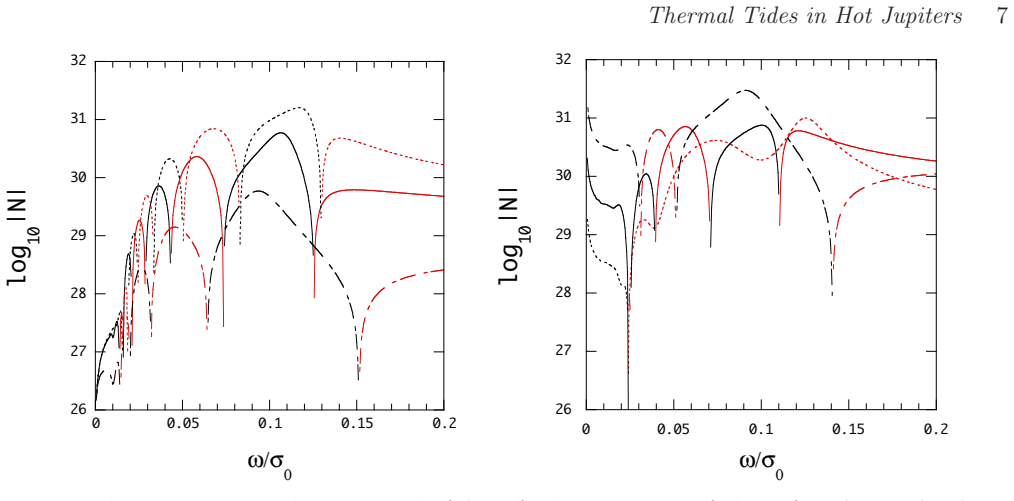
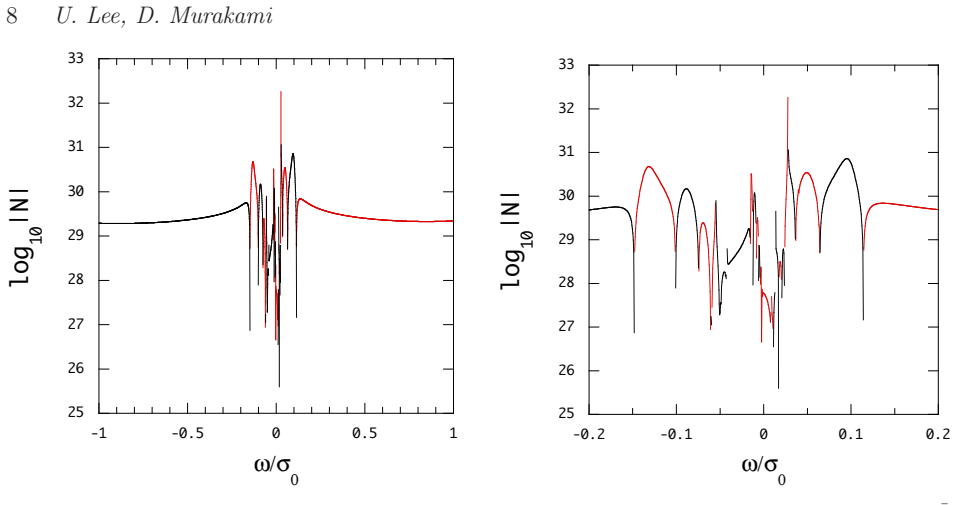
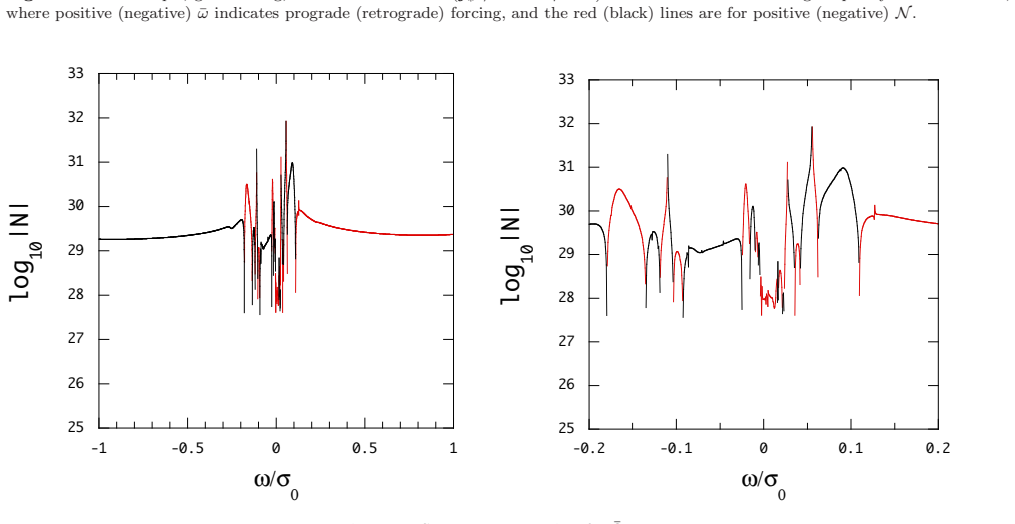
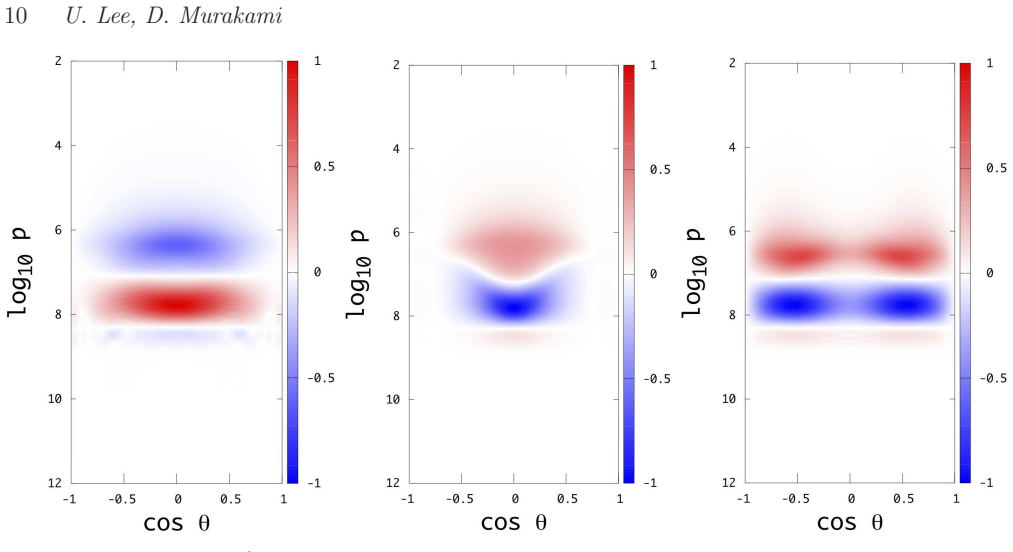
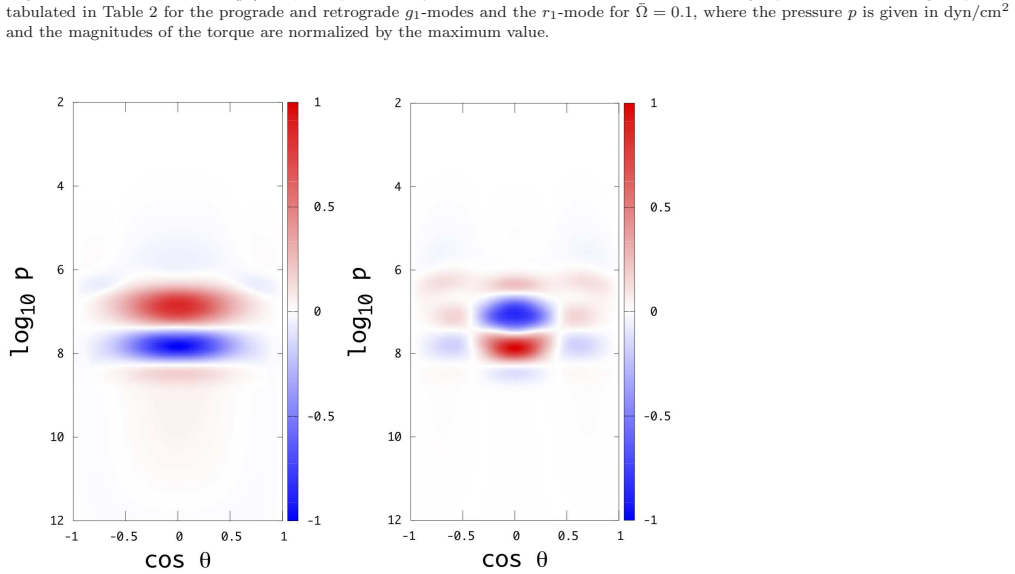
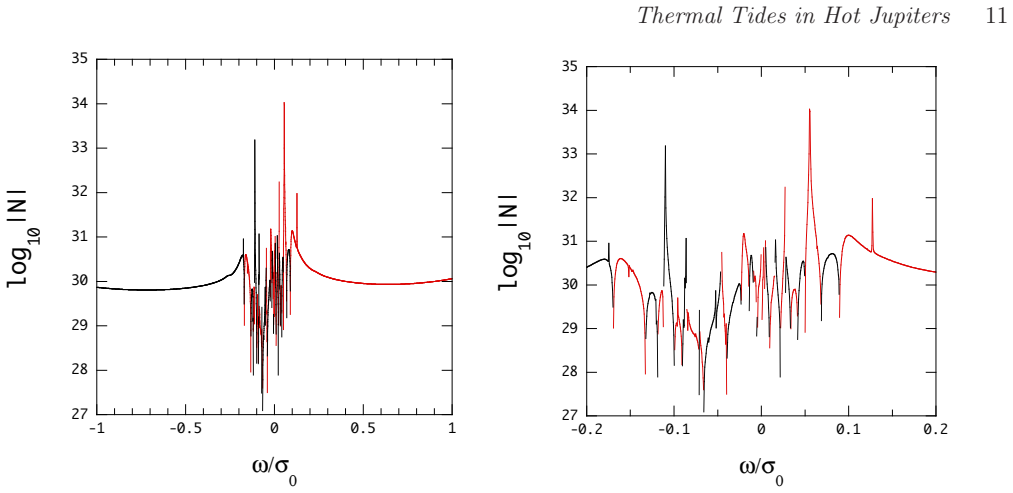
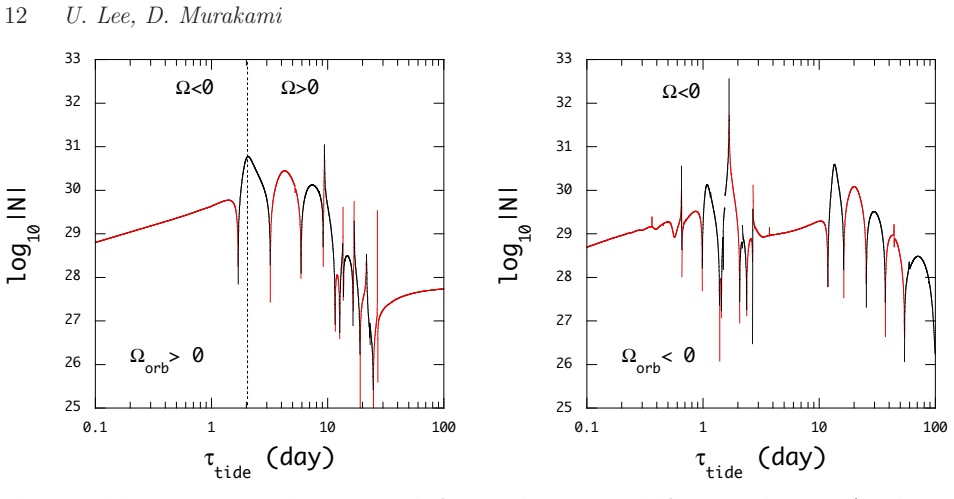
Resonance with the g- and r-modes produces broad peaks and that with the inertial modes very sharp peaks in the tidal torque as a function of forcing frequency, with different behavior between prograde and retrograde forcing for long periods due to r-modes existing only on the retrograde side.
What carries the argument
Spherical-harmonic series expansions (multiple l for fixed m) of the non-adiabatic tidal responses in a two-layer model consisting of a convective core and radiative envelope.
If this is right
- The tidal torque increases at the resonant forcing frequencies set by the planet's oscillation modes.
- Resonance with g- and r-modes in the envelope produces broad peaks in the torque-frequency relation.
- Resonance with inertial modes in the core produces very sharp peaks in the torque-frequency relation.
- The torque as a function of forcing period differs between prograde and retrograde cases at long periods.
- Non-adiabatic effects associated with the modes control the width of the resonance peaks.
Where Pith is reading between the lines
- The direction-dependent torque could produce different spin-orbit evolution depending on whether the planet is being forced prograde or retrograde.
- The narrow inertial-mode peaks might create isolated frequency windows where thermal tides strongly affect orbital migration or spin.
- Incorporating these resonances could change estimates of how thermal tides contribute to the long-term evolution of hot-Jupiter orbits and atmospheres.
Load-bearing premise
A simple model of a nearly isentropic convective core plus thin radiative envelope is adequate to represent the tidal responses of rotating hot Jupiters when rotation and radiative cooling are included.
What would settle it
Tidal torque or orbital-decay measurements on hot Jupiters that show no peaks at the resonant frequencies of g-, r-, or inertial modes and no difference between prograde and retrograde forcing at long periods.
Figures
read the original abstract
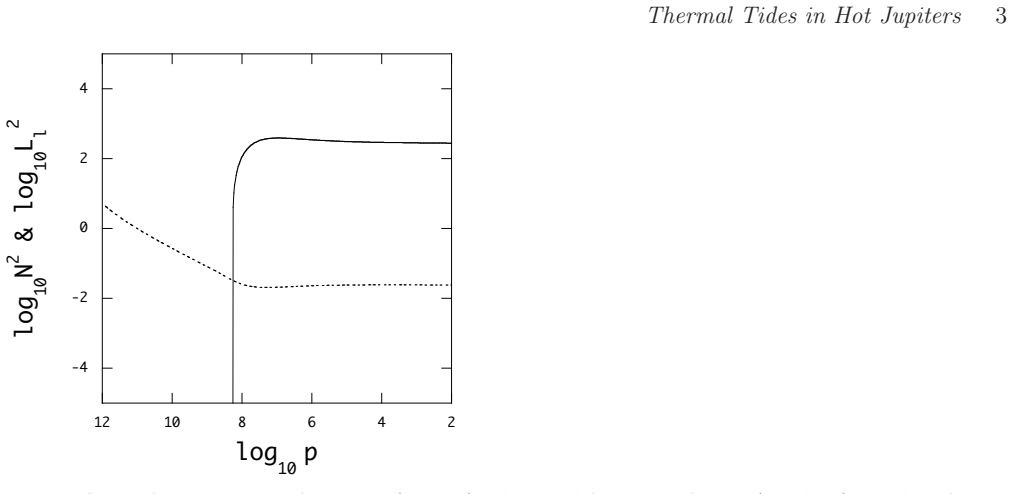
We calculate tidal torque due to semi-diurnal thermal tides in rotating hot Jupiters, taking account of the effects of radiative cooling in the envelope and of the planets rotation on the tidal responses. We use a simple Jovian model composed of a nearly isentropic convective core and a thin radiative envelope. To represent the tidal responses of rotating planets, we employ series expansions in terms of spherical harmonic functions $Y_l^m$ with different $l$s for a given $m$. For low forcing frequency, there occurs frequency resonance between the forcing and the $g$- and $r$-modes in the envelope and inertial modes in the core. We find that the resonance enhances the tidal torque, and that the resonance with the $g$- and $r$-modes produces broad peaks and that with the inertial modes very sharp peaks, depending on the magnitude of the non-adiabatic effects associated with the oscillation modes. We also find that the behavior of the tidal torque as a function of the forcing frequency (or period) is different between prograde and retrograde forcing, particularly for long forcing periods because the $r$-modes, which have long periods, exist only on the retrograde side.
Editorial analysis
A structured set of objections, weighed in public.
Referee Report
Summary. The manuscript calculates the tidal torque due to semi-diurnal thermal tides in rotating hot Jupiters. It employs a two-layer model consisting of a nearly isentropic convective core and a thin radiative envelope, incorporates radiative cooling and rotation via spherical-harmonic expansions that allow multiple l for each m, and reports that resonances with g- and r-modes produce broad torque peaks while inertial modes produce sharp peaks, with prograde/retrograde asymmetry arising because r-modes exist only on the retrograde side.
Significance. If the resonance calculations hold, the work supplies a concrete forward model of how non-adiabatic thermal tides can drive spin-orbit evolution in hot Jupiters, distinguishing the width of g/r-mode resonances from the narrow inertial-mode features and the one-sided r-mode contribution. This supplies a useful benchmark for more elaborate interior models.
minor comments (3)
- [Abstract] The abstract states that the model is 'nearly isentropic' in the core; the manuscript should quantify the small entropy gradient adopted and show that the reported resonance locations are insensitive to that choice within the stated range.
- Clarify the truncation level in the spherical-harmonic series (i.e., the maximum l retained for each m) and demonstrate convergence of the torque peaks with respect to that truncation.
- The distinction between broad g/r-mode peaks and sharp inertial-mode peaks is central; a figure or table that tabulates the quality factor or damping rate for representative modes of each class would make the dependence on non-adiabatic effects explicit.
Simulated Author's Rebuttal
We thank the referee for the positive and accurate summary of our work on thermal tidal torques in rotating hot Jupiters. The referee correctly identifies the key results regarding resonances with g-, r-, and inertial modes and the resulting torque behavior. We appreciate the recommendation for minor revision and will incorporate any editorial or minor clarifications in the revised version. No major comments requiring substantive changes were raised.
Circularity Check
No significant circularity
full rationale
The paper performs a direct forward calculation of tidal torques from a specified Jovian model (nearly isentropic core + thin radiative envelope) using spherical-harmonic expansions that incorporate rotation and radiative cooling. Resonance peaks with g/r-modes and inertial modes are reported as numerical outcomes of the linear non-adiabatic equations; no parameter is fitted to the target torque curve and then re-labeled as a prediction, and no load-bearing step reduces to a self-citation or self-definition. The derivation chain is therefore self-contained against the stated model assumptions.
Axiom & Free-Parameter Ledger
axioms (1)
- domain assumption A simple Jovian model with nearly isentropic convective core and thin radiative envelope suffices to represent hot Jupiters for tidal torque calculations.
Reference graph
Works this paper leans on
-
[1]
Andr\'e Q., Barker A.J., Mathis S., 2017, A&A, 605, A117
work page 2017
- [2]
-
[3]
Auclair-Desrotour P., Leconte J., 2018, A&A, 613, A45
work page 2018
-
[4]
Auclair-Desrotour P., Mathis S., Laskar J., 2018, A&A, 609, A118
work page 2018
-
[5]
Arras P., Bildsten L., 2006, ApJ, 650, 394
work page 2006
-
[6]
Arras P., Socrates A., 2010, ApJ, 714, 1
work page 2010
-
[7]
Baraffe I., Chabrier G., Barman T.S., Allard F., Hauschildt P.H., 2003, A&A, 402, 701
work page 2003
-
[8]
Bodenheimer P., Lin D.N.C., Mardling R.A., 2001, ApJ, 548, 466
work page 2001
-
[9]
Deming D., Mumma M.J., Espenak F., Jennings D.E., Kostiuk T., Wiedemann G., Loewenstein R., Piscitelli J, 1989, ApJ, 343, 456
work page 1989
-
[10]
Clayton D.D., 1983, Principles of Stellar Evolution and Nucleosynthesis, The University of Chicago Press, Chicago
work page 1983
-
[11]
Fuller J., Lai D., 2013, MNRAS, 430, 274
work page 2013
-
[12]
Goldreich P., Nicholson P.D., 1977, Icarus, 30, 301
work page 1977
-
[13]
Goldreich P., Soter S., 1966, Icarus, 5, 375
work page 1966
-
[14]
Goodman J., Dickson E.S., 1998, ApJ, 507, 938
work page 1998
-
[15]
Greenspan H.P., 1969, The Theory of Rotating Fluids, Cambridge University Press, Cambridge
work page 1969
-
[16]
Gerkema T., Shrira V.I., 2005, Journal of Fluid Mechanics, 529, 195
work page 2005
-
[17]
Iro N., B\'ezard B., Guillot T., 2005, A&A, 436, 719
work page 2005
-
[18]
Ivanov P.B., Papaloizou J.C.B., 2007, MNRAS, 376, 682
work page 2007
-
[19]
Jermyn A.D., Tout C.A., Ogilvie G.I., 2017, MNRAS, 469, 1768
work page 2017
-
[20]
Kumar P., Goodman J., 1996, ApJ, 466, 946
work page 1996
-
[21]
Lai D., 1997, ApJ, 490, 847
work page 1997
-
[22]
Lee U., 2019, MNRAS, 484, 5845
work page 2019
-
[23]
Lee U., Saio H., 1986, MNRAS, 221, 365
work page 1986
-
[24]
Lee U., Saio H., 1987, MNRAS, 224, 513
work page 1987
-
[25]
Lee U., Saio H., 1987b, MNRAS, 225, 643
-
[26]
Lee U., Saio H., 1989, MNRAS, 237, 875
work page 1989
-
[27]
Lee U., Saio H., 1990a, ApJ, 359, 29
-
[28]
Lee U., Saio H., 1990b, ApJ, 360, 590
-
[29]
Lee U., Saio H., 1997, ApJ, 491, 839
work page 1997
-
[30]
Magalh\ aes J.A., Weir A.L., Conrath B.J., Gierasch P.J., Leroy S.S., 1989, Nature, 337, 444
work page 1989
-
[31]
Mihalas D., Weibel-Mihalas B., 1999, Foundations of Radiation Hydrodynamics, Dover Publishing, New York
work page 1999
-
[32]
Ogilvie G.I., 2014, Annu. Rev. Astron. Astrophys., 52, 171
work page 2014
-
[33]
Ogilvie G.I., Lin N.D.C., 2004, ApJ, 610, 477
work page 2004
-
[34]
Papaloizou J., Pringle J.E., 1978, MNRAS, 182, 423
work page 1978
-
[35]
Press W.H., Teukolsky S.A., 1977, ApJ, 213, 183
work page 1977
-
[36]
Savonije G.J., Papaloizou J.C.B., 1984, MNRAS, 207, 685
work page 1984
-
[37]
Savonije G.J., Papaloizou J.C.B., 1997, MNRAS, 291, 633
work page 1997
- [38]
-
[39]
Stevenson D.J., Salpeter E.E., 1977a, ApJS, 35, 221
-
[40]
Stevenson D.J., Salpeter E.E., 1977b, ApJS, 35, 239
-
[41]
Turner J.S., 1979, Buoyancy Effects in Fluids, Cambridge University Press, Cambridge
work page 1979
-
[42]
Unno W., Osaki Y., Ando H., Saio H., Shibahashi H., 1989, Nonradial Oscillations of Stars, 2nd ed., University of Tokyo Press, Tokyo
work page 1989
-
[43]
Witte M.G., Savonije G.J., 2002, A&A, 386, 222
work page 2002
-
[44]
Yoshida S., Lee U., 2000, ApJ, 529, 997
work page 2000
-
[45]
Zahn J.P., 1977, A&A, 57, 383
work page 1977
discussion (0)
Sign in with ORCID, Apple, or X to comment. Anyone can read and Pith papers without signing in.