REVIEW 4 major objections 5 minor 86 references
Seismic tomography using variational inference methods
T0 review · 4 major / 5 minor · reviewed 2026-08-14 · deepseek-v4-flash
Pith's one-line read The paper claims that variational inference methods — which replace Bayesian sampling by optimization — can match Monte Carlo posterior uncertainty maps in seismic tomography at a small fraction of the computational cost, provided…
desk verdict Useful first demonstration of variational inference in travel-time tomography with real cost savings, but the abstract overstates accuracy; evidence is mostly visual. read the letter →
The pith
A machine-rendered reading of the paper's core claim, the machinery that carries it, and where it could break.
The reading
What carries the argument
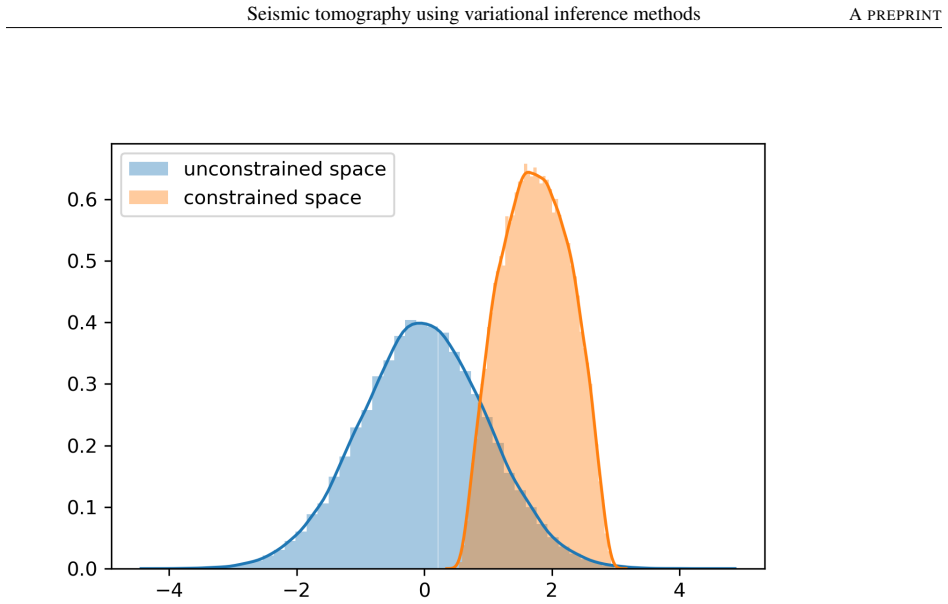
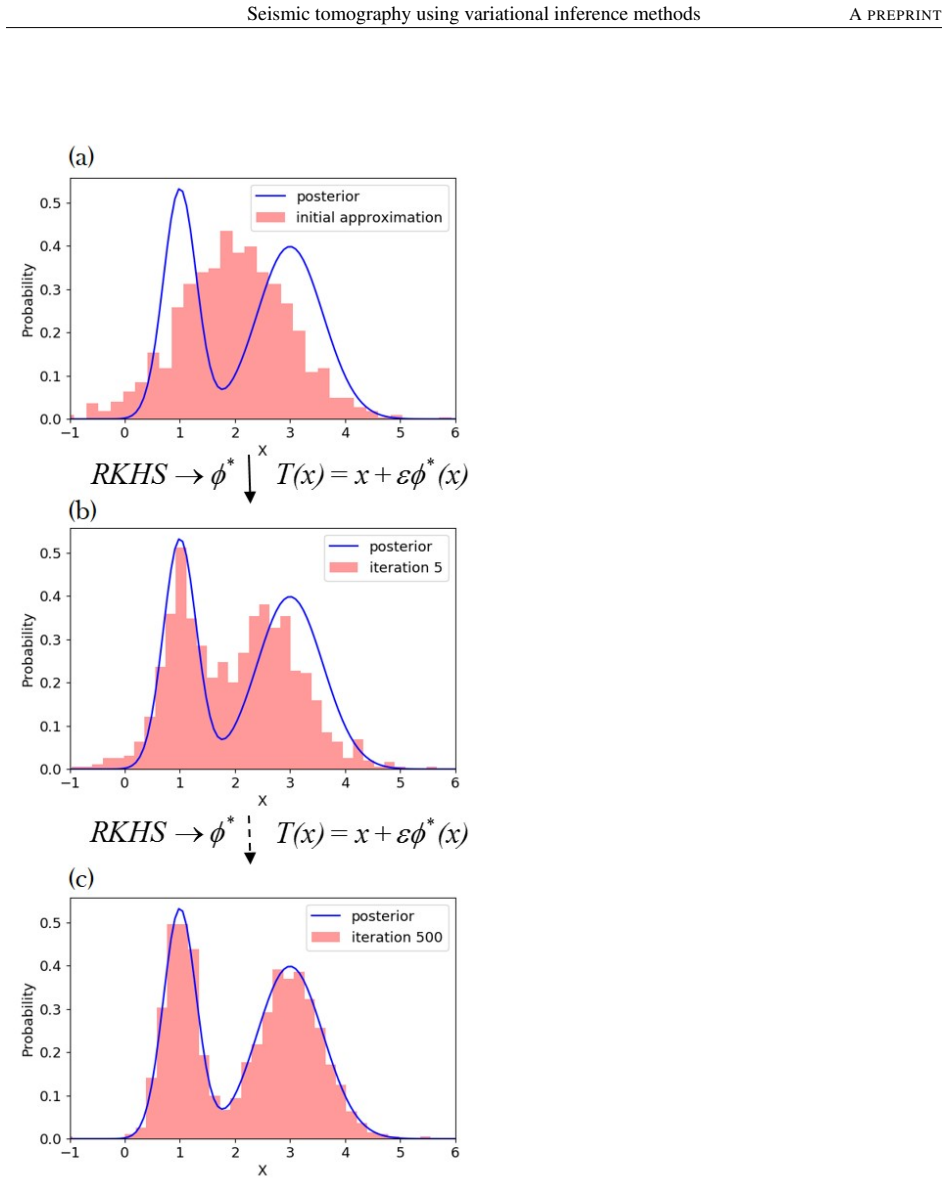
The core mechanism is the replacement of Monte Carlo sampling by Kullback-Leibler divergence minimization: instead of generating posterior samples, one maximizes the ELBO over a chosen family of distributions. ADVI uses a Gaussian variational family in an unconstrained transformed space, with a Cholesky parameterization of the covariance and reparameterized Monte Carlo gradient estimates; a logit transform keeps velocities within their physical bounds. SVGD uses a set of particles moved deterministically along the kernelized Stein discrepancy direction, in which one term attracts particles toward high-probability regions and a second repulsive term prevents collapse, allowing approximation of arbitrary posterior shapes. Both methods depend on the same load-bearing object: gradients of the log posterior with respect to model parameters, which in this paper are obtained by ray-tracing the Eikonal equation with a fast marching method.
What would settle it
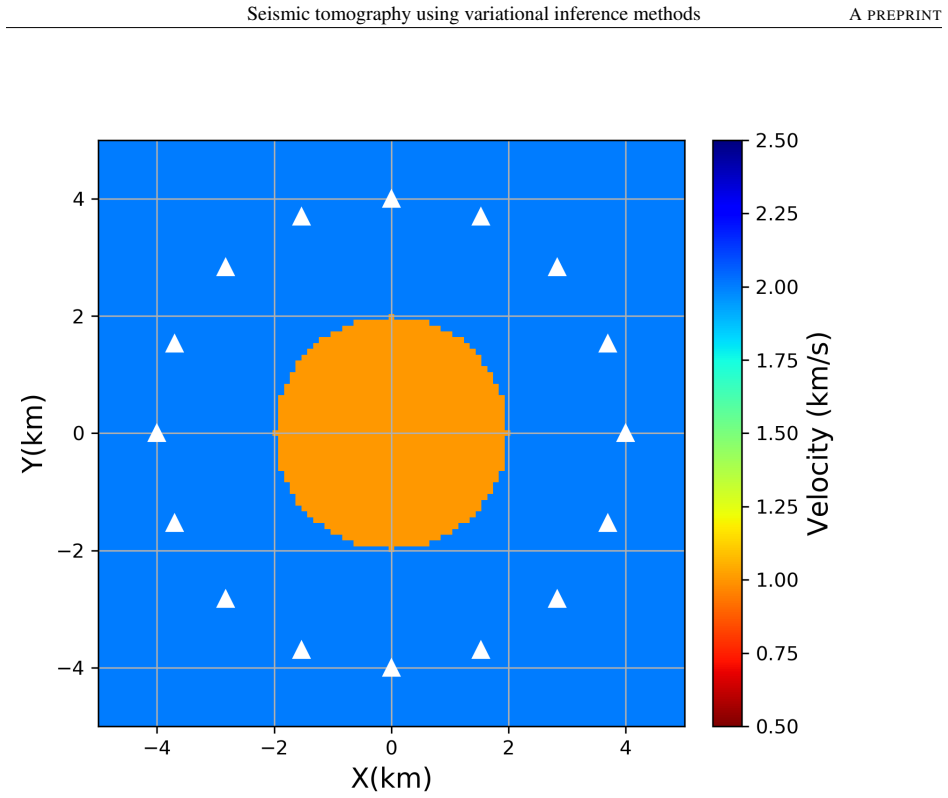
Run the paper's synthetic experiment with two well-separated low-velocity anomalies (or reduced ray coverage) so the posterior is genuinely multimodal, and compare ADVI and SVGD marginals at a point between the modes against a very long rj-McMC chain; if the VI marginals remain unimodal or their standard deviations do not bracket the two-mode spread, the general claim that VI produces accurate approximations to Monte Carlo posteriors fails in exactly the setting proposed.
Extended reading notes
Core claim
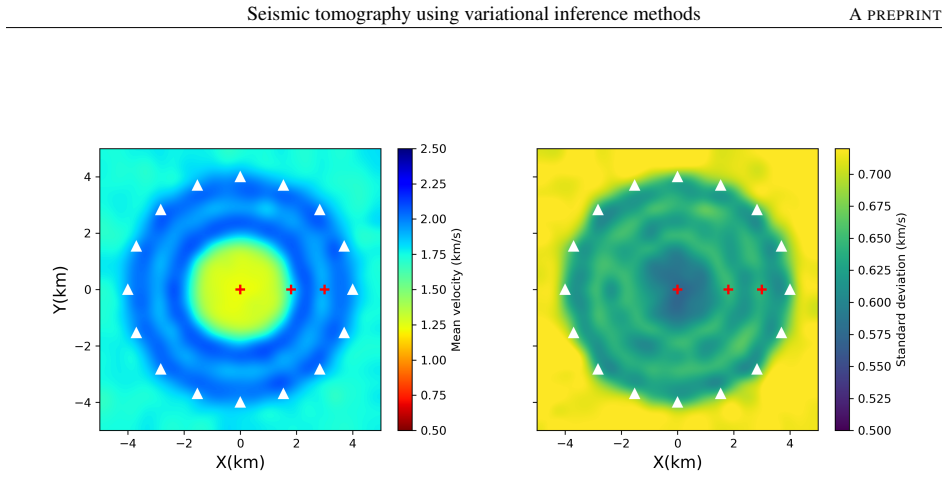
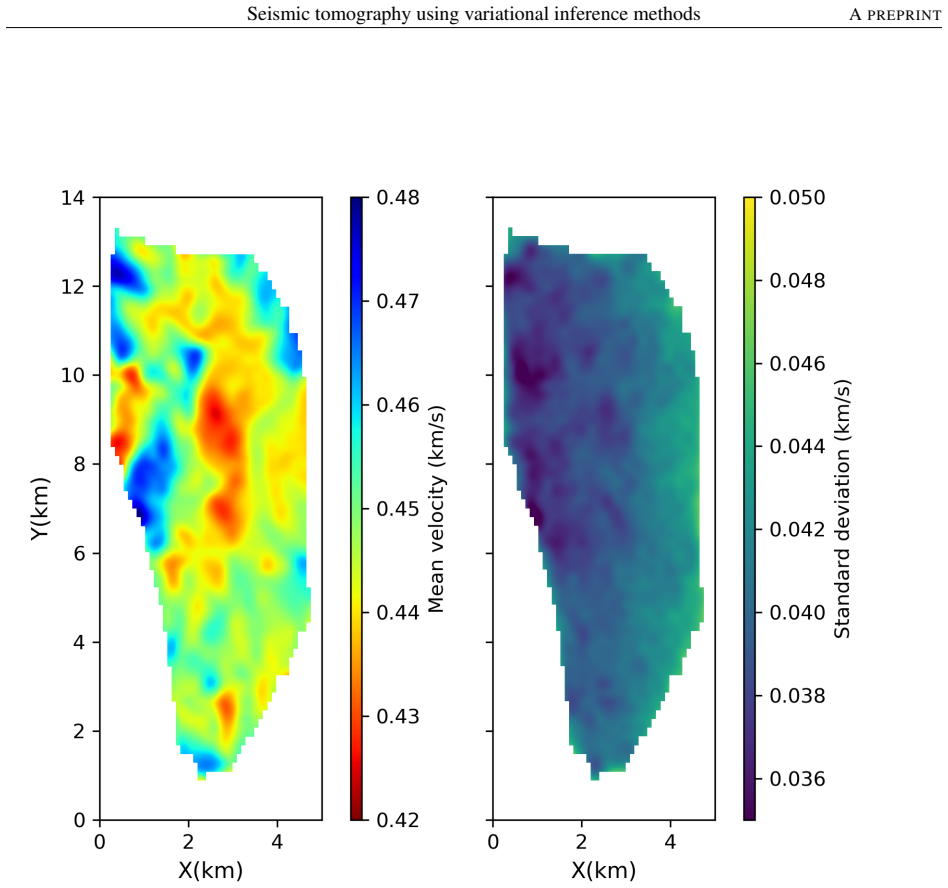
The paper demonstrates that ADVI and SVGD can be applied to 2D seismic tomography and can approximate the posterior probability density functions that Monte Carlo methods deliver, at substantially lower computational cost. On the synthetic test, SVGD reproduces the characteristic double-loop uncertainty pattern seen in MH-McMC, whereas ADVI flattens that structure because its Gaussian approximation cannot represent non-Gaussian posterior shapes. On the Grane field data, the mean phase-velocity maps from ADVI and SVGD are nearly identical to each other and broadly consistent with rj-McMC, while the uncertainty maps differ, with SVGD showing more structure and rj-McMC showing much smaller uncertainties because of its lower-dimensional parameterization. The paper concludes that variational inference is an efficient alternative to McMC for tomography whenever gradients of parameters with respect to data can be computed efficiently.
Load-bearing premise
The load-bearing premise is that the posterior distribution of the velocity model has a shape the chosen variational family can represent; in particular ADVI's single Gaussian cannot represent a multimodal posterior, so in multimodal tomography problems its uncertainty maps are biased by construction.
Editorial extensions
If this is right
- Seismic tomography can obtain Bayesian posterior mean and uncertainty maps by optimization rather than sampling, cutting compute from hundreds of CPU hours to single-digit or sub-hour CPU times in the synthetic test, and from over 1,800 CPU hours to under 150 CPU hours on the Grane field data.
- SVGD is usable where the posterior shape is unknown, since it preserves the double-loop uncertainty pattern that MH-McMC shows and that ADVI's Gaussian approximation smooths away.
- Because variational inference is an optimization problem, large data sets can be handled with stochastic minibatches and parallel gradient evaluation, a strategy McMC cannot use without breaking detailed balance.
- The same recipe opens a route to Bayesian 3D tomography and full waveform inversion, where Monte Carlo cost is currently prohibitive, provided efficient gradients are available.
- ADVI can serve as a very cheap screening tool for mean models and Gaussian uncertainty when a unimodal approximation is considered sufficient.
Reading between the lines
- A testable extension the paper only gestures at: adjoint-based full waveform inversion meets the same gradient requirement, so SVGD-style posterior sampling should transfer to FWI problems that are currently out of reach for McMC; applying it there would reveal whether the cost advantage survives realistic waveform gradients.
- Because rj-McMC and the fixed-grid VI inversions solve different parameter-estimation problems, the comparison conflates algorithm choice with parameterization choice; a trans-dimensional variational scheme, varying Voronoi-cell number and geometry, would narrow the gap in uncertainty magnitudes and test that distinction.
- Running ADVI and SVGD side by side on the same data set functions as a practical multimodality diagnostic: where their uncertainty maps diverge, the posterior is likely non-Gaussian, and the ADVI map should not be interpreted as a faithful uncertainty estimate.
Signed reviews
Editorial analysis
A structured set of objections, weighed in public.
Referee Report
Summary. This paper applies two variational inference methods, automatic differential variational inference (ADVI) and Stein variational gradient descent (SVGD), to 2D seismic travel-time tomography. In a synthetic test with a circular low-velocity anomaly, the authors compare mean and standard deviation maps and selected marginal posterior distributions against fixed-dimensional Metropolis-Hastings McMC (MH-McMC) and trans-dimensional reversible-jump McMC (rj-McMC), and they apply the methods to ambient-noise phase-velocity data from the Grane field. The paper reports that ADVI and SVGD recover mean models similar to the McMC benchmarks at considerably lower CPU cost, while ADVI's uncertainty estimates are biased by its Gaussian approximation. The central claim is that variational inference can produce accurate approximations to Monte Carlo sampling results at significantly lower computational cost, provided gradients with respect to data can be computed efficiently.
Significance. If fully substantiated, the paper would provide a practical route to Bayesian uncertainty quantification in seismic tomography at a fraction of Monte Carlo cost, which is a valuable contribution given the intractability of McMC for large 3D problems. The study is clearly written, the variational mathematics is standard and correctly transcribed, and the synthetic experiments include two independent Monte Carlo benchmarks as well as explicit convergence checks (doubled iterations and doubled particle count for ADVI and SVGD). The authors also honestly document ADVI's limitations and the parameterization mismatch with rj-McMC. However, because the central accuracy claim rests on visual comparison rather than quantitative metrics, and because ADVI is conceded to be biased, the paper's significance is presently smaller than its abstract claims.
major comments (4)
- [Abstract; §3.1; Fig. 10] The abstract's accuracy claim is not supported quantitatively: Section 3.1 and Figure 10 compare the ADVI, SVGD, MH-McMC and rj-McMC results only through visual inspection of mean and standard deviation maps and of marginal pdfs at three points, with no numerical discrepancy measure such as KL divergence, Wasserstein distance, coverage probability, or a calibration statistic. Since this is the load-bearing evidence for the paper's main claim, the authors should add a quantitative comparison of the VI posteriors against the fixed-dimensional MH-McMC posterior and report the corresponding metric.
- [§2.2; §5; Fig. 10f] The abstract's claim is also too broad for ADVI. Section 2.2 explicitly states that ADVI 'provides a unimodal approximation' and 'will not be effective for multimodal distributions,' and Figure 10f shows that the rj-McMC marginal at the anomaly boundary (1.8, 0) is clearly multimodal. Section 5 concedes that ADVI 'produces biased posterior pdfs.' The paper should therefore restrict the accuracy claim to SVGD, or condition it on unimodal posteriors, and the abstract and conclusion should be rewritten accordingly.
- [§3.1; §5] The comparison with rj-McMC cannot serve as a posterior-accuracy validation because the parameterizations are fundamentally different: the fixed grid inversions use 441 cells while the rj-McMC posterior lives in a trans-dimensional Voronoi space with roughly 10 cells, as stated in Section 3.1. Section 5 itself notes that the results are 'essentially not directly comparable.' Since the abstract claims accuracy relative to Monte Carlo sampling methods generically, the validation must rest on the MH-McMC comparison using the identical 21×21 grid; that comparison is currently only visual, which is the gap identified in the first major comment.
- [§3.2; Table 1] The computational-cost comparison is not fully quantitative because convergence is assessed subjectively. Section 3.2 acknowledges that 'the above comparison depends on the methods used to assess convergence for each method, which introduces some subjectivity in the comparison.' To substantiate the claim of 'significantly lower computational cost,' the authors should report convergence diagnostics or a cost-to-accuracy curve (e.g., CPU time required to reach a target posterior accuracy) rather than only raw CPU hours.
minor comments (5)
- [Author affiliation] The affiliation line contains a typo: 'Unite Kingdom' should be 'United Kingdom.'
- [Fig. 10 caption] Figure 10's caption refers to 'pluses in Figure 3,4,5,6' but the relevant figures are Figures 5–8.
- [§3.1] There is a typo in Section 3.1: 'reciever' should be 'receiver.'
- [§2.2; §3.2] The text alternates between 'constrains' and 'constraints'; the latter spelling should be used consistently.
- [§3.0] It would help to state explicitly whether the same initial particles or random seed were used for the SVGD convergence checks, so that the comparisons with doubled iterations and doubled particle count are cleanly interpretable.
Circularity Check
No significant circularity: the variational results are validated against independently run Monte Carlo benchmarks, and the accuracy claim does not reduce to the methods' inputs.
full rationale
The paper's central claim is that ADVI and SVGD can approximate Monte Carlo posterior results at lower cost. This claim is evaluated in a synthetic test by comparing the variational posteriors against MH-McMC and rj-McMC runs that use the same data, prior, and (for MH-McMC) the same 21x21 grid parameterization; the MC results are not used to fit or define the variational approximations. ADVI and SVGD are standard algorithms from the external literature (Kucukelbir et al. 2017; Liu and Wang 2016), and their objective functions are the ELBO and Stein discrepancy, respectively, not a fit to the Monte Carlo outputs. The self-citations that appear are used to set up the synthetic example (Galetti et al. 2015), supply a real-data noise level (Zhang et al. 2018), and provide benchmark context; these are empirical inputs and prior results, not definitions equivalent to the target conclusion. The paper explicitly concedes that ADVI gives a unimodal, biased approximation, which is a stated limitation rather than a disguised input. The comparison with rj-McMC is acknowledged to involve different parameterizations, and this is a validity caveat about interpretability, not a circular reduction. No equation in the paper is claimed as a prediction while actually being an input by construction. The central derivation chain is therefore self-contained against independently obtained Monte Carlo benchmarks, and the manuscript does not exhibit material circularity.
Assumptions & free parameters
free parameters (1)
- Data noise level for VI inversions =
0.05 s
assumptions (5)
- domain assumption The likelihood p(d|m) is Gaussian with known variance
- domain assumption The fast marching Eikonal solver provides accurate forward travel times
- domain assumption Gradients of log p with respect to model parameters are correctly computed by ray tracing
- domain assumption The prior pdf for each cell is Uniform
- standard math The RBF kernel with median heuristic is a valid Stein kernel
Cite this review
Pith. "Pith review of Seismic tomography using variational inference methods." pith.science (2026). https://pith.science/paper/7K5UEML4
@misc{pith2026190808356,
  author       = {Pith},
  title        = {Pith review of: Seismic tomography using variational inference methods},
  year         = {2026},
  howpublished = {\url{https://pith.science/paper/7K5UEML4}},
  note         = {Machine review of arXiv:1908.08356}
}
read the original abstract
Seismic tomography is a methodology to image the interior of solid or fluid media, and is often used to map properties in the subsurface of the Earth. In order to better interpret the resulting images it is important to assess imaging uncertainties. Since tomography is significantly nonlinear, Monte Carlo sampling methods are often used for this purpose, but they are generally computationally intractable for large datasets and high-dimensional parameter spaces. To extend uncertainty analysis to larger systems we use variational inference methods to conduct seismic tomography. In contrast to Monte Carlo sampling, variational methods solve the Bayesian inference problem as an optimization problem, yet still provide probabilistic results. In this study, we applied two variational methods, automatic differential variational inference (ADVI) and Stein variational gradient descent (SVGD), to 2D seismic tomography problems using both synthetic and real data and we compare the results to those from two different Monte Carlo sampling methods. The results show that variational inference methods can produce accurate approximations to the results of Monte Carlo sampling methods at significantly lower computational cost, provided that gradients of parameters with respect to data can be calculated efficiently. We expect that the methods can be applied fruitfully to many other types of geophysical inverse problems.
Figures

Figures from the paper (11 more)






Reference graph
Works this paper leans on
-
[1]
Determination of three-dimensional velocity anomalies under a seismic array using first P arrival times from local earthquakes: 1
Keiiti Aki and WHK Lee. Determination of three-dimensional velocity anomalies under a seismic array using first P arrival times from local earthquakes: 1. a homogeneous initial model. Journal of Geophysical research, 81(23):4381–4399, 1976
1976
-
[2]
Interrogation theory
Richard Arnold and Andrew Curtis. Interrogation theory. Geophysical Journal International, 214(3):1830–1846, 2018
2018
-
[3]
A 3-D shear velocity model of the crust and uppermost mantle beneath the United States from ambient seismic noise
GD Bensen, MH Ritzwoller, and Y Yang. A 3-D shear velocity model of the crust and uppermost mantle beneath the United States from ambient seismic noise. Geophysical Journal International, 177(3):1177–1196, 2009
2009
-
[4]
Pattern recognition and machine learning
Christopher M Bishop. Pattern recognition and machine learning. springer, 2006
2006
-
[5]
Variational inference: A review for statisticians
David M Blei, Alp Kucukelbir, and Jon D McAuliffe. Variational inference: A review for statisticians. Journal of the American Statistical Association, 112(518):859–877, 2017
2017
-
[6]
Seismic tomography with the reversible jump algorithm
Thomas Bodin and Malcolm Sambridge. Seismic tomography with the reversible jump algorithm. Geophysical Journal International, 178(3):1411–1436, 2009
2009
-
[7]
Thomas Bodin, Malcolm Sambridge, H Tkal ˇci´c, Pierre Arroucau, Kerry Gallagher, and Nicholas Rawlinson. Transdimensional inversion of receiver functions and surface wave dispersion.Journal of Geophysical Research: Solid Earth, 117(B2), 2012
work page 2012
-
[8]
Velocity variations and uncertainty from transdimensional P-wave tomography of North America
Scott Burdick and Vedran Leki ´c. Velocity variations and uncertainty from transdimensional P-wave tomography of North America. Geophysical Journal International, 209(2):1337–1351, 2017
work page 2017
Show all 86 references
-
[9]
Long-range correlations in the diffuse seismic coda
Michel Campillo and Anne Paul. Long-range correlations in the diffuse seismic coda. Science, 299(5606): 547–549, 2003
2003
-
[10]
Probability and stochastics, volume 261
Erhan Çınlar. Probability and stochastics, volume 261. Springer Science & Business Media, 2011
2011
-
[11]
Transdimensional ambient noise tomography of Bass Strait, southeast Australia, reveals the sedimentary basin and deep crustal structure beneath a failed continental rift
E Crowder, N Rawlinson, S Pilia, DG Cornwell, and AM Reading. Transdimensional ambient noise tomography of Bass Strait, southeast Australia, reveals the sedimentary basin and deep crustal structure beneath a failed continental rift. Geophysical Journal International, 217(2):97...
2019
-
[12]
Prior information, sampling distributions, and the curse of dimensionality
Andrew Curtis and Anthony Lomax. Prior information, sampling distributions, and the curse of dimensionality. Geophysics, 66(2):372–378, 2001
2001
-
[13]
Reconditioning inverse problems using the genetic algorithm and revised parameterization
Andrew Curtis and Roel Snieder. Reconditioning inverse problems using the genetic algorithm and revised parameterization. Geophysics, 62(5):1524–1532, 1997
1997
-
[14]
Probing the earth’s interior with seismic tomography.International Geophysics Series, 81(A):861–874, 2002
Andrew Curtis and Roel Snieder. Probing the earth’s interior with seismic tomography.International Geophysics Series, 81(A):861–874, 2002
2002
-
[15]
Seismic interferometry – turning noise into signal
Andrew Curtis, Peter Gerstoft, Haruo Sato, Roel Snieder, and Kees Wapenaar. Seismic interferometry – turning noise into signal. The Leading Edge, 25(9):1082–1092, 2006
2006
-
[16]
Variational MCMC
Nando De Freitas, Pedro Højen-Sørensen, Michael I Jordan, and Stuart Russell. Variational MCMC. InProceed- ings of the Seventeenth conference on Uncertainty in artificial intelligence , pages 120–127. Morgan Kaufmann Publishers Inc., 2001
2001
-
[17]
An efficient, probabilistic neural network approach to solving inverse problems: Inverting surface wave velocities for Eurasian crustal thickness
RJR Devilee, A Curtis, and K Roy-Chowdhury. An efficient, probabilistic neural network approach to solving inverse problems: Inverting surface wave velocities for Eurasian crustal thickness. Journal of Geophysical Research: Solid Earth, 104(B12):28841–28857, 1999
1999
-
[18]
Global images of the Earth’s interior
Adam M Dziewonski and John H Woodhouse. Global images of the Earth’s interior. Science, 236(4797):37–48, 1987
1987
-
[19]
Probabilistic neural-network based 2D travel time tomography
Stephanie Earp and Andrew Curtis. Probabilistic neural-network based 2D travel time tomography. arXiv preprint arXiv:1907.00541, 2019
1907 arXiv
-
[20]
Wavelet-based double-difference seismic tomography with sparsity regular- ization
Hongjian Fang and Haijiang Zhang. Wavelet-based double-difference seismic tomography with sparsity regular- ization. Geophysical Journal International, 199(2):944–955, 2014
2014
-
[21]
Transdimensional electrical resistivity tomography
E Galetti and A Curtis. Transdimensional electrical resistivity tomography. Journal of Geophysical Research: Solid Earth, 123(8):6347–6377, 2018
2018
-
[22]
Uncertainty loops in travel-time to- mography from nonlinear wave physics
Erica Galetti, Andrew Curtis, Giovanni Angelo Meles, and Brian Baptie. Uncertainty loops in travel-time to- mography from nonlinear wave physics. Physical review letters, 114(14):148501, 2015
2015
-
[23]
Transdimensional love-wave tomography of the British Isles and shear-velocity structure of the east Irish Sea Basin from ambient-noise inter- ferometry
Erica Galetti, Andrew Curtis, Brian Baptie, David Jenkins, and Heather Nicolson. Transdimensional love-wave tomography of the British Isles and shear-velocity structure of the east Irish Sea Basin from ambient-noise inter- ferometry. Geophysical Journal International, 208(1):3...
2017
-
[24]
Measuring sample quality with Stein’s method
Jackson Gorham and Lester Mackey. Measuring sample quality with Stein’s method. In Advances in Neural Information Processing Systems, pages 226–234, 2015
2015
-
[25]
Reversible jump Markov chain Monte Carlo computation and Byesian model determination
Peter J Green. Reversible jump Markov chain Monte Carlo computation and Byesian model determination. Biometrika, pages 711–732, 1995
1995
-
[26]
Reversible jump MCMC
Peter J Green and David I Hastie. Reversible jump MCMC. Genetics, 155(3):1391–1403, 2009
2009
-
[27]
Introduction to RKHS, and some simple kernel algorithms
Arthur Gretton. Introduction to RKHS, and some simple kernel algorithms. 2013
2013
-
[28]
Monte Carlo sampling methods using Markov chains and their applications
W Keith Hastings. Monte Carlo sampling methods using Markov chains and their applications. Biometrika, 57 (1):97–109, 1970
1970
-
[29]
Geophysical imaging using trans-dimensional trees
Rhys Hawkins and Malcolm Sambridge. Geophysical imaging using trans-dimensional trees. Geophysical Journal International, 203(2):972–1000, 2015
2015
-
[30]
Structured stochastic variational inference
Matthew D Hoffman and David M Blei. Structured stochastic variational inference. In Artificial Intelligence and Statistics, 2015
2015
-
[31]
Seismic tomography: Theory and practice
HM Iyer and Kazuro Hirahara. Seismic tomography: Theory and practice. Springer Science & Business Media, 1993
1993
-
[32]
A first course in stochastic processes
Samuel Karlin. A first course in stochastic processes. Academic press, 2014
2014
-
[33]
A framework for fast probabilistic centroid-moment-tensor determination – inversion of regional static displacement measurements
Paul Käufl, Andrew P Valentine, Thomas B O’Toole, and Jeannot Trampert. A framework for fast probabilistic centroid-moment-tensor determination – inversion of regional static displacement measurements. Geophysical Journal International, 196(3):1676–1693, 2013
2013
-
[34]
Robust and fast probabilistic source param- eter estimation from near-field displacement waveforms using pattern recognition
Paul Käufl, Andrew Valentine, Ralph de Wit, and Jeannot Trampert. Robust and fast probabilistic source param- eter estimation from near-field displacement waveforms using pattern recognition. Bulletin of the Seismological Society of America, 105(4):2299–2312, 2015
2015
-
[35]
Auto-encoding variational Byes
Diederik P Kingma and Max Welling. Auto-encoding variational Byes. arXiv preprint arXiv:1312.6114, 2013
2013 arXiv
-
[36]
Stochastic approximation algorithms and applications
CS Kubrusly and J Gravier. Stochastic approximation algorithms and applications. In 1973 IEEE conference on decision and control including the 12th symposium on adaptive processes, pages 763–766. IEEE, 1973
1973
-
[37]
Automatic differentiation variational inference
Alp Kucukelbir, Dustin Tran, Rajesh Ranganath, Andrew Gelman, and David M Blei. Automatic differentiation variational inference. The Journal of Machine Learning Research, 18(1):430–474, 2017
2017
-
[38]
On information and sufficiency.The annals of mathematical statistics, 22(1):79–86, 1951
Solomon Kullback and Richard A Leibler. On information and sufficiency.The annals of mathematical statistics, 22(1):79–86, 1951
1951
-
[39]
Stein variational gradient descent: A general purpose Byesian inference algorithm
Qiang Liu and Dilin Wang. Stein variational gradient descent: A general purpose Byesian inference algorithm. In Advances In Neural Information Processing Systems, pages 2378–2386, 2016
2016
-
[40]
A kernelized Stein discrepancy for goodness-of-fit tests
Qiang Liu, Jason Lee, and Michael Jordan. A kernelized Stein discrepancy for goodness-of-fit tests. In Interna- tional Conference on Machine Learning, pages 276–284, 2016
2016
-
[41]
Parsimonious Byesian Markov chain Monte Carlo inversion in a nonlinear geophysical problem
Alberto Malinverno. Parsimonious Byesian Markov chain Monte Carlo inversion in a nonlinear geophysical problem. Geophysical Journal International, 151(3):675–688, 2002
2002
-
[42]
Expanded uncertainty quantification in inverse problems: Hierarchi- cal Byes and empirical Byes
Alberto Malinverno and Victoria A Briggs. Expanded uncertainty quantification in inverse problems: Hierarchi- cal Byes and empirical Byes. Geophysics, 69(4):1005–1016, 2004
2004
-
[43]
A Monte Carlo method to quantify uncertainty in the inversion of zero-offset VSP data
Alberto Malinverno, Scott Leaney, et al. A Monte Carlo method to quantify uncertainty in the inversion of zero-offset VSP data. In 2000 SEG Annual Meeting. Society of Exploration Geophysicists, 2000
2000
-
[44]
An introduction to sampling via mea- sure transport
Youssef Marzouk, Tarek Moselhy, Matthew Parno, and Alessio Spantini. An introduction to sampling via mea- sure transport. arXiv preprint arXiv:1602.05023, 2016
2016 arXiv
-
[45]
A global crustal model constrained by nonlinearised inversion of fundamental mode surface waves
U Meier, A Curtis, and J Trampert. A global crustal model constrained by nonlinearised inversion of fundamental mode surface waves. Geophysical Research Letters, 34:L16304, 2007
2007
-
[46]
Global crustal thickness from neural network inversion of surface wave data
Ueli Meier, Andrew Curtis, and Jeannot Trampert. Global crustal thickness from neural network inversion of surface wave data. Geophysical Journal International, 169(2):706–722, 2007
2007
-
[47]
The Monte Carlo method
Nicholas Metropolis and Stanislaw Ulam. The Monte Carlo method. Journal of the American statistical associ- ation, 44(247):335–341, 1949
1949
-
[48]
Monte Carlo sampling of solutions to inverse problems
Klaus Mosegaard and Albert Tarantola. Monte Carlo sampling of solutions to inverse problems. Journal of Geophysical Research: Solid Earth, 100(B7):12431–12447, 1995
1995
-
[49]
Rapid discriminative variational Byesian inversion of geophysical data for the spatial distribution of geological properties
MA Nawaz and A Curtis. Rapid discriminative variational Byesian inversion of geophysical data for the spatial distribution of geological properties. Journal of Geophysical Research: Solid Earth, 2019. 23 Seismic tomography using variational inference methods A PREPRINT
2019
-
[50]
Variational Bayesian inversion (VBI) of quasi-localized seismic attributes for the spatial distribution of geological facies
Muhammad Atif Nawaz and Andrew Curtis. Variational Bayesian inversion (VBI) of quasi-localized seismic attributes for the spatial distribution of geological facies. Geophysical Journal International, 214(2):845–875, 2018
2018
-
[51]
Seismic interferometry and ambient noise tomography in the British Isles
Heather Nicolson, Andrew Curtis, Brian Baptie, and Erica Galetti. Seismic interferometry and ambient noise tomography in the British Isles. Proceedings of the Geologists’ Association, 123(1):74–86, 2012
2012
-
[52]
Rayleigh wave tomography of the British Isles from ambient seismic noise
Heather Nicolson, Andrew Curtis, and Brian Baptie. Rayleigh wave tomography of the British Isles from ambient seismic noise. Geophysical Journal International, 198(2):637–655, 2014
2014
-
[53]
Local three-dimensional earthquake tomography by trans-dimensional Monte Carlo sampling
Nicola Piana Agostinetti, Genny Giacomuzzi, and Alberto Malinverno. Local three-dimensional earthquake tomography by trans-dimensional Monte Carlo sampling. Geophysical Journal International , 201(3):1598– 1617, 2015
2015
-
[54]
Black box variational inference
Rajesh Ranganath, Sean Gerrish, and David Blei. Black box variational inference. In Artificial Intelligence and Statistics, pages 814–822, 2014
2014
-
[55]
Hierarchical variational models
Rajesh Ranganath, Dustin Tran, and David Blei. Hierarchical variational models. In International Conference on Machine Learning, pages 324–333, 2016
2016
-
[56]
Multiple reflection and transmission phases in complex layered media using a multistage fast marching method
Nick Rawlinson and Malcolm Sambridge. Multiple reflection and transmission phases in complex layered media using a multistage fast marching method. Geophysics, 69(5):1338–1350, 2004
2004
-
[57]
Robust and accelerated Byesian inversion of marine controlled-source electromagnetic data using parallel tempering
Anandaroop Ray, David L Alumbaugh, G Michael Hoversten, and Kerry Key. Robust and accelerated Byesian inversion of marine controlled-source electromagnetic data using parallel tempering. Geophysics, 78(6):E271– E280, 2013
2013
-
[58]
Low frequency full waveform seismic inversion within a tree based Byesian framework
Anandaroop Ray, Sam Kaplan, John Washbourne, and Uwe Albertin. Low frequency full waveform seismic inversion within a tree based Byesian framework. Geophysical Journal International, 212(1):522–542, 2017
2017
-
[59]
Variational inference with normalizing flows
Danilo Jimenez Rezende and Shakir Mohamed. Variational inference with normalizing flows. arXiv preprint arXiv:1505.05770, 2015
2015 arXiv
-
[60]
A stochastic approximation method
Herbert Robbins and Sutton Monro. A stochastic approximation method. The annals of mathematical statistics, pages 400–407, 1951
1951
-
[61]
Monte Carlo statistical methods
Christian Robert and George Casella. Monte Carlo statistical methods . Springer Science & Business Media, 2013
2013
-
[62]
Neural networks and inversion of seismic data
Gunter Röth and Albert Tarantola. Neural networks and inversion of seismic data. Journal of Geophysical Research: Solid Earth, 99(B4):6753–6768, 1994
1994
-
[63]
Markov chain Monte Carlo and variational inference: Bridg- ing the gap
Tim Salimans, Diederik Kingma, and Max Welling. Markov chain Monte Carlo and variational inference: Bridg- ing the gap. In International Conference on Machine Learning, pages 1218–1226, 2015
2015
-
[64]
Geophysical inversion with a neighbourhood algorithm – i
Malcolm Sambridge. Geophysical inversion with a neighbourhood algorithm – i. searching a parameter space. Geophysical journal international, 138(2):479–494, 1999
1999
-
[65]
Exploiting tractable substructures in intractable networks
Lawrence K Saul and Michael I Jordan. Exploiting tractable substructures in intractable networks. In Advances in neural information processing systems, pages 486–492, 1996
1996
-
[66]
Fast probabilistic nonlinear petrophysical inversion
Mohammad S Shahraeeni and Andrew Curtis. Fast probabilistic nonlinear petrophysical inversion. Geophysics, 76(2):E45–E58, 2011
2011
-
[67]
Fast probabilistic petrophysical mapping of reser- voirs from 3D seismic data
Mohammad S Shahraeeni, Andrew Curtis, and Gabriel Chao. Fast probabilistic petrophysical mapping of reser- voirs from 3D seismic data. Geophysics, 77(3):O1–O19, 2012
2012
-
[68]
High-resolution surface-wave tomography from ambient seismic noise
Nikolai M Shapiro, Michel Campillo, Laurent Stehly, and Michael H Ritzwoller. High-resolution surface-wave tomography from ambient seismic noise. Science, 307(5715):1615–1618, 2005
2005
-
[69]
Joint inversion of surface wave dispersion and receiver functions: a Byesian Monte-Carlo approach
Weisen Shen, Michael H Ritzwoller, Vera Schulte-Pelkum, and Fan-Chi Lin. Joint inversion of surface wave dispersion and receiver functions: a Byesian Monte-Carlo approach. Geophysical Journal International, 192(2): 807–836, 2012
2012
-
[70]
Weisen Shen, Michael H Ritzwoller, and Vera Schulte-Pelkum. A 3-D model of the crust and uppermost mantle beneath the central and western US by joint inversion of receiver functions and surface wave dispersion.Journal of Geophysical Research: Solid Earth, 118(1):262–276, 2013
2013
-
[71]
Data analysis: A Byesian tutorial (oxford science publications)
DS Sivia. Data analysis: A Byesian tutorial (oxford science publications). 1996
1996
-
[72]
Sequential Monte Carlo methods in practice
Adrian Smith. Sequential Monte Carlo methods in practice. Springer Science & Business Media, 2013
2013
-
[73]
A bound for the error in the normal approximation to the distribution of a sum of dependent random variables
Charles Stein et al. A bound for the error in the normal approximation to the distribution of a sum of dependent random variables. In Proceedings of the Sixth Berkeley Symposium on Mathematical Statistics and Probability, Volume 2: Probability Theory. The Regents of the Univer...
1972
-
[74]
Inverse problem theory and methods for model parameter estimation, volume 89
Albert Tarantola. Inverse problem theory and methods for model parameter estimation, volume 89. SIAM, 2005
2005
-
[75]
Stan modeling language users guide and reference manual
Stan Development Team et al. Stan modeling language users guide and reference manual. Technical report, 2016
2016
-
[76]
The variational Gaussian process
Dustin Tran, Rajesh Ranganath, and David M Blei. The variational Gaussian process. arXiv preprint arXiv:1511.06499, 2015
2015 arXiv
-
[77]
Identification of parametric models from experimental data
Eric Walter and Luc Pronzato. Identification of parametric models from experimental data . Springer Verlag, 1997
1997
-
[78]
On the precision of noise correlation interferometry
Richard L Weaver, Céline Hadziioannou, Eric Larose, and Michel Campillo. On the precision of noise correlation interferometry. Geophysical Journal International, 185(3):1384–1392, 2011
2011
-
[79]
Analysis of ambient noise energy distribution and phase velocity bias in ambient noise tomography, with application to SE tibet
Huajian Yao and Robert D Van Der Hilst. Analysis of ambient noise energy distribution and phase velocity bias in ambient noise tomography, with application to SE tibet. Geophysical Journal International, 179(2):1113–1132, 2009
2009
-
[80]
Transdimensional inversion of ambient seismic noise for 3D shear velocity structure of the Tasmanian crust
Mallory K Young, Nicholas Rawlinson, and Thomas Bodin. Transdimensional inversion of ambient seismic noise for 3D shear velocity structure of the Tasmanian crust. Geophysics, 78(3):WB49–WB62, 2013
2013
-
[81]
Fully 3D Monte Carlo ambient noise tomography over Grane field
X Zhang, F Hansteen, and A Curtis. Fully 3D Monte Carlo ambient noise tomography over Grane field. In 81st EAGE Conference and Exhibition 2019, 2019
2019
-
[82]
Wavelet-based time-dependent travel time tomography method and its applica- tion in imaging the Etna volcano in Italy
Xin Zhang and Haijiang Zhang. Wavelet-based time-dependent travel time tomography method and its applica- tion in imaging the Etna volcano in Italy. Journal of Geophysical Research: Solid Earth , 120(10):7068–7084, 2015
2015
-
[83]
3-D Monte Carlo surface wave tomography
Xin Zhang, Andrew Curtis, Erica Galetti, and Sjoerd de Ridder. 3-D Monte Carlo surface wave tomography. Geophysical Journal International, 215(3):1644–1658, 2018
2018
-
[84]
Geophysical inverse theory and regularization problems, volume 36
Michael S Zhdanov. Geophysical inverse theory and regularization problems, volume 36. Elsevier, 2002
2002
-
[85]
Transdimensional Byesian seismic ambient noise tomography across SE tibet
DingChang Zheng, Erdinc Saygin, Phil Cummins, Zengxi Ge, Zhaoxu Min, Athanasius Cipta, and Runhai Yang. Transdimensional Byesian seismic ambient noise tomography across SE tibet. Journal of Asian Earth Sciences, 134:86–93, 2017
2017
-
[86]
Upper crustal structure of central Java, Indonesia, from transdimensional seismic ambient noise tomography
Z Zulfakriza, Erdinc Saygin, PR Cummins, Sri Widiyantoro, Andri Dian Nugraha, B-G Lühr, and T Bodin. Upper crustal structure of central Java, Indonesia, from transdimensional seismic ambient noise tomography. Geophysical Journal International, 197(1):630–635, 2014. A The entro...
2014
Reviewed August 14, 2026 · model on record in the stance chip above.
Discussion (0). Continue with ORCID to comment.