REVIEW 4 major objections 6 minor 111 references
Impact of Non-metricity and Matter Source on the Geometry of Anisotropic Spheres
T0 review · 4 major / 6 minor · reviewed 2026-08-16 · deepseek-v4-flash
Pith's one-line read The paper argues that four known compact stars can be modeled as stable anisotropic spheres in f(Q,T) gravity, with matter that satisfies every energy condition and stability test.
desk verdict A routine f(Q,T) compact-star paper whose explicit field equations are algebraically impossible, so the central stability claim is unverified. read the letter →
The pith
A machine-rendered reading of the paper's core claim, the machinery that carries it, and where it could break.
The reading
What carries the argument
The central object is the linear model $f(Q,T)=hQ+kT$, where $Q$ is non-metricity (the failure of the connection to preserve the metric tensor) and $T$ is the trace of the energy-momentum tensor. From the variational field equations, the paper writes explicit density and pressure formulas in terms of the metric functions $\xi(r)$ and $\eta(r)$; substituting the ansatz turns those formulas into closed expressions for $\rho$, $p_r$, and $p_t$. Surface matching conditions fix the three constants from each star's observed mass and radius, and the resulting profiles are then fed into the energy conditions, equilibrium, sound-speed, and adiabatic-index tests. The load-bearing device is therefore the linear $f(Q,T)$ model together with this specific metric ansatz: it is what converts a complicated modified-gravity system into testable stellar profiles.
What would settle it
Re-derive the explicit density and pressure formulas from the general field equations by direct substitution of $f=hQ+kT$; the printed equations give density a denominator $2h^2+k-1$ while both pressures carry $2k^2+k-1$, so a single correct substitution should settle whether the system is consistent.
Extended reading notes
Core claim
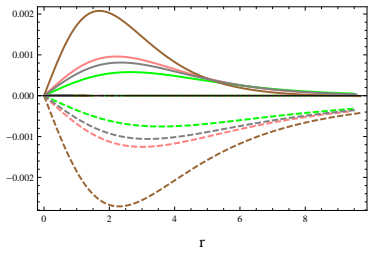
On the paper's own terms, the central discovery is that the chosen metric ansatz with the constants fixed by the junction conditions produces anisotropic compact-star solutions in $f(Q,T)$ gravity whose matter variables are regular and decreasing, satisfy the null, weak, strong, and dominant energy conditions, obey the equilibrium condition, and lie within the causality and adiabatic-index stability windows. The density and both pressures peak at the center and fall toward the boundary; tangential pressure exceeds radial pressure, so the anisotropy is positive and repulsive. The mass function rises monotonically, and the compactness and surface redshift stay below the standard bounds. The conclusion is stated as unconditional: the proposed compact stars in the $f(Q,T)$ framework are physically viable and stable.
Load-bearing premise
The entire analysis rests on the unshown algebra that turns the general $f(Q,T)$ field equations into the explicit density and pressure formulas; if those formulas are wrong, every graph and stability conclusion built on them fails.
Editorial extensions
If this is right
- Vela X-1, 4U 1608-52, PSR J1903+327, and PSR J1614-2230 can each be fitted by the same two-function ansatz with constants determined from their observed mass and radius.
- The matter in these fits is ordinary: all four energy conditions hold throughout the interior.
- The configurations are in hydrostatic equilibrium: the gravitational, hydrostatic, and anisotropic forces sum to zero at every radius.
- The models are causally stable and resist radial collapse: sound speeds lie in $[0,1]$, their difference obeys the cracking condition, and the adiabatic index stays above $4/3$.
- Compactness and surface redshift respect the standard bounds, so the stars are neither too compact nor produce unphysically large redshift.
Reading between the lines
- If the field equations are correct, the linear $f(Q,T)$ model with the chosen parameters becomes a tunable extension of general relativity; scanning $h$ and $k$ against a larger catalog of neutron stars could map which modifications are compatible with observation.
- The same ansatz could be inverted to extract an approximate equation of state $\rho(p_r)$ from each fitted star, something the paper does not do; a derived equation of state would connect the model to nuclear-matter predictions.
- Treating $k$ as a free parameter rather than fixing it ahead of the plots would test how strongly the viability conclusion depends on the matter coupling.
Signed reviews
Editorial analysis
A structured set of objections, weighed in public.
Referee Report
Summary. The manuscript constructs anisotropic compact star models in f(Q,T)=hQ+kT extended symmetric teleparallel gravity. Starting from the generic field equations (31)-(33), the authors adopt the linear model (34), the metric ansatz (38), fix the constants a,b,c by matching to the observed masses and radii of four compact stars (Table 1), and then examine energy conditions, EoS parameters, TOV equilibrium, causality, and adiabatic stability (Sections 3-4). The conclusion is that all four proposed stars are physically viable and stable. The paper also includes appendices deriving the non-metricity scalar Q and its variation.
Significance. If the explicit field equations (35)-(37) were correct, the paper would be a standard application of the f(Q,T) framework to neutron-star-like objects, one of many such ansatz-based studies. The use of four observational data sets and the explicit appendices for Q are useful. However, the central technical step—the reduction of the generic field equations to the explicit expressions—is algebraically inconsistent, and the EoS and adiabatic-index formulas are identical for the radial and tangential components despite the claimed anisotropy. As a result, the plots and the conclusion of viability and stability are not supported. The manuscript therefore does not meet the standard for publication in its present form.
major comments (4)
- [Section 2, Eqs. (35)-(37)] The explicit field equations cannot be obtained from the generic system (31)-(33) with f(Q,T)=hQ+kT. Substituting f_Q=h, f_T=k, f_QQ=0 into (31)-(33) gives a system that is linear in (rho,p_r,p_t), with the fluid-coupling matrix depending only on k; for the signs shown, the determinant is (1+k)^2, so the denominators of the solved expressions can contain only k (e.g., factors (1+k)^2), not h or h^2. The displayed denominator 2h^2+k-1 in (35) and 2k^2+k-1 in (36)-(37) is therefore algebraically impossible, and the manuscript gives no derivation of these equations. Because (35)-(37) are the basis for Figures 2-10 and all subsequent physical conclusions, the central claim is unsupported.
- [Section 3.3 and Section 4.2] The radial and tangential EoS parameters omega_r and omega_t are printed with identical expressions, and the adiabatic indices Gamma_r and Gamma_t in (46)-(47) are also identical. This is inconsistent with the anisotropic matter model (30) and with the reported finding p_t > p_r. Either the anisotropic reduction is incorrect, or the printed stability formulas are wrong; in either case the causality and adiabatic-index stability analysis (Figures 9-10) and the anisotropy-based TOV analysis (Figure 8) are not valid.
- [Section 3.5] The TOV equilibrium condition is not stated as an equation: the display reads 'MG(r)/r^2 (rho+pr)e^{(xi-eta)/2} + p'_r - 2Delta/r ,' with no '=0', and the text then refers to 'Equation (??)'. The missing equation and broken cross-reference prevent verification of the force-balance calculation. This is a load-bearing part of the equilibrium claim and must be corrected.
- [Section 2 (Table 1, Eq. (40)) and Section 5] The constants a,b,c are fixed by matching to the observed mass and radius of each star, and the subsequent checks are performed on the same fitted solution. Describing these checks as 'predictions' (abstract, Section 5) overstates their status; they are internal consistency tests of the ansatz. The conclusions should be rephrased accordingly.
minor comments (6)
- [Section 2] The line 'The variation of Eq.(45) yields' refers to an equation number that does not exist; the intended reference is likely Eq. (21).
- [Section 3.5] The TOV expression is missing a right-hand side ('=0') and the cross-reference 'Equation (??)' is broken.
- [Section 4.1] The sentence 'the difference between ust and ust' should read 'the difference |u_t^2 - u_r^2|' or similar.
- [Throughout] The notation f(Q,T) and f (Q, T) is used inconsistently; please standardize.
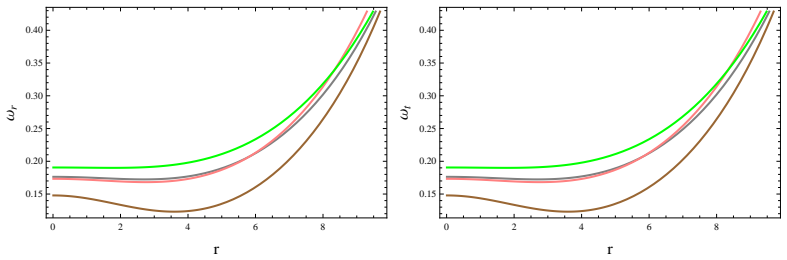
- [Figure 1] The colors mentioned in the text (gray, pink, green, brown) are not visible in a grayscale rendering; the caption should identify the curves explicitly.
- [References] The bibliographic details of entries [66] and [67] appear to overlap (both Eur. Phys. J. C 83 (2023) 1088); please verify these references.
Circularity Check
No significant circularity: the ansatz and matching produce a solution whose viability criteria are evaluated inequalities, not quantities forced by the inputs.
full rationale
The paper's workflow is an exact-solution consistency analysis common in modified-gravity astrophysics: choose f(Q,T)=hQ+kT and the Tolman-type metric ansatz (38), fix the constants (a,b,c) via Darmois matching to the observed mass and radius of four compact stars, then compute the fluid variables and test standard physical criteria. None of the paper's central viability claims reduces to a fitted input by construction. The energy conditions, causality bounds, Herrera cracking condition, and adiabatic-index inequality are genuine inequalities evaluated on the constructed solution; they can fail for arbitrary choices of the model parameters or metric ansatz, so their satisfaction is not a renaming of the input. The matching constants are indeed fixed by the observed M and R, and the resulting mass function and compactness at the boundary reflect those inputs, but the paper does not present these as independent predictions; they are consistency checks, and the interior behavior used in the plots is not determined by the boundary data alone. The TOV check in Section 3.5 is the closest point to inspect, since equilibrium equations can be identities for exact solutions of covariant field equations; however, the paper uses the standard TOV combination without deriving it from the f(Q,T) field equations, and whether that combination is automatic in this theory is a correctness question rather than a definitional circularity. The larger concern is algebraic rather than circular: Eqs. (35)-(37) are stated with no derivation from (31)-(34), and the denominators '2h^2+k-1' and '2k^2+k-1' appear inconsistent for f=hQ+kT, since f_QQ=0 leaves h linear and the 3x3 solve would give denominators depending on k only. That is a serious verification risk, but a suspected algebra error is not evidence that a result is equivalent to its inputs. The paper also cites prior work by the same authors extensively, but those citations are background and comparison material, not load-bearing justifications for the ansatz or the field equations; the model and metric are attributed to external references (Xu et al., Tolman, Jimenez et al.). Accordingly, no circular step can be exhibited with the required specificity, and the appropriate finding is no significant circularity.
Assumptions & free parameters
free parameters (2)
- h =
2
- k =
3
assumptions (3)
- domain assumption The interior of the star is a static, spherically symmetric, anisotropic perfect fluid with zero heat flux and the exterior is Schwarzschild (Eqs. (29), (39)).
- ad hoc to paper The matter Lagrangian is L_m = -(p_r + 2p_t)/3 (stated in Section 2 before Eq. (31)).
- ad hoc to paper The metric ansatz (38), e^xi = a(1+r^2/b) and e^eta = (2r^2/b+1)/((r^2/b+1)(1-r^2/c)), is a valid interior geometry.
Cite this review
Pith. "Pith review of Impact of Non-metricity and Matter Source on the Geometry of Anisotropic Spheres." pith.science (2026). https://pith.science/paper/7LM3DQEN
@misc{pith2026250421348,
  author       = {Pith},
  title        = {Pith review of: Impact of Non-metricity and Matter Source on the Geometry of Anisotropic Spheres},
  year         = {2026},
  howpublished = {\url{https://pith.science/paper/7LM3DQEN}},
  note         = {Machine review of arXiv:2504.21348}
}
abstract
This paper delves into the impact of extended symmetric teleparallel theory on anisotropic compact stellar structures. The explicit field equations were formulated by considering a minimum model of this extended gravity. Basically, the Darmois junction conditions are used to determine the unknown constants of metric coefficients. We explore some significant properties of the compact stars under consideration to check their viable existence in this modified framework. The Tolman-Oppenheimer-Volkoff equation assess the equilibrium state of the compact stars. Moreover, the stability analysis is defined by using methods based on sound speed (related to how disturbances propagate in the star) and adiabatic index (related to the thermodynamic behavior of the star). We find that the proposed compact stars in the $f(\mathbb{Q}, \mathbb{T})$ gravity are physically viable and stable.
Figures


Figures from the paper (7 more)





Reference graph
Works this paper leans on
-
[1]
Weyl, H.S.: Preuss. Akad. Wiss. 1(1918)465
1918
-
[2]
and Koivisto, L.T.: Phys
Jimenez, J.B., Heisenberg, I. and Koivisto, L.T.: Phys. Rev. D 98(2018)044048
2018
-
[3]
et al.: Phys
Lazkoz, R. et al.: Phys. Rev. D 100(2019)104027
2019
-
[4]
et al.: Eur
Xu, Y. et al.: Eur. Phys. J. C 79(2019)708
2019
-
[5]
et al.: Phys
Cognola, G. et al.: Phys. Rev. D 77(2008)046009
2008
-
[6]
and Tsujikawa S.R.: Living Rev
Felice, A.D. and Tsujikawa S.R.: Living Rev. Relativ. 13(2010)161
2010
-
[7]
and Iqbal, A.: Int
Jawad, A. and Iqbal, A.: Int. J. Mod. Phys. D 25(2016)1650074
2016
-
[8]
and Rani, S.: Eur
Jawad, A. and Rani, S.: Eur. Phys. J. C 76(2016)704
2016
Show all 111 references
-
[9]
et al.: Astrophys
Jawad, A. et al.: Astrophys. Space Sci. 362(2017)63
2017
-
[10]
Sharif, M., Gul, M.Z.: Eur. Phys. J. Plus 133(2018)345
2018
-
[11]
Sharif, M., Gul, M.Z.: Int. J. Mod. Phys. D 28(2019)1950054
2019
-
[12]
Sharif, M., Gul, M.Z.: Chin. J. Phys. 57(2019)329
2019
-
[13]
and Sharif, M.: Universe 96(2021)154
Gul, M.Z. and Sharif, M.: Universe 96(2021)154
2021
-
[14]
et al.: Phys
Jawad, A. et al.: Phys. Dark Universe 46(2024)101631
2024
-
[15]
and Sharif, M.: Chin
Gul, M.Z. and Sharif, M.: Chin. J. Phys. 88(2024)388. 25
2024
-
[16]
et al.: Chin
Sharif, M. et al.: Chin. J. Phys. 91(2024)66
2024
-
[17]
et al.: Eur
Sharif, M. et al.: Eur. Phys. J. C 84(2024)1065
2024
-
[18]
and Sharif, M.: Phys
Gul, M.Z. and Sharif, M.: Phys. Scr. 99(2024)055036
2024
-
[19]
and Afzal, A.: Chin
Gul, M.Z., Sharif, M. and Afzal, A.: Chin. J. Phys. 89(2024)1347
2024
-
[20]
Dark Universe 46(2024)101606
Sharif, M., et al.: Phys. Dark Universe 46(2024)101606
2024
-
[21]
Sharif, M., Gul, M.Z.: Ann. Phys. 465(2024)169674
2024
-
[22]
Sharif, M., et al.: Eur. Phys. J. C 84(2024)1094
2024
-
[23]
and Hashim, I.: Phys
Gul, M.Z., Sharif, M. and Hashim, I.: Phys. Dark Universe 45(2024)101537
2024
-
[24]
and Kanwal, I.: New Astron
Gul, M.Z., Sharif, M. and Kanwal, I.: New Astron. 109(2024)102204
2024
-
[25]
et al.: Chin
Jawad, A. et al.: Chin. J. Phys. 90(2024)275
2024
-
[26]
and Sahoo, P.K.: Phys
Tayde, M., Hassan, Z. and Sahoo, P.K.: Phys. Dark Universe 42(2023)101288
2023
-
[27]
and Sahoo, P.K.: Eur
Tayde, M., Santos, J.R., Araujo, J.N. and Sahoo, P.K.: Eur. Phys . J. Plus 138(2023)539
2023
-
[28]
and Sahoo, P.K.: Chin
Pradhan, S., Mohanty, D. and Sahoo, P.K.: Chin. Phys. C 47(2023)095104
2023
-
[29]
et al.: Phys
Bourakadi, K. et al.: Phys. Dark Universe 41(2023)101246
2023
-
[30]
and De, A.: Ann
Loo, T.H., Koussour, M. and De, A.: Ann. Phys. 454(2023)169333
2023
-
[31]
and Mishra, B.: Nucl
Narawade, S.A., Koussour, M. and Mishra, B.: Nucl. Phys. B 992(2023)116233
2023
-
[32]
and Sahoo, P.K.: Chin
Tayde, M., Hassan, Z. and Sahoo, P.K.: Chin. J. Phys. 89(2024)195
2024
-
[33]
et al.: Phys
Khurana, M. et al.: Phys. Dark Universe 43(2024)101408
2024
-
[34]
and Sofuoglu, D.: Mod
Shukla, B.K., Tiwari, R.K., Beesham, A. and Sofuoglu, D.: Mod. Phys . Lett. A 39(2024)2450005. 26
2024
-
[35]
Xu, Y., Harko, T., Shahidi, S., and Liang, S.D.: Eur. Phys. J. C 80(2020)449
2020
-
[36]
and Sahoo, P.K.: Phys
Arora, S. and Sahoo, P.K.: Phys. Scr. 95(2020)095003
2020
-
[37]
and Sahoo, P.K.: Eur
Bhattacharjee, S. and Sahoo, P.K.: Eur. Phys. J. C 80(2020)289
2020
-
[38]
et al.: Phys
Arora, S. et al.: Phys. Dark Universe 30(2020)100664
2020
-
[39]
Dark Universe 33(2021)100863
Agrawal, A.S., Pati, L., Tripathy, S.K., and Mishra, B.: Phys. Dark Universe 33(2021)100863
2021
-
[40]
and Samanta, G.C.: Int
Godani, N. and Samanta, G.C.: Int. J. Geom. Methods Mod. Phys . 18(2021)2150134
2021
-
[41]
and Fajardo, A.: Phys
Najera, A. and Fajardo, A.: Phys. Dark Universe 34(2021)100889
2021
-
[42]
and Sahoo, P.K.: Phys
Arora, S., Santos, J.R.L. and Sahoo, P.K.: Phys. Dark Universe 31(2021)100790
2021
-
[43]
et al.: Eur
Gul, M.Z. et al.: Eur. Phys. J. C 84(2024)775
2024
-
[44]
and Shabbir, S.: Eur
Gul, M.Z., Sharif, M. and Shabbir, S.: Eur. Phys. J. C 84(2024)802
2024
-
[45]
and Arooj, A.: Fortschr
Gul, M.Z., Sharif, M. and Arooj, A.: Fortschr. Phys. 72(2024)2300221
2024
-
[46]
et al.: Phys
Nan, G. et al.: Phys. Dark Universe 46(2024)101635
2024
-
[47]
and Arooj, A.: Phys
Gul, M.Z., Sharif, M. and Arooj, A.: Phys. Scr. 99(2024)045006
2024
-
[48]
and Arooj, A.: Gen
Gul, M.Z., Sharif, M. and Arooj, A.: Gen. Relativ. Gravit. 56(2024)45
2024
-
[49]
and Javed, F.: Phys
Gul, M.Z., Sharif, M., Shahid, S. and Javed, F.: Phys. Scr. 99(2024)125004
2024
-
[50]
and Arooj, A.: Chin
Gul, M.Z., Sharif, M. and Arooj, A.: Chin. Phys. C. 48(2024)12503
2024
-
[51]
and Zwicky, F.: Phys
Baade, W. and Zwicky, F.: Phys. Rev. 46(1934)76
1934
-
[52]
and Liang, E.P.T.: Astrophys
Bowers, R.L. and Liang, E.P.T.: Astrophys. J. 188(1974)657
1974
-
[53]
and Santos, N.O.: Phys
Herrera, L. and Santos, N.O.: Phys. Rep. 286(1997)53
1997
-
[54]
and Gleiser, M.: Gen
Dev, K. and Gleiser, M.: Gen. Relativ. Gravit. 39(2002)1793. 27
2002
-
[55]
and Harko, T.: Int
Mak, M.K. and Harko, T.: Int. J. Mod. Phys. D 13(2004)156
2004
-
[56]
et al.: Eur
Kalam, M. et al.: Eur. Phys. J. C 72(2012)2248
2012
-
[57]
et al.: Gen
Rahaman, F. et al.: Gen. Relativ. Gravit. 44(2012)107
2012
-
[58]
et al.: Phys
Mustafa, G. et al.: Phys. Dark Universe 30(2020) 100652
2020
-
[59]
et al.: Phys
Mustafa, G. et al.: Phys. Rev. D 101(2020)104013
2020
-
[60]
et al.: Eur
Mustafa, G. et al.: Eur. Phys. J. C 80(2020)26
2020
-
[61]
et al.: Phys
Mustafa, G. et al.: Phys. Scr. 96(2021)105008
2021
-
[62]
et al.: Phys
Mustafa, G. et al.: Phys. Scr. 96(2021)045009
2021
-
[63]
et al.: Chin
Mustafa, G. et al.: Chin. J. Phys. 77(2022)1742
2022
-
[64]
et al.: Nucl
Javed, F. et al.: Nucl. Phys. B 990(2023)116180
2023
-
[65]
et al.: Fortschr
Javed, F. et al.: Fortschr. Phys. 2023(2023)2200214
2023
-
[66]
et al.: Eur
Javed, F. et al.: Eur. Phys. J. C 83(2023)1088
2023
-
[67]
et al.: Eur
Waseem, A. et al.: Eur. Phys. J. C 83(2023)1088
2023
-
[68]
Jeans, J.H.: Mon. Not. R. Astron. Sot. 82(1922)122
1922
-
[69]
and Liang, E.: Astrophys
Bowers, R. and Liang, E.: Astrophys. J. 188(1974)657
1974
-
[70]
and Ponce de Leon, J.: J
Herrera, L. and Ponce de Leon, J.: J. Math. Phys. 26(1985)2847
1985
-
[71]
and Bhamra, K.: Int
Singh, K. and Bhamra, K.: Int. J. Theor. Phys. 29(1990)1015
1990
-
[72]
and Mehra, A.: Gen
Gokhroo, M. and Mehra, A.: Gen. Rel. Grav. 26(1994)75
1994
-
[73]
and Santos, N.O.: Phys
Herrera, L. and Santos, N.O.: Phys. Report 286(1997)53
1997
-
[74]
Herrera, L.: Phys. Rev. D 101(2020)104024
2020
-
[75]
and Capozziello, S.: Eur
Nashed, G.G. and Capozziello, S.: Eur. Phys. J. C 81(2021)481
2021
-
[76]
and Prasad, A.K.: Phys
Kumar, J., Singh, H.D. and Prasad, A.K.: Phys. Dark Universe 34(2021)100880. 28
2021
-
[77]
and Nag, R.: Chin
Maurya, S.K., Singh, K.N. and Nag, R.: Chin. J. Phys. 74(2021)313
2021
-
[78]
and Zhai, X.H.: Phys
Lin, R.H. and Zhai, X.H.: Phys. Rev. D 103(2021)124001
2021
-
[79]
and Rashid, A.: Int
Shamir, M.F. and Rashid, A.: Int. J. Geom. Methods Mod. Phys. 20(2023)2350026
2023
-
[80]
and Gul, M.Z.: Pramana-J
Sharif, M. and Gul, M.Z.: Pramana-J. Phys. 97(2023)122
2023
-
[81]
and Gul, M.Z.: Gen
Sharif, M. and Gul, M.Z.: Gen. Relative. Gravit. 55(2023)10
2023
-
[82]
and Gul, M.Z.: Phys
Sharif, M. and Gul, M.Z.: Phys. Scr. 98(2023)035030
2023
-
[83]
et al.: Mod
Adeel, M. et al.: Mod. Phys. Lett. A 38(2023)2350152
2023
-
[84]
et al.: Eur
Gul, M.Z. et al.: Eur. Phys. J. C 84(2024)8
2024
-
[85]
et al.: Int
Rani, S. et al.: Int. J. Geom. Methods Mod. Phys. 21(2024)2450033
2024
-
[86]
and Bhar, P.: New Astron
Rej, P. and Bhar, P.: New Astron. 105(2024)102113
2024
-
[87]
and Khurana, M.: Phys
Das, K.P., Debnath, U., Ashraf, A. and Khurana, M.: Phys. Dark Uni- verse 43(2024)101398
2024
-
[88]
and Shamir, M.F.: Eur
Malik, A., Arif, A. and Shamir, M.F.: Eur. Phys. J. Plus 139(2024)67
2024
-
[89]
Dirac, P.A.M.: Proc. R. Soc. Lond. A 333(1973)403
1973
-
[90]
and Perez Bergliaffa, S.E.: Phys
Novello, M. and Perez Bergliaffa, S.E.: Phys. Rep. 463(2008)127
2008
-
[91]
et al.: Rev
Hehl, F.W. et al.: Rev. Mod. Phys. 48(1976)393
1976
-
[92]
and Lifshitz, E.M.: The Classical Theory of Fields (Perg- amon Press, Oxford, 1970)
Landau, L.D. and Lifshitz, E.M.: The Classical Theory of Fields (Perg- amon Press, Oxford, 1970)
1970
-
[93]
and Sahoo, P.K.: Phys
Moraes, P.H.R.S. and Sahoo, P.K.: Phys. Rev. D 97(2018)024007; Ra- haman, M. et al.: Eur. Phys. J. C 80(2020)272
2018
-
[94]
and Koivisto, T.: J
Jimenez, J.B., Heisenberg, L. and Koivisto, T.: J. Cosmol. Astrop art. Phys. 08(2018)039
2018
-
[95]
Tolman, R.C.: Phys. Rev. D 55(1939)364
1939
-
[96]
et al.: Astrophys
Rawls, M.L. et al.: Astrophys. J. 730(2011)25. 29
2011
-
[97]
et al.: Astrophys
Guver, T. et al.: Astrophys. J. 719(2010)1807
2010
-
[98]
et al.: Mon
Freire, P.C.C. et al.: Mon. Not. R. Astron. Soc. 412(2011)2763
2011
-
[99]
Demorest, P.B.: Nature 467(2010)1081
2010
-
[100]
Buchdahl, A.H.: Phys. Rev. D 116(1959)1027
1959
-
[101]
Ivanov, B.V.: Phys. Rev. D 65(2002)104011
2002
-
[102]
Tolman, R.C.: Phys. Rev. 55(1939)364; Oppenheimer, J.R. and Volkoff, G.M.: Phys. Rev. 55(1939)374
1939
-
[103]
et al.: Class
Abreu, H. et al.: Class. Quantum Grav. 24(2007)4631
2007
-
[104]
Herrera, L.: Phys. Lett. A 165(1992)206
1992
-
[105]
and Mehra, A.L.: Gen
Gokhroo, M.K. and Mehra, A.L.: Gen. Relativ. Gravit. 26(1994)75
1994
-
[106]
et al.: Ann
Deb, D. et al.: Ann. Phys. 387(2017)239
2017
-
[107]
et al.: Eur
Singh, K.N. et al.: Eur. Phys. J. A 53(2017)21
2017
-
[108]
and Waseem, A.: Can
Sharif, M. and Waseem, A.: Can. J. Phys. 94(2016)1024
2016
-
[109]
et al.: Eur
Yousaf, Z. et al.: Eur. Phys. J. C 77(2017)691
2017
-
[110]
et al.: Int
Bhatti, M.Z.U.H. et al.: Int. J. Mod. Phys. D 27(2018)1850044
2018
-
[111]
and Gul, M.Z.: Fortschr
Sharif, M. and Gul, M.Z.: Fortschr. Phys. 71(2023)2200184. 30
2023
Reviewed August 16, 2026 · model on record in the stance chip above.
Discussion (0). Continue with ORCID to comment.