Reimagining SED Fitting with Cosmological Galaxy Simulations and Machine Learning
Pith reviewed 2026-06-26 20:10 UTC · model grok-4.3
The pith
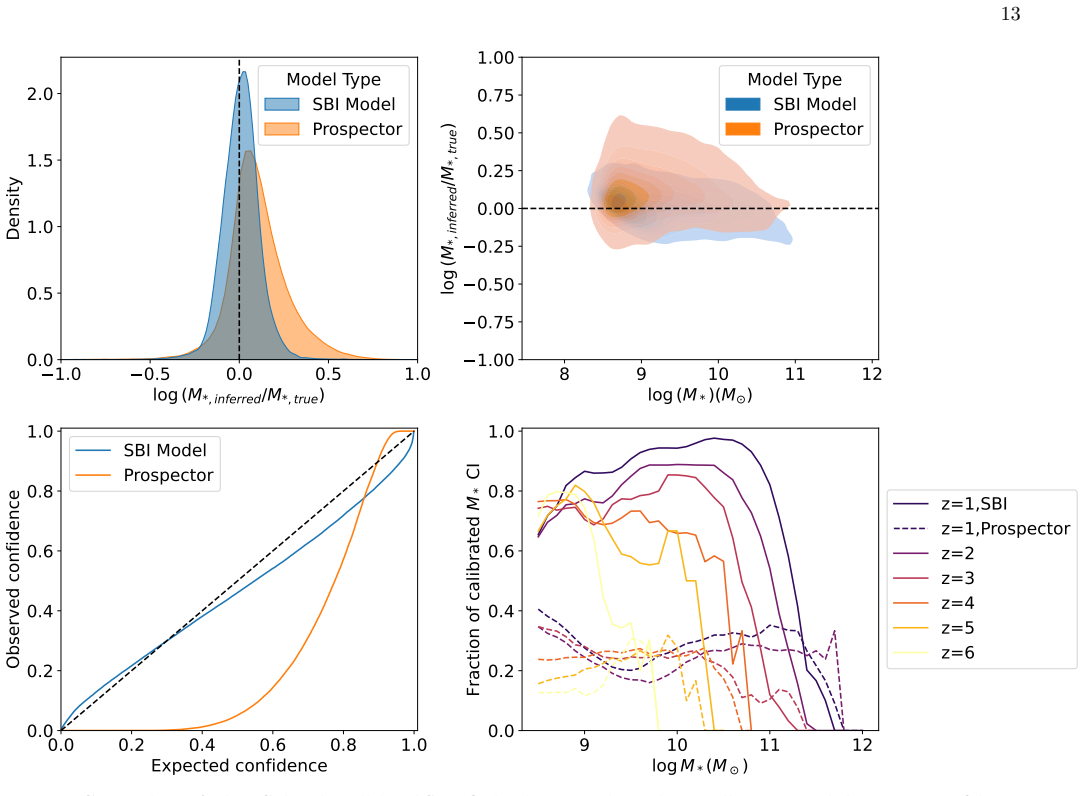
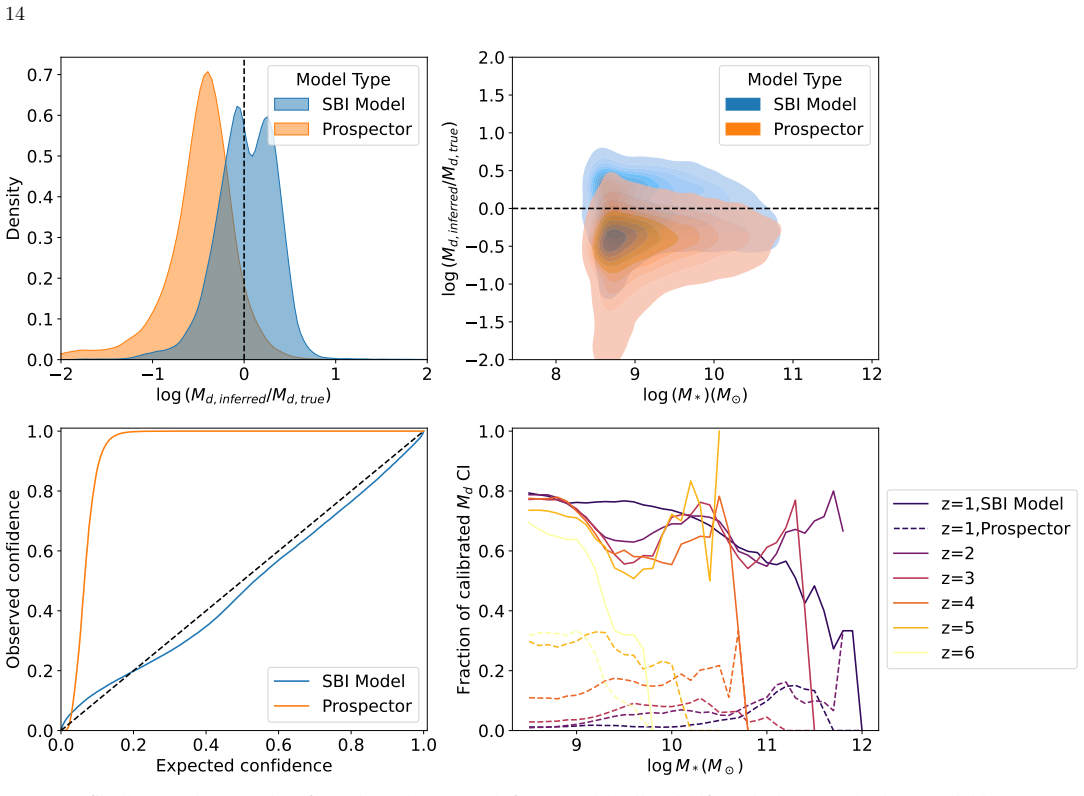
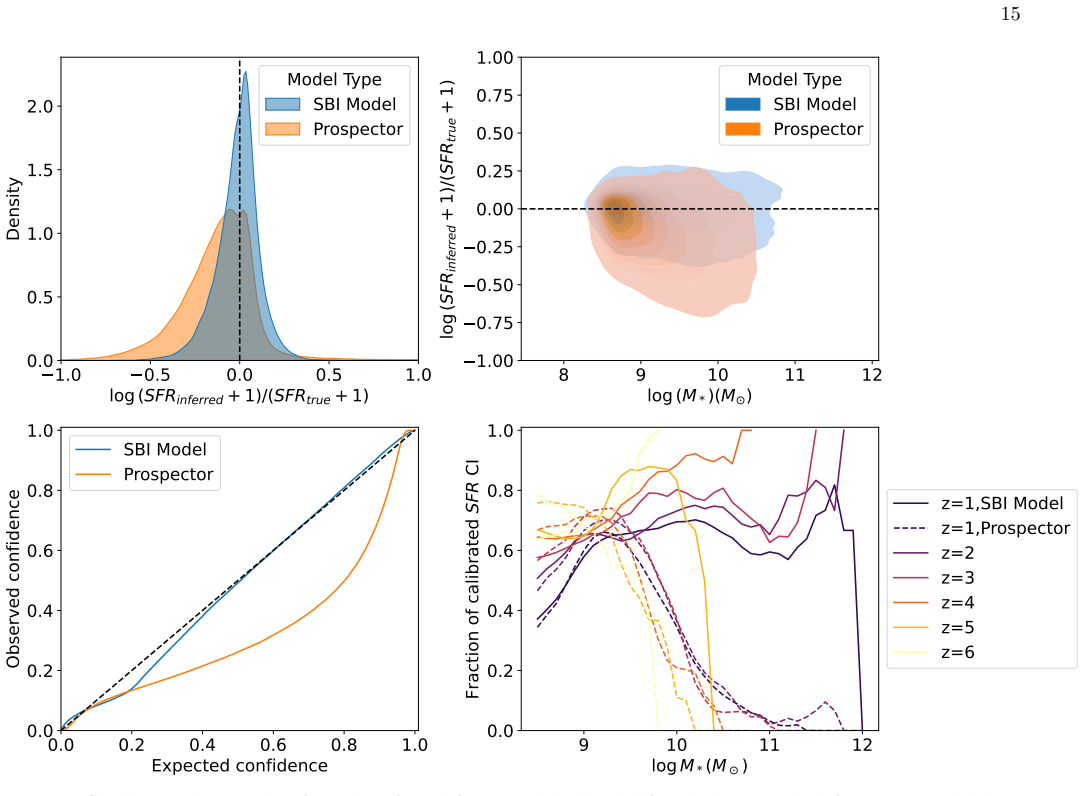
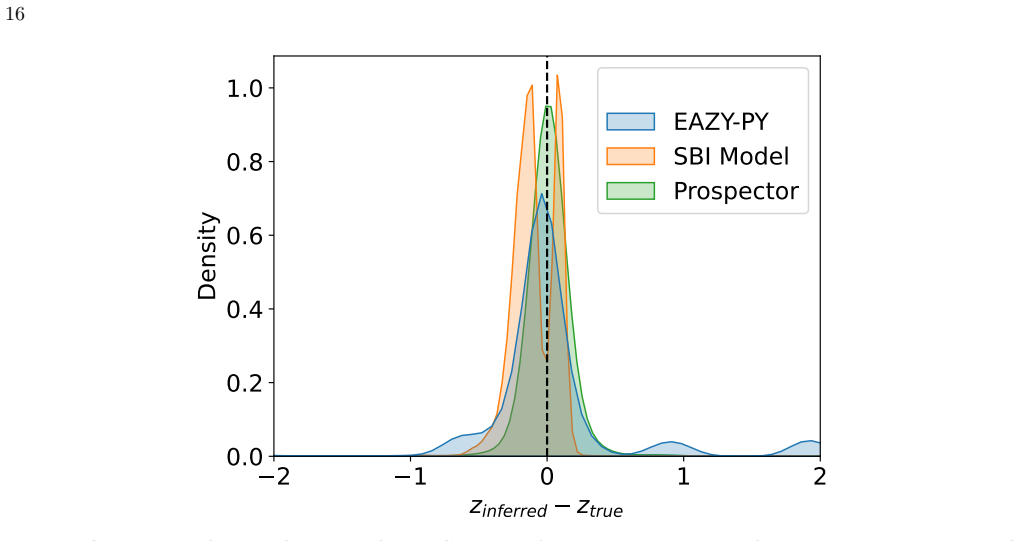
Phot-Gal uses machine learning trained on simulated galaxy photometry to recover redshift, stellar mass, dust mass, and star formation rate more accurately than prospector on held-out test data.
A machine-rendered reading of the paper's core claim, the machinery that carries it, and where it could break.
Core claim
Phot-Gal solves the inverse SED fitting problem by training a machine learning model on photometry generated from 3D radiative transfer of simulated galaxies. The model accepts arbitrary input photometry via K-nearest neighbors imputation and predicts redshift, stellar mass, dust mass, and star formation rate together with uncertainties. When evaluated on a testing set drawn from the same simulation suite, Phot-Gal recovers the properties more accurately than prospector, though its uncertainty estimates are more likely to be miscalibrated when fewer photometric constraints are supplied. The workflow components are dissected to reveal physical motivations for the most influential inputs and t
What carries the argument
Phot-Gal, a machine learning model trained on radiative-transfer photometry from cosmological galaxy simulations that employs K-nearest neighbors imputation to process arbitrary numbers of input bands.
If this is right
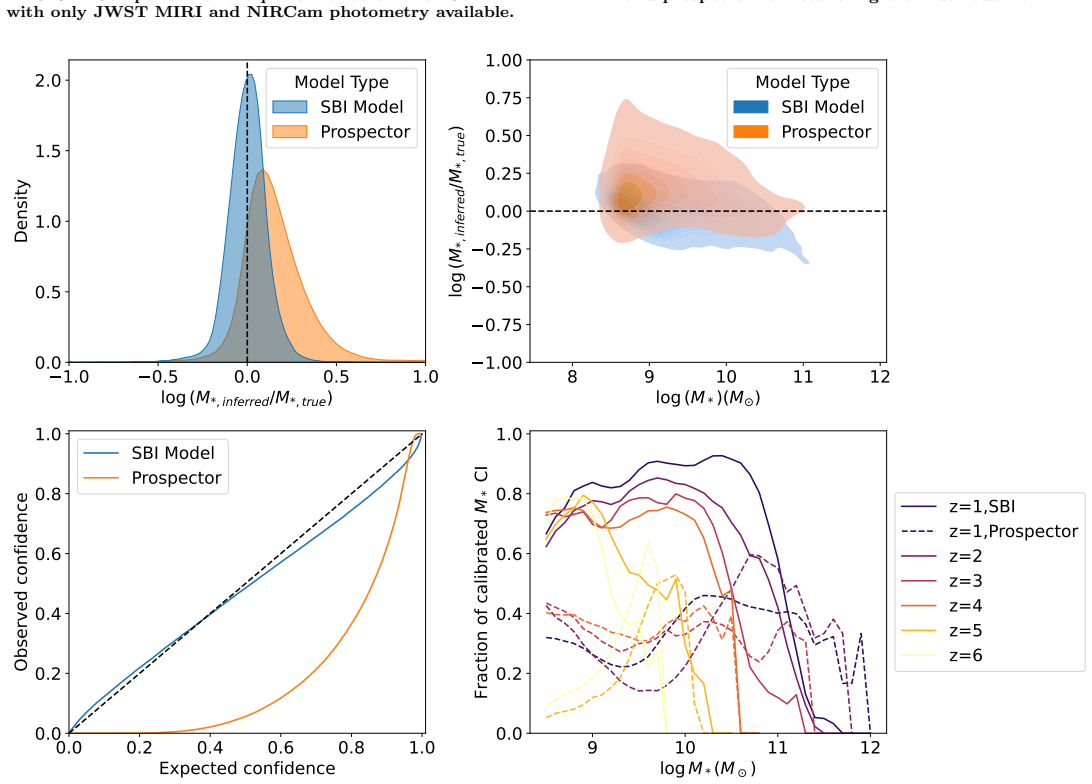
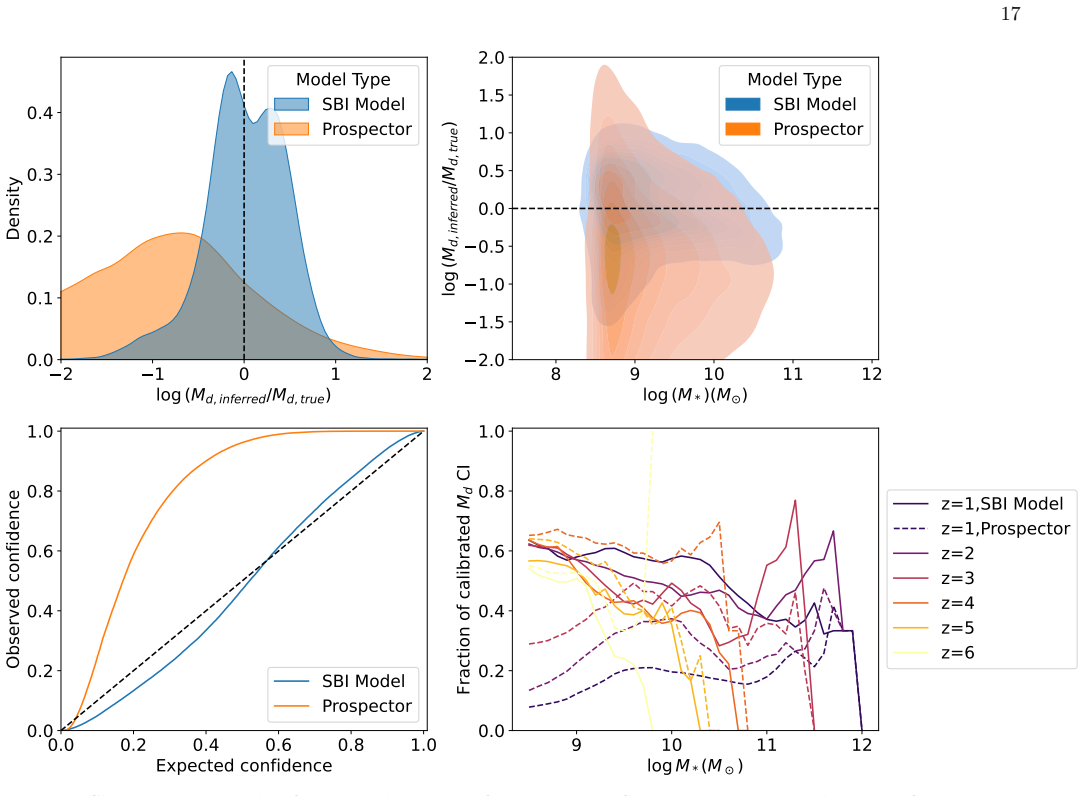
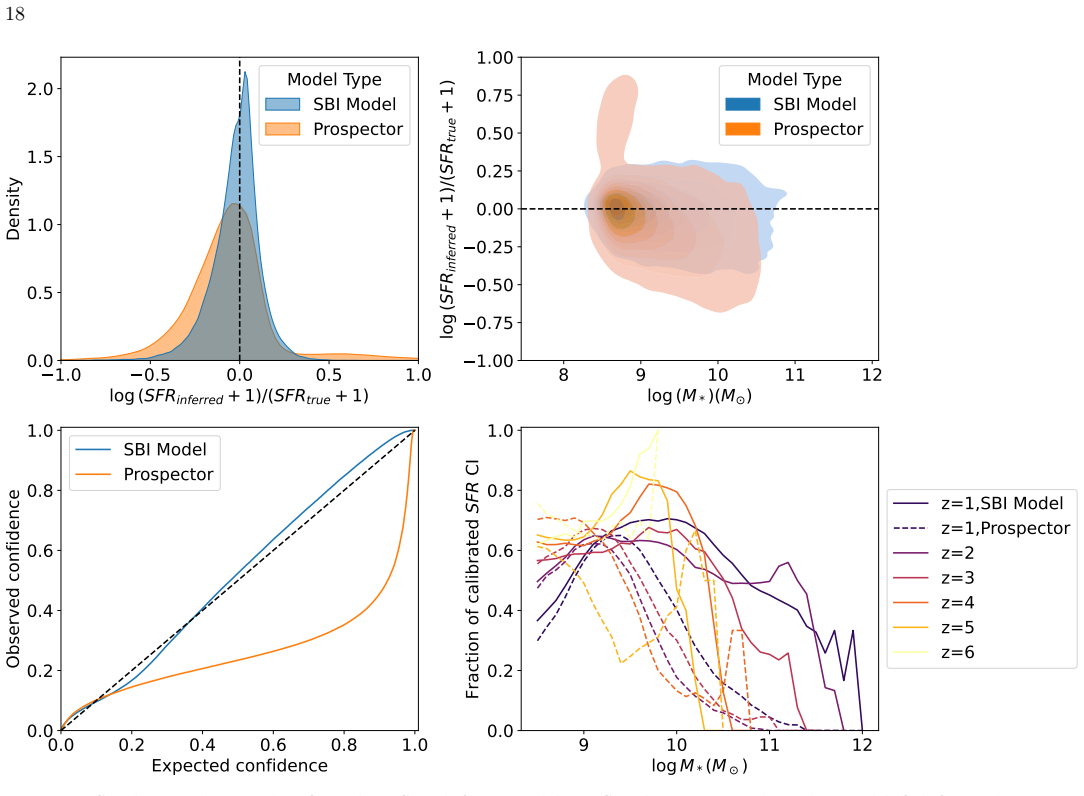
- Phot-Gal recovers redshift, stellar mass, dust mass, and star formation rate with higher accuracy than prospector on the simulation test set.
- Uncertainty estimates from Phot-Gal are more likely to fail to reflect true offsets when fewer photometric bands are supplied.
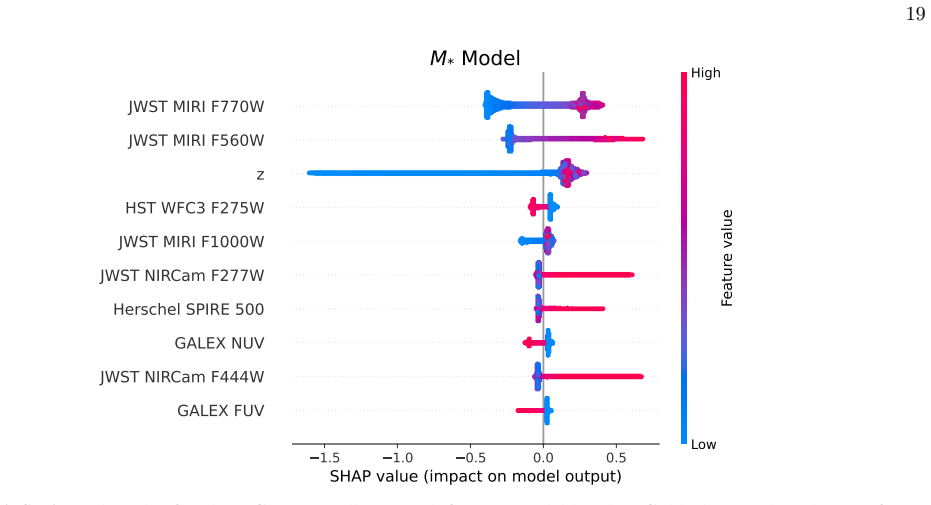
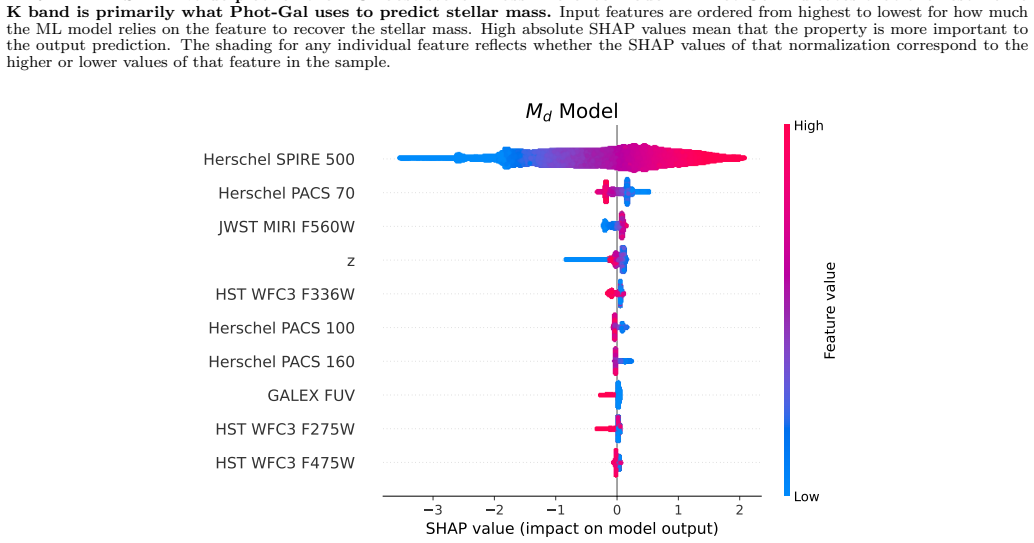
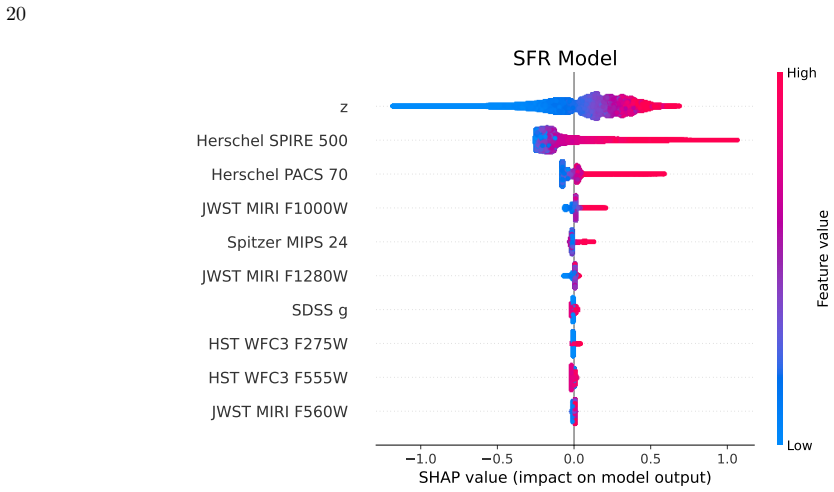
- Dissection of the model identifies physically justified photometric inputs that carry the most predictive weight.
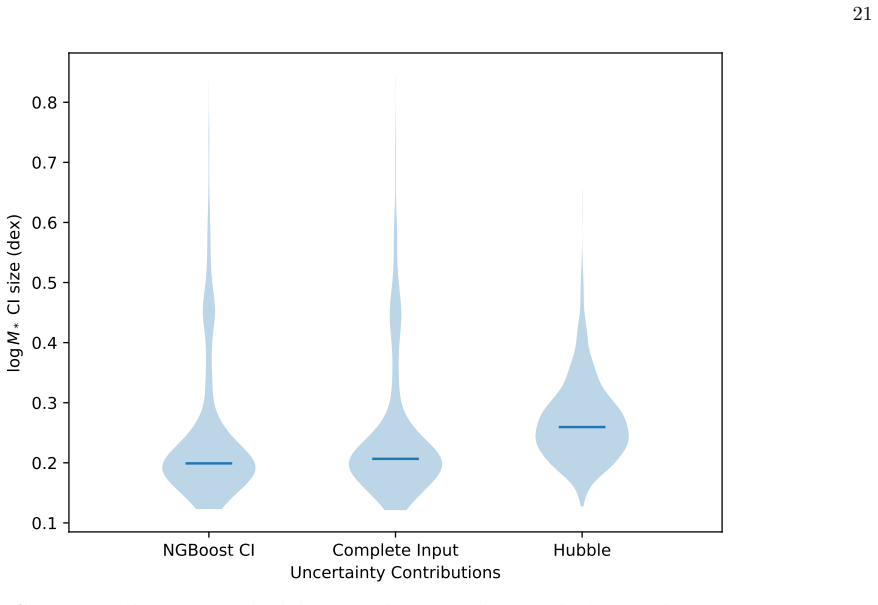
- Each step in the Phot-Gal workflow can be traced to its contribution to the output posterior.
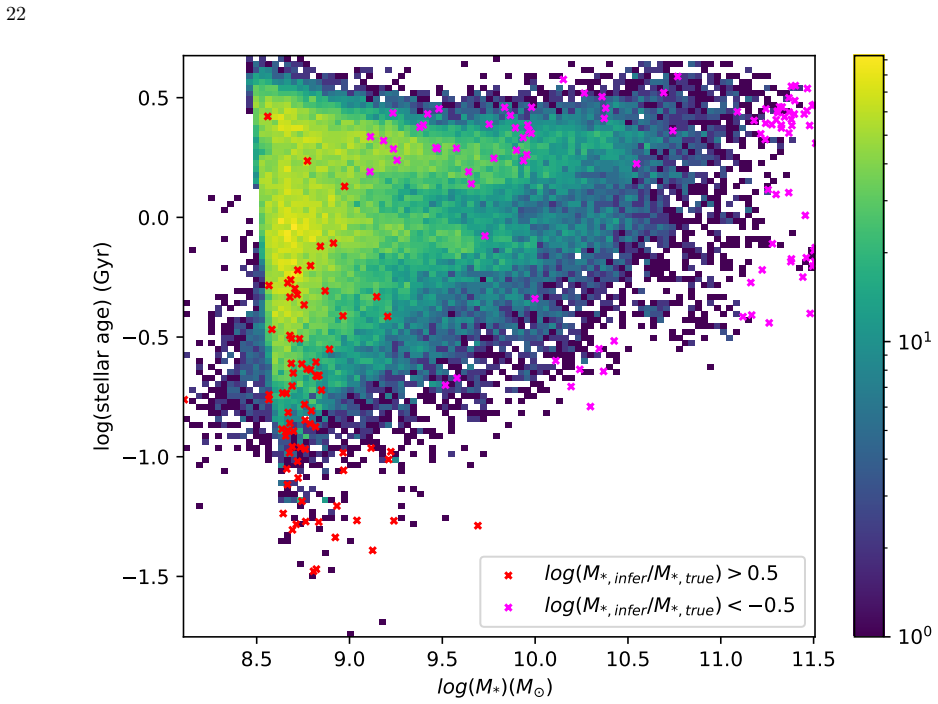
- The model demonstrates measurable generalization when applied to data drawn from outside the original training distribution.
Where Pith is reading between the lines
- If the implemented simulation physics capture the dominant processes in real galaxies, Phot-Gal could be retrained on larger simulation volumes to serve upcoming wide-field surveys.
- The imputation strategy suggests the same architecture could ingest heterogeneous multi-survey photometry without requiring uniform band coverage.
- The observed degradation in uncertainty calibration with sparse inputs points to a natural next step of adding explicit uncertainty-aware loss terms during training.
Load-bearing premise
Performance measured on held-out galaxies from the same simulation suite reliably indicates how well the model will work on real observed galaxies.
What would settle it
A side-by-side comparison of Phot-Gal and prospector outputs against independent property measurements (for example, spectroscopic stellar masses or dust masses) on a sample of real galaxies with known redshifts.
Figures
read the original abstract
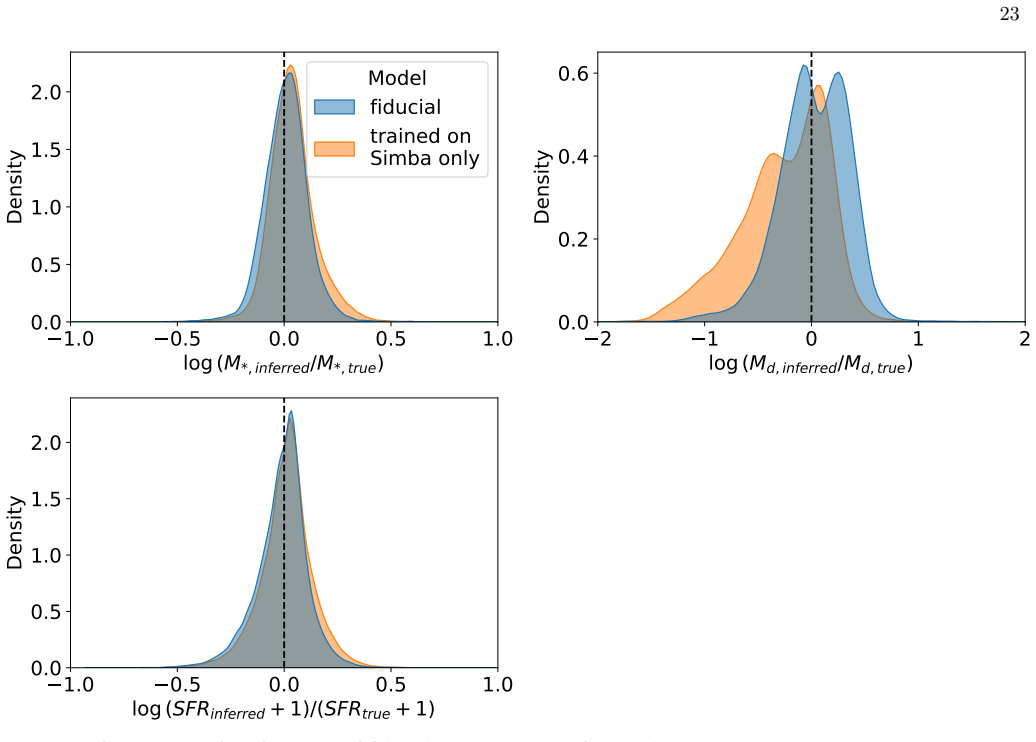
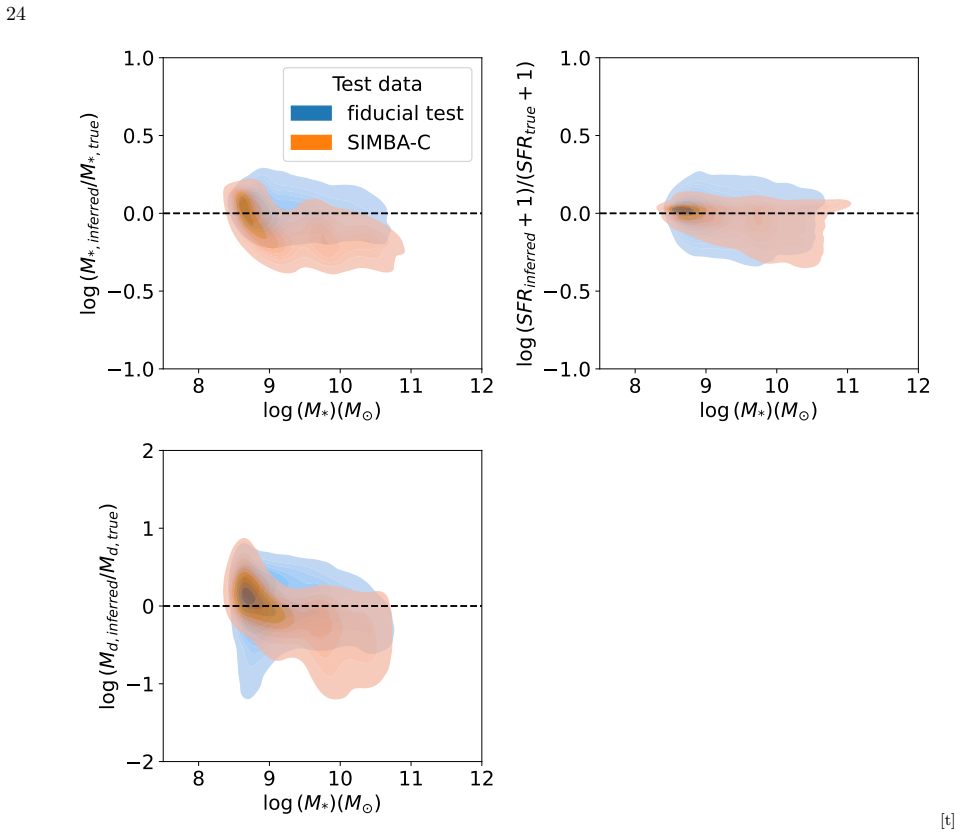
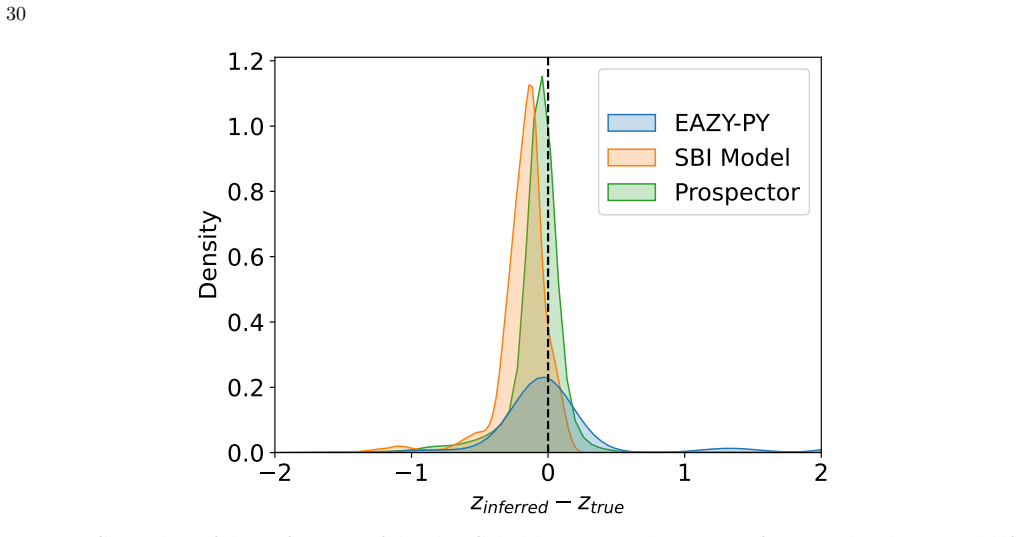
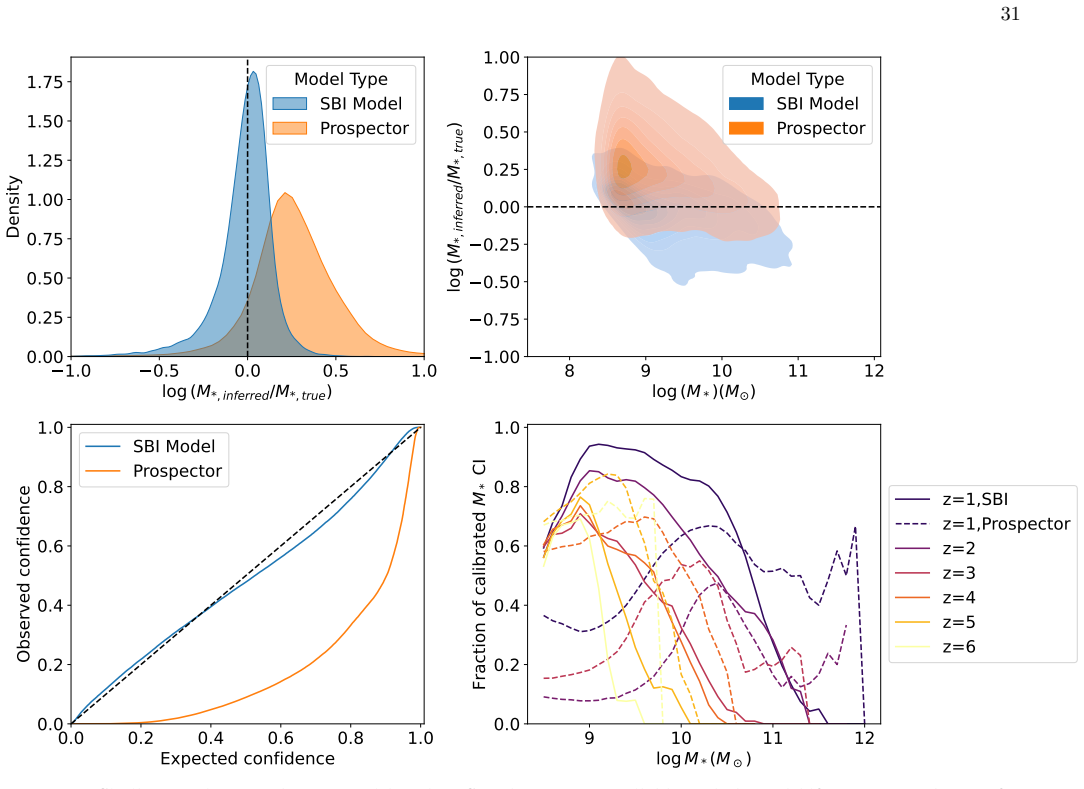
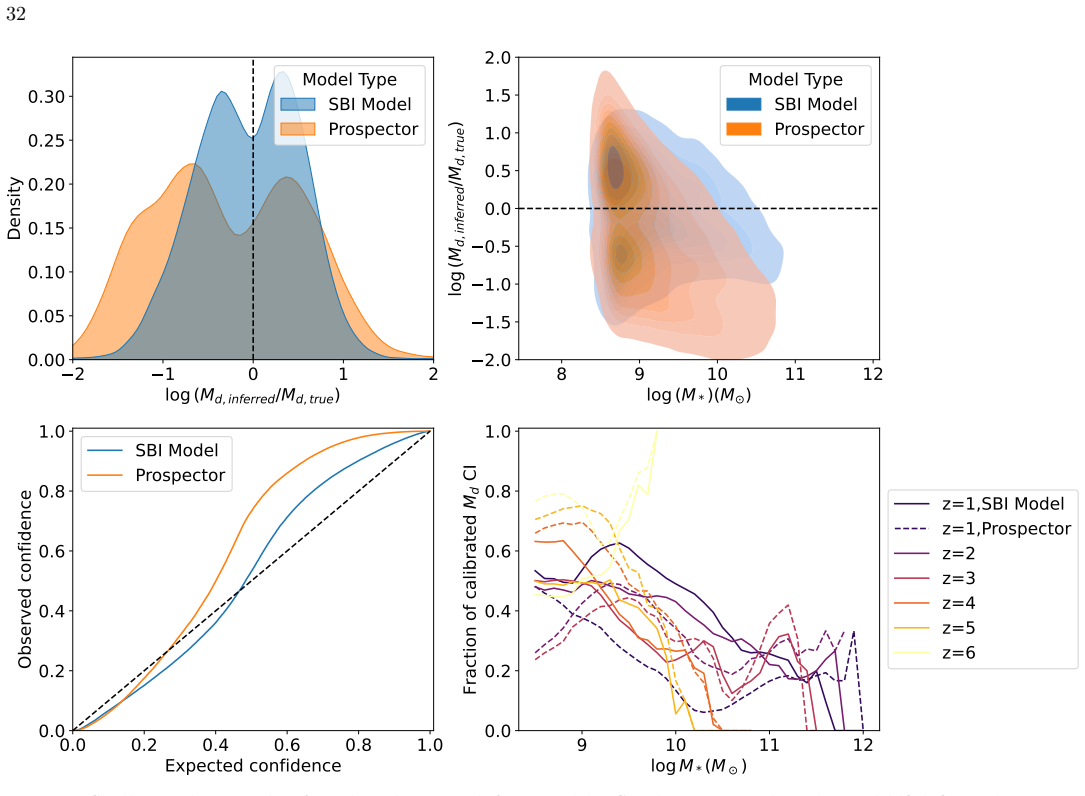
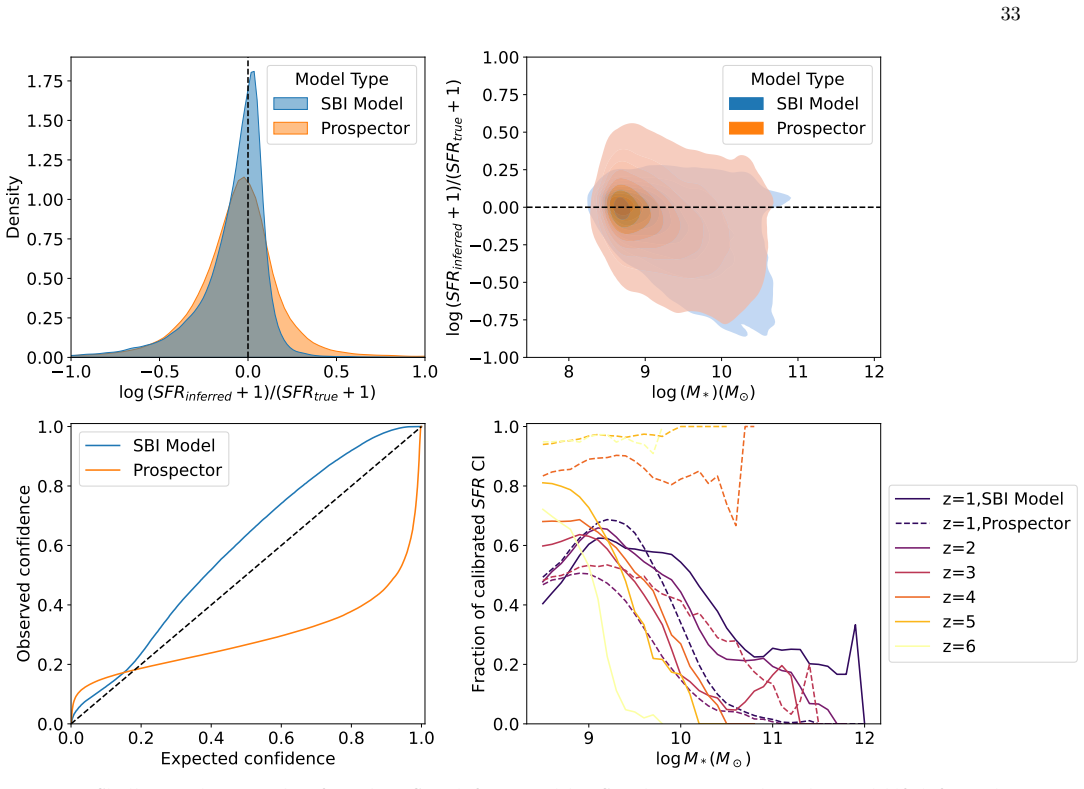
SED fitting is the most common technique to recover galaxy physical properties from observed photometry. However, SED fitting requires many assumptions that essentially collapse a galaxy from a three-dimensional spatially varying object with complex structure into a scalar point. Moreover, modern inference techniques are computationally intensive, which presents a unique challenge in the era of extremely large datasets. We present \textsc{Phot-Gal}, a new galaxy SED modeling tool that solves the inverse problem of SED fitting by training a machine learning model on photometry generated from 3D radiative transfer of simulated galaxies with a wide range of implemented physics. \textsc{Phot-Gal} is designed to accept an arbitrary amount of input photometry by utilizing a $K$-nearest neighbors imputation strategy. Our fiducial model predicts redshift, stellar mass, dust mass, and star formation rate with uncertainties based on the provided input photometry. We evaluate the performance of \textsc{Phot-Gal} relative to the commonly-used SED fitting tool \textsc{prospector} in successfully recovering each of these properties with several metrics for the inferred values and uncertainties and find that it outperforms the accuracy of standard SED fitting software on the testing set. However, with fewer photometric constraints, \textsc{Phot-Gal} is more likely to have output uncertainties that do not reflect the offset from the ground truth. We dissect the components of \textsc{Phot-Gal} to find reasonable physical justifications for the photometry it relies on most, understand how each step in its workflow contributes to the eventual output posterior, and evaluate its ability to generalize to novel data.
Editorial analysis
A structured set of objections, weighed in public.
Referee Report
Summary. The paper introduces Phot-Gal, an ML-based SED fitting tool trained on photometry generated via 3D radiative transfer from cosmological galaxy simulations. It uses K-nearest neighbors imputation to handle arbitrary photometric inputs and predicts redshift, stellar mass, dust mass, and SFR with associated uncertainties. The central claim is that Phot-Gal outperforms the standard tool prospector in accuracy on a held-out test set drawn from the same simulation suite, while also examining component contributions, physical justifications, and generalization to novel data; the abstract notes that output uncertainties frequently fail to reflect true offsets under sparse photometric constraints.
Significance. If validated beyond simulations, the approach could enable faster inference on large photometric catalogs by directly learning from simulated physics rather than parametric assumptions. The work ships a reproducible ML pipeline and dissects feature importance, but the simulation-only test set means any accuracy gain is currently demonstrated only as fidelity to the training distribution rather than transfer to observations.
major comments (2)
- [Abstract] Abstract and testing-set evaluation: the claim that Phot-Gal 'outperforms the accuracy of standard SED fitting software' is supported only on held-out data from the identical cosmological simulation suite used for training; because both the ground-truth labels and the photometry-to-property mapping derive from the same implemented physics and radiative transfer, the reported metrics reduce to how well the model reproduces the simulation distribution rather than an external benchmark.
- [Abstract] Abstract: the paper states that generalization to novel data was examined, yet supplies no quantitative metrics (e.g., bias, scatter, or uncertainty calibration) on actual observed galaxies; this leaves the transferability of the reported accuracy advantage and uncertainty calibration untested, which is load-bearing for any claim of practical superiority over prospector for real SED fitting.
minor comments (2)
- The description of the K-nearest neighbors imputation strategy lacks detail on the choice of K and distance metric; these free parameters should be stated explicitly with sensitivity tests.
- Figure captions and axis labels should clarify whether error bars represent the model's reported uncertainties or the offset from ground truth.
Simulated Author's Rebuttal
We thank the referee for their constructive comments. We address each major point below, with revisions where appropriate to improve clarity without altering the manuscript's core scope.
read point-by-point responses
-
Referee: [Abstract] Abstract and testing-set evaluation: the claim that Phot-Gal 'outperforms the accuracy of standard SED fitting software' is supported only on held-out data from the identical cosmological simulation suite used for training; because both the ground-truth labels and the photometry-to-property mapping derive from the same implemented physics and radiative transfer, the reported metrics reduce to how well the model reproduces the simulation distribution rather than an external benchmark.
Authors: We agree the evaluation uses held-out data from the training simulation suite, so metrics reflect fidelity to that distribution's physics and radiative transfer. This is explicitly a controlled test with known ground truth, allowing direct comparison to prospector on identical inputs. The abstract already qualifies the result as 'on the testing set.' We will revise the abstract and discussion to emphasize that outperformance is demonstrated within the simulation framework rather than claiming broader external validity. revision: yes
-
Referee: [Abstract] Abstract: the paper states that generalization to novel data was examined, yet supplies no quantitative metrics (e.g., bias, scatter, or uncertainty calibration) on actual observed galaxies; this leaves the transferability of the reported accuracy advantage and uncertainty calibration untested, which is load-bearing for any claim of practical superiority over prospector for real SED fitting.
Authors: The 'novel data' tests in the manuscript refer to held-out simulation galaxies with varied photometric coverage or subpopulations, not real observations. We acknowledge that no quantitative metrics (bias, scatter, calibration) are supplied for actual observed galaxies. This is a genuine limitation of the current work, which prioritizes validation where ground truth is known. We will add explicit clarification in the abstract and conclusions that transfer to observations remains unquantified and is left for future work. revision: yes
- Provision of quantitative metrics on real observed galaxies, which would require new analysis outside the simulation-based scope of the present manuscript.
Circularity Check
No circularity: standard ML training and held-out simulation testing
full rationale
The paper trains Phot-Gal on photometry from cosmological simulations and evaluates recovery of redshift, stellar mass, dust mass, and SFR on a held-out test set drawn from the same simulation suite, comparing metrics against prospector. This is a conventional supervised learning workflow with no self-definitional reduction, no parameter fitted to a subset then renamed as a prediction of the same quantity, and no load-bearing self-citation or imported uniqueness theorem. The reported outperformance is an empirical result internal to the simulation framework; it does not reduce by construction to the inputs via any equation or ansatz. Generalization to real observations is noted as unquantified in the abstract but is an applicability question, not a circularity in the derivation or evaluation chain presented.
Axiom & Free-Parameter Ledger
free parameters (1)
- K in KNN imputation
axioms (1)
- domain assumption Cosmological galaxy simulations with implemented physics and 3D radiative transfer generate photometry that can be used to train a model capable of recovering real galaxy properties from observations.
Reference graph
Works this paper leans on
-
[1]
B. M. Tinsley, The Astrophysical Journal151, 547 (1968). H. Spinrad and B. J. Taylor, The Astrophysical Journal Supplement Series22, 445 (1971). S. M. Faber, Astronomy and Astrophysics20, 361 (1972). J. Walcher, B. Groves, T. Budav´ ari, and D. Dale, Astrophysics and Space Science331, 1 (2011). 26 C. Conroy, Annual Review of Astronomy and Astrophysics51, ...
Pith/arXiv arXiv 1968
-
[2]
Speagle, The Astrophysical Journal876, 3 (2019). S. Lower, D. Narayanan, J. Leja, B. D. Johnson, C. Conroy, and R. Dav´ e, The Astrophysical Journal904, 33 (2020). B. Wang, J. Leja, H. Atek, R. Bezanson, E. Burnham, P. Dayal, R. Feldmann, J. E. Greene, B. D. Johnson, I. Labbe, M. V
2019
-
[3]
Maseda, T. Nanayakkara, S. H. Price, K. A. Suess, J. R. Weaver, and K. E. Whitaker, arXiv e-prints , arXiv:2504.15255 (2025). D. Narayanan, C. Conroy, R. Dav´ e, B. D. Johnson, and G. Popping, The Astrophysical Journal869, 70 (2018). S. Lower, D. Narayanan, J. Leja, B. D. Johnson, C. Conroy, and R. Dav´ e, The Astrophysical Journal931, 14 (2022). C. Hahn ...
arXiv 2025
-
[4]
Ferrero, and A
Ferreira, I. Ferrero, and A. Finoguenov, ˚ ap691, A175 (2024). 27 Euclid Collaboration, A. Humphrey, P. A. C. Cunha, L. Bisigello, C. Tortora, M. Bolzonella, L. Pozzetti, M. Baes, B. R. Granett, A. Amara, S. Andreon, N. Auricchio, C. Baccigalupi, M. Baldi, S. Bardelli, C. Bodendorf, D. Bonino, E. Branchini, M. Brescia, J. Brinchmann, S. Camera, V. Capobia...
2024
-
[5]
Conselice, A. Enia, L. K. Hunt, P. Iglesias-Navarro, E. Iodice, J. H. Knapen, F. R. Marleau, O. Muller, R. F. Peletier, J. Roman, R. Ragusa, P. Salucci, T. Saifollahi, M. Scodeggio, M. Siudek, T. de Waele, A. Amara, S. Andreon, N. Auricchio, C. Baccigalupi, M. Baldi, S. Bardelli, P. Battaglia, R. Bender, C. Bodendorf, D. Bonino, W. Bon, E. Branchini, M. B...
arXiv 2024
-
[6]
Bryan, The Open Journal of Astrophysics7, 54 (2024). C. C. Lovell, W. J. Roper, A. P. Vijayan, S. M. Wilkins, S. Newman, and L. Seeyave, The Open Journal of Astrophysics8, 152 (2025). W. Roper, C. Lovell, A. Vijayan, S. Wilkins, H. Akins, S. Berger, C. Sant Fournier, T. Harvey, K. Iyer, M. Leonardi, S. Newman, B. Pautasso, A. Perry, L. Seeyave, L. Sommovi...
2024
-
[7]
Spergel, R. S. Somerville, R. Dave, A. Pillepich, L. Hernquist, D. Nelson, P. Torrey, D. Narayanan, Y. Li, O. Philcox, V. La Torre, A. Maria Delgado, S. Ho, S. Hassan, B. Burkhart, D. Wadekar, N. Battaglia, G. Contardo, and G. L. Bryan, The Astrophysical Journal915, 71 (2021). F. Villaescusa-Navarro, S. Genel, D. Angl´ es-Alc´ azar, L. A. Perez, P. Villan...
2021
-
[8]
Hassan, E
Mohammad, S. Hassan, E. Moser, E. T. Lau, L. F. Machado Poletti Valle, A. Nicola, L. Thiele, Y. Jo, O. H. E. Philcox, B. D. Oppenheimer, M. Tillman, C. Hahn, N. Kaushal, A. Pisani, M. Gebhardt, A. M. Delgado, J. Caliendo, C. Kreisch, K. W. K. Wong, W. R. Coulton, M. Eickenberg, G. Parimbelli, Y. Ni, U. P. Steinwandel, V. La Torre, R. Dave, N. Battaglia, D...
2023
-
[9]
Regan, J
Turk, J. Regan, J. H. Wise, H.-Y. Schive, T. Abel, A. Emerick, B. W. O’Shea, P. Anninos, C. B. Hummels, and S. Khochfar, Monthly Notices of the Royal Astronomical Society466, 2217 (2017), aDS Bibcode: 2017MNRAS.466.2217S. A. Rahmati, A. H. Pawlik, M. Raiˇ cevi´ c, and J. Schaye, Monthly Notices of the Royal Astronomical Society430, 2427 (2013). F. Haardt ...
2017
-
[10]
Quataert, and N
Hopkins, E. Quataert, and N. Murray, Monthly Notices of the Royal Astronomical Society470, 4698 (2017a). D. Angl´ es-Alc´ azar, R. Dav´ e, C.-A. Faucher-Gigu` ere, F.¨Ozel, and P. F. Hopkins, Monthly Notices of the Royal Astronomical Society464, 2840 (2017b). H. Bondi, Monthly Notices of the Royal Astronomical Society 112, 195 (1952). E. Choi, J. P. Ostri...
1952
-
[11]
Peacock, S. Cole, P. Thomas, H. Couchman, A. Evrard, J. Colberg, and F. Pearce, Nature435, 629 (2005). D. Narayanan, M. J. Turk, T. Robitaille, A. J. Kelly, B. C
2005
-
[12]
McClellan, R. S. Sharma, P. Garg, M. Abruzzo, E. Choi, C. Conroy, B. D. Johnson, B. Kimock, Q. Li, C. C. Lovell, S. Lower, G. C. Privon, J. Roberts, S. Sethuram, G. F. Snyder, R. Thompson, and J. H. Wise, The Astrophysical Journal Supplement Series252, 12 (2021), aDS Bibcode: 2021ApJS..252...12N. B. Paxton, L. Bildsten, A. Dotter, F. Herwig, P. Lesaffre, ...
2021
-
[13]
Peletier, Monthly Notices of the Royal Astronomical Society 404, 1639 (2010), aDS Bibcode: 2010MNRAS.404.1639V. J. Falc´ on-Barroso, P. S´ anchez-Bl´ azquez, A. Vazdekis, E. Ricciardelli, N. Cardiel, A. J. Cenarro, J. Gorgas, and R. F
2010
-
[14]
Peletier, Astronomy and Astrophysics532, A95 (2011), aDS Bibcode: 2011A&A...532A..95F. A. Vazdekis, P. Coelho, S. Cassisi, E. Ricciardelli, J. Falc´ on-Barroso, P. S´ anchez-Bl´ azquez, F. La Barbera, M. A. Beasley, and A. Pietrinferni, Monthly Notices of the Royal Astronomical Society449, 1177 (2015), aDS Bibcode: 2015MNRAS.449.1177V. T. P. Robitaille, A...
arXiv 2011
-
[15]
joshspeagle/dynesty: v3.0.0,
Sheehan, Matt Pitkin, Matthew Kirk, Lu Xu, Joel Leja, and joezuntz, “joshspeagle/dynesty: v3.0.0,” (2025). G. B. Brammer, P. G. van Dokkum, and P. Coppi, The Astrophysical Journal686, 1503 (2008). L. S. Shapley, Proceedings of the National Academy of Sciences 39, 1095 (1953). B. T. Draine, D. A. Dale, G. Bendo, K. D. Gordon, J. D. T
2025
-
[16]
Sheth, and H
Hollenbach, K. Sheth, and H. I. Teplitz,\apj663, 866 (2007). R. C. Kennicutt, Jr.,\araa36, 189 (1998b). K. E. Whitaker, A. Pope, R. Cybulski, C. M. Casey, G. Popping, and M. S. Yun, The Astrophysical Journal850, 208 (2017), aDS Bibcode: 2017ApJ...850..208W. D. T. Zimmerman, D. Narayanan, K. E. Whitaker, and R. Dav´ e, \apj973, 146 (2024). R. T. Hough, D. ...
2007
discussion (0)
Sign in with ORCID, Apple, or X to comment. Anyone can read and Pith papers without signing in.