Thermal Corrections and Analysis on the Phase Stability of CsPbCl3 and Cs2AgSbCl6 during In-Situ Thermal Treatment
Pith reviewed 2026-06-29 01:11 UTC · model grok-4.3
The pith
A method using control substrates and structural refinements verifies true sample temperature in in-situ XRD of CsPbCl3 and Cs2AgSbCl6.
A machine-rendered reading of the paper's core claim, the machinery that carries it, and where it could break.
Core claim
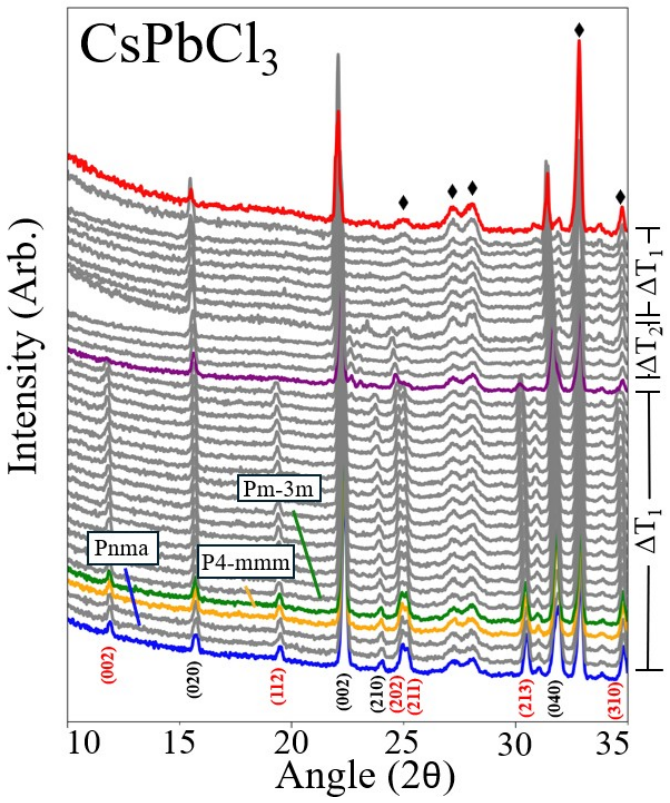
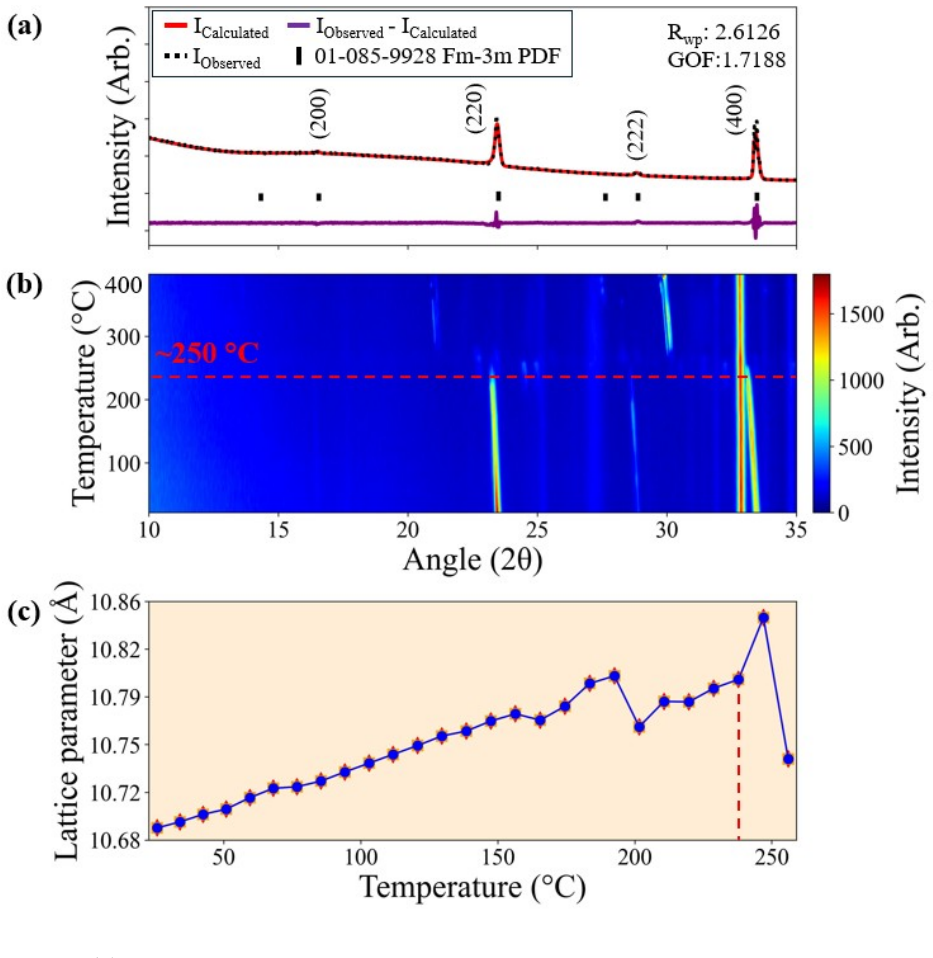
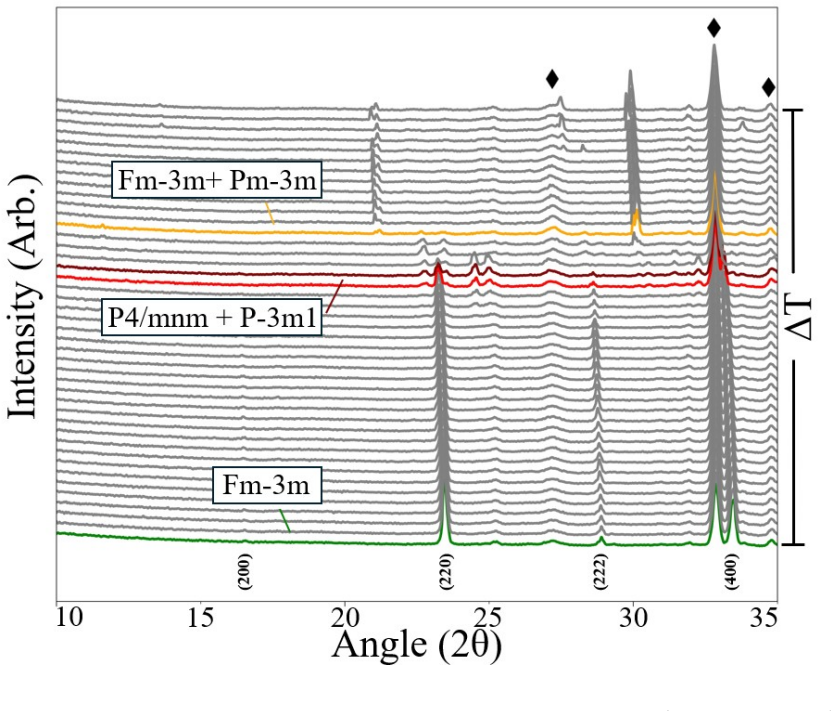
By analyzing stoichiometry, crystalline structure, and particle morphology of CsPbCl3 synthesized via ligand-assisted re-precipitation, the authors calculate temperature conversions using a control substrate and apply refinements to estimate changing structure parameters. In-situ temperature-dependent X-ray diffraction then probes the phase transitions and decomposition temperatures of the halide powders, confirming known high-temperature structural phenomena of model perovskite halides while verifying the true sample temperature. This calibrated process is extended to probe the thermal interactions of the double perovskite Cs2AgSbCl6.
What carries the argument
In-situ temperature-dependent X-ray diffraction with control-substrate temperature conversions and structural refinements to determine true sample temperature and track phase changes.
If this is right
- The method confirms known high-temperature structural phenomena of model perovskite halides.
- It verifies the true sample temperature during in-situ measurements on CsPbCl3.
- The calibrated approach enables reliable testing of thermal kinetics on the double perovskite Cs2AgSbCl6.
- The process can be used to examine other perovskites and perovskite families under high-temperature conditions.
Where Pith is reading between the lines
- The calibration step could be transferred to other in-situ techniques such as Raman or optical spectroscopy on the same materials.
- Verified temperatures may allow extraction of kinetic rates for the observed transitions rather than only onset points.
- Systematic application across additional compounds could reveal comparative stability trends within the cesium-chlorine perovskite family.
Load-bearing premise
Temperature conversions calculated from a control substrate and refinements of structure parameters accurately reflect the true sample temperature without unaccounted experimental artifacts.
What would settle it
An independent sensor placed directly on the sample during the in-situ run records temperatures that differ by more than a few degrees from the values derived from the control substrate and refinements, or the observed phase-transition temperatures for CsPbCl3 deviate substantially from established literature values.
Figures
read the original abstract
Cesium lead chloride (CsPbCl3) is a well known and principal model for inorganic perovskite halide optoelectronic research. The many available techniques including high temperature stability testing have been used to investigate the increasing interest in inorganic perovskites as primary layers in solar cell applications. Due to the nature of high temperature testing, the characterization technique, reproducibility, and the true sample temperature are vital in determining relative stability. By choosing CsPbCl3 in the investigation of the structural stability of perovskites at high temperatures, it acts as a baseline to create and verify a methodology that accurately probes sample temperature, phase transitions, and decomposition onsets. Therefore, we present a methodological approach to investigate the thermal interactions and stability of CsPbCl3 as a parent single perovskite halide based on ligand-assisted re-precipitation synthesis techniques. Where we use our approach to inform and probe thermal interactions in other cesium/chlorine compounds like Cs2AgSbCl6. By analyzing the stoichiometry and initial phases through investigations of the crystalline structure and particle morphology, we calculated temperature conversions using a control substrate and refinements to best estimate changing structure parameters. Using in-situ temperature dependent X-ray diffraction, we were able to effectively probe the phase transitions and decomposition temperatures of the investigated halide powders. Creating a process that can confirm known high temperature structural phenomena of model perovskite halides while verifying our true sample temperature. Which allowed for further testing on the thermal kinetics of on the double perovskite structure Cs2AgSbCl6 and will continue to allow us to test other perovskites and perovskite families of interest in modern high temperature perovskite halide research.
Editorial analysis
A structured set of objections, weighed in public.
Referee Report
Summary. The manuscript describes the synthesis of CsPbCl3 via ligand-assisted re-precipitation and the application of in-situ temperature-dependent X-ray diffraction, using a control substrate for temperature calibration together with structural refinements, to determine phase transitions and decomposition onsets; the same protocol is then applied to Cs2AgSbCl6 to probe its thermal stability, with the goal of confirming known high-temperature phenomena for the model compound while verifying true sample temperature.
Significance. If the control-substrate calibration and refinements accurately map to the powder temperature without unaccounted gradients or artifacts, the work supplies a practical, verifiable protocol for high-temperature structural studies of halide perovskites that could be extended to other compositions; the choice of CsPbCl3 as a baseline compound is a logical strength for method validation.
major comments (2)
- [Experimental/Methods (temperature calibration subsection)] The central claim that the control-substrate method plus refinements 'verify our true sample temperature' and thereby confirm known transition temperatures rests on an untested assumption; the manuscript provides no quantitative comparison of calibrated temperatures against independent thermocouples, literature values with uncertainties, or tests for beam-heating/contact-resistance effects that would be required to establish the mapping.
- [Results (CsPbCl3 section)] No error analysis, reported transition temperatures with uncertainties, or figures showing raw vs. calibrated data appear in the presented material; without these, the assertion that the method 'effectively probe[s] the phase transitions and decomposition temperatures' cannot be evaluated and the extension to Cs2AgSbCl6 lacks a demonstrated foundation.
minor comments (2)
- [Abstract] Abstract contains awkward phrasing ('thermal kinetics of on the double perovskite') and lacks any numerical results, which weakens the summary of the central claim.
- [Results (refinement details)] The manuscript should clarify whether the structural refinements treat temperature-dependent lattice changes independently or absorb other effects (e.g., strain, composition) into the fitted parameters.
Simulated Author's Rebuttal
We thank the referee for their constructive comments on our manuscript. We address each major comment below and indicate where revisions will be made to improve clarity and rigor.
read point-by-point responses
-
Referee: [Experimental/Methods (temperature calibration subsection)] The central claim that the control-substrate method plus refinements 'verify our true sample temperature' and thereby confirm known transition temperatures rests on an untested assumption; the manuscript provides no quantitative comparison of calibrated temperatures against independent thermocouples, literature values with uncertainties, or tests for beam-heating/contact-resistance effects that would be required to establish the mapping.
Authors: We agree that additional quantitative validation would strengthen the central claim. In the revised manuscript we will add a table comparing our calibrated temperatures against the accepted literature values for the CsPbCl3 phase transitions (including uncertainties derived from the Rietveld refinements). We will also expand the Methods section with a brief discussion of beam-heating and contact-resistance considerations based on the experimental geometry and the observed agreement with known transition points. Direct thermocouple measurements were not performed, so we cannot add new experimental data of that type; the literature comparison will serve as the primary validation. revision: partial
-
Referee: [Results (CsPbCl3 section)] No error analysis, reported transition temperatures with uncertainties, or figures showing raw vs. calibrated data appear in the presented material; without these, the assertion that the method 'effectively probe[s] the phase transitions and decomposition temperatures' cannot be evaluated and the extension to Cs2AgSbCl6 lacks a demonstrated foundation.
Authors: We accept this criticism. The revised Results section will include (i) error propagation for the temperature calibration, (ii) all reported transition and decomposition temperatures with uncertainties, and (iii) a new figure (or supplementary figure) overlaying raw and calibrated temperature scales. These additions will allow readers to evaluate the method directly and will provide the necessary foundation for the Cs2AgSbCl6 results. revision: yes
Circularity Check
No circularity; experimental calibration and measurements are independent of any self-referential derivation.
full rationale
The paper is an experimental study describing in-situ XRD measurements on halide perovskites, with temperature calibration performed via a control substrate and structural refinements. No equations, derivations, or first-principles results are presented that reduce by construction to fitted inputs or self-citations. The central claims rest on direct observations of phase transitions rather than any load-bearing self-referential logic. This is the expected non-finding for a measurement-focused manuscript.
Axiom & Free-Parameter Ledger
Reference graph
Works this paper leans on
-
[1]
INTRODUCTION In the study of next generation photoelectronic devices, alternative materials such as metal halide perovskites have been of high interest due to their outstanding optoelectronic properties [1–3] and the volume of elementally diverse materials that fit the base perovskite structure [4, 5]. CsP bCl 3 can be seen as one of the central models of...
-
[2]
METHODS Two samples were prepared, CsP bCl 3, and Cs 2AgSbCl 6 [34]. The initial stoichiometric compounds were combined: Cesium Chloride ( CsCl ) [99.9%, Thermal Scientific Chemicals] and Lead Chloride ( P bCl2) [99.9%, Thermo Scientific Chemicals] for CsP bCl 3. Cesium Chloride (CsCl ) [99.9%,BeanTown Chemical], Silver Chloride (AgCl) [99.995%, BeanTown ...
-
[3]
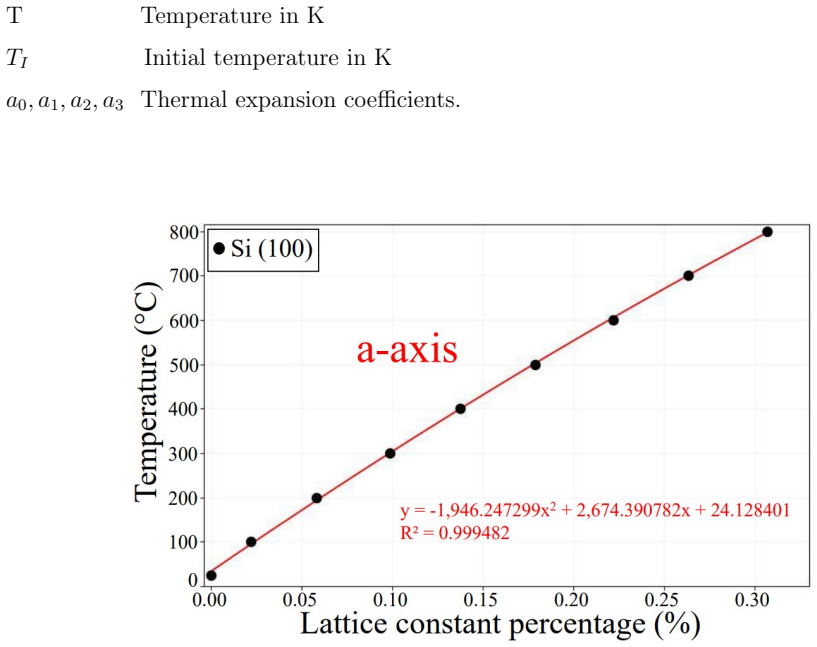
DOMED HEA TING ST AGE A TT ACHMENT CALIBRA TION A large part of the process of thermally testing these perovskite halides comes from calibrating the temperatures of our synthesized powders dropcasted on Si (100) substrates. The Anton Paar DHS 1100 is composed of the resistance based kanthal heater and 1 mm thick Aluminum Nitride (AlN) heating plate, where...
-
[4]
Stoichiometric Characterization FIG
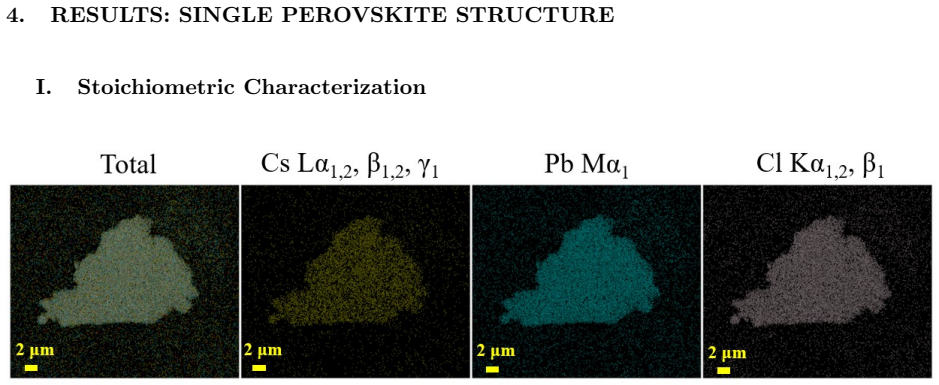
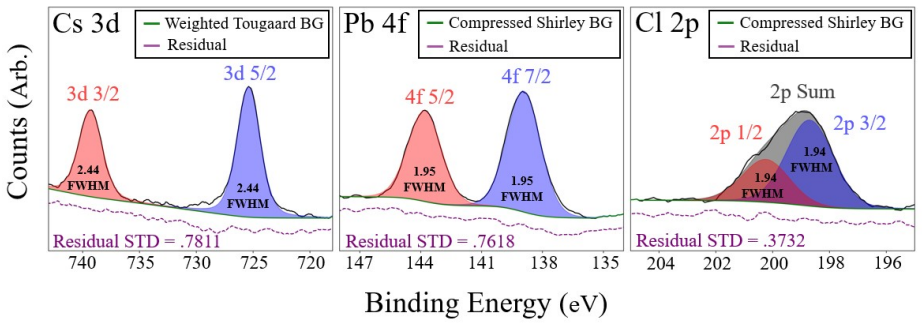
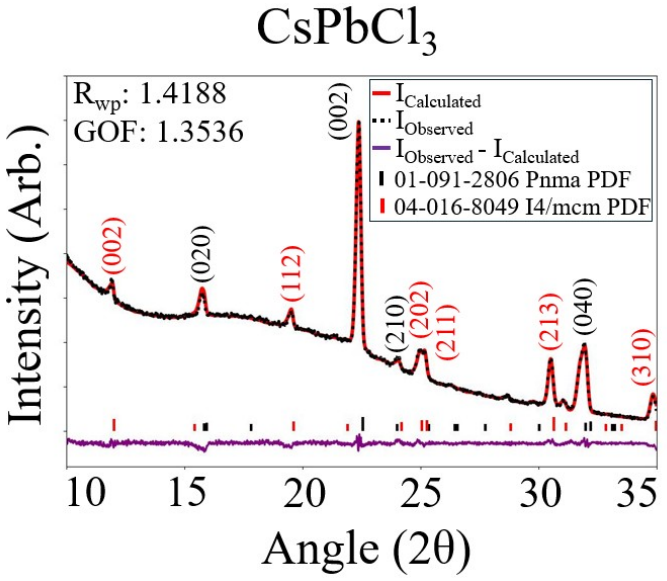
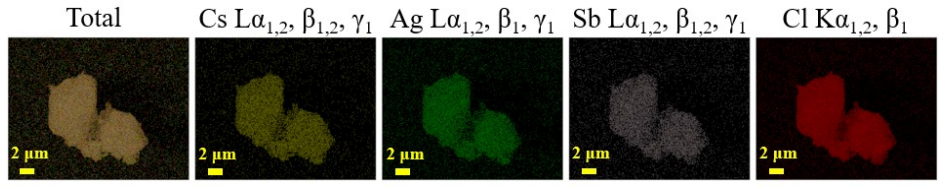
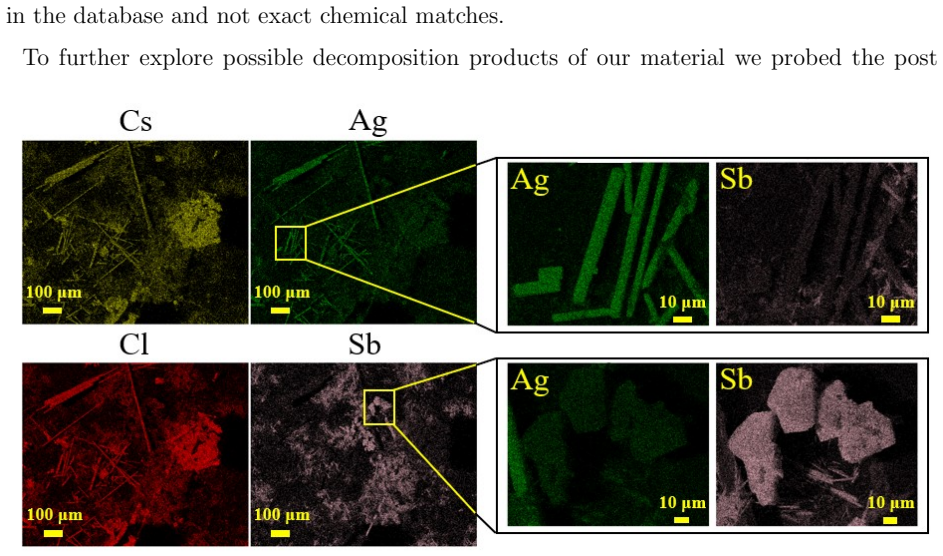
RESUL TS: SINGLE PEROVSKITE STRUCTURE I. Stoichiometric Characterization FIG. 2. Atomic ratio and homogeneity is probed using EDS on a single grain of CsP bCl 3. Two scans were taken at an acceleration voltage of 15 kV using a working distance of 5 mm at 3250X magnification. Fig.2 displays EDS elemental intensity images before annealing for the single ino...
2026
-
[5]
Devices varying in specificity, environment, preparation, and synthesis can lead to a vast collection of variables that can affect a single property such as structure decomposition
DISCUSSION This research, through recreation of the results of the known literature of a single per- ovskite halide and an investigation on a lesser reported double perovskite structure decompo- sition, is pertinent due to the variety that can be seen in high temperature testing. Devices varying in specificity, environment, preparation, and synthesis can ...
-
[6]
CONCLUSION A ligand-assisted re-precipitation technique was utilized to synthesize the inorganic CsP bCl 3 and Cs 2AgSbCl 6 perovskite halides. By applying conversions based on substrate temperatures using a lattice constant percentage fitting strategy, we were able to effectively probe the phase transitions and onset of structural decomposition temperatu...
-
[7]
R. Wang, T. Huang, J. Xue, J. Tong, K. Zhu, and Y. Yang, Prospects for metal halide perovskite-based tandem solar cells (2021)
2021
-
[8]
M. A. Haque, S. Kee, D. R. Villalva, W. L. Ong, and D. Baran, Halide Perovskites: Thermal Transport and Prospects for Thermoelectricity (2020)
2020
-
[9]
J. S. Manser, J. A. Christians, and P. V. Kamat, Intriguing Optoelectronic Properties of Metal Halide Perovskites (2016)
2016
-
[10]
M. Li, T. Liu, Y. Wang, W. Yang, and X. L¨ u, Pressure responses of halide perovskites with various compositions, dimensionalities, and morphologies (2020)
2020
-
[11]
Simenas, A
M. Simenas, A. Gagor, J. Banys, and M. Maczka, Phase Transitions and Dynamics in Mixed Three- and Low-Dimensional Lead Halide Perovskites (2024)
2024
-
[12]
Q. You, S. Gu, and X. Gou, The Highly Accurate Interatomic Potential of CsPbBr3 Per- ovskite with Temperature Dependence on the Structure and Thermal Properties, Materials 16, 10.3390/ma16052043 (2023)
-
[13]
Aktary, M
M. Aktary, M. Kamruzzaman, and R. Afrose, A comparative study of the mechanical sta- bility, electronic, optical and photocatalytic properties of CsPbX3 (X = Cl, Br, I) by DFT calculations for optoelectronic applications, RSC Advances 12, 23704 (2022)
2022
-
[14]
Zhang, S
X. Zhang, S. Zhang, Z. Ren, S. Wang, H. Liu, P. Wang, Z. Huang, R. Li, and R. Chen, Recent advances toward intraoctahedral phase change in metal halide perovskite nanomaterials (2024)
2024
-
[15]
B. A. Rosales, K. Schutt, J. J. Berry, and L. M. Wheeler, Leveraging Low-Energy Structural Thermodynamics in Halide Perovskites (2023)
2023
-
[16]
Jin, Can We Find the Perfect A-Cations for Halide Perovskites? (2021)
S. Jin, Can We Find the Perfect A-Cations for Halide Perovskites? (2021)
2021
-
[17]
Fransson, J
E. Fransson, J. M. Rahm, J. Wiktor, and P. Erhart, Revealing the Free Energy Landscape of Halide Perovskites: Metastability and Transition Characters in CsPbBr3 and MAPbI3, Chemistry of Materials 35, 8229 (2023)
2023
-
[18]
J. S. Bechtel and A. Van Der Ven, First-principles thermodynamics study of phase stability in inorganic halide perovskite solid solutions, Physical Review Materials 2, 10.1103/PhysRev- Materials.2.045401 (2018). 21
-
[19]
Travis, E
W. Travis, E. N. Glover, H. Bronstein, D. O. Scanlon, and R. G. Palgrave, On the application of the tolerance factor to inorganic and hybrid halide perovskites: A revised system, Chemical Science 7, 4548 (2016)
2016
-
[20]
C. J. Bartel, C. Sutton, B. R. Goldsmith, R. Ouyang, C. B. Musgrave, L. M. Ghiringhelli, and M. Scheffler, New tolerance factor to predict the stability of perovskite oxides and halides, Science Advances 5, 10.1126/sciadv.aav0693 (2019)
-
[21]
Dawa and B
T. Dawa and B. Sajjadi, Exploring the potential of perovskite structures for chemical looping technology: A state-of-the-art review (2024)
2024
-
[22]
M. T. Klug, A. Osherov, A. A. Haghighirad, S. D. Stranks, P. R. Brown, S. Bai, J. T. Wang, X. Dang, V. Bulovi´ c, H. J. Snaith, and A. M. Belcher, Tailoring metal halide perovskites through metal substitution: Influence on photovoltaic and material properties, Energy and Environmental Science 10, 236 (2017)
2017
-
[23]
S. Wang, A. Wang, and F. Hao, iScience Toward stable lead halide perovskite solar cells: A knob on the A/X sites components, Iscience 25, 10.1016/j.isci (2022)
-
[24]
L. R. Morss, M. Siegal, L. Stenger, and N. Edelstein, Preparation of cubic chloro complex compounds of trivalent metals: Cs2NaMCl6, Inorganic Chemistry 9 (1970)
1970
-
[25]
G. K. Grandhi, D. Hardy, M. Krishnaiah, B. Vargas, B. Al-Anesi, M. P. Suryawanshi, D. Solis- Ibarra, F. Gao, R. L. Hoye, and P. Vivo, Wide-Bandgap Perovskite-Inspired Materials: Defect- Driven Challenges for High-Performance Optoelectronics (2024)
2024
-
[26]
X. Zhou, Z. Lu, L. Zhang, and Q. Ke, Wide-bandgap all-inorganic lead-free perovskites for ultraviolet photodetectors (2023)
2023
-
[27]
J. Zhou, X. Rong, M. S. Molokeev, X. Zhang, and Z. Xia, Exploring the transposition effects on the electronic and optical properties of Cs2AgSbCl6: Via a combined computational- experimental approach, Journal of Materials Chemistry A 6, 2346 (2018)
2018
-
[28]
R. L. Milot, M. T. Klug, C. L. Davies, Z. Wang, H. Kraus, H. J. Snaith, M. B. John- ston, and L. M. Herz, The Effects of Doping Density and Temperature on the Optoelec- tronic Properties of Formamidinium Tin Triiodide Thin Films, Advanced Materials 30, 10.1002/adma.201804506 (2018)
-
[29]
Ricciarelli, D
D. Ricciarelli, D. Meggiolaro, F. Ambrosio, and F. De Angelis, Instability of tin iodide per- ovskites: Bulk p-doping versus surface tin oxidation, ACS Energy Letters 5, 2787 (2020). 22
2020
-
[30]
S. Mazumdar, Y. Zhao, and X. Zhang, Stability of Perovskite Solar Cells: Degradation Mech- anisms and Remedies, Frontiers in Electronics 2, 10.3389/felec.2021.712785 (2021)
-
[31]
Meneses-Rodr´ ıguez, P
D. Meneses-Rodr´ ıguez, P. P. Horley, J. Gonz´ alez-Hern´ andez, Y. V. Vorobiev, and P. N. Gorley, Photovoltaic solar cells performance at elevated temperatures, Solar Energy 78, 243 (2005)
2005
-
[32]
J. C. Costa, J. Azevedo, L. M. Santos, and A. Mendes, On the Deposition of Lead Halide Perovskite Precursors by Physical Vapor Method, Journal of Physical Chemistry C 121, 2080 (2017)
2080
-
[33]
Zhao and K
Y. Zhao and K. Zhu, Organic-inorganic hybrid lead halide perovskites for optoelectronic and electronic applications (2016)
2016
-
[34]
Kayalvizhi, A
T. Kayalvizhi, A. Sathya, and K. R. Preethi Meher, Hydrothermal Synthesis of Perovskite CsPbBr3: Spotlight on the Role of Stoichiometry in Phase Formation Mechanism, Journal of Electronic Materials 51, 3466 (2022)
2022
-
[35]
Z. Song, S. C. Watthage, A. B. Phillips, B. L. Tompkins, R. J. Ellingson, and M. J. Heben, Impact of Processing Temperature and Composition on the Formation of Methylammonium Lead Iodide Perovskites, Chemistry of Materials 27, 4612 (2015)
2015
-
[36]
C. Sun, Y. Jiang, L. Zhang, K. Wei, and M. Yuan, Toward the Controlled Synthesis of Lead Halide Perovskite Nanocrystals (2023)
2023
-
[37]
Xiang, E
W. Xiang, E. Cronk, J. Wall, L. Li, K. Zhu, J. J. Berry, R. J. Lad, L. Yu, and F. Yan, Double Perovskite Interlayer Stabilized Highly Efficient Perovskite Solar Cells, ACS Applied Materials and Interfaces 16, 44988 (2024)
2024
-
[38]
Y. Kim, M. Um, S. Shin, H. Song, Y. R. Park, and J. Yang, Understanding Synthesis Space in Ligand-Assisted Reprecipitated CsPb(BrxI1-x)3 Perovskite Nanocrystals (2025)
2025
-
[39]
A. Fatemi, K. Jamshidi-Ghaleh, T. Tohidi, and F. Bayat, CaCl2 doping effect on optical and structural properties of halide perovskites under ligand assisted reprecipitation synthesis, Physica B: Condensed Matter 691, 10.1016/j.physb.2024.416360 (2024)
-
[40]
V. R. Yandri, P. Wulandari, and R. Hidayat, Photoluminescence Properties of CsPbCl3and CsPbBr3Nanocrystals synthesized by LARP Method with Various Ligands and Anti-solvents, Journal of Physics: Conference Series 2243, 10.1088/1742-6596/2243/1/012120 (2022)
-
[41]
N. M. Van Der Pers, R. W. Hendrikx, and A. J. B¨ ottger, A simple and effective attachment to prevent dome diffraction reaching 2D or 1D detectors in x-ray diffractometers, Review of Scientific Instruments 92, 10.1063/5.0052057 (2021). 23
-
[42]
volume 13
Touloukian Y, Kirby R, Taylor E, and Lee T, Thermophysical properties of matter-the tprc data series. volume 13. thermal expansion-nonmetallic solids. , Tech. Rep. (Thermophysical Properties Research Center, 1977)
1977
-
[43]
Anton Paar, Thermal Lattice Expansion as a Tool for Temperature Validation in Non-ambient XRD, Tech. Rep. (Anton Paar)
-
[44]
Eggert, effect of the silicon drift detector on edax standardless quant methods, Mi- croscopy Today 28, 34 (2020)
F. Eggert, effect of the silicon drift detector on edax standardless quant methods, Mi- croscopy Today 28, 34 (2020)
2020
-
[45]
H. Chen, Y. Zhao, L. Bian, Y. Cao, L. Li, Y. Zhang, J. Duan, Q. Guo, Q. Zhang, and Q. Tang, Refining the Buried Interface via Alkali Metal Carbonate for Efficient All-Inorganic Perovskite Solar Cells, ACS Applied Materials and Interfaces 17, 21469 (2025)
2025
-
[46]
De Keersmaecker, P
M. De Keersmaecker, P. Dietrich, M. Bahri, N. D. Browning, N. R. Armstrong, and E. L. Ratcliff, Activated Corrosion and Recovery in Lead Mixed-Halide Perovskites Revealed by Dynamic Near-Ambient Pressure X-ray Photoelectron Spectroscopy, Journal of the American Chemical Society 147, 8881 (2025)
2025
-
[47]
Bertolotti, L
F. Bertolotti, L. Protesescu, M. V. Kovalenko, S. Yakunin, A. Cervellino, S. J. Billinge, M. W. Terban, J. S. Pedersen, N. Masciocchi, and A. Guagliardi, Coherent Nanotwins and Dynamic Disorder in Cesium Lead Halide Perovskite Nanocrystals, ACS Nano 11, 3819 (2017)
2017
-
[48]
D. S. Tsvetkov, M. O. Mazurin, V. V. Sereda, I. L. Ivanov, D. A. Malyshkin, and A. Y. Zuev, Formation Thermodynamics, Stability, and Decomposition Pathways of CsPbX3 (X = Cl, Br, I) Photovoltaic Materials, Journal of Physical Chemistry C 124, 4252 (2020)
2020
-
[49]
P. Pal, S. Saha, A. Banik, A. Sarkar, and K. Biswas, All-Solid-State Mechanochemical Syn- thesis and Post-Synthetic Transformation of Inorganic Perovskite-type Halides, Chemistry - A European Journal 24, 1811 (2018)
2018
-
[50]
Becerril, J
L. Becerril, J. Balderas, B. Rodr´ ıguez, R. I. L´ opez-Esquivel, and C. Falcony, Photolumines- cence analysis of CsPb2Cl5 and CsPbCl3 perovskite films doped with Yb3+ deposited by aerosol-assisted CVD, Ceramics International 49, 41106 (2023)
2023
-
[51]
J. Wei, Y. Rong, C. Wang, M. Lv, Y. Yang, Z. Li, Y. Zhang, G. Wei, Y. Liu, M. Zhong, and H. Liu, The controllable growth of CsPb2Cl5 nanosheets and their application as a sta- ble photodetector for ultraviolet, Applied Surface Science 645, 10.1016/j.apsusc.2023.158868 (2024). 24
-
[52]
Fayon, Y
F. Fayon, Y. Vaills, P. Simon, P. Echegut, C. Bessada, J. Emery, and J.-Y. Buzare, Study of CsPbCl3 between T = 47 ◦C and the melting point by the 133 Cs NMR AND Gd 3+ epr measurements, Ferroelectrics 185, 201 (1996)
1996
-
[53]
Bingham, and Liping Yu, Kinetic Scaling Rules Governing Phase Instability in Perovskite Halides, Journal of the American Chemical Society (Under Review) (2026)
Biswajit Ball, Ethan Cronk, Wenjun Xiang, Feng Yan, Nichloas S. Bingham, and Liping Yu, Kinetic Scaling Rules Governing Phase Instability in Perovskite Halides, Journal of the American Chemical Society (Under Review) (2026)
2026
-
[54]
K. Agrawal, S. M. A. Hasan, J. Blawat, N. Mehta, Y. Wang, R. Cueto, M. Siebenbuerger, O. Kizilkaya, N. S. Prasad, J. Dorman, R. Jin, and M. R. Gartia, Thermal, Physical, and Opti- cal Properties of the Solution and Melt Synthesized Single Crystal CsPbBr3 Halide Perovskite, Chemosensors 10, 10.3390/chemosensors10090369 (2022)
-
[55]
M. Liao, B. Shan, and M. Li, In Situ Raman Spectroscopic Studies of Thermal Stability of All-Inorganic Cesium Lead Halide (CsPbX 3 , X = Cl, Br, I) Perovskite Nanocrystals, Journal of Physical Chemistry Letters 10, 1217 (2019)
2019
-
[56]
W. Deng, Z. Y. Deng, J. He, M. Wang, Z. X. Chen, S. H. Wei, and H. J. Feng, Synthesis of Cs2AgSbCl6 and improved optoelectronic properties of Cs2AgSbCl6/TiO2 heterostructure driven by the interface effect for lead-free double perovskites solar cells, Applied Physics Letters 111, 10.1063/1.4999192 (2017). 25 SUPPLEMENT AR Y INFORMA TION Supplementary Figur...
discussion (0)
Sign in with ORCID, Apple, or X to comment. Anyone can read and Pith papers without signing in.