REVIEW 3 major objections 4 minor 34 references
Asymmetric Floquet-Engineered Mode Coupling in Hybrid Magnonics
T0 review · 3 major / 4 minor · reviewed 2026-08-01 · deepseek-v4-flash
Pith's one-line read The relative phase of two commensurate Floquet drives continuously controls the asymmetry of a magnon's sidebands, making the coupling between two hybrid modes single-sided and switchable by tuning the phase.
desk verdict Phase-programmable asymmetric Floquet replicas in cavity magnonics: a believable effect with a disclosed systematic caveat in the ATS metric. read the letter →
The pith
A machine-rendered reading of the paper's core claim, the machinery that carries it, and where it could break.
The reading
What carries the argument
The central object is the dual-tone Floquet expansion of the modulated magnon phase, e^{-iϵ(t)} = Σ_n C_n e^{-inΩ1 t}, with C_n = Σ_p J_{n-2p}(β1) J_p(β2) e^{-ipθ}. This sum over multiphoton pathways is what carries the argument: the interference between pathways that differ by one quantum of the 2Ω1 drive has opposite sign for +n and -n replicas, which is exactly the source of the asymmetry. The phase θ acts as a Peierls phase on the next-nearest-neighbor hopping in the synthetic frequency lattice, and the effective intermode coupling is set by g̃_n ~ g C_n.
What would settle it
With the second drive off, measure the reflection spectrum at the same probe frequencies: the model requires the sidebands to be exactly symmetric for any θ (since the phase θ is undefined when h2=0). If a one-tone spectrum shows any asymmetry between +n and -n sidebands, the effect is not the predicted Floquet interference. A second check: at θ=π/2 the model predicts identical sideband heights; a spectrum taken at this phase with equal drive amplitudes should show symmetric replicas within noise.
Extended reading notes
Core claim
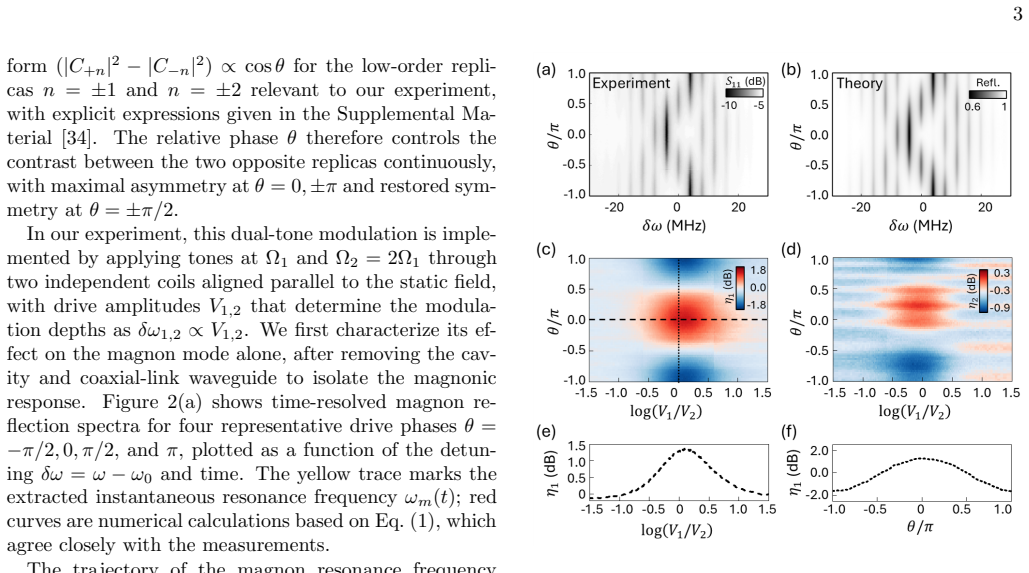
The central discovery is that the Floquet coefficients of a two-tone-driven magnon, C_n = Σ_p J_{n-2p}(β1) J_p(β2) e^{-ipθ}, produce unequal spectral weights for opposite sidebands because the two interfering pathways carry opposite relative phases for +n and -n. To leading order, |C_{+n}|² - |C_{-n}|² ∝ cosθ for n=1,2, so θ continuously controls the imbalance. In the hybrid cavity-magnon system, the effective replica-assisted coupling is g̃_n ∝ g C_n, so the imbalance translates directly into asymmetric hybridization of the two normal modes. Experimentally, this appears as single-sided ATS that switches between the two modes as θ is varied, with the asymmetry metric η_ATS following cosθ and
Load-bearing premise
The central claim depends on the two drive tones being phase-locked and delivered with equal fidelity to the magnon; if the coil's frequency response distorts the second harmonic as θ is swept, the observed single-sided ATS could be an artifact of the drive rather than the Floquet interference.
Editorial extensions
If this is right
- A single device can be switched between symmetric and single-sided mode coupling just by tuning the drive phase, without changing amplitudes or frequencies.
- The cosθ dependence gives a spectroscopic calibration of the relative drive phase, making the interference contrast directly measurable.
- In a ladder of equally spaced modes, the phase-controlled replica imbalance creates a synthetic dimension with a tunable Peierls phase, a route to chiral state transfer and Floquet topological phases.
- The mechanism transfers to other bichromatically driven hybrid systems, such as cavity optomechanics, circuit QED, and optomagnonics, across microwave to optical frequencies.
Reading between the lines
- The theory predicts sideband asymmetry for any low-order commensurate drive ratio, not just 1:2; the supplementary frequency-ratio scan hints that the effect weakens at higher-order commensurabilities, so a systematic map of asymmetry versus ratio could test the generality of the interference picture.
- Because the asymmetry arises from classical interference of Floquet pathways, it should persist in the quantum regime; a natural extension is to measure the unequal populations of the +n and -n sidebands under weak driving.
- A sharper test would measure the phase of the reflected signal, not just its amplitude, since the model fixes the relative phase of the sideband responses; amplitude-only measurements cannot fully distinguish a genuine phase-controlled imbalance from a drive-amplitude artifact.
Editorial analysis
A structured set of objections, weighed in public.
Referee Report
Summary. The paper proposes a dual-tone Floquet modulation scheme for a magnon mode, using two commensurate drives at frequencies Ω1 and 2Ω1 with relative phase θ, and claims that this breaks the symmetric replica structure that is unavoidable with single-tone driving. The central theoretical result is that the spectral weights of the ±n Floquet replicas become unequal, with the leading imbalance proportional to cosθ (Eq. S17). The authors support this with magnon-only reflection and time-resolved measurements showing phase-dependent replica asymmetry, and then demonstrate hybrid cavity–magnon spectra in which the Autler–Townes splitting appears predominantly on one hybrid mode or the other as θ is varied, interpreted as phase-programmable asymmetric mode coupling. A supplemental section provides additional data at an off-resonant drive frequency where the relevant spectral branches are resolved.
Significance. The idea of using the relative phase of two commensurate drives to break replica symmetry in Floquet-engineered magnonic coupling is conceptually clean and, if quantitatively confirmed, opens a practical room-temperature route to nonreciprocal and topological magnonic devices. The analytical derivation of the asymmetry via coherent interference of Floquet pathways is simple and parameter-free in its phase dependence. The experimental data clearly show a cosθ-type variation of the replica asymmetry and a switching of the ATS between hybrid modes, which is nontrivial and not present under single-tone driving. The inclusion of a frequency-ratio scan (Fig. S5) showing that the effect is specific to low-order commensurability is a strength, as is the time-resolved spectroscopy that directly visualizes the θ-controlled trajectory asymmetry. However, the quantitative support for the headline 'single-sided ATS' claim is weaker than the main text suggests, because the hybrid spectra are not compared to a full Floquet simulation and the main quantitative metric η_ATS is extracted from unresolved branches.
major comments (3)
- [Section 4 and Fig. 4; Supplemental Sec. 2.6] The central claim that tuning θ switches single-sided ATS between the two hybrid modes is not backed by a direct model-to-data comparison. The magnon-only spectra in Fig. 3 are compared with the Floquet Green-function calculation, but the hybrid spectra in Fig. 4 are interpreted only through the heuristic relation g̃_n ∼ g C_n and Eq. (S39). Since the inner branches a+ and b− merge into one unresolved dip (as admitted in Sec. 2.6 of the Supplement), the extracted Δωa and Δωb and hence η_ATS could be affected by linewidths, background, and the fitting procedure. Please compute the full two-mode Floquet reflection spectrum from Eqs. (S27)–(S29) using the experimental parameters and overlay it on the data in Fig. 4(b)–(d). This is necessary to establish that the observed single-sided ATS is quantitatively reproduced by the model rather than being an artifact of branch merging or extraction.
- [Fig. 3(b) and Section 3] The theoretical spectra in Fig. 3(b) are computed with δω1/2π = δω2/2π = 10 MHz without any independent calibration of the modulation depths. The voltage-to-frequency conversion for the drive coils is not characterized, and the statement that the calculation 'agrees closely' is qualitative. Because the magnitude of the asymmetry depends on β1 and β2, the quantitative support for the model is incomplete. Please provide a calibration (e.g., from single-tone sideband amplitudes or a line-shape fit) and/or report the fitted modulation depths with uncertainties, and quantify the agreement (e.g., residual or correlation) between Fig. 3(a) and 3(b).
- [Fig. 4(d) and Supplemental Sec. 2.6] The main text presents η_ATS as the quantitative measure of coupling asymmetry and fits it to a cosine, but the Supplement states that the extracted η_ATS 'systematically underestimates the actual coupling asymmetry' because the merged inner branches are treated as a single feature. This limitation should be stated in the main text near Fig. 4(d), and the expected size of the underestimate should be estimated. Without that caveat, the quantitative agreement between the measured η_ATS and the leading-order cosθ prediction may be accidental. Please also clarify whether the cosine fit shown is to the raw extracted values or to some corrected quantity.
minor comments (4)
- [Supplemental Sec. 2.3] The frequency-drift correction aligns all spectra to the 0th-order replica, but when that replica is suppressed another replica is used for alignment. Please state explicitly why this procedure cannot affect relative amplitudes or linewidths, and show an example raw and aligned spectrum with a fixed frequency reference to validate the claim.
- [Supplemental Sec. 2.2 / Fig. 2] The red curves in Fig. 2(a) are numerical calculations from Eq. (1) but no quantitative agreement metric or residuals are given. A simple root-mean-square deviation would help the reader judge the quality of the time-resolved fit.
- [Section 4, phase-calibration] The two drives are stated to be phase-locked, but the frequency-dependent transfer function of the coils can introduce a phase offset, which the authors acknowledge as a 'slight systematic offset' in η_ATS. Please report the measured phase offset and, if possible, calibrate it by comparing the observed zero-asymmetry phase to θ = ±π/2.
- [Abstract / Introduction] The phrase 'direct spectroscopic signature of phase-programmable asymmetric coupling' is stronger than the evidence supports, given the branch-merging issue. Consider tempering the wording to 'consistent with' until the full Floquet simulation is provided.
Circularity Check
No significant circularity: the phase-asymmetry prediction is derived analytically and independently compared with data.
full rationale
The paper's central prediction is the phase-controlled replica asymmetry |C+n|² ≠ |C−n|². This is derived from the assumed modulation field h(t) = h₁ cos(Ω₁t) + h₂ cos(2Ω₁t+θ), giving Eq. (1); the Floquet coefficients in Eq. (2)/Eq. (S12) follow directly from the Jacobi–Anger expansion, and Eqs. (S15)–(S20) yield the parameter-free leading-order relation |C+n|²−|C−n|² ∝ cosθ. No parameter is fitted to the predicted asymmetry; the measured η₁, η₂, and η_ATS are independent experimental quantities compared with this functional form. The numerical spectra in Fig. 3(b) use reasonable drive-depth inputs (δω₁/2π = δω₂/2π = 10 MHz), but the qualitative cosθ phase dependence and the θ=±π/2 symmetry restoration do not reduce to those fitted values. Self-citations [31]–[33] are used only to contextualize prior Floquet magnonics and symmetric single-tone ATS; the dual-tone symmetry-breaking claim is derived in the present Supplemental Material, not imported from a self-citation. The acknowledged limitation in SM Sec. 2.6 — that the merged inner branches a₊ and b₋ cause η_ATS to underestimate the actual asymmetry — is an experimental extraction caveat, not a circular definition; the paper also provides the 7 MHz off-resonant scan where the inner branches are resolved, supporting the same phase-controlled switching. Thus there is no load-bearing circular step.
Assumptions & free parameters
free parameters (2)
- δω1, δω2 (modulation depths) =
10 MHz used for Fig. 3(b); no independent calibration
- η_ATS cosine fit amplitude/offset =
not stated; cosine fit with 'slight systematic offset'
assumptions (6)
- standard math Jacobi-Anger expansion for e^{-i(β1 sin Ω1t + β2 sin(2Ω1t+θ))}
- domain assumption Magnon response is linear and semiclassical; operators replaced by coherent amplitudes
- domain assumption Modulation acts only as a frequency shift of the magnon mode: ωm(t)=γ[H0+h(t)]
- domain assumption Cavity-magnon coupling is the linear Hermitian interaction g(c†m+cm†)
- domain assumption The two drives are phase-locked with fixed relative phase θ
- ad hoc to paper Frequency drift can be removed by aligning replicas without changing linewidths/spacings
Cite this review
Pith. "Pith review of Asymmetric Floquet-Engineered Mode Coupling in Hybrid Magnonics." pith.science (2026). https://pith.science/paper/7N4T5YJK
@misc{pith2026260726453,
  author       = {Pith},
  title        = {Pith review of: Asymmetric Floquet-Engineered Mode Coupling in Hybrid Magnonics},
  year         = {2026},
  howpublished = {\url{https://pith.science/paper/7N4T5YJK}},
  note         = {Machine review of arXiv:2607.26453}
}
abstract
In hybrid magnonic systems, linear magnon--photon hybridization inherently produces symmetric, reciprocal interactions, precluding asymmetric mode coupling. Floquet driving can tailor mode coupling strengths but, with single-tone modulation, inevitably generates a symmetric interaction that preserves this reciprocity. Here we introduce dual-tone Floquet modulation to unlock a new degree of freedom in hybrid magnonic systems, where the relative phase $\theta$ of two commensurate drives continuously controls the asymmetry of the Floquet-engineered interaction, enabling asymmetric mode coupling absent in existing hybrid magnonic systems. We demonstrate this in a strongly coupled cavity magnonic device, where tuning $\theta$ reversibly switches single-sided Autler--Townes splitting between the two hybrid modes---a direct spectroscopic signature of phase-programmable asymmetric coupling. This approach opens a new path toward controllable nonreciprocal and topological functionalities in hybrid magnonic systems, with broad implications for advanced quantum and classical signal processing.
Figures


Figures from the paper (2 more)


Reference graph
Works this paper leans on
-
[1]
Haigh, Koji Usami, Dany Lachance-Quirion, Yasunobu Nakamura, Can-Ming Hu, Hong X
Babak Zare Rameshti, Silvia Viola Kusminskiy, James A. Haigh, Koji Usami, Dany Lachance-Quirion, Yasunobu Nakamura, Can-Ming Hu, Hong X. Tang, Gerrit E. W. Bauer, and Yaroslav M. Blanter,Cavity magnonics, Physics Reports979, 1–61 (2022)
2022
-
[2]
Dany Lachance-Quirion, Yutaka Tabuchi, Arnaud Gloppe, Koji Usami, and Yasunobu Nakamura,Hybrid quantum systems based on magnonics, Applied Physics Express12, 070101 (2019)
2019
-
[3]
Yi Li, Wei Zhang, Vasyl Tyberkevych, Wai-Kwong Kwok, Axel Hoffmann, and Valentine Novosad,Hybrid magnonics: Physics, circuits, and applications for coher- ent information processing, Journal of Applied Physics 128, 130902 (2020)
2020
-
[4]
Awschalom, Chunhui Rita Du, Rui He, F
David D. Awschalom, Chunhui Rita Du, Rui He, F. Joseph Heremans, Axel Hoffmann, Justin Hou, Hidekazu Kurebayashi, Yi Li, Luqiao Liu, Valentine Novosad, Joseph Sklenar, Sean E. Sullivan, Dali Sun, Hong Tang, Vasyl Tyberkevych, Cody Trevillian, Adam W. Tsen, Leah R. Weiss, Wei Zhang, Xufeng Zhang, Liuyan Zhao, and Ch. W. Zollitsch,Quantum Engineering With H...
2021
-
[5]
A. V. Chumak, P. Kabos, M. Wu, C. Abert, C. Adel- mann, A. O. Adeyeye, J. ˚Akerman, F. G. Aliev, A. Anane, A. Awad, C. H. Back, A. Barman, G. E. W. Bauer, M. Becherer, E. N. Beginin, V. A. S. V. Bit- tencourt, Y. M. Blanter, P. Bortolotti, I. Boventer, D. A. Bozhko, S. A. Bunyaev, J. J. Carmiggelt, R. R. Cheenikundil, F. Ciubotaru, S. Cotofana, G. Csaba, ...
2022
-
[6]
Benedetta Flebus, Dirk Grundler, Bivas Rana, YoshiChika Otani, Igor Barsukov, Anjan Barman, Gianluca Gubbiotti, Pedro Landeros, Johan Akerman, Ursula Ebels, Philipp Pirro, Vladislav E Demidov, Katrin Schultheiss, Gyorgy Csaba, Qi Wang, Florin Ciubotaru, Dmitri E Nikonov, Ping Che, Riccardo Hertel, Teruo Ono, Dmytro Afanasiev, Johan Mentink, Theo Rasing, B...
2024
-
[7]
Xufeng Zhang,A review of common materials for hy- brid quantum magnonics, Materials Today Electronics5, 100044 (2023)
2023
-
[8]
¨O. O. Soykal, and M. E. Flatt´ e,Strong Field Interactions between a Nanomagnet and a Photonic Cavity, Physical Review Letters104, 077202 (2010)
2010
Show all 34 references
-
[9]
Zollitsch, Johannes Lotze, Fredrik Hocke, Moritz Greifenstein, Achim Marx, Rudolf Gross, and Sebastian T
Hans Huebl, Christoph W. Zollitsch, Johannes Lotze, Fredrik Hocke, Moritz Greifenstein, Achim Marx, Rudolf Gross, and Sebastian T. B. Goennenwein,High Cooper- ativity in Coupled Microwave Resonator Ferrimagnetic Insulator Hybrids, Physical Review Letters111, 127003 (2013)
2013
-
[10]
Yutaka Tabuchi, Seiichiro Ishino, Toyofumi Ishikawa, Rekishu Yamazaki, Koji Usami, and Yasunobu Naka- mura,Hybridizing Ferromagnetic Magnons and Mi- crowave Photons in the Quantum Limit, Physical Review Letters113, 083603 (2014)
2014
-
[11]
Tang,Strongly Coupled Magnons and Cavity Mi- crowave Photons, Physical Review Letters113, 156401 (2014)
Xufeng Zhang, Chang-Ling Zou, Liang Jiang, and Hong X. Tang,Strongly Coupled Magnons and Cavity Mi- crowave Photons, Physical Review Letters113, 156401 (2014)
2014
-
[12]
Farr, Daniel L
Maxim Goryachev, Warrick G. Farr, Daniel L. Creedon, Yaohui Fan, Mikhail Kostylev, and Michael E. Tobar, High-Cooperativity Cavity QED with Magnons at Mi- crowave Frequencies, Physical Review Applied2, 054002 (2014)
2014
-
[13]
Harder, Y
Lihui Bai, M. Harder, Y. P. Chen, X. Fan, J. Q. Xiao, and C.-M. Hu,Spin Pumping in Electrodynamically Coupled Magnon-Photon Systems, Physical Review Letters114, 227201 (2015)
2015
-
[14]
Yutaka Tabuchi, Seiichiro Ishino, Atsushi Noguchi, Toy- ofumi Ishikawa, Rekishu Yamazaki, Koji Usami, and Ya- sunobu Nakamura,Coherent coupling between a ferro- magnetic magnon and a superconducting qubit, Science 349, 405-408 (2015)
2015
-
[15]
Yi Li, Tomas Polakovic, Yong-Lei Wang, Jing Xu, Sergi Lendinez, Zhizhi Zhang, Junjia Ding, Trupti Khaire, Hilal Saglam, Ralu Divan, John Pearson, Wai-Kwong Kwok, Zhili Xiao, Valentine Novosad, Axel Hoffmann, and Wei Zhang,Strong Coupling be- tween Magnons and Microwave Photons...
2019
-
[16]
Hou, and Luqiao Liu,Strong Coupling between Microwave Photons and Nanomagnet Magnons, Physical Review Letters123, 107702 (2019)
Justin T. Hou, and Luqiao Liu,Strong Coupling between Microwave Photons and Nanomagnet Magnons, Physical Review Letters123, 107702 (2019)
2019
-
[17]
Dany Lachance-Quirion, Samuel Piotr Wolski, Yutaka Tabuchi, Shingo Kono, Koji Usami, and Yasunobu Naka- mura,Entanglement-based single-shot detection of a sin- gle magnon with a superconducting qubit, Science367, 425-428 (2020)
2020
-
[18]
Dany Lachance-Quirion, Yutaka Tabuchi, Seiichiro Ishino, Atsushi Noguchi, Toyofumi Ishikawa, Rekishu Ya- mazaki, and Yasunobu Nakamura,Resolving quanta of collective spin excitations in a millimeter-sized ferromag- net, Science Advances3, 1603150 (2017)
2017
-
[19]
Yuan-Chao Weng, Da Xu, Zhen Chen, Li-Zhou Tan, Xu-Ke Gu, Jie Li, Hai-Feng Yu, Shi-Yao Zhu, Xuedong Hu, Franco Nori, and J. Q. You,Magnon squeezing in the quantum regime, Nature Communications17, 2679 (2026)
2026
-
[20]
Harder, Y
M. Harder, Y. Yang, B. M. Yao, C. H. Yu, J. W. Rao, Y. S. Gui, R. L. Stamps, and C.-M. Hu,Level Attraction Due to Dissipative Magnon-Photon Coupling, Physical Review Letters121, 137203 (2018)
2018
-
[21]
Dany Zhang, Xiang-Qian Luo, Yi-Pu Wang, Tie-Fu Li, and J. Q. You,Observation of the exceptional point in cavity magnon-polaritons, Nature Communications8, 1368 (2017)
2017
-
[22]
Xufeng Zhang, Kun Ding, Xianjing Zhou, Jing Xu, and Dafei Jin,Experimental Observation of an Exceptional Surface in Synthetic Dimensions with Magnon Polari- tons, Physical Review Letters123, 237202 (2019)
2019
-
[23]
Hisatomi, A
R. Hisatomi, A. Osada, Y. Tabuchi, T. Ishikawa, A. Noguchi, R. Yamazaki, K. Usami, and Y. Nakamura, Bidirectional conversion between microwave and light via ferromagnetic magnons, Phys. Rev. B93, 174427 (2016)
2016
-
[24]
Kejie Fang, Zongfu Yu, and Shanhui Fan,Realizing effec- tive magnetic field for photons by controlling the phase of dynamic modulation, Nature Physics8, 560–564 (2012)
2012
-
[25]
Lawrence D. Tzuang, Kejie Fang, Paulo Nussenzveig, Shanhui Fan, and Michal Lipson,Non-reciprocal phase shift induced by an effective magnetic flux for light, Na- ture Photonics8, 701–705 (2014)
2014
-
[26]
Avik Dutt, Momchil Minkov, Qian Lin, Luqi Yuan, David A. B. Miller, and Shanhui Fan,Experimental band structure spectroscopy along a synthetic dimension, Na- ture Communications10, 3122 (2019)
2019
-
[27]
Avik Dutt, Qian Lin, Luqi Yuan, Momchil Minkov, Meng Xiao, and Shanhui Fan,A single photonic cavity with two independent physical synthetic dimensions, Science367, 59–64 (2020)
2020
-
[28]
Ma- theny, Florian Marquardt, Aashish A
Kejie Fang, Jie Luo, Anja Metelmann, Matthew H. Ma- theny, Florian Marquardt, Aashish A. Clerk, and Oskar Painter,Generalized non-reciprocity in an optomechan- ical circuit via synthetic magnetism and reservoir engi- neering, Nature Physics13, 465–471 (2017)
2017
-
[29]
Nathan R. A. Lee, Marek Pechal, E. Alex Wollack, Patricio Arrangoiz-Arriola, Zhaoyou Wang, and Amir H. Safavi-Naeni,Propagation of microwave photons along a synthetic dimension, Physical Review A101, 053807 (2020)
2020
-
[30]
Roushan, C
P. Roushan, C. Neill, A. Megrant, Y. Chen, R. Bab- bush, R. Barends, B. Campbell, Z. Chen, B. Chiaro, A. Dunsworth, A. Fowler, E. Jeffrey, J. Kelly, E. Lucero, J. Mutus, P. J. J. O’Malley, M. Neeley, C. Quintana, D. Sank, A. Vainsencher, J. Wenner, T. White, A. Korotkov, A. N....
2017
-
[31]
Jing Xu, Changchun Zhong, Xu Han, Dafei Jin, Liang Jiang, and Xufeng Zhang,Floquet Cavity Electromagnon- ics, Physical Review Letters125, 237201 (2020)
2020
-
[32]
Jornet, Liang Jiang, and Xufeng Zhang,Resonance-enhanced Floquet cavity elec- tromagnonics, Physical Review Applied24, 014026 (2025)
Amin Pishehvar, Zixin Yan, Zhaoyou Wang, Yu Jiang, Yizhong Huang, Josep M. Jornet, Liang Jiang, and Xufeng Zhang,Resonance-enhanced Floquet cavity elec- tromagnonics, Physical Review Applied24, 014026 (2025)
2025
-
[33]
Jornet, Jia-Mian Hu, Liang Jiang, and Xufeng Zhang,On-demand magnon res- onance isolation in cavity magnonics, Physical Review Applied23, 024053 (2025)
Amin Pishehvar, Zhaoyou Wang, Yujie Zhu, Yu Jiang, Zixin Yan, Fangxin Li, Josep M. Jornet, Jia-Mian Hu, Liang Jiang, and Xufeng Zhang,On-demand magnon res- onance isolation in cavity magnonics, Physical Review Applied23, 024053 (2025)
2025
-
[34]
Asymmetric Floquet-Engineered Mode Coupling in Hybrid Magnonics
See Supplemental Material below for details about device modeling, assembling, and measurements. 7 Supplemental Material for “Asymmetric Floquet-Engineered Mode Coupling in Hybrid Magnonics” 1 THEORETICAL MODEL 1.1 Floquet Green–function F ormulation Of The Driven Magnon Mode ...
Reviewed August 1, 2026 · model on record in the stance chip above.
Discussion (0). Sign in to comment.