Determining stress-based bending mode limits for the Vera C. Rubin Observatory M1M3 active mirror system
Pith reviewed 2026-07-01 02:56 UTC · model grok-4.3
The pith
Root-sum-square combination of unit bending mode stresses predicts peak principal stress in the M1M3 mirror within a few percent of full simulations.
A machine-rendered reading of the paper's core claim, the machinery that carries it, and where it could break.
Core claim
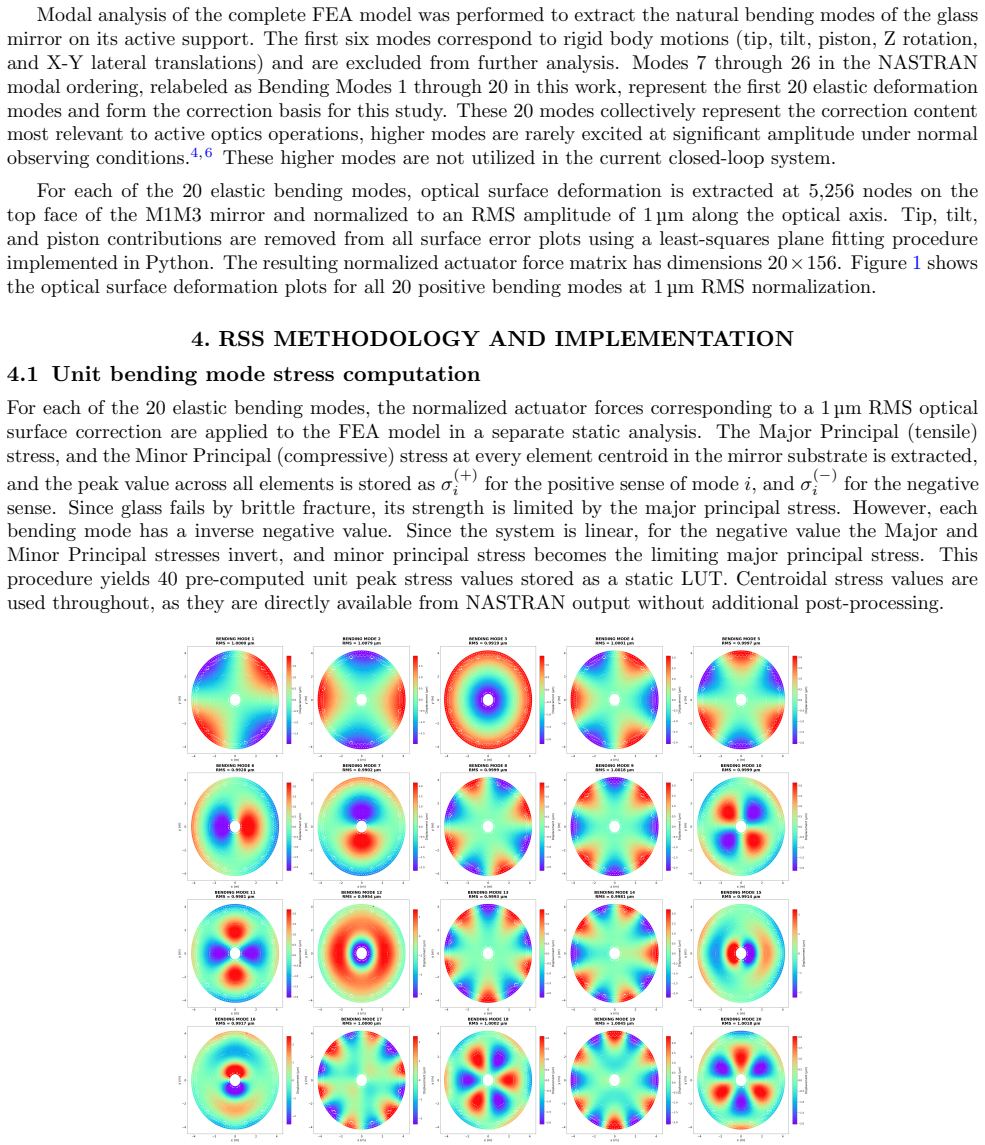
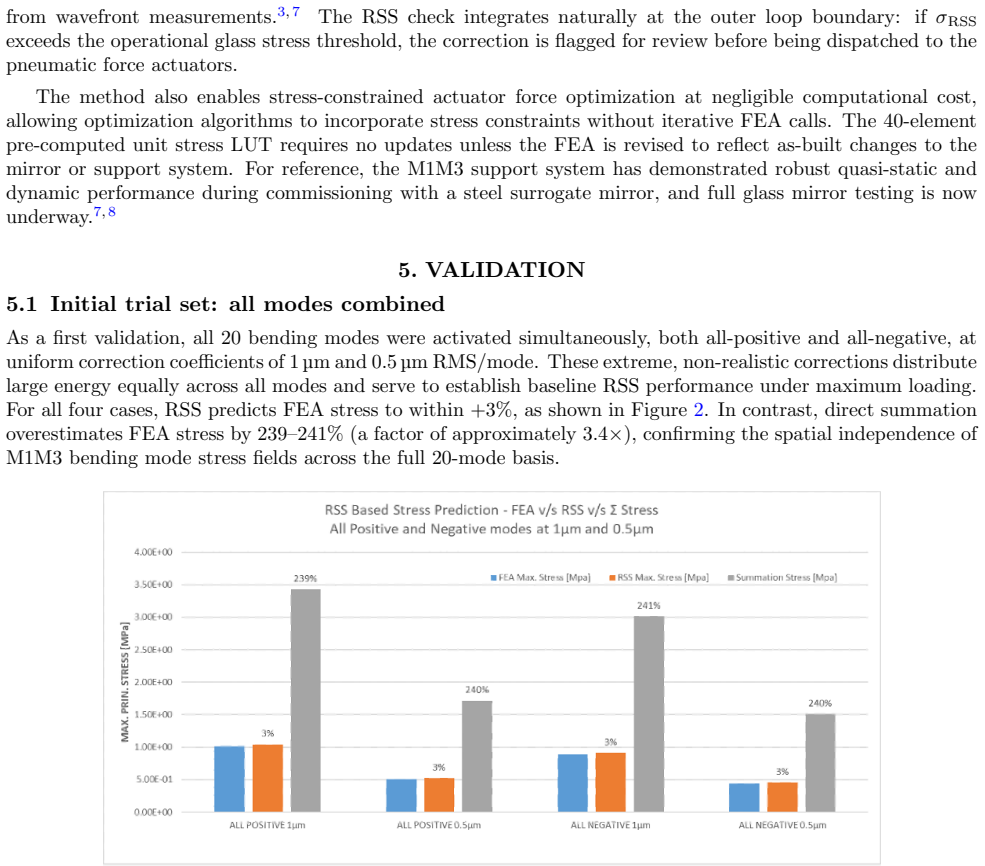
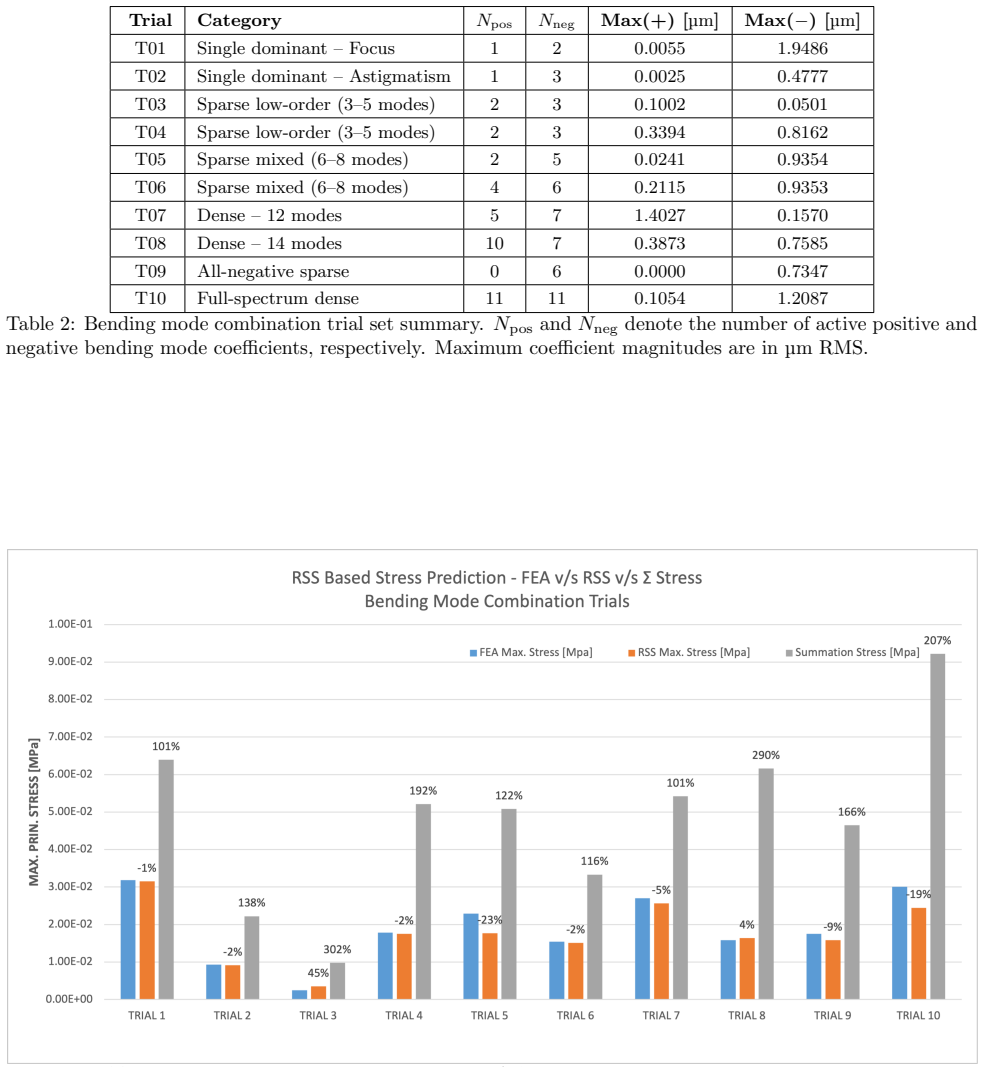
Unit displacement and corresponding unit stress fields for the first 20 natural bending modes of the M1M3 system are generated using NASTRAN; representative multi-mode corrections are then analyzed, and the RSS-based major principal stress predictions are shown to agree with the NASTRAN results within a few percent for peak principal major stress across the mirror glass substrate.
What carries the argument
Root-sum-square combination of pre-computed unit bending mode stress fields.
If this is right
- Near-instantaneous stress margin evaluation becomes possible for active optics corrections.
- Safety-limit checking can be performed in real time during telescope operations.
- Actuator-force optimization routines can incorporate stress constraints without added computational cost.
- The method integrates directly into the M1M3 active optics control system for ongoing use.
Where Pith is reading between the lines
- The same pre-computed unit stress approach could be tested on other large cast-borosilicate active mirrors to check transferability.
- Real-time control loops could use the RSS estimates to set tighter actuator force limits than displacement-only methods allow.
- Extending the validation to include thermal or gravity load cases would test whether the proportionality assumption holds under combined loading.
Load-bearing premise
That peak stresses combine by root-sum-square in the same manner as displacements because stress remains proportional to strain and strain to displacement.
What would settle it
A NASTRAN simulation or on-telescope measurement of peak major principal stress for a specific multi-mode correction (such as astigmatism plus coma) that deviates by more than a few percent from the RSS prediction.
Figures
read the original abstract
The Vera C. Rubin Observatory Simonyi Survey Telescope's primary-tertiary mirror (M1M3) is an actively supported, 8.4-m cast borosilicate optic controlled by 156 pneumatic actuators. This work presents a rapid stress-estimation methodology based on the root-sum-square (RSS) combination of Finite Element Analysis to derive pre-computed unit bending mode stresses. Since the stress is proportional to strain, and strain is proportional to displacements, we theorized that since the bending mode displacements can be combined RSS, that the peak stresses would also combine by RSS. We validate the RSS-based major principal stress predictions against NASTRAN simulations for representative bending mode combinations, demonstrating agreement within a few percent for peak Principal major stress across the mirror glass substrate. Unit displacement and corresponding unit stress fields for the first 20 natural bending modes of the M1M3 system are generated using NASTRAN. Representative multi-mode corrections including combinations that include astigmatism, coma, and spherical modes of higher order are then analyzed to compare the resulting peak principal stresses with RSS-based predictions. The method enables near instantaneous evaluation of stress margins for active optics corrections, safety-limit checking, and actuator-force optimization during telescope operations. This paper outlines the formulation, implementation workflow, validation results, and practical use cases for integrating RSS-based stress prediction into the Vera C. Rubin Observatory's M1M3 active optics system.
Editorial analysis
A structured set of objections, weighed in public.
Referee Report
Summary. The manuscript presents a rapid stress-estimation methodology for the Vera C. Rubin Observatory M1M3 active mirror system. It pre-computes unit bending mode stresses via NASTRAN FEA for the first 20 natural modes and proposes combining their peak major principal stresses via root-sum-square (RSS) to evaluate multi-mode active optics corrections. The authors justify the RSS approach by noting that stress is proportional to strain and strain to displacement (which are known to combine via RSS), and they report validation against full NASTRAN simulations for representative combinations of astigmatism, coma, and spherical modes, with agreement within a few percent for peak principal stress across the glass substrate. The method is intended to enable near-instantaneous stress margin checks during operations.
Significance. If the RSS method proves reliable across the full range of corrections, it would offer a practical tool for real-time safety-limit checking and actuator optimization in large active optics systems, reducing reliance on repeated full FEA runs. The independent NASTRAN validation for the tested cases is a clear strength, providing concrete numerical support rather than purely theoretical derivation.
major comments (2)
- [Abstract] Abstract (theorized proportionality paragraph): The justification that 'stress ∝ strain ∝ displacement, therefore peaks combine by RSS' does not hold for the reported scalar quantity. The peak major principal stress is max_x [largest eigenvalue of σ(x)], where σ_total(x) = Σ c_k σ_k(x) is linear but the max and eigenvalue operations are nonlinear and spatially dependent. The RSS of per-mode peak scalars therefore supplies neither an equality nor a general bound on the true peak of the superposed field.
- [Validation results] Validation results (representative multi-mode corrections paragraph): Validation is reported only for 'representative' combinations. No information is given on whether these include cases in which individual-mode principal-stress maxima coincide spatially and add constructively, nor on the number of combinations tested or any statistical measure (e.g., maximum observed error, distribution of residuals). Without such coverage, agreement 'within a few percent' for the tested set does not establish the method's suitability for safety-limit checking across all possible corrections.
minor comments (2)
- [Abstract] The abstract and methods description do not specify the exact linear coefficients c_k used in the representative combinations or the precise definition of 'peak Principal major stress' (e.g., whether it is the global maximum or a surface-averaged quantity).
- No equation is provided for the RSS formula as applied to the stress peaks, nor for how the unit mode stresses are normalized.
Simulated Author's Rebuttal
We thank the referee for the detailed and constructive comments. We address each major point below and will revise the manuscript accordingly to clarify the heuristic nature of the approach and expand the validation reporting.
read point-by-point responses
-
Referee: [Abstract] Abstract (theorized proportionality paragraph): The justification that 'stress ∝ strain ∝ displacement, therefore peaks combine by RSS' does not hold for the reported scalar quantity. The peak major principal stress is max_x [largest eigenvalue of σ(x)], where σ_total(x) = Σ c_k σ_k(x) is linear but the max and eigenvalue operations are nonlinear and spatially dependent. The RSS of per-mode peak scalars therefore supplies neither an equality nor a general bound on the true peak of the superposed field.
Authors: We agree that the peak major principal stress computation involves nonlinear operations (spatial maximum and eigenvalue extraction), so the RSS of per-mode peak scalars is not a rigorous equality or bound. The original justification was a heuristic based on linearity of the underlying stress and displacement fields. We will revise the abstract to present the RSS method explicitly as an empirical approximation whose accuracy is demonstrated by the NASTRAN validation rather than a direct theoretical result. revision: yes
-
Referee: [Validation results] Validation results (representative multi-mode corrections paragraph): Validation is reported only for 'representative' combinations. No information is given on whether these include cases in which individual-mode principal-stress maxima coincide spatially and add constructively, nor on the number of combinations tested or any statistical measure (e.g., maximum observed error, distribution of residuals). Without such coverage, agreement 'within a few percent' for the tested set does not establish the method's suitability for safety-limit checking across all possible corrections.
Authors: We acknowledge that the current description of the validation set is limited. In revision we will specify the number of combinations examined, confirm inclusion of cases with spatially coinciding stress maxima, and report quantitative measures including the maximum observed error and the distribution of residuals across the tested set. This additional detail will better substantiate the method's performance for operational use. revision: yes
Circularity Check
No significant circularity; hypothesis validated against independent simulations
full rationale
The paper's core step is a proportionality hypothesis (stress ∝ strain ∝ displacement) leading to an RSS rule for peak principal stresses, followed by direct numerical validation against separate NASTRAN runs on representative multi-mode cases. This validation is external to the hypothesis itself and does not reduce any claimed prediction to a fitted parameter or self-referential definition. No self-citations are load-bearing, no ansatz is smuggled, and no renaming of known results occurs. The derivation chain is therefore self-contained against external benchmarks.
Axiom & Free-Parameter Ledger
axioms (1)
- domain assumption Bending mode displacements can be combined using root-sum-square, and the same applies to peak stresses due to proportionality of stress to strain and strain to displacement.
Reference graph
Works this paper leans on
-
[1]
LSST primary/tertiary monolithic mirror,
Sebag, J., Gressler, W., Liang, M., Neill, D., Araujo-Hauck, C., Andrew, J., Angeli, G., Cho, M., Claver, C., Daruich, F., Gessner, C., Hileman, E., Krabbendam, V., Muller, G., Poczulp, G., Repp, R., Wiecha, O., Xin, B., Kenagy, K., Martin, H. M., Tuell, M. T., and West, S. C., “LSST primary/tertiary monolithic mirror,” in [Ground-based and Airborne Teles...
2016
-
[2]
Final design of the LSST primary/tertiary mirror cell assembly,
Neill, D. R., Muller, G., Hileman, E., DeVries, J., Araujo, C., Gressler, W. J., Lotz, P. J., Mills, D., Sebag, J., Thomas, S., Warner, M., and Wiecha, O., “Final design of the LSST primary/tertiary mirror cell assembly,” in [Ground-based and Airborne Telescopes VI],Proc. SPIE9906, 99060Q (2016)
2016
-
[3]
LSST M1M3 active mirror support system optimized to accommodate rapid telescope motions,
Daruich, F., Neill, D., Warner, M., Hileman, E., Cho, M., Dribusch, C., Araujo, C., Booth, M., Contaxis, C., Harris, R., Johnson, B., Knight, G., Mills, N., Muller, G., Stover, E., Wiecha, O., and Xin, B., “LSST M1M3 active mirror support system optimized to accommodate rapid telescope motions,” in [Ground-based and Airborne Telescopes VII],Proc. SPIE1070...
2018
-
[4]
Overview of the LSST active optics system,
Neill, D., Angeli, G., Claver, C., Hileman, E., DeVries, J., Sebag, J., and Xin, B., “Overview of the LSST active optics system,” in [Modeling, Systems Engineering, and Project Management for Astronomy VI], Proc. SPIE9150, 91500G (2014)
2014
-
[5]
LSST active optics system software architecture,
Thomas, S. J. et al., “LSST active optics system software architecture,” in [Ground-based and Airborne Telescopes VI],Proc. SPIE9906, 99063B (2016)
2016
-
[6]
Rubin observatory primary tertiary mirror cell assembly: optical testing of the fully assembled mirror support system,
Xin, B., Neill, D. R., Thomas, S., Claver, C. F., Contaxis, C., Hileman, E., Hubler, W. W., Loeff, A. R., Kenagy, K. L., Martin, H. M., Meyen, S., Tuell, M. T., and West, S. C., “Rubin observatory primary tertiary mirror cell assembly: optical testing of the fully assembled mirror support system,” in [Ground-based and Airborne Telescopes VIII],Proc. SPIE1...
2020
-
[7]
Rubin M1M3 support system dynamic performance,
Quint, B. C., Daruich, F., Kub´ anek, P., Neill, D. R., Megias, G., Shestakov, A., Shugart, A., Jeremie, A., Levine, B., Stalder, B., Lage, C., Sanmarti ` m, D., Boutigny, D., Urbach, E., Dennihy, E., Mu˜ noz Arancibia, F., Drass, H., Park, H., Sevilla-Noarbe, I., Sotuela, I., Sebag, J., Hern´ andez, J., Carlin, J., Aubel, K., Fanning, K., Reil, K., Torib...
2024
-
[8]
Rubin observatory primary tertiary mirror cell assembly: final integration and commissioning,
Daruich, F., Aguilar, C., Andrew, J., Araya, C., Aubel, K., Boutigny, D., Bugeno, E., Clements, A., Colleoni, F., Daugherty, K., Ferguson, P., Fern´ andez, M., Garc´ ıa, M., Godoy, R., Harris, R., Jeremie, A., Johnson, B., Kang, Y., Kubanek, P., Lopez, J., Lopez, R., Neill, D., Munoz, F., Ordenes, I., Park, H., Pineiro, E., Quint, B., Rascon, M., Reeve, T...
2024
-
[9]
Timoshenko, S. P. and Goodier, J. N., [Theory of Elasticity], McGraw-Hill, New York, 3rd ed. (1970)
1970
-
[10]
Analysis of active optics correction for a large honeycomb mirror,
Blomquist, S., Martin, H., Kang, H., et al., “Analysis of active optics correction for a large honeycomb mirror,” (2023). arXiv:2309.04584
-
[11]
Manufacture and final tests of the LSST monolithic primary/tertiary mirror,
Martin, H. M., Angel, J. R. P., Angeli, G. Z., Burge, J. H., Gressler, W. J., Kim, D., Kingsley, J. S., Law, K., Liang, M., Neill, D., Sebag, J., Strittmatter, P. A., Tuell, M. T., West, S. C., Woolf, N. J., and Xin, B., “Manufacture and final tests of the LSST monolithic primary/tertiary mirror,” in [Advances in Optical and Mechanical Technologies for Te...
2016
discussion (0)
Sign in with ORCID, Apple, or X to comment. Anyone can read and Pith papers without signing in.