REVIEW 3 major objections 4 minor 7 cited by
Metasurface-based Fluid Antennas: from Electromagnetics to Communications Model
T0 review · 3 major / 4 minor · reviewed 2026-08-06 · deepseek-v4-flash
Pith's one-line read DMA fluid antennas can match ideal flexible antennas in full-wave simulation.
desk verdict A real analytical bridge from DMA circuit models to FAS signal models, with genuine out-of-sample full-wave checks; the FAMA performance claim outruns the validation because absolute power quantities were never compared to CST. read the letter →
The pith
A machine-rendered reading of the paper's core claim, the machinery that carries it, and where it could break.
The reading
What carries the argument
The machinery is an admittance-matrix multiport network in which every slot, waveguide port, and user antenna is a port described by mutual admittances obtained from dyadic Green's functions. The radiating elements are magnetic dipoles with tunable load admittance $Y_{\mathrm{rad}}$ in the ON state and effectively infinite admittance when short-circuited. The bridge to communications is the DMA response vector $\mathbf{g}_u = \frac{1}{Y_g+Y_p}\tilde{\mathbf{Y}}_{sr}^T(\mathbf{Y}_s^{(u)}+\tilde{\mathbf{Y}}_{ss})^{-1}$, whose inner product with the wireless channel gives the equivalent channel; the same object appears in the covariance formula and governs power delivery, radiation efficiency, and the correlation between virtual ports.
What would settle it
Measure or full-wave simulate a DMA configuration outside the calibration set and compare the predicted and simulated radiation pattern or port correlation; disagreement beyond the already-observed endfire region would indicate that slot-to-slot coupling changes $Y_{\mathrm{rad}}$ in a way the constant-admittance model cannot capture.
Extended reading notes
Core claim
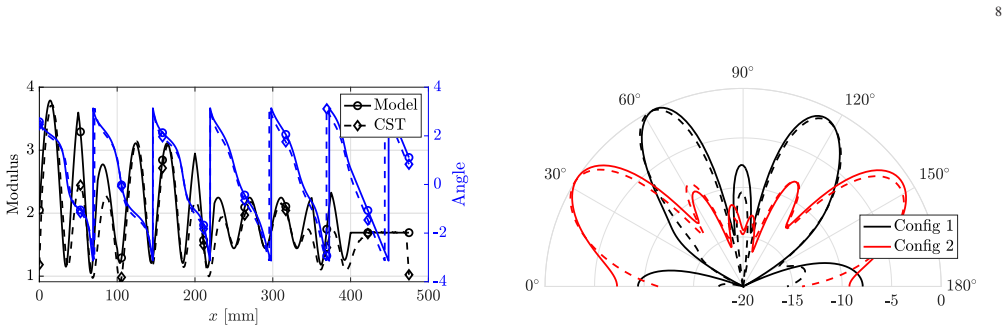
The central discovery is that a fluid antenna does not have to move in space: switching p-i-n diode states over slots of a waveguide-fed metasurface changes the radiation pattern, and this is equivalent to moving the antenna in beamspace. Using circuit theory with each slot modeled as an infinitesimal magnetic dipole, the paper derives the end-to-end received-signal model and the closed-form covariance $\left(\mathbf{\Sigma}_{\tilde m}^{(m)}\right)_{u,\tilde u}=\mathbf{g}_u^T\mathbf{\Sigma}_{y,\tilde m}^{(m)}\mathbf{g}_{\tilde u}^*$, which separates environment-imposed channel correlation from the controllable DMA response. Full-wave simulations of a 16-slot substrate-integrated-waveguide antenna at 2.4 GHz confirm the model's predicted waveguide field, two-dimensional and three-dimensional radiation patterns, and the correlation between virtual ports. The paper concludes that a practical DMA-based FAS can reach the performance of the idealized freely-moving antenna, and that densifying the codebook preserves the oversampling gain that sparse codebooks lose.
Load-bearing premise
The model assumes every elliptical slot behaves as an infinitesimal magnetic dipole with a constant admittance $Y_{\mathrm{rad}}$ fitted once on a single reference configuration, and that this value stays valid when other slots are switched on or off.
Editorial extensions
If this is right
- A DMA-based fluid antenna can match the outage performance of an idealized position-flexible antenna when its codebook is dense enough.
- The correlation between virtual ports is a product of the environment covariance and the DMA response, so antenna design can shape correlation rather than merely inherit it.
- Sparse codebooks lose most of the oversampling gain, so the number and design of configurations matter as much as the physical aperture.
- Because switching is electronic, the model supports fast fluid-antenna multiple access scenarios in which mechanical movement would be too slow.
Reading between the lines
- If the constant-admittance assumption holds beyond the tested designs, the model's closed-form covariance makes it practical to optimize codebooks for a target correlation structure rather than only for beam direction.
- The same circuit-theory bridge could be applied to other reconfigurable surfaces, such as reconfigurable-intelligent-surface links, to bring their electromagnetic degrees of freedom into a communication model.
- An experimental prototype with a switched slot array and a channel sounder could test whether the simulated performance parity with an ideal fluid antenna survives real diode losses and manufacturing tolerances.
Editorial analysis
A structured set of objections, weighed in public.
Referee Report
Summary. The manuscript develops a circuit-theoretic model of dynamic metasurface antennas (DMAs) and specializes it to a p-i-n-diode-controlled, single-waveguide fluid antenna. The model is mapped onto the standard FAS signal model, yielding the effective channel response vector g_u and a closed-form expression for the covariance between virtual ports, Eq. (43). Two parameters, the magnetic-dipole length l_m and the radiating-slot admittance Y_rad, are calibrated on one reference configuration using CST full-wave data; the model is then validated against CST for other configurations in terms of in-waveguide field, normalized radiation patterns, and correlation coefficients. The paper concludes by evaluating FAMA outage probability, reporting that a 46-codeword DMA-based FAS performs close to an ideal freely-moving antenna.
Significance. The framework is a useful bridge between electromagnetics and FAS communications, and the covariance expression in Eq. (43) is a physically grounded design tool that clarifies how the DMA response, rather than the propagation environment alone, shapes the effective port correlation. The validation is genuinely out-of-sample with respect to configurations: calibration is performed on Config. 3 while Configs. 1-2 and 5-14 are used for testing. The paper also provides closed-form expressions and promises reproducible MATLAB code. The main limitation is that the absolute-power quantities that drive the final performance claim are never checked against full-wave simulation, so the headline conclusion in Fig. 11 is not yet fully supported.
major comments (3)
- [Sec. IV-B and Sec. V, Fig. 11] The performance conclusion in Fig. 11 is computed exclusively from the analytical model, yet no full-wave check is reported for the configuration-dependent absolute powers that determine port selection in Eq. (46). The validations in Figs. 5-7 use normalized radiation patterns, and Fig. 9 reports the normalized correlation coefficient (45); both operations remove exactly the diagonal information of the covariance matrix that sets the relative port powers. The statements in Sec. IV-B that most configurations achieve S11 below -10 dB and average radiation efficiency around 70% are not verified against CST for the codebook configurations. I therefore do not consider the closeness to the ideal FAS in Fig. 11 to be established. Please add full-wave validation of S11, Prad/Ps, and at least several diagonal entries of the covariance matrix for the codebook configurations, or substantially weaken the corresponding claim.
- [Sec. III-A, Eqs. (28)-(30)] The model treats inactive slots as perfect shorts (Ys,n -> infinity), whereas the forward-biased SMP1345 diode has finite impedance. Because Yrad is calibrated on a single configuration via Eq. (36), any configuration-dependent residual loading of inactive slots is absorbed into Yrad only for that reference configuration. If the residual load of an inactive slot changes with the pattern of active slots, the predicted power imbalance across the 46 codebook ports will be biased, which propagates into the SIR-maximizing selector in Eq. (46) and into Fig. 11. Please quantify the sensitivity of the results to this idealization, for example by repeating the calibration and the outage evaluation with the measured ON-state impedance included in Ys for inactive slots, or by providing a quantitative argument that the residual is negligible.
- [Sec. III-C2, Eq. (36)] The calibration target for Yrad is the internal waveguide field h_z,w, rather than the radiated power or the slot currents. This choice is appropriate for pattern-type metrics, but it does not by itself constrain the absolute radiated power that enters the diagonal of the covariance matrix and the SIR in Eq. (46). The paper should either explain explicitly why fitting the internal field fixes the absolute power scale or add a validation quantity that directly tests it, such as Prad/Ps or |S11| for the codebook configurations.
minor comments (4)
- [Abstract and Sec. I] The phrase 'complete analytical model' overstates the role of the two parameters lm and Yrad, which are themselves fitted to full-wave data in Eqs. (35)-(36); consider calling the result a 'calibrated analytical model' or tempering the word 'complete'.
- [Sec. IV-B, Fig. 10] Fig. 10 compares eigenvalues of the 20x20 wireless-channel covariance with eigenvalues of the 46x46 effective-port covariance; please state how the spectra are aligned or truncated so that the comparison is not misleading.
- [Sec. IV-B, Eq. (44)] The optimization variable S is called a selection matrix, but the text then says 'checking all the possible configurations'; please clarify whether S is a binary diagonal matrix or a subset of active-slot indices.
- [References] Reference [21] contains a typo in the arXiv identifier: '2506:09181' should be '2506.09181'.
Circularity Check
No significant circularity: the fitted parameter is calibrated on one explicitly declared configuration and tested on other configurations, and the covariance expression is an algebraic consequence of the stated linear model.
full rationale
The derivation is not circular. The only fitted parameters are lm and Yrad, and the paper states they are calibrated on Configuration 3 only: 'Model calibration is done for Configuration 3 by numerically solving (36) ... Once calibrated, the values of lm and Yrad remain constant for any other configuration.' The validations in Figs. 4-6 and 9 use different configurations (Configs 1, 2, and codebook Configs 5-14), so they are genuine out-of-sample checks. The claimed signal model in Eq. (41) follows from circuit algebra (Eqs. (2)-(12)) and defines gu as a function of the admittance model, not from the quantity being predicted. Eq. (43) is a direct consequence of the bilinear form in Eq. (42) and the definition of gu; it is a mathematical identity given the model, not a fitted result, and it is not used to fit Yrad. The use of Ref. [18] for the mutual-admittance formulas is a self-citation by one of the authors, but the modeling assumptions are independently exercised here through full-wave CST comparisons and the cited foundation is published and falsifiable; no load-bearing claim rests solely on the self-citation. The skeptic's concern--that absolute powers (S11, radiated efficiency, covariance diagonal) for the N=20 codebook are not compared with full-wave data--is a validation-gap/correctness-risk issue, not a circularity: the absence of a check does not make the analytical output equal to its input. No step reduces, by construction, to its own input.
Assumptions & free parameters
free parameters (2)
- lm (magnetic dipole length) =
sqrt( Y0_cst * a * b * k^2 / (2 * omega * epsilon * kx) ), Eq. (35)
- Yrad (active slot load admittance) =
3.7e-5 - i*0.0037 S (Table I)
assumptions (5)
- domain assumption Radiating slots and devices are modeled as infinitesimal magnetic dipoles oriented along z.
- domain assumption Unilateral assumption: backscattering from the wireless channel is neglected (Y_ds^T = 0 in transmit, Y_ds = 0 in receive).
- domain assumption An infinite PEC ground plane is assumed for the DMA.
- domain assumption Waveguides are lossless, filled with permittivity epsilon, and only the TE10 mode propagates.
- ad hoc to paper The self-admittance singularity of the magnetic dipole is removed by discarding the diverging real part and keeping a finite reactive term.
Cite this review
Pith. "Pith review of Metasurface-based Fluid Antennas: from Electromagnetics to Communications Model." pith.science (2026). https://pith.science/paper/7NTQ5RIN
@misc{pith2026250717982,
  author       = {Pith},
  title        = {Pith review of: Metasurface-based Fluid Antennas: from Electromagnetics to Communications Model},
  year         = {2026},
  howpublished = {\url{https://pith.science/paper/7NTQ5RIN}},
  note         = {Machine review of arXiv:2507.17982}
}
read the original abstract
Fluid antenna systems (FASs) have become a popular topic in the wireless community as an effective yet simple means of exploiting spatial diversity. Due to the limitations of physically moving radiating elements, electronically reconfigurable antennas are emerging as practical implementations of FASs, since changing the radiation pattern is functionally equivalent to physically moving the device. However, electronically reconfigurable antennas pose a challenge in terms of analytical modeling, often requiring full-wave simulations or measurements for their characterization; this severely limits the extraction of theoretical insights useful for system design. Motivated by these difficulties and the growing interest in FASs, we propose in this paper a complete analytical model for metasurface-based embodiments of FASs. Specifically, we advocate for the implementation of the FAS concept through dynamic metasurface antennas (DMAs), hitherto proposed as array replacements in multiple-input multiple-output (MIMO) systems. We leverage circuit theory to rewrite the conventional signal model of FASs in terms of admittance matrices accounting for the electromagnetic effects inherent to metasurfaces. The model is validated with full-wave simulations, showing good agreement. We further illustrate how to apply the model for standard performance analysis, and provide closed-form expressions for key metrics, including the resulting signal covariance matrix. Results confirm that practical DMA-based FASs can achieve similar performance to that of idealized implementations of position-flexible antennas.
Figures


Figures from the paper (7 more)


Forward citations
Cited by 7 Pith papers
-
Electromagnetic-Aware Fluid Antenna Array
An EM-aware current-domain framework for planar fluid antenna arrays enables joint position–current optimization that exploits mutual coupling for lower sidelobes and higher multi-user sum rates in simulation.
-
ADC-Aware End-to-End Optimization of a Dynamic Metasurface Antenna with Strong Mutual Coupling for Monostatic Scene Classification
ADC-aware end-to-end training of a 96-element DMA with experimentally calibrated mutual-coupling model maintains 87.2% scene-classification accuracy under 1-bit uniform ADCs, versus 56% when ADC effects are ignored.
-
Implementing Fluid Antennas in the Beamspace: Performance Evaluation and Codebook Design
Metasurface-based fluid antennas outperform conceptual fluid antennas in interference-heavy multi-user scenarios by exploiting projection onto the interference null space.
-
Hybrid Multiport Receivers for Slow Fluid Antenna Multiple Access
A fluid-antenna hybrid multiport receiver achieves performance close to full-digital multiport schemes using only 2 RF chains and cuts computational load by over 60 percent in slow multiuser scenarios.
-
Optimizing Dynamic Metasurface Antenna Configurations for Direction-of-Arrival and Polarization Estimation Using an Experimentally Calibrated Multiport-Network Model
An experimentally calibrated multiport-network model enables optimization of dynamic metasurface antenna configuration sequences for joint DoA-polarization estimation, delivering the largest gains over random sequence...
-
Learned Blockwise Port Activation for Real Time Beamforming in Fluid Antenna Arrays
A learned blockwise port-activation scheme for fluid antenna arrays lowers average peak sidelobes by 3.26 dB over uniform sparse activation at a slightly higher simulated sum rate, and by 8–10 dB over channel-driven s...
-
Hybrid Multiport Receivers for Slow Fluid Antenna Multiple Access
Proposes FAHM receiver using analog combining and a port-selection stopping criterion that achieves comparable performance to fully-digital multiport schemes with only 2 RF chains and over 60% computational reduction ...
Reference graph
Works this paper leans on
-
[18]
Electromagnetic based communication model for dynamic me tasurface antennas,
R. J. Williams, P . Ram´ ırez-Espinosa, J. Y uan, and E. de Carvalho, “Electromagnetic based communication model for dynamic me tasurface antennas,” IEEE Trans. Wireless Commun. , vol. 21, no. 10, pp. 8616– 8630, 2022
2022
-
[1]
Br uce lee- inspired fluid antenna system: Six research topics and the po tentials for 6G,
K.-K. Wong, K.-F. Tong, Y . Shen, Y . Chen, and Y . Zhang, “Br uce lee- inspired fluid antenna system: Six research topics and the po tentials for 6G,” Front. Comms. Net. , vol. 3, 2022
2022
-
[2]
Slow fluid antenna multiple access,
K.-K. Wong, D. Morales-Jimenez, K.-F. Tong, and C.-B. Ch ae, “Slow fluid antenna multiple access,” IEEE Trans. Commun. , vol. 71, no. 5, pp. 2831–2846, 2023
2023
-
[3]
A new spatial block-correlation model for fluid antenna systems,
P . Ram´ ırez-Espinosa, D. Morales-Jimenez, and K.-K. Wo ng, “A new spatial block-correlation model for fluid antenna systems, ” IEEE Trans. Wireless Commun., vol. 23, no. 11, pp. 15 829–15 843, 2024
2024
-
[4]
Modeling and performance ana lysis for movable antenna enabled wireless communications,
L. Zhu, W. Ma, and R. Zhang, “Modeling and performance ana lysis for movable antenna enabled wireless communications,” IEEE Trans. Wireless Commun., vol. 23, no. 6, pp. 6234–6250, 2024
2024
-
[5]
F luid antenna system: New insights on outage probability and dive rsity gain,
W. K. New, K.-K. Wong, H. Xu, K.-F. Tong, and C.-B. Chae, “F luid antenna system: New insights on outage probability and dive rsity gain,” IEEE Trans. Wireless Commun. , vol. 23, no. 1, pp. 128–140, 2024
work page 2024
-
[6]
A new analy tical ap- proximation of the fluid antenna system channel,
M. Khammassi, A. Kammoun, and M.-S. Alouini, “A new analy tical ap- proximation of the fluid antenna system channel,” IEEE Trans. Wireless Commun., vol. 22, no. 12, pp. 8843–8858, 2023
2023
-
[7]
Movable-antenna enh anced multiuser communication via antenna position optimizatio n,
L. Zhu, W. Ma, B. Ning, and R. Zhang, “Movable-antenna enh anced multiuser communication via antenna position optimizatio n,” IEEE Trans. Wireless Commun. , vol. 23, no. 7, pp. 7214–7229, 2024
2024
Show all 36 references
-
[8]
Movable antennas for wireles s commu- nication: Opportunities and challenges,
L. Zhu, W. Ma, and R. Zhang, “Movable antennas for wireles s commu- nication: Opportunities and challenges,” IEEE Commun. Mag. , vol. 62, no. 6, pp. 114–120, 2024
2024
-
[9]
Movable antenna for wireless communications: Pro- totyping and experimental results,
Z. Dong et al. , “Movable antenna for wireless communications: Pro- totyping and experimental results,” arXiv e-prints, arXiv:2408.08588 [cs.IT], 2024
2024 arXiv
-
[10]
Fluidically beam-steering meta surfaced antenna,
A. H. Naqvi and S. Lim, “Fluidically beam-steering meta surfaced antenna,” in 2019 IEEE Int. Symp. Antennas Propag. USNC-URSI Radio Science Meeting , 2019, pp. 695–696
2019
-
[11]
Liqu id antennas: Past, present and future,
Y . Huang, L. Xing, C. Song, S. Wang, and F. Elhouni, “Liqu id antennas: Past, present and future,” IEEE Open J. Antennas Propag. , vol. 2, pp. 473–487, 2021
2021
-
[12]
Electromagnetically reconfigurable fluid antenna system for wireless communications: Design, modeling, algorithm , fabrication, and experiment,
R. Wang et al., “Electromagnetically reconfigurable fluid antenna system for wireless communications: Design, modeling, algorithm , fabrication, and experiment,” arXiv e-prints, arXiv:2502.19643 [eess.SP] , 2025
2025
-
[13]
Design and implementation of mmwave surface wave enabled fluid antennas and experimental results for fluid ant enna multi- ple access,
Y . Shen et al. , “Design and implementation of mmwave surface wave enabled fluid antennas and experimental results for fluid ant enna multi- ple access,” arXiv e-prints, arXiv:2405.09663 [eess] , 2024
2024
-
[14]
Pro- grammable meta-fluid antenna for spatial multiplexing in fa st fluctuating radio channels,
B. Liu, K.-F. Tong, K.-K. Wong, C.-B. Chae, and H. Wong, “ Pro- grammable meta-fluid antenna for spatial multiplexing in fa st fluctuating radio channels,” Opt. Express , vol. 33, no. 13, pp. 28 898–28 915, Jun 2025
2025
-
[15]
A novel pixel-based reconfigurable antenna applied in fluid antenna systems with high switching speed,
J. Zhang et al. , “A novel pixel-based reconfigurable antenna applied in fluid antenna systems with high switching speed,” IEEE Open J. Antennas Propag., vol. 6, no. 1, pp. 212–228, 2025
2025
-
[16]
Dynamic metasurface antennas for 6G extreme ma ssive MIMO communications,
N. Shlezinger, G. C. Alexandropoulos, M. F. Imani, Y . C. Eldar, and D. R. Smith, “Dynamic metasurface antennas for 6G extreme ma ssive MIMO communications,” IEEE Wireless Commun. , vol. 28, no. 2, pp. 106–113, 2021
2021
-
[17]
Hierarc hical codebook design with dynamic metasurface antennas for energy-effici ent arrays,
J. Carlson, M. R. Castellanos, and R. W. Heath, “Hierarc hical codebook design with dynamic metasurface antennas for energy-effici ent arrays,” IEEE Trans. Wireless Commun. , vol. 23, no. 10, pp. 14 790–14 804, 2024
2024
-
[19]
Energy efficiency maximization of massive MIMO communicat ions with dynamic metasurface antennas,
L. Y ou, J. Xu, G. C. Alexandropoulos, J. Wang, W. Wang, an d X. Gao, “Energy efficiency maximization of massive MIMO communicat ions with dynamic metasurface antennas,” IEEE Trans. Wireless Commun. , vol. 22, no. 1, pp. 393–407, 2023
2023
-
[20]
The tri-hybrid MIMO architecture,
R. W. Heath et al. , “The tri-hybrid MIMO architecture,” arXiv preprint arXiv:2505.21971, 2025
2025 arXiv
-
[21]
Energy effi- ciency of DMAs vs. conventional MIMO: a sensitivity analysi s,
P . Ram´ ırez-Espinosa, D. Morales-Jim´ enez, and B. Sor et, “Energy effi- ciency of DMAs vs. conventional MIMO: a sensitivity analysi s,” arXiv e-prints, arXiv:2506:09181 [eess.SP] , 2025
2025
-
[22]
Electronically steered metasurface antenna,
M. Boyarsky, T. Sleasman, M. F. Imani, J. N. Gollub, and D . R. Smith, “Electronically steered metasurface antenna,” Scientific reports , vol. 11, no. 1, p. 4693, 2021
2021
-
[23]
Waveguide-fed tunable metamaterial element for dynamic apertures,
T. Sleasman et al. , “Waveguide-fed tunable metamaterial element for dynamic apertures,” IEEE Antennas Wireless Propag. Lett. , vol. 15, pp. 606–609, 2016
2016
-
[24]
Experimental char acterization of a waveguide-fed varactor-tuned metamaterial element usin g the coupled dipole framework,
I. Y oo, D. R. Smith, and M. Boyarsky, “Experimental char acterization of a waveguide-fed varactor-tuned metamaterial element usin g the coupled dipole framework,” IEEE Antennas Wireless Propag. Lett., vol. 22, no. 2, pp. 387–391, 2023
2023
-
[25]
Programmab le meta- surface based on substrate-integrated waveguide for compa ct dynamic- pattern antenna,
S. Li, F. Xu, X. Wan, T. J. Cui, and Y .-Q. Jin, “Programmab le meta- surface based on substrate-integrated waveguide for compa ct dynamic- pattern antenna,” IEEE Trans. Antennas Propag. , vol. 69, no. 5, pp. 2958–2962, 2021
2021
-
[26]
60 GHz programmable dynamic metasurface antenna (DMA) for next-generation communication, sensing, and ima ging appli- cations: From concept to prototype,
A. Jabbar et al. , “60 GHz programmable dynamic metasurface antenna (DMA) for next-generation communication, sensing, and ima ging appli- cations: From concept to prototype,” IEEE Open J. Antennas Propag. , vol. 5, no. 3, pp. 705–726, 2024
2024
-
[27]
Closed-for m expressions for spatial correlation parameters for perfor mance analysis of fluid antenna systems,
K. K. Wong, K. F. Tong, Y . Chen, and Y . Zhang, “Closed-for m expressions for spatial correlation parameters for perfor mance analysis of fluid antenna systems,” Electronics Lett., vol. 58, no. 11, pp. 454–457, 2022
2022
-
[28]
Analysis of a waveguide-fed metasurface antenna,
D. R. Smith, O. Y urduseven, L. P . Mancera, P . Bowen, and N. B. Kundtz, “Analysis of a waveguide-fed metasurface antenna,” Phys. Rev. Applied, vol. 8, p. 054048, Nov 2017
2017
-
[29]
Discrete- dipole approximation model for control and optimization of a holog raphic metamaterial antenna,
M. Johnson, P . Bowen, N. Kundtz, and A. Bily, “Discrete- dipole approximation model for control and optimization of a holog raphic metamaterial antenna,” Appl. Opt., vol. 53, no. 25, pp. 5791–5799, 2014
2014
-
[30]
Application of the minimum scattering ante nna theory to mismatched antennas,
P . Rogers, “Application of the minimum scattering ante nna theory to mismatched antennas,” IEEE Trans. Antennas Propag. , vol. 34, no. 10, pp. 1223–1228, 1986
1986
-
[31]
On the eigenfu nction expansion of electromagnetic dyadic Green’s functions in r ectangular cavities and waveguides,
L. Li, P . Kooi, M. Leong, T. Y eo, and S. Ho, “On the eigenfu nction expansion of electromagnetic dyadic Green’s functions in r ectangular cavities and waveguides,” IEEE Trans. Microw. Theory Techn. , vol. 43, no. 3, pp. 700–702, Mar. 1995
1995
-
[32]
Compact ultra m assive antenna array: A simple open-loop massive connectivity sch eme,
K.-K. Wong, C.-B. Chae, and K.-F. Tong, “Compact ultra m assive antenna array: A simple open-loop massive connectivity sch eme,” IEEE Trans. Wireless Commun. , vol. 23, no. 6, pp. 6279–6294, 2024
2024
-
[33]
D. M. Pozar, Microwave engineering , 4th ed. Hoboken, NJ: Wiley, 2012
2012
-
[34]
Phy sically consistent modeling of wireless links with reconfigurable i ntelligent surfaces using multiport network analysis,
J. A. Nossek, D. Semmler, M. Joham, and W. Utschick, “Phy sically consistent modeling of wireless links with reconfigurable i ntelligent surfaces using multiport network analysis,” IEEE Wireless Commun. Lett., vol. 13, no. 8, pp. 2240–2244, 2024
2024
-
[35]
Simu lation and experiment on SIW slot array antennas,
L. Y an, W. Hong, G. Hua, J. Chen, K. Wu, and T. J. Cui, “Simu lation and experiment on SIW slot array antennas,” IEEE Microw. Wireless Compon. Lett. , vol. 14, no. 9, pp. 446–448, 2004
2004
-
[36]
SMP1345 Series Datasheet,
Skyworks Solutions, “SMP1345 Series Datasheet,” http s://www. skyworksinc.com/Products/Diodes/SMP1345-Series, accessed: 2025-07- 10
2025
Reviewed August 6, 2026 · model on record in the stance chip above.
Discussion (0). Sign in to comment.