REVIEW 3 major objections 4 minor 11 references
Information Degradation and Misinformation in Gossip Networks
T0 review · 3 major / 4 minor · reviewed 2026-08-10 · deepseek-v4-flash
Pith's one-line read A node's stored gossip quality equals the degradation chain applied to the fastest path's hop count.
desk verdict The paper's core idea is attractive, but the main theorem has a real coupling gap that likely breaks the hopcount identity, and the ring lemma has a concrete algebraic error. read the letter →
The pith
A machine-rendered reading of the paper's core claim, the machinery that carries it, and where it could break.
The reading
What carries the argument
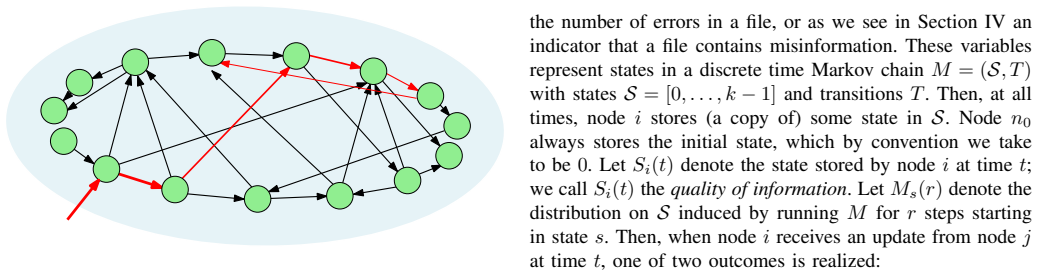
The load-bearing object is the reversed auxiliary graph G′: take the gossip graph, reverse every edge, and weight each edge by an independent exponential random variable with the same rate as the gossip update on that edge. The first-passage time T(i,n0) in G′ reproduces the age process, and the number H(i,n0) of edges on the minimizing path is argued to be the exact number of times the degradation Markov chain is applied to the stored packet. All later scaling laws come from bounding this hopcount in the complete graph and the ring.
What would settle it
Simulate the continuous-time gossip process on a small graph, such as a source plus three nodes arranged so that a direct edge and a two-hop path have comparable first-passage times, with explicit rates and a two-state true/false chain; compare the empirical P[Si(t)=T] at each node to $p^{{H(i,n0)}}$. If any positive-probability overwrite along the minimizing path changes the number of Markov transitions the winning packet undergoes, the observed distribution will diverge from the Theorem 1 prediction.
Extended reading notes
Core claim
The paper establishes Theorem 1: for a gossip network with source n0, if T(i,n0) is the first-passage time in the reversed weighted auxiliary graph and H(i,n0) is the number of edges on the minimizing path, then Si(t) = -1 when T(i,n0) > t and Si(t) = M0(H(i,n0)) otherwise. In other words, a node's information quality is exactly the degradation Markov chain evaluated at the hop count of the fastest path. The proof couples the reversed first-passage process to the age process from earlier work and argues that the packet that wins the race survives without being overwritten. Specializing to a two-state true/false chain, the paper derives P(Kn) = $p^{{Θ(log n)}}$ and P(Cn) = $p^{{Θ(√n)}}$, and conjectures that all gossip networks have hopcount and first-passage time scaling at the same rate, so the networks with the best age of information also spread misinformation the slowest.
Load-bearing premise
The proof assumes that the packet which eventually reaches a node travels the exact minimizing path without ever being overwritten by a fresher packet, so the number of Markov-chain transitions equals the hop count; in a continuous gossip stream this survival is asserted via a coupling rather than fully proved.
Editorial extensions
If this is right
- If Theorem 1 holds, quality analysis reduces to hopcount analysis: to know what any node stores, compute the fastest-path hop count and run the degradation chain that many steps.
- In the fully connected graph, the long-run fraction of truthful nodes is p^{Θ(log n)}; with fixed p below 1 this decays as a power of n.
- On the ring, the long-run fraction of truthful nodes is p^{Θ(√n)}, which decays exponentially in √n and is much worse than the clique's polynomial decay.
- The source rate and per-edge rates drop out of the quality law except through the first-passage time and hopcount, so the results extend to arbitrary λ after rescaling time.
- The paper's conjecture that hopcount and first-passage time scale together in every gossip network implies that networks with the best age-of-information scaling also retain truthful information the longest.
Reading between the lines
- The paper leaves implicit a testable consequence: in any graph where the hopcount of the first-passage path has a known scaling, the truthful fraction should scale as p raised to that hopcount; for grids this would predict a p^{Θ(n^{1/3})} law if the conjecture holds.
- Comparing the paper's 'timeliness prevails' model with the earlier 'truth prevails' model under the same first-passage coupling on K_n or C_n would isolate the effect of stale-packet recovery, which the paper identifies as the likely reason earlier simulations showed more truthful nodes.
- If the minimizing-path survival assumption fails under heavy traffic, the true quality distribution could depend on overwrite counts rather than hopcount alone; a small network with two near-equal-speed paths would separate those predictions.
Signed reviews
Editorial analysis
A structured set of objections, weighed in public.
Referee Report
Summary. The manuscript introduces a model of information quality in gossip networks, in which each packet's quality evolves according to a discrete-time Markov chain as it is forwarded, and nodes always accept packets with a newer timestamp. The central claim, Theorem 1, is that the quality stored at node i at time t is either undefined or M0(H(i,n0)), where H(i,n0) is the hopcount of the first-passage path in a reversed auxiliary graph. Section IV specializes the Markov chain to a true/false misinformation model and states that the limiting proportion of truthful nodes is p^{Theta(log n)} for the complete graph and p^{Theta(sqrt n)} for the ring graph. The proof of Theorem 1 is presented as a coupling with a single packet in the reversed graph, and Lemma 1 is used to bound the ring hopcount.
Significance. If Theorem 1 were valid, it would be an attractive and useful reduction: information quality would be a function of the hopcount of the first-passage path, and all of the existing AoI hopcount machinery would transfer immediately to content quality. The two-state specialization gives crisp, falsifiable scaling predictions and a clear qualitative comparison between complete and ring graphs. The paper also has the merit of attempting to move beyond AoI to the actual content stored at nodes. However, the central identity is not established and, under the model as written, appears to be false; the later scaling results therefore do not follow. The potential significance is high, but the present manuscript does not support it.
major comments (3)
- [Section III, proof of Theorem 1 (after Eq. (8))] The proof tracks a single packet and explicitly assumes that this packet is not overwritten, but overwriting by newer packets is a defining feature of the model in Section II.A: a node accepts every packet with a newer timestamp, regardless of the route it took. This is not a harmless technicality. Concretely, let S-A-i have total delay 2 and S-B-C-i have total delay 3. Suppose version 1 is generated at time 0 and reaches i at time 2 via S-A-i, and version 2 is generated at time epsilon and first reaches i at time 3+epsilon via S-B-C-i, because the source-to-A clock has not rung after epsilon. At that time i stores version 2, so Si(t)=M0(3) with positive probability, while H(i,n0)=2. This contradicts Eq. (3) even in distribution. The sentence 'assuming the packet is not overwritten at some point' is exactly the missing condition, and it is not guaranteed by the model. Since Theorems 3 and 4 are obtained by composing Eq. (3) with hopcount bounds, their p^{Theta(log n)} and p^{Theta(sqrt n)} conclusions are not supported by the current proof. A different model, such as a single packet with no subsequent source updates, would be needed for the statement as written.
- [Lemma 1, Eqs. (13)-(15)] The displayed probability computation is algebraically incorrect. For independent X ~ Exp(1) and Y ~ Exp(i/n), P(X<Y) = n/(n+i), not (n-i)/(n+1). Equation (15) is then used in Eq. (17) to compute the expected absorption time, so the claimed expected hopcount bound is not established by the argument as written. In addition, the transition probabilities in Eq. (12) do not match the boundary-clock probability computed in Eqs. (13)-(15); the claimed coupling between the Markov chain X(t) and the exploration of the auxiliary cycle is asserted rather than proved. It is possible that the Theta(sqrt n) conclusion can be salvaged with the correct probability, but the current proof does not do so.
- [Section IV, paragraph before Theorem 3] The reduction of the complete-graph hopcount to Theta(log n) is not a proof. The text changes zero-weight source edges to Exp(1/n) edges and then rescales all edge weights by n, but it does not show that these operations preserve the hopcount or that the hypotheses of the result in [11] are satisfied by the resulting nonuniform edge-weight model. The sentence 'We omit the tedious details, as the proof follows almost verbatim from [11]' is not a substitute for the argument. Since Theorem 3 is one of the two main quantitative results, this is a load-bearing gap.
minor comments (4)
- [Section II.A, first paragraph] The notation 'lambda_j(i) != lambda_j(i)' is a typo; it should presumably be 'lambda_j(i) != lambda_i(j)'.
- [Abstract and Theorems 3-4] The text says 'average number of nodes containing truthful information', but the quantity P(G) defined in Eq. (9) is a proportion, not a number; please rephrase consistently.
- [Section IV, Observation 1 and Theorem 4] The notation p^{Theta(log n)} and p^{Theta(sqrt n)} should specify whether the constants in Theta are uniform in n and over the range of p; this matters when p varies with n.
- [References] Reference [7] is missing the colon in the arXiv identifier and would benefit from a year; the arXiv ids in [7] and [8] should be formatted consistently.
Circularity Check
No significant circularity: Theorem 1 extends an independent prior age result, and the misinformation scaling follows from hopcount bounds without fitted parameters.
full rationale
The possible circularity candidate is the reliance on [8, Theorem 2], which shares the present paper's first author and is load-bearing for Theorem 1. However, [8, Theorem 2] is an independent prior theorem about the age process only: it states X̃_i(t)=min{T(i,n0),t}, and its assumptions do not include the target quality/misinformation claim. It therefore functions as real evidence rather than a self-citation loop. The later results are also non-circular: Theorem 3 composes the two-state observation P[M_T(k)=T]=p^k with an external hopcount bound from Bhamidi et al. for K_n, and Lemma 1 gives a self-contained coupling argument for the ring yielding EH=Θ(√n); Theorem 4 is the same composition. No parameter is fitted to the target conclusion, and no quantity is merely renamed. The main caveat is a proof gap, not circularity: in the proof of Theorem 1, the text says a packet on the minimal path will be mutated 'exactly equal to the length of γ′, assuming the packet is not overwritten at some point' and then asserts that by Theorem 2 the packet 'will survive.' In the finite-λe model, a newer source update can arrive along a non-geodesic path with more hops and be accepted, so the hopcount identity is not fully established. That is a correctness risk, not a reduction of the conclusion to its inputs.
Assumptions & free parameters
assumptions (4)
- standard math Age process characterization: tild eX_i(t) = min{T(i,n0), t} from [8, Theorem 2].
- standard math Complete graph hopcount scaling: expected hopcount is Θ(log n) for exponential edge weights (Bhamidi et al. [11]).
- domain assumption Poisson gossip model: source and nodes update neighbors at the stated Poisson rates, and nodes accept a packet iff it has a newer version.
- domain assumption One Markov transition per accepted transmission.
Cite this review
Pith. "Pith review of Information Degradation and Misinformation in Gossip Networks." pith.science (2026). https://pith.science/paper/7NZIBHXX
@misc{pith2026250113086,
  author       = {Pith},
  title        = {Pith review of: Information Degradation and Misinformation in Gossip Networks},
  year         = {2026},
  howpublished = {\url{https://pith.science/paper/7NZIBHXX}},
  note         = {Machine review of arXiv:2501.13086}
}
read the original abstract
We study networks of gossiping users where a source observing a process sends updates to an underlying graph. Nodes in the graph update their neighbors randomly and nodes always accept packets that have newer information, thus attempting to minimize their age of information (AoI). We show that while gossiping reduces AoI, information can rapidly degrade in such a network. We model degradation by arbitrary discrete-time Markov chains on k states. As a packet is transmitted through the network it modifies its state according to the Markov chain. In the last section, we specialize the Markov chain to represent misinformation spread, and show that the rate of misinformation spread is proportional to the age of information in both the fully-connected graph and ring graph.
Figures

Reference graph
Works this paper leans on
-
[8]
T. J. Maranzatto and M. Michelen. Age of gossip from connective properties via first passage percolation. Available at arXiv:2409.12710
-
[9]
P. Kaswan and S. Ulukus. Information mutation and spread of mis- information in timely gossip networks. In IEEE Globecom , December 2023
work page 2023
-
[11]
S. Bhamidi, R. Van Der Hofstad, and G. Hooghiemstra. First passage percolation on the Erd ˝os–R´enyi random graph. Combinatorics, Proba- bility and Computing , 20(5):683–707, June 2011
work page 2011
- [1]
-
[2]
K. Birman. The promise, and limitations, of gossip protocols. ACM SIGOPS Oper. Syst. Rev., 41(5):8–13, October 2007
work page 2007
-
[3]
R. D. Yates. The age of gossip in networks. In IEEE ISIT, July 2021
work page 2021
-
[4]
R. D. Yates. Timely gossip. In IEEE SPAWC, 2021
work page 2021
-
[5]
B. Buyukates, M. Bastopcu, and S. Ulukus. Version age of information in clustered gossip networks. IEEE Jour. on Selected Areas in Informa- tion Theory, 3(1):85–97, March 2022
work page 2022
Show all 11 references
-
[6]
Srivastava and S
A. Srivastava and S. Ulukus. Age of gossip on a grid. In Allerton Conference, September 2023
2023
-
[7]
T. J. Maranzatto. Age of gossip in random and bipartite networks. Available at arXiv2401.11580
-
[10]
Auffinger, M
A. Auffinger, M. Damron, and J. Hanson. 50 years of first-passage percolation, volume 68 of University Lecture Series . American Mathe- matical Society, Providence, RI, 2017
2017
Reviewed August 10, 2026 · model on record in the stance chip above.
Discussion (0). Continue with ORCID to comment.