REVIEW 4 major objections 4 minor 86 references
Shell-model-like approach based on cranking covariant density functional theory with a separable pairing force
T0 review · 4 major / 4 minor · reviewed 2026-08-14 · deepseek-v4-flash
Pith's one-line read The cranking shell-model-like approach (SLAP) is extended to a finite-range separable pairing force and reproduces all three observed rotational bands of 60Fe with cleaner convergence than the monopole-pairing version.
desk verdict A solid, honest method paper that adds a realistic separable pairing force to cranking CDFT-SLAP and tests it on one nucleus; the main soft spot is that convergence is only demonstrated at low rotational frequency, not where the band crossing happens. read the letter →
The pith
A machine-rendered reading of the paper's core claim, the machinery that carries it, and where it could break.
The reading
What carries the argument
SLAP is the shell-model-like approach: instead of a BCS quasiparticle vacuum, the cranking many-body Hamiltonian $\hat{H}=\hat{H}'+\hat{H}_{\rm pair}$ is diagonalized exactly in a truncated many-particle configuration (MPC) space built from cranked single-particle Routhians (single-particle energies in the rotating frame), so particle number is conserved and blocking effects are handled automatically. The pair interaction is the separable finite-range force of Ref. [65], $\hat{V}_{\rm pair}=G\,\delta(\mathbf{R}-\mathbf{R}')\,P(\mathbf{r})P(\mathbf{r}')\,\frac{1}{2}(1-P^{\sigma})$, with $P(\mathbf{r})=e^{-r^{2}/4a^{2}}/(4\pi a^{2})^{3/2}$. In the three-dimensional harmonic-oscillator basis its antisymmetrized matrix elements factorize into a sum of separable terms built from one-dimensional Talmi-Moshinsky brackets, which makes the many-body diagonalization practical and gives the cleaner convergence with MPC dimension. The finite Gaussian range avoids the ultraviolet divergence of zero-range forces and, because the force is not restricted to $J=0$ pairs, the pairing energy stays finite after band crossing; occupation probabilities from the diagonalization are fed back into the CDFT densities and currents for self-consistency.
What would settle it
Apply the same formalism and the same G and a to a neighbouring even-mass Fe isotope such as 58Fe or 62Fe and compare the calculated yrast energies and band-crossing frequencies with measured data; a systematic growing offset, or disagreement with measured odd-even mass differences, would show that the nuclear-matter-fitted parameters do not transfer to finite nuclei.
Extended reading notes
Core claim
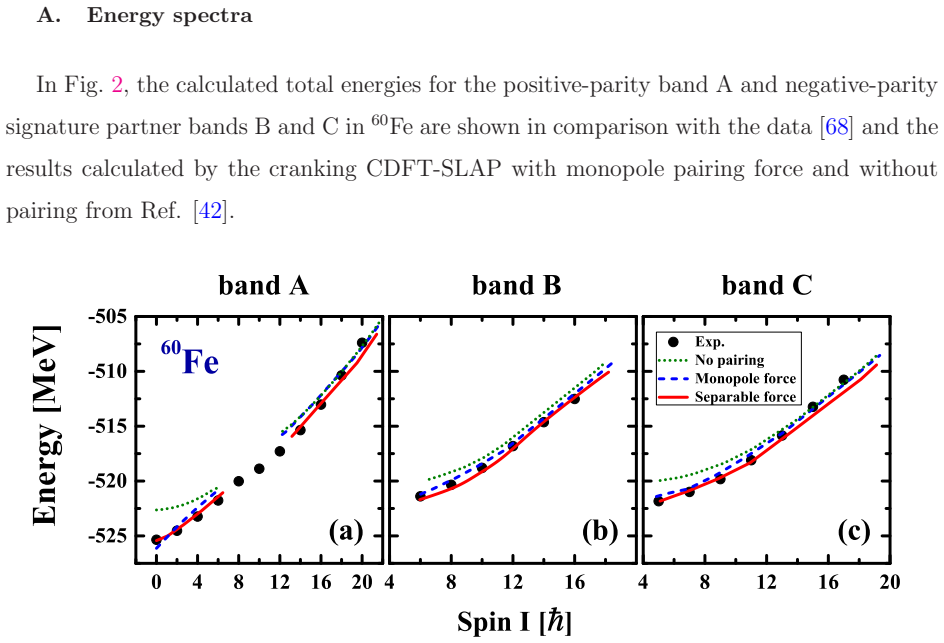
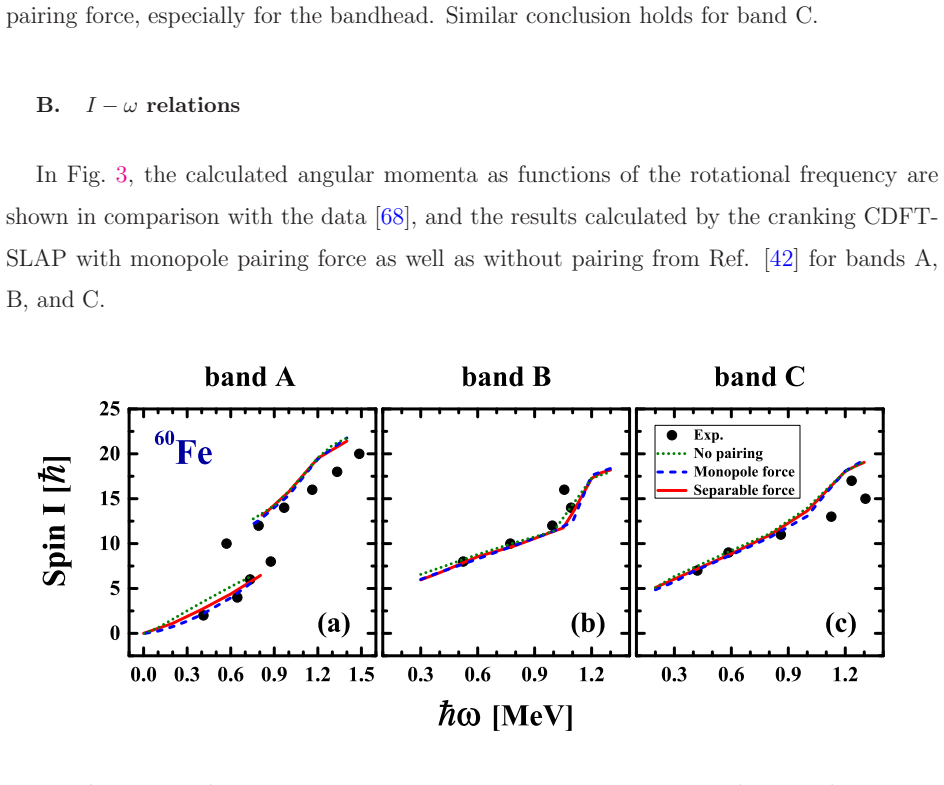
Using the PC-PK1 point-coupling density functional in the particle-hole channel and the separable pairing parameters $G = -728$ MeV fm$^3$ and $a = 0.644$ fm from Ref. [65] in the particle-particle channel, the cranking CDFT-SLAP reproduces the three observed rotational bands of 60Fe: band A (positive-parity yrast) and bands B and C (negative-parity signature partners). For band A the agreement is comparable to the monopole-pairing calculation and clearly better than ignoring pairing, with a band crossing that appears slightly later, about $\hbar\omega = 0.85$ MeV instead of $0.75$ MeV. For bands B and C the separable force gives a better bandhead description. The calculations also show smoother convergence with the dimension of the many-particle configuration space, and pairing energies that fall gradually with rotation without collapsing to zero, because the separable force carries correlations in pairs beyond $J = 0$.
Load-bearing premise
The load-bearing premise is that the separable pairing parameters fitted to nuclear-matter pairing gaps, $G = -728$ MeV fm$^3$ and $a = 0.644$ fm, retain their validity inside the finite nucleus 60Fe when used with the PC-PK1 functional and the SLAP diagonalization.
Editorial extensions
If this is right
- For the positive-parity band A of 60Fe, the separable-pairing calculation places the band crossing at about $\hbar\omega=0.85$ MeV, slightly above the monopole and no-pairing values near $0.75$ MeV, and still reproduces the observed sudden structure change at spin $I=8\hbar$.
- For the two negative-parity signature partner bands, the separable force yields a better description of the bandheads, and band B's crossing at $\hbar\omega\approx1.1$ MeV is reproduced well.
- Total energy and angular momentum converge as the many-particle configuration space grows; enlarging the MPC dimension from 1000 to 2000 changes the total energy by only about 0.15 percent at $\hbar\omega=0.2$ MeV, whereas the monopole version needs its effective pairing strength re-tuned with dimension.
- Neutron and proton pairing energies decrease smoothly with rotational frequency rather than collapsing, and for band A the separable-force neutron pairing energy stays near 1 MeV after crossing while the monopole result drops to almost zero.
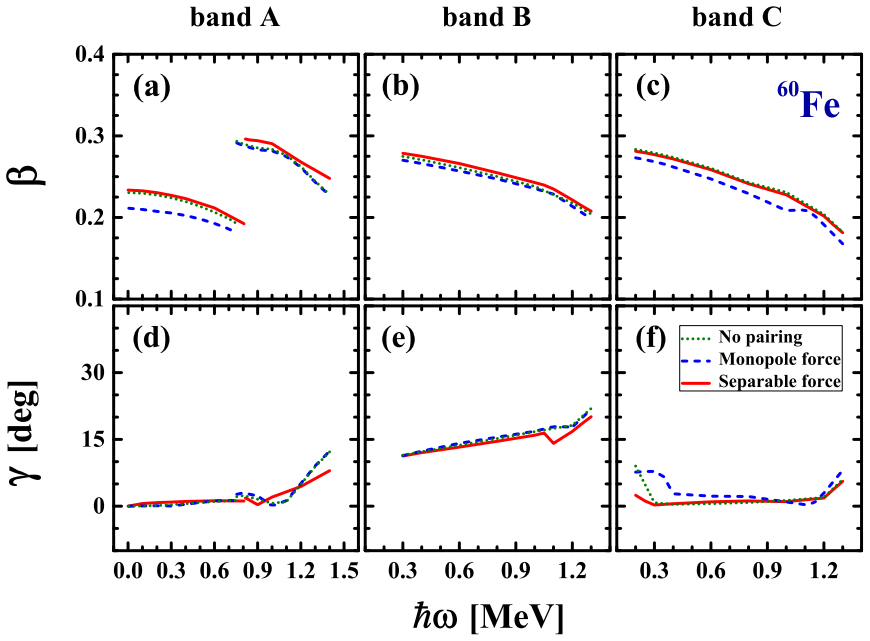
- Because the separable force includes pair correlations with angular momentum beyond $J=0$, the calculated quadrupole deformation is slightly larger than in the monopole calculation even where the pairing energy is larger.
Reading between the lines
- Editorial inference: if the clean convergence with MPC dimension holds in other nuclei, the method turns the pairing strength into a fixed input and enables systematic large-scale surveys of rotating nuclei without truncation-dependent re-normalization.
- Editorial inference: a sharper test of the separable force would be to compute odd-even mass differences or two-particle transfer strengths in odd and even Fe isotopes; the force's $J>0$ components should leave fingerprints beyond level energies.
- Editorial inference: the slightly later band-crossing frequency in band A may be a systematic tendency of this nuclear-matter-fitted force; comparing 58Fe and 62Fe with the same parameters would show whether the offset grows in a predictable way with mass.
Signed reviews
Editorial analysis
A structured set of objections, weighed in public.
Referee Report
Summary. The manuscript develops the shell-model-like approach (SLAP) based on cranking covariant density functional theory (CDFT) with a separable pairing force of the Tian-Ma-Ring form, replacing the monopole pairing force used in the earlier cranking CDFT-SLAP of Ref. [42]. The method is applied to 60Fe to study the positive-parity yrast band A and the two negative-parity signature partner bands B and C. The calculated total energies, angular momenta, pairing energies, and deformation parameters are compared with data from Ref. [68] and with the monopole-pairing and no-pairing results of Ref. [42]. The paper reports better MPC-dimension convergence than the monopole variant and claims excellent agreement with the data.
Significance. The implementation is a genuine technical step: the separable pairing force is finite-range, avoids ultraviolet divergences, and is computationally cheaper than other finite-range forces, and the Appendix provides a detailed derivation of the pairing matrix elements in the 3D HO basis. The calculation is predictive in that the pairing parameters G and a are taken from a nuclear-matter fit rather than fitted to 60Fe data, and the comparison with the monopole-pairing variant is a useful benchmark. However, the quantitative evidence for the central claims is thin: convergence is tested only at one low frequency, the 'excellent agreement' is asserted without error measures, and the band-A crossing is admitted to be delayed. If these points are addressed, the paper would be a valid contribution.
major comments (4)
- [§III, Fig. 1] The MPC-dimension convergence test is reported only for ℏω = 0.2 MeV, where the changes between dimension 1000 and 2000 are 0.151% for the total energy and 0.667% for the alignment. The physics of interest, however, lies near the band crossing in band A at ℏω ≈ 0.85 MeV (Sec. IV.B), where configuration mixing is maximal and truncation errors are expected to be largest. Please report the same convergence data at frequencies across the crossing region, including total energies, alignments, and the crossing frequency itself as functions of MPC dimension. Without this, the delayed crossing and the claimed agreement could be truncation artifacts.
- [§IV.A, Fig. 2] The statement 'excellent agreement with the available data' is not supported by any quantitative error measure. No rms deviations or average differences for excitation energies, transition energies, or alignments are given. Please include a table comparing calculated and experimental level energies for bands A, B, and C with deviations. The text also concedes that the band crossing in band A occurs 'a bit later' than the data; quantify this delay and discuss whether it lies within the typical accuracy of the approach.
- [§IV.B, Fig. 3] For band A, the crossing frequency from the separable-pairing calculation is ℏω ≈ 0.85 MeV, versus ≈ 0.75 MeV from both the monopole-pairing and no-pairing calculations of Ref. [42]. Since the data indicate a structural change around I = 8ℏ, the separable force produces a larger crossing delay than the simpler monopole force. Please state explicitly whether this is an improvement or a known deficiency, and test whether the delay is sensitive to the MPC truncation (see the first major comment).
- [§II.B and §III] The separable-pairing parameters G = −728 MeV fm^3 and a = 0.644 fm are taken from a nuclear-matter fit to Gogny pairing gaps in Ref. [65]. The paper provides no evidence that these parameters are transferable to the finite nucleus 60Fe when combined with the PC-PK1 functional and the SLAP diagonalization. Please add a sensitivity study (for example, vary G and a by a few percent and show the effect on yrast energies and crossing frequencies) or cite previous finite-nucleus applications that validate this parameter set in the same framework.
minor comments (4)
- [Title page] The affiliation line contains visible spacing artifacts ('den sity', 'Chin a') that should be corrected.
- [Figs. 2 and 3] The experimental data are shown as solid dots in all panels, which makes it hard to distinguish bands A, B, and C at a glance; consider using distinct point styles for the data sets.
- [§IV.C] The comparison of neutron pairing energies from the separable and monopole forces is informative, but the text could clarify that these are model-dependent quantities rather than directly observable pairing condensates.
- [References] Ref. [42] is cited for both the monopole-pairing SLAP results and the no-pairing results; it would be helpful to state explicitly in the text which curves are reproduced from that paper.
Circularity Check
No significant circularity: all pairing parameters are taken from prior independent fits, and the 60Fe spectra are genuine predictions.
full rationale
The paper's central derivation is self-contained against external benchmarks. The separable pairing force parameters G = -728 MeV fm^3 and a = 0.644 fm are quoted from Ref. [65], where they were fitted to nuclear-matter Gogny pairing gaps, and the monopole pairing strengths are quoted from Ref. [42]; neither is fitted to the 60Fe data that the paper predicts. The SLAP diagonalization is applied with fixed parameters and a chosen MPC truncation, and the resulting energies and alignments are compared directly with experimental bands. No quantity extracted from the 60Fe data is reinserted as an input, so the agreement is a genuine test rather than a fitted reproduction. The convergence check is reported at hbar-omega = 0.2 MeV only, and the skeptic's concern that convergence may be worse near the band crossing at hbar-omega ~ 0.85 MeV is a numerical-accuracy risk, not a circularity: it does not make the output equivalent to the input by construction. The self-citations to Refs. [42] and [65] are load-bearing only as sources of previously established formalism and parameters, both of which are external to this paper's claims, so they do not create circularity.
Assumptions & free parameters
free parameters (4)
- G (separable pairing strength) =
-728 MeV fm^3
- a (separable pairing range) =
0.644 fm
- MPC space dimension =
1000
- Major oscillator shells N_f =
12
assumptions (4)
- domain assumption The point-coupling density functional PC-PK1 provides a valid effective interaction in the particle-hole channel.
- domain assumption The separable pairing force parameters G and a from nuclear matter are transferable to the finite nucleus 60Fe.
- domain assumption The cranking condition J_x = sqrt(I(I+1)) relates the rotational frequency to the angular momentum quantum number.
- domain assumption The three types of pairing matrix elements other than <a bbar|V_pair|c dbar>_a vanish due to spatial symmetries of the PAC density.
Cite this review
Pith. "Pith review of Shell-model-like approach based on cranking covariant density functional theory with a separable pairing force." pith.science (2026). https://pith.science/paper/7OA26VBE
@misc{pith2026190803561,
  author       = {Pith},
  title        = {Pith review of: Shell-model-like approach based on cranking covariant density functional theory with a separable pairing force},
  year         = {2026},
  howpublished = {\url{https://pith.science/paper/7OA26VBE}},
  note         = {Machine review of arXiv:1908.03561}
}
abstract
The shell-model-like approach (SLAP) based on cranking covariant density functional theory (CDFT) with a separable pairing force is developed. The developed cranking CDFT-SLAP with separable pairing force is applied to investigate the rotational spectra in $^{60}$Fe, including the positive-parity yrast band and two negative-parity signature partner bands, in comparison with the cranking CDFT-SLAP with monopole pairing force calculations. Excellent agreement with the available data is achieved.
Figures

Figures from the paper (2 more)

Reference graph
Works this paper leans on
-
[42]
Ring and P
P. Ring and P. Schuck, The Nuclear Many-Body Problem (Springer-Verlag, Berlin, 1980)
1980
-
[68]
W. Y. Liang, C. F. Jiao, Q. Wu, X. M. Fu, and F. R. Xu, Phys. R ev. C 92, 064325 (2015)
work page 2015
- [65]
-
[1]
with given signature α self-consistently, the single- particle Routhian εµα and the corresponding eigenstate ψ µα for each level µ can be obtained [20, 24]. B. Cranking CDFT-SLAP The cranking CDFT-SLAP starts from a cranking many-body Hamilto nian including pairing correlations ˆH = ˆH ′ + ˆHpair, (5) where ˆH ′ = ∑ ˆh′ s. p. is the one-body Hamiltonian w...
-
[2]
(7) Here, R = 1 2(r1 +r2) and r = r1 −r2 denote the center-of-mass and the relative coordinates, respectively, and P (r) is the Gaussian function P (r) = 1 (4πa 2)3/ 2 e− r2 4a2
= Gδ (R − R′)P (r)P (r′) 1 2 (1 −P σ ). (7) Here, R = 1 2(r1 +r2) and r = r1 −r2 denote the center-of-mass and the relative coordinates, respectively, and P (r) is the Gaussian function P (r) = 1 (4πa 2)3/ 2 e− r2 4a2. (8) The projector 1 2(1−P σ ) allows only the states with the total spin S = 0. The two parameters G and a were determined in Ref. [ 65] b...
2000
-
[3]
(A2) Here, |nxnynz⟩ is the harmonic oscillator wave function in Cartesian coordinates, an d nx, n y, n z are the corresponding quantum numbers
read |nxnynz;α = +⟩ = |nxnynz⟩iny √ 2 (−1)nz+1 [ | ↑⟩ + (−1)ny+nz| ↓⟩ ] , (A1) |nxnynz;α = −⟩ = |nxnynz⟩iny √ 2 [ | ↑⟩ + (−1)ny+nz+1| ↓⟩ ] . (A2) Here, |nxnynz⟩ is the harmonic oscillator wave function in Cartesian coordinates, an d nx, n y, n z are the corresponding quantum numbers. The labels α = + and α = − represent the states with positive and negati...
-
[4]
= Gδ (R − R′)P (r)P (r′) 1 2 (1 −P σ ) ≡W (r1, r2; r′ 1, r′
-
[5]
(A3) There are four types of such matrix elements, i.e., ⟨a¯b| ˆVpair|c ¯d⟩a, ⟨ab| ˆVpair|cd⟩a, ⟨ab| ˆVpair|¯c ¯d⟩a, and ⟨¯a¯b| ˆVpair|¯c ¯d⟩a
1 2 (1 −P σ ). (A3) There are four types of such matrix elements, i.e., ⟨a¯b| ˆVpair|c ¯d⟩a, ⟨ab| ˆVpair|cd⟩a, ⟨ab| ˆVpair|¯c ¯d⟩a, and ⟨¯a¯b| ˆVpair|¯c ¯d⟩a. In the PAC-CDFT, the latter three types of matrix ele- ments vanish because of the spatial symmetries fulfilled by the nucle ar density distribution. As a result, only the matrix elements ⟨a¯b| ˆVpai...
Show all 86 references
-
[6]
Johnson, H
A. Johnson, H. Ryde, and J. Sztarkier, Phys. Lett. B 34, 605 (1971)
1971
-
[7]
F. S. Stephens and R. S. Simon, Nucl. Phys. A 183, 257 (1972)
1972
-
[8]
P. J. Twin, B. M. Nyak´ o, A. H. Nelson, J. Simpson, M. A. Ben tley, H. W. Cranmer-Gordon, P. D. Forsyth, D. Howe, A. R. Mokhtar, J. D. Morrison et al. , Phys. Rev. Lett. 57, 811 (1986)
1986
-
[9]
Frauendorf, J
S. Frauendorf, J. Meng, and J. Reif, in: M. A. Deleplanque (Ed.), Proceedings of the Confer- ence on Physics From Large γ-Ray Detector Arrays, in: Report LBL35687, Univ. of Califor nia, Berkeley vol. II , p. 52 (1994)
1994
-
[10]
Frauendorf, Z
S. Frauendorf, Z. Phys. A 358, 163 (1997)
1997
-
[11]
Frauendorf, Rev
S. Frauendorf, Rev. Mod. Phys. 73, 463 (2001)
2001
-
[12]
H¨ ubel, Prog
H. H¨ ubel, Prog. Part. Nucl. Phys. 54, 1 (2005)
2005
-
[13]
Frauendorf and J
S. Frauendorf and J. Meng, Nucl. Phys. A 617, 131 (1997)
1997
-
[14]
Meng and S
J. Meng and S. Q. Zhang, J. Phys. G. 37, 064025 (2010)
2010
-
[15]
Meng, Internat
J. Meng, Internat. J. Modern Phys. E 20, 341 (2011)
2011
-
[16]
J. Meng, Q. B. Chen, and S. Q. Zhang, Internat. J. Modern P hys. E 23, 1430016 (2014)
2014
-
[17]
Meng and P
J. Meng and P. W. Zhao, Phys. Scr. 91, 053008 (2016)
2016
-
[18]
B. W. Xiong and Y. Y. Wang, At. Data Nucl. Data Tables 125, 193 (2019)
2019
-
[19]
Bohr and B
A. Bohr and B. R. Mottelson, Nuclear Structure, vol. 2 (Benjamin, New York, 1975)
1975
-
[20]
Tim´ ar, Q
J. Tim´ ar, Q. B. Chen, B. Kruzsicz, D. Sohler, I. Kuti, S. Q. Zhang, J. Meng, P. Joshi, R. Wadsworth, K. Starosta et al ., Phys. Rev. Lett. 122, 062501 (2019)
2019
-
[21]
Ring, Prog
P. Ring, Prog. Part. Nucl. Phys. 37, 193 (1996). 17
1996
-
[22]
J. Meng, H. Toki, S.-G. Zhou, S. Q. Zhang, W. H. Long, and L . S. Geng, Prog. Part. Nucl. Phys. 57, 470 (2006)
2006
-
[23]
Meng and S.-G
J. Meng and S.-G. Zhou, J. Phys. G 42, 093101 (2015)
2015
-
[24]
H. Z. Liang, J. Meng, and S.-G. Zhou, Phys. Rep. 570, 1 (2015)
2015
-
[25]
Meng, ed., Relativistic Density Functional for Nuclear Structure , vol
J. Meng, ed., Relativistic Density Functional for Nuclear Structure , vol. 10 of International Review of Nuclear Physics (World Scientific, Singapore, 2016)
2016
-
[26]
Koepf and P
W. Koepf and P. Ring, Nucl. Phys. A 511, 279 (1990)
1990
-
[27]
J. Peng, J. Meng, P. Ring, and S. Q. Zhang, Phys. Rev. C 78, 024313 (2008)
2008
-
[28]
P. W. Zhao, S. Q. Zhang, J. Peng, H. Z. Liang, P. Ring, and J . Meng, Phys. Lett. B 699, 181 (2011)
2011
-
[29]
J. Meng, J. Peng, S. Q. Zhang, and P. W. Zhao, Front. Phys. 8, 55 (2013)
2013
-
[30]
Madokoro, J
H. Madokoro, J. Meng, M. Matsuzaki, and S. Yamaji, Phys. Rev. C 62, 061301 (2000)
2000
-
[31]
P. W. Zhao, Phys. Lett. B 773, 1 (2017)
2017
-
[32]
L. F. Yu, P. W. Zhao, S. Q. Zhang, P. Ring, and J. Meng, Phys . Rev. C 85, 024318 (2012)
2012
-
[33]
P. W. Zhao, J. Peng, H. Z. Liang, P. Ring, and J. Meng, Phys . Rev. Lett. 107, 122501 (2011)
2011
-
[34]
P. W. Zhao, J. Peng, H. Z. Liang, P. Ring, and J. Meng, Phys . Rev. C 85, 054310 (2012)
2012
-
[35]
P. W. Zhao, N. Itagaki, and J. Meng, Phys. Rev. Lett. 115, 022501 (2015)
2015
-
[36]
Z. X. Ren, S. Q. Zhang, P. W. Zhao, N. Itagaki, J. A. Maruhn , and J. Meng, Sci. China Phys. Mech. 62, 112062 (2019)
2019
-
[37]
J. Meng, J. Peng, S. Q. Zhang, and S.-G. Zhou, Phys. Rev. C 73, 037303 (2006)
2006
-
[38]
J. Peng, H. Sagawa, S. Q. Zhang, J. M. Yao, Y. Zhang, and J. Meng, Phys. Rev. C 77, 024309 (2008)
2008
-
[39]
J. M. Yao, B. Qi, S. Q. Zhang, J. Peng, S. Y. Wang, and J. Men g, Phys. Rev. C 79, 067302 (2009)
2009
-
[40]
J. Li, S. Q. Zhang, and J. Meng, Phys. Rev. C 83, 037301 (2011)
2011
-
[41]
B. Qi, H. Jia, N. B. Zhang, C. Liu, and S. Y. Wang, Phys. Rev . C 88, 027302 (2013)
2013
-
[43]
J. Y. Zeng and T. S. Cheng, Nucl. Phys. A 405, 1 (1983)
1983
-
[44]
Rowe, Nuclear Collective Motion (Butler & Tanner Ltd, Frome and London, 1970)
D. Rowe, Nuclear Collective Motion (Butler & Tanner Ltd, Frome and London, 1970)
1970
-
[45]
B. R. Mottelson and J. G. Valatin, Phys. Rev. Lett. 5, 511 (1960)
1960
-
[46]
J. Meng, J. Y. Guo, L. Liu, and S. Q. Zhang, Front. Phys. Ch ina 1, 38 (2006). 18
2006
-
[47]
Z. Shi, Z. H. Zhang, Q. B. Chen, S. Q. Zhang, and J. Meng, Ph ys. Rev. C 97, 034317 (2018)
2018
-
[48]
J. Y. Zeng, Y. A. Lei, T. H. Jin, and Z. J. Zhao, Phys. Rev. C 50, 746 (1994)
1994
-
[49]
S. X. Liu, J. Y. Zeng, and E. G. Zhao, Phys. Rev. C 66, 024320 (2002)
2002
-
[50]
X. T. He, S. X. Liu, S. Y. Yu, J. Y. Zeng, and E. G. Zhao, Euro . Phys. J. A 23, 217 (2005)
2005
-
[51]
X. Wu, Z. H. Zhang, J. Y. Zeng, and Y. A. Lei, Phys. Rev. C 83, 034323 (2011)
2011
-
[52]
Z. H. Zhang, P. W. Zhao, J. Meng, J. Y. Zeng, E. G. Zhao, and S.-G. Zhou, Phys. Rev. C 87, 054314 (2013)
2013
-
[53]
Z. H. Zhang, Phys. Rev. C 94, 034305 (2016)
2016
-
[54]
S. X. Liu, J. Y. Zeng, and L. Yu, Nucl. Phys. A 735, 77 (2004)
2004
-
[55]
Z. H. Zhang, X. Wu, Y. A. Lei, and J. Y. Zeng, Nucl. Phys. A 816, 19 (2009)
2009
-
[56]
Z. H. Zhang, Y. A. Lei, and J. Y. Zeng, Phys. Rev. C 80, 034313 (2009)
2009
-
[57]
B. H. Li, Z. H. Zhang, and Y. A. Lei, Chin. Phys. C 37, 014101 (2013)
2013
-
[58]
Y. C. Li and X. T. He, Sci. China Phys. Mech. 59, 672011 (2016)
2016
-
[59]
Z. H. Zhang, Nucl. Phys. A 949, 22 (2016)
2016
-
[60]
Z. H. Zhang, J. Meng, E. G. Zhao, and S.-G. Zhou, Phys. Rev . C 87, 054308 (2013)
2013
-
[61]
X. T. He, Z. Z. Ren, S. X. Liu, and E. G. Zhao, Nucl. Phys. A 817, 45 (2009)
2009
-
[62]
Z. H. Zhang, J. Y. Zeng, E. G. Zhao, and S.-G. Zhou, Phys. R ev. C 83, 011304 (2011)
2011
-
[63]
Z. H. Zhang, X. T. He, J. Y. Zeng, E. G. Zhao, and S.-G. Zhou , Phys. Rev. C 85, 014324 (2012)
2012
-
[64]
L. Liu, Z. H. Zhang, and P. W. Zhao, Phys. Rev. C 92, 044304 (2015)
2015
-
[66]
X. M. Fu, F. R. Xu, J. C. Pei, C. F. Jiao, Y. Shi, Z. H. Zhang, and Y. A. Lei, Phys. Rev. C 87, 044319 (2013)
2013
-
[67]
Pillet, P
N. Pillet, P. Quentin, and J. Libert, Nucl. Phys. A 697, 141 (2002)
2002
-
[69]
Liu, Phys
L. Liu, Phys. Rev. C 99, 024317 (2019)
2019
-
[70]
Y. Tian, Z. Y. Ma, and P. Ring, Phys. Lett. B 676, 44 (2009)
2009
-
[71]
Y. K. Wang, Phys. Rev. C 96, 054324 (2017)
2017
-
[72]
Y. K. Wang, Phys. Rev. C 97, 064321 (2018)
2018
-
[73]
A. N. Deacon, S. J. Freeman, R. V. F. Janssens, M. Honma, M . P. Carpenter, P. Chowdhury, T. Lauritsen, C. J. Lister, D. Seweryniak, J. F. Smith et al. , Phys. Rev. C 76, 054303 (2007). 19
2007
-
[74]
B¨ urvenich, D
T. B¨ urvenich, D. G. Madland, J. A. Maruhn, and P.-G. Rei nhard, Phys. Rev. C 65, 044308 (2002)
2002
-
[75]
Nikˇ si´ c, D
T. Nikˇ si´ c, D. Vretenar, and P. Ring, Phys. Rev. C 78, 034318 (2008)
2008
-
[76]
P. W. Zhao, Z. P. Li, J. M. Yao, and J. Meng, Phys. Rev. C 82, 054319 (2010)
2010
-
[77]
Koepf and P
W. Koepf and P. Ring, Nucl. Phys. A 493, 61 (1989)
1989
-
[78]
K¨ onig and P
J. K¨ onig and P. Ring, Phys. Rev. Lett. 71, 3079 (1993)
1993
-
[79]
Kaneko, M
K. Kaneko, M. Nakano, and M. Matsuzaki, Phys. Lett. B 317, 261 (1993)
1993
-
[80]
Koepf and P
W. Koepf and P. Ring, Phys. Lett. B 212, 397 (1988)
1988
-
[81]
Dobaczewski and J
J. Dobaczewski and J. Dudek, Comput. Phys. Commun. 102, 166 (1997)
1997
-
[82]
J. M. Yao, H. Chen, and J. Meng, Phys. Rev. C 74, 024307 (2006)
2006
-
[83]
Nikˇ si´ c, Z
T. Nikˇ si´ c, Z. P. Li, D. Vretenar, L. Pr´ ochniak, J. Meng, and P. Ring, Phys. Rev. C 79, 034303 (2009)
2009
-
[84]
J. Y. Zeng, T. H. Jin, and Z. J. Zhao, Phys. Rev. C 50, 1388 (1994)
1994
-
[85]
Nikˇ si´ c, P
T. Nikˇ si´ c, P. Ring, D. Vretenar, Y. Tian, and Z. Y. Ma, P hys. Rev. C 81, 054318 (2010)
2010
-
[86]
Nikˇ si´ c, N
T. Nikˇ si´ c, N. Paar, D. Vretenar, and P. Ring, Comput. P hys. Commun. 185, 1808 (2014). 20
2014
Reviewed August 14, 2026 · model on record in the stance chip above.
Discussion (0). Continue with ORCID to comment.