REVIEW 3 major objections 4 minor 79 references
Effects of the Hubbard interaction on the quantum metric
T0 review · 3 major / 4 minor · reviewed 2026-08-11 · deepseek-v4-flash
Pith's one-line read This paper shows that repulsive Hubbard interactions monotonically suppress the quantum metric of a fermionic Creutz ladder, and that the dressed quantum metric matches exact diagonalization more closely than the generalized quantum metric.
desk verdict A careful, honest benchmark of two interacting quantum-metric definitions against exact diagonalization in a fermionic Creutz ladder; the DQM wins, but the independence of the benchmark is partly compromised by its shared fidelity-susceptibility ancestry. read the letter →
The pith
A machine-rendered reading of the paper's core claim, the machinery that carries it, and where it could break.
The reading
What carries the argument
The load-bearing comparison is between three objects: the generalized quantum metric (GQM), defined through the optical conductivity via the current-current correlator; the dressed quantum metric (DQM), defined through the fidelity susceptibility with dressed spectral functions; and the many-body quantum metric (MBQM), computed from the overlap of ground states with and without a flux twist threaded through the ring. In the flat-band limit the Green's functions develop additional poles at $\omega \approx \pm 3 t$ alongside the bare poles at $\pm t$, and the ratio identity $g^{\mathrm{DQM}}_{\alpha \beta} / g^{\mathrm{GQM}}_{\alpha \beta} = (\omega_\alpha + \omega_\beta)^2 / (4 t^2)$ shows why the two interacting metrics differ once the renormalized pole frequencies $\omega_\alpha$ shift from $t$. The noninteracting benchmark relation $g_{\mathrm{MBQM}} = (1/L) \sum_k g(k)$, exact only at $U=0$, is used to compare the momentum-summed analytic metrics with the exact-diagonalization result.
What would settle it
Extrapolate the many-body quantum metric to larger ladder lengths at fixed $U$, or measure the optical-conductivity sum rule in an ultracold-atom Creutz ladder at controlled $U/t$; if the slope of $g$ versus $U^2/t^2$ approaches the generalized formula's coefficient $-5/256$ rather than the dressed formula's $-5/512$, the paper's ranking is wrong.
Extended reading notes
Core claim
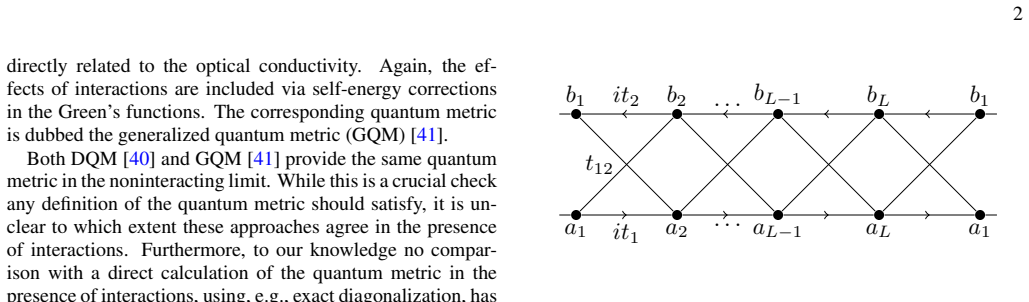
The central claim is that in the half-filled fermionic Creutz ladder the repulsive Hubbard interaction suppresses the quantum metric, and that the dressed quantum metric is the more accurate way to compute that suppression. In the flat-band limit the paper derives $g_{\mathrm{GQM}} \approx \frac{1}{2} - \frac{5 U^2}{256 t^2}$ and $g_{\mathrm{DQM}} \approx \frac{1}{2} - \frac{5 U^2}{512 t^2}$, so both reduce to the noninteracting value $1/2$ at $U=0$, but fall at different rates. The many-body quantum metric obtained by exact diagonalization for ladders up to $L=6$ unit cells follows the dressed curve rather than the generalized one, and the same ranking holds for weakly dispersive bands with $t_{12}=1.1\,t$. The paper concludes that the dressed quantum metric, tied to the fidelity susceptibility of the ground state, is a good stand-in for the exact interacting quantum metric when exact diagonalization is impossible.
Load-bearing premise
The comparison rests on assuming that the many-body ground-state overlap computed for small ladders measures the same interaction-dressed quantum metric the Green's-function definitions approximate; that identification is exact only at zero interaction strength.
Editorial extensions
If this is right
- In flat-band and weakly dispersive Creutz ladders, the interacting quantum metric decreases monotonically with $U$ and saturates at a positive value, meaning the localization length shrinks as interactions strengthen.
- The dressed quantum metric offers a practical path beyond exact diagonalization, since it can be built from renormalized Green's functions and spectral functions in larger or higher-dimensional systems.
- Interaction effects shift the spectral peaks away from the bare bands and create replica bands near $\omega \approx \pm 3t$, with the optical conductivity gaining a peak near $4t$ from transitions between original and replica bands.
- The same ranking of dressed over generalized appears for weakly dispersive bands, so the conclusion is not an artifact of exactly flat bands and should carry over to optical probes of correlated materials.
Reading between the lines
- Beyond the paper: if the dressed metric is the correct interacting quantity, superfluid-weight and flat-band superconductivity estimates should be recomputed with dressed band geometry, which will shift quantitative predictions at finite coupling.
- Beyond the paper: because the dressed metric is tied to fidelity susceptibility, optical-absorption measurements of the quantum metric may double as a probe of interaction-driven localization, with the saturation value encoding the correlation length.
- Beyond the paper: an experimental test in ultracold-atom Creutz ladders would compare the optical-conductivity sum-rule metric with a direct wave-function-overlap measurement; agreement would support the dressed definition, while disagreement would reopen the question.
Editorial analysis
A structured set of objections, weighed in public.
Referee Report
Summary. The paper studies how the Hubbard interaction modifies the quantum metric in a fermionic Creutz ladder, comparing two existing Green's-function-based extensions of the quantum metric to exact diagonalization. The authors derive a second-order self-energy in the flat-band limit (Appendices A and B), use it to obtain the generalized quantum metric (GQM), defined through the optical conductivity, and the dressed quantum metric (DQM), defined through the dynamic fidelity susceptibility and spectral functions. As an exact reference, they compute the many-body quantum metric (MBQM) from ground-state fidelity under a flux twist. The main claims are that repulsive Hubbard interactions monotonically suppress the quantum metric and that the DQM provides a better fit to the MBQM than the GQM, both for flat bands and for weakly dispersive bands. The paper also discusses replica bands, the spectral function, and the optical conductivity in the interacting system.
Significance. If the central claim holds, the dressed quantum metric would be a useful and reliable approximation to the many-body quantum metric in interacting flat-band systems, a practically important issue for systems such as twisted bilayer graphene and other narrow-band materials. The paper has notable strengths: the analytic derivations in Appendices A and B are detailed and give explicit closed-form expressions (e.g., Eqs. (33) and (37)), the exact diagonalization procedure is standard and based on a public package, and the optical-conductivity result in Eq. (44) is a concrete falsifiable prediction. The main weakness is that the decisive benchmark, g_MBQM, is itself a fidelity-susceptibility quantity and is related to the single-particle metric only in the noninteracting limit, which the authors explicitly concede. This makes the DQM-versus-GQM ranking potentially benchmark-specific rather than a statement about the actual many-body quantum metric. The claims are nevertheless conditional rather than demonstrably wrong, and they could be strengthened by additional independent checks.
major comments (3)
- [Sec. III C, Eq. (42)] The benchmark relation g_MBQM = (1/L) Σ_k g(k) is derived for noninteracting systems, and the authors explicitly state that they do not expect it to hold exactly when interactions are included. The central comparison in Figs. 3 and 5 nevertheless uses g_MBQM from Eq. (41) as the reference against which the GQM and DQM are ranked. At finite U, g_MBQM is a flux-twist many-body fidelity susceptibility; it has not been shown to coincide with the momentum average of an interaction-dressed single-particle quantum metric. Because the GQM is a current-current/optical-conductivity object and the DQM is a spectral-fidelity object, the observed disagreement between the GQM and the benchmark may simply reflect that the benchmark shares the fidelity-susceptibility structure with the DQM. I request an independent check of what the exact ground state realizes: for example, compute the many-body Resta polarization or the Drude weight/optical sum rule for the same finite system and compare both analytic metrics against such a quantity, or derive a finite-U relation connecting g_MBQM to the DQM.
- [Sec. III B and Sec. IV B] The DQM in Eq. (34) is constructed from the dynamic fidelity susceptibility, and the MBQM in Eq. (41) is also a ground-state fidelity overlap under a flux twist. The paper itself notes in Sec. IV B that the agreement "may have its roots in a direct relation between the fidelity susceptibility and the DQM." This is a circularity risk: if both objects are fidelity susceptibilities, agreement is partly built into the choice of benchmark and does not independently validate the DQM as the more accurate many-body quantum metric. I recommend replacing or supplementing the MBQM benchmark with a quantity that is not a fidelity susceptibility, or explicitly proving that g_MBQM reduces to the DQM in the relevant limit. Without such an independent check, the headline conclusion remains conditional.
- [Sec. IV A and Sec. IV B, Figs. 3 and 5] The conclusion that "the DQM provides a much better fit" is supported only by visual inspection. The figures contain no error bars, no fit residuals, and for the dispersive case the difference between the DQM and the GQM is of order 10^-3, comparable to the finite-size effects visible in the bottom panels. I ask the authors to report quantitative deviations (for example, root-mean-square differences over U in [0, t] between each analytic metric and g_MBQM), to show the dependence on the numerical broadening δ used in Fig. 5, and to give a criterion for when the L-dependence is converged. This is needed to make the claimed ranking of the two metrics quantitative and robust.
minor comments (4)
- [Sec. III C, Eq. (42)] The symbol g(k) in Eq. (42) is used without an explicit definition in the main text; it should be defined as the noninteracting single-particle quantum metric (for example, the trace of the quantum geometric tensor) so that the benchmark relation can be checked by the reader.
- [Sec. IV B] The numerical integration for dispersive bands is described only briefly: the authors state that the first expressions in Eqs. (17) and (25) are used and that a Kramers-Kronig relation provides the real part of the self-energy, but they do not specify how the flat-band step-function assumption is relaxed. A short description of the dispersive-band self-energy calculation would improve reproducibility.
- [Figs. 3 and 5, bottom panels] The bottom panels use a strongly suppressed vertical scale. It would be helpful to show the absolute values of g_MBQM or to include an explicit table of values, since the deviations from 1/2 are tiny and the finite-size differences are otherwise hard to assess.
- [Sec. IV C] The strong-coupling results in Fig. 6 are presented only for L = 6. A brief statement on whether the monotonic suppression and saturation persist for other L values would strengthen the claim that the behavior is not a finite-size artifact.
Circularity Check
No significant circularity: the paper benchmarks two Green's-function-based quantum metrics against an independent exact-diagonalization ground-state overlap, with no fitted parameters or self-referential reduction.
full rationale
The central comparison is self-contained. The GQM (Eq. 32) and DQM (Eq. 34) are computed analytically/numerically from the same second-order self-energy, with no parameter adjusted to the exact-diagonalization data. The benchmark g_MBQM (Eq. 41) is an independent many-body ground-state fidelity susceptibility obtained with QuSpin for up to L=6. The paper explicitly flags the assumption that Eq. (42) is only exact for noninteracting systems ('we do not expect Eq. (42) to hold exactly when interactions are included. Nevertheless, g_MBQM serves as a useful benchmark'), which is a stated limitation of the comparison, not a circular construction. The observation in Sec. IV B that the DQM-MBQM agreement 'may have its roots in a direct relation between the fidelity susceptibility and the DQM' is a post hoc explanation; the paper does not use it to define either quantity, and the DQM remains a single-particle spectral expression while g_MBQM is an exact many-body overlap, so the concurrence in Figs. 3 and 5 is a substantive benchmark result rather than an identity built into the definitions. The only apparent self-citation is Ref. [15], a book cited in a general review list in the introduction; it is not load-bearing. No uniqueness theorem is imported, no ansatz is smuggled via citation, and no fitted input is renamed as a prediction.
Assumptions & free parameters
free parameters (1)
- Numerical broadening δ =
10^-3 t
assumptions (4)
- ad hoc to paper Flat-band low-temperature step-function approximation for Fermi-Dirac and Bose-Einstein distributions
- domain assumption Second-order perturbation theory in U with only the direct self-energy diagram
- ad hoc to paper Benchmark identity g_MBQM = (1/L) Σ_k g(k) remains approximately valid under interactions
- domain assumption The Hubbard interaction is the only interaction term and is local on each ladder leg
Cite this review
Pith. "Pith review of Effects of the Hubbard interaction on the quantum metric." pith.science (2026). https://pith.science/paper/7OR5VGED
@misc{pith2026241202753,
  author       = {Pith},
  title        = {Pith review of: Effects of the Hubbard interaction on the quantum metric},
  year         = {2026},
  howpublished = {\url{https://pith.science/paper/7OR5VGED}},
  note         = {Machine review of arXiv:2412.02753}
}
read the original abstract
Quantum geometry provides important information about the structure and topology of quantum states in various forms of quantum matter. The information contained therein has profound effects on observable quantities such as superconducting weight, Drude weight, and optical responses. Motivated by the recent advances in flat-band interacting systems, we investigate the role of interaction effects on the quantum metric. By using the fermionic Creutz ladder as a representative system, we show that the repulsive Hubbard interaction monotonically suppresses the quantum metric. While the eigenstates and their overlap quantifying the quantum metric can be obtained exactly in the presence of interactions through exact diagonalization, this method is limited to small system sizes. Alternatively, two theoretical proposals, the generalized quantum metric and the dressed quantum metric, suggest using renormalized Green's functions to define the interacting quantum metric. By comparing these analytical approaches with results from exact diagonalization, we show that the dressed quantum metric provides a better fit to the exact diagonalization results. Our conclusion holds for both flat-band and dispersive systems.
Figures


Figures from the paper (6 more)


Reference graph
Works this paper leans on
-
[1]
Original basis In the original basis, the Green’s function of a noninteract- ing system is block-diagonal in the spin space with each of the blocks defined as G(orig) 0,σ (k, iωn) = [iωn − Hσ(k)]−1 , (13) where ωn = πT (2n+1) is the fermionic Matsubara frequency and Hσ(k) is defined in Eq. (4). The Green’s function can be conveniently represented as G(ori...
-
[2]
Diagonal basis The Green’s function for the band η and the spin projection σ in the diagonal basis is G(diag) 0,η,σ (k, iωn) = 1 iωn − ϵk,η,σ . (24) The interacting Green’s function is defined similarly to that in the original basis, see Eq. (16). Referring to Appendix A for details, the final expression for the self-energy reads Σ(diag) ηη ′′,σ(k, iωn) =...
-
[3]
Original basis The interaction line corresponding to the Hubbard interaction in Eq. (6) and the Feynman diagrams corresponding to the nontrivial second-order contributions to the self-energy are given in Fig. 8. Other first- and second-order diagrams only shift the Fermi energy and, hence, can be neglected. The Hubbard interaction between particles of opp...
-
[4]
(11) to derive the self-energy
Diagonal basis In the diagonal basis, we perform a direct S-matrix expansion [54, 67] starting from the Hubbard interaction in Eq. (11) to derive the self-energy. The only nontrivial contribution to the self-energy in the diagonal basis is the diagram shown in Fig. 9. The corresponding expression reads as Σηη ′′ σ (k, iωn) = −4T 2 Z dk′ 2π Z dq 2π X iωn′ ...
-
[5]
Generalized quantum metric Let us start with the generalized quantum metric (GQM) discussed in Sec. III A. The quantum metric is related to the optical conductivity via Eq. (29), see also Eq. (32). First, we insert the spectral functions in the original basis given in Eq. (23) into the momentum integral of the trace in Eq. (31). The integral is then carri...
-
[6]
III B for the discussion and final results
Dressed quantum metric Let us now calculate the dressed quantum metric (DQM); see Sec. III B for the discussion and final results. Assuming the zero-temperature limit in Eq. (34) and using Eq. (36), we obtain gDQM(k) = 1 2 X η=± Z ∞ 0 dΩ Z ∞ −∞ dωA(diag) η (k, ω)A(diag) −η (k, ω+ Ω) [θ(ω) − θ(−ω − Ω)] = 1 2 X η=± Z ∞ 0 dΩ Z 0 −Ω dω δ(ΩU (ω) − ηtU (ω)) δ(Ω...
-
[7]
J. P. Provost and G. Vallee, Riemannian structure on manifolds of quantum states, Commun. Math. Phys. 76, 289 (1980)
1980
-
[8]
R. Cheng, Quantum Geometric Tensor (Fubini-Study Metric) in Simple Quantum System: A pedagogical Introduction (2010), arXiv:1012.1337
arXiv 2010
Show all 79 references
-
[9]
Rossi, Quantum metric and correlated states in two- dimensional systems, Curr
E. Rossi, Quantum metric and correlated states in two- dimensional systems, Curr. Opin. Solid State Mater. Sci. 25, 100952 (2021), arXiv:2108.11478
2021 arXiv
-
[10]
M. V . Berry, Quantal phase factors accompanying adiabatic changes, Proc. R. Soc. Lond. Math. Phys. Sci. 392, 45 (1984)
1984
-
[11]
D. J. Thouless, M. Kohmoto, M. P. Nightingale, and M. Den Nijs, Quantized Hall Conductance in a Two- Dimensional Periodic Potential, Phys. Rev. Lett. 49, 405 (1982)
1982
-
[12]
D. Xiao, J. Shi, D. P. Clougherty, and Q. Niu, Polarization and adiabatic pumping in inhomogeneous crystals, Phys. Rev. Lett. 102, 087602 (2009), arXiv:0711.1855
2009 arXiv
-
[13]
Nagaosa, J
N. Nagaosa, J. Sinova, S. Onoda, A. H. MacDonald, and N. P. Ong, Anomalous Hall effect, Rev. Mod. Phys.82, 1539 (2010), arXiv:0904.4154
2010 arXiv
-
[14]
G. P. Mikitik and Yu. V . Sharlai, Magnetic susceptibility of topological semimetals, J. Low Temp. Phys. 197, 272 (2019), arXiv:1903.12208
2019 arXiv
-
[15]
M. Z. Hasan and C. L. Kane, Colloquium : Topological insula- tors, Rev. Mod. Phys. 82, 3045 (2010), arXiv:1002.3895
2010 arXiv
-
[16]
A. M. Turner and A. Vishwanath, Beyond Band Insulators: Topology of Semi-Metals and Interacting Phases , edited by M. Franz and L. Molenkamp (Elsevier Science, Amsterdam,
-
[17]
B. A. Bernevig and T. L. Hughes, Topological Insulators and Topological Superconductors (Princeton University Press, Princeton, NJ, 2013)
2013
-
[18]
Cayssol and J
J. Cayssol and J. N. Fuchs, Topological and geometrical aspects of band theory, J. Phys. Mater. 4, 034007 (2021), arXiv:2012.11941
2021 arXiv
-
[19]
N. P. Armitage, E. J. Mele, and A. Vishwanath, Weyl and Dirac semimetals in three-dimensional solids, Rev. Mod. Phys. 90, 015001 (2018), arXiv:1705.01111
2018 arXiv
-
[20]
Zhang, Y .-Q
D.-W. Zhang, Y .-Q. Zhu, Y . X. Zhao, H. Yan, and S.-L. Zhu, Topological quantum matter with cold atoms, Advances in Physics 67, 253 (2018), arXiv:1810.09228
2018 arXiv
-
[21]
E. V . Gorbar, V . A. Miransky, I. A. Shovkovy, and P. O. Sukhachov, Electronic Properties of Dirac and Weyl Semimet- als (World Scientific, Singapore, 2021)
2021
-
[22]
McClarty, Topological Magnons: A Review, Annu
P. McClarty, Topological Magnons: A Review, Annu. Rev. Condens. Matter Phys. 13, 171 (2022), arXiv:2106.01430
2022 arXiv
-
[23]
Peotta and P
S. Peotta and P. T¨orm¨a, Superfluidity in topologically nontrivial flat bands, Nat. Commun. 6, 8944 (2015)
2015
-
[24]
Liang, T
L. Liang, T. I. Vanhala, S. Peotta, T. Siro, A. Harju, and P. T ¨orm¨a, Band geometry, Berry curvature, and superfluid weight, Phys. Rev. B 95, 024515 (2017), arXiv:1610.01803
2017 arXiv
-
[25]
T ¨orm¨a, S
P. T ¨orm¨a, S. Peotta, and B. A. Bernevig, Superconductivity, superfluidity and quantum geometry in twisted multilayer sys- tems, Nat. Rev. Phys. 4, 528 (2022), arXiv:2111.00807
2022 arXiv
-
[26]
H. Tian, X. Gao, Y . Zhang, S. Che, T. Xu, P. Cheung, K. Watan- abe, T. Taniguchi, M. Randeria, F. Zhang, C. N. Lau, and M. W. Bockrath, Evidence for Dirac flat band superconduc- tivity enabled by quantum geometry, Nature 614, 440 (2023), arXiv:2112.13401
2023 arXiv
-
[27]
Shavit and J
G. Shavit and J. Alicea, Quantum Geometric Unconventional Superconductivity (2024), arXiv:2411.05071 [cond-mat]
2024 arXiv
-
[28]
Jahin and S.-Z
A. Jahin and S.-Z. Lin, Enhanced Kohn-Luttinger topological superconductivity in bands with nontrivial geometry (2024), arXiv:2411.09664 [cond-mat]
2024
-
[29]
Gao and D
Y . Gao and D. Xiao, Nonreciprocal Directional Dichroism In- duced by the Quantum Metric Dipole, Phys. Rev. Lett. 122, 227402 (2019), arXiv:1810.02728
2019 arXiv
-
[30]
Ahn, G.-Y
J. Ahn, G.-Y . Guo, and N. Nagaosa, Low-Frequency Diver- gence and Quantum Geometry of the Bulk Photovoltaic Effect in Topological Semimetals, Phys. Rev. X 10, 041041 (2020), arXiv:2006.06709
2020 arXiv
-
[31]
Arora, M
A. Arora, M. S. Rudner, and J. C. W. Song, Quantum Plas- monic Nonreciprocity in Parity-Violating Magnets, Nano Lett. 22, 9351 (2022), arXiv:2202.08284
2022 arXiv
-
[32]
E. Y . Andrei and A. H. MacDonald, Graphene Bilayers with a Twist, Nat. Mater.19, 1265 (2020), arXiv:2008.08129
2020 arXiv
-
[33]
Tan, D.-W
X. Tan, D.-W. Zhang, Z. Yang, J. Chu, Y .-Q. Zhu, D. Li, X. Yang, S. Song, Z. Han, Z. Li, Y . Dong, H.-F. Yu, H. Yan, S.- L. Zhu, and Y . Yu, Experimental Measurement of the Quantum Metric Tensor and Related Topological Phase Transition with a Superconducting Qubit, Phys. Rev....
2019 arXiv
-
[34]
M. Yu, P. Yang, M. Gong, Q. Cao, Q. Lu, H. Liu, S. Zhang, M. B. Plenio, F. Jelezko, T. Ozawa, N. Goldman, and J. Cai, Experimental measurement of the quantum geometric tensor using coupled qubits in diamond, Natl. Sci. Rev. 7, 254 (2020), arXiv:1811.12840 [quant-ph]
2020 arXiv
-
[35]
Gianfrate, O
A. Gianfrate, O. Bleu, L. Dominici, V . Ardizzone, M. De Giorgi, D. Ballarini, G. Lerario, K. W. West, L. N. Pfeiffer, D. D. Solnyshkov, D. Sanvitto, and G. Malpuech, Mea- surement of the quantum geometric tensor and of the anoma- lous Hall drift, Nature 578, 381 (2020), arXiv...
2020 arXiv
-
[36]
M. Kang, S. Kim, Y . Qian, P. M. Neves, L. Ye, J. Jung, D. Pun- tel, F. Mazzola, S. Fang, C. Jozwiak, A. Bostwick, E. Roten- berg, J. Fuji, I. V obornik, J.-H. Park, J. G. Checkelsky, B.-J. Yang, and R. Comin, Measurements of the quantum geomet- ric tensor in solids, Nat. Phys...
2024 doi
-
[37]
Huhtinen and P
K.-E. Huhtinen and P. T ¨orm¨a, Conductivity in flat bands from the Kubo-Greenwood formula, Phys. Rev. B 108, 155108 (2023), arXiv:2212.03192
2023 arXiv
-
[38]
Souza, T
I. Souza, T. Wilkens, and R. M. Martin, Polarization and local- ization in insulators: Generating function approach, Phys. Rev. B 62, 1666 (2000), arXiv:cond-mat/9911007
2000 arXiv
-
[39]
Ozawa and N
T. Ozawa and N. Goldman, Probing localization and quantum geometry by spectroscopy, Phys. Rev. Res. 1, 032019 (2019)
2019
-
[40]
Salerno, T
G. Salerno, T. Ozawa, and P. T ¨orm¨a, Drude weight and the many-body quantum metric in one-dimensional Bose systems, Phys. Rev. B 108, L140503 (2023), arXiv:2307.10012
2023 arXiv
-
[41]
Matsyshyn, G
O. Matsyshyn, G. Vignale, and J. C. W. Song, Superconducting Berry Curvature Dipole (2024), arXiv:2410.21363 [cond-mat]
2024 arXiv
-
[42]
D. Mao, J. F. Mendez-Valderrama, and D. Chowdhury, Is the low-energy optical absorption in correlated insulators con- trolled by quantum geometry? (2024), arXiv:2410.16352 [cond-mat]
2024 arXiv
-
[43]
Roy, Band geometry of fractional topological insulators, Phys
R. Roy, Band geometry of fractional topological insulators, Phys. Rev. B 90, 165139 (2014)
2014
-
[44]
T. S. Jackson, G. M ¨oller, and R. Roy, Geometric stability of topological lattice phases, Nature Communications 6, 8629 (2015)
2015
-
[45]
Andrews, M
B. Andrews, M. Raja, N. Mishra, M. P. Zaletel, and R. Roy, 15 Stability of fractional Chern insulators with a non-Landau level continuum limit, Phys. Rev. B 109, 245111 (2024)
2024
-
[46]
Chen and G
W. Chen and G. von Gersdorff, Measurement of interaction- dressed Berry curvature and quantum metric in solids by optical absorption, SciPost Phys. Core 5, 040 (2022), arXiv:2202.03494
2022 arXiv
-
[47]
Kashihara, Y
T. Kashihara, Y . Michishita, and R. Peters, Quantum metric on the Brillouin zone in correlated electron systems and its rela- tion to topology for Chern insulators, Phys. Rev. B107, 125116 (2023)
2023
- [48]
-
[49]
G. A. V olovik,The Universe in a Helium Droplet (Oxford Uni- versity Press, Oxford, England, 2003)
2003
-
[50]
You, Y .-W
W.-L. You, Y .-W. Li, and S.-J. Gu, Fidelity, dynamic structure factor, and susceptibility in critical phenomena, Phys. Rev. E 76, 022101 (2007), arXiv:quant-ph/0701077
2007 arXiv
-
[51]
Gu, Fidelity approach to quantum phase transitions, Int
S.-J. Gu, Fidelity approach to quantum phase transitions, Int. J. Mod. Phys. B 24, 4371 (2010), arXiv:0811.3127 [quant-ph]
2010 arXiv
-
[52]
Creutz, End states, ladder compounds, and domain-wall fermions, Phys
M. Creutz, End states, ladder compounds, and domain-wall fermions, Phys. Rev. Lett. 83, 2636 (1999)
1999
-
[53]
Mazza, A
L. Mazza, A. Bermudez, N. Goldman, M. Rizzi, M. A. Martin- Delgado, and M. Lewenstein, An optical-lattice-based quantum simulator for relativistic field theories and topological insula- tors, New J. Phys. 14, 015007 (2012)
2012
-
[54]
J ¨unemann, A
J. J ¨unemann, A. Piga, S.-J. Ran, M. Lewenstein, M. Rizzi, and A. Bermudez, Exploring interacting topological insulators with ultracold atoms: The synthetic creutz-hubbard model, Phys. Rev. X 7, 031057 (2017)
2017
-
[55]
J. H. Kang, J. H. Han, and Y . Shin, Creutz ladder in a resonantly shaken 1D optical lattice, New J. Phys. 22, 013023 (2020)
2020
-
[56]
Schrodi, A
F. Schrodi, A. Aperis, and P. M. Oppeneer, Cascade of replica bands in flat-band systems: Predictions for twisted bilayer graphene, Phys. Rev. B 103, 144505 (2021)
2021
-
[57]
C. Chen, K. P. Nuckolls, S. Ding, W. Miao, D. Wong, M. Oh, R. L. Lee, S. He, C. Peng, D. Pei, Y . Li, C. Hao, H. Yan, H. Xiao, H. Gao, Q. Li, S. Zhang, J. Liu, L. He, K. Watan- abe, T. Taniguchi, C. Jozwiak, A. Bostwick, E. Rotenberg, C. Li, X. Han, D. Pan, Z. Liu, X. Dai, C. ...
2024
-
[58]
Tovmasyan, S
M. Tovmasyan, S. Peotta, P. T ¨orm¨a, and S. D. Huber, Effec- tive theory and emergent SU (2) symmetry in the flat bands of attractive Hubbard models, Phys. Rev. B94, 245149 (2016)
2016
-
[59]
Note that the sawtooth lattice [68, 69] has a similar structure albeit different hopping constants
-
[60]
A. A. Abrikosov, L. P. Gorkov, and I. E. Dzyaloshinski, Meth- ods of Quantum Field Theory in Statistical Physics(Dover, New York, 1963)
1963
-
[61]
J. J. Lee, F. T. Schmitt, R. G. Moore, S. Johnston, Y .-T. Cui, W. Li, M. Yi, Z. K. Liu, M. Hashimoto, Y . Zhang, D. H. Lu, T. P. Devereaux, D.-H. Lee, and Z.-X. Shen, Interfacial mode coupling as the origin of the enhancement of Tc in FeSe films on SrTiO 3, Nature 515, 245 (2...
2014 arXiv
-
[62]
Rademaker, Y
L. Rademaker, Y . Wang, T. Berlijn, and S. Johnston, En- hanced superconductivity due to forward scattering in FeSe thin films on SrTiO 3 substrates, New J. Phys. 18, 022001 (2016), arXiv:1507.03967 [cond-mat.supr-con]
2016 arXiv
-
[63]
S. N. Rebec, T. Jia, C. Zhang, M. Hashimoto, D.-H. Lu, R. G. Moore, and Z.-X. Shen, Coexistence of Replica Bands and Su- perconductivity in FeSe Monolayer Films, Phys. Rev. Lett.118, 067002 (2017)
2017
-
[64]
Aperis and P
A. Aperis and P. M. Oppeneer, Multiband full-bandwidth anisotropic Eliashberg theory of interfacial electron-phonon coupling and high - Tc superconductivity in FeSe/SrTiO3, Phys. Rev. B 97, 060501 (2018), arXiv:1701.08136 [cond-mat.supr- con]
2018 arXiv
-
[65]
(22), the poles of the interacting Green’s function are always away from ±3t
As follows from Eq. (22), the poles of the interacting Green’s function are always away from ±3t. Therefore, taking into ac- count that Im Σ(orig) ∝ δ(ω ± 3t), the spectral function van- ishes at ω = ±3t
-
[66]
J. S. Toll, Causality and the Dispersion Relation: Logical Foun- dations, Phys. Rev. 104, 1760 (1956)
1956
-
[67]
G. D. Mahan, Many-Particle Physics (Springer New York, New York, 2000)
2000
-
[68]
Zanardi, P
P. Zanardi, P. Giorda, and M. Cozzini, Information-Theoretic Differential Geometry of Quantum Phase Transitions, Phys. Rev. Lett. 99, 100603 (2007), arXiv:quant-ph/0701061
2007 arXiv
-
[69]
In noninteracting cases, the momentum sum over the quantum metric has also been connected to the spread of Wannier func- tions, see, e.g., Refs. [70–73]
-
[70]
The Green’s function approach uses a grand canonical ensemble
Note that exact diagonalization uses a canonical ensemble where particle number is fixed. The Green’s function approach uses a grand canonical ensemble. To make a valid comparison, we fixed the renormalized Fermi energy to ensure half-filling also in the Green’s function approach
-
[71]
Weinberg and M
P. Weinberg and M. Bukov, QuSpin: A Python package for dy- namics and exact diagonalisation of quantum many body sys- tems part I: Spin chains, SciPost Physics 2, 003 (2017)
2017
-
[72]
Weinberg and M
P. Weinberg and M. Bukov, QuSpin: A Python package for dynamics and exact diagonalisation of quantum many body systems. Part II: Bosons, fermions and higher spins, SciPost Physics 7, 020 (2019)
2019
-
[73]
Bruus and K
H. Bruus and K. Flensberg, Many-Body Quantum Theory in Condensed Matter Physics: An Introduction (Oxford Univer- sity Press, Oxford, 2004)
2004
-
[74]
Nakamura and K
T. Nakamura and K. Kubo, Elementary excitations in the ∆ chain, Phys. Rev. B 53, 6393 (1996)
1996
-
[75]
D. Sen, B. S. Shastry, R. E. Walstedt, and R. Cava, Quantum solitons in the sawtooth lattice, Phys. Rev. B 53, 6401 (1996), arXiv:cond-mat/9508121
1996 arXiv
-
[76]
Marzari and D
N. Marzari and D. Vanderbilt, Maximally localized generalized Wannier functions for composite energy bands, Phys. Rev. B 56, 12847 (1997), arXiv:cond-mat/9707145
1997 arXiv
-
[77]
Marzari, A
N. Marzari, A. A. Mostofi, J. R. Yates, I. Souza, and D. Vander- bilt, Maximally localized Wannier functions: Theory and appli- cations, Rev. Mod. Phys. 84, 1419 (2012)
2012
-
[78]
M. S. M. de Sousa, A. L. Cruz, and W. Chen, Mapping quan- tum geometry and quantum phase transitions to real space by a fidelity marker, Phys. Rev. B 107, 205133 (2023)
2023
-
[79]
L. F. C ´ardenas-Castillo, S. Zhang, F. L. Freire, D. Kochan, and W. Chen, Detecting the spread of valence-band Wannier func- tions by optical sum rules, Phys. Rev. B 110, 075203 (2024)
2024
Reviewed August 11, 2026 · model on record in the stance chip above.
Discussion (0). Continue with ORCID to comment.