REVIEW 3 major objections 5 minor 96 references
At 50 pc resolution, the same region of SNL-1 still yields Kroupa-like dynamics and Salpeter-like spectra, and a newly resolved 1.6-billion-solar-mass black hole.
Reviewed by Pith at T0; open to challenge. T0 means a machine referee read the full paper against a public rubric. the ladder, T0–T4 →
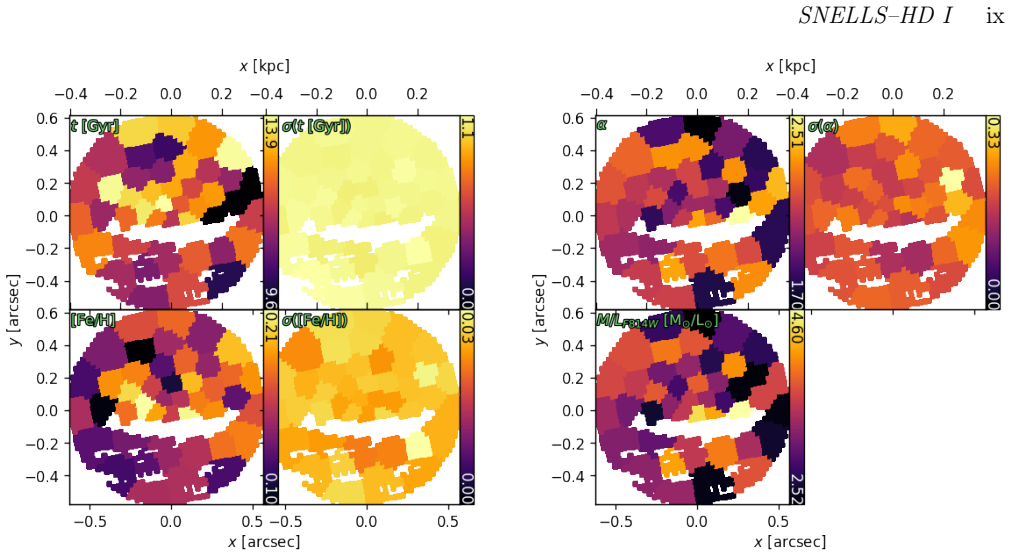
At 50 pc resolution the stellar mass-to-light ratio from dynamics is Kroupa-like (about 2.3) while spectral fitting is Salpeter-like (about 3.5), so the IMF tension persists over the same field of view.
T0 review reviewed 2026-08-05 challenge →
load-bearing objection A careful, transparent study that delivers the first 50 pc view of SNL-1; the IMF tension finding is persuasive but the PSF systematic and missing spectral M/L uncertainty need attention before publication. the 3 major comments →
SNELLS-HD I: a first look at the stellar properties of the massive strong-lens galaxy SNL-1 with 50 pc resolution
The pith
A machine-rendered reading of the paper's core claim, the machinery that carries it, and where it could break.
The reading
Core claim
Using new adaptive-optics-assisted MUSE Narrow-Field Mode data, the paper measures stellar kinematics of SNL-1's inner 1.25 arcseconds (about 805 pc) at an effective resolution of ~36 pc. A triaxial Schwarzschild orbit-superposition model reproduces all four observed line-of-sight kinematic moments and directly resolves the black hole's sphere of influence, yielding M_bh = (1.62 +0.056/-0.054) x 10^9 solar masses. The same model gives a stellar mass-to-light ratio M/L_F814W ~ 2.3, consistent with a Kroupa-like IMF. Spectral fits with the flexible full-spectrum fitting code alf over the identical aperture give M/L_F814W ~ 3.5, favouring a Salpeter-like IMF slope alpha ~ 2.3 for stars below on
What carries the argument
The central machinery is a triaxial Schwarzschild orbit-superposition model: a large library of stellar orbits is integrated in each trial gravitational potential, and a weighted subset is chosen to reproduce the observed kinematic maps after convolution with a modelled point-spread function. The PSF is a multi-Gaussian expansion fitted to the MUSE exposure-time calculator prediction. The spectroscopic counterpart is alf, a full-spectrum fitting code that varies stellar age, chemical abundances, kinematics, and a broken-power-law IMF. The argument is carried by comparing the mass-to-light ratios from both techniques over one common aperture.
Load-bearing premise
The adaptive-optics point-spread function is taken from an exposure-time calculator model rather than measured from the data, and it is convolved into every dynamical-model prediction; if the true PSF core differs, the black-hole mass and nuclear disk structure could shift beyond the quoted statistical errors.
What would settle it
Measure the actual delivered PSF of the NFM observations from a suitably placed star, a parallel AO calibration frame, or telemetry-based PSF reconstruction, and re-run the same Schwarzschild fits. If the recovered black-hole mass or the central velocity-dispersion peak changes by more than the quoted ~5 percent uncertainty, the central claim is not stable. A second check is to observe SNL-1's nucleus with an independent high-resolution IFU and verify that the same M_bh and M/L emerge without the AO PSF assumption.
If this is right
- Previous comparisons of spectral and dynamical IMF estimates that did not match apertures must be revisited: aperture mismatch is not the explanation for SNL-1.
- The resolved black-hole mass, consistent with the M-sigma relation, rules out an unresolved central dark mass as the source of the dynamical-to-spectroscopic M/L discrepancy.
- The nuclear disk and bar-like gas and dust morphology mean SNL-1's centre is structurally complex; models assuming simple axisymmetric or isotropic orbits could be biased.
- A joint multi-scale, multi-tracer model combining the narrow-field and wide-field kinematics with lensing and gas data is needed to confirm the inferred nuclear structure and dark-matter properties.
- Future adaptive-optics spectroscopy of other strong-lens galaxies can test whether the same-aperture IMF mismatch is generic or peculiar to SNL-1.
Where Pith is reading between the lines
- If the ETC model PSF is broader than the actually delivered PSF, the quoted black-hole mass could be overestimated and the flattening of the nuclear disk underestimated; the turbulence-independent PSF deserves an on-sky calibration.
- The persistence of the mismatch at fixed aperture suggests that spectral 'IMF' parameters and dynamical 'IMF' parameters need not agree even in principle, because they integrate over different stellar-mass ranges; a joint model with the low-mass cutoff as a free parameter could reconcile them.
- SNL-1 may be a poor benchmark for cross-technique IMF comparisons; its complex nucleus could exaggerate differences that simpler galaxies would not show.
- The two-part power-law IMF prior fixes the high-mass slope, forcing spectroscopic M/L to scale with the dwarf fraction; allowing the high-mass slope to vary would be a direct test of the claimed tension.
Editorial analysis
A structured set of objections, weighed in public.
Referee Report
Summary. This paper presents new VLT/MUSE NFM AO-assisted observations of the central ~1.25 arcsec of the strong-lens early-type galaxy SNL-1, reaching ~50 pc resolution. The authors measure stellar kinematics and fit triaxial Schwarzschild dynamical models, obtaining a black-hole mass M_bh = (1.62 +0.056/-0.054) x 10^9 solar masses with a resolved sphere of influence, and detecting a nuclear stellar disk. They also fit the spectra with alf, recovering a Salpeter-like low-mass IMF slope and a stellar M/L_F814W ~3.5, in contrast to the dynamical M/L_F814W ~2.3 (Kroupa-like). The IMF tension therefore persists when both methods probe the same aperture. The paper discusses possible resolutions, including a high low-mass cutoff, and excludes several previously suggested explanations.
Significance. If the results hold, this is a valuable demonstration of MUSE NFM's ability to resolve black-hole spheres of influence and nuclear kinematics at ~50 pc in a lens galaxy, and the same-aperture comparison of dynamical and spectral IMF diagnostics is an important step forward for the IMF debate. The paper is commendably transparent: it corrects an underestimated error cube (Appendix B), documents CTI-induced sky residuals and describes its ad-hoc sky subtraction (Appendix A), masks dust, and explicitly acknowledges that the low-mass cutoff m_cut is unconstrained. The dynamical and spectral analyses are independent, and both are compared against external IMF expectations. The principal weakness is the unverified ETC-based PSF, which enters every Schwarzschild prediction and is not propagated into the quoted M_bh uncertainty; this limits the strength of the central claim until quantified.
major comments (3)
- [§2.1, Table 2, §3.1, Table 3, §6] The adopted PSF is the ETC model, not measured from data, and footnote 2 states that the ETC model does not depend on turbulence. The MGE PSF (Table 2) has FWHM components 0.052″ and 0.102″ containing ~42% and ~50% of the weight, while the BH sphere of influence is ~0.12″ (§6). The BH signal is therefore only marginally resolved. The quoted uncertainty on log10(M_bh) (Table 3, ±0.0148 dex) is the statistical spread of the model grid and does not include any PSF systematic. The statement in §6 that the constraint on M_bh is “unambiguous” is not supported outside the grid. Please quantify the PSF systematic (e.g., by repeating the fit with perturbed MGE PSF models or independent PSF estimates) and propagate it into M_bh and into the dynamical M/L used in the alpha_IMF comparison via the M_bh–Υ anticorrelation (Fig. 6).
- [Appendix A] The sky subtraction uses an annulus at ~3.5″ radius from the galaxy centre, and the text states that this annulus “contains sky and some signal from the science target”. This ad-hoc sky spectrum is subtracted from the whole cube. The impact of subtracting galaxy light, which has its own stellar population and LOSVD, on the central 1.25″ science aperture is not quantified. If the annulus galaxy contribution is not negligible, it could introduce a systematic additive component in both the stellar kinematics and the alf spectral fits, with consequences for M_bh and the measured IMF slope. Please estimate the surface-brightness contrast between the annulus and the science aperture and test sensitivity to the choice of annulus.
- [§4.1, Appendix D] The spatially resolved alf fits fix 11 elemental abundances to their best-fit values from the integrated aperture spectrum. The paper acknowledges the implicit assumption of no strong gradients in those elements. Because the IMF slope alpha_1 and the derived M/L can trade off with abundance variations, a test is needed to show that this procedure does not bias the spectroscopic M/L. For example, fitting a subset of bins with all abundances free, or injecting synthetic abundance gradients, would demonstrate robustness.
minor comments (5)
- [Fig. 3 caption] “Wield-Field Camera 2” should be “Wide Field and Planetary Camera 2” (or the intended instrument name).
- [§3.1, Eq. (2)] The definition of V2 in the circularity expression is non-standard and potentially confusing; please clarify the notation (e.g., whether V2 is the squared velocity magnitude and how it enters the denominator).
- [§5] The caveat that the central regions are not well described by a single LOSVD is stated for the gas kinematics; the same caveat applies to the stellar kinematics measured with pPXF, which assumes a single LOSVD per bin. It would be helpful to note this explicitly when presenting the stellar kinematic maps.
- [§6] “at least 10 Gyrold” should read “at least 10 Gyr old”.
- [Fig. 13] The light curves from randomly sampled posteriors sometimes deviate from the measured curves; consider displaying median and credible intervals instead of a random sample to aid readability.
Circularity Check
No circularity: the dynamical and spectral analyses are independent, and the PSF/mcut caveats are acknowledged systematics rather than circular inputs.
full rationale
The paper's central claim is a comparison of two independent measurement techniques applied to the same 1.25-arcsec aperture: a triaxial Schwarzschild dynamical model fit to MUSE NFM stellar kinematics, giving M/L_F814W ~ 2.3 and M_bh = (1.62+0.056/-0.054)e9 M_sun, and the alf spectral-fitting code giving a Salpeter-like low-mass IMF slope and M/L_F814W ~ 3.5. Neither measurement is defined in terms of the other, and the quoted alpha_IMF ~ 0.65 is a direct ratio of these independently fitted quantities against standard IMF calibrations. The SMBH mass is constrained by the kinematics through the Schwarzschild grid, not taken from any input assumption; the PSF used in the models is adopted from the MUSE ETC (footnote 2 transparently notes it is turbulence-independent), which is an unverified systematic that could affect the M_bh error budget, but this is a correctness/robustness concern, not circular reasoning. The paper's proposed high-mcut resolution is explicitly stated to be unconstrained by the data ('We conclude that mcut is unconstrained by the data'), so it is not presented as a derived result. Self-citations to prior work by the authors (Poci & Smith 2022; Smith 2014, 2020) provide context and previously proposed hypotheses, but the conclusions do not reduce to those citations: the exclusion of the spatial-mismatch explanation is based on the new same-FoV measurements, and the mcut discussion is explicitly left unresolved. No equation in the paper reduces a predicted quantity to a fitted input by construction. The paper also documents data-reduction limitations (CTI sky issues, error-cube underestimation) in appendices, further supporting that the analysis is a transparent application of independent methods rather than a self-justifying derivation.
Axiom & Free-Parameter Ledger
free parameters (5)
- M_bh (SMBH mass) =
1.62e9 M_sun (log10 = 9.21 +/- 0.0148)
- q, p, u (intrinsic axis ratios) =
0.3973, 0.9210, 0.9999
- log10(M200/M_star) =
1.25 +/- 0.285
- Upsilon (global M/L) =
2.335 +/- 0.0753 M_sun/L_sun
- alpha1 (IMF low-mass slope in alf) =
2.28 +/- 0.19 from aperture fit; ~2.3 in binned fits
axioms (6)
- standard math Planck 2018 cosmology (H0=67.66, Om=0.3111)
- domain assumption Concentration-mass relation of Dutton & Maccio (2014)
- domain assumption Spatially constant M/L over the kinematic FoV
- ad hoc to paper The ETC PSF model represents the true delivered PSF
- ad hoc to paper Sky is constant and galaxy light negligible in the 3.5 arcsec annulus used for sky subtraction
- domain assumption alf IMF parametrisation: two-part broken power law with fixed high-mass slope 2.3 and m_max=100 Msun
Cite this review
Pith. "Pith review of SNELLS-HD I: a first look at the stellar properties of the massive strong-lens galaxy SNL-1 with 50 pc resolution." pith.science (2026). https://pith.science/paper/7PBA3QY4
@misc{pith2026250901732,
  author       = {Pith},
  title        = {Pith review of: SNELLS-HD I: a first look at the stellar properties of the massive strong-lens galaxy SNL-1 with 50 pc resolution},
  year         = {2026},
  howpublished = {\url{https://pith.science/paper/7PBA3QY4}},
  note         = {Machine review of arXiv:2509.01732}
}
abstract
We present a dynamical and chemical study of the centre of a massive early-type strong-lens galaxy ESO286-G022 (SNL-1). Analysing new data obtained through the adaptive-optics-assisted Narrow-Field Mode of VLT/MUSE, we aim to measure the mass distribution and internal properties of SNL-1 at $\sim 50\ {\rm pc}$ resolution. In particular, we aim to address the tension in the reported IMF measurements of SNL-1 between strong-lens/dynamical and spectral-fitting techniques. We fit a triaxial orbital dynamical model to the measured stellar kinematics, including constraining the mass of the (resolved) central supermassive black-hole. The dynamical model is consistent with the mass-to-light ratio expected for a Kroupa-like IMF. We also employ a highly-flexible spectral-fitting technique, which instead favours a Salpeter-like IMF (low-mass slope $\alpha\approx 2.3$) over the same spatial region. To conclude, we discuss possible origins of this discrepancy, both intrinsic and technical.
Figures




Reference graph
Works this paper leans on
-
[1]
Alton P. D., Smith R. J., Lucey J. R., 2018, @doi [Monthly Notices of the Royal Astronomical Society] 10.1093/mnras/sty1242 , 478, 4464
-
[2]
SPIE, pp 577--588, @doi 10.1117/12.790359
Arsenault R., et al., 2008, in Adaptive Optics Systems . SPIE, pp 577--588, @doi 10.1117/12.790359
-
[3]
Astropy Collaboration et al., 2013, @doi [Astronomy and Astrophysics] 10.1051/0004-6361/201322068 , 558, A33
-
[4]
Athanassoula E., Bureau M., 1999, @doi [The Astrophysical Journal] 10.1086/307677 , 522, 699
-
[5]
SPIE, pp 131--139, @doi 10.1117/12.856027
Bacon R., et al., 2010, in Ground-Based and Airborne Instrumentation for Astronomy III . SPIE, pp 131--139, @doi 10.1117/12.856027
-
[6]
Barnab \`e M., Spiniello C., Koopmans L. V. E., Trager S. C., Czoske O., Treu T., 2013, @doi [Monthly Notices of the Royal Astronomical Society] 10.1093/mnras/stt1727 , 436, 253
-
[7]
R., 2023, @doi [Monthly Notices of the Royal Astronomical Society] 10.1093/mnras/stac3481 , 519, 688
Bate M. R., 2023, @doi [Monthly Notices of the Royal Astronomical Society] 10.1093/mnras/stac3481 , 519, 688
-
[8]
S., Smith K., 2011, @doi [Computing in Science Engineering] 10.1109/MCSE.2010.118 , 13, 31
Behnel S., Bradshaw R., Citro C., Dalcin L., Seljebotn D. S., Smith K., 2011, @doi [Computing in Science Engineering] 10.1109/MCSE.2010.118 , 13, 31
-
[9]
Brewer B. J., et al., 2012, @doi [Monthly Notices of the Royal Astronomical Society] 10.1111/j.1365-2966.2012.20870.x , 422, 3574
arXiv 2012
-
[10]
J., Katz H., Witten C., Saxena A., Laporte N., Bunker A
Cameron A. J., Katz H., Witten C., Saxena A., Laporte N., Bunker A. J., 2023, Nebular Dominated Galaxies: Insights into the Stellar Initial Mass Function at High Redshift, @doi 10.48550/arXiv.2311.02051
-
[11]
400-410.] 10.1046/j.1365-8711.2002.05412.x , 333, 400
Cappellari M., 2002, @doi [Monthly Notices of the Royal Astronomical Society, Volume 333, Issue 2, pp. 400-410.] 10.1046/j.1365-8711.2002.05412.x , 333, 400
arXiv 2002
-
[12]
Cappellari M., 2016, @doi [Annual Review of Astronomy and Astrophysics] 10.1146/annurev-astro-082214-122432 , 54, 597
-
[13]
Cappellari M., 2017, @doi [Monthly Notices of the Royal Astronomical Society, Volume 466, Issue 1, p.798-811] 10.1093/mnras/stw3020 , 466, 798
-
[14]
345-354.] 10.1046/j.1365-8711.2003.06541.x , 342, 345
Cappellari M., Copin Y., 2003, @doi [Monthly Notice of the Royal Astronomical Society, Volume 342, Issue 2, pp. 345-354.] 10.1046/j.1365-8711.2003.06541.x , 342, 345
arXiv 2003
-
[15]
Cappellari M., Emsellem E., 2004, @doi [Publications of the Astronomical Society of the Pacific] 10.1086/381875 , 116, 138
doi:10.1086/381875 2004
-
[16]
Chabrier G., Hennebelle P., Charlot S., 2014, @doi [The Astrophysical Journal] 10.1088/0004-637X/796/2/75 , 796, 75
-
[17]
Initial mass function variability from the integrated light of diverse stellar systems
Cheng C. M., Villaume A., Balogh M. L., Brodie J. P., Mart \'i n-Navarro I., Romanowsky A. J., van Dokkum P. G., 2023, Initial Mass Function Variability from the Integrated Light of Diverse Stellar Systems, @doi 10.48550/arXiv.2309.14415
work page internal anchor Pith review Pith/arXiv arXiv doi:10.48550/arxiv.2309.14415 2023
-
[18]
Collier W. P., Smith R. J., Lucey J. R., 2018a, @doi [Monthly Notices of the Royal Astronomical Society] 10.1093/mnras/stx2297 , 473, 1103
-
[19]
Collier W. P., Smith R. J., Lucey J. R., 2018b, @doi [Monthly Notices of the Royal Astronomical Society] 10.1093/mnras/sty1188 , 478, 1595
-
[20]
G., Villaume A., 2017, @doi [The Astrophysical Journal] 10.3847/1538-4357/aa6190 , 837, 166
Conroy C., van Dokkum P. G., Villaume A., 2017, @doi [The Astrophysical Journal] 10.3847/1538-4357/aa6190 , 837, 166
-
[21]
G., Lind K., 2018, @doi [The Astrophysical Journal] 10.3847/1538-4357/aaab49 , 854, 139
Conroy C., Villaume A., van Dokkum P. G., Lind K., 2018, @doi [The Astrophysical Journal] 10.3847/1538-4357/aaab49 , 854, 139
-
[22]
Davis T. A., McDermid R. M., 2017, @doi [Monthly Notices of the Royal Astronomical Society] 10.1093/mnras/stw2366 , 464, 453
-
[23]
Davis T. A., et al., 2022, @doi [Monthly Notices of the Royal Astronomical Society] 10.1093/mnras/stac600 , 512, 1522
-
[24]
Deeley S., Drinkwater M., Sweet S., Bekki K., Couch W., Forbes D., 2023, The Formation Pathways of Compact Elliptical Galaxies, @doi 10.48550/arXiv.2308.00305
work page internal anchor Pith review Pith/arXiv arXiv doi:10.48550/arxiv.2308.00305 2023
-
[25]
Della Bruna L., et al., 2022, @doi [Astronomy and Astrophysics] 10.1051/0004-6361/202142315 , 660, A77
-
[26]
Dutton A. A., Macci \`o A. V., 2014, @doi [Monthly Notices of the Royal Astronomical Society] 10.1093/mnras/stu742 , 441, 3359
-
[27]
Dutton A. A., Mendel J. T., Simard L., 2012, @doi [Monthly Notices of the Royal Astronomical Society: Letters] 10.1111/j.1745-3933.2012.01230.x , 422, L33
arXiv 2012
-
[28]
Emsellem E., et al., 2022, arXiv:2110.03708 [astro-ph]
Pith/arXiv arXiv 2022
-
[29]
F \'e tick R. J. L., et al., 2019, @doi [Astronomy & Astrophysics] 10.1051/0004-6361/201935830 , 628, A99
-
[30]
Foreman-Mackey D., Hogg D. W., Lang D., Goodman J., 2013, @doi [Publications of the Astronomical Society of the Pacific] 10.1086/670067 , 125, 306
doi:10.1086/670067 2013
-
[31]
Gadotti D. A., Seidel M. K., S \'a nchez-Bl \'a zquez P., Falc \'o n-Barroso J., Husemann B., Coelho P., P \'e rez I., 2015, @doi [Astronomy and Astrophysics] 10.1051/0004-6361/201526677 , 584, A90
-
[32]
Gr \`e bol-Tom \`a s P., Ferr \'e -Mateu A., Dom \'i nguez-S \'a nchez H., 2023, Bridging the Gap in the Mass-Size Relation of Compact Galaxies with MaNGA , @doi 10.48550/arXiv.2309.12394
work page internal anchor Pith review Pith/arXiv arXiv doi:10.48550/arxiv.2309.12394 2023
-
[33]
Gu M., Greene J. E., Newman A. B., Kreisch C., Quenneville M. E., Ma C.-P., Blakeslee J. P., 2022, @doi [The Astrophysical Journal] 10.3847/1538-4357/ac69ea , 932, 103
-
[34]
R., et al., 2020, @doi [Nature] 10.1038/s41586-020-2649-2 , 585, 357
Harris C. R., et al., 2020, @doi [Nature] 10.1038/s41586-020-2649-2 , 585, 357
-
[35]
D., 2007, @doi [Computing in Science and Engineering, vol
Hunter J. D., 2007, @doi [Computing in Science and Engineering, vol. 9, no. 3, pp. 90-95] 10.1109/MCSE.2007.55 , 9, 90
-
[36]
Kam Z. S., Carignan C., Chemin L., Amram P., Epinat B., 2015, @doi [Monthly Notices of the Royal Astronomical Society] 10.1093/mnras/stv517 , 449, 4048
-
[37]
S., Remus R.-S., Burkert A., Dolag K., Hoffmann T
Karademir G. S., Remus R.-S., Burkert A., Dolag K., Hoffmann T. L., Moster B. P., Steinwandel U. P., Zhang J., 2019, @doi [Monthly Notices of the Royal Astronomical Society] 10.1093/mnras/stz1251 , 487, 318
-
[38]
Kormendy J., Ho L. C., 2013, @doi [Annual Review of Astronomy and Astrophysics] 10.1146/annurev-astro-082708-101811 , 51, 511
-
[40]
Kroupa P., 2001, @doi [Monthly Notices of the Royal Astronomical Society] 10.1046/j.1365-8711.2001.04022.x , 322, 231
arXiv 2001
-
[41]
Kroupa P., 2002, @doi [Science] 10.1126/science.1067524 , 295, 82
-
[42]
La Barbera F., Vazdekis A., Ferreras I., Pasquali A., Allende Prieto C., R \"o ck B., Aguado D. S., Peletier R. F., 2017, @doi [Monthly Notices of the Royal Astronomical Society] 10.1093/mnras/stw2407 , 464, 3597
-
[43]
La Barbera F., et al., 2019, @doi [Monthly Notices of the Royal Astronomical Society] 10.1093/mnras/stz2192 , 489, 4090
-
[44]
La Barbera F., Vazdekis A., Ferreras I., Pasquali A., 2021, @doi [Monthly Notices of the Royal Astronomical Society] 10.1093/mnras/stab1136 , 505, 415
-
[45]
Liu L., Bureau M., Blitz L., Davis T. A., Onishi K., Smith M., North E., Iguchi S., 2021, @doi [Monthly Notices of the Royal Astronomical Society] 10.1093/mnras/stab1537 , 505, 4048
-
[46]
Lu S., Zhu K., Cappellari M., Li R., Mao S., Xu D., 2023a, MaNGA DynPop -- II . Global Stellar Population, Gradients, and Star-Formation Histories from Integral-Field Spectroscopy of 10K Galaxies: Link with Galaxy Rotation, Shape, and Total-Density Gradients, @doi 10.48550/arXiv.2304.11712
work page internal anchor Pith review Pith/arXiv arXiv doi:10.48550/arxiv.2304.11712
-
[47]
Lu S., Zhu K., Cappellari M., Li R., Mao S., Xu D., 2023b, MaNGA DynPop -- V . The Dark-Matter Fraction versus Stellar Velocity Dispersion Relation and Initial Mass Function Variations: Dynamical Models and Full Spectrum Fitting of Integral-Field Spectroscopy, @doi 10.48550/arXiv.2309.12395
work page internal anchor Pith review Pith/arXiv arXiv doi:10.48550/arxiv.2309.12395
-
[48]
Lu A., et al., 2024, WISDOM Project XX -- Strong Shear Tearing Molecular Clouds Apart in NGC 524, @doi 10.48550/arXiv.2406.01291
work page internal anchor Pith review Pith/arXiv arXiv doi:10.48550/arxiv.2406.01291 2024
-
[49]
Lyubenova M., et al., 2016, @doi [Monthly Notices of the Royal Astronomical Society] 10.1093/mnras/stw2434 , 463, 3220
-
[50]
Martig M., et al., 2021, @doi [Monthly Notices of the Royal Astronomical Society] 10.1093/mnras/stab2729 , 508, 2458
-
[51]
Mart \'i n-Navarro I., et al., 2015, @doi [The Astrophysical Journal] 10.1088/2041-8205/806/2/L31 , 806, L31
-
[52]
Mart \'i n-Navarro I., et al., 2019, @doi [Astronomy & Astrophysics] 10.1051/0004-6361/201935360 , 626, A124
-
[53]
Mart \'i n-Navarro I., et al., 2021, @doi [Astronomy & Astrophysics] 10.1051/0004-6361/202141348 , 654, A59
-
[54]
Massey R., Stoughton C., Leauthaud A., Rhodes J., Koekemoer A., Ellis R., Shaghoulian E., 2010, @doi [Monthly Notices of the Royal Astronomical Society] 10.1111/j.1365-2966.2009.15638.x , 401, 371
arXiv 2010
-
[55]
Mitchell C. J., Williams T. B., Spekkens K., Lee-Waddell K., Kuzio de Naray R., Sellwood J. A., 2015, @doi [The Astronomical Journal] 10.1088/0004-6256/149/3/116 , 149, 116
-
[56]
Naab T., Johansson P. H., Ostriker J. P., 2009, @doi [The Astrophysical Journal] 10.1088/0004-637X/699/2/L178 , 699, L178
-
[57]
Navarro J. F., Frenk C. S., White S. D. M., 1996, @doi [The Astrophysical Journal] 10.1086/177173 , 462, 563
doi:10.1086/177173 1996
-
[58]
Newman A. B., Smith R. J., Conroy C., Villaume A., van Dokkum P., 2017, @doi [The Astrophysical Journal] 10.3847/1538-4357/aa816d , 845, 157
-
[59]
Oser L., Ostriker J. P., Naab T., Johansson P. H., Burkert A., 2010, @doi [The Astrophysical Journal] 10.1088/0004-637X/725/2/2312 , 725, 2312
-
[60]
Parikh T., Saglia R., Thomas J., Mehrgan K., Bender R., Maraston C., 2024, Stellar Populations of Massive Early-Type Galaxies Observed by MUSE , @doi 10.48550/arXiv.2402.06628
work page internal anchor Pith review Pith/arXiv arXiv doi:10.48550/arxiv.2402.06628 2024
-
[61]
E., 2007, @doi [Computing in Science Engineering] 10.1109/MCSE.2007.53 , 9, 21
Perez F., Granger B. E., 2007, @doi [Computing in Science Engineering] 10.1109/MCSE.2007.53 , 9, 21
-
[62]
Pietrinferni A., Cassisi S., Salaris M., Castelli F., 2004, @doi [The Astrophysical Journal] 10.1086/422498 , 612, 168
doi:10.1086/422498 2004
-
[63]
Planck Collaboration et al., 2020, @doi [Astronomy and Astrophysics] 10.1051/0004-6361/201833910 , 641, A6
-
[64]
J., 2022, @doi [Monthly Notices of the Royal Astronomical Society] 10.1093/mnras/stac776 , 512, 5298
Poci A., Smith R. J., 2022, @doi [Monthly Notices of the Royal Astronomical Society] 10.1093/mnras/stac776 , 512, 5298
-
[65]
Poci A., McDermid R. M., Zhu L., van de Ven G., 2019, @doi [Monthly Notices of the Royal Astronomical Society] 10.1093/mnras/stz1154 , 487, 3776
-
[66]
Poci A., et al., 2022, @doi [Monthly Notices of the Royal Astronomical Society] 10.1093/mnras/stac1514 , 514, 3660
-
[67]
Poci A., Smith R., Davis T., in prep
-
[68]
E., 1955, @doi [Astrophysical Journal, vol
Salpeter E. E., 1955, @doi [Astrophysical Journal, vol. 121, p.161] 10.1086/145971 , 121, 161
doi:10.1086/145971 1955
-
[69]
Schwarzschild M., 1979, @doi [Astrophysical Journal, Part 1, vol. 232, Aug. 15, 1979, p. 236-247.] 10.1086/157282 , 232, 236
doi:10.1086/157282 1979
-
[70]
Austin, Texas, pp 92--96, @doi 10.25080/Majora-92bf1922-011
Seabold S., Perktold J., 2010, in Python in Science Conference . Austin, Texas, pp 92--96, @doi 10.25080/Majora-92bf1922-011
-
[71]
Smith R. J., 2014, @doi [Monthly Notices of the Royal Astronomical Society: Letters] 10.1093/mnrasl/slu082 , 443, L69
-
[72]
Smith R. J., 2020, @doi [Annual Review of Astronomy and Astrophysics] 10.1146/annurev-astro-032620-020217 , 58, 577
-
[73]
Smith R. J., Lucey J. R., Conroy C., 2015a, @doi [Monthly Notices of the Royal Astronomical Society] 10.1093/mnras/stv518 , 449, 3441
-
[74]
Smith R. J., Alton P., Lucey J. R., Conroy C., Carter D., 2015b, @doi [Monthly Notices of the Royal Astronomical Society: Letters] 10.1093/mnrasl/slv132 , 454, L71
-
[75]
Sollima A., 2019, @doi [Monthly Notices of the Royal Astronomical Society] 10.1093/mnras/stz2093 , 489, 2377
-
[76]
A., 2007, @doi [The Astrophysical Journal] 10.1086/518471 , 664, 204
Spekkens K., Sellwood J. A., 2007, @doi [The Astrophysical Journal] 10.1086/518471 , 664, 204
doi:10.1086/518471 2007
-
[77]
Spiniello C., Koopmans L. V. E., Trager S. C., Czoske O., Treu T., 2011, @doi [Monthly Notices of the Royal Astronomical Society] 10.1111/j.1365-2966.2011.19458.x , 417, 3000
arXiv 2011
-
[78]
Spiniello C., et al., 2023, INSPIRE : INvestigating Stellar Population In RElics V . A Catalogue of Ultra-Compact Massive Galaxies Outside the Local Universe and Their Degree of Relicness, @doi 10.48550/arXiv.2309.12966
work page internal anchor Pith review Pith/arXiv arXiv doi:10.48550/arxiv.2309.12966 2023
-
[79]
SPIE, pp 1116--1126, @doi 10.1117/12.926110
Str \"o bele S., et al., 2012, in Adaptive Optics Systems III . SPIE, pp 1116--1126, @doi 10.1117/12.926110
-
[80]
Vaughan S. P., Davies R. L., Zieleniewski S., Houghton R. C. W., 2018, @doi [Monthly Notices of the Royal Astronomical Society] 10.1093/mnras/stx3199 , 475, 1073
-
[81]
Vazdekis A., Casuso E., Peletier R. F., Beckman J. E., 1996, @doi [The Astrophysical Journal Supplement Series] 10.1086/192340 , 106, 307
doi:10.1086/192340 1996
This paper was first reviewed by deepseek-v4-flash on August 5, 2026.
discussion (0)
Sign in with ORCID, Apple, or X to comment. Anyone can read and Pith papers without signing in.