REVIEW 2 major objections 5 minor 80 references
Motion-Refined DINOSAUR for Unsupervised Multi-Object Discovery
T0 review · 2 major / 5 minor · reviewed 2026-08-15 · deepseek-v4-flash
Pith's one-line read Motion-only pseudo labels let unsupervised slot attention beat supervised baselines on driving scenes.
desk verdict A well-ablated, genuinely unsupervised extension of DINOSAUR that beats prior SOTA on TRI-PD and KITTI; trust the central result, but ask for a threshold sensitivity sweep. read the letter →
The pith
A machine-rendered reading of the paper's core claim, the machinery that carries it, and where it could break.
The reading
What carries the argument
The load-bearing mechanism is an unsupervised pseudo-label generator that first labels a frame pair as quasi-static when the average optical-flow magnitude in most image corners is below a threshold, then thresholds flow magnitude to get a foreground mask, extracts connected components, and splits components that contain flow-gradient discontinuities using density-based clustering on flow magnitude, angle, and pixel position. The second mechanism is a two-stage training scheme: stage 1 applies Hungarian matching and a weighted binary cross-entropy loss to pull DINOSAUR's alpha masks onto the pseudo instance masks, and stage 2 trains a slot-deactivation MLP with a foreground/background loss (negative log-likelihood plus background regularization) and a similarity-based drop loss that ignores unmatched slots whose representations resemble matched foreground slots, so static objects are not erased. Together these convert motion-only cues into a foreground/background decision for every slot.
What would settle it
Run MR-DINOSAUR on a video dataset where every frame has camera motion, once with the still-frame filter and once with it turned off; if the two versions perform equally, the static-camera assumption is not load-bearing, whereas the paper's own results on the constantly-moving MOVI-E dataset suggest the filtered version should win.
Extended reading notes
Core claim
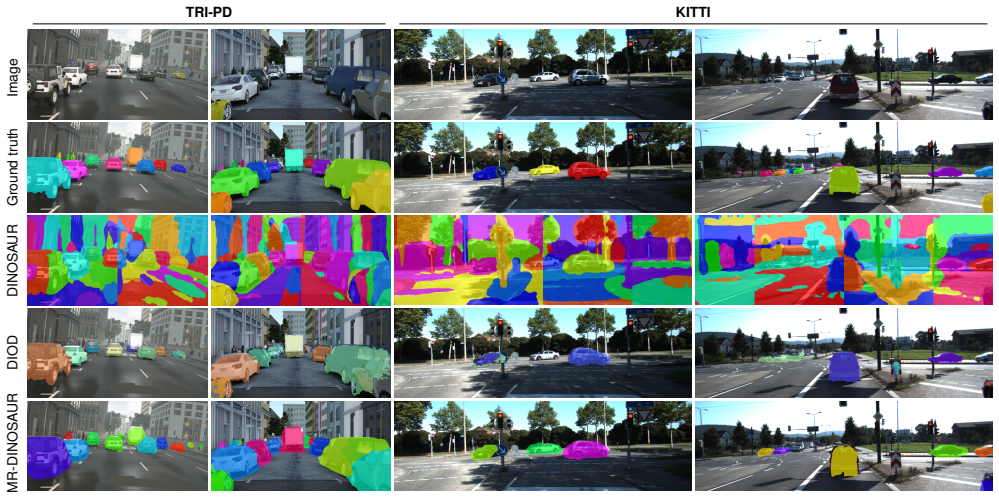
On the paper's own terms, the central discovery is that the hard part of multi-object discovery is not the object-centric model but the label signal: once high-quality instance masks are obtained without supervision—by exploiting frames where the background is static and flow is caused only by moving objects—a standard slot-attention model such as DINOSAUR can be refined into a state-of-the-art object segmenter. The refinement happens in two stages: a weighted binary cross-entropy loss matches slot alpha masks to the pseudo instance masks and sharpens object boundaries, then a slot-deactivation module learns to switch off background slots, with a similarity-based drop loss that keeps the model from punishing slots that plausibly represent static objects. The paper reports that this fully unsupervised system improves $F_1$ by 6.6 points over DIOD on TRI-PD and 11.8 points on KITTI, and that its own pseudo labels score substantially higher than the supervised TSAM labels used by prior work (15.4 vs 8.9 $F_1$ on the same subset).
Load-bearing premise
The approach presumes that training videos contain frames in which the camera is perfectly still; when camera motion is constant, as in the MOVI-E dataset, the motion clues lose their meaning and the method's segmentation quality falls below the comparison method.
Editorial extensions
If this is right
- Fully unsupervised multi-object discovery is achievable on real driving scenes: on KITTI, MR-DINOSAUR reaches $F_1$ 35.0, beating DIOD without any synthetic pretraining (DIOD drops to 14.1 when retrained on KITTI only).
- Motion-derived pseudo labels from quasi-static frames are enough to refine a pre-trained object-centric model; the paper's own pseudo labels outperform the supervised TSAM labels used by earlier methods on the same frames (15.4 vs 8.9 $F_1$).
- The similarity-based drop loss lets the model go beyond the moving objects seen in pseudo labels, so static objects of the same category can still be discovered rather than being forced into the background.
- The method is agnostic to the base object-centric learner, so future improvements in slot-attention or object-centric backbones can be plugged in to raise accuracy further.
- The refinement stage needs only a fraction of the training data (about 13,280 of 94,200 TRI-PD frames) and modest compute, with stage 1 taking about 11 hours and stage 2 about 40 minutes on a single GPU.
Reading between the lines
- The paper leaves implicit that its quasi-static frame filter is a data-selection prior: coupling it with estimated ego-motion or inertial cues could extend the pipeline to handheld, drone, or always-moving cameras while keeping the same pseudo-label generator.
- A testable consequence of the similarity-based drop loss is a precision-recall trade-off controlled by the slot-similarity threshold; sweeping that threshold on TRI-PD would show whether the module mainly suppresses false positives or also sacrifices genuinely static objects.
- Because pseudo labels contain only moving objects, the method's 'object' category is motion-defined; connecting it to image-level object-centricity signals could yield a system that discovers static objects as reliably as dynamic ones, going beyond what the paper evaluates.
- The two-stage refinement—first sharpening masks, then learning which slots are objects—could transfer directly to other slot-attention backbones or to weakly supervised panoptic segmentation, where background slots are rarely labeled.
Signed reviews
Editorial analysis
A structured set of objections, weighed in public.
Referee Report
Summary. The paper proposes MR-DINOSAUR, an unsupervised multi-object discovery method that extends DINOSAUR by refining its slot representations with pseudo-labels derived from motion segmentation of quasi-static video frames. Pseudo-labels are generated by thresholding unsupervised optical flow (SMURF) on frames with minimal camera motion, extracting connected components, and splitting them via flow-gradient thresholding and HDBSCAN. Stage 1 fine-tunes the DINOSAUR slot-attention module with a weighted binary cross-entropy loss between matched slot alpha masks and pseudo-instance masks; stage 2 trains a slot deactivation module with a foreground/background loss and a similarity-based drop-loss to handle static objects. The method is evaluated on TRI-PD, KITTI, and MOVI-E, achieving F1_50 of 48.1 on TRI-PD and 35.0 on KITTI, improving over the previous supervised-pseudo-label method DIOD (41.5 and 23.2).
Significance. If the results hold, this is a valuable contribution to unsupervised multi-object discovery. The paper demonstrates that high-quality pseudo-labels can be obtained without any supervision by exploiting quasi-static frames, replacing the supervised TSAM pseudo-labels used by prior work. The two-stage training scheme and the slot-deactivation module are simple and effective, and the drop-loss is a sensible mechanism for recovering static objects. The paper includes useful ablations (Table 3), a pseudo-label quality analysis (Table 4), and an equal-footing comparison with DIOD retrained on KITTI (Table 2, DIOD*‡). The code release and detailed hyperparameters in the supplement support reproducibility.
major comments (2)
- [§3.1, Tabs. 7–8] The pseudo-label pipeline depends on three hand-set thresholds (τstatic, τfg, τ∇). The supplementary validates only τstatic, and only on KITTI (Tab. 7); no sensitivity analysis is provided for τfg or τ∇, and no validation is reported for τstatic on TRI-PD. Moreover, on MOVI-E (supp. D.1), which has constant camera motion, the method retrieves 84,831 of 87,741 frames as quasi-static, indicating that the static-background assumption is effectively not enforced there. Because the 'fully unsupervised' claim is load-bearing, the authors should state how each threshold was chosen without using benchmark labels and provide a robustness sweep, such as F1_50 as a function of τfg and τ∇ over a reasonable range, to show that the reported gains over DIOD are not peaked.
- [§3.2, Eq. (4), Tab. 3b] The drop-loss is the only mechanism for discovering objects that are static in the current frame, but its effect is shown only globally (F1_50 46.3 → 48.1 in Tab. 3b). The claim that the method 'discovers objects beyond the dynamic ones' is not directly evaluated; the cosine-similarity condition (max c_u ≤ τdrop) may recover same-category static objects but could miss static objects of categories never observed moving. The authors should provide evidence for static-object discovery, for example by computing F1_50 separately for moving and static instances in the KITTI ground truth, and analyze the fraction of discovered objects that are static.
minor comments (5)
- [§4.1, Tabs. 1–2] All main results are reported without error bars or multiple seeds; please add at least a note on variance or run additional seeds for the key comparisons.
- [§4.1, Tab. 2] The high AP50 (59.7) but low AR50 (24.7) on KITTI indicates a strong precision-recall imbalance; please discuss whether this is due to the conservative slot deactivation, and how it affects the interpretation of F1_50.
- [Supplementary D.2] The supplementary lists the GPU as 'NVIDIA RTX 6000 Ada' while the main text says 'NVIDIA A6000 Ada'; please use consistent hardware names.
- [Fig. 1] The F1_50 gains are shown as '+6.6%' and '+11.8%', but the absolute values on the bars would help readers; please consider labeling them.
- [§3.1] The quasi-static frame retrieval uses corner patches covering 15% of image height and width; please justify this choice or note that it is dataset-agnostic.
Circularity Check
No significant circularity: MR-DINOSAUR's pseudo-labels are motion-derived, while evaluation uses ground-truth instance masks; no load-bearing self-citation or fitted-input prediction found.
full rationale
MR-DINOSAUR's derivation chain is: SMURF optical flow on quasi-static frames yields motion-based pseudo-instance masks; these masks supervise refinement of DINOSAUR slots in stage 1 and a slot-deactivation module in stage 2; the final F1_50/ARI numbers are computed against ground-truth instance masks on TRI-PD, KITTI, and MOVI-E. No step equates a prediction with a fitted quantity by construction: the pseudo-labels are generated without using the evaluation labels, and the final evaluation includes static objects, so the reported benchmark result is not simply the motion threshold or the pseudo-label mask renamed. The hand-set thresholds (τstatic, τfg, τ∇) are hyperparameters of a data-generation pipeline, not parameters fitted to the benchmark target; even if their selection were not fully documented, that would be a robustness or correctness concern, not circularity. Self-citations (e.g., Hahn et al. [27]; Singh et al. [58]) appear only in related-work or discussion context and are not load-bearing. The paper explicitly reports the MOVI-E failure case and the stated limitation that motion-based learning is, by definition, restricted to object categories capable of moving (Sec. 5), so no circular dependency is hidden. The result is therefore self-contained with respect to the external benchmarks.
Assumptions & free parameters
free parameters (5)
- tau_static =
0.5 (TRI-PD), 1.7 (KITTI, MOVI-E)
- tau_fg =
2.5
- tau_grad =
20
- tau_drop =
0.99
- r_bg =
0.2
assumptions (5)
- domain assumption Objects are defined as entities capable of moving (Sec. 1, Sec. 3)
- domain assumption Quasi-static frames exist in the training videos and are identifiable by corner-flow magnitude thresholding (Sec. 3.1)
- domain assumption SMURF unsupervised optical flow is accurate enough for motion segmentation (Sec. 3.1)
- domain assumption Common-fate principle: pixels with similar motion belong to the same object (Sec. 3.1)
- standard math DINOv2 features and DINOSAUR slot attention provide a suitable representation space for refinement (Sec. 3.2)
Cite this review
Pith. "Pith review of Motion-Refined DINOSAUR for Unsupervised Multi-Object Discovery." pith.science (2026). https://pith.science/paper/7QPYB32D
@misc{pith2026250902545,
  author       = {Pith},
  title        = {Pith review of: Motion-Refined DINOSAUR for Unsupervised Multi-Object Discovery},
  year         = {2026},
  howpublished = {\url{https://pith.science/paper/7QPYB32D}},
  note         = {Machine review of arXiv:2509.02545}
}
read the original abstract
Unsupervised multi-object discovery (MOD) aims to detect and localize distinct object instances in visual scenes without any form of human supervision. Recent approaches leverage object-centric learning (OCL) and motion cues from video to identify individual objects. However, these approaches use supervision to generate pseudo labels to train the OCL model. We address this limitation with MR-DINOSAUR -- Motion-Refined DINOSAUR -- a minimalistic unsupervised approach that extends the self-supervised pre-trained OCL model, DINOSAUR, to the task of unsupervised multi-object discovery. We generate high-quality unsupervised pseudo labels by retrieving video frames without camera motion for which we perform motion segmentation of unsupervised optical flow. We refine DINOSAUR's slot representations using these pseudo labels and train a slot deactivation module to assign slots to foreground and background. Despite its conceptual simplicity, MR-DINOSAUR achieves strong multi-object discovery results on the TRI-PD and KITTI datasets, outperforming the previous state of the art despite being fully unsupervised.
Figures


Figures from the paper (5 more)



Reference graph
Works this paper leans on
-
[1]
write newline
" write newline "" before.all 'output.state := FUNCTION n.dashify 't := "" t empty not t #1 #1 substring "-" = t #1 #2 substring "--" = not "--" * t #2 global.max substring 't := t #1 #1 substring "-" = "-" * t #2 global.max substring 't := while if t #1 #1 substring * t #2 global.max substring 't := if while FUNCTION format.date year duplicate empty "emp...
-
[2]
Adil Kaan Akan and Yucel Yemez. Slot-guided adaptation of pre-trained diffusion models for object-centric learning and compositional generation. In ICLR, 2025
work page 2025
-
[3]
An overview of optical flow-based approaches for motion segmentation
Shivangi Anthwal and Dinesh Ganotra. An overview of optical flow-based approaches for motion segmentation. Imaging Sci. J. , 67 0 (5): 0 284--294, 2019
work page 2019
-
[4]
o rkay Aydemir, Weidi Xie, and Fatma G \
G \" o rkay Aydemir, Weidi Xie, and Fatma G \" u ney. Self-supervised object-centric learning for videos. In NeurIPS*2023, pages 32879--32899
work page 2023
-
[5]
Discovering objects that can move
Zhipeng Bao, Pavel Tokmakov, Allan Jabri, Yu - Xiong Wang, Adrien Gaidon, and Martial Hebert. Discovering objects that can move. In CVPR, pages 11779--11788, 2022
work page 2022
-
[6]
Object discovery from motion-guided tokens
Zhipeng Bao, Pavel Tokmakov, Yu - Xiong Wang, Adrien Gaidon, and Martial Hebert. Object discovery from motion-guided tokens. In CVPR, pages 22972--22981, 2023
work page 2023
-
[7]
Michael J. Black and David J. Fleet. Probabilistic detection and tracking of motion boundaries. Int. J. Comput. Vis., 38 0 (3): 0 231--245, 2000
work page 2000
-
[8]
YOLACT : R eal-time instance segmentation
Daniel Bolya, Chong Zhou, Fanyi Xiao, and Yong Jae Lee. YOLACT : R eal-time instance segmentation. In ICCV, pages 9156--9165, 2019
work page 2019
Show all 80 references
-
[9]
o dermann, David Br \
Tim Br \" o dermann, David Br \" u ggemann, Christos Sakaridis, Kevin Ta, Odysseas Liagouris, Jason Corkill, and Luc Van Gool. MUSES: T he multi-sensor semantic perception dataset for driving under uncertainty. In ECCV, pages 21--38, 2024
2024
-
[10]
Object segmentation by long term analysis of point trajectories
Thomas Brox and Jitendra Malik. Object segmentation by long term analysis of point trajectories. In ECCV, pages 282--295, 2010
2010
-
[11]
MONet : U nsupervised scene decomposition and representation
Christopher P Burgess, Loic Matthey, Nicholas Watters, Rishabh Kabra, Irina Higgins, Matt Botvinick, and Alexander Lerchner. MONet : U nsupervised scene decomposition and representation. arXiv:1901.11390 [cs.CV] , 2019
1901 arXiv
-
[12]
Cascade R-CNN : H igh quality object detection and instance segmentation
Zhaowei Cai and Nuno Vasconcelos. Cascade R-CNN : H igh quality object detection and instance segmentation. IEEE Trans. Pattern Anal. Mach. Intell., 43 0 (5): 0 1483--1498, 2019
2019
-
[13]
Ricardo J. G. B. Campello, Davoud Moulavi, and J \" o rg Sander. Density-based clustering based on hierarchical density estimates. In PAKDD , pages 160--172, 2013
2013
-
[14]
Emerging properties in self-supervised vision transformers
Mathilde Caron, Hugo Touvron, Ishan Misra, Herv \'e J \'e gou, Julien Mairal, Piotr Bojanowski, and Armand Joulin. Emerging properties in self-supervised vision transformers. In ICCV, pages 9650--9660, 2021
2021
-
[15]
Guess what moves: U nsupervised video and image segmentation by anticipating motion
Subhabrata Choudhury, Laurynas Karazija, Iro Laina, Andrea Vedaldi, and Christian Rupprecht. Guess what moves: U nsupervised video and image segmentation by anticipating motion. In BMVC, page 554, 2022
2022
-
[16]
The C ityscapes dataset for semantic urban scene understanding
Marius Cordts, Mohamed Omran, Sebastian Ramos, Timo Scharwächter, Markus Enzweiler, Rodrigo Benenson, Uwe Franke, Stefan Roth, and Bernt Schiele. The C ityscapes dataset for semantic urban scene understanding. In CVPR, pages 3213--3223
-
[17]
Motion competition: A variational approach to piecewise parametric motion segmentation
Daniel Cremers and Stefano Soatto. Motion competition: A variational approach to piecewise parametric motion segmentation. Int. J. Comput. Vis., 62 0 (3): 0 249--265, 2005
2005
-
[18]
Towards segmenting anything that moves
Achal Dave, Pavel Tokmakov, and Deva Ramanan. Towards segmenting anything that moves. In ICCVW , pages 1493--1502, 2019
2019
-
[19]
A simple and efficient connected components labeling algorithm
Luigi Di Stefano and Andrea Bulgarelli. A simple and efficient connected components labeling algorithm. In ICIAP , pages 322--327, 1999
1999
-
[20]
Mozer, and Thomas Kipf
Gamaleldin Elsayed, Aravindh Mahendran, Sjoerd Van Steenkiste, Klaus Greff, Michael C. Mozer, and Thomas Kipf. SAVi++ : T owards end-to-end object-centric learning from real-world videos. In NeurIPS*2022, pages 28940--28954
2022
-
[21]
Genesis-v2: Inferring unordered object representations without iterative refinement
Martin Engelcke, Oiwi Parker Jones, and Ingmar Posner. Genesis-v2: Inferring unordered object representations without iterative refinement. In NeurIPS*2021, pages 8085--8094
2021
-
[22]
Kosiorek, Oiwi Parker Jones, and Ingmar Posner
Martin Engelcke, Adam R. Kosiorek, Oiwi Parker Jones, and Ingmar Posner. GENESIS: G enerative scene inference and sampling with object-centric latent representations. In ICLR, 2020
2020
-
[23]
Obstacle detection by evaluation of optical flow fields from image sequences
Wilfried Enkelmann. Obstacle detection by evaluation of optical flow fields from image sequences. Image Vis. Comput. , 9 0 (3): 0 160--168, 1991
1991
-
[24]
S. M. Ali Eslami, Nicolas Heess, Theophane Weber, Yuval Tassa, David Szepesvari, Koray Kavukcuoglu, and Geoffrey E Hinton. Attend, infer, repeat: Fast scene understanding with generative models. In NIPS*2016
2016
-
[25]
Vision meets robotics: T he KITTI dataset
Andreas Geiger, Philip Lenz, Christoph Stiller, and Raquel Urtasun. Vision meets robotics: T he KITTI dataset. Int. J. Robot. Res., pages 1231--1237, 2013
2013
-
[26]
Multi-object representation learning with iterative variational inference
Klaus Greff, Rapha \"e l Lopez Kaufman, Rishabh Kabra, Nick Watters, Christopher Burgess, Daniel Zoran, Loic Matthey, Matthew Botvinick, and Alexander Lerchner. Multi-object representation learning with iterative variational inference. In ICML, pages 2424--2433, 2019
2019
-
[27]
Fuchs, Ingmar Posner, and Andrea Vedaldi
Oliver Groth, Fabian B. Fuchs, Ingmar Posner, and Andrea Vedaldi. ShapeStacks : L earning vision-based physical intuition for generalised object stacking. In ECCV, pages 702--717, 2018
2018
-
[28]
Scene-centric unsupervised panoptic segmentation
Oliver Hahn, Christoph Reich, Nikita Araslanov, Daniel Cremers, Christian Rupprecht, and Stefan Roth. Scene-centric unsupervised panoptic segmentation. In CVPR, pages 24485--24495, 2025
2025
-
[29]
Girshick
Kaiming He, Georgia Gkioxari, Piotr Doll \' a r, and Ross B. Girshick. Mask R-CNN . IEEE Trans. Pattern Anal. Mach. Intell., 42 0 (2): 0 386--397, 2020
2020
-
[30]
Object-centric slot diffusion
Jindong Jiang, Fei Deng, Gautam Singh, and Sungjin Ahn. Object-centric slot diffusion. In NeurIPS*2023, pages 8563--8601
2023
-
[31]
Scalor: Generative world models with scalable object representations
Jindong Jiang, Sepehr Janghorbani, Gerard De Melo, and Sungjin Ahn. Scalor: Generative world models with scalable object representations. In ICLR, 2019
2019
-
[32]
SCALOR: G enerative world models with scalable object representations
Jindong Jiang, Sepehr Janghorbani, Gerard de Melo, and Sungjin Ahn. SCALOR: G enerative world models with scalable object representations. In ICLR, 2020
2020
-
[33]
Lawrence Zitnick, and Ross Girshick
Justin Johnson, Bharath Hariharan, Laurens Van Der Maaten, Li Fei-Fei, C. Lawrence Zitnick, and Ross Girshick. CLEVR : A diagnostic dataset for compositional language and elementary visual reasoning. In CVPR, pages 2901--2910, 2017
2017
-
[34]
SPOT : S elf-training with patch-order permutation for object-centric learning with autoregressive transformers
Ioannis Kakogeorgiou, Spyros Gidaris, Konstantinos Karantzalos, and Nikos Komodakis. SPOT : S elf-training with patch-order permutation for object-centric learning with autoregressive transformers. In CVPR, pages 22776--22786, 2024
2024
-
[35]
The background also matters: B ackground-aware motion-guided objects discovery
Sandra Kara, Hejer Ammar, Florian Chabot, and Quoc - Cuong Pham. The background also matters: B ackground-aware motion-guided objects discovery. In WACV, pages 1205--1214, 2024 a
2024
-
[36]
DIOD: S elf-distillation meets object discovery
Sandra Kara, Hejer Ammar, Julien Denize, Florian Chabot, and Quoc - Cuong Pham. DIOD: S elf-distillation meets object discovery. In CVPR, pages 3975--3985, 2024 b
2024
-
[37]
U nsupervised M ulti-object S egmentation by P redicting P robable M otion P atterns
Laurynas Karazija, Subhabrata Choudhury, Iro Laina, Christian Rupprecht, and Andrea Vedaldi. U nsupervised M ulti-object S egmentation by P redicting P robable M otion P atterns. In NeurIPS*2022, pages 2128--2141
2022
-
[38]
Clevrtex: A texture-rich benchmark for unsupervised multi object segmentation
Laurynas Karazija, Iro Laina, and Christian Rupprecht. Clevrtex: A texture-rich benchmark for unsupervised multi object segmentation. In NeurIPS Datasets and Benchmarks, 2021
2021
-
[39]
Kingma and Jimmy Ba
Diederik P. Kingma and Jimmy Ba. Adam: A method for stochastic optimization. In ICLR, 2015
2015
-
[40]
Elsayed, Aravindh Mahendran, Austin Stone, Sara Sabour, Georg Heigold, Rico Jonschkowski, Alexey Dosovitskiy, and Klaus Greff
Thomas Kipf, Gamaleldin F. Elsayed, Aravindh Mahendran, Austin Stone, Sara Sabour, Georg Heigold, Rico Jonschkowski, Alexey Dosovitskiy, and Klaus Greff. Conditional object-centric learning from video. In ICLR, 2021
2021
-
[41]
Berg, Wan-Yen Lo, Piotr Doll \'a r, and Ross Girshick
Alexander Kirillov, Eric Mintun, Nikhila Ravi, Hanzi Mao, Chloe Rolland, Laura Gustafson, Tete Xiao, Spencer Whitehead, Alexander C. Berg, Wan-Yen Lo, Piotr Doll \'a r, and Ross Girshick. Segment anything. In ICCV, pages 4015--4026, 2023
2023
-
[42]
Perception: An introduction to the gestalt-theorie
Kurt Koffka. Perception: An introduction to the gestalt-theorie. Psychological Bulletin, page 531, 1922
1922
-
[43]
Harold W. Kuhn. The Hungarian method for the assignment problem. Nav. Res. Logist. , 2 0 (1-2): 0 83--97, 1955
1955
-
[44]
Learning object-centric representations of multi-object scenes from multiple views
Nanbo Li, Cian Eastwood, and Robert Fisher. Learning object-centric representations of multi-object scenes from multiple views. In NeurIPS*2020, pages 5656--5666
2020
-
[45]
Improving generative imagination in object-centric world models
Zhixuan Lin, Yi-Fu Wu, Skand Peri, Bofeng Fu, Jindong Jiang, and Sungjin Ahn. Improving generative imagination in object-centric world models. In ICML, pages 6140--6149, 2020 a
2020
-
[46]
Space: Unsupervised object-oriented scene representation via spatial attention and decomposition
Zhixuan Lin, Yi-Fu Wu, Skand Vishwanath Peri, Weihao Sun, Gautam Singh, Fei Deng, Jindong Jiang, and Sungjin Ahn. Space: Unsupervised object-oriented scene representation via spatial attention and decomposition. In ICLR, 2020 b
2020
-
[47]
Object-centric learning with slot attention
Francesco Locatello, Dirk Weissenborn, Thomas Unterthiner, Aravindh Mahendran, Georg Heigold, Jakob Uszkoreit, Alexey Dosovitskiy, and Thomas Kipf. Object-centric learning with slot attention. In NeurIPS*2020, pages 11525--11538
2020
-
[48]
Image segmentation using deep learning: A survey
Shervin Minaee, Yuri Boykov, Fatih Porikli, Antonio Plaza, Nasser Kehtarnavaz, and Demetri Terzopoulos. Image segmentation using deep learning: A survey. IEEE Trans. Pattern Anal. Mach. Intell., 44 0 (7): 0 3523--3542, 2022
2022
-
[49]
Unsupervised layered image decomposition into object prototypes
Tom Monnier, Elliot Vincent, Jean Ponce, and Mathieu Aubry. Unsupervised layered image decomposition into object prototypes. In ICCV, pages 8620--8630, 2021
2021
-
[50]
Higher order motion models and spectral clustering
Peter Ochs and Thomas Brox. Higher order motion models and spectral clustering. In CVPR, pages 614--621, 2012
2012
-
[51]
Maxime Oquab, Timoth \' e e Darcet, Th \' e o Moutakanni, Huy V. Vo, Marc Szafraniec, Vasil Khalidov, Pierre Fernandez, Daniel Haziza, Francisco Massa, Alaaeldin El - Nouby, Mido Assran, Nicolas Ballas, Wojciech Galuba, Russell Howes, Po - Yao Huang, Shang - Wen Li, Ishan Misr...
2024
-
[52]
PyTorch : An imperative style, high-performance deep learning library
Adam Paszke, Sam Gross, Francisco Massa, Adam Lerer, James Bradbury, Gregory Chanan, Trevor Killeen, Zeming Lin, Natalia Gimelshein, Luca Antiga, Alban Desmaison, Andreas K \"o pf, Edward Yang, Zach DeVito, Martin Raison, Alykhan Tejani, Sasank Chilamkurthy, Benoit Steiner, Lu...
2019
-
[53]
Barron, Ferran Marqu \'e s, and Jitendra Malik
Jordi Pont-Tuset, Pablo Arbel \'a ez, Jonathan T. Barron, Ferran Marqu \'e s, and Jitendra Malik. Multiscale combinatorial grouping for image segmentation and object proposal generation. In IEEE Trans. Pattern Anal. Mach. Intell., pages 128--140, 2015
2015
-
[54]
Bernstein, Alexander C
Olga Russakovsky, Jia Deng, Hao Su, Jonathan Krause, Sanjeev Satheesh, Sean Ma, Zhiheng Huang, Andrej Karpathy, Aditya Khosla, Michael S. Bernstein, Alexander C. Berg, and Li Fei - Fei. Imagenet large scale visual recognition challenge. Int. J. Comput. Vis., 115 0 (3): 0 211--...
2015
-
[55]
Multi-object discovery by low-dimensional object motion
Sadra Safadoust and Fatma G \"u ney. Multi-object discovery by low-dimensional object motion. In ICCV, pages 734--744, 2023
2023
-
[56]
B. G. Schunck. Image flow segmentation and estimation by constraint line clustering. IEEE Trans. Pattern Anal. Mach. Intell., 11 0 (10): 0 1010--1027, 1989
1989
-
[57]
Bridging the gap to real-world object-centric learning
Maximilian Seitzer, Max Horn, Andrii Zadaianchuk, Dominik Zietlow, Tianjun Xiao, Carl-Johann Simon-Gabriel, Tong He, Zheng Zhang, Bernhard Sch \"o lkopf, Thomas Brox, and Francesco Locatello. Bridging the gap to real-world object-centric learning. In ICLR, 2023
2023
-
[58]
Simple unsupervised object-centric learning for complex and naturalistic videos
Gautam Singh, Yi - Fu Wu, and Sungjin Ahn. Simple unsupervised object-centric learning for complex and naturalistic videos. In NeurIPS*2022, pages 18181--18196
2022
-
[59]
Guided latent slot diffusion for object-centric learning
Krishnakant Singh, Simone Schaub-Meyer, and Stefan Roth. Guided latent slot diffusion for object-centric learning. arXiv:2407.17929 [cs.CV], 2024
2024 arXiv
-
[60]
SF2SE3: C lustering scene flow into SE(3) -motions via proposal and selection
Leonhard Sommer, Philipp Schr \" o ppel, and Thomas Brox. SF2SE3: C lustering scene flow into SE(3) -motions via proposal and selection. In GCPR, pages 215--229, 2022
2022
-
[61]
SMURF : S elf-teaching multi-frame unsupervised RAFT with full-image warping
Austin Stone, Daniel Maurer, Alper Ayvaci, Anelia Angelova, and Rico Jonschkowski. SMURF : S elf-teaching multi-frame unsupervised RAFT with full-image warping. CVPR, pages 3886--3895, 2021
2021
-
[62]
RAFT : R ecurrent all-pairs field transforms for optical flow
Zachary Teed and Jia Deng. RAFT : R ecurrent all-pairs field transforms for optical flow. In ECCV, pages 402--419, 2020
2020
-
[63]
Thompson, Kathleen M Mutch, and Valdis A Berzins
William B. Thompson, Kathleen M Mutch, and Valdis A Berzins. Dynamic occlusion analysis in optical flow fields. IEEE Trans. Pattern Anal. Mach. Intell., 7 0 (4): 0 374--383, 1985
1985
-
[64]
Geometric motion segmentation and model selection
Philip Torr. Geometric motion segmentation and model selection. Philos. Trans. R. Soc. A , 356 0 (1740): 0 1321--1340, 1998
1998
-
[65]
Gomez, ukasz Kaiser, and Illia Polosukhin
Ashish Vaswani, Noam Shazeer, Niki Parmar, Jakob Uszkoreit, Llion Jones, Aidan N. Gomez, ukasz Kaiser, and Illia Polosukhin. Attention is all you need. In NIPS*2017
2017
-
[66]
Unsupervised object discovery: A comprehensive survey and unified taxonomy
Jos \'e -Fabian Villa-V \'a squez and Marco Pedersoli. Unsupervised object discovery: A comprehensive survey and unified taxonomy. arXiv:2411.00868 [cs.CV] , 2024
2024 arXiv
-
[67]
Yu, and Ishan Misra
Xudong Wang, Rohit Girdhar, Stella X. Yu, and Ishan Misra. Cut and learn for unsupervised object detection and instance segmentation. In CVPR, pages 3124--3134, 2023 a
2023
-
[68]
Videocutler: Surprisingly simple unsupervised video instance segmentation
Xudong Wang, Ishan Misra, Ziyun Zeng, Rohit Girdhar, and Trevor Darrell. Videocutler: Surprisingly simple unsupervised video instance segmentation. In CVPR, pages 22755--22764, 2024
2024
-
[69]
Crowley, and Dominique Vaufreydaz
Yangtao Wang, Xi Shen, Yuan Yuan, Yuming Du, Maomao Li, Shell Xu Hu, James L. Crowley, and Dominique Vaufreydaz. Tokencut: Segmenting objects in images and videos with self-supervised transformer and normalized cut. IEEE Trans. Pattern Anal. Mach. Intell., 45 0 (12): 0 15790--...
2023
-
[70]
Experimentelle studien \"u ber das sehen von bewegung
Max Wertheimer. Experimentelle studien \"u ber das sehen von bewegung. Leipzig: J.A. Barth., 1912
1912
-
[71]
SlotDiffusion : O bject-centric generative modeling with diffusion models
Ziyi Wu, Jingyu Hu, Wuyue Lu, Igor Gilitschenski, and Animesh Garg. SlotDiffusion : O bject-centric generative modeling with diffusion models. In NeurIPS*2023, pages 50932--50958
2023
-
[72]
Slotformer: Unsupervised visual dynamics simulation with object-centric models
Ziyi Wu, Nikita Dvornik, Klaus Greff, Thomas Kipf, and Animesh Garg. Slotformer: Unsupervised visual dynamics simulation with object-centric models. In ICLR, 2023
2023
-
[73]
Moving object segmentation: A ll you need is SAM (and flow)
Junyu Xie, Charig Yang, Weidi Xie, and Andrew Zisserman. Moving object segmentation: A ll you need is SAM (and flow). In ACCV, pages 162--178, 2024
2024
-
[74]
Motion segmentation: A review
Luca Zappella, Xavier Llad \'o , and Joaquim Salvi. Motion segmentation: A review. Artif. Intell. Res. Dev. , 184: 0 398--407, 2008
2008
-
[75]
Segmentation of moving objects in image sequence: A review
Dengsheng Zhang and Guojun Lu. Segmentation of moving objects in image sequence: A review. Circuits, Syst. Signal Process. , 20: 0 143--183, 2001
2001
-
[76]
Image segmentation in foundation model era: A survey
Tianfei Zhou, Fei Zhang, Boyu Chang, Wenguan Wang, Ye Yuan, Ender Konukoglu, and Daniel Cremers. Image segmentation in foundation model era: A survey. arXiv: 2408.12957 [CV.cv], 2024
2024 arXiv
-
[77]
Zimmermann, Sjoerd van Steenkiste, Mehdi S
Roland S. Zimmermann, Sjoerd van Steenkiste, Mehdi S. M. Sajjadi, Thomas Kipf, and Klaus Greff. Sensitivity of slot-based object-centric models to their number of slots. arXiv:2305.18890 [cs.CV] , 2023
2023 arXiv
-
[78]
https://paralleldomain.com/
Parallel Domain. https://paralleldomain.com/. June 2025
2025
-
[79]
Fleet, Dan Gnanapragasam, Florian Golemo, Charles Herrmann, Thomas Kipf, Abhijit Kundu, Dmitry Lagun, Issam H
Klaus Greff, Francois Belletti, Lucas Beyer, Carl Doersch, Yilun Du, Daniel Duckworth, David J. Fleet, Dan Gnanapragasam, Florian Golemo, Charles Herrmann, Thomas Kipf, Abhijit Kundu, Dmitry Lagun, Issam H. Laradji, Hsueh - Ti Derek Liu, Henning Meyer, Yishu Miao, Derek Nowrou...
2022
-
[80]
Object-centric learning for real-world videos by predicting temporal feature similarities
Andrii Zadaianchuk, Maximilian Seitzer, and Georg Mar-tius. Object-centric learning for real-world videos by predicting temporal feature similarities. In NeurIPS*2023
2023
Reviewed August 15, 2026 · model on record in the stance chip above.
Discussion (0). Continue with ORCID to comment.