REVIEW 3 major objections 4 minor 6 cited by
Hints of noncold dark matter? Observational constraints on barotropic dark matter with a constant equation of state parameter
T0 review · 3 major / 4 minor · reviewed 2026-08-06 · deepseek-v4-flash
Pith's one-line read Current cosmological data give a marginal 95% credible hint that dark matter has a small positive pressure, a property that would suppress small-scale structure and could dissolve the S8 tension.
desk verdict A competent, transparent update of Mueller's Lambda wDM constraints whose claimed detection of non-cold dark matter rests entirely on a linear-theory S8 prior and a one-sided prior, so the hint is not yet supported. read the letter →
The pith
A machine-rendered reading of the paper's core claim, the machinery that carries it, and where it could break.
The reading
What carries the argument
The central object is the barotropic dark-matter fluid with a constant equation of state $w_{\rm dm}$. In the linear perturbation equations, the square of the sound speed equals $w_{\rm dm}$ (since the non-adiabatic sound speed is set to zero), so a small positive $w_{\rm dm}$ increases the effective pressure support of dark matter. This slightly raises the Jeans wavelength and suppresses the matter power spectrum at small scales, which lowers $\sigma_8$ and $S_8$ without appreciably altering the background expansion. The paper also notes an equivalent background description: the model can be recast as cold dark matter plus a dynamical dark-energy component that behaves like a cosmological constant at low redshift and like quintessence at high redshift when $w_{\rm dm}>0$.
What would settle it
Run the same parameter estimation using the full KiDS-1000 weak-lensing likelihood with a nonlinear halo model adapted to a dark-matter sound speed $c_s^2=w_{\rm dm}$, rather than the $S_8$ prior. If the posterior on $w_{\rm dm}$ then includes zero at 95% credibility while the $S_8$ tension remains, the claimed detection and tension reduction would be falsified.
Extended reading notes
Core claim
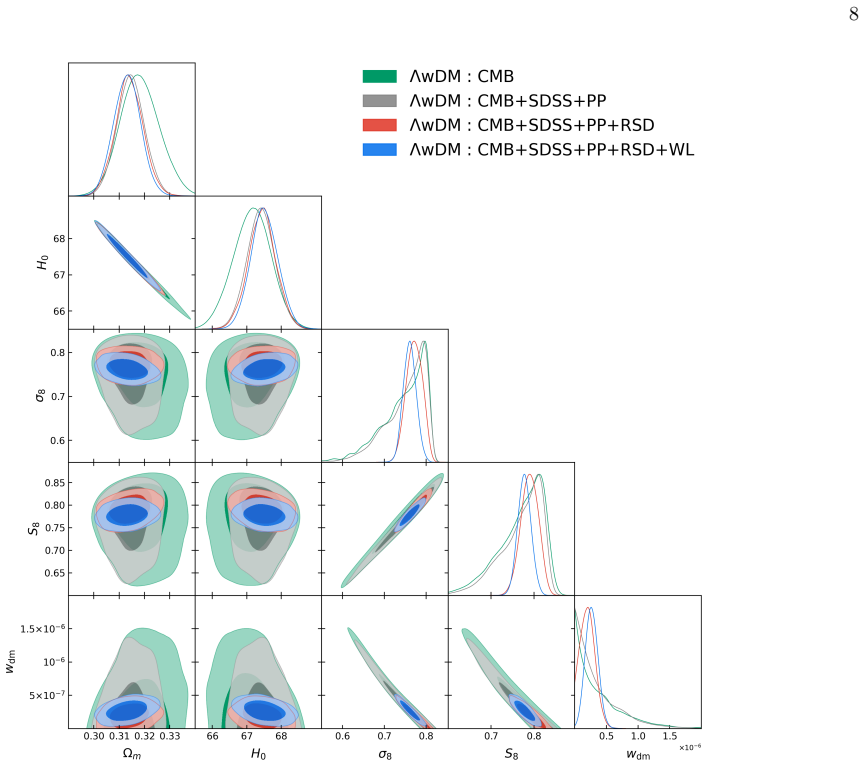
The central claim is that the combined observational data prefer a small positive dark-matter equation of state parameter, at roughly 95% confidence, and that this single additional parameter resolves the $S_8$ tension. In the $\Lambda w$DM model, the dark matter fluid has $c_{s}^2 = w_{\rm dm}$, so a positive $w_{\rm dm}$ produces a positive sound speed that suppresses the matter power spectrum on small scales via an increased Jeans wavelength. The authors show that this mechanism reduces the tension between the CMB-based $S_8$ and the late-universe RSD+WL-based $S_8$ from $T_1=3.42$ in $\Lambda$CDM to $T_1=0.16$ in $\Lambda w$DM. They also find that the model is close to being positively preferred over $\Lambda$CDM by AIC for the SDSS-based joint dataset, though not decisively.
Load-bearing premise
The load-bearing assumption is that a Gaussian prior on $S_8$ from KiDS-1000, computed from the linear matter power spectrum, adequately represents the constraints the full weak-lensing likelihood would place on the $\Lambda w$DM model.
Editorial extensions
If this is right
- If $w_{\rm dm}$ is genuinely positive at the level indicated, dark matter would be a barotropic fluid with a tiny pressure, and structure formation would be suppressed on small scales, potentially easing small-scale challenges like the core-cusp or missing-satellite problems.
- The $S_8$ tension between early- and late-universe probes would be reduced from more than $3\sigma$ to below $1\sigma$ without invoking new interactions or modified gravity.
- The model makes a testable prediction for the nonlinear matter power spectrum: a specific suppression at high $k$ that future weak-lensing and galaxy-clustering surveys could detect.
- Since a positive $w_{\rm dm}$ implies a high-redshift quintessence-like dark energy component, the model's viability is directly tied to the dark-energy equation of state inferred from DESI BAO data; the authors find that including DESI lowers the preferred $w_{\rm dm}$ only slightly.
- The AIC comparison shows that, for at least one dataset combination, $\Lambda w$DM is close to being preferred over $\Lambda$CDM, so the model is a viable competitor that future data could distinguish.
Reading between the lines
- The authors' choice of a flat prior $w_{\rm dm}\in[0,100]\times10^{-7}$ forbids negative values, so the claimed 'non-zero' signal is one-sided; a prior allowing negative $w_{\rm dm}$ would be needed to assess whether the data truly exclude $w_{\rm dm}=0$ or merely prefer positive pressure over negative imaginary sound speed.
- A direct test of the claim would be to replace the Gaussian $S_8$ prior with the full KiDS-1000 weak-lensing likelihood, including a halo model adapted to $\Lambda w$DM; if that full analysis drives $w_{\rm dm}$ back to zero, the reported signal would likely be an artifact of the approximate likelihood.
- The equivalence to a dynamical dark-energy component suggests that the same data could be reinterpreted as a constraint on early dark energy or quintessence; combining future DESI BAO data with tomographic weak lensing may sharpen this discriminant.
- The 95% credible interval for $w_{\rm dm}$ still includes values near zero, so the paper's conclusion is a hint rather than a detection; confirmation would require independent probes of the small-scale matter power spectrum, such as Lyman-$\alpha$ forest or 21-cm measurements.
Editorial analysis
A structured set of objections, weighed in public.
Referee Report
Summary. The paper constrains a model (ΛwDM) in which dark matter is a barotropic fluid with a constant equation-of-state parameter wdm, so that its sound speed squared equals wdm. Using Planck CMB, SDSS and DESI BAO, Pantheon+ SNe, RSD, and a Gaussian prior on S8 from KiDS-1000 (computed from the linear matter power spectrum), the authors report a marginal 95% credible detection of positive wdm ≈ 2.7×10^-7 (SDSS case) or 2.29×10^-7 (DESI case) when the weak lensing prior is included, and a reduction of the S8 tension from >3σ in ΛCDM to <1σ in ΛwDM. Model comparison via AIC does not show a decisive preference for ΛwDM. The paper explicitly acknowledges that the full KiDS-1000 likelihood is replaced by a one-number S8 prior because nonlinear modeling for ΛwDM is unavailable.
Significance. If the central result held, it would constitute an interesting hint of non-cold dark matter and an economical resolution of the S8 tension with a single extra parameter. The statistical machinery is standard (MontePython, CLASS, GetDist), and the paper is transparent about its main assumption and limitations, which is a strength. However, the significance is currently limited because the reported hint and the tension reduction both depend critically on an unvalidated approximation—the use of a linear-theory Gaussian S8 prior in place of the full weak lensing likelihood. The paper does not overclaim in its conclusions, and the AIC analysis honestly shows no strong model preference.
major comments (3)
- [Section III (Weak Lensing) and Table II] The claimed 95% positive lower bound on wdm appears only when the Gaussian S8 prior from KiDS-1000 is added: for CMB+SDSS+PP+RSD, the 95% interval for 10^7 wdm is [0, 4.04] (mean 2.1, lower error -2.1), while after adding the WL prior it becomes [0.8, 4.7]. The paper states in Section III that the S8 prior is assumed to adequately represent the full KiDS-1000 likelihood, but no validation is provided. Because a positive wdm suppresses small-scale power in a scale-dependent way, the full shear correlation functions carry shape information that a one-number prior discards, and the prior itself is calibrated within ΛCDM. The central hint is therefore contingent on an equivalence that has not been demonstrated; the paper should either implement the full likelihood (even approximately) or clearly reframe the result as conditional on this untested assumption.
- [Table I: prior on wdm] The flat prior wdm ∈ [0, 100]×10^-6 truncates the parameter space at zero. Although a negative wdm would correspond to an imaginary adiabatic sound speed (c_s^2 = wdm), the hard boundary makes the reported detection one-sided. The 95% lower bounds quoted for the WL-inclusive datasets are computed on a truncated posterior, and the posterior mass is pushed away from the boundary. The authors should assess the sensitivity to this truncation, for example by running a follow-up with a prior that extends to negative wdm (even if treated as unphysical) to quantify how much of the "positive detection" is driven by the boundary, or by reporting the posterior percentile relative to a two-sided prior and discussing the implications.
- [Section IV: S8 tension estimators T1 and T2] The tension reduction from >3σ to <1σ is computed using the RSD+WL dataset as the low-redshift leg, where the WL component is the same approximate Gaussian S8 prior. This is not an independent low-redshift constraint: the model is being fit to the same prior that is used to claim the tension is resolved. The value of S8 in the RSD+WL run (0.765±0.021 for ΛwDM) is very close to the input prior mean of 0.759, so the reduction in T1/T2 largely reflects the fact that the model can lower the CMB-predicted S8 by increasing wdm, while the low-redshift S8 is essentially predetermined by the prior. A more convincing assessment would compare the model to the actual KiDS-1000 shear data (with nonlinear modeling) or at least use a tension metric that does not rely on the same approximate likelihood in both legs.
minor comments (4)
- [Abstract and Section V] The notation "2.7+2.0−1.9 ×10⁻⁷( at 95% confidence level)" has an extra parenthesis and missing spacing; the same issue appears in the concluding remarks. Please fix these typographical errors.
- [Table I vs Tables II-VI] The prior in Table I is labeled "10^6 wdm" with range [0,100], while all results are quoted as "10^7 wdm". This unit inconsistency is confusing; please standardize to a single unit (e.g., 10^7 wdm) throughout the paper.
- [Tables II-VI] The error format such as "3.64+0.54−3.64" is ambiguous when the lower error exceeds the mean; the lower bound is not transparent. Reporting the actual credible intervals (e.g., [0, 4.18] at 68%) would improve readability.
- [Section IV, Eq. (13) discussion] The statement that the dynamical-DE interpretation "is in tension with recently released DESI data since the latter support phantom behavior for DE at high redshifts" is asserted without a reference or quantitative support; either add a citation to the DESI results or soften the claim.
Circularity Check
The 95% hint of positive wdm and the claimed S8-tension relief are both driven by the KiDS-1000 S8 prior fed into the fit; the rest of the derivation is standard and transparently sourced from Mueller (2005).
-
fitted input called prediction
[Section III (Weak Lensing paragraph) and Section IV (Table II, CMB+SDSS+PP+RSD+WL row)]
"we incorporate a prior on S8, i.e. S8 = 0.759+0.024−0.021 [42], which is based on the measurements from KiDS1000. (For the Λ wDM model, utilizing the full WL likelihood necessitates a thorough consideration of nonlinear effects. Due to the unavailability of these tools, we confine our analysis to the linear power spectrum and assume that including the S8 prior adequately represents the constraints imposed by the KiDS1000 likelihood on the Λ wDM model). ... we finally find a statistically significant signal for a positive DM parameter wdm = 2.70+2.0−1.9 × 10⁻⁷ (at the 95% confidence level)."
Table II shows the 95% interval for 10^7 wdm contains zero for CMB, CMB+SDSS+PP, and CMB+SDSS+PP+RSD; it excludes zero (lower bound 0.8) only in the CMB+SDSS+PP+RSD+WL row. The paper itself states that S8 and wdm are negatively correlated, so a Gaussian prior on S8 centered at 0.759 (below the CMB-determined value ~0.83) statistically forces wdm upward in the fit. The 'hint of non-cold dark matter' is therefore the input low-S8 measurement re-expressed in wdm coordinates, under the explicitly flagged assumption that a linear-theory Gaussian S8 prior reproduces the full KiDS-1000 likelihood for ΛwDM. Because the prior is a ΛCDM-derived compressed summary of the same data class that defines the S8 tension, the detection is not independent of the input it claims to explain.
-
fitted input called prediction
[Section IV (S8-tension paragraph, T1/T2 definitions and values)]
"Now, we assess the Λ wDM model's ability to relieve the S8 tension by using the following two quantities T1 = xCMB+SDSS+PP − xRSD+WL / sqrt(σ2CMB+SDSS+PP + σ2RSD+WL), T2 = xCMB+DESI+PP − xRSD+WL / sqrt(σ2CMB+DESI+PP + σ2RSD+WL), where x = S8. For the Λ wDM model, we have T1 = 0.16 and T2 = 0.10; for the ΛCDM model, we have T1 = 3.42 and T2 = 3.12, therefore, we can see that the Λ wDM model can reduce the S8 tension from beyond 3σ to below 1σ."
The low-redshift leg xRSD+WL for ΛwDM is 0.765 ± 0.021 (Table VI), essentially the input KiDS-1000 S8 prior (0.759) that is a component of the fitted likelihood. The high-redshift leg xCMB+SDSS+PP = 0.770 is a posterior mean pushed down by the one-sided prior wdm ≥ 0, which truncates the wdm posterior at the boundary and inflates its mean. The claimed reduction from 3.42σ to 0.16σ is thus largely a consistency restatement of the input S8 prior plus the truncated wdm prior, rather than an independent prediction, although the fit's Δχ2 = 8.4 shows the low-S8 preference is real under the assumed likelihood.
full rationale
The ΛwDM model and its perturbation equations are transparently taken from the literature: the paper states 'it has been proposed and discussed in Ref. [21] for about two decades' and uses the GDM equations from Ref. [24]; no ansatz is smuggled via citation, and no uniqueness theorem is invoked. The authors' self-citations ([27]-[29]) are peripheral GDM follow-up references and are not load-bearing. The remaining concern is structural rather than derivational: the paper's headline results — the 95% exclusion of wdm = 0 and the S8-tension reduction to <1σ — are both produced by the KiDS-1000 S8 prior fed into the MCMC, combined with the one-sided flat prior wdm ∈ [0,100]×10^-6. The paper explicitly flags this: 'we can only use the model-dependent S8 prior to replace the complete WL likelihood to constrain Λ wDM. This may introduce some bias into the fitting results,' and in the concluding remarks lists 'the absence of applying the full WL likelihood for ΛwDM' as a critical limitation. Because the low-S8 prior is a compressed summary of the same data class that defines the S8 tension, the 'hint of non-cold dark matter' and the 'tension relief' are substantially the input measurement re-expressed in model coordinates. Nevertheless, the fit has independent multi-probe content: CMB, BAO, SNe, and RSD genuinely tolerate wdm ~ 2-3 × 10^-7, the χ2 improvement relative to ΛCDM is a real statistical preference under the stated likelihood, and the AIC comparison honestly reports no decisive model preference. Score 4 reflects this partial circularity: the central numerical claims reduce largely to the input S8 prior and the prior floor, while the model, equations, and remaining derivation are self-contained and externally sourced.
Assumptions & free parameters
free parameters (1)
- wdm =
2.7e-7 (95% CI 0.8 to 4.7e-7) for CMB+SDSS+PP+RSD+WL; 2.29e-7 for CMB+DESI+PP+RSD+WL
assumptions (3)
- domain assumption The dark matter fluid is barotropic with zero non-adiabatic sound speed, so c_s^2 = wdm (Eqs. 5-8).
- ad hoc to paper The Gaussian S8 prior from KiDS-1000, combined with the linear power spectrum, adequately represents the full weak lensing likelihood for Lambda wDM.
- domain assumption RSD measurements can be analyzed with the growth rate f evaluated at a fixed k = 0.1 h/Mpc even though f is scale-dependent in Lambda wDM.
Cite this review
Pith. "Pith review of Hints of noncold dark matter? Observational constraints on barotropic dark matter with a constant equation of state parameter." pith.science (2026). https://pith.science/paper/7QW7VGHF
@misc{pith2026250700478,
  author       = {Pith},
  title        = {Pith review of: Hints of noncold dark matter? Observational constraints on barotropic dark matter with a constant equation of state parameter},
  year         = {2026},
  howpublished = {\url{https://pith.science/paper/7QW7VGHF}},
  note         = {Machine review of arXiv:2507.00478}
}
abstract
This study investigates the potential of a cosmological model termed $\Lambda w$DM, in which a cosmological constant play the role of dark energy and dark matter is barotropic and has a constant equation of state parameter ($w_{\rm dm}$), to address the $S_8$ tension between early- and late- universe observations. By incorporating the latest cosmological datasets -- including Planck Cosmic Microwave Background (CMB), Baryon Acoustic Oscillation (BAO), Ia supernovae (SNe Ia), Redshift Space Distortions (RSD), and weak lensing (WL) -- we constrain the $\Lambda w$DM compared to $\Lambda$CDM. Our analysis reveals a marginal preference for a non-zero $w_{\rm dm}=2.7^{+2.0}_{-1.9}\times10^{-7}$( at 95\% confidence level) when combining CMB, SDSS BAO, SNe Ia, RSD, and WL data, and a marginal preference for a non-zero $w_{\rm dm} = 2.29^{+1.9}_{-2.0} \times 10^{-7}$( at 95\% confidence level) when combining CMB, DESI Y1 BAO, SNe Ia, RSD, and WL data. In addition, we find that, compared to $\Lambda$CDM, $\Lambda w$DM can alleviate the $S_8$ tension from $>3\sigma$ to $<1\sigma$. Furthermore, we find that, for CMB+SDSS+PP+RSD+WL datasets, the $\Lambda w$DM model is close to being positively preferred over the $\Lambda$CDM model.
Figures


Figures from the paper (2 more)


Forward citations
Cited by 6 Pith papers
-
Accelerating scaling solutions from dark matter particle creation
Accelerating scaling attractors without dark energy appear only when the interaction is controlled by DM density and energy flows from DM to a barotropic fluid.
-
Model-independent late-universe measurements of $H_0$ and $\Omega_K$ with the parametrization based on cosmic age-improved inverse distance ladder
A cosmic-age-based inverse distance ladder with DESI DR2, DESY5, SGL, CC and GRB data gives H0=71.59±0.94 km/s/Mpc and ΩK=0.001±0.038.
-
Exploring non-cold dark matter in a scenario of dynamical dark energy with DESI DR2 data
Using DESI DR2, Planck, and supernova data, a nonzero dark matter equation of state is preferred at 2.8 to 3.3 sigma only when dark energy is assumed to have a constant equation of state.
-
Neutrino mass constraints in the Schwarzschild-de Sitter black-hole dark energy model with ACT DR6 and DESI DR2 data
SdSDE dark energy yields a ~0.16–0.21 eV positive neutrino-mass preference with DESI+ACT data, but χ² strongly favors extended ΛCDM and the shift is likely compensation.
-
Alleviating the $H_0$ tension through the interacting dark energy model from quantum gravitational field theory in light of DESI DR2
With DESI DR2 BAO plus CMB and a SH0ES prior, the two-parameter eeΛCDM model gives δΛ=-0.41±0.14 and H0=71.9±1.0, easing the Hubble tension to 0.8σ, but SN datasets erase the signal.
-
Cosmological preference for a positive neutrino mass at 2.7$\sigma$: A joint analysis of DESI DR2, DESY5, and DESY1 data
A joint fit of DESI DR2, CMB, DESY5 and DESY1 data gives total neutrino mass 0.098 (+0.016, -0.037) eV, a 2.7 sigma preference for positive mass in the w0waCDM model.
Reference graph
Works this paper leans on
-
[21]
Hu, The Astrophysical Journal 506(2), 485 (1998)
W. Hu, The Astrophysical Journal 506(2), 485 (1998)
work page 1998
-
[1]
Riess, A.V
A.G. Riess, A.V. Filippenko, P. Challis, A. Clocchiatti, A. Diercks, P.M. Garnavich, R.L. Gilliland, C.J. Hogan, S. Jha, R.P. Kirshner, et al., The Astronomical Journal 116(3), 1009 (1998)
1998
-
[2]
BAO Measurements from DESI This sample includes the BAO measurements obtained from the first year of DESI observations, as detailed in Ref. [58]. It consists of the Bright Galaxy Sample (BGS), LRG, a combination of LRG and ELG, ELG, QSO, and Lyα forest [58–60]. We refer to this sample as DESI. Pantheon Plus (PP) : We use the distance modu- lus measurement...
2018
-
[3]
Perlmutter, G
S. Perlmutter, G. Aldering, G. Goldhaber, R. Knop, P. Nugent, P. Castro, S. Deustua, S. Fabbro, A. Goobar, D. Groom, et al., The Astrophysical Journal 517(2), 565 (1999)
1999
-
[4]
Dunkley, R
J. Dunkley, R. Hlozek, J. Sievers, V. Acquaviva, P.A. Ade, P. Aguirre, M. Amiri, J. Appel, L. Barrientos, E. Battistelli, et al., The Astrophysical Journal 739(1), 52 (2011)
2011
-
[5]
Hinshaw, D
G. Hinshaw, D. Larson, E. Komatsu, D.N. Spergel, C. Bennett, J. Dunkley, M. Nolta, M. Halpern, R. Hill, N. Odegard, et al., The Astrophysical Journal Supple- ment Series 208(2), 19 (2013)
2013
-
[6]
Story, D
K. Story, D. Hanson, P. Ade, K. Aird, J. Austermann, J. Beall, A. Bender, B. Benson, L. Bleem, J. Carlstrom, et al., The Astrophysical Journal 810(1), 50 (2015)
2015
-
[7]
S. Alam, M. Ata, S. Bailey, F. Beutler, D. Bizyaev, J.A. Blazek, A.S. Bolton, J.R. Brownstein, A. Burden, C.H. Chuang, et al., Monthly Notices of the Royal Astronom- ical Society 470(3), 2617 (2017)
2017
Show all 90 references
-
[8]
Troxel, N
M.A. Troxel, N. MacCrann, J. Zuntz, T. Eifler, E. Krause, S. Dodelson, D. Gruen, J. Blazek, O. Friedrich, S. Samuroff, et al., Physical Review D 98(4), 043528 (2018)
2018
-
[9]
Aghanim, Y
N. Aghanim, Y. Akrami, M. Ashdown, J. Aumont, C. Baccigalupi, M. Ballardini, A.J. Banday, R. Barreiro, N. Bartolo, S. Basak, et al., Astronomy & Astrophysics 641, A6 (2020)
2020
-
[10]
Klypin, A.V
A. Klypin, A.V. Kravtsov, O. Valenzuela, F. Prada, The Astrophysical Journal 522(1), 82 (1999)
1999
-
[11]
Moore, S
B. Moore, S. Ghigna, F. Governato, G. Lake, T. Quinn, J. Stadel, P. Tozzi, The Astrophysical Journal 524(1), L19 (1999)
1999
-
[12]
Boylan-Kolchin, J.S
M. Boylan-Kolchin, J.S. Bullock, M. Kaplinghat, Monthly Notices of the Royal Astronomical Society 422(2), 1203 (2012)
2012
-
[13]
Moore, T
B. Moore, T. Quinn, F. Governato, J. Stadel, G. Lake, Monthly Notices of the Royal Astronomical Society 310(4), 1147 (1999)
1999
-
[14]
Springel, J
V. Springel, J. Wang, M. Vogelsberger, A. Ludlow, A. Jenkins, A. Helmi, J.F. Navarro, C.S. Frenk, S.D. White, Monthly Notices of the Royal Astronomical Soci- ety 391(4), 1685 (2008)
2008
-
[15]
Blumenthal, H
G.R. Blumenthal, H. Pagels, J.R. Primack, Nature 299(5878), 37 (1982)
1982
-
[16]
Bode, J.P
P. Bode, J.P. Ostriker, N. Turok, The Astrophysical Journal 556(1), 93 (2001)
2001
-
[17]
W. Hu, R. Barkana, A. Gruzinov, Physical Review Let- ters 85(6), 1158 (2000)
2000
-
[18]
Marsh, J
D.J. Marsh, J. Silk, Monthly Notices of the Royal Astro- nomical Society 437(3), 2652 (2014)
2014
-
[19]
Spergel, P.J
D.N. Spergel, P.J. Steinhardt, Physical review letters 84(17), 3760 (2000)
2000
-
[20]
Wang, A.H
M.Y. Wang, A.H. Peter, L.E. Strigari, A.R. Zentner, B. Arant, S. Garrison-Kimmel, M. Rocha, Monthly No- tices of the Royal Astronomical Society 445(1), 614 (2014)
2014
-
[22]
C.M. Mueller, Physical Review D 71(4), 047302 (2005) 6 Parameters CMB CMB+SDSS+PP CMB+SDSS+PP+RSD CMB+SDSS+PP+RSD+WL 100ωb 2.232 ± 0.015+0.029 −0.028 2.237 ± 0.014+0.027 −0.027 2.237 ± 0.013+0.025 −0.026 2.238 ± 0.013+0.027 −0.026 ωdm 0.1205 ± 0.0012+0.0025 −0.0024 0.11995 ± 0...
2005
-
[23]
Kumar, L
S. Kumar, L. Xu, Physics Letters B 737, 244 (2014)
2014
-
[24]
M. Kopp, C. Skordis, D.B. Thomas, S. Ili´ c, Physical Re- view Letters 120(22), 221102 (2018)
2018
-
[25]
Kumar, R.C
S. Kumar, R.C. Nunes, S.K. Yadav, Monthly Notices of the Royal Astronomical Society 490(1), 1406 (2019)
2019
-
[26]
Ili´ c, M
S. Ili´ c, M. Kopp, C. Skordis, D.B. Thomas, Physical Re- view D 104(4), 043520 (2021)
2021
-
[27]
S. Pan, W. Yang, E. Di Valentino, D.F. Mota, J. Silk, Journal of Cosmology and Astroparticle Physics 2023(07), 064 (2023)
2023
-
[28]
Yao, J.C
Y.H. Yao, J.C. Wang, X.H. Meng, Physical Review D 109(6), 063502 (2024)
2024
-
[29]
Liu, Y.H
J. Liu, Y.H. Yao, Y. Su, J. Wu, Research in Astronomy and Astrophysics (2025)
2025
-
[30]
T.N. Li, Y.M. Zhang, Y.H. Yao, P.J. Wu, J.F. Zhang, X. Zhang, arXiv preprint arXiv:2506.09819 (2025)
2025
-
[31]
Macaulay, I.K
E. Macaulay, I.K. Wehus, H.K. Eriksen, Physical review letters 111(16), 161301 (2013)
2013
-
[32]
Joudaki, C
S. Joudaki, C. Blake, C. Heymans, A. Choi, J. Harnois- Deraps, H. Hildebrandt, B. Joachimi, A. Johnson, A. Mead, D. Parkinson, et al., Monthly Notices of the 7 Parameters CMB+DESI+PP CMB+DESI+PP+RSD CMB+DESI+PP+RSD+WL 100ωb 2.244 ± 0.014+0.027 −0.026 2.245 ± 0.013+0.027 −0.027...
2016
-
[33]
P. Bull, Y. Akrami, J. Adamek, T. Baker, E. Bellini, J.B. Jimenez, E. Bentivegna, S. Camera, S. Clesse, J.H. Davis, et al., Physics of the Dark Universe 12, 56 (2016)
2016
-
[34]
Joudaki, A
S. Joudaki, A. Mead, C. Blake, A. Choi, J. de Jong, T. Erben, I. Fenech Conti, R. Herbonnet, C. Heymans, H. Hildebrandt, et al., Monthly Notices of the Royal As- tronomical Society 471(2), 1259 (2017)
2017
-
[35]
Nesseris, G
S. Nesseris, G. Pantazis, L. Perivolaropoulos, Physical Review D 96(2), 023542 (2017)
2017
-
[36]
Kazantzidis, L
L. Kazantzidis, L. Perivolaropoulos, Physical Review D 97(10), 103503 (2018)
2018
-
[37]
Asgari, T
M. Asgari, T. Tr¨ oster, C. Heymans, H. Hildebrandt, J.L. Van den Busch, A.H. Wright, A. Choi, T. Erben, B. Joachimi, S. Joudaki, et al., Astronomy & Astro- physics 634, A127 (2020)
2020
-
[38]
Hildebrandt, F
H. Hildebrandt, F. K¨ ohlinger, J. Van den Busch, B. Joachimi, C. Heymans, A. Kannawadi, A. Wright, M. Asgari, C. Blake, H. Hoekstra, et al., Astronomy & Astrophysics 633, A69 (2020) 8 FIG. 1. One dimensional posterior distributions and two dimensional joint contours at 68% an...
2020
-
[39]
Skara, L
F. Skara, L. Perivolaropoulos, Physical Review D 101(6), 063521 (2020)
2020
-
[40]
Abbott, M
T. Abbott, M. Aguena, A. Alarcon, S. Allam, S. Allen, J. Annis, S. Avila, D. Bacon, K. Bechtol, A. Bermeo, et al., Physical Review D 102(2), 023509 (2020)
2020
-
[41]
Joudaki, H
S. Joudaki, H. Hildebrandt, D. Traykova, N. Chisari, C. Heymans, A. Kannawadi, K. Kuijken, A. Wright, M. Asgari, T. Erben, et al., Astronomy & Astrophysics 638, L1 (2020)
2020
-
[42]
Heymans, T
C. Heymans, T. Tr¨ oster, M. Asgari, C. Blake, H. Hilde- brandt, B. Joachimi, K. Kuijken, C.A. Lin, A.G. S´ anchez, J.L. Van Den Busch, et al., Astronomy & Astrophysics 646, A140 (2021)
2021
-
[43]
Asgari, C.A
M. Asgari, C.A. Lin, B. Joachimi, B. Giblin, C. Heymans, H. Hildebrandt, A. Kannawadi, B. St¨ olzner, T. Tr¨ oster, J.L. van den Busch, et al., Astronomy & Astrophysics 645, A104 (2021)
2021
-
[44]
Loureiro, L
A. Loureiro, L. Whittaker, A.S. Mancini, B. Joachimi, A. Cuceu, M. Asgari, B. St¨ olzner, T. Tr¨ oster, A. Wright, M. Bilicki, et al., arXiv preprint arXiv:2110.06947 (2021)
2021 arXiv
-
[45]
Abbott, M
T. Abbott, M. Aguena, A. Alarcon, S. Allam, O. Alves, A. Amon, F. Andrade-Oliveira, J. Annis, S. Avila, D. Ba- con, et al., Physical Review D 105(2), 023520 (2022)
2022
-
[46]
A. Amon, D. Gruen, M. Troxel, N. MacCrann, S. Dodel- son, A. Choi, C. Doux, L. Secco, S. Samuroff, E. Krause, et al., Physical Review D 105(2), 023514 (2022) 9 FIG. 2. One dimensional posterior distributions and two dimensional joint contours at 68% and 95% CL for the most rel...
2022
-
[47]
Secco, S
L. Secco, S. Samuroff, E. Krause, B. Jain, J. Blazek, M. Raveri, A. Campos, A. Amon, A. Chen, C. Doux, et al., Physical Review D 105(2), 023515 (2022)
2022
-
[48]
Philcox, M.M
O.H. Philcox, M.M. Ivanov, Physical Review D 105(4), 043517 (2022)
2022
-
[49]
Aghanim, Y
N. Aghanim, Y. Akrami, M. Ashdown, J. Aumont, C. Baccigalupi, M. Ballardini, A.J. Banday, R. Barreiro, N. Bartolo, S. Basak, et al., Astronomy & Astrophysics 641, A5 (2020)
2020
-
[50]
Aghanim, Y
N. Aghanim, Y. Akrami, M. Ashdown, J. Aumont, C. Baccigalupi, M. Ballardini, A.J. Banday, R. Barreiro, N. Bartolo, S. Basak, et al., Astronomy & Astrophysics 641, A8 (2020)
2020
-
[51]
Beutler, C
F. Beutler, C. Blake, M. Colless, D.H. Jones, L. Staveley- Smith, L. Campbell, Q. Parker, W. Saunders, F. Wat- son, Monthly Notices of the Royal Astronomical Society 416(4), 3017 (2011)
2011
-
[52]
S. Alam, M. Aubert, S. Avila, C. Balland, J.E. Bautista, M.A. Bershady, D. Bizyaev, M.R. Blanton, A.S. Bolton, J. Bovy, et al., Physical Review D 103(8), 083533 (2021)
2021
-
[53]
A.J. Ross, L. Samushia, C. Howlett, W.J. Percival, A. Burden, M. Manera, Monthly Notices of the Royal Astronomical Society 449(1), 835 (2015)
2015
-
[54]
Bautista, R
J.E. Bautista, R. Paviot, M. Vargas Maga˜ na, S. de La Torre, S. Fromenteau, H. Gil-Mar ´ ın, A.J. Ross, E. Burtin, K.S. Dawson, J. Hou, et al., Monthly Notices of the Royal Astronomical Society 500(1), 736 10 FIG. 3. One dimensional posterior distributions and two dimensional...
2021
-
[55]
Gil-Mar ´ ın, J.E
H. Gil-Mar ´ ın, J.E. Bautista, R. Paviot, M. Vargas- Maga˜ na, S. de La Torre, S. Fromenteau, S. Alam, S. ´Avila, E. Burtin, C.H. Chuang, et al., Monthly Notices of the Royal Astronomical Society 498(2), 2492 (2020)
2020
-
[56]
Hou, A.G
J. Hou, A.G. S´ anchez, A.J. Ross, A. Smith, R. Neveux, J. Bautista, E. Burtin, C. Zhao, R. Scoccimarro, K.S. Dawson, et al., Monthly Notices of the Royal Astronom- ical Society 500(1), 1201 (2021)
2021
-
[57]
De Mattia, V
A. De Mattia, V. Ruhlmann-Kleider, A. Raichoor, A.J. Ross, A. Tamone, C. Zhao, S. Alam, S. Avila, E. Burtin, J. Bautista, et al., Monthly Notices of the Royal Astro- nomical Society 501(4), 5616 (2021)
2021
-
[58]
Des Bourboux, J
H.D.M. Des Bourboux, J. Rich, A. Font-Ribera, V. de Sainte Agathe, J. Farr, T. Etourneau, J.M. Le Goff, A. Cuceu, C. Balland, J.E. Bautista, et al., The Astro- physical Journal 901(2), 153 (2020)
2020
-
[59]
Adame, J
A. Adame, J. Aguilar, S. Ahlen, S. Alam, D. Alexander, M. Alvarez, O. Alves, A. Anand, U. Andrade, E. Armen- gaud, et al., arXiv preprint arXiv:2404.03002 (2024)
2024 arXiv
-
[60]
Adame, J
A. Adame, J. Aguilar, S. Ahlen, S. Alam, D. Alexander, M. Alvarez, O. Alves, A. Anand, U. Andrade, E. Armen- gaud, et al., arXiv preprint arXiv:2404.03000 (2024)
2024 arXiv
-
[61]
Adame, J
A. Adame, J. Aguilar, S. Ahlen, S. Alam, D. Alexander, M. Alvarez, O. Alves, A. Anand, U. Andrade, E. Armen- gaud, et al., arXiv preprint arXiv:2404.03001 (2024)
2024 arXiv
-
[62]
Scolnic, D
D. Scolnic, D. Brout, A. Carr, A.G. Riess, T.M. Davis, A. Dwomoh, D.O. Jones, N. Ali, P. Charvu, R. Chen, et al., The Astrophysical Journal 938(2), 113 (2022)
2022
-
[63]
Sagredo, S
B. Sagredo, S. Nesseris, D. Sapone, Physical Review D 98(8), 083543 (2018)
2018
-
[64]
Song, W.J
Y.S. Song, W.J. Percival, Journal of Cosmology and As- troparticle Physics 2009(10), 004 (2009)
2009
-
[65]
Davis, A
M. Davis, A. Nusser, K.L. Masters, C. Springob, J.P. Huchra, G. Lemson, Monthly Notices of the Royal As- tronomical Society 413(4), 2906 (2011)
2011
-
[66]
Samushia, W.J
L. Samushia, W.J. Percival, A. Raccanelli, Monthly No- tices of the Royal Astronomical Society 420(3), 2102 (2012)
2012
-
[67]
Turnbull, M.J
S.J. Turnbull, M.J. Hudson, H.A. Feldman, M. Hicken, R.P. Kirshner, R. Watkins, Monthly Notices of the Royal Astronomical Society 420(1), 447 (2012)
2012
-
[68]
Hudson, S.J
M.J. Hudson, S.J. Turnbull, The Astrophysical Journal Letters 751(2), L30 (2012)
2012
-
[69]
Blake, S
C. Blake, S. Brough, M. Colless, C. Contreras, W. Couch, S. Croom, D. Croton, T.M. Davis, M.J. Drinkwater, 11 FIG. 4. One dimensional posterior distributions and two dimensional joint contours at 68% and 95% CL for the most relevant parameters of the ΛCDM model using CMB, CMB+...
2012
-
[70]
Blake, I.K
C. Blake, I.K. Baldry, J. Bland-Hawthorn, L. Christodoulou, M. Colless, C. Conselice, S.P. Driver, A.M. Hopkins, J. Liske, J. Loveday, et al., Monthly Notices of the Royal Astronomical Society 436(4), 3089 (2013)
2013
-
[71]
S´ anchez, F
A.G. S´ anchez, F. Montesano, E.A. Kazin, E. Aubourg, F. Beutler, J. Brinkmann, J.R. Brownstein, A.J. Cuesta, K.S. Dawson, D.J. Eisenstein, et al., Monthly Notices of the Royal Astronomical Society 440(3), 2692 (2014)
2014
-
[72]
Chuang, F
C.H. Chuang, F. Prada, M. Pellejero-Ibanez, F. Beutler, A.J. Cuesta, D.J. Eisenstein, S. Escoffier, S. Ho, F.S. Kitaura, J.P. Kneib, et al., Monthly Notices of the Royal Astronomical Society 461(4), 3781 (2016)
2016
-
[73]
Howlett, A.J
C. Howlett, A.J. Ross, L. Samushia, W.J. Percival, M. Manera, Monthly Notices of the Royal Astronomical Society 449(1), 848 (2015)
2015
-
[74]
M. Feix, A. Nusser, E. Branchini, Physical Review Let- ters 115(1), 011301 (2015)
2015
-
[75]
Okumura, C
T. Okumura, C. Hikage, T. Totani, M. Tonegawa, H. Okada, K. Glazebrook, C. Blake, P.G. Ferreira, S. More, A. Taruya, et al., Publications of the Astro- nomical Society of Japan 68(3), 38 (2016)
2016
-
[76]
Huterer, D.L
D. Huterer, D.L. Shafer, D.M. Scolnic, F. Schmidt, Jour- nal of Cosmology and Astroparticle Physics 2017(05), 015 (2017)
2017
-
[77]
Pezzotta, S
A. Pezzotta, S. de La Torre, J. Bel, B. Granett, L. Guzzo, J. Peacock, B. Garilli, M. Scodeggio, M. Bolzonella, U. Abbas, et al., Astronomy & Astrophysics 604, A33 (2017)
2017
-
[78]
G.B. Zhao, Y. Wang, S. Saito, H. Gil-Mar ´ ın, W.J. Per- cival, D. Wang, C.H. Chuang, R. Ruggeri, E.M. Mueller, F. Zhu, et al., Monthly Notices of the Royal Astronomical Society 482(3), 3497 (2019)
2019
-
[79]
Arjona, J
R. Arjona, J. Garc ´ ıa-Bellido, S. Nesseris, Physical Re- view D 102(10), 103526 (2020)
2020
-
[80]
Audren, J
B. Audren, J. Lesgourgues, K. Benabed, S. Prunet, Jour- nal of Cosmology and Astroparticle Physics 2013(02), 001 (2013)
2013
-
[81]
Brinckmann, J
T. Brinckmann, J. Lesgourgues, Physics of the Dark Uni- verse 24, 100260 (2019)
2019
-
[82]
Lesgourgues, arXiv preprint arXiv:1104.2932 (2011)
J. Lesgourgues, arXiv preprint arXiv:1104.2932 (2011)
2011 arXiv
-
[83]
D. Blas, J. Lesgourgues, T. Tram, Journal of Cosmology and Astroparticle Physics 2011(07), 034 (2011)
2011
-
[84]
Gelman, D.B
A. Gelman, D.B. Rubin, Statistical science 7(4), 457 (1992)
1992
-
[85]
Lewis, (2019)
A. Lewis, (2019). URL https://getdist.readthedocs. io
2019
-
[86]
Mossa, K
V. Mossa, K. St¨ ockel, F. Cavanna, F. Ferraro, M. Aliotta, F. Barile, D. Bemmerer, A. Best, A. Boeltzig, C. Brog- gini, et al., Nature 587(7833), 210 (2020)
2020
-
[87]
Akaike, IEEE transactions on automatic control 19(6), 716 (1974)
H. Akaike, IEEE transactions on automatic control 19(6), 716 (1974)
1974
-
[88]
Sch¨ oneberg, G.F
N. Sch¨ oneberg, G.F. Abell´ an, A.P. S´ anchez, S.J. Witte, V. Poulin, J. Lesgourgues, Physics Reports 984, 1 (2022)
2022
-
[89]
Jeffreys
H. Jeffreys. edition 3. theory of probability (1961)
1961
-
[90]
Nesseris, J
S. Nesseris, J. Garcia-Bellido, Journal of Cosmology and Astroparticle Physics 2013(08), 036 (2013)
2013
Reviewed August 6, 2026 · model on record in the stance chip above.
Discussion (0). Sign in to comment.