DIVER:Diving Deeper into Distilled Data via Expressive Semantic Recovery
Pith reviewed 2026-05-14 21:11 UTC · model grok-4.3
The pith
A dual-stage framework uses a pre-trained diffusion model to recover expressive semantics from distilled datasets and improve performance across different neural architectures.
A machine-rendered reading of the paper's core claim, the machinery that carries it, and where it could break.
Core claim
DIVER performs semantic inheritance to embed high-level semantics of abstract distilled images into latent space, applies semantic guidance to direct the reverse diffusion procedure, and restricts semantic fusion to the concrete phase of the reverse process so that architecture-specific noise is filtered while original semantics are preserved.
What carries the argument
The three-step semantic recovery process (inheritance into latent space, guidance of reverse diffusion, and late-stage fusion) that filters architecture-specific noise using a pre-trained diffusion model.
If this is right
- Distilled datasets become usable across a wider range of model architectures without retraining the distillation step.
- The same compact dataset can support privacy-preserving training on both convolutional and transformer-based networks.
- Processing overhead stays comparable to a single forward pass of a diffusion transformer on 256x256 images.
- Memory consumption remains under 4 GB, allowing the method to run on modest hardware.
Where Pith is reading between the lines
- The same latent-space filtering step might be applied to other forms of synthetic data such as generated images or text embeddings to remove model-specific artifacts.
- Late-stage semantic fusion could be tested as a general technique for stabilizing guidance in any conditional diffusion process.
- If the assumption holds, the method suggests a route to architecture-agnostic dataset distillation that does not require joint optimization over multiple target models.
Load-bearing premise
The pre-trained diffusion model can separate architecture-specific noise from the intrinsic semantics of the distilled images in latent space.
What would settle it
Training a different architecture on DIVER-processed distilled data yields no accuracy gain over the original single-stage distilled data on the same task.
Figures


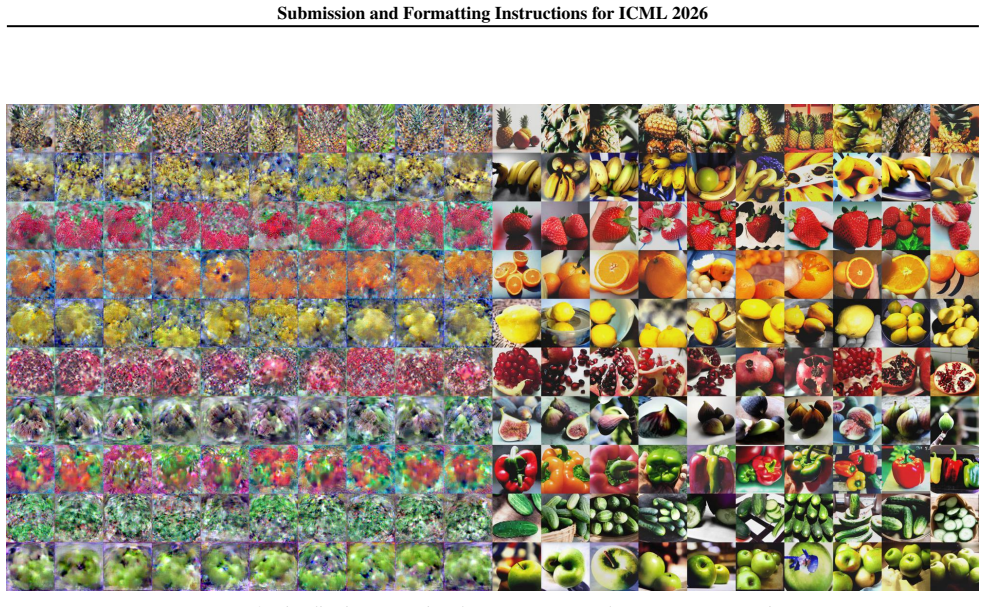


read the original abstract
Dataset distillation aims to synthesize a compact proxy dataset that is unreadable or non-raw from the original dataset for privacy protection and highly efficient learning. However, previous approaches typically adopt a single-stage distillation paradigm, which suffers from learning specific patterns that overfit on a prior architecture, consequently suppressing the expression of semantics and leading to performance degradation across heterogeneous architectures. To address this issue, we propose a novel dual-stage distillation framework called ${\textbf{DIVER}}$, which leverages the pre-trained diffusion model to dive deeper into $\textbf{DI}$stilled data $\textbf{V}$ia $\textbf{E}$xpressive semantic $\textbf{R}$ecovery, an entire process of semantic inheritance, guidance, and fusion. Semantic inheritance distills high-level semantics of abstract distilled images into the latent space to filter out architecture-specific ``noise" and retain the intrinsic semantics. Furthermore, semantic guidance improves the preservation of the original semantics by directing the reverse procedure. Finally, semantic fusion is designed to provide semantic guidance only during the concrete phase of the reverse process, preventing semantic ambiguity and artifacts while maintaining the guidance information. Extensive experiments validate the effectiveness and efficiency of DIVER in improving classical distillation techniques and significantly improving cross-architecture generalization, requiring processing time comparable to raw DiT on ImageNet (256$\times$256) with only 4 GB of GPU memory usage.
Editorial analysis
A structured set of objections, weighed in public.
Referee Report
Summary. The manuscript proposes DIVER, a dual-stage dataset distillation framework that leverages a pre-trained diffusion model to perform semantic inheritance (distilling high-level semantics into latent space to filter architecture-specific noise), semantic guidance (directing the reverse diffusion process), and semantic fusion (applying guidance only in the concrete phase of the reverse process). The central claim is that this recovers expressive semantics from distilled data, overcoming the architecture-specific overfitting of single-stage methods and yielding significantly better cross-architecture generalization, while requiring only DiT-comparable runtime and 4 GB GPU memory on ImageNet (256×256).
Significance. If the diffusion-based semantic recovery mechanism is shown to cleanly separate intrinsic semantics from architecture-specific patterns without introducing new biases, the work would meaningfully advance dataset distillation by providing a practical route to architecture-agnostic proxies. The reported efficiency (DiT-level time at 4 GB) would further strengthen its utility for privacy-preserving and resource-constrained learning scenarios.
major comments (2)
- [Abstract] Abstract: The central claim that semantic inheritance via the pre-trained diffusion model 'filters out architecture-specific noise' while retaining intrinsic semantics is load-bearing, yet the manuscript provides no explicit verification such as latent-space distance metrics, t-SNE visualizations, or failure-mode analysis demonstrating that the diffusion prior does not itself inject dataset-specific biases.
- [Abstract] Abstract: The assertion that restricting semantic guidance to the 'concrete phase' of the reverse process prevents ambiguity and artifacts is presented without a precise definition of how the concrete phase is identified or an ablation showing that earlier guidance stages produce the claimed artifacts.
minor comments (1)
- [Abstract] The efficiency claim of 'processing time comparable to raw DiT' and 'only 4 GB of GPU memory' should be supported by a dedicated runtime/memory table with exact hardware specifications and batch sizes.
Simulated Author's Rebuttal
We thank the referee for the constructive feedback on our manuscript. We address each major comment point by point below and indicate the planned revisions.
read point-by-point responses
-
Referee: [Abstract] Abstract: The central claim that semantic inheritance via the pre-trained diffusion model 'filters out architecture-specific noise' while retaining intrinsic semantics is load-bearing, yet the manuscript provides no explicit verification such as latent-space distance metrics, t-SNE visualizations, or failure-mode analysis demonstrating that the diffusion prior does not itself inject dataset-specific biases.
Authors: We agree that explicit verification would strengthen the central claim. In the revised manuscript, we will add t-SNE visualizations of latent representations before and after semantic inheritance, quantitative metrics such as average cosine similarity and Euclidean distances in latent space across architectures, and a failure-mode analysis discussing potential biases from the diffusion prior. These will be included in Section 4 and the supplementary material. revision: yes
-
Referee: [Abstract] Abstract: The assertion that restricting semantic guidance to the 'concrete phase' of the reverse process prevents ambiguity and artifacts is presented without a precise definition of how the concrete phase is identified or an ablation showing that earlier guidance stages produce the claimed artifacts.
Authors: We acknowledge the need for a precise definition and ablation. The concrete phase will be defined as the final 400 timesteps (t ≤ 400) of the reverse process. We will add an ablation study comparing guidance at different stages, showing artifacts and performance drops for earlier guidance, with quantitative metrics on image quality and downstream accuracy. This will be added to Section 3.3 and the experiments. revision: yes
Circularity Check
No significant circularity; framework adds independent stages on external pre-trained models
full rationale
The paper's core contribution is a dual-stage distillation framework (DIVER) that applies semantic inheritance, guidance, and fusion using an external pre-trained diffusion model. The abstract and description introduce these as novel additions to filter architecture-specific noise while preserving semantics, without any equations, fitted parameters renamed as predictions, or self-citations that reduce the claims to tautologies or prior author work. The process is presented as building directly on independent diffusion priors, with no self-definitional loops or load-bearing internal citations visible. This qualifies as a self-contained derivation against external benchmarks, consistent with a normal non-circular finding.
Axiom & Free-Parameter Ledger
axioms (1)
- domain assumption Pre-trained diffusion models can recover high-level semantics from distilled images by operating in latent space
discussion (0)
Sign in with ORCID, Apple, or X to comment. Anyone can read and Pith papers without signing in.