REVIEW 3 major objections 3 minor 89 references
Relativistic k-fields with Massless Soliton Solutions in 3+1 Dimensions
T0 review · 3 major / 3 minor · reviewed 2026-08-14 · deepseek-v4-flash
Pith's one-line read A nonlinear field theory in 3+1 dimensions admits a single zero-energy soliton that is stable against deformation.
desk verdict A checkable zero-energy k-field construction in 3+1D, but the uniqueness claim is false: R=0 with a null ψ1 wave gives an infinite zero-energy family. read the letter →
The pith
A machine-rendered reading of the paper's core claim, the machinery that carries it, and where it could break.
The reading
What carries the argument
The load-bearing object is the engineered Lagrangian density $L=B\sum_{i=1}^{12}K_i^3$ in Eq. (19), where the $K_i$ are twelve independent linear combinations of twelve scalar quantities $L_i$ formed from the five fields through the kinetic scalars $S_{ij}=\partial_\mu\varphi_i\partial^\mu\varphi_j$. The cubic power is what makes a simultaneous zero of all $L_i$ a solution: at such a configuration $L$, its derivatives with respect to the fields, and the derived quantities entering the equations of motion all vanish, so the Euler-Lagrange equations and the zero-energy condition are automatic. The energy density then takes the form $B\sum_i K_i^2(3C_i-K_i)$ with the bracket positive at the massless solution, which is what turns the zero-energy configuration into an energy minimum.
What would settle it
Find a localized solution of the twelve equations $L_i=0$ (equivalently $K_i=0$) that is not related to (41) by the space-time symmetries of the theory. If one exists, the massless solution is not single, and the global energy-minimum argument loses its force; local stability could still hold.
Extended reading notes
Core claim
The paper's central claim is that the extended Klein-Gordon system (19), a sum of cubes of twelve functionals $K_i$ built from five real scalar fields $R$, $\theta$, $\psi_1$, $\psi_2$, $\psi_3$, has a single non-topological massless solitary wave solution (41). The fields are $R=1/(1+r^2)$, $\theta=\pm\sqrt{2}\,t$, and $\psi_j=\pm x_j/(1+r^2)$ with $x_j=x,y,z$ and $r^2=x^2+y^2+z^2$. On this configuration all twelve scalars $L_i$ (equivalently all $K_i$) vanish, so by design the equations of motion and the energy density, $\varepsilon=B\sum_i K_i^2(3C_i-K_i)$, vanish identically; hence the lump has total energy zero. The paper further claims that any arbitrary deformation above this background makes at least one $K_i$ nonzero and therefore makes the total energy positive, so the massless solution is the energetic ground state of the model.
Load-bearing premise
The global stability conclusion rests on the assumption that the field configuration (41) is the only localized zero-energy solution; the paper verifies a list of candidate ansätze but does not prove exhaustiveness.
Editorial extensions
If this is right
- Every solution of the new system other than the massless lump has a positive total energy, because at least one of the nonnegative squared terms in the energy density is nonzero.
- A relativistic boost of the massless lump also has zero energy for any velocity, so the model contains a classical zero-rest-mass object that can be at rest or moving.
- Because the lump is non-topological, widely separated copies can be superposed; at early times the combination is approximately a solution with negligible interaction energy.
- When copies with different velocities are combined, the phase field $\theta$ must interpolate between the two vacuum phases in the region where $R$ and $\psi_j$ are nearly zero, which the paper argues leaves the energy zero to the same approximation.
Reading between the lines
- Editorial extension: the paper's uniqueness claim is checked against a finite list of ansätze rather than proven. A systematic numerical or analytical search over all localized solutions of equations (48)-(50) would provide a decisive test.
- Editorial extension: the design recipe can be generalized. Adding further scalar fields and extra independent $L_i$ constraints should produce other models with unique massless solitons of different shapes, turning the present construction into a template rather than a single example.
- Editorial extension: if the model is taken as a classical description of a massless particle, its zero rest energy means a non-rigid lump would be slightly deformed by any interaction and would acquire a tiny positive energy; whether such an object can remain stable under self-interaction is a separate dynamical question.
Signed reviews
Editorial analysis
A structured set of objections, weighed in public.
Referee Report
Summary. The manuscript constructs a k-field Lagrangian L = B Σ_{i=1}^{12} K_i^3 for five real scalar fields R, θ, ψ1, ψ2, ψ3, and proposes the explicit configuration (41) as a single massless non-topological solitary wave whose energy density vanishes everywhere. The authors argue that because the energy density is a sum of positive terms quadratic in the Ki's, and because the zero-energy solution is claimed to be unique, the configuration is energetically stable in the strong sense that any arbitrary deformation above its background increases the total energy.
Significance. The explicit solution (41) does satisfy the equations of motion by construction, and the local second-order positivity of the energy variation is straightforward and nicely demonstrated. If the uniqueness claim were correct, the paper would provide a curious example of a massless classical soliton in 3+1 dimensions. However, the uniqueness claim is not only unproven but false: there exists an infinite-dimensional family of exact zero-energy solutions that the paper overlooks. Consequently the central physical claim of a single massless soliton is invalid, and the global stability conclusion drawn from it does not follow.
major comments (3)
- [§3, Eqs. (20)-(21) and the sentence after Eq. (24)] The statement that the conditions Ki = 0 are equivalent to Li = 0 is false because the linear transformation from the Li to the Ki has a field-dependent determinant that vanishes when R=0. For instance, K1 = R^2 L2, so K1 = 0 does not force L2 = 0 on configurations with R = 0. This invalidates the counting argument used to justify the uniqueness of the zero-energy solution.
- [§3, around Eqs. (41)-(47)] The family R = 0, θ = 0 (or any constant), ψ1 = f(x−t), ψ2 = ψ3 = 0, with f any compactly supported function, satisfies all twelve conditions Ki = 0. Each term in the equations of motion (22)-(24) contains a factor Ki, so these equations are satisfied, and the energy density (25) is identically zero. This exact zero-energy solution is distinct from (41) and from all configurations listed in (42)-(47) and (53)-(63), so the 'single massless solution' assertion is false.
- [§3, Eq. (52) and the concluding paragraph] The local positivity argument only establishes that the second variation of the energy is positive for infinitesimal perturbations around (41). It does not establish that 'any arbitrary deformation above its background' increases the energy, and the existence of the zero-energy family above shows that the claimed uniqueness, which is the premise for the global minimum statement, fails. The paper's own caveat that 'if one succeeds to find another massless solution' further indicates that uniqueness was not proven.
minor comments (3)
- [Eq. (31)] Eq. (31) repeats K4 in the prefactor of ε5; it should presumably be K5.
- [Eq. (25)] In Eq. (25), the phrase 'the energy-density belongs to the new extended Lagrangian-density (6)' should refer to Eq. (19).
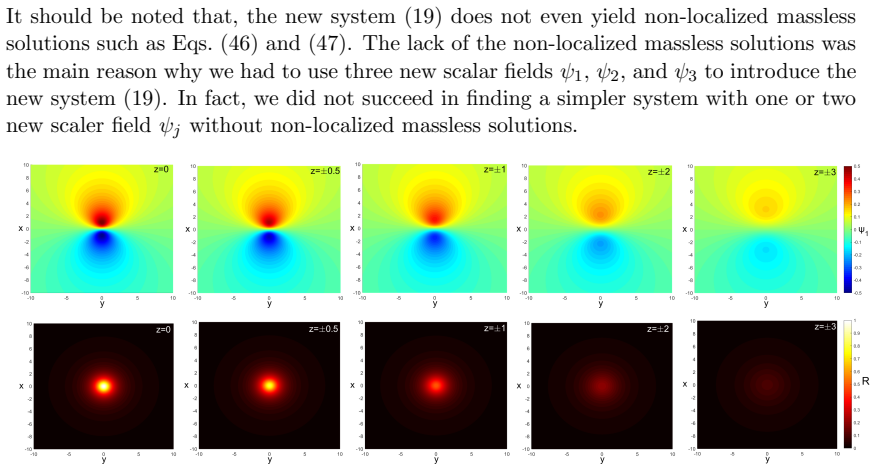
- [Fig. 2 and Eqs. (53)-(63)] The numerical plots in Fig. 2 only probe the specific ansatze (43) and (53)-(63), so they do not constitute a general check of stability; the claim of stability for arbitrary deformations requires a proof that is not supplied.
Circularity Check
The zero-energy solution is built into the Lagrangian by construction, and the claimed uniqueness rests on an equivalence that fails at R=0, leaving the paper's central stability claim partly circular and partly unsupported.
-
self definitional
[Section 3, around Eqs. (19), (25), and after Eq. (41)]
"However, we build the new extended KG system (19) in such a way that there is a single massless solution exceptionally, for which Li = 0, as follows: ... these coupled equations are built deliberately in such a way that made Eq. (41) an exceptional static common solution; meaning that, we first consider Eq. (41), and then try to find the proper restrictive conditions Li = 0 (i = 1,··· , 12) to support it as an exceptional massless solution."
Because L = BΣK_i^3 and ε = BΣK_i^2[3C_i−K_i], any field configuration with all K_i = 0 automatically satisfies the equations of motion (22)-(24) and has ε = 0. The L_i (and hence K_i) were chosen after fixing the target profile (41), so the 'result' that (41) is a massless solution is a direct restatement of the construction, not an independent prediction. The nontrivial checks are limited to positivity of C_i and the absence of identically zero constraints; the existence of a zero-energy solution is essentially guaranteed by definition.
-
other
[Section 3, between Eqs. (20)-(24) and after Eq. (41)]
"Note that, since Ki’s are twelve independent linear combination of twelve independent scalars Li’s, it is easy to understand that the conditions Ki = 0 are equivalent to Li = 0 (i = 1,··· , 12). ... In sum, it seems right that the special solution (41) is a single massless solution and we use this name in the rest of the paper."
The asserted equivalence K_i = 0 ⇔ L_i = 0 is false when R = 0. K_1 = R^2L_2, and all K_i containing L_2 are multiplied by R^2 or h_jR^2, so at R = 0 the K_i conditions do not force L_2 = 0. Explicitly, R = 0, ψ_1 = f(x−t), ψ_2 = ψ_3 = 0, θ = 0 gives L_2 = −2 but every K_i = 0, hence all equations of motion (22)-(24) hold and ε = 0. This is a zero-energy solution distinct from (41), so the uniqueness premise used to conclude that (41) is the global energy minimum is not derived; it is an assertion, and in fact it is false as stated. The load-bearing stability conclusion therefore rests on an unproved—and contradicted—uniqueness premise.
full rationale
This paper is an inverse-design model-building exercise: the Lagrangian (19) is deliberately constructed so that a preselected profile (41) makes all twelve K_i vanish, and the paper is transparent about this ('we first consider Eq. (41), and then try to find the proper restrictive conditions'). Consequently, the existence of a zero-energy solution is largely a tautology of the construction, which is the self-definitional component of the circularity. The genuinely independent content lies in the positivity calculation (all C_i > 0) and in verifying that the constraints are not identically zero. However, the paper's central claim that (41) is the single massless solution and hence that any arbitrary deformation increases the total energy depends on the equivalence K_i = 0 ⇔ L_i = 0 and on a finite list of candidate deformations. That equivalence fails at R = 0, where R = 0, ψ_1 = f(x−t), ψ_2 = ψ_3 = 0, θ = 0 gives all K_i = 0 and ε = 0 for a continuum of configurations not listed among the excluded families. Thus the uniqueness premise is unsupported and actually false. The self-citations to [66]-[70] provide background methodology but are not load-bearing enough by themselves to raise the score; the main problem is the construction-as-prediction for existence and the assumed uniqueness for stability. Overall, the paper is partially circular but not a fully tautological derivation, so a score of 4 is appropriate.
Assumptions & free parameters
free parameters (1)
- B =
arbitrary positive number
assumptions (3)
- standard math The Euler-Lagrange equations from a Lagrangian density are the correct equations of motion.
- domain assumption Positive definiteness of the energy density and a global minimum of total energy are the correct criteria for soliton stability.
- ad hoc to paper The massless solution (41) is the unique solution of the system of conditions K_i=0 (i=1,...,12).
invented entities (1)
-
Auxiliary scalar fields psi_1, psi_2, psi_3
Cite this review
Pith. "Pith review of Relativistic k-fields with Massless Soliton Solutions in 3+1 Dimensions." pith.science (2026). https://pith.science/paper/7RCQ2T45
@misc{pith2026190810291,
  author       = {Pith},
  title        = {Pith review of: Relativistic k-fields with Massless Soliton Solutions in 3+1 Dimensions},
  year         = {2026},
  howpublished = {\url{https://pith.science/paper/7RCQ2T45}},
  note         = {Machine review of arXiv:1908.10291}
}
read the original abstract
In this work, the relativistic non-standard Lagrangian densities (k-fields) with massless solutions are generally introduced. Such solutions are not necessarily energetically stable. However, in 3+1 dimensions, we introduce a new k-field model that results in a single non-topological massless solitary wave solution. This special solution is energetically stable; that is, any arbitrary deformation above its background leads to an increase in the total energy. In other words, its energy is zero which is the least energy in all solutions. Hence, it can be called a massless soliton solution.
Figures

Reference graph
Works this paper leans on
-
[1]
Rajaraman, R. (1982). Solitons and instantons. North Holland, Elsevier, Amsterdam
1982
-
[2]
Das, A. (1989). Integrable models (Vol. 30). World scientific
1989
-
[3]
Lamb Jr, G. L. (1980). Elements of soliton theory . New York, Wiley-Interscience
1980
-
[4]
Manton, N., & Sutcliffe, P. (2004). Topological solitons. Cambridge University Press
2004
-
[5]
K., Peyrard, M., & Sodano, P
Campbell, D. K., Peyrard, M., & Sodano, P. (1986). Kink-antikink interactions in the double sine-Gordon equation . Physica D: Nonlinear Phenomena, 19(2), 165-205
1986
-
[6]
H., & Haberman, R
Goodman, R. H., & Haberman, R. (2005). Kink-Antikink Collisions in the φ4 Equa- tion: The n-Bounce Resonance and the Separatrix Map . SIAM Journal on Applied Dynamical Systems, 4(4), 1195-1228
2005
-
[7]
Riazi, N. (1993). Particle aspects of kink interactions . International journal of theo- retical physics, 32(11), 2155-2160
1993
-
[8]
R., Riazi, N., & Mohebbi, A
Gharaati, A. R., Riazi, N., & Mohebbi, A. F. (2006). Internal modes of relativistic solitons. International Journal of Theoretical Physics, 45(1), 53-63
2006
Show all 89 references
-
[9]
Mohammadi, M., & Riazi, N. (2011). Approaching integrability in bi-dimensional nonlinear field equations. Progress of Theoretical Physics, 126(2), 237-248
2011
-
[10]
Mohammadi, M., & Riazi, N. (2019). The affective factors on the uncertainty in the collisions of the soliton solutions of the double field sine-Gordon system . Communi- cations in Nonlinear Science and Numerical Simulation, 72, 176-193
2019
-
[11]
Mohammadi, M., & Riazi, N. (2014). Bi-dimensional soliton-like solutions of the non- linear complex sine-Gordon system. Progress of Theoretical and experimental Physics, 2014(2), 023A03
2014
-
[12]
Hassanabadi, H., Lu, L., Maghsoodi, E., Liu, G., & Zarrinkamar, S. (2014). Scattering of Klein-Gordon particles by a Kink-like potential . Annals of Physics, 342, 264-269
2014
-
[13]
Alonso-Izquierdo, A., & Guilarte, J. M. (2012). On a family of ( 1 + 1)-dimensional scalar field theory models: kinks, stability, one-loop mass shifts . Annals of Physics, 327(9), 2251-2274
2012
-
[14]
A., & Kudryavtsev, A
Gani, V. A., & Kudryavtsev, A. E. (1999). Kink–antikink interactions in the double sine-Gordon equation and the problem of resonance frequencies . Physical Review E, 60(3), 3305. 12
1999
-
[15]
Popov, C. A. (2005). Perturbation theory for the double sine-Gordon equation . Wave Motion, 42(4), 309-316
2005
-
[16]
Riazi, N., & Gharaati, A. R. (1998). Dynamics of sine-Gordon solitons . International journal of theoretical physics, 37(3), 1081-1120
1998
-
[17]
Mohammadi, M., Riazi, N., & Azizi, A. (2012). Radiative Properties of Kinks in the sin4(ϕ) System. Progress of theoretical physics, 128(4), 615-627
2012
-
[18]
Dorey, P., Mersh, K., Romanczukiewicz, T., & Shnir, Y. (2011). Kink-antikink colli- sions in the φ6 model. Physical review letters, 107(9), 091602
2011
-
[19]
A., Kudryavtsev, A
Gani, V. A., Kudryavtsev, A. E., & Lizunova, M. A. (2014). Kink interactions in the (1 + 1)-dimensional ϕ6 model. Physical Review D, 89(12), 125009
2014
-
[20]
C., & Saxena, A
Khare, A., Christov, I. C., & Saxena, A. (2014). Successive phase transitions and kink solutions in φ8, φ10, and φ12 field theories. Physical Review E, 90(2), 023208
2014
-
[21]
M., Gani, V
Marjaneh, A. M., Gani, V. A., Saadatmand, D., Dmitriev, S. V., & Javidan, K. (2017). Multi-kink collisions in the φ6 model. Journal of High Energy Physics, 2017(7), 28
2017
-
[22]
A., Marjaneh, A
Gani, V. A., Marjaneh, A. M., & Saadatmand, D. (2019). Multi-kink scattering in the double sine-Gordon model. The European Physical Journal C, 79(7), 620
2019
-
[23]
Bazeia, D., Belendryasova, E., & Gani, V. A. (2018). Scattering of kinks of the sinh- deformedϕ4 model. The European Physical Journal C, 78(4), 340
2018
-
[24]
A., Marjaneh, A
Gani, V. A., Marjaneh, A. M., Askari, A., Belendryasova, E., & Saadatmand, D. (2018). Scattering of the double sine-Gordon kinks . The European Physical Journal C, 78(4), 345
2018
-
[25]
(2018).Resonant kink-antikink scattering through quasinormal modes
Dorey, P., & Roma´ nczukiewicz, T. (2018).Resonant kink-antikink scattering through quasinormal modes. Physics Letters B, 779, 117-123
2018
-
[26]
A., Lensky, V., & Lizunova, M
Gani, V. A., Lensky, V., & Lizunova, M. A. (2015). Kink excitation spectra in the (1+ 1)-dimensional ϕ8 model. Journal of High Energy Physics, 2015(8), 147
2015
-
[27]
V., & Javidan, K
Askari, A., Saadatmand, D., Dmitriev, S. V., & Javidan, K. (2018). High energy den- sity spots and production of kink–antikink pairs in particle collisions . Wave Motion, 78, 54-59
2018
-
[28]
Morris, J. R. (2018). Small deformations of kinks and walls . Annals of Physics, 393, 122-131
2018
-
[29]
Morris, J. R. (2019). Interacting kinks and meson mixing . Annals of Physics, 400, 346-365
2019
-
[30]
Skyrme, T. H. R. (1961). A non-linear field theory . Proceedings of the Royal Society A. 260, 127–138
1961
-
[31]
Skyrme, T. H. R. (1962). A unified field theory of mesons and baryons . Nuclear Physics, 31, 556-569
1962
-
[32]
S., Schroers, B
Manton, N. S., Schroers, B. J., & Singer, M. A. (2004). The interaction energy of well-separated Skyrme solitons . Communications in mathematical physics, 245(1), 123-147
2004
-
[33]
Manton, N. S. (1987). Geometry of skyrmions . Communications in Mathematical Physics, 111(3), 469-478. 13
1987
-
[34]
Li, T. Z. (1988). Are there other types of skyrmions? . International journal of theo- retical physics, 27(3), 307-313
1988
-
[35]
Li, T. Z. (1991). Skyrmions of different types . International journal of theoretical physics, 30(6), 829-836
1991
-
[36]
’t Hooft, G. (1974). Magnetic monopoles in unified theories . Nucl. Phys. B, 79 (CERN-TH-1876), 276-284
1974
-
[37]
Polyakov, A. M. (1974). Spectrum of particles in quantum field theory . JETP Lett, 20, 430-433
1974
-
[38]
Prasad, M. K. (1980). Instantons and monopoles in Yang-Mills gauge field theories . Physica D: Nonlinear Phenomena, 1(2), 167-191
1980
-
[39]
Nishino, S., Matsudo, R., Warschinke, M., & Kondo, K. I. (2018).Magnetic monopoles in pure Yang-Mills theory with a gauge-invariant mass . Progress of Theoretical and Experimental Physics, 2018(10), 103B04
2018
-
[40]
Eto, M., Hirono, Y., Nitta, M., & Yasui, S. (2014). Vortices and other topological solitons in dense quark matter . Progress of Theoretical and Experimental Physics, 2014(1), 012D01
2014
-
[41]
Wazwaz, A. M. (2004). The tanh method for traveling wave solutions of nonlinear equations. Applied Mathematics and Computation, 154(3), 713-723
2004
-
[42]
G., & Smolyakov, M
Panin, A. G., & Smolyakov, M. N. (2017). Problem with classical stability of U(1) gauged Q-balls. Physical Review D, 95(6), 065006
2017
-
[43]
Kovtun, A., Nugaev, E., & Shkerin, A. (2018). Vibrational modes of Q-balls. Physical Review D, 98(9), 096016
2018
-
[44]
Smolyakov, M. N. (2018). Perturbations against a Q-ball: Charge, energy, and addi- tivity property. Physical Review D, 97(4), 045011
2018
-
[45]
I., Copeland, E
Tsumagari, M. I., Copeland, E. J., & Saffin, P. M. (2008). Some stationary properties of a Q-ball in arbitrary space dimensions . Physical Review D, 78(6), 065021
2008
-
[46]
D., & Pang, Y
Lee, T. D., & Pang, Y. (1992). Nontopological solitons. Physics Reports, 221(5-6), 251-350
1992
-
[47]
Coleman, S. (1985). Q-balls. Nuclear Physics B, 262(2), 263-283
1985
-
[48]
A., & Menezes, R
Bazeia, D., Marques, M. A., & Menezes, R. (2016). Exact solutions, energy, and charge of stable Q-balls . The European Physical Journal C, 76(5), 241
2016
-
[49]
A., & Menezes, R
Bazeia, D., Losano, L., Marques, M. A., & Menezes, R. (2017). Split Q-balls. Physics Letters B, 765, 359-364
2017
-
[50]
N., Axenides, M., Floratos, E
Anagnostopoulos, K. N., Axenides, M., Floratos, E. G., & Tetradis, N. (2001). Large gauged Q balls . Physical Review D, 64(12), 125006
2001
-
[51]
Axenides, M., Komineas, S., Perivolaropoulos, L., & Floratos, M. (2000). Dynamics of nontopological solitons: Q balls . Physical Review D, 61(8), 085006
2000
-
[52]
Bowcock, P., Foster, D., & Sutcliffe, P. (2009). Q-balls, integrability and duality . Journal of Physics A: Mathematical and Theoretical, 42(8), 085403
2009
-
[53]
Shiromizu, T., Uesugi, T., & Aoki, M. (1999). Perturbation analysis of deformed Q-balls and primordial magnetic field . Physical Review D, 59(12), 125010. 14
1999
-
[54]
Shiromizu, T. (1998). Generation of a magnetic field due to excited Q-balls . Physical Review D, 58(10), 107301
1998
-
[55]
Ishihara, H., & Ogawa, T. (2019). Charge-screened nontopological solitons in a sponta- neously brokenU(1) gauge theory. Progress of Theoretical and Experimental Physics, 2019(2), 021B01
2019
-
[56]
A., Menezes, R., & da Rocha, R
Bazeia, D., Losano, L., Marques, M. A., Menezes, R., & da Rocha, R. (2016).Compact Q-balls. Physics Letters B, 758, 146-151
2016
-
[57]
P., & Rybakov, Y
Kumar, A., Nisichenko, V. P., & Rybakov, Y. P. (1979). Stability of charged solitons . International Journal of Theoretical Physics, 18(6), 425-432
1979
-
[58]
Grillakis, M. (1988). Linearized instability for nonlinear schr¨ odinger and klein-gordon equations. Communications on pure and applied mathematics, 41(6), 747-774
1988
-
[59]
Grillakis, M., Shatah, J., & Strauss, W. (1987). Stability theory of solitary waves in the presence of symmetry, I . Journal of functional analysis, 74(1), 160-197
1987
-
[60]
D., & Sirlin, A
Friedberg, R., Lee, T. D., & Sirlin, A. (1976). Class of scalar-field soliton solutions in three space dimensions. Physical Review D, 13(10), 2739
1976
-
[61]
Smolyakov, M. N. (2019). Perturbations against a Q-ball. II. Contribution of nonoscil- lation modes. Physical Review D, 100(4), 045002
2019
-
[62]
G., & Kolokolov, A
Vakhitov, N. G., & Kolokolov, A. A. (1973). Stationary solutions of the wave equation in the medium with nonlinearity saturation . Radiophysics and Quantum Electronics, 16(7), 783-789
1973
-
[63]
Kolokolov, A. A. (1973). Stability of the dominant mode of the nonlinear wave equation in a cubic medium . Journal of Applied Mechanics and Technical Physics, 14(3), 426- 428
1973
-
[64]
Cordero, R., & Mota, R. D. (2004). Soliton stability in a generalized sine-Gordon potential. International Journal of Theoretical Physics, 43(11), 2215-2222
2004
-
[65]
Derrick, G. H. (1964). Comments on nonlinear wave equations as models for elemen- tary particles. Journal of Mathematical Physics, 5(9), 1252-1254
1964
-
[66]
Mohammadi, M., & Gheisari, R. (2019). Zero rest mass soliton solutions . Physica Scripta, 95(1), 015301
2019
-
[67]
Mohammadi, M. (2019). The role of the massless phantom term in the stability of a non-topological soliton solution. Iranian Journal of Science and Technology, Transac- tions A: Science, 43(5), 2627-2634
2019
-
[68]
Mohammadi, M. (2020). Introducing a relativistic nonlinear field system with a single stable non-topological soliton solution in 1 + 1 dimensions. Annals of Physics, 414, 168099
2020
-
[69]
Mohammadi, M. (2020). An energetically stable Q-ball solution in 3+ 1 dimensions . Physica Scripta, 95(4), 045302
2020
-
[70]
Mohammadi, M. (2020). Stability catalyzer for a relativistic non-topological soliton solution. Annals of Physics, 168304
2020
-
[71]
Saha, A., & Talukdar, B. (2014). Inverse variational problem for nonstandard La- grangians. Reports on Mathematical Physics, 73(3), 299-309. 15
2014
-
[72]
Musielak, Z. E. (2008). Standard and non-standard Lagrangians for dissipative dy- namical systems with variable coefficients . Journal of Physics A: Mathematical and Theoretical, 41(5), 055205
2008
-
[73]
El-Nabulsi, A. R. (2013). Non-linear dynamics with non-standard Lagrangians. Qual- itative theory of dynamical systems, 12(2), 273-291
2013
-
[74]
El-Nabulsi, R. A. (2015). Classical string field mechanics with non-standard La- grangians. Mathematical Sciences, 9(3), 173-179
2015
-
[75]
El-Nabulsi, R. A. (2014). Nonlinear integro-differential Einstein’s field equations from nonstandard Lagrangians. Canadian Journal of Physics, 92(10), 1149-1153
2014
-
[76]
El-Nabulsi, R. A. (2013). Generalizations of the Klein-Gordon and the Dirac equations from non-standard Lagrangians . Proceedings of the National Academy of Sciences, India Section A: Physical Sciences, 83(4), 383-387
2013
-
[77]
Bazeia, D., Losano, L., Menezes, R., & Oliveira, J. C. R. E. (2007). Generalized global defect solutions. The European Physical Journal C, 51(4), 953-962
2007
-
[78]
(2007).k-defects as compactons
Adam, C., Sanchez-Guillen, J., & Wereszczy´ nski, A. (2007).k-defects as compactons. Journal of Physics A: Mathematical and Theoretical, 40(45), 13625
2007
-
[79]
Babichev, E. (2006). Global topological k-defects. Physical Review D, 74(8), 085004
2006
-
[80]
Vasheghani, A., & Riazi, N. (1996). Isovector solitons and Maxwell’s equations . In- ternational Journal of Theoretical Physics, 35(3), 587-591
1996
-
[81]
H., & Riazi, N
Mahzoon, M. H., & Riazi, N. (2007). Nonlinear electrodynamics and NED-inspired chiral solitons. International Journal of Theoretical Physics, 46(4), 823-831
2007
-
[82]
Armend´ariz-Pic´on, C., Damour, T., & Mukhanov, V. I. (1999). k-Inflation. Physics Letters B, 458(2-3), 209-218
1999
-
[83]
Chiba, T., Okabe, T., & Yamaguchi, M. (2000). Kinetically driven quintessence . Physical Review D, 62(2), 023511
2000
-
[84]
Armendariz-Picon, C., Mukhanov, V., & Steinhardt, P. J. (2000). Dynamical solution to the problem of a small cosmological constant and late-time cosmic acceleration . Physical Review Letters, 85(21), 4438
2000
-
[85]
Armendariz-Picon, C., & Lim, E. A. (2005). Haloes of k-essence. Journal of Cosmol- ogy and Astroparticle Physics, 2005(08), 007
2005
-
[86]
D., & Milosevic, M
Dimitrijevic, D. D., & Milosevic, M. (2012, August). About non standard Lagrangians in cosmology. In AIP Conference Proceedings (Vol. 1472, No. 1, pp. 41-46). American Institute of Physics
2012
-
[87]
Padmanabhan, T., & Choudhury, T. R. (2002). Can the clustered dark matter and the smooth dark energy arise from the same scalar field? . Physical Review D, 66(8), 081301
2002
-
[88]
Renaux-Petel, S., & Tasinato, G. (2009). Nonlinear perturbations of cosmological scalar fields with non-standard kinetic terms . Journal of Cosmology and Astroparticle Physics, 2009(01), 012
2009
-
[89]
El-Nabulsi, R. A. (2013). Nonstandard Lagrangian cosmology. Journal of Theoretical and Applied Physics, 7(1), 58. 16
2013
Reviewed August 14, 2026 · model on record in the stance chip above.
Discussion (0). Continue with ORCID to comment.