REVIEW 3 major objections 8 minor 1 cited by
Mass-Gap Neutron Stars from Vector \texorpdfstring{$f(R)$}{f(R)} Gravity Inflationary Deformations
T0 review · 3 major / 8 minor · reviewed 2026-08-06 · deepseek-v4-flash
Pith's one-line read The paper argues that vector f(R) gravity inflationary models, solved as scalar-tensor theories, support static neutron stars up to about 2.75 solar masses with the MPA1 equation of state, placing them in the mass-gap region below the…
desk verdict A standard scalar-tensor TOV scan for four vector-f(R) inflationary models whose central mass-gap claim is currently unreproducible because the coupling alpha is defined two incompatible ways. read the letter →
The pith
A machine-rendered reading of the paper's core claim, the machinery that carries it, and where it could break.
The reading
What carries the argument
The load-bearing machinery is the conformally transformed scalar-tensor system together with the physical-mass conversion formula. After the transformation $\tilde{g}_{\mu\nu} = A^{-2}g_{\mu\nu}$ with $A(\phi) = e^{\phi/(2\sqrt{6+\beta^2})}$, each vector $f(R)$ model supplies a potential $V(\phi)$ that enters the TOV equations along with the coupling $\alpha(\phi) = \frac{1}{2}\sqrt{6+\beta^2}$. A double-shooting LSODA solver tunes the central values $\nu_c$ and $\phi_c$ so that the scalar field vanishes at numerical infinity, where the metric becomes Schwarzschild; Eq. (23) then converts the Einstein-frame ADM mass into the physical Jordan-frame mass, which receives contributions from outside the star because the scalar field does not vanish at the stellar surface. The four models share the same $A(\phi)$ and $\alpha(\phi)$ and differ mainly in $V(\phi)$, which is why their mass-radius curves nearly coincide.
What would settle it
Recompute the mass-radius curve for the near-general-relativity model ($\beta = 10^4$, coupling about $5\times10^{-5}$) with the MPA1 equation of state and compare its maximum mass with the general-relativistic result for the same equation of state; the two must agree if the mass conversion is correct, yet the paper reports about $2.749\,M_\odot$ for that model and gives no GR baseline.
Extended reading notes
Core claim
Vector $f(R)$ gravity, built by replacing the Ricci scalar $R$ with $R + A^\mu A_\mu + \beta\nabla_\mu A^\mu$ in the Lagrangian, becomes a scalar-tensor theory on shell, and its four inflationary models are solved numerically for static neutron stars. The paper reports that the four models produce almost indistinguishable Jordan-frame mass-radius curves. Confronted with the NICER bounds, a refined version of NICER, the PSR J0740+6620 constraints, and the CSI, CSII, and CSIII radius constraints, the MPA1 equation of state is the only one compatible with all of them for all four models, with maximum masses around 2.749 solar masses for each model, below the 3-solar-mass causal limit. The WFF1, MS1, and MS1b equations of state are excluded by the constraints used. The paper also asserts that a cosmologically non-viable inflationary model can still give viable neutron-star phenomenology, that this is a model-dependent feature, and closes by noting that the theoretical context complies with the general behavior of viable modified-gravity models rather than producing a new physics prediction.
Load-bearing premise
The paper's mass values rest on the assumption that the numerical integration and the formula converting the computed mass into the physical mass are correct, including the boundary condition that the scalar field vanishes at very large radius; the near-general-relativity model is never checked against the known GR maximum mass for the MPA1 equation of state, so a systematic offset in the reported masses cannot be ruled out.
Editorial extensions
If this is right
- The MPA1 equation of state in these vector $f(R)$ models supports static neutron stars up to about $2.749\,M_\odot$, inside the mass-gap region and below the $3\,M_\odot$ causal limit.
- The WFF1, MS1, and MS1b equations of state are ruled out, while MPA1 satisfies all the observational constraints used in the paper.
- A single mass-gap neutron star observation would not distinguish the four inflationary models, because their mass-radius curves are nearly identical.
- Cosmological viability of the inflationary model is not a prerequisite for viable neutron-star phenomenology in this theory class.
- The paper's conclusion implies that mass-gap objects could be static, non-rotating neutron stars without requiring masses above the $3\,M_\odot$ limit.
Reading between the lines
- The near-identical curves suggest the result is controlled by the shared conformal coupling functions rather than by the specific potential, so other scalar-tensor theories with the same $A(\phi)$ and $\alpha(\phi)$ would likely give the same neutron-star phenomenology.
- Because no general-relativistic baseline for the MPA1 equation of state is reported, an independent integration should reproduce the known GR maximum mass before the $2.75\,M_\odot$ value is taken at face value.
- Tidal deformability, moment of inertia, and oscillation spectra are more sensitive to the scalar field than mass-radius curves are, so those observables are the most promising way to break the degeneracy among the four models.
- The MPA1 scenario predicts a specific radius near 11.3 km at maximum mass, so a future radius measurement of a heavy neutron star candidate could test the scenario independently of mass alone.
Editorial analysis
A structured set of objections, weighed in public.
Referee Report
Summary. The manuscript studies static neutron stars in a class of vector f(R) gravity theories that are recast as scalar-tensor theories. The author integrates the Einstein-frame TOV equations (10)-(14) with a Python LSODA double-shooting solver for nine piecewise-polytropic equations of state, and converts the results to the Jordan frame using the conformal factor A(φ) and the ADM mass formula (23). Four inflationary models are considered: the Starobinsky R^2 model (Model I), a Starobinsky variant with β≈0.1 (Model II), a power-law f(R) model with β=1, n=1.8 (Model III), and a large-β limit with β=10^4, n=4 (Model IV), the last being cosmologically non-viable. The central claim is that the MPA1 equation of state produces maximum masses around 2.749 M⊙ for all four models, placing them in the mass-gap region while remaining below the 3 M⊙ causal limit, and that even the non-viable inflationary model produces viable neutron star phenomenology, with all models giving nearly indistinguishable mass-radius curves.
Significance. If the numerical results are correct, the paper would be a useful forward-prediction study: the inflationary parameters (β, n, M, m) are fixed before the neutron-star calculation, so the MPA1 maximum-mass prediction is not obtained by fitting theory parameters to neutron star data. The paper also confronts the results with multiple constraints (NICER I/II, PSR J0740+6620, CSI–CSIII) and honestly states that the model does not produce new physics beyond existing modified-gravity behavior. However, the central quantitative claim is currently unverifiable from the manuscript because of internal inconsistencies in the definitions of A(φ) and α(φ), and because no GR baseline is tabulated. The significance of the result therefore cannot be assessed until these issues are resolved.
major comments (3)
- [Sec. I.A, Eqs. (37)-(39)] Equations (37), (38), and (39) are mutually inconsistent. From Eq. (37), ϕ = exp(2φ/√(6+β²)), so with A = Ω^{-1/2} = ϕ^{-1/2} from Eq. (5) the correct conformal factor is A(φ) = exp(-φ/√(6+β²)) and α(φ) = d ln A/dφ = -1/√(6+β²). The manuscript instead gives A(φ) = exp(+φ/(2√(6+β²))) in Eq. (38) and α(φ) = √(6+β²)/2 in Eq. (39). The two α values differ by a factor of (6+β²), which for Model IV (β=10^4) is about 10^8. Since α enters the TOV equations (12) and (13), the computed mass-radius curves and maximum masses in Table II depend critically on which expression was used in the solver. The author must state explicitly which definitions were implemented, correct any typographical or conceptual errors, and rerun the analysis if the implemented expressions do not match the corrected ones.
- [Sec. I.B, Table II and Fig. 6] The near-GR limit of Model IV is not documented. For β=10^4, the potential in Eq. (43) is strongly suppressed and, if α is taken from the derivative of the (corrected) conformal factor, the model should reduce essentially to general relativity. In that case the reported MPA1 maximum mass of 2.749149 M⊙ should equal the GR maximum mass for the same piecewise-polytropic MPA1 equation of state. The paper never quotes the GR maximum mass (or GR radii at 1.4 M⊙ or 2 M⊙) for any of the nine EoSs, so the reader cannot tell whether Model IV is being computed in the weak-coupling near-GR regime or in a strongly coupled regime (if Eq. (39) with α ≈ 5×10³ was used). Without this baseline, the assertion that all four models—including the non-viable one—produce viable and nearly identical mass-radius curves is not testable. Please provide the GR M–R curve and tabulated GR maximum masses for all EoSs, and identify the actual α used in the code.
- [Sec. I, Eq. (23)] The Jordan-frame ADM mass formula (23) depends explicitly on A(φ(r_E)) and α(φ(r_E))(dφ/dr) evaluated at numerical infinity. Given the inconsistency of Eqs. (37)–(39), both the sign and the magnitude of the scalar-field correction term are ambiguous; for Model IV the correction could either vanish (small α) or dominate (large α from Eq. (39)). In addition, the manuscript does not provide convergence tests for the choice of the numerical infinity r_E, the shooting tolerance, or the residual of the scalar field at infinity. Please include such tests, together with the asymptotic values of A(φ) and α(φ) at r_E, to demonstrate that the extracted Jordan-frame masses are stable and that the quoted 2.749 M⊙ value is well defined.
minor comments (8)
- [Table VIII] Table VIII lists R_ENG = 1.437837 km for Model III, which is almost certainly a typo (likely 11.437837 km) and is inconsistent with the other entries for the ENG EoS; please correct it.
- [Table XI] Table XI lists M_max = 10.866 M⊙ for the SLy EoS in Model II, which is physically implausible and inconsistent with Model II's other rows and with the M–R figures; all tables should be carefully regenerated from the corrected numerical output.
- [Sec. I.A, after Eq. (42)] The formula for the parameter m is garbled: 'm = 5.1 × 10⁻⁴pc−1/2 n (2pN )−(p+2)/4' is not readable. Please write the expression with clear notation for the Planck mass, the e-folding number N, and the indices p and n.
- [Eq. (1)] The causal-limit formula (1) uses ρ_u and P_u without defining the transition density or the matching procedure; please clarify what ρ_u and P_u refer to in the causal EoS construction.
- [Table II] The maximum masses in Table II are quoted to as many as seven significant figures (e.g., 2.749149112 M⊙). This precision exceeds what is meaningful for piecewise-polytropic parametrizations and should be rounded consistently.
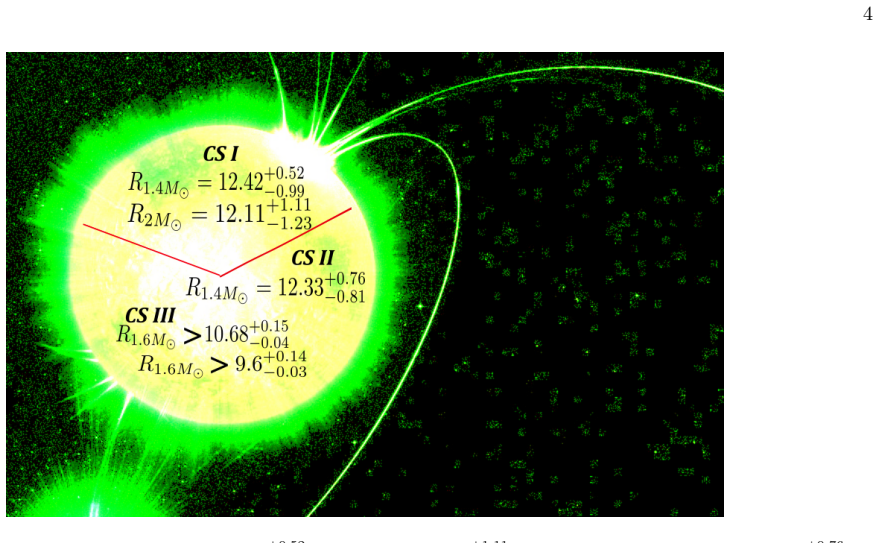
- [Fig. 1] Figure 1 is described as presenting the CSI, CSII, and CSIII constraints, but the figure appears to be an edited astronomical image without visible constraint bands; please overlay the actual mass-radius constraint regions or replace the figure with one that conveys the relevant information.
- [Abstract and Sec. I] The abstract says 'we solve the TOV equations', but the paper actually solves the Einstein-frame scalar-tensor TOV equations and then converts the results to the Jordan frame; this distinction should be stated explicitly in the abstract or in the opening of Section I.
- [Table XII] The header of Table XII contains a broken phrase ('the and the correspondent') and the table formatting of the EoS names is inconsistent; please correct the formatting.
Circularity Check
No circular derivation: inflationary parameters are fixed before the TOV solve; the mass-gap result is a forward numerical prediction.
full rationale
The derivation is forward and self-contained with respect to the central mass-gap claim. The vector-f(R) potentials and parameters (beta, n, M, m) are fixed by the inflationary model (Eqs. 40-43) before any neutron-star calculation; none are fitted to the NS constraints or to the M-R curves. The TOV system Eqs. (10)-(14) and the Jordan-frame ADM mass formula Eq. (23) are derived from the action and conformal transformation, and the double-shooting condition phi -> 0 at numerical infinity is an external boundary condition, not an input that encodes the 2.75 M_sun result. The MPA1 preference is a post-hoc comparison across nine EoSs against external NICER/CSI/CSII/CSIII constraints, so it is model selection rather than a circular derivation. The self-citations ([11], [12]) motivating MPA1 and the 3 M_sun rule are contextual and not load-bearing, since the paper recomputes all cases. A genuine internal inconsistency exists between Eq. (38) and Eq. (39) for alpha(phi): the derivative of Eq. (38) is 1/(2 sqrt(6+beta^2)), not (1/2) sqrt(6+beta^2), which is a correctness/support caveat for the numerical implementation, but it does not make the prediction equivalent to its inputs. The paper even concedes it did not reveal new physics, consistent with a non-circular, independent benchmark calculation.
Assumptions & free parameters
free parameters (4)
- beta (Starobinsky deformation parameter) =
Model I: 0; Model II: 0.1; Model III: 1; Model IV: 10^4
- n (power-law exponent in f(R)=R+m^2(1-n) R^n) =
n = 1.8 for Model III; n = 4 for Model IV
- e-folding number N =
N = 60
- Mass scale M (Model I and II), m (Models III and IV) =
M ~ 1.3e-5 sqrt(1+beta^2/6) (60/55)^{-1}; m = 5.1e-4 pc^{-1/2} n (2pN)^{-(p+2)/4}
assumptions (5)
- domain assumption The vector f(R) gravity action (25) is equivalent, after integrating out the auxiliary fields, to the scalar-tensor theory (28).
- standard math The Einstein-frame TOV equations (10)-(14) correctly describe static neutron stars in scalar-tensor gravity.
- domain assumption The Jordan-frame ADM mass formula (23) correctly relates the Einstein-frame mass to the physical mass.
- domain assumption The scalar field vanishes at numerical infinity and the metric becomes Schwarzschild.
- ad hoc to paper The 3 solar mass causal limit applies to these modified gravity theories.
Cite this review
Pith. "Pith review of Mass-Gap Neutron Stars from Vector \texorpdfstring{$f(R)$}{f(R)} Gravity Inflationary Deformations." pith.science (2026). https://pith.science/paper/7REI2RUX
@misc{pith2026250717384,
  author       = {Pith},
  title        = {Pith review of: Mass-Gap Neutron Stars from Vector \texorpdfstring$f(R)$f(R) Gravity Inflationary Deformations},
  year         = {2026},
  howpublished = {\url{https://pith.science/paper/7REI2RUX}},
  note         = {Machine review of arXiv:2507.17384}
}
abstract
The latest observations from the LIGO-Virgo indicated the existence of mass-gap region astrophysical objects. This is a rather sensational observation and there are two possibilities for the nature of these mass-gap region astrophysical objects, these are either small black holes that result from the mergers of ordinary mass neutron stars, or these are heavy neutron stars. In the line of research implied by the former possibility, in this work we shall examine the implied neutron star phenomenology from vector $f(R)$ gravity inflationary models. These theories are basically scalar-tensor deformations of the Starobinsky inflationary model. We shall present the essential features of cosmologically viable and non-viable deformations of the Starobinsky model, originating from vector $f(R)$ gravity inflationary theories, and we indicate which models and for which equations of state provide a viable neutron star phenomenology. We solve the Tolman-Oppenheimer-Volkov equations using a robust double shooting LSODA python based code, for the following piecewise polytropic equations of state the WFF1, the SLy, the APR, the MS1, the AP3, the AP4, the ENG, the MPA1 and the MS1b. We confront the resulting phenomenology with several well known neutron star constraints and we indicate which equation of state and model fits the phenomenological constraints. A remarkable feature, also known from other inflationary attractor models, is that the MPA1 is the equation of state which is most nicely fitted the constraints, for all the theoretical models used, and actually the maximum mass for this equation of state is well inside the mass-gap region. Another mentionable feature that stroked us with surprise is the fact that even cosmologically non-viable inflationary models produced a viable neutron star phenomenology, which most likely has to be a model-dependent feature.
Figures


Figures from the paper (3 more)


Forward citations
Cited by 1 Pith paper
-
Fibre Inflation Meets Quintessence: Implications of Perturbative Stabilisation
Adding a base-modulus redefinition to fibre inflation in perturbative LVS shifts (ns, r) into ACT-allowed territory and yields an axion quintessence companion.
Reference graph
Works this paper leans on
-
[1]
R. Abbott et al. [LIGO Scientific and Virgo], Astrophys. J. Lett. 896 (2020) no.2, L44 doi:10.3847/2041-8213/ab960f [arXiv:2006.12611 [astro-ph.HE]]
arXiv 2020
-
[2]
A. G. Abac et al. [LIGO Scientific, Virgo,, KAGRA and VIRGO], Astrophys. J. Lett. 970 (2024) no.2, L34 doi:10.3847/2041-8213/ad5beb [arXiv:2404.04248 [astro-ph.HE]]
arXiv 2024
-
[3]
P. Haensel, A. Y. Potekhin and D. G. Yakovlev, Astrophys. Space Sci. Libr. 326 (2007), pp.1-619 doi:10.1007/978-0-387- 47301-7
-
[4]
J. L. Friedman and N. Stergioulas, “Rotating Relativistic Stars,” doi:10.1017/CBO9780511977596
-
[5]
G. Baym, T. Hatsuda, T. Kojo, P. D. Powell, Y. Song and T. Takatsuka, Rept. Prog. Phys. 81 (2018) no.5, 056902 doi:10.1088/1361-6633/aaae14 [arXiv:1707.04966 [astro-ph.HE]]
arXiv 2018
-
[6]
J. M. Lattimer and M. Prakash, Science 304 (2004), 536-542 doi:10.1126/science.1090720 [arXiv:astro-ph/0405262 [astro- ph]]
arXiv 2004
-
[7]
G. J. Olmo, D. Rubiera-Garcia and A. Wojnar, Phys. Rept. 876 (2020), 1-75 doi:10.1016/j.physrep.2020.07.001 [arXiv:1912.05202 [gr-qc]]
arXiv 2020
-
[8]
C. E. Rhoades, Jr. and R. Ruffini, Phys. Rev. Lett. 32 (1974), 324-327 doi:10.1103/PhysRevLett.32.324
Show all 109 references
-
[9]
Kalogera and G
V. Kalogera and G. Baym, Astrophys. J. Lett. 470 (1996), L61-L64 doi:10.1086/310296 [arXiv:astro-ph/9608059 [astro- ph]]
1996 arXiv
-
[10]
A. V. Astashenok, S. Capozziello, S. D. Odintsov and V. K. Oikonomou, Phys. Lett. B 816 (2021), 136222 doi:10.1016/j.physletb.2021.136222 [arXiv:2103.04144 [gr-qc]]
2021
-
[11]
S. D. Odintsov and V. K. Oikonomou, Phys. Rev. D 107 (2023) no.10, 104039 doi:10.1103/PhysRevD.107.104039 [arXiv:2305.05515 [gr-qc]]
2023 arXiv
-
[12]
V. K. Oikonomou, Class. Quant. Grav. 41 (2024) no.8, 085008 doi:10.1088/1361-6382/ad33cd [arXiv:2403.09818 [gr-qc]]
2024 arXiv
-
[13]
B. P. Abbott et al. [LIGO Scientific and Virgo], Phys. Rev. Lett. 119 (2017) no.16, 161101 doi:10.1103/PhysRevLett.119.161101 [arXiv:1710.05832 [gr-qc]]. 14
2017 arXiv
-
[14]
R. W. Romani, D. Kandel, A. V. Filippenko, T. G. Brink and W. Zheng, Astrophys. J. Lett. 934 (2022) no.2, L18 doi:10.3847/2041-8213/ac8007 [arXiv:2207.05124 [astro-ph.HE]]
2022 arXiv
-
[15]
Nojiri, S
S. Nojiri, S. D. Odintsov and V. K. Oikonomou, Phys. Rept. 692 (2017) 1 [arXiv:1705.11098 [gr-qc]]
2017 arXiv
-
[16]
Capozziello, M
S. Capozziello, M. De Laurentis, Phys. Rept. 509, 167 (2011)
2011
-
[17]
Faraoni and S
V. Faraoni and S. Capozziello, Fundam. Theor. Phys. 170 (2010)
2010
-
[18]
Nojiri, S.D
S. Nojiri, S.D. Odintsov, Phys. Rept. 505, 59 (2011)
2011
-
[19]
S. D. Odintsov, V. K. Oikonomou, I. Giannakoudi, F. P. Fronimos and E. C. Lymperiadou, Symmetry 15 (2023), 9 doi:10.3390/sym15091701 [arXiv:2307.16308 [gr-qc]]
2023 arXiv
-
[20]
Ozkan, Y
M. Ozkan, Y. Pang and S. Tsujikawa, Phys. Rev. D 92 (2015) no.2, 023530 doi:10.1103/PhysRevD.92.023530 [arXiv:1502.06341 [astro-ph.CO]]
2015 arXiv
-
[21]
J. M. Lattimer, Ann. Rev. Nucl. Part. Sci. 62 (2012), 485-515 doi:10.1146/annurev-nucl-102711-095018 [arXiv:1305.3510 [nucl-th]]
2012 arXiv
-
[22]
A. W. Steiner and S. Gandolfi, Phys. Rev. Lett.108 (2012), 081102 doi:10.1103/PhysRevLett.108.081102 [arXiv:1110.4142 [nucl-th]]
2012 arXiv
-
[23]
C. J. Horowitz, M. A. Perez-Garcia, D. K. Berry and J. Piekarewicz, Phys. Rev. C 72 (2005), 035801 doi:10.1103/PhysRevC.72.035801 [arXiv:nucl-th/0508044 [nucl-th]]
2005 arXiv
-
[24]
Watanabe, K
G. Watanabe, K. Iida and K. Sato, Nucl. Phys. A 676 (2000), 455-473 [erratum: Nucl. Phys. A 726 (2003), 357-365] doi:10.1016/S0375-9474(00)00197-4 [arXiv:astro-ph/0001273 [astro-ph]]
2000 arXiv
-
[25]
H. Shen, H. Toki, K. Oyamatsu and K. Sumiyoshi, Nucl. Phys. A637 (1998), 435-450 doi:10.1016/S0375-9474(98)00236-X [arXiv:nucl-th/9805035 [nucl-th]]
1998 arXiv
-
[26]
J. Xu, L. W. Chen, B. A. Li and H. R. Ma, Astrophys. J. 697 (2009), 1549-1568 doi:10.1088/0004-637X/697/2/1549 [arXiv:0901.2309 [astro-ph.SR]]
2009 arXiv
-
[27]
Hebeler, J
K. Hebeler, J. M. Lattimer, C. J. Pethick and A. Schwenk, Astrophys. J. 773 (2013), 11 doi:10.1088/0004-637X/773/1/11 [arXiv:1303.4662 [astro-ph.SR]]
2013 arXiv
-
[28]
de Jes´ us Mendoza-Temis, M
J. de Jes´ us Mendoza-Temis, M. R. Wu, G. Mart ´ ınez-Pinedo, K. Langanke, A. Bauswein and H. T. Janka, Phys. Rev. C 92 (2015) no.5, 055805 doi:10.1103/PhysRevC.92.055805 [arXiv:1409.6135 [astro-ph.HE]]
2015 arXiv
-
[29]
W. C. G. Ho, K. G. Elshamouty, C. O. Heinke and A. Y. Potekhin, Phys. Rev. C 91 (2015) no.1, 015806 doi:10.1103/PhysRevC.91.015806 [arXiv:1412.7759 [astro-ph.HE]]
2015 arXiv
-
[30]
Kanakis-Pegios, P
A. Kanakis-Pegios, P. S. Koliogiannis and C. C. Moustakidis, Symmetry 13 (2021) no.2, 183 doi:10.3390/sym13020183 [arXiv:2012.09580 [astro-ph.HE]]
2021 arXiv
-
[31]
Tsaloukidis, P
L. Tsaloukidis, P. S. Koliogiannis, A. Kanakis-Pegios and C. C. Moustakidis, Phys. Rev. D 107 (2023) no.2, 023012 doi:10.1103/PhysRevD.107.023012 [arXiv:2210.15644 [astro-ph.HE]]
2023 arXiv
-
[32]
Kanakis-Pegios, V
A. Kanakis-Pegios, V. Petousis, M. Veselsky, J. Leja and C. C. Moustakidis, Phys. Rev. D 109 (2024) no.4, 043028 doi:10.1103/PhysRevD.109.043028 [arXiv:2309.12469 [nucl-th]]
2024 arXiv
-
[33]
Buschmann, R
M. Buschmann, R. T. Co, C. Dessert and B. R. Safdi, Phys. Rev. Lett. 126 (2021) no.2, 021102 doi:10.1103/PhysRevLett.126.021102 [arXiv:1910.04164 [hep-ph]]
2021 arXiv
-
[34]
B. R. Safdi, Z. Sun and A. Y. Chen, Phys. Rev. D 99 (2019) no.12, 123021 doi:10.1103/PhysRevD.99.123021 [arXiv:1811.01020 [astro-ph.CO]]
2019 arXiv
-
[35]
A. Hook, Y. Kahn, B. R. Safdi and Z. Sun, Phys. Rev. Lett.121 (2018) no.24, 241102 doi:10.1103/PhysRevLett.121.241102 [arXiv:1804.03145 [hep-ph]]
2018 arXiv
-
[36]
T. D. P. Edwards, B. J. Kavanagh, L. Visinelli and C. Weniger, Phys. Rev. Lett. 127 (2021) no.13, 131103 doi:10.1103/PhysRevLett.127.131103 [arXiv:2011.05378 [hep-ph]]
2021 arXiv
-
[37]
Nurmi, E
S. Nurmi, E. D. Schiappacasse and T. T. Yanagida, JCAP 09 (2021), 004 doi:10.1088/1475-7516/2021/09/004 [arXiv:2102.05680 [hep-ph]]
2021 arXiv
-
[38]
A. V. Astashenok, S. Capozziello, S. D. Odintsov and V. K. Oikonomou, Phys. Lett. B 811 (2020), 135910 doi:10.1016/j.physletb.2020.135910 [arXiv:2008.10884 [gr-qc]]
2020
-
[39]
Capozziello, M
S. Capozziello, M. De Laurentis, R. Farinelli and S. D. Odintsov, Phys. Rev. D 93 (2016) no.2, 023501 doi:10.1103/PhysRevD.93.023501 [arXiv:1509.04163 [gr-qc]]
2016 arXiv
-
[40]
A. V. Astashenok, S. Capozziello and S. D. Odintsov, JCAP 01 (2015), 001 doi:10.1088/1475-7516/2015/01/001 [arXiv:1408.3856 [gr-qc]]
2015 arXiv
-
[41]
A. V. Astashenok, S. Capozziello and S. D. Odintsov, Phys. Rev. D 89 (2014) no.10, 103509 doi:10.1103/PhysRevD.89.103509 [arXiv:1401.4546 [gr-qc]]
2014 arXiv
-
[42]
A. V. Astashenok, S. Capozziello and S. D. Odintsov, JCAP 12 (2013), 040 doi:10.1088/1475-7516/2013/12/040 [arXiv:1309.1978 [gr-qc]]
2013 arXiv
-
[43]
A. S. Arapoglu, C. Deliduman and K. Y. Eksi, JCAP 07 (2011), 020 doi:10.1088/1475-7516/2011/07/020 [arXiv:1003.3179 [gr-qc]]
2011 arXiv
-
[44]
Panotopoulos, T
G. Panotopoulos, T. Tangphati, A. Banerjee and M. K. Jasim, Phys. Lett. B 817 (2021), 136330 doi:10.1016/j.physletb.2021.136330 [arXiv:2104.00590 [gr-qc]]
2021
-
[45]
Lobato, O
R. Lobato, O. Louren¸ co, P. H. R. S. Moraes, C. H. Lenzi, M. de Avellar, W. de Paula, M. Dutra and M. Malheiro, JCAP 12 (2020), 039 doi:10.1088/1475-7516/2020/12/039 [arXiv:2009.04696 [astro-ph.HE]]
2020 arXiv
-
[46]
Numajiri, T
K. Numajiri, T. Katsuragawa and S. Nojiri, Phys. Lett. B 826 (2022), 136929 doi:10.1016/j.physletb.2022.136929 [arXiv:2111.02660 [gr-qc]]
2022
-
[47]
Pani and E
P. Pani and E. Berti, Phys. Rev. D 90 (2014) no.2, 024025 doi:10.1103/PhysRevD.90.024025 [arXiv:1405.4547 [gr-qc]]. 15
2014 arXiv
-
[48]
K. V. Staykov, D. D. Doneva, S. S. Yazadjiev and K. D. Kokkotas, JCAP 10 (2014), 006 doi:10.1088/1475- 7516/2014/10/006 [arXiv:1407.2180 [gr-qc]]
2014 arXiv
-
[49]
Horbatsch, H
M. Horbatsch, H. O. Silva, D. Gerosa, P. Pani, E. Berti, L. Gualtieri and U. Sperhake, Class. Quant. Grav. 32 (2015) no.20, 204001 doi:10.1088/0264-9381/32/20/204001 [arXiv:1505.07462 [gr-qc]]
2015 arXiv
-
[50]
H. O. Silva, C. F. B. Macedo, E. Berti and L. C. B. Crispino, Class. Quant. Grav. 32 (2015), 145008 doi:10.1088/0264- 9381/32/14/145008 [arXiv:1411.6286 [gr-qc]]
2015 arXiv
-
[51]
D. D. Doneva, S. S. Yazadjiev, N. Stergioulas and K. D. Kokkotas, Phys. Rev. D 88 (2013) no.8, 084060 doi:10.1103/PhysRevD.88.084060 [arXiv:1309.0605 [gr-qc]]
2013 arXiv
-
[52]
R. Xu, Y. Gao and L. Shao, Phys. Rev. D 102 (2020) no.6, 064057 doi:10.1103/PhysRevD.102.064057 [arXiv:2007.10080 [gr-qc]]
2020 arXiv
-
[53]
Salgado, D
M. Salgado, D. Sudarsky and U. Nucamendi, Phys. Rev. D 58 (1998), 124003 doi:10.1103/PhysRevD.58.124003 [arXiv:gr- qc/9806070 [gr-qc]]
1998
-
[54]
Shibata, K
M. Shibata, K. Taniguchi, H. Okawa and A. Buonanno, Phys. Rev. D 89 (2014) no.8, 084005 doi:10.1103/PhysRevD.89.084005 [arXiv:1310.0627 [gr-qc]]
2014 arXiv
-
[56]
F. M. Ramazano˘ glu and F. Pretorius, Phys. Rev. D 93 (2016) no.6, 064005 doi:10.1103/PhysRevD.93.064005 [arXiv:1601.07475 [gr-qc]]
2016 arXiv
-
[57]
Altaha Motahar, J
Z. Altaha Motahar, J. L. Bl´ azquez-Salcedo, D. D. Doneva, J. Kunz and S. S. Yazadjiev, Phys. Rev. D 99 (2019) no.10, 104006 doi:10.1103/PhysRevD.99.104006 [arXiv:1902.01277 [gr-qc]]
2019 arXiv
-
[58]
X. Y. Chew, V. Dzhunushaliev, V. Folomeev, B. Kleihaus and J. Kunz, Phys. Rev. D 100 (2019) no.4, 044019 doi:10.1103/PhysRevD.100.044019 [arXiv:1906.08742 [gr-qc]]
2019 arXiv
-
[59]
J. L. Bl´ azquez-Salcedo, F. Scen Khoo and J. Kunz, EPL 130 (2020) no.5, 50002 doi:10.1209/0295-5075/130/50002 [arXiv:2001.09117 [gr-qc]]
2020 arXiv
-
[60]
Altaha Motahar, J
Z. Altaha Motahar, J. L. Bl´ azquez-Salcedo, B. Kleihaus and J. Kunz, Phys. Rev. D 96 (2017) no.6, 064046 doi:10.1103/PhysRevD.96.064046 [arXiv:1707.05280 [gr-qc]]
2017 arXiv
-
[61]
S. D. Odintsov and V. K. Oikonomou, Phys. Dark Univ. 32 (2021), 100805 doi:10.1016/j.dark.2021.100805 [arXiv:2103.07725 [gr-qc]]
2021
-
[62]
S. D. Odintsov and V. K. Oikonomou, Annals Phys. 440 (2022), 168839 doi:10.1016/j.aop.2022.168839 [arXiv:2104.01982 [gr-qc]]
2022
-
[63]
V. K. Oikonomou, Class. Quant. Grav. 38 (2021) no.17, 175005 doi:10.1088/1361-6382/ac161c [arXiv:2107.12430 [gr-qc]]
2021 arXiv
-
[64]
J. M. Z. Pretel, J. D. V. Arba˜ nil, S. B. Duarte, S. E. Jor´ as and R. R. R. Reis, JCAP 09 (2022), 058 doi:10.1088/1475- 7516/2022/09/058 [arXiv:2206.03878 [gr-qc]]
2022 arXiv
-
[65]
J. M. Z. Pretel and S. B. Duarte, Class. Quant. Grav. 39 (2022) no.15, 155003 doi:10.1088/1361-6382/ac7a88 [arXiv:2202.04467 [gr-qc]]
2022 arXiv
-
[66]
R. R. Cuzinatto, C. A. M. de Melo, L. G. Medeiros and P. J. Pompeia, Phys. Rev. D 93 (2016) no.12, 124034 [erratum: Phys. Rev. D 98 (2018) no.2, 029901] doi:10.1103/PhysRevD.93.124034 [arXiv:1603.01563 [gr-qc]]
2016 arXiv
-
[67]
V. K. Oikonomou, Mon. Not. Roy. Astron. Soc. 520 (2023) no.2, 2934-2941 doi:10.1093/mnras/stad326 [arXiv:2301.12136 [gr-qc]]
2023 arXiv
-
[68]
V. K. Oikonomou, Class. Quant. Grav. 40 (2023) no.8, 085005 doi:10.1088/1361-6382/acc2a7 [arXiv:2303.06270 [gr-qc]]
2023 arXiv
-
[69]
P. Brax, A. C. Davis and R. Jha, Phys. Rev. D95 (2017) no.8, 083514 doi:10.1103/PhysRevD.95.083514 [arXiv:1702.02983 [gr-qc]]
2017 arXiv
-
[70]
Akarsu, J
¨O. Akarsu, J. D. Barrow, S. C ¸ ıkınto˘ glu, K. Y. Ek¸ si and N. Katırcı, Phys. Rev. D 97 (2018) no.12, 124017 doi:10.1103/PhysRevD.97.124017 [arXiv:1802.02093 [gr-qc]]
2018 arXiv
-
[71]
Sava¸ s Arapo˘ glu, K
A. Sava¸ s Arapo˘ glu, K. Yavuz Ek¸ si and A. Emrah Y¨ ukselci, Phys. Rev. D 99 (2019) no.6, 064055 doi:10.1103/PhysRevD.99.064055 [arXiv:1903.00391 [gr-qc]]
2019 arXiv
-
[72]
J. M. Z. Pretel, S. E. Jor´ as, R. R. R. Reis and J. D. V. Arba˜ nil, JCAP08 (2021), 055 doi:10.1088/1475-7516/2021/08/055 [arXiv:2105.07573 [gr-qc]]
2021 arXiv
-
[73]
R. H. Lin, X. N. Chen and X. H. Zhai, Eur. Phys. J. C 82 (2022) no.4, 308 doi:10.1140/epjc/s10052-022-10268-2 [arXiv:2109.00191 [gr-qc]]
2022 arXiv
-
[74]
N. Alam, S. Pal, A. Rahmansyah and A. Sulaksono, Phys. Rev. D 109 (2024) no.8, 083007 doi:10.1103/PhysRevD.109.083007 [arXiv:2309.06022 [gr-qc]]
2024 arXiv
-
[75]
Murshid and M
M. Murshid and M. Kalam, JCAP 09 (2024), 030 doi:10.1088/1475-7516/2024/09/030 [arXiv:2306.13758 [gr-qc]]
2024 arXiv
-
[76]
C. E. Mota, J. M. Z. Pretel and C. O. V. Flores, Eur. Phys. J. C 84 (2024) no.7, 673 doi:10.1140/epjc/s10052-024-13042-8 [arXiv:2402.13360 [gr-qc]]
2024 arXiv
-
[77]
M. A. Alwan, T. Inagaki, B. Mishra and S. A. Narawade, JCAP 09 (2024), 011 doi:10.1088/1475-7516/2024/09/011 [arXiv:2407.03669 [gr-qc]]
2024 arXiv
-
[78]
Model II
indicates that the radius of a 1 .4M⊙ mass NS has to be R1.4M⊙ = 12.42+0.52 −0.99 and the radius of an 2 M⊙ mass NS must be R2M⊙ = 12.11+1.11 −1.23 km. The constraint CSII [87] indicates that the radius of a 1 .4M⊙ mass NS has to be R1.4M⊙ = 12.33+0.76 −0.81 km, while the cons...
-
[79]
Altiparmak, C
S. Altiparmak, C. Ecker and L. Rezzolla, Astrophys. J. Lett. 939 (2022) no.2, L34 doi:10.3847/2041-8213/ac9b2a [arXiv:2203.14974 [astro-ph.HE]]
2022 arXiv
-
[80]
Bauswein, G
A. Bauswein, G. Guo, J. H. Lien, Y. H. Lin and M. R. Wu, Phys. Rev. D 107 (2023) no.8, 083002 doi:10.1103/PhysRevD.107.083002 [arXiv:2012.11908 [astro-ph.HE]]
2023 arXiv
-
[81]
Vretinaris, N
S. Vretinaris, N. Stergioulas and A. Bauswein, Phys. Rev. D 101 (2020) no.8, 084039 doi:10.1103/PhysRevD.101.084039 [arXiv:1910.10856 [gr-qc]]. 16
2020 arXiv
-
[82]
Bauswein, S
A. Bauswein, S. Blacker, V. Vijayan, N. Stergioulas, K. Chatziioannou, J. A. Clark, N. U. F. Bastian, D. B. Blaschke, M. Cierniak and T. Fischer, Phys. Rev. Lett. 125 (2020) no.14, 141103 doi:10.1103/PhysRevLett.125.141103 [arXiv:2004.00846 [astro-ph.HE]]
2020 arXiv
-
[83]
Bauswein, O
A. Bauswein, O. Just, H. T. Janka and N. Stergioulas, Astrophys. J. Lett. 850 (2017) no.2, L34 doi:10.3847/2041- 8213/aa9994 [arXiv:1710.06843 [astro-ph.HE]]
2017 arXiv
-
[84]
E. R. Most, L. R. Weih, L. Rezzolla and J. Schaffner-Bielich, Phys. Rev. Lett. 120 (2018) no.26, 261103 doi:10.1103/PhysRevLett.120.261103 [arXiv:1803.00549 [gr-qc]]
2018 arXiv
-
[85]
Rezzolla, E
L. Rezzolla, E. R. Most and L. R. Weih, Astrophys. J. Lett. 852 (2018) no.2, L25 doi:10.3847/2041-8213/aaa401 [arXiv:1711.00314 [astro-ph.HE]]
2018 arXiv
-
[86]
Nathanail, E
A. Nathanail, E. R. Most and L. Rezzolla, Astrophys. J. Lett. 908 (2021) no.2, L28 doi:10.3847/2041-8213/abdfc6 [arXiv:2101.01735 [astro-ph.HE]]
2021 arXiv
-
[87]
K¨ oppel, L
S. K¨ oppel, L. Bovard and L. Rezzolla, Astrophys. J. Lett. 872 (2019) no.1, L16 doi:10.3847/2041-8213/ab0210 [arXiv:1901.09977 [gr-qc]]
2019 arXiv
-
[88]
Raaijmakers, S
G. Raaijmakers, S. K. Greif, K. Hebeler, T. Hinderer, S. Nissanke, A. Schwenk, T. E. Riley, A. L. Watts, J. M. Lattimer and W. C. G. Ho, Astrophys. J. Lett. 918 (2021) no.2, L29 doi:10.3847/2041-8213/ac089a [arXiv:2105.06981 [astro-ph.HE]]
2021 arXiv
-
[89]
E. R. Most, L. J. Papenfort, S. Tootle and L. Rezzolla, Astrophys. J. 912 (2021) no.1, 80 doi:10.3847/1538-4357/abf0a5 [arXiv:2012.03896 [astro-ph.HE]]
2021 arXiv
-
[90]
Ecker and L
C. Ecker and L. Rezzolla, Mon. Not. Roy. Astron. Soc. 519 (2022) no.2, 2615-2622 doi:10.1093/mnras/stac3755 [arXiv:2209.08101 [astro-ph.HE]]
2022 arXiv
-
[91]
J. L. Jiang, C. Ecker and L. Rezzolla, Astrophys. J. 949 (2023) no.1, 11 doi:10.3847/1538-4357/acc4be [arXiv:2211.00018 [gr-qc]]
2023 arXiv
-
[92]
J. S. Read, B. D. Lackey, B. J. Owen and J. L. Friedman, Phys. Rev. D 79 (2009), 124032
2009
-
[93]
J. S. Read, C. Markakis, M. Shibata, K. Uryu, J. D. E. Creighton and J. L. Friedman, Phys. Rev. D 79 (2009), 124033
2009
-
[94]
Douchin and P
F. Douchin and P. Haensel, Astron. Astrophys. 380 (2001), 151 doi:10.1051/0004-6361:20011402 [arXiv:astro-ph/0111092 [astro-ph]]
2001 arXiv
-
[95]
Akmal and V
A. Akmal and V. R. Pandharipande, Phys. Rev. C 56 (1997), 2261-2279 doi:10.1103/PhysRevC.56.2261 [arXiv:nucl- th/9705013 [nucl-th]]
1997
-
[96]
R. B. Wiringa, V. Fiks and A. Fabrocini, Phys. Rev. C 38 (1988), 1010-1037 doi:10.1103/PhysRevC.38.1010
1988 doi
-
[97]
Engvik, G
L. Engvik, G. Bao, M. Hjorth-Jensen, E. Osnes and E. Ostgaard, Astrophys. J. 469 (1996), 794 doi:10.1086/177827 [arXiv:nucl-th/9509016 [nucl-th]]
1996 arXiv
-
[98]
M¨ uther, M
H. M¨ uther, M. Prakash and T. L. Ainsworth, Phys. Lett. B 199 (1987), 469-474 doi:10.1016/0370-2693(87)91611-X
1987 doi
-
[99]
Mueller and B
H. Mueller and B. D. Serot, Nucl. Phys. A 606 (1996), 508-537 doi:10.1016/0375-9474(96)00187-X [arXiv:nucl-th/9603037 [nucl-th]]
1996 arXiv
-
[100]
Akmal, V
A. Akmal, V. R. Pandharipande and D. G. Ravenhall, Phys. Rev. C 58 (1998), 1804-1828 doi:10.1103/PhysRevC.58.1804 [arXiv:nucl-th/9804027 [nucl-th]]
1998 arXiv
-
[101]
A. S. Schneider, C. Constantinou, B. Muccioli and M. Prakash, Phys. Rev. C 100 (2019) no.2, 025803 doi:10.1103/PhysRevC.100.025803 [arXiv:1901.09652 [nucl-th]]
2019 arXiv
-
[102]
M. G. Alford and A. Sedrakian, Phys. Rev. Lett. 119 (2017) no.16, 161104 doi:10.1103/PhysRevLett.119.161104 [arXiv:1706.01592 [astro-ph.HE]]
2017 arXiv
-
[103]
Arnowitt, S
R. Arnowitt, S. Deser and C. W. Misner, Phys. Rev. 118 (1960), 1100-1104 doi:10.1103/PhysRev.118.1100
1960 doi
-
[105]
Providˆ encia, T
C. Providˆ encia, T. Malik, M. B. Albino and M. Ferreira, doi:10.1201/9781003306580-5 [arXiv:2307.05086 [nucl-th]]
-
[106]
M. C. Miller, F. K. Lamb, A. J. Dittmann, S. Bogdanov, Z. Arzoumanian, K. C. Gendreau, S. Guillot, W. C. G. Ho, J. M. Lattimer and M. Loewenstein, et al. Astrophys. J. Lett. 918 (2021) no.2, L28 doi:10.3847/2041-8213/ac089b [arXiv:2105.06979 [astro-ph.HE]]
2021 arXiv
-
[107]
Kallosh and A
R. Kallosh and A. Linde, JCAP 06 (2013), 028 doi:10.1088/1475-7516/2013/06/028 [arXiv:1306.3214 [hep-th]]
2013 arXiv
-
[108]
Ferrara, R
S. Ferrara, R. Kallosh, A. Linde and M. Porrati, Phys. Rev. D 88 (2013) no.8, 085038 doi:10.1103/PhysRevD.88.085038 [arXiv:1307.7696 [hep-th]]
2013 arXiv
-
[109]
Kallosh, A
R. Kallosh, A. Linde and D. Roest, JHEP 11 (2013), 198 doi:10.1007/JHEP11(2013)198 [arXiv:1311.0472 [hep-th]]
2013 arXiv
-
[110]
Nikolaos Stergioulas, https://github.com/niksterg
-
[111]
V. K. Oikonomou, Symmetry 14 (2022), 1 doi:10.3390/sym14010032 [arXiv:2112.10221 [gr-qc]]
2022 arXiv
Reviewed August 6, 2026 · model on record in the stance chip above.
Discussion (0). Sign in to comment.