REVIEW 2 major objections 4 minor 29 references
Incremental Online Scene Reconstruction by 3D Gaussian Triangulation
T0 review · 2 major / 4 minor · reviewed 2026-07-14 · grok-4.5
Pith's one-line read 3D Gaussians can be triangulated online into high-fidelity meshes without offline implicit conversion.
desk verdict Solid engineering fix for the offline-meshing bottleneck in Gaussian surface reconstruction; useful incremental RGB-D pipeline with clean ablations, not a fundamental leap. read the letter →
The pith
A machine-rendered reading of the paper's core claim, the machinery that carries it, and where it could break.
The reading
What carries the argument
Direct Gaussian triangulation: after plane-based pulling and opacity/depth filtering produce a geometric Gaussian set, neighbors are projected onto the local tangent plane, sorted by angle, and connected by a greedy 10-degree-angle rule, with local remeshing and region freezing keeping the mesh consistent and memory-bounded.
What would settle it
Run the full pipeline on an RGB-D sequence that contains large depth holes or missing views and measure whether the resulting mesh still improves accuracy and completion over ball-pivoting or Marching-Cubes baselines; any degradation to worse-than-baseline geometry would falsify the claim that the constrained Gaussians remain triangulation-ready.
Extended reading notes
Core claim
A dense geometric Gaussian representation whose primitives are constrained to be planar elliptical surfels can be triangulated directly into high-fidelity explicit meshes while the scene is still being scanned, eliminating the offline implicit-field conversion that has previously blocked seamless online reconstruction.
Load-bearing premise
The method needs accurate depth maps and known camera poses; without them the plane-pulling step cannot produce a clean, hole-free set of surfels ready for triangulation.
Editorial extensions
If this is right
- Downstream robotics and AR systems can receive an expanding, watertight mesh without waiting for a global offline extraction step.
- Memory and compute remain roughly constant for long sequences because fully optimized historical regions are frozen out of the active graph.
- The same Gaussian set continues to support real-time novel-view rendering, so reconstruction and appearance stay synchronized.
- Local remeshing after each new frame removes topological conflicts that would otherwise accumulate when meshes from different viewpoints are fused.
Reading between the lines
- If the plane-pulling idea generalizes, pure-RGB monocular streams might later be handled by replacing measured depth with multi-view stereo or monocular depth estimates, though that extension is left open by the authors.
- The freezing heuristic could be reused by other incremental Gaussian SLAM systems that currently keep every primitive active, offering an immediate route to longer trajectories.
- Because the mesh is built directly from the same primitives used for rendering, any future improvement in Gaussian density control would automatically improve both surface fidelity and image quality.
Editorial analysis
A structured set of objections, weighed in public.
Referee Report
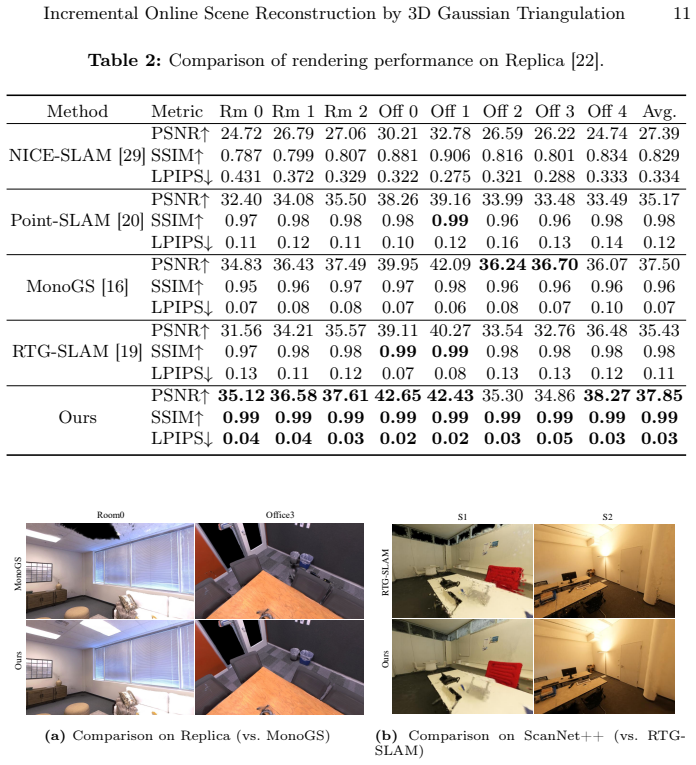
Summary. The paper proposes an online incremental RGB-D reconstruction framework that maintains a dense geometric Gaussian representation (planar elliptical surfels with high opacity) and directly triangulates a filtered Geometric Gaussian Set G_geo to produce and update explicit meshes without an intermediate implicit field. Key technical pieces are: (i) dual-branch rendering with opaque-plane depth (Eq. 3), (ii) a plane-based pulling loss (Eq. 5) plus normal consistency (Eq. 6) and sparsity (Eq. 7) that align Gaussians to local surfaces, (iii) an angle-based greedy triangulation with local remeshing (Botsch-style edge split/collapse/flip + Laplacian), and (iv) dynamic freezing of fully optimized historical regions once observation count and loss thresholds are met. Experiments on Replica and ScanNet++ report superior Acc./Comp. ratios and PSNR/SSIM/LPIPS versus KinectFusion, NICE-SLAM, MonoGS and RTG-SLAM, together with higher FPS and lower peak memory, under ground-truth poses.
Significance. If the claims hold, the work removes a practical bottleneck of recent Gaussian-based surface methods (SuGaR, 2DGS, GOF, GS-Pull) that still rely on offline Poisson/Marching Cubes extraction. Direct, incremental triangulation of mesh-ready surfels plus region freezing yields a single representation that simultaneously supports high-fidelity novel-view synthesis and continuously updated watertight meshes, which is directly useful for AR and robotic perception. Strengths that raise the contribution above pure engineering are the concrete efficiency numbers (Tabs. 4–5: 10.34 FPS, 2325 MB, 5.34 s mesh extraction) and the ablations (Tab. 6, Figs. 6–7) that isolate each geometric constraint and the selection threshold τ. The approach is empirical rather than theoretical, yet the operating regime (RGB-D + known poses) is clearly stated and the limitation of unobserved regions is acknowledged.
major comments (2)
- All quantitative tables (Tabs. 1–3) and efficiency numbers (Tab. 4) are obtained with ground-truth camera poses (explicitly stated in §4.1). Because the plane-pulling loss (Eq. 5), geometric-Gaussian selection (Eq. 9) and freezing criteria all depend on multi-view consistency of depth and normals, the reported gains may shrink under realistic pose noise. A controlled experiment with noisy or SLAM-estimated poses (or at least a sensitivity study) is needed to substantiate the claim of practical online reconstruction.
- The geometric selection threshold τ=0.001 (Eq. 9) and the freezing thresholds N_obs=10, ε_gs=0.1 are fixed after a limited sweep (Fig. 7) performed only on Replica. No cross-dataset validation or automatic schedule is provided; the same values are used for ScanNet++. Because both mesh fidelity and memory savings hinge on these cut-offs, a short sensitivity analysis on ScanNet++ (or a statement of how they transfer) is required before the efficiency claims can be considered robust.
minor comments (4)
- Fig. 4 caption states that RTG-SLAM meshes are obtained by ball-pivoting; the main text should also note whether the same post-processing is applied to MonoGS or whether only point sampling is used, to keep the Acc./Comp. comparison fully transparent.
- Notation for the dual-branch depth (Eq. 3) is dense; a short clarifying sentence or diagram inset would help readers distinguish the three cases (no intersection, front-facing opaque, otherwise).
- The active-window sizes (6 frames / 50 iters for Replica, 3 / 75 for ScanNet++) appear only in the implementation paragraph; moving them into a small hyper-parameter table would improve reproducibility.
- A few typographical issues remain (e.g., missing spaces after commas in several equations, “Gaussiansurfels” in §3.4). A careful proof-read is recommended.
Circularity Check
No significant circularity; the pipeline is an empirical engineering method whose losses, selection criteria, and triangulation are defined independently of the reported accuracy/rendering metrics.
full rationale
The paper presents an online RGB-D Gaussian framework whose core steps (planar/opacity constraints on primitives, L_plane + L_n + L_sparse supervision, geometric-set filtering via opacity/depth thresholds, angle-based greedy triangulation, local remeshing, and freezing of converged regions) are constructive algorithms and loss terms, not mathematical derivations that reduce to their own inputs. Evaluation metrics (Acc., Acc. Ratio, Comp. Ratio, PSNR/SSIM/LPIPS) are computed against external ground-truth meshes and images on Replica and ScanNet++; ablations (Tab. 6, Figs. 6–7) isolate each component without circular forcing. Hyper-parameters (λ weights, τ=0.001, N_obs=10) are tuned but do not redefine the target quantities. Citations to GS-Pull and GaussianShader supply prior ideas for pulling and normals; they are external works by different authors and are not load-bearing uniqueness claims. No self-definitional equations, fitted-input-as-prediction, or renamed known results appear. The derivation chain is therefore self-contained against the stated benchmarks.
Assumptions & free parameters
free parameters (4)
- loss weights λc, λd, λp, λn, λs =
0.8, 1.0, 0.05, 0.2, 0.001
- geometric selection threshold τ =
0.001
- freezing thresholds Nobs and ϵgs =
10 and 0.1
- active window size and optimization iterations =
dataset-specific
assumptions (3)
- domain assumption 3D Gaussians with si3 o0 and αi≈1 behave as planar elliptical surfels that can be directly triangulated into accurate surfaces.
- ad hoc to paper Local plane-pulling loss (Eq. 5) plus normal consistency (Eq. 6) suffice to correct noisy depth and produce mesh-ready centers.
- domain assumption Ground-truth camera poses are available for all frames.
invented entities (2)
-
Dense Geometric Gaussian representation / Geometric Gaussian Set Ggeo
-
Angle-based greedy Gaussian triangulation with local remeshing and freezing
Cite this review
Pith. "Pith review of Incremental Online Scene Reconstruction by 3D Gaussian Triangulation." pith.science (2026). https://pith.science/paper/7RFWMUFB
@misc{pith2026260710690,
  author       = {Pith},
  title        = {Pith review of: Incremental Online Scene Reconstruction by 3D Gaussian Triangulation},
  year         = {2026},
  howpublished = {\url{https://pith.science/paper/7RFWMUFB}},
  note         = {Machine review of arXiv:2607.10690}
}
read the original abstract
Incremental scene reconstruction is essential for real-world applications. Although 3D Gaussian Splatting shows strong potential, most existing approaches require offline conversion of the optimized Gaussians into an intermediate implicit field for explicit mesh extraction, which hinders seamless integration with downstream tasks. To address this limitation, we propose a novel online framework that incrementally reconstructs and updates high-fidelity explicit meshes by directly triangulating a dense geometric Gaussian representation, which supports both high-quality rendering and incremental surface reconstruction. Moreover, we present a direct meshing algorithm that efficiently extracts and updates the mesh from the Gaussian set. To ensure mesh accuracy, we enforce a plane-based pulling constraint that dynamically aligns 3D Gaussian primitives to the approximated local surface. Furthermore, our framework significantly reduces memory and computational overhead during long-sequence processing by dynamically freezing fully optimized historical regions. Experiments on public datasets demonstrate that our method outperforms conventional Gaussian-based methods on both rendering quality and reconstruction accuracy.
Figures


Figures from the paper (4 more)



Reference graph
Works this paper leans on
-
[1]
In: Proceedings of the IEEE/CVF international conference on computer vision
Barron, J.T., Mildenhall, B., Tancik, M., Hedman, P., Martin-Brualla, R., Srini- vasan, P.P.: Mip-nerf: A multiscale representation for anti-aliasing neural radiance fields. In: Proceedings of the IEEE/CVF international conference on computer vision. pp. 5855–5864 (2021)
2021
-
[2]
IEEE transactions on visualization and computer graphics5(4), 349–359 (2002)
Bernardini, F., Mittleman, J., Rushmeier, H., Silva, C., Taubin, G.: The ball- pivoting algorithm for surface reconstruction. IEEE transactions on visualization and computer graphics5(4), 349–359 (2002)
2002
-
[3]
In: Proceedings of the 2004 Eurographics/ACM SIGGRAPH symposium on Geometry processing
Botsch, M., Kobbelt, L.: A remeshing approach to multiresolution modeling. In: Proceedings of the 2004 Eurographics/ACM SIGGRAPH symposium on Geometry processing. pp. 185–192 (2004)
2004
-
[4]
In: Forty-first International Conference on Machine Learning (2024)
Cheng, K., Long, X., Yang, K., Yao, Y., Yin, W., Ma, Y., Wang, W., Chen, X.: Gaussianpro: 3d gaussian splatting with progressive propagation. In: Forty-first International Conference on Machine Learning (2024)
2024
-
[5]
In: ACM SIGGRAPH 2024 conference papers
Dai, P., Xu, J., Xie, W., Liu, X., Wang, H., Xu, W.: High-quality surface recon- struction using gaussian surfels. In: ACM SIGGRAPH 2024 conference papers. pp. 1–11 (2024)
2024
-
[6]
Gopi, M.: A fast and efficient projection-based approach for surface reconstruction. Int. J. of High Performance Computer Graphics, Multimedia and Visualization 1(1), 1–12 (2000) 16 Y. Zhu et al
2000
-
[7]
In: Proceedings of the IEEE/CVF Conference on Computer Vision and Pattern Recognition
Guédon, A., Lepetit, V.: Sugar: Surface-aligned gaussian splatting for efficient 3d mesh reconstruction and high-quality mesh rendering. In: Proceedings of the IEEE/CVF Conference on Computer Vision and Pattern Recognition. pp. 5354– 5363 (2024)
2024
-
[8]
Image and Vision Computing 68, 14–27 (2017)
Häne, C., Heng, L., Lee, G.H., Fraundorfer, F., Furgale, P., Sattler, T., Pollefeys, M.: 3d visual perception for self-driving cars using a multi-camera system: Calibra- tion, mapping, localization, and obstacle detection. Image and Vision Computing 68, 14–27 (2017)
2017
Show all 29 references
-
[9]
In: ACM SIGGRAPH 2024 conference papers
Huang, B., Yu, Z., Chen, A., Geiger, A., Gao, S.: 2d gaussian splatting for geo- metrically accurate radiance fields. In: ACM SIGGRAPH 2024 conference papers. pp. 1–11 (2024)
2024
-
[10]
In: Proceedings of the IEEE/CVF Conference on Computer Vision and Pattern Recognition
Jiang, Y., Tu, J., Liu, Y., Gao, X., Long, X., Wang, W., Ma, Y.: Gaussianshader: 3d gaussian splatting with shading functions for reflective surfaces. In: Proceedings of the IEEE/CVF Conference on Computer Vision and Pattern Recognition. pp. 5322–5332 (2024)
2024
-
[11]
In: Proceed- ings of the fourth Eurographics symposium on Geometry processing
Kazhdan, M., Bolitho, M., Hoppe, H.: Poisson surface reconstruction. In: Proceed- ings of the fourth Eurographics symposium on Geometry processing. pp. 61–70 (2006)
2006
-
[12]
ACM Trans
Kerbl, B., Kopanas, G., Leimkühler, T., Drettakis, G.: 3d gaussian splatting for real-time radiance field rendering. ACM Trans. Graph.42(4), 139–1 (2023)
2023
-
[13]
ACM siggraph computer graphics21(4), 163–169 (1987)
Lorensen, W.E., Cline, H.E.: Marching cubes: A high resolution 3d surface con- struction algorithm. ACM siggraph computer graphics21(4), 163–169 (1987)
1987
-
[14]
In: Proceedings of the IEEE/CVF Conference on Computer Vision and Pattern Recognition
Lu, T., Yu, M., Xu, L., Xiangli, Y., Wang, L., Lin, D., Dai, B.: Scaffold-gs: Struc- tured 3d gaussians for view-adaptive rendering. In: Proceedings of the IEEE/CVF Conference on Computer Vision and Pattern Recognition. pp. 20654–20664 (2024)
2024
-
[15]
In: 2009 IEEE international conference on robotics and automation
Marton, Z.C., Rusu, R.B., Beetz, M.: On fast surface reconstruction methods for large and noisy point clouds. In: 2009 IEEE international conference on robotics and automation. pp. 3218–3223. IEEE (2009)
2009
-
[16]
In: ProceedingsoftheIEEE/CVFConferenceonComputerVisionandPatternRecog- nition
Matsuki, H., Murai, R., Kelly, P.H., Davison, A.J.: Gaussian splatting slam. In: ProceedingsoftheIEEE/CVFConferenceonComputerVisionandPatternRecog- nition. pp. 18039–18048 (2024)
2024
-
[17]
Commu- nications of the ACM65(1), 99–106 (2021)
Mildenhall, B., Srinivasan, P.P., Tancik, M., Barron, J.T., Ramamoorthi, R., Ng, R.: Nerf: Representing scenes as neural radiance fields for view synthesis. Commu- nications of the ACM65(1), 99–106 (2021)
2021
-
[18]
In: 2011 10th IEEE international symposium on mixed and augmented reality
Newcombe, R.A., Izadi, S., Hilliges, O., Molyneaux, D., Kim, D., Davison, A.J., Kohi, P., Shotton, J., Hodges, S., Fitzgibbon, A.: Kinectfusion: Real-time dense surface mapping and tracking. In: 2011 10th IEEE international symposium on mixed and augmented reality. pp. 127–136...
2011
-
[19]
Peng, Z., Shao, T., Liu, Y., Zhou, J., Yang, Y., Wang, J., Zhou, K.: Rtg-slam: Real- time3dreconstructionatscaleusinggaussiansplatting.In:ACMSIGGRAPH2024 Conference Papers. pp. 1–11 (2024)
2024
-
[20]
In: Proceedings of the IEEE/CVF International Conference on Computer Vision
Sandström, E., Li, Y., Van Gool, L., Oswald, M.R.: Point-slam: Dense neural point cloud-based slam. In: Proceedings of the IEEE/CVF International Conference on Computer Vision. pp. 18433–18444 (2023)
2023
-
[21]
IEEE transactions on visualization and computer graphics23(11), 2455–2462 (2017)
Schöps, T., Oswald, M.R., Speciale, P., Yang, S., Pollefeys, M.: Real-time view correction for mobile devices. IEEE transactions on visualization and computer graphics23(11), 2455–2462 (2017)
2017
-
[22]
arXiv preprint arXiv:1906.05797 (2019) Incremental Online Scene Reconstruction by 3D Gaussian Triangulation 17
Straub, J., Whelan, T., Ma, L., Chen, Y., Wijmans, E., Green, S., Engel, J.J., Mur-Artal, R., Ren, C., Verma, S., et al.: The replica dataset: A digital replica of indoor spaces. arXiv preprint arXiv:1906.05797 (2019) Incremental Online Scene Reconstruction by 3D Gaussian Tria...
1906 arXiv
-
[23]
In: Proceedings of the IEEE/CVF international conference on computer vision
Sucar, E., Liu, S., Ortiz, J., Davison, A.J.: imap: Implicit mapping and position- ing in real-time. In: Proceedings of the IEEE/CVF international conference on computer vision. pp. 6229–6238 (2021)
2021
-
[24]
Waczyńska, J., Borycki, P., Tadeja, S., Tabor, J., Spurek, P.: Games: Mesh-based adapting and modification of gaussian splatting (2024),https://arxiv.org/abs/ 2402.01459
2024 arXiv
-
[25]
In: Proceedings of the International Conference on Computer Vision (ICCV) (2023)
Yeshwanth, C., Liu, Y.C., Nießner, M., Dai, A.: Scannet++: A high-fidelity dataset of 3d indoor scenes. In: Proceedings of the International Conference on Computer Vision (ICCV) (2023)
2023
-
[26]
In: Proceedings of the IEEE/CVF conference on computer vi- sion and pattern recognition
Yu, Z., Chen, A., Huang, B., Sattler, T., Geiger, A.: Mip-splatting: Alias-free 3d gaussian splatting. In: Proceedings of the IEEE/CVF conference on computer vi- sion and pattern recognition. pp. 19447–19456 (2024)
2024
-
[27]
ACM Transactions on Graphics (ToG)43(6), 1–13 (2024)
Yu, Z., Sattler, T., Geiger, A.: Gaussian opacity fields: Efficient adaptive surface reconstruction in unbounded scenes. ACM Transactions on Graphics (ToG)43(6), 1–13 (2024)
2024
-
[28]
Advances in Neural Information Processing Systems37, 101856–101879 (2024)
Zhang, W., Liu, Y.S., Han, Z.: Neural signed distance function inference through splatting 3d gaussians pulled on zero-level set. Advances in Neural Information Processing Systems37, 101856–101879 (2024)
2024
-
[29]
In: Proceedings of the IEEE/CVF conference on computer vision and pattern recognition
Zhu, Z., Peng, S., Larsson, V., Xu, W., Bao, H., Cui, Z., Oswald, M.R., Pollefeys, M.: Nice-slam: Neural implicit scalable encoding for slam. In: Proceedings of the IEEE/CVF conference on computer vision and pattern recognition. pp. 12786– 12796 (2022)
2022
Reviewed July 14, 2026 · model on record in the stance chip above.
Discussion (0). Sign in to comment.