REVIEW 2 major objections 6 minor 36 references
A Standard Quantum Mechanical Treatment to Rationalize the Delayed-Choice Quantum Eraser
T0 review · 2 major / 6 minor · reviewed 2026-08-07 · deepseek-v4-flash
Pith's one-line read The delayed-choice quantum eraser is a measurement-basis choice, not a retrocausal effect.
desk verdict A correct pedagogical re-derivation of the standard DCQE account, whose Stern-Gerlach analogy contains a detector-basis inversion that needs fixing before publication. read the letter →
The pith
A machine-rendered reading of the paper's core claim, the machinery that carries it, and where it could break.
The reading
What carries the argument
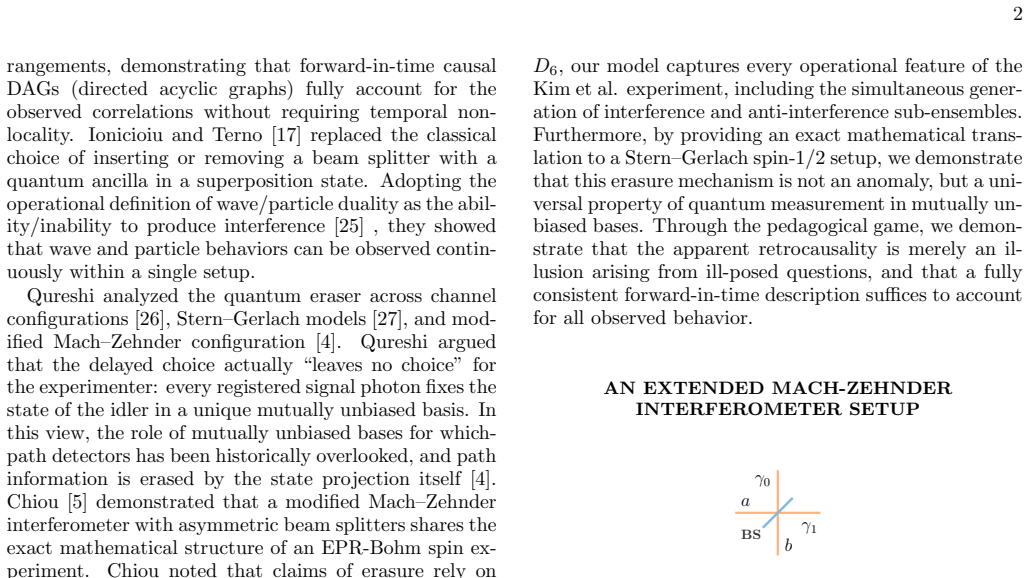
The load-bearing object is an extended Mach-Zehnder interferometer in which two entangled photon-pair sources placed along the interferometer arms generate the non-separable path state $|\psi_{ES}\rangle = \frac{1}{\sqrt{2}}(|i_0\rangle|s_0\rangle + |i_1\rangle|s_1\rangle)|D\rangle$. Tunable beam splitters BS3 and BS4, controlled by a single parameter $\theta$, switch the idler from erasure ($\theta=0$) to which-path ($\theta=\pi$) to delayed choice ($\theta=\pi/2$), and the paper derives the final states $|\psi_I\rangle$, $|\psi_{II}\rangle$, and $|\psi_{III}\rangle$ from one common calculation. The same state and basis structure is then mapped onto a spin-1/2 entangled pair, where measuring one particle in the $z$-basis and the other in the $z$- or $x$-basis produces identical conditional statistics. This demonstrates that quantum erasure is a general property of entangled two-level systems measured in mutually unbiased bases, not a special optical anomaly.
What would settle it
In a delayed-choice eraser built as in the paper, measure the joint detection probabilities P(D1,D5), P(D2,D6), P(D1,D3), and P(D2,D4); if they do not match the paper's Table I values (1/4, 1/4, 1/8, and 1/8 for case III), or if the unconditioned D1/D2 rates show interference, the ideal-state assumption or the measurement-basis account fails.
Extended reading notes
Core claim
The paper's central claim is that choosing between which-path and erasure detectors is simply a choice of measurement bases, which does not rewrite a photon's past. It proves this by writing the initial entangled path state, routing the signal and idler modes through beam splitters, and obtaining the final joint state for three configurations: complete erasure, which-path detection, and delayed choice. In the delayed-choice case the signal photon is detected before the idler, yet the conditional statistics show one-to-one interference and anti-interference subensembles when the idler is measured in the erasure basis, and no interference when measured in the which-path basis. Because the joint state was non-separable from the start, the later idler measurement only selects a subensemble; it does not alter the past.
Load-bearing premise
The calculations assume the entangled photon-pair sources produce exactly the ideal equal-amplitude, zero-relative-phase path-entangled state with no losses or vacuum component; any real-source imperfection would change the predicted conditional probabilities.
Editorial extensions
If this is right
- No retrocausal explanation is required for the delayed-choice quantum eraser; the initial entangled state plus the chosen measurement basis fully determine all joint statistics.
- The interference and anti-interference subensembles in the eraser arise entirely from post-selecting on idler outcomes, and the unconditioned ensemble shows no interference.
- The same conditional statistics would appear in any two-level entangled system, so the eraser is a generic feature of entangled measurements rather than a photon-specific effect.
- Delayed choice changes which idler basis is used for data filtering, not the history of the signal photon; the apparent paradox is an artifact of asking how the signal photon 'knew' the future.
Reading between the lines
- The same basis-rotation argument should extend to delayed-choice setups with more than two paths or higher-dimensional entanglement: no retrocausality would appear there either, though the mutually unbiased basis structure becomes richer.
- A testable extension is to put the idler's basis choice itself in a superposition, forming a quantum-controlled eraser; the joint statistics should still obey the same basis-rotation predictions without any past-directed influence.
- The paper's claim implies that apparent retrocausal signatures in any post-selected experiment are artifacts of conditioning; comparing conditional and unconditional statistics in real data would make this vivid.
Editorial analysis
A structured set of objections, weighed in public.
Referee Report
Summary. The manuscript presents a purely unitary, basis-change treatment of the delayed-choice quantum eraser. It analyzes an extended Mach-Zehnder interferometer with entangled photon-pair sources, derives the final states for three configurations (Eqs. (5)-(7)), and tabulates the joint detection probabilities (Table I). It then proposes a Stern-Gerlach spin-1/2 analogue (Eqs. (8)-(10)) and a coin-and-ball game to argue that the delayed-choice correlations are ordinary post-selected correlations of an entangled state, requiring no retrocausality.
Significance. The direct MZI calculation is the paper's main strength: starting from the entangled path state Eq. (4) and the beam-splitter unitaries, Eqs. (5)-(7) and Table I are derived explicitly and reproduce the accepted conditional statistics (one-to-one for D5/D6, 50/50 for D3/D4). The derivation has no fitted parameters, and the paper correctly attributes the effect to measurement-basis selection and post-selection. The pedagogical game is a helpful illustration of why post-selected sub-ensembles do not imply backward causation. If the Stern-Gerlach analogy were repaired, the paper would be a useful self-contained addition to the existing literature; the no-retrocausality conclusion itself is standard and is not the main issue.
major comments (2)
- [Section III (A Stern-Gerlach Analogy), Eqs. (8)-(10) and Fig. 6] The detector mapping in the Stern-Gerlach analogy swaps the physical roles of the z- and x-bases relative to the optical setup. In the MZI, the reflected idler modes |d3>,|d4> realize a which-path (z-type) measurement of the idler in {|i0>,|i1>}, while the transmitted modes recombining at BS5 into |d5>,|d6> realize the erasure (x-type) measurement (Appendix Eq. (A8) and Fig. 5). In the SG model, however, the text assigns z-basis outcomes |0>,|1> to D5/D6 and x-basis outcomes |+>,|-> to D3/D4, so the one-to-one D1-D5/D2-D6 correlations are generated by a z-basis measurement in the SG model but by an x-basis measurement in the MZI. Matching Table I therefore requires an unstated relabeling of the signal detectors as x-basis outcomes of the electron, while the electron is explicitly measured in the z-basis. As written, Eqs. (9)-(10) do not establish the claimed algebraic equivalence; the section needs a corrected basis mapping or an explicit statement that the analogy is heuristic only and not an isomorphism.
- [Section II (Operational assumptions) and Conclusion] The paper claims that the model captures 'every operational feature' of Kim et al., but it assumes an ideal lossless source producing exactly the state in Eq. (4), with no vacuum component, no amplitude imbalance, and no relative phase fluctuations. The authors do flag this as a proof-of-concept in the 'Operational assumptions' paragraph, which is good, but the 'every operational feature' claim in the Introduction and Conclusion should be qualified so that it is not read as a claim about realistic sources.
minor comments (6)
- [Section II, after Eq. (4)] The text says 'Immediately following the action of EEPS', which should read 'EPPS'.
- [Section III heading] The heading 'A STERN-GERLACH ANALOGY FOR DELA YED CHOICE QUANTUM ERASER' contains a typo: 'DELA YED' should be 'DELAYED'.
- [References [8] and [28]] References [8] and [28] are the same Walborn et al. paper; one of the two entries should be removed.
- [Reference [29]] The title of reference [29] contains 'dollar-quantum pairs', which appears to be an OCR/transcription artifact; please verify the original title.
- [Introduction, paragraph 2] There is a missing space in 'delayed-choicegedankenexperiments'; it should be 'delayed-choice gedankenexperiments'.
- [Table I] Consider adding row or column sums to Table I so readers can immediately verify marginal probabilities; this would also make the comparison with the conditional sub-ensembles more transparent.
Circularity Check
No significant circularity: the MZI derivation is a self-contained unitary calculation with no fitted parameters and no load-bearing self-citation.
full rationale
The paper's central derivation is self-contained. Starting from the assumed maximally entangled path state of Eq. (4), |psi_ES> = 1/sqrt(2)(|i0>|s0> + |i1>|s1>)|D>, and the explicitly specified beam-splitter unitaries in Appendix A (Eqs. A1-A2), it computes the final states for the three cases (Eqs. 5-7 and A9-A11) and the joint probabilities in Table I. No parameter is fitted to any experimental subset, and no predicted quantity is defined in terms of the quantity it claims to explain. The conditional interference and no-interference subensembles follow algebraically from the assumed state and the chosen idler measurement basis. The Stern-Gerlach and ball-game sections are explicitly presented as analogies or replicas that reproduce the already-derived case-III algebra, not as independent evidence; the paper even states that the SG replica 'simply reproduces the algebraic results obtained in case III.' All cited works are external prior literature with no author overlap with this paper, and no load-bearing uniqueness or existence claim is imported from a self-citation. The possible criticism that the Stern-Gerlach analogy swaps the physical roles of D3/D4 versus D5/D6 compared to the MZI is a correctness or interpretation concern about the analogy, not a circularity in the main calculation. The core result, that delayed-choice erasure is a basis-choice effect, is therefore derived rather than assumed, and the paper merits a circularity score of 0.
Assumptions & free parameters
free parameters (2)
- beam splitter angle θ for BS3 and BS4 =
0, π, π/2 for cases I, II, III
- phase shift φ in case I =
π
assumptions (4)
- standard math 50:50 beam splitter unitary transformation with i phase (Eq. A1/A2)
- domain assumption EPPS generates a maximally entangled path state |ψES> = 1/√2(|i0>|s0> + |i1>|s1>)|D>
- domain assumption Detectors are ideal and projective, with no loss or dark counts
- domain assumption The idler and signal are independent after the EPPS except for the entanglement
Cite this review
Pith. "Pith review of A Standard Quantum Mechanical Treatment to Rationalize the Delayed-Choice Quantum Eraser." pith.science (2026). https://pith.science/paper/7RI7VAZI
@misc{pith2026260802185,
  author       = {Pith},
  title        = {Pith review of: A Standard Quantum Mechanical Treatment to Rationalize the Delayed-Choice Quantum Eraser},
  year         = {2026},
  howpublished = {\url{https://pith.science/paper/7RI7VAZI}},
  note         = {Machine review of arXiv:2608.02185}
}
read the original abstract
Ever since the proposal of delayed choice quantum erasure and subsequent realization in the experiment by Kim et al., the interpretation and implications of delayed-choice experiments have remained a subject of intense foundational debate. This paper resolves the apparent paradox attached to the experiment using standard quantum mechanics. Using an extended Mach-Zehnder interferometer which captures every operational feature of the original experiment, we show that choosing between which-path and erasure detectors is simply a choice of measurement bases, which does not rewrite a photon's past. Furthermore, by mapping the experiment to a two-way Stern-Gerlach framework, we prove that quantum erasure is an expected result of measuring entangled states, not a physical anomaly. Ultimately, through a pedagogical game, we illustrate that the illusion of retrocausality arises from asking illegitimate questions, and that a forward-in-time description is entirely sufficient to explain the logic.
Figures


Figures from the paper (3 more)


Reference graph
Works this paper leans on
-
[1]
An extended, operational variation of the Mach–Zehnder interferometer
-
[2]
An analogical treatment using two-way Stern–Gerlach measurements
-
[3]
A pedagogical game that replicates the delayed- choice outcomes. By explicitly defining the 50 : 50 beam splitters and maintaining full symmetry across detectorsD 1 through D6, our model captures every operational feature of the Kim et al. experiment, including the simultaneous gener- ation of interference and anti-interference sub-ensembles. Furthermore,...
-
[4]
T. Qureshi, The delayed-choice quantum eraser leaves no choice, International Journal of Theoretical Physics60, 3076 (2021)
work page 2021
-
[5]
To implement a delayed choice, we make the idler armsi 0 andi 1 much longer than the signal armss 0 and s1. This way, the signal photons are detected atD 1 or D2 before the idler photons reach their beam splitters. This setup corresponds to the delayed-choice quantum eraser (DCQE). The final state, after all transformations, is given by (see Appendix I): ...
-
[6]
A Standard Quantum Mechanical Treatment to Rationalize the Delayed-Choice Quantum Eraser
applied causal modeling to modified delayed-choice ar- arXiv:2608.02185v2 [quant-ph] 4 Aug 2026 2 rangements, demonstrating that forward-in-time causal DAGs (directed acyclic graphs) fully account for the observed correlations without requiring temporal non- locality. Ionicioiu and Terno [17] replaced the classical choice of inserting or removing a beam s...
work page Pith review arXiv 2026
-
[7]
As in the setup by Kim et al. [1], a coincidence click betweenD 2 andD 6 isolates the sub-ensemble corresponding to the balanced MZIinter- ference. Similarly, a coincidence click betweenD 1 and D5 corresponds to thecomplementary-interference. The choice of whether an idler photon is registered at D3/D4 orD 5/D6 is determined long after the signal pho- ton...
-
[8]
Y.-H. Kim, R. Yu, S. P. Kulik, Y. Shih, and M. O. Scully, Delayed “choice” quantum eraser, Physical Review Let- ters84, 1 (2000)
work page 2000
Show all 36 references
-
[9]
past” and the “delayed-choice
J. A. Wheeler, The “past” and the “delayed-choice” double-slit experiment, in Mathematical Foundations of Quantum Theory, edited by A. R. Marlow (Academic Press, New York, 1978) pp. 9–48
1978
-
[10]
Qureshi, Demystifying the delayed-choice quantum eraser, European Journal of Physics41, 055403 (2020)
T. Qureshi, Demystifying the delayed-choice quantum eraser, European Journal of Physics41, 055403 (2020)
2020
-
[11]
Chiou, Delayed-choice quantum erasers and the einstein-podolsky-rosen paradox, International Journal of Theoretical Physics62, 10.1007/s10773-023-05370-4 (2023)
D.-W. Chiou, Delayed-choice quantum erasers and the einstein-podolsky-rosen paradox, International Journal of Theoretical Physics62, 10.1007/s10773-023-05370-4 (2023)
2023 doi
-
[12]
Chaves, G
R. Chaves, G. B. Lemos, and J. Pienaar, Causal model- ing the delayed-choice experiment, Phys. Rev. Lett.120, 190401 (2018)
2018
-
[13]
Bracken, J
C. Bracken, J. R. Hance, and S. Hossenfelder, The quan- tum eraser paradox (2021)
2021
-
[15]
X.-S. Ma, J. Kofler, A. Qarry, N. Tetik, T. Scheidl, R. Ursin, S. Ramelow, T. Herbst, L. Ratschbacher, A. Fedrizzi, T. Jennewein, and A. Zeilinger, Quantum erasure with causally disconnected choice, Proceedings of the National Academy of Sciences110, 1221 (2013)
2013
-
[16]
R. E. Kastner, The ‘delayed choice quantum eraser’ nei- ther erases nor delays, Foundations of Physics49, 717 (2019)
2019
-
[17]
Aharonov and M
Y. Aharonov and M. S. Zubairy, Time and the quantum: Erasing the past and im- pacting the future, Science307, 875 (2005), https://www.science.org/doi/pdf/10.1126/science.1107787
2005 doi
-
[18]
B. J. Hiley and R. E. Callaghan, What is erased in the quantum erasure?, Foundations of Physics36, 1869 (2006)
2006
-
[19]
D. P. Ellerman, Why delayed choice experiments do not imply retrocausality, Quantum Studies: Mathematics and Foundations2, 183 (2015)
2015
-
[20]
Fankhauser, Taming the delayed choice quantum eraser, Quanta (2017)
J. Fankhauser, Taming the delayed choice quantum eraser, Quanta (2017)
2017
-
[21]
Englert, M
B.-G. Englert, M. O. Scully, and H. Walther, Quantum erasure in double-slit interferometers with which-way de- tectors, American Journal of Physics67, 325 (1999). 8
1999
-
[22]
U. J. Mohrhoff, Objectivity, retrocausation, and the ex- periment of englert, scully, and walther, American Jour- nal of Physics67, 330 (1999)
1999
-
[23]
Ionicioiu and D
R. Ionicioiu and D. R. Terno, Proposal for a quantum delayed-choice experiment, Phys. Rev. Lett.107, 230406 (2011)
2011
-
[24]
Masi, A review of modern which-way and de- layed quantum erasing experiments: demystifying retro- causality and the point-particle myth
M. Masi, A review of modern which-way and de- layed quantum erasing experiments: demystifying retro- causality and the point-particle myth. (2019)
2019
-
[25]
Heisenberg, ¨ uber den anschaulichen inhalt der quan- tentheoretischen kinematik und mechanik, Zeitschrift f¨ ur Physik43, 172 (1927)
W. Heisenberg, ¨ uber den anschaulichen inhalt der quan- tentheoretischen kinematik und mechanik, Zeitschrift f¨ ur Physik43, 172 (1927)
1927
-
[26]
C. F. von Weizs¨ acker, Ortsbestimmung eines elektrons durch ein mikroskop, Zeitschrift f¨ ur Physik70, 114 (1931)
1931
-
[27]
Einstein, R
A. Einstein, R. C. Tolman, and B. Podolsky, Knowledge of past and future in quantum mechanics, Phys. Rev.37, 780 (1931)
1931
-
[28]
G. Hermann, Die naturphilosophischen grundlagen der quantenmechanik, Abhandlungen der Fries’schen Schule 6, 75 (1935), english translation in: ”The Foundations of Quantum Mechanics in the Philosophy of Nature,” Alkis Gounaris (Ed.), 2018
1935
-
[29]
delayed choice
M. O. Scully and K. Dr¨ uhl, Quantum eraser: A pro- posed photon correlation experiment concerning observa- tion and “delayed choice” in quantum mechanics, Phys. Rev. A25, 2208 (1982)
1982
-
[30]
Gaasbeek, Demystifying the delayed choice experi- ments (2010), arXiv:1007.3977 [cs.LG]
B. Gaasbeek, Demystifying the delayed choice experi- ments (2010), arXiv:1007.3977 [cs.LG]
2010 arXiv
-
[31]
Greenstein and A
G. Greenstein and A. G. Zajonc, The quantum challenge: Modern research on the foundations of quantum mechan- ics (Jones and Bartlett, Boston, 1997) Chap. 2
1997
-
[32]
Qureshi, The enigma of delayed choice quantum eraser, Quanta14, 66 (2025)
T. Qureshi, The enigma of delayed choice quantum eraser, Quanta14, 66 (2025)
2025
-
[33]
Qureshi and Z
T. Qureshi and Z. Rahman, Quantum eraser using a mod- ified stern-gerlach setup, Progress of Theoretical Physics 127, 71 (2012), https://academic.oup.com/ptp/article- pdf/127/1/71/19572854/127-1-71.pdf
2012
-
[34]
S. P. Walborn, M. O. Terra Cunha, S. P´ adua, and C. H. Monken, Double-slit quantum eraser, Phys. Rev. A65, 033818 (2002)
2002
-
[35]
D. C. Burnham and D. L. Weinberg, Observation of si- multaneity in parametric production of dollar-quantum pairs, Physical Review Letters25, 84 (1970)
1970
-
[36]
P. G. Kwiat, K. Mattle, H. Weinfurter, A. Zeilinger, A. V. Sergienko, and Y. Shih, New high-intensity source of polarization-entangled photon pairs, Physical Review Letters75, 4337 (1995)
1995
-
[37]
M. A. Nielsen and I. L. Chuang, Quantum Computation and Quantum Information (Cambridge University Press, 2012). Appendix A: Quantum State Evolution in the Delayed-Choice Experiment In this appendix, we present the complete calculations for the quantum state evolution across th...
2012
Reviewed August 7, 2026 · model on record in the stance chip above.
Discussion (0). Continue with ORCID to comment.