REVIEW 2 major objections 4 minor 27 references
Layer-wise decision fusion in a frozen XLS-R model detects fake audio with 6.90% equal error rate on the In-the-Wild dataset, a cross-domain benchmark.
Reviewed by Pith at T0; open to challenge. T0 means a machine referee read the full paper against a public rubric. the ladder, T0–T4 →
T0 review · deepseek-v4-flash
2026-08-01 11:00 UTC pith:7RM6TWQC
load-bearing objection Solid internal comparison and useful layer analysis, but the headline 6.90% EER overstates the cross-dataset claim because the baselines weren't run under the same protocol and the number is best-of-four on the test set. the 2 major comments →
Layer-Wise Decision Fusion for Fake Audio Detection Using XLS-R
The pith
A machine-rendered reading of the paper's core claim, the machinery that carries it, and where it could break.
Core claim
Attaching a one-class softmax classifier to each of the 25 XLS-R layer representations and then summing (or weighted-summing) the per-layer scores—rather than pooling all layer features into one vector before classification—prevents feature collapse and improves cross-dataset generalization. With a shared bottleneck projection and no reconstruction loss (LW BN), the method reaches an EER of 6.90% on In-the-Wild, compared to 10.97% for the feature-fusion variant under the same training protocol. Layer-weight analyses show that feature fusion tends to rely on a few inconsistently selected layers across runs, while decision fusion activates more layers and consistently emphasizes early-middle l
What carries the argument
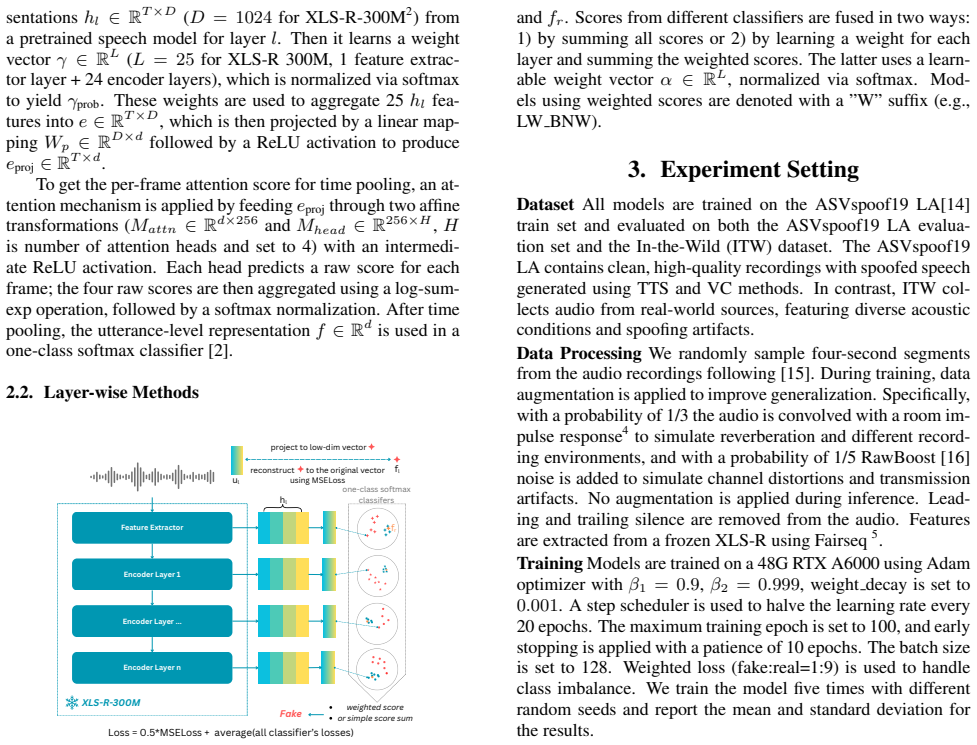
Layer-wise decision fusion: each XLS-R layer's hidden representation is pooled by attention, projected through a shared bottleneck (optionally with an autoencoder-style reconstruction loss), and scored by its own one-class softmax classifier; the final score is the sum or learned weighted sum of the per-layer scores. This contrasts with feature fusion, which learns a softmax-normalized weight vector over layers to aggregate hidden states into a single representation before classification.
Load-bearing premise
The reported baselines (especially NN-ASP and NN-ACP) are directly comparable to the proposed models; the paper itself acknowledges that their feature-fusion reproduction (FF) uses fixed-length 4-second segments while those baselines use variable-length inputs, which could affect the performance gap.
What would settle it
Re-implement NN-ASP and NN-ACP under the same training protocol (fixed 4-second segments, same augmentation, same scheduler, same loss weighting) and compare EERs on In-the-Wild. If the gap between 6.90% and the re-implemented baselines vanishes or reverses, the claimed decision-fusion advantage is an artifact of protocol mismatch.
If this is right
- If correct, late decision fusion is a simple drop-in replacement for feature fusion that improves cross-domain robustness without fine-tuning the large speech model.
- The method's transparency allows practitioners to inspect which layers carry discriminative information for a given spoofing type, guiding which layers to keep or discard for specific deployment scenarios.
- Training without leading/trailing silence is confirmed as essential for real-world generalization; including silence produces a silent-segment shortcut that inflates in-domain performance but hurts cross-dataset EER.
- The released important token sets provide a starting point for linking discrete pseudo-phoneme tokens to detection-relevant acoustic cues.
Where Pith is reading between the lines
- The consistent activation of early-middle and late layers across runs suggests that robust detection may require a mix of local acoustic detail and global prosodic or linguistic structure—an hypothesis the paper's layer-wise lens makes directly testable.
- A testable extension would be applying the same decision-fusion design to other large speech models (WavLM, Whisper) to see whether the benefit generalizes beyond XLS-R.
- The moderate correlation between important-token similarity and cross-domain EER hints that a token-aware training objective—encouraging the model to focus on tokens that transfer across datasets—could yield a further robustness gain.
- Because the fusion weights are learned, the architecture could be adapted online to emphasize layers that fire correctly on a target domain's small labeled probe set.
Editorial analysis
A structured set of objections, weighed in public.
Referee Report
Summary. The paper proposes layer-wise decision fusion for fake audio detection. Instead of aggregating hidden features from all XLS-R layers into one utterance-level representation before classification (feature fusion), the model attaches a one-class softmax classifier to each of the 25 layers and fuses per-layer scores either by summation or by learned weights. Two bottleneck variants (LW BN, LW BNR) and a weighted-score variant (LW BNW) are compared with a feature-fusion baseline (FF) and with published baselines. Models are trained on ASVspoof19 LA and evaluated on ASVspoof19 LA and In-the-Wild (ITW). The best reported result is LW BN with an ITW EER of 6.90%, which the abstract and conclusion describe as the best cross-dataset performance among strong baselines. The paper also presents analyses of layer-weight patterns, silence handling, and discrete-token similarity across datasets.
Significance. If the results hold, the paper makes a useful contribution: late decision fusion is a simple and plausible remedy for the risk that feature fusion collapses information from different depths of a large pre-trained speech model. The internal controlled comparison is a genuine strength: all four LW variants beat the paper's own FF baseline (10.97 -> 9.11–6.90) across five seeds, with standard deviations reported. The analysis of layer usage, silence, and discrete tokens is thoughtful and moves beyond a single EER number. The main limitation is that the headline 'best on ITW' rests on baseline numbers from [8] that were not re-run under the same protocol, and the best-performing variant is selected after seeing the test set.
major comments (2)
- [Section 4, Table 1] The claim that LW BN achieves the 'best cross-dataset performance on the In-the-Wild dataset (EER 6.90%) compared to other strong baselines' is not supported by a protocol-matched comparison. The authors state that FF is similar to NN-ASP and that the gap between FF (10.97) and NN-ASP (9.49) 'likely stems from' the fixed-length vs variable-length input. This is an explicit admission that the published NN-ASP/NN-ACP numbers come from a different training/inference protocol. Since the margin over NN-ASP is 2.59 EER, which is within the reported cross-run std of FF and could plausibly close under a matched protocol, the headline comparison is load-bearing and needs to be re-run under identical conditions (same fixed-length 4-second segments, same augmentation, same loss weighting, same early stopping) or explicitly re-labeled as non-comparable and removed from the abstract/conclusion.
- [Section 4, Table 1] The headline 6.90% is the best of four LW variants evaluated on the test set (LW 9.11, LW BN 6.90, LW BNR 7.40, LW BNW 7.52). Selecting the best variant after seeing ITW performance makes the reported number optimistic. This is not fatal for the qualitative claim that decision fusion beats feature fusion — all four variants outperform FF — but it does undermine the specific '6.90%' as a claim about a pre-specified method. The authors should either pre-register the selection rule, use a validation split for model selection, or explicitly state that 6.90% is the result of post-hoc selection over four variants.
minor comments (4)
- [Throughout] Typos and formatting: 'Utliizing' (Abstract), 'V oice' (Introduction), 'contribution 1 includes' should be 'contributions include', 'the followinglayer-wiseanalysis' is missing spaces, 'xlsr-r-300w' is inconsistently capitalized, and 'ASVpsoof19' is a typo. These should be cleaned up.
- [Section 5.2, Figure 4] Figure 4d has a missing title (blank after 'Fake'), and the four panels are not individually captioned. Please fix for readability.
- [Section 5.3, Figure 5] The x-axis similarity labels are hard to read; for example, the value '6.86' appears at the top of the first bar but is not clearly separated from the axis. The definition of 'important token set' (top 10% per trial per layer, then intersection across trials) would benefit from a one-sentence clarification in the figure caption.
- [Section 4, Table 1] The claim that LW variants 'consistently outperform' NN-ASP and NN-ACP is based on means only. Given that five seeds were run, a paired significance test or per-seed reporting would strengthen the statement, especially where standard deviations overlap.
Circularity Check
No circularity: the method is an empirical architecture comparison with no fitted-vs-predicted equation or self-citation chain.
full rationale
The paper contains no derivation chain in which an output is defined in terms of the claimed result. The proposed LW BN model is trained on ASVspoof19 LA with a one-class softmax loss and then evaluated on In-the-Wild; the ITW EER of 6.90% is a measured evaluation metric, not a value obtained by fitting to ITW labels or by renaming an input. The four LW variants (LW, LW BN, LW BNR, LW BNW) are all reported, and the qualitative conclusion that decision fusion outperforms feature fusion (FF 10.97% vs LW variants 6.90-9.11%) holds across the entire family, so the headline is not a single cherry-picked number that carries the argument alone. The authors' own note that NN-ASP/NN-ACP use variable-length input while the proposed models use fixed 4-second segments is a protocol-comparability limitation, not a circular step: it affects whether the external baselines are directly comparable, but it does not make the claimed result equivalent to its inputs. The analyses of layer weights, center similarities, and important discrete tokens are post-hoc explanatory observations derived from the trained model; they are not used as premises to define the architecture or to compute the reported EER. There are no self-citations, no imported uniqueness theorems, and no ansatz smuggled in via citation. The moderate token-similarity correlation is an exploratory finding, not a prediction forced by construction. Overall, no pattern of self-definitional, fitted-input-called-prediction, self-citation-load-bearing, or renaming circularity is present.
Axiom & Free-Parameter Ledger
free parameters (6)
- Bottleneck dimension d =
Not reported
- Number of attention heads H =
4
- Reconstruction loss coefficient =
0.5
- Silence trimming choice =
without silence
- Weighted loss ratio (fake:real) =
1:9
- Important-token threshold (top 10%) =
10%
axioms (6)
- domain assumption One-class softmax loss learns a compact real-audio center and generalizes to unseen spoofing attacks
- domain assumption Layers of XLS-R encode complementary acoustic, phonetic, and linguistic information
- domain assumption The attention pooling with a single affine map per layer is sufficient to aggregate frame-level evidence
- standard math Autoencoder-style reconstruction loss keeps the shared projection informative
- domain assumption ASVspoof19 LA training data and In-the-Wild test data are a valid train/OOD-test pair for cross-dataset generalization
- domain assumption XLS-R discrete tokens are meaningful pseudo-phonemes for the important-token analysis
read the original abstract
Recent fake audio detection methods often leverage large speech models to achieve robust speech representations. These models are typically very deep, providing multiple layer-wise representations. However, current works often rely solely on single layer representation or feature fusion to extract one utterance-level representation for decision making. These methods risk underutilizing rich information from multiple layers and might induce feature collapse. We propose a novel layer-wise decision fusion method that applies fusion after per-layer decision making and achieves the best cross-dataset performance on In-the-Wild dataset (EER 6.90%) compared to other strong baselines. Our model design also makes the model more transparent, allowing us to conduct detailed analysis to reveal the underlying mechanism of decision making.
Figures


Reference graph
Works this paper leans on
-
[1]
While modern FAD systems can achieve high in-domain performance, a main challenge lies in their generalization abil- ities [1]
Introduction Fake audio detection (FAD) refers to the task of determining whether a given speech recording is genuine or synthetically generated (e.g., via Text-to-Speech (TTS) or V oice Conversion (VC)). While modern FAD systems can achieve high in-domain performance, a main challenge lies in their generalization abil- ities [1]. Specifically, the perfor...
-
[2]
Feature Fusion Methods We implement aFeature Fusion(FF) method based on [8] for comparative analysis
Methods 2.1. Feature Fusion Methods We implement aFeature Fusion(FF) method based on [8] for comparative analysis. The method first extracts hidden repre- 1https://github.com/XIAOYixuan/tomatoDD/tree/ interspeech25-layer-wise arXiv:2607.20023v1 [cs.SD] 22 Jul 2026 sentationsh l ∈R T×D (D= 1024for XLS-R-300M 2) from a pretrained speech model for layerl. Th...
Pith/arXiv arXiv 2026
-
[3]
The latter uses a learn- able weight vectorα∈R L, normalized via softmax
by summing all scores or 2) by learning a weight for each layer and summing the weighted scores. The latter uses a learn- able weight vectorα∈R L, normalized via softmax. Mod- els using weighted scores are denoted with a ”W” suffix (e.g., LW BNW)
-
[4]
The ASVspoof19 LA contains clean, high-quality recordings with spoofed speech generated using TTS and VC methods
Experiment Setting DatasetAll models are trained on the ASVspoof19 LA[14] train set and evaluated on both the ASVspoof19 LA evalua- tion set and the In-the-Wild (ITW) dataset. The ASVspoof19 LA contains clean, high-quality recordings with spoofed speech generated using TTS and VC methods. In contrast, ITW col- lects audio from real-world sources, featurin...
-
[5]
Results and Discussion Table 1:Performance comparison. Method ASV ITW Baseline Methods XLS-R+logres[7]: 300m (w silence) 1.00 21.30 1b (w silence) 1.30 18.70 2b (w silence) 0.60 7.20 wav2vec2+binary classifier [11] 2.98 26.65 NN-ASP (w silence) [8] 0.22 11.10 NN-ASP(w/o silence) [8] 5.56 9.49 NN-ACP (w silence) [8]0.1911.09 NN-ACP(w/o silence) [8] 8.09 10...
1911
-
[6]
Conclusion We propose a novel decision fusion method that has the best cross-dataset performance compared to baselines. Detailed analyses reveal that, unlike the feature fusion model which suf- fers from feature collapse and has inconsistent layer reliance, our method includes features from more layers and shows con- sistent reliance. Moreover, including ...
-
[7]
However, as the model ca- pacity increases (e.g., from 300M to 2B parameter models used in [7]), performance improves noticeably
and [11] use a single-layer representation and in general show poor cross-dataset performance, showing the limitation of using only one layer for detection. However, as the model ca- pacity increases (e.g., from 300M to 2B parameter models used in [7]), performance improves noticeably. Our proposed meth- ods, along with two baselinesNN-ASPandNN-ACP, which...
-
[8]
important
Analysis In this section, we aim to understand the underlying reasons why LW variants outperform FF. Additionally, we conduct a layer-wise analysis to examine how silence affects performance. Does it only impact shallow layers? Are deeper layers, which are less relevant to simple signal characteristics, more resis- tant? Furthermore, since we can extract ...
-
[9]
with high average attention scores and 2) being “activated” repetitively across all trials. Discrete tokens can be assigned to each frame by XLS-R, and the frame’s attention score is gen- erated by our attention-based time pooling method during in- ference. Therefore, for a given dataset, token-score pairs can be collected per layer. Later, for each layer...
-
[10]
Does audio deepfake detection generalize?
N. M. M ¨uller, P. Czempin, F. Dieckmann, A. Froghyar, and K. B ¨ottinger, “Does audio deepfake detection generalize?” in 23rd Annual Conference of the International Speech Communi- cation Association, Interspeech 2022, Incheon, Korea, September 18-22, 2022, H. Ko and J. H. L. Hansen, Eds. ISCA, 2022, pp. 2783–2787
2022
-
[11]
One-class learning towards synthetic voice spoofing detection,
Y . Zhang, F. Jiang, and Z. Duan, “One-class learning towards synthetic voice spoofing detection,”IEEE Signal Process. Lett., vol. 28, pp. 937–941, 2021
2021
-
[12]
One-class learning with adaptive centroid shift for audio deepfake detection,
H. M. Kim, K. Jang, and H. Kim, “One-class learning with adaptive centroid shift for audio deepfake detection,”CoRR, vol. abs/2406.16716, 2024
Pith/arXiv arXiv 2024
-
[13]
Robust speech recognition via large-scale weak su- pervision,
A. Radford, J. W. Kim, T. Xu, G. Brockman, C. McLeavey, and I. Sutskever, “Robust speech recognition via large-scale weak su- pervision,” inInternational Conference on Machine Learning, ICML 2023, 23-29 July 2023, Honolulu, Hawaii, USA, ser. Pro- ceedings of Machine Learning Research, A. Krause, E. Brunskill, K. Cho, B. Engelhardt, S. Sabato, and J. Scarl...
2023
-
[14]
XLS-R: self-supervised cross-lingual speech representation learning at scale,
A. Babu, C. Wang, A. Tjandra, K. Lakhotia, Q. Xu, N. Goyal, K. Singh, P. von Platen, Y . Saraf, J. Pino, A. Baevski, A. Con- neau, and M. Auli, “XLS-R: self-supervised cross-lingual speech representation learning at scale,” in23rd Annual Conference of the International Speech Communication Association, Interspeech 2022, Incheon, Korea, September 18-22, 20...
2022
-
[15]
Wavlm: Large- scale self-supervised pre-training for full stack speech process- ing,
S. Chen, C. Wang, Z. Chen, Y . Wu, S. Liu, Z. Chen, J. Li, N. Kanda, T. Yoshioka, X. Xiao, J. Wu, L. Zhou, S. Ren, Y . Qian, Y . Qian, J. Wu, M. Zeng, X. Yu, and F. Wei, “Wavlm: Large- scale self-supervised pre-training for full stack speech process- ing,”IEEE J. Sel. Top. Signal Process., vol. 16, no. 6, pp. 1505– 1518, 2022
2022
-
[16]
Towards generalisable and calibrated audio deepfake detection with self- supervised representations,
O. Pascu, A. Stan, D. Oneata, E. Oneata, and H. Cucu, “Towards generalisable and calibrated audio deepfake detection with self- supervised representations,” inInterspeech 2024, 2024, pp. 4828– 4832
2024
-
[17]
Exploring self-supervised embeddings and syn- thetic data augmentation for robust audio deepfake detection,
J. M. Mart ´ın-Do˜nas, A. ´Alvarez, E. Rosello, A. M. Gomez, and A. M. Peinado, “Exploring self-supervised embeddings and syn- thetic data augmentation for robust audio deepfake detection,” in Interspeech 2024, 2024, pp. 2085–2089
2024
-
[18]
Layer-wise analysis of a self-supervised speech representation model,
A. Pasad, J. Chou, and K. Livescu, “Layer-wise analysis of a self-supervised speech representation model,” inIEEE Automatic Speech Recognition and Understanding Workshop, ASRU 2021, Cartagena, Colombia, December 13-17, 2021. IEEE, 2021, pp. 914–921
2021
-
[19]
Comparative layer-wise anal- ysis of self-supervised speech models,
A. Pasad, B. Shi, and K. Livescu, “Comparative layer-wise anal- ysis of self-supervised speech models,” inIEEE International Conference on Acoustics, Speech and Signal Processing ICASSP 2023, Rhodes Island, Greece, June 4-10, 2023. IEEE, 2023, pp. 1–5
2023
-
[20]
Spoofed training data for speech spoofing countermeasure can be efficiently created using neu- ral vocoders,
X. Wang and J. Yamagishi, “Spoofed training data for speech spoofing countermeasure can be efficiently created using neu- ral vocoders,” inIEEE International Conference on Acoustics, Speech and Signal Processing ICASSP 2023, Rhodes Island, Greece, June 4-10, 2023. IEEE, 2023, pp. 1–5
2023
-
[21]
Attentive merging of hidden embeddings from pre-trained speech model for anti- spoofing detection,
Z. Pan, T. Liu, H. B. Sailor, and Q. Wang, “Attentive merging of hidden embeddings from pre-trained speech model for anti- spoofing detection,” inInterspeech 2024, 2024, pp. 2090–2094
2024
-
[22]
D. Bank, N. Koenigstein, and R. Giryes, “Autoencoders,” CoRR, vol. abs/2003.05991, 2020. [Online]. Available: https: //arxiv.org/abs/2003.05991
Pith/arXiv arXiv 2003
-
[23]
Asvspoof 2019: A large-scale public database of synthesized, converted and replayed speech,
X. Wang, J. Yamagishi, M. Todisco, H. Delgado, A. Nautsch, N. W. D. Evans, M. Sahidullah, V . Vestman, T. Kinnunen, K. A. Lee, L. Juvela, P. Alku, Y . Peng, H. Hwang, Y . Tsao, H. Wang, S. L. Maguer, M. Becker, and Z. Ling, “Asvspoof 2019: A large-scale public database of synthesized, converted and replayed speech,”Comput. Speech Lang., vol. 64, p. 101114, 2020
2019
-
[24]
End-to-end anti-spoofing with rawnet2,
H. Tak, J. Patino, M. Todisco, A. Nautsch, N. Evans, and A. Larcher, “End-to-end anti-spoofing with rawnet2,” inICASSP 2021 - 2021 IEEE International Conference on Acoustics, Speech and Signal Processing (ICASSP), 2021, pp. 6369–6373
2021
-
[25]
Rawboost: A raw data boosting and augmentation method ap- plied to automatic speaker verification anti-spoofing,
H. Tak, M. R. Kamble, J. Patino, M. Todisco, and N. W. D. Evans, “Rawboost: A raw data boosting and augmentation method ap- plied to automatic speaker verification anti-spoofing,” inIEEE International Conference on Acoustics, Speech and Signal Pro- cessing, ICASSP 2022, Virtual and Singapore, 23-27 May 2022. IEEE, 2022, pp. 6382–6386
2022
-
[26]
Speech is silver, silence is golden: What do asvspoof-trained models really learn?
N. M. M ¨uller, F. Dieckmann, P. Czempin, R. Canals, and K. B ¨ottinger, “Speech is silver, silence is golden: What do asvspoof-trained models really learn?”CoRR, vol. abs/2106.12914, 2021. [Online]. Available: https://arxiv.org/abs/ 2106.12914
Pith/arXiv arXiv 2021
-
[27]
An information-theoretic analysis of self-supervised discrete repre- sentations of speech,
B. M. Abdullah, M. M. Shaik, B. M ¨obius, and D. Klakow, “An information-theoretic analysis of self-supervised discrete repre- sentations of speech,” in24th Annual Conference of the Inter- national Speech Communication Association, Interspeech 2023, Dublin, Ireland, August 20-24, 2023, N. Harte, J. Carson- Berndsen, and G. Jones, Eds. ISCA, 2023, pp. 2883–2887
2023
discussion (0)
Sign in with ORCID, Apple, or X to comment. Anyone can read and Pith papers without signing in.