REVIEW 4 major objections 5 minor 43 references
Rethinking the Detail-Preserved Completion of Complex Tubular Structures based on Point Cloud: a Dataset and a Benchmark
T0 review · 4 major / 5 minor · reviewed 2026-08-15 · deepseek-v4-flash
Pith's one-line read This paper argues that reconnecting fractured coronary arteries is best posed as point cloud completion, and it introduces a clinical benchmark and a network, TSRNet, that beat voxel-based repair and prior point-cloud methods on three…
desk verdict Useful new point cloud completion benchmark for coronary vessels, but the ground truth is segmentation output and the coronaries are centerlines, so the 'detail-preserved' claim overreaches. read the letter →
The pith
A machine-rendered reading of the paper's core claim, the machinery that carries it, and where it could break.
The reading
What carries the argument
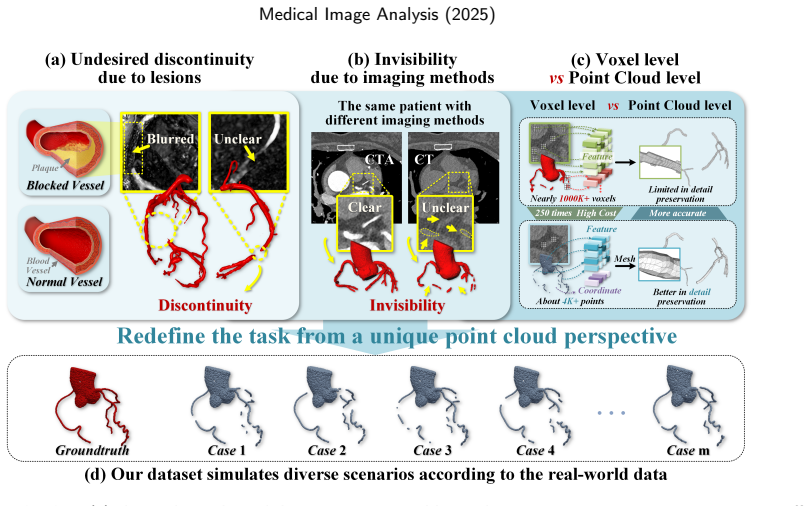
The load-bearing object is TSRNet plus the dataset-construction pipeline. The pipeline converts clinical coronary segmentations into a point cloud by extracting the aorta surface with marching cubes and farthest point sampling, extracting coronary centre lines, normalizing, and then deleting entire connected point-components at random to create fractured inputs while keeping the intact cloud as ground truth. The network's components are a Core Points Selection module that samples separately in dense and sparse regions with priority for endpoints and isolated points; a TransSA module that alternates set abstraction and transformer self-attention; a two-stage dense refinement that reconstructs a coarse cloud then a fine cloud; and a global-to-local loss that applies Chamfer Distance and Fidelity Error globally, then re-applies both only to sparse regions once global loss falls below a threshold. That loss schedule is what shifts training from overall shape alignment to fine vascular detail.
What would settle it
Take a set of coronary CTAs with expert-annotated complete vessel trees, remove vessel segments at locations of genuine stenosis or occlusion rather than random components, and ask TSRNet to reconnect them; if its completion error on those real clinical fractures is no better than generic point-cloud completion, the PC-CAC synthetic fractures are not representative of the clinical problem.
Extended reading notes
Core claim
The central claim is that vessel reconnection can be redefined as a point cloud completion problem, and that a dedicated dataset and network make that formulation effective. PC-CAC contains 3,416 point clouds from 427 patients, each with 4,096 points (3,072 on the aorta surface, 1,024 on coronary branch centre lines), with 10 to 30 percent of coronary points removed in up to eight synthetic fracture patterns per patient to simulate stenosis, occlusion, and tortuous-region breakage. TSRNet combines a core-point selection module that balances dense and sparse regions, a transformer set-abstraction feature extractor, two progressive refinement stages, and a global-to-local loss mixing Chamfer Distance and Fidelity Error. On PC-CAC, PC-ImageCAS, and PC-PTR the paper reports the lowest Chamfer Distance and Fidelity Error in every case and the highest F1 on two of the three datasets, with the largest margin on PC-PTR fidelity error (0.102 versus 3.666 for the second-best model). The authors take this as evidence that point-cloud-level completion preserves thin tubular detail better than voxel-level repair or generic point-cloud completion.
Load-bearing premise
The whole benchmark assumes that the authors' segmentation of clinical CTAs is an accurate complete ground truth, and that randomly deleting connected chunks of that segmentation mimics the discontinuities a clinician would see in real stenosis or occlusion.
Editorial extensions
If this is right
- Point-cloud representation cuts the reconnection problem from over a million voxels to about four thousand points, making completion fast enough to serve as a preprocessing step in clinical pipelines.
- The reconnected point cloud can be converted directly into a sub-voxel mesh, so downstream hemodynamic simulation and anatomical reconstruction do not need to return to voxel space.
- Because TSRNet does not rely on explicit fracture endpoint detection, it avoids a failure mode of random-walk reconnection methods that require local endpoint matching.
- The method remains stable as fracture severity rises from 10% to 30%, and at bifurcations it reconstructs all intersecting branches, suggesting the model is not merely filling short gaps.
- Evaluating the same network on coronary and pulmonary datasets indicates the approach transfers across different tubular anatomies, not just one vessel tree.
Reading between the lines
- The synthetic fractures are random deletions of connected point components in segmentation-derived clouds; real occlusions also corrupt image intensity, so a test on CTA regions with true stenosis may show different failure modes than the benchmark captures.
- Because the ground truth is the authors' own segmentation output, part of the reported gap over other methods may reflect how closely TSRNet reproduces that particular segmentation's topology; an independent expert-annotated completeness standard would separate reconnection skill from dataset bias.
- The unusually large fidelity-error margin on PC-PTR suggests the method's density-aware sampling and sparse-region loss are especially valuable when thin structures dominate; this predicts strong transfer to retinal vessels, airways, or other slender tubular networks.
- The authors state plans to pair point clouds with original image data; that pairing could be used to resolve ambiguous long-gap reconnections by consulting image appearance, a direction their current geometry-only model cannot test.
Signed reviews
Editorial analysis
A structured set of objections, weighed in public.
Referee Report
Summary. The paper introduces PC-CAC, a point cloud-based coronary artery completion dataset derived from real CT data, and proposes TSRNet, a network for reconnecting fractured tubular structures. The dataset and TSRNet are evaluated on PC-CAC and two converted public datasets (PC-ImageCAS, PC-PTR) against generic point cloud completion baselines and two voxel-based methods. The authors report that TSRNet achieves the best or second-best results on most metrics across the three datasets, and they provide ablations of the main components and hyperparameters. The dataset and code are publicly released.
Significance. If the benchmark were independently validated, this would be a useful contribution: a large-scale (427 patients, 3,416 cases) public benchmark for a clinically motivated reconnection task, with a strong baseline and broad comparisons against seven point cloud completion methods and two voxel-based methods. The paper also ships a public codebase and dataset link, which supports reproducibility. However, the significance is substantially tempered by the fact that the ground truth is the authors' own automatic segmentation output without expert correction or independent anatomical validation, and by internal inconsistencies in the reported loss threshold and ablation setup. The central clinical claim—that the benchmark and method capture 'detail-preserved' completion of true coronary anatomy—is not yet supported.
major comments (4)
- [Sec. 4.1 and Algorithm 1] The PC-CAC ground truth is generated from automatic segmentation results (nnU-Net and the authors' own DSN, Qi et al. 2023) and then skeletonized to a centerline for the coronary arteries. No expert correction or independent anatomical verification is reported. The completion task is therefore defined as reconstructing the segmentation pipeline's output, not the patient's true coronary anatomy. This is load-bearing for the clinical framing in the Introduction and for the 'detail-preserved' claim, because the representation discards vessel caliber and the ground truth embeds any systematic bias of the segmentation. I recommend that the authors either obtain expert-verified ground truth for at least a test subset, or explicitly reframe the benchmark as 'segmentation-output reconnection' and temper claims about clinical validity.
- [Sec. 4.3 vs. Table 4] The implementation details state that the loss threshold epsilon is set to 6 × 10^-3, but Table 4 reports an ablation over epsilon with values 3.1, 2.9, and 2.7, and row 7 (epsilon = 2.7) is declared best. If the Table 4 values are implicitly scaled by 10^-3, then the default (6 × 10^-3) differs from the reported best (2.7 × 10^-3). If they are not scaled, the units are inconsistent. The paper does not clarify which epsilon was actually used for the main results in Table 2. This ambiguity directly affects the reproducibility of the loss function and the interpretation of the ablation study, so it must be resolved.
- [Sec. 5.1.1 and Table 4] The text states that the hyperparameter ablation is conducted 'on the PC-CAC dataset', but the best row (Row 7) reports CD=2.395, F1=96.83, Fidelity=2.062, which exactly match the TSRNet results for PC-ImageCAS in Table 2, not the PC-CAC results in the same table. This indicates a mismatch between the table's data and its stated evaluation dataset. As written, the ablation conclusions are not reproducible and the experimental setup is unclear. The authors should correct either the text or the table and re-run the ablation on the appropriate dataset.
- [Sec. 5.1.1 and Table 2] The paper's abstract claims TSRNet 'consistently outperforms state-of-the-art approaches across multiple evaluation metrics', and Sec. 5.1.1 states it achieves 'state-of-the-art performance in CD, F1, and Fidelity Error' on all three datasets. This is contradicted by Table 2 on PC-ImageCAS, where SeedFormer achieves F1=97.47 and TSRNet achieves 96.83; the text later acknowledges 'second-best F1'. The authors should either weaken the headline claim to reflect metric-wise and dataset-wise exceptions, or provide a clear statistical argument for why the method is still considered consistently superior (e.g., paired significance tests).
minor comments (5)
- [Sec. 5.2] The text refers to 'Table 5.2.2' while the actual table is labeled 'Table 5'; the cross-reference should be corrected.
- [Sec. 5.2.2] Typo: 'where fice representative cases' should be 'where five representative cases'.
- [Sec. 4.3] The evaluation metric 'Fidelity Error' is also used as a loss term (Sec. 3.3). This coupling should be explicitly acknowledged, since optimizing the loss directly minimizes the evaluation metric and may inflate its reported advantage.
- [Fig. 4 and Fig. 5] The qualitative figures show red-marked error regions, but the criteria for marking are not defined. A brief description of how error regions were determined would improve interpretability.
- [Sec. 4.1] The PC-ImageCAS and PC-PTR conversion details are summarized only in Table 1. It would be helpful to state explicitly whether the same fracture-simulation algorithm (Algorithm 1) is applied to these public datasets, and with which min/max break ratios beyond the point-removal percentages mentioned.
Circularity Check
No significant circularity: TSRNet's superiority is tested against external baselines on held-out splits; PC-CAC's self-referential provenance is a validity caveat, not a derivationally circular step.
full rationale
The paper's central comparative claim is not circular: TSRNet is a supervised point-cloud completion network trained with Chamfer Distance and Fidelity Error losses on synthetically fractured inputs, and its reported superiority is evaluated on held-out test splits of PC-CAC, PC-ImageCAS, and PC-PTR against external baselines (GRNet, PoinTr, SeedFormer, SnowflakeNet, AnchorFormer, PointAttN, CRA-PCN, DRTT, VSR-Net) trained under the same protocol (Sec. 4.3). No fitted parameter is renamed as a prediction, and no equation defining TSRNet's output is identical by construction to the evaluation metric in a way that forces the ranking. The only self-referential element is the provenance of PC-CAC: its 'complete' ground truth is a centerline skeleton extracted from automatic segmentation results, including the authors' own Qi et al. (2023) method (Sec. 4.1-4.2, Alg. 1), and the fractured inputs are random connected-component deletions of that same skeleton. This raises a validity concern about whether the benchmark reflects independently verified anatomy, but it does not make the method's derivation circular, because the input and target are not equal by construction and the comparative results on two public datasets are external. Under the requested standard of exhibited reduction rather than vague concern, no circular step is established.
Assumptions & free parameters
free parameters (5)
- Loss threshold epsilon =
2.7 (reported as 6e-3 in Sec. 4.3)
- Loss trade-off gamma =
0.5
- Number of SA+Transformer blocks =
2
- Core point ratio N0 =
1/4 of complete point cloud
- Fracture simulation parameters =
10% to 30% removal, random break count
assumptions (4)
- domain assumption Segmentation output is a valid proxy for true tubular anatomy.
- domain assumption Synthetic random point deletion produces realistic clinical discontinuities.
- domain assumption Point cloud representation preserves clinically relevant topology.
- domain assumption Chamfer Distance, F1, and Fidelity Error adequately capture reconnection quality.
Cite this review
Pith. "Pith review of Rethinking the Detail-Preserved Completion of Complex Tubular Structures based on Point Cloud: a Dataset and a Benchmark." pith.science (2026). https://pith.science/paper/7ROVKFXD
@misc{pith2026250817658,
  author       = {Pith},
  title        = {Pith review of: Rethinking the Detail-Preserved Completion of Complex Tubular Structures based on Point Cloud: a Dataset and a Benchmark},
  year         = {2026},
  howpublished = {\url{https://pith.science/paper/7ROVKFXD}},
  note         = {Machine review of arXiv:2508.17658}
}
read the original abstract
Complex tubular structures are essential in medical imaging and computer-assisted diagnosis, where their integrity enhances anatomical visualization and lesion detection. However, existing segmentation algorithms struggle with structural discontinuities, particularly in severe clinical cases such as coronary artery stenosis and vessel occlusions, which leads to undesired discontinuity and compromising downstream diagnostic accuracy. Therefore, it is imperative to reconnect discontinuous structures to ensure their completeness. In this study, we explore the tubular structure completion based on point cloud for the first time and establish a Point Cloud-based Coronary Artery Completion (PC-CAC) dataset, which is derived from real clinical data. This dataset provides a novel benchmark for tubular structure completion. Additionally, we propose TSRNet, a Tubular Structure Reconnection Network that integrates a detail-preservated feature extractor, a multiple dense refinement strategy, and a global-to-local loss function to ensure accurate reconnection while maintaining structural integrity. Comprehensive experiments on our PC-CAC and two additional public datasets (PC-ImageCAS and PC-PTR) demonstrate that our method consistently outperforms state-of-the-art approaches across multiple evaluation metrics, setting a new benchmark for point cloud-based tubular structure reconstruction. Our benchmark is available at https://github.com/YaoleiQi/PCCAC.
Figures


Figures from the paper (5 more)


Reference graph
Works this paper leans on
-
[1]
write newline
" write newline "" before.all 'output.state := FUNCTION n.dashify 't := "" t empty not t #1 #1 substring "-" = t #1 #2 substring "--" = not "--" * t #2 global.max substring 't := t #1 #1 substring "-" = "-" * t #2 global.max substring 't := while if t #1 #1 substring * t #2 global.max substring 't := if while FUNCTION word.in bbl.in ":" * " " * FUNCTION f...
-
[2]
author Beetz, M. , author Banerjee, A. , author Ossenberg-Engels, J. , author Grau, V. , year 2023 . title Multi-class point cloud completion networks for 3d cardiac anatomy reconstruction from cine magnetic resonance images . journal Medical image analysis volume 90 , pages 102975
work page 2023
-
[3]
author Bernard, F. , author Salamanca, L. , author Thunberg, J. , author Tack, A. , author Jentsch, D. , author Lamecker, H. , author Zachow, S. , author Hertel, F. , author Goncalves, J. , author Gemmar, P. , year 2017 . title Shape-aware surface reconstruction from sparse 3d point-clouds . journal Medical image analysis volume 38 , pages 77--89
work page 2017
-
[4]
author Chen, X. , author Ravikumar, N. , author Xia, Y. , author Attar, R. , author Diaz-Pinto, A. , author Piechnik, S.K. , author Neubauer, S. , author Petersen, S.E. , author Frangi, A.F. , year 2021 . title Shape registration with learned deformations for 3d shape reconstruction from sparse and incomplete point clouds . journal Medical image analysis ...
work page 2021
-
[5]
author Chen, Z. , author Long, F. , author Qiu, Z. , author Yao, T. , author Zhou, W. , author Luo, J. , author Mei, T. , year 2023 . title Anchorformer: Point cloud completion from discriminative nodes , in: booktitle Proceedings of the IEEE/CVF conference on computer vision and pattern recognition , pp. pages 13581--13590
work page 2023
-
[6]
author Fan, H. , author Su, H. , author Guibas, L.J. , year 2017 . title A point set generation network for 3d object reconstruction from a single image , in: booktitle Proceedings of the IEEE conference on computer vision and pattern recognition , pp. pages 605--613
work page 2017
-
[7]
author Fei, B. , author Yang, W. , author Chen, W.M. , author Li, Z. , author Li, Y. , author Ma, T. , author Hu, X. , author Ma, L. , year 2022 . title Comprehensive review of deep learning-based 3d point cloud completion processing and analysis . journal IEEE Transactions on Intelligent Transportation Systems volume 23 , pages 22862--22883
work page 2022
-
[8]
author Garje, A. , author Adhav, Y. , author Bodas, D. , year 2015 . title Design and simulation of blocked blood vessel for early detection of heart diseases , in: booktitle 2015 2nd International Symposium on Physics and Technology of Sensors (ISPTS) , organization IEEE . pp. pages 204--208
work page 2015
Show all 43 references
-
[9]
, author Chen, N
author Gharleghi, R. , author Chen, N. , author Sowmya, A. , author Beier, S. , year 2022 . title Towards automated coronary artery segmentation: A systematic review . journal Computer Methods and Programs in Biomedicine volume 225 , pages 107015
2022
-
[10]
, year 2006
author Grady, L. , year 2006 . title Random walks for image segmentation . journal IEEE transactions on pattern analysis and machine intelligence volume 28 , pages 1768--1783
2006
-
[11]
, author Zhang, Y
author Gupta, S. , author Zhang, Y. , author Hu, X. , author Prasanna, P. , author Chen, C. , year 2023 . title Topology-aware uncertainty for image segmentation . journal Advances in Neural Information Processing Systems volume 36 , pages 8186--8207
2023
-
[12]
, author Jeon, J
author Han, K. , author Jeon, J. , author Jang, Y. , author Jung, S. , author Kim, S. , author Shim, H. , author Jeon, B. , author Chang, H.J. , year 2022 . title Reconnection of fragmented parts of coronary arteries using local geometric features in x-ray angiography images ....
2022
-
[13]
, author Jaeger, P.F
author Isensee, F. , author Jaeger, P.F. , author Kohl, S.A. , author Petersen, J. , author Maier-Hein, K.H. , year 2021 . title nnu-net: a self-configuring method for deep learning-based biomedical image segmentation . journal Nature methods volume 18 , pages 203--211
2021
-
[14]
, author Cameron, J.D
author Ko, B.S. , author Cameron, J.D. , author Munnur, R.K. , author Wong, D.T. , author Fujisawa, Y. , author Sakaguchi, T. , author Hirohata, K. , author Hislop-Jambrich, J. , author Fujimoto, S. , author Takamura, K. , author Crossett, M. , author Leung, M. , author Kugane...
2017
-
[15]
, author Wang, X
author Kong, B. , author Wang, X. , author Bai, J. , author Lu, Y. , author Gao, F. , author Cao, K. , author Xia, J. , author Song, Q. , author Yin, Y. , year 2020 . title Learning tree-structured representation for 3d coronary artery segmentation . journal Computerized Medic...
2020
-
[16]
, author Chen, C.H
author Lee, M.S. , author Chen, C.H. , year 2015 . title Myocardial bridging: an up-to-date review . journal The Journal of invasive cardiology volume 27 , pages 521
2015
-
[17]
, author Tang, Z
author Li, H. , author Tang, Z. , author Nan, Y. , author Yang, G. , year 2022 . title Human treelike tubular structure segmentation: A comprehensive review and future perspectives . journal Computers in Biology and Medicine volume 151 , pages 106241
2022
-
[18]
, author Gong, H
author Li, Y. , author Gong, H. , author Wu, W. , author Liu, G. , author Chen, G. , year 2015 . title An automated method using hessian matrix and random walks for retinal blood vessel segmentation , in: booktitle 2015 8th International Congress on Image and Signal Processing...
2015
-
[19]
, author Xia, Q
author Li, Z. , author Xia, Q. , author Hu, Z. , author Wang, W. , author Xu, L. , author Zhang, S. , year 2021 . title A deep reinforced tree-traversal agent for coronary artery centerline extraction , in: booktitle International Conference on Medical Image Computing and Comp...
2021
-
[20]
, author Tarigopula, M
author Madhavan, M.V. , author Tarigopula, M. , author Mintz, G.S. , author Maehara, A. , author Stone, G.W. , author G \'e n \'e reux, P. , year 2014 . title Coronary artery calcification: pathogenesis and prognostic implications . journal Journal of the American College of C...
2014
-
[21]
, author Chen, L
author Mou, L. , author Chen, L. , author Cheng, J. , author Gu, Z. , author Zhao, Y. , author Liu, J. , year 2019 . title Dense dilated network with probability regularized walk for vessel detection . journal IEEE transactions on medical imaging volume 39 , pages 1392--1403
2019
-
[22]
, author Sels, J.W.E
author Pijls, N.H. , author Sels, J.W.E. , year 2012 . title Functional measurement of coronary stenosis . journal Journal of the American College of Cardiology volume 59 , pages 1045--1057
2012
-
[23]
, author Su, H
author Qi, C.R. , author Su, H. , author Mo, K. , author Guibas, L.J. , year 2017 a. title Pointnet: Deep learning on point sets for 3d classification and segmentation , in: booktitle Proceedings of the IEEE conference on computer vision and pattern recognition , pp. pages 652--660
2017
-
[24]
, author Yi, L
author Qi, C.R. , author Yi, L. , author Su, H. , author Guibas, L.J. , year 2017 b. title Pointnet++: Deep hierarchical feature learning on point sets in a metric space . journal Advances in neural information processing systems volume 30 , pages 5105--5114
2017
-
[25]
, author He, Y
author Qi, Y. , author He, Y. , author Qi, X. , author Zhang, Y. , author Yang, G. , year 2023 . title Dynamic snake convolution based on topological geometric constraints for tubular structure segmentation , in: booktitle Proceedings of the IEEE/CVF international conference o...
2023
-
[26]
, author Li, Z
author Qiu, Y. , author Li, Z. , author Wang, Y. , author Dong, P. , author Wu, D. , author Yang, X. , author Hong, Q. , author Shen, D. , year 2023 . title Corsegrec: a topology-preserving scheme for extracting fully-connected coronary arteries from ct angiography , in: bookt...
2023
-
[27]
, author Zhou, H
author Rong, Y. , author Zhou, H. , author Yuan, L. , author Mei, C. , author Wang, J. , author Lu, T. , year 2024 . title Cra-pcn: Point cloud completion with intra-and inter-level cross-resolution transformers , in: booktitle Proceedings of the AAAI Conference on Artificial ...
2024
-
[28]
, author Richter, S.R
author Tatarchenko, M. , author Richter, S.R. , author Ranftl, R. , author Li, Z. , author Koltun, V. , author Brox, T. , year 2019 . title What do single-view 3d reconstruction networks learn? , in: booktitle Proceedings of the IEEE/CVF conference on computer vision and patte...
2019
-
[29]
, author Robinson, T
author Thanvi, B. , author Robinson, T. , year 2007 . title Complete occlusion of extracranial internal carotid artery: clinical features, pathophysiology, diagnosis and management . journal Postgraduate medical journal volume 83 , pages 95--99
2007
-
[30]
, author Cui, Y
author Wang, J. , author Cui, Y. , author Guo, D. , author Li, J. , author Liu, Q. , author Shen, C. , year 2024 . title Pointattn: You only need attention for point cloud completion , in: booktitle Proceedings of the AAAI Conference on artificial intelligence , pp. pages 5472--5480
2024
-
[31]
, author Xiang, P
author Wen, X. , author Xiang, P. , author Han, Z. , author Cao, Y.P. , author Wan, P. , author Zheng, W. , author Liu, Y.S. , year 2022 . title Pmp-net++: Point cloud completion by transformer-enhanced multi-step point moving paths . journal IEEE Transactions on Pattern Analy...
2022
-
[32]
, author Yang, J
author Weng, Z. , author Yang, J. , author Liu, D. , author Cai, W. , year 2023 . title Topology repairing of disconnected pulmonary airways and vessels: baselines and a dataset , in: booktitle International Conference on Medical Image Computing and Computer-Assisted Intervent...
2023
-
[33]
, author Wen, X
author Xiang, P. , author Wen, X. , author Liu, Y.S. , author Cao, Y.P. , author Wan, P. , author Zheng, W. , author Han, Z. , year 2022 . title Snowflake point deconvolution for point cloud completion and generation with skip-transformer . journal IEEE Transactions on Pattern...
2022
-
[34]
, author Yao, H
author Xie, H. , author Yao, H. , author Zhou, S. , author Mao, J. , author Zhang, S. , author Sun, W. , year 2020 . title Grnet: Gridding residual network for dense point cloud completion , in: booktitle European conference on computer vision , organization Springer . pp. pag...
2020
-
[35]
, author Zhang, X
author Ye, H. , author Zhang, X. , author Hu, Y. , author Fu, H. , author Liu, J. , year 2025 . title Vsr-net: Vessel-like structure rehabilitation network with graph clustering . journal IEEE Transactions on Image Processing , pages 1090--1105
2025
-
[36]
, author Rao, Y
author Yu, X. , author Rao, Y. , author Wang, Z. , author Liu, Z. , author Lu, J. , author Zhou, J. , year 2021 . title Pointr: Diverse point cloud completion with geometry-aware transformers , in: booktitle Proceedings of the IEEE/CVF international conference on computer visi...
2021
-
[37]
, author Khot, T
author Yuan, W. , author Khot, T. , author Held, D. , author Mertz, C. , author Hebert, M. , year 2018 . title Pcn: Point completion network , in: booktitle 2018 international conference on 3D vision (3DV) , organization IEEE . pp. pages 728--737
2018
-
[38]
, author Wu, C
author Zeng, A. , author Wu, C. , author Lin, G. , author Xie, W. , author Hong, J. , author Huang, M. , author Zhuang, J. , author Bi, S. , author Pan, D. , author Ullah, N. , author Khan, K.N. , author Wang, T. , author Shi, Y. , author Li, X. , author Xu, X. , year 2023 . t...
2023
-
[39]
, author Li, X
author Zhang, S. , author Li, X. , author Zong, M. , author Zhu, X. , author Cheng, D. , year 2017 . title Learning k for knn classification . journal ACM Transactions on Intelligent Systems and Technology (TIST) volume 8 , pages 1--19
2017
-
[40]
, author Sun, K
author Zhang, X. , author Sun, K. , author Wu, D. , author Xiong, X. , author Liu, J. , author Yao, L. , author Li, S. , author Wang, Y. , author Feng, J. , author Shen, D. , year 2023 . title An anatomy-and topology-preserving framework for coronary artery segmentation . jour...
2023
-
[41]
, author Zhang, J
author Zhang, X. , author Zhang, J. , author Ma, L. , author Xue, P. , author Hu, Y. , author Wu, D. , author Zhan, Y. , author Feng, J. , author Shen, D. , year 2022 . title Progressive deep segmentation of coronary artery via hierarchical topology learning , in: booktitle In...
2022
-
[42]
, author Jiang, L
author Zhao, H. , author Jiang, L. , author Jia, J. , author Torr, P.H. , author Koltun, V. , year 2021 . title Point transformer , in: booktitle Proceedings of the IEEE/CVF international conference on computer vision , pp. pages 16259--16268
2021
-
[43]
, author Cao, Y
author Zhou, H. , author Cao, Y. , author Chu, W. , author Zhu, J. , author Lu, T. , author Tai, Y. , author Wang, C. , year 2022 . title Seedformer: Patch seeds based point cloud completion with upsample transformer , in: booktitle European conference on computer vision , org...
2022
Reviewed August 15, 2026 · model on record in the stance chip above.
Discussion (0). Continue with ORCID to comment.