REVIEW 4 major objections 6 minor 2 cited by
Cosmological Gravitational Waves from Ultralight Vector Dark Matter
T0 review · 4 major / 6 minor · reviewed 2026-07-05 · glm-5.2
Pith's one-line read Vector dark matter generates gravitational waves through broken isotropy
desk verdict GW spectrum from VFDM: careful derivation, but the main numerical feature may be beyond the perturbative order used read the letter →
The pith
A machine-rendered reading of the paper's core claim, the machinery that carries it, and where it could break.
The reading
What carries the argument
Bianchi I metric with metric shear σ_ij; SVT (scalar-vector-tensor) mixing at linear order in perturbation theory; Weinberg adiabatic mode construction extended to anisotropic backgrounds; class.VFDM (modified CLASS Boltzmann solver) for numerical evolution
What would settle it
If second-order corrections in the metric shear substantially alter the spectrum shape or amplitude — particularly at high frequencies where relativistic modes contribute — the quantitative predictions of this paper would need revision. Conversely, a measurement of the predicted anisotropic spectrum with peaks at the Jeans scale for a given mass would confirm the mechanism.
Extended reading notes
Core claim
The central mechanism is the scalar-vector-tensor (SVT) mixing induced by a background vector dark matter field in a Bianchi I spacetime. In standard isotropic cosmology, scalar (density), vector (vorticity), and tensor (gravitational wave) perturbations evolve independently at linear order — this decoupling is a direct consequence of spatial isotropy. A homogeneous vector field with a fixed spatial direction breaks that isotropy, and the paper shows that the broken symmetry couples the sectors through the metric shear tensor σ_ij and the vector field's anisotropic stress. The key calculational result is that scalar perturbations source tensor modes through this coupling, generating a calcul
Load-bearing premise
The perturbative treatment of the metric shear (keeping only linear order in σ_ij) is self-consistent for computing the gravitational-wave spectrum. The authors themselves note that the backreaction of tensor modes on the scalar sector is of the same order as the linear shear terms they neglect, and that second-order corrections are needed for reliable predictions at high frequencies.
Editorial extensions
If this is right
- A detection of an anisotropic stochastic gravitational-wave background with a sin²(γ_k) angular dependence would point specifically toward vector dark matter and away from scalar alternatives.
- The gravitational-wave spectrum's peak location encodes the vector boson mass through the Jeans scale at oscillation onset, offering a potential mass-measurement channel complementary to structure-formation constraints.
- If the primordial scalar-tensor cross-correlation is nonzero (as some inflationary models generating vector fields might predict), the gravitational-wave signal would be amplified beyond what the paper computes with zero primordial tensors.
- Extending the calculation to second order in the metric shear — which the authors flag as needed for precision on small scales — could shift the high-frequency portion of the spectrum and might reveal additional observational signatures.
Signed reviews
Editorial analysis
A structured set of objections, weighed in public.
Referee Report
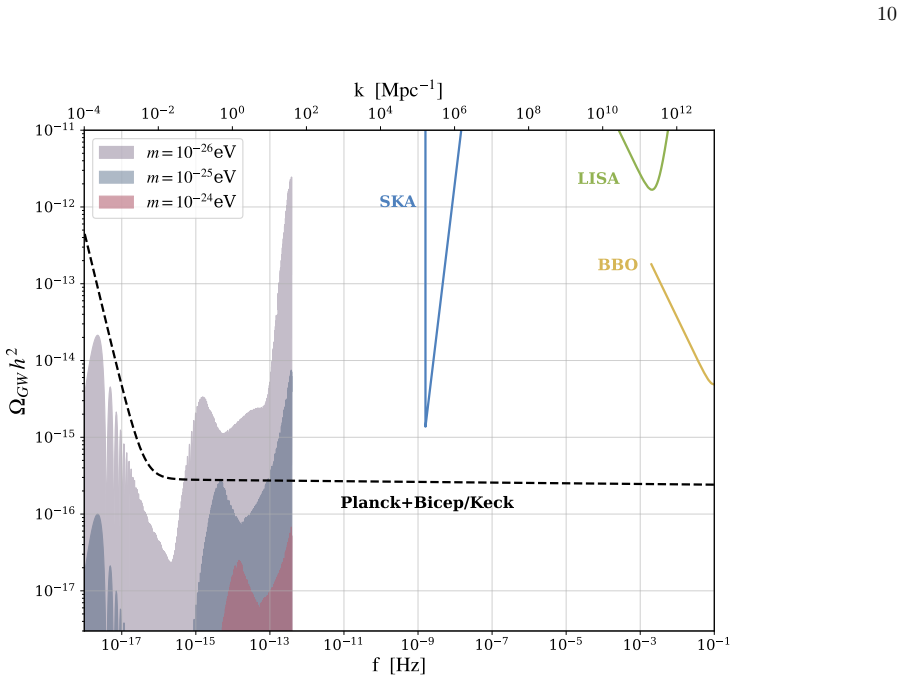
Summary. This paper studies the production of a stochastic gravitational-wave (GW) background from ultralight vector (spin-1) dark matter (VFDM) in a Bianchi I spacetime. The homogeneous background vector field breaks spatial isotropy, inducing mixing between scalar, vector, and tensor (SVT) perturbation sectors. The authors derive the linear perturbation equations, construct super-horizon adiabatic initial conditions via the Weinberg construction (verifying explicit cancellations between vector-field and shear-tensor contributions), and implement the tensor-sector evolution in a modified version of CLASS (class.VFDM). The main numerical output is the present-day GW abundance spectrum (Fig. 2), which exhibits peaks near the Jeans scale at oscillation onset and an anisotropic sin^2(gamma_k) dependence. The public code is provided.
Significance. The paper addresses a well-motivated question—distinguishing the spin of ultralight dark matter through cosmological observables—and extends prior work (Refs. [12, 13]) by the same authors to the tensor sector. The derivation of the perturbation equations and the Weinberg adiabatic mode construction in a Bianchi I background with SVT mixing is carefully executed, with cancellations verified explicitly. The provision of reproducible code (class.VFDM, Ref. [22]) and falsifiable spectral predictions (Fig. 2, with detector sensitivity comparisons) are concrete strengths. The anisotropic sin^2(gamma_k) dependence is a distinctive, testable signature. However, the central quantitative claim—the GW spectrum—rests on a perturbative truncation whose self-consistency for the dominant spectral features is questionable, as detailed below.
major comments (4)
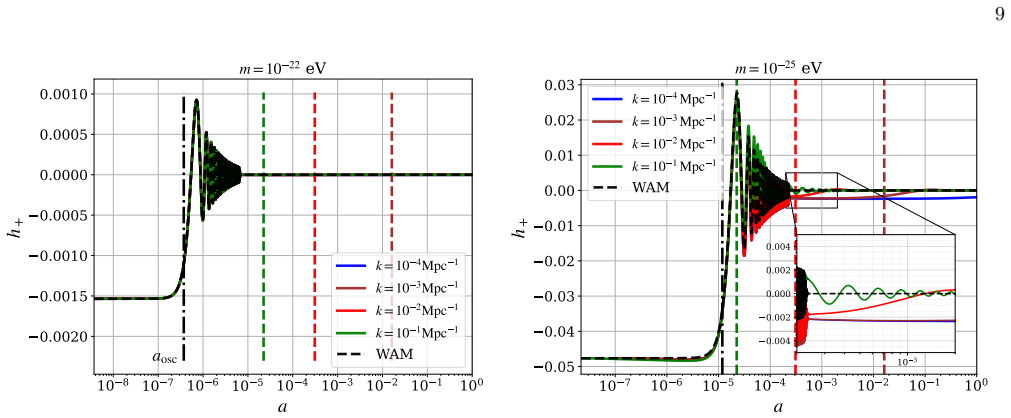
- Sec. IV, discussion of Fig. 2 and the zoom in Fig. 1: The first peak in the GW spectrum is explicitly attributed by the authors to the discrepancy between the numerical solution and the leading-order Weinberg adiabatic mode. The text states: 'the numerical solution is different from the Weinberg solution... and the difference is an effect of second order in |sigma_ij|.' The equations of motion (Eq. 32) and the VFDM fluid variables (Eqs. 21) retain only zeroth-order terms in |sigma_ij| in the stress-energy tensor (with the Einstein tensor kept to linear order). If the leading-order solution cancels exactly (as demonstrated by the Weinberg construction in Sec. III), the residual signal generating the first peak is formally second order in |sigma_ij|, but the code does not include the second-order source terms that would self-consistently produce this signal. The authors should clarify: (a)
- Sec. IV: Photon and neutrino sources for tensor modes are dropped 'for simplicity.' The standard free-streaming damping of tensor modes by neutrinos (and photons before recombination) is a well-known effect that suppresses the GW spectrum at frequencies entering the horizon during radiation domination. Since the predicted spectrum in Fig. 2 has features precisely in the frequency range where this damping is relevant, the omission is load-bearing for the quantitative amplitude. The authors should either include these sources or provide a quantitative estimate of the expected suppression.
- Sec. IV, Fig. 2: The spectrum is shown only for transversal modes (gamma_k = pi/2), with the statement that the general case is multiplied by sin^2(gamma_k). However, the angular dependence of the scalar-tensor mixing and the vector-field perturbation sources (Eqs. 21, 33) involves both cos(gamma_k) and sin(gamma_k) factors in a non-trivial way. A simple sin^2(gamma_k) overall factor should be verified explicitly, or the qualification should be stated more precisely.
- Sec. IV, end of section and Sec. V: The authors acknowledge that the backreaction of tensor modes on the scalar sector is of the same order as terms linear in |sigma_ij| that are neglected, and that second-order corrections in sigma_ij are needed for precision on small scales. Given that the high-frequency increase in the spectrum is attributed to relativistic modes (small scales), the quantitative reliability of this portion of Fig. 2 is unclear. The authors should delineate which frequency range of the predicted spectrum is robust at the stated perturbative order and which is not.
minor comments (6)
- Ref. [22] (code repository) appears as an unresolved placeholder in the reference list. Please verify the link is correct and functional.
- Eq. (37) and surrounding text: the notation for the transfer functions (script T) is introduced somewhat abruptly. A brief sentence defining each symbol would improve readability.
- Fig. 1: the axis labels and legend are difficult to read in the multi-panel layout. Please increase font sizes and clarify what each curve represents.
- Sec. II, Eq. (4): the solution for sigma_ij is stated without derivation in the main text (deferred to Appendix A). A brief forward-reference or a one-line summary of the perturbative assumption would help if stated upfront.
- Appendix C, Eqs. (C4)-(C5): the averaging parameters theta_tol = 0.1 and theta_th = 100 are stated without justification. A brief comment on the sensitivity of results to these values would be useful.
- The abstract states the spectrum is obtained from class.VFDM but does not mention the key caveats (neglected photon/neutrino sources, perturbative order limitations). Consider adding a brief qualifier or adding a footnote.
Simulated Author's Rebuttal
We thank the referee for a careful and constructive report. The referee raises important questions about (1) the self-consistency of the perturbative truncation for the first peak in the GW spectrum, (2) the omission of photon and neutrino damping sources, (3) the angular dependence of the spectrum, and (4) the robustness of the high-frequency portion of the spectrum. We address each point below. We find that comments (1), (2), and (4) are partially or fully valid and require revisions to the manuscript text to clarify the perturbative order and limitations. Comment (3) is addressed by an explicit verification of the angular dependence.
read point-by-point responses
-
Referee: Sec. IV, discussion of Fig. 2 and the zoom in Fig. 1: The first peak in the GW spectrum is attributed to the discrepancy between the numerical solution and the leading-order Weinberg adiabatic mode, which is formally second order in |sigma_ij|, but the code does not include second-order source terms. The authors should clarify this self-consistency issue.
Authors: The referee is correct that the first peak in the GW spectrum arises from a residual that is formally second order in |sigma_ij|, while the equations implemented in the code retain only zeroth-order terms in |sigma_ij| in the stress-energy tensor (with the Einstein tensor kept to linear order). We acknowledge that this is a genuine limitation of the current perturbative treatment. To clarify: the code evolves the full (untruncated) tensor equation of motion, Eq. (32), including all terms shown. The Weinberg adiabatic mode provides the initial conditions and the super-horizon analytic approximation. The discrepancy between the numerical solution and the Weinberg mode for the lightest masses (visible in the zoom of Fig. 1) arises because the numerical solution captures effects that the leading-order Weinberg construction does not—specifically, subleading corrections in |sigma_ij| that enter through the full evolution equations but are not fully self-consistent at the level of the source terms in the stress-energy tensor. We agree that a fully self-consistent treatment of this peak would require including second-order source terms in |sigma_ij|. We will revise the manuscript to state this limitation explicitly and to qualify the first peak as a feature whose existence is robust (it arises from the known incompleteness of the leading-order Weinberg approximation) but whose quantitative amplitude is not fully self-consistent at the stated perturbative order. revision: partial
-
Referee: Sec. IV: Photon and neutrino sources for tensor modes are dropped 'for simplicity.' The standard free-streaming damping by neutrinos and photons suppresses the GW spectrum at frequencies entering the horizon during radiation domination. The omission is load-bearing for the quantitative amplitude. The authors should either include these sources or provide a quantitative estimate of the expected suppression.
Authors: The referee is correct that the omission of photon and neutrino anisotropic stress sources is load-bearing for the quantitative amplitude of the GW spectrum in the frequency range where free-streaming damping is relevant. We will address this in two ways. First, we will add a quantitative estimate of the expected suppression. The standard damping of tensor modes by free-streaming neutrinos suppresses the GW amplitude by a factor of approximately (1 - R_nu/2)^2 ~ 0.8 in the radiation-dominated era for modes entering the horizon before matter-radiation equality, where R_nu ~ 0.4 is the neutrino fraction of radiation. For modes entering during matter domination, the suppression is negligible. Second, we will include the neutrino and photon tensor sources in a forthcoming update to class.VFDM. For the revised manuscript, we will add a paragraph in Sec. IV providing this quantitative estimate and clearly stating that the spectrum in Fig. 2 represents an upper bound on the GW abundance in the relevant frequency range, with the actual spectrum suppressed by the factor quoted above. revision: partial
-
Referee: Sec. IV, Fig. 2: The spectrum is shown only for transversal modes (gamma_k = pi/2), with the statement that the general case is multiplied by sin^2(gamma_k). However, the angular dependence involves both cos(gamma_k) and sin(gamma_k) factors in a non-trivial way. A simple sin^2(gamma_k) overall factor should be verified explicitly.
Authors: We have verified the angular dependence explicitly. The key observation is that the background vector field is decomposed as A_L = cos(gamma_k) * c * tau and A_T = sin(gamma_k) * c * tau (see Eqs. A9). The tensor perturbation h_+ is sourced by the transversal component of the vector field perturbation delta_A_{t1} and by the shear component sigma_+, both of which are proportional to A_T^2 and hence to sin^2(gamma_k). Specifically, sigma_+ = -c_T^2 / (2 m_P^2 a^2) (Eq. A9c), where c_T = sin(gamma_k) * c. The source terms in the tensor equation (Eq. 33a) and the mass term (Eq. 32a) both involve A_{t1} and sigma_+, which carry the sin^2(gamma_k) factor. The longitudinal component A_L does not source h_+ directly; it enters only through the constraint equation (Eq. 11) and the scalar sector, which decouple from the tensor sector for the adiabatic mode (as shown by the cancellations in Sec. III). For the h_x polarization, the background has no component along e_2 by construction, so sigma_x = 0 and h_x = 0. Therefore, the overall sin^2(gamma_k) factor is exact for the GW spectrum sourced by the VFDM mixing. We will add a brief derivation of this result in the revised manuscript to make the verification explicit. revision: yes
-
Referee: Sec. IV, end of section and Sec. V: The backreaction of tensor modes on the scalar sector is of the same order as terms linear in |sigma_ij| that are neglected, and second-order corrections are needed for precision on small scales. The quantitative reliability of the high-frequency portion of Fig. 2 is unclear. The authors should delineate which frequency range is robust and which is not.
Authors: The referee is correct that the high-frequency portion of the spectrum, attributed to relativistic modes on small scales, is not quantitatively reliable at the stated perturbative order. We will revise the manuscript to delineate the robust and non-robust frequency ranges. Specifically: (1) The low-frequency portion of the spectrum (frequencies below the Jeans scale at oscillation onset, corresponding to the first peak) is robust in terms of the existence of the feature, though its quantitative amplitude is affected by the second-order issues discussed in response to comment 1. (2) The second peak, corresponding to the Jeans scale k_J = a_osc * m * H_osc, is a robust qualitative feature determined by the background dynamics. (3) The high-frequency increase in the spectrum (frequencies above the Jeans scale) is not quantitatively reliable, as we explicitly acknowledge in the manuscript: 'on such small scales it becomes necessary to include second-order corrections in cosmological perturbation theory.' We will add a clear statement in Sec. IV and Sec. V delineating these ranges, and we will shade or mark the non-robust region in Fig. 2. We will also add a statement that the spectrum should be understood as an order-of-magnitude estimate in the high-frequency regime, pending the inclusion of next-to-leading-order corrections in |sigma_ij|. revision: yes
Circularity Check
No significant circularity; self-citations provide building blocks but the GW spectrum is independently derived
full rationale
The paper's derivation chain proceeds from the Proca action (Eq. 1) through the Bianchi I Einstein equations to obtain SVT-coupled perturbation equations (Eqs. 12, 21, 22, 32), uses Weinberg's adiabatic mode construction (external citations [14, 15]) for initial conditions, and numerically integrates the tensor perturbation equations to obtain the GW spectrum (Fig. 2). The constant c is fixed by the observed DM abundance (Eq. A8), an external input. The self-citations [12, 13] provide the background evolution and scalar-sector CLASS implementation, but these are prior derivations from the same first principles (Proca action + Einstein equations), not fits to the target GW quantity. The tensor-sector equations and their coupling to the scalar sector are derived in this paper. The sin²(γ_k) anisotropy factor arises geometrically from the vector field decomposition (Eqs. 6-7), not from a fit. The skeptic's concern about the first peak being a second-order effect in |σ_ij| beyond the truncation order is a correctness/consistency issue, not circularity—the authors are transparent about this limitation and do not hide it. No step in the derivation chain reduces to its inputs by construction.
Assumptions & free parameters
free parameters (4)
- m (vector field mass) =
10^{-22} eV and 10^{-25} eV shown
- c (background field amplitude) =
Fixed by Eq. (A8) using observed Ω_DM,0
- w+ (primordial tensor amplitude) =
0
- θ_tol, θ_th (averaging parameters) =
0.1, 100
assumptions (4)
- domain assumption The dark matter is entirely described by a minimally coupled Proca field (Eq. 1).
- domain assumption The vector field was produced in a sufficiently coherent and homogeneous state that the classical field approximation is valid (Sec. I).
- ad hoc to paper Metric shear σ_ij can be treated perturbatively (linear order) for the masses considered.
- domain assumption Weinberg's adiabatic mode construction holds at leading order in anisotropies for Bianchi I with VFDM (Sec. III).
invented entities (1)
-
Ultralight vector (spin-1) dark matter field
independent evidence
Cite this review
Pith. "Pith review of Cosmological Gravitational Waves from Ultralight Vector Dark Matter." pith.science (2026). https://pith.science/paper/7RSOUUHD
@misc{pith2026260421080,
  author       = {Pith},
  title        = {Pith review of: Cosmological Gravitational Waves from Ultralight Vector Dark Matter},
  year         = {2026},
  howpublished = {\url{https://pith.science/paper/7RSOUUHD}},
  note         = {Machine review of arXiv:2604.21080}
}
read the original abstract
We compute the abundance of cosmological gravitational waves produced during the evolution of an ultralight vector (spin-1) dark matter field. A homogeneous background vector field breaks spatial isotropy, requiring a Bianchi I geometry and inducing a mixing between the scalar, vector, and tensor perturbation sectors. We derive the perturbation equations in this background and show that, as a consequence of this mixing, scalar perturbations act as a source of tensor modes, generating a stochastic GW background. The production and cosmological evolution of these gravitational waves are implemented in \texttt{class.VFDM}, a modified version of \texttt{CLASS}, from which we obtain the present-day spectrum.
Figures
Forward citations
Cited by 2 Pith papers
-
Isotropic universes with a preferred direction
A tuned vector-field EFT can have an exactly isotropic FLRW background while hiding a preferred direction that reappears in perturbations as direction-dependent propagation and scalar–tensor mixing.
-
Spin-1 Ultralight Dark Matter under Cosmological Scrutiny: Mass Constraints from CMB and Distance Probes
Cosmological data place a lower bound near 10⁻²⁴ eV on spin-1 ultralight dark matter and predict a CMB anisotropy signature that may be detectable when the vector field is a minor dark-matter component.
Reference graph
Works this paper leans on
-
[23]
S. Weinberg, “Adiabatic modes in cosmology,”Physical Review D, vol. 67, jun 2003
work page 2003
-
[22]
Ultralight vector dark 15 matter, anisotropies, and cosmological adiabatic modes,
T. F. Chase and D. L´ opez Nacir, “Ultralight vector dark 15 matter, anisotropies, and cosmological adiabatic modes,” Phys. Rev. D, vol. 109, no. 8, p. 083521, 2024
work page 2024
-
[1]
Scalar sector For a perturbed energy momentum tensorδT µν, scalar effective fluid variables can be defined as: δρ=�δT 0 0 ,(20a) δP= 1 3 δT i i ,(20b) (ρ+P)θ=ik iδT 0 i ,(20c) (ρ+P)δΣ ∥ =� �ˆkiˆkj � 1 3 γj i � δΣi j ,(20d) whereδΣ ij =δT ij �δT kkδij/3 is the anisotropic stress. For the VFDM, the fluid variables in Newtonian gauge are given by δρA = 1 a4 ...
-
[2]
The Weinberg construction of the adiabatic mode ex- cludes vector perturbations
Vector sector The Einstein vector equations can be obtained by pro- jectingδG 0i in the directions ˆe1 and ˆe2, thus obtaining respectively � m2 m2 P A2 t� + k2 2 � V1 = m2At� m2 P δA0 +S V ,(28) k 2 V2 =�2iσ v� h× � i a2m2 P A′ LδAt� ,(29) whereS V is SV =�ik 1 � 2 � (3� 2 � � ′)σv� +�σ ′ v� � ψ(30) �ikσ v� ϕ�ik σv� � ψ′ . The Weinberg construction of th...
-
[3]
Tensor sector The tensor sector is obtained by projecting Einstein equations with Λil jm =P ilPjm � 1 2 P i j P l m ,(31) whereP ij = (γ ij � ˆkiˆkj). The equations of motion for the two polarizations of the tensor perturbations are then calculated by contracting the resulting equations in the directions ˆe1 i ˆe1 j and ˆe1 i ˆe2 j. By doing this on both ...
-
[4]
Therefore, by settingw × = 0, we have thath × = 0 for the whole evolution. This behavior is confirmed by our numerical results, although we do not show it for simplicity, as the amplitude remains negligible at all times. In Fig. 2 we present the gravitational wave abundance at present-day for different masses of the vector field and forγ k =π/2. We note t...
-
[5]
Scalar sector Now we present the scalar sector of Einstein’s equa- tions in Bianchi I background with VFDM. The Einstein tensor at linear order in the metric shear can be written as δG0(S) 0 = 2k2η� �h ′ + 3σ∥η′ + 2σ+h′ + ,(B5a) +iσ v� E1 ˆkiδG0(S) i = 2k2η′ �3k 2σ∥η�k 2σ+h+ ,(B5b) δGi(S) i = 3h′′ + 6�h ′ �6k 2η+ 18σ +h′ + (B5c) + 9ikσv� E′ 1 , δG(S) ∥ = ...
-
[6]
For the vector sector we consider that the VFDM is the only species that sources the vector modes
Vector sector We present the vector sector in synchronous gauge for completeness, although it is not implemented in CLASS. For the vector sector we consider that the VFDM is the only species that sources the vector modes. As in newto- nian gauge, the Einstein vector equations can be obtained by projectingδG 0i in the directions ˆe1 and ˆe2, thus ob- taini...
Show all 38 references
-
[7]
Tensor sector The tensor perturbations are gauge invariant, so their equations of motion in synchronous gauge are still given by Eqs. (32). The sourcesH + andA +, however, need to be written in terms of the variables in synchronous gauge, as H+ = σ+ � η′′ + σ+ 2 h′ �2 � (1� � ...
-
[8]
This implementation is per- formed in Synchronous gauge, and is based on Ref
Background In this appendix, we describe the implementation of the VFDM model in CLASS, including the mixing of the scalar and tensor sector. This implementation is per- formed in Synchronous gauge, and is based on Ref. [12]. In here, we present the equations that need to be m...
-
[9]
The tensor perturbations are only affected by the ˆe 1 compo- nents of the vector field
Linear perturbations Now we present the modifications carried out in the linear regime to include the tensor perturbations. The tensor perturbations are only affected by the ˆe 1 compo- nents of the vector field. We therefore focus on the im- plementation of the transversal Fo...
-
[10]
Planck 2018 results. vi. cosmological parameters,
P. collaboration, “Planck 2018 results. vi. cosmological parameters,”Astronomy & Astrophysics, vol. 641, p. A6, sep 2020
2018
-
[11]
Ultra-light dark matter,
E. G. M. Ferreira, “Ultra-light dark matter,”The As- tronomy and Astrophysics Review, vol. 29, sep 2021
2021
-
[12]
Axion cosmology,
D. J. Marsh, “Axion cosmology,”Physics Reports, vol. 643, pp. 1–79, jul 2016
2016
-
[13]
Vector Coherent Oscillation Dark Mat- ter,
K. Nakayama, “Vector Coherent Oscillation Dark Mat- ter,”JCAP, vol. 10, p. 019, 2019
2019
-
[14]
Misalignment mechanism for a mass-varying vector boson,
K. Kaneta, H.-S. Lee, J. Lee, and J. Yi, “Misalignment mechanism for a mass-varying vector boson,”JCAP, vol. 09, p. 017, 2023
2023
-
[15]
Viable vector coherent oscillation dark matter,
N. Kitajima and K. Nakayama, “Viable vector coherent oscillation dark matter,”JCAP, vol. 07, p. 014, 2023
2023
-
[16]
A Lower Bound on Dark Matter Mass,
M. A. Amin and M. Mirbabayi, “A Lower Bound on Dark Matter Mass,”Phys. Rev. Lett., vol. 132, no. 22, p. 221004, 2024
2024
-
[17]
Axion dark matter, soli- tons and the cusp–core problem,
D. J. E. Marsh and A.-R. Pop, “Axion dark matter, soli- tons and the cusp–core problem,”Mon. Not. Roy. As- tron. Soc., vol. 451, no. 3, pp. 2479–2492, 2015
2015
-
[18]
Strong Bound on Canoni- cal Ultralight Axion Dark Matter from the Lyman-Alpha Forest,
K. K. Rogers and H. V. Peiris, “Strong Bound on Canoni- cal Ultralight Axion Dark Matter from the Lyman-Alpha Forest,”Phys. Rev. Lett., vol. 126, no. 7, p. 071302, 2021
2021
-
[19]
Isotropy theorem for cosmological vector fields,
J. A. R. Cembranos, C. Hallabrin, A. L. Maroto, and S. J. N. Jareno, “Isotropy theorem for cosmological vector fields,”Phys. Rev. D, vol. 86, p. 021301, 2012
2012
-
[20]
Isotropy theorem for arbitrary-spin cosmolog- ical fields,
J. A. R. Cembranos, A. L. Maroto, and S. J. N´ u˜ nez Jare˜ no, “Isotropy theorem for arbitrary-spin cosmolog- ical fields,”JCAP, vol. 03, p. 042, 2014
2014
-
[21]
Cosmological perturbations with ultralight vector dark matter fields: Numerical implementation in class,
T. F. Chase, M. Leizerovich, D. L´ opez Nacir, and S. Lan- dau, “Cosmological perturbations with ultralight vector dark matter fields: Numerical implementation in class,” Phys. Rev. D, vol. 111, no. 10, p. 103520, 2025
2025
-
[24]
Damping of tensor modes in cosmology,
S. Weinberg, “Damping of tensor modes in cosmology,” Phys. Rev. D, vol. 69, p. 023503, 2004
2004
-
[25]
Theory of cosmological perturbations in an anisotropic uni- verse,
T. S. Pereira, C. Pitrou, and J.-P. Uzan, “Theory of cosmological perturbations in an anisotropic uni- verse,”Journal of Cosmology and Astroparticle Physics, vol. 2007, pp. 006–006, sep 2007
2007
-
[26]
Cosmological perturba- tion theory in the synchronous and conformal Newtonian gauges,
C.-P. Ma and E. Bertschinger, “Cosmological perturba- tion theory in the synchronous and conformal Newtonian gauges,”Astrophys. J., vol. 455, pp. 7–25, 1995
1995
-
[27]
Gravitational waves from stochastic relativistic sources: Primordial turbulence and magnetic fields,
C. Caprini and R. Durrer, “Gravitational waves from stochastic relativistic sources: Primordial turbulence and magnetic fields,”Phys. Rev. D, vol. 74, p. 063521, 2006
2006
-
[28]
Gravitational waves from self-ordering scalar fields,
E. Fenu, D. G. Figueroa, R. Durrer, and J. Garcia- Bellido, “Gravitational waves from self-ordering scalar fields,”JCAP, vol. 10, p. 005, 2009
2009
-
[29]
Relativistic viscous effects on the primordial gravitational waves spectrum,
N. Mir´ on-Granese, “Relativistic viscous effects on the primordial gravitational waves spectrum,”JCAP, vol. 06, p. 008, 2021
2021
-
[30]
The cosmic linear anisotropy solving system (class). part ii: Approxima- tion schemes,
D. Blas, J. Lesgourgues, and T. Tram, “The cosmic linear anisotropy solving system (class). part ii: Approxima- tion schemes,”Journal of Cosmology and Astroparticle Physics, vol. 2011, no. 07, p. 034, 2011. [22]���������������������������������������
2011
-
[31]
Imprint of ultralight vector fields on gravitational wave propagation,
A. D. Miravet and A. L. Maroto, “Imprint of ultralight vector fields on gravitational wave propagation,”Phys. Rev. D, vol. 103, no. 12, p. 123546, 2021
2021
-
[32]
Gravitational-wave sensitivity curves,
C. J. Moore, R. H. Cole, and C. P. L. Berry, “Gravitational-wave sensitivity curves,”Class. Quant. Grav., vol. 32, no. 1, p. 015014, 2015
2015
-
[33]
Improved Constraints on Primor- dial Gravitational Waves using Planck, WMAP, and BI- CEP/Keck Observations through the 2018 Observing Season,
P. A. R. Adeet al., “Improved Constraints on Primor- dial Gravitational Waves using Planck, WMAP, and BI- CEP/Keck Observations through the 2018 Observing Season,”Phys. Rev. Lett., vol. 127, no. 15, p. 151301, 2021
2018
-
[34]
Constraints on primordial gravitational waves from the Cosmic Mi- crowave Background,
T. J. Clarke, E. J. Copeland, and A. Moss, “Constraints on primordial gravitational waves from the Cosmic Mi- crowave Background,”JCAP, vol. 10, p. 002, 2020
2020
-
[35]
Tensor perturbations in inflationary models as a probe of cos- mology,
M. S. Turner, M. J. White, and J. E. Lidsey, “Tensor perturbations in inflationary models as a probe of cos- mology,”Phys. Rev. D, vol. 48, pp. 4613–4622, 1993
1993
-
[36]
Gravitational wave experiments and early universe cosmology,
M. Maggiore, “Gravitational wave experiments and early universe cosmology,”Phys. Rept., vol. 331, pp. 283–367, 2000
2000
-
[37]
xPand: An algorithm for perturbing homogeneous cosmologies,
C. Pitrou, X. Roy, and O. Umeh, “xPand: An algorithm for perturbing homogeneous cosmologies,”Class. Quant. Grav., vol. 30, p. 165002, 2013
2013
-
[38]
xPert: Computer algebra for metric perturbation theory,
D. Brizuela, J. M. Martin-Garcia, and G. A. Mena Maru- gan, “xPert: Computer algebra for metric perturbation theory,”Gen. Rel. Grav., vol. 41, pp. 2415–2431, 2009
2009
Reviewed July 5, 2026 · model on record in the stance chip above.
Discussion (0). Continue with ORCID to comment.