REVIEW 3 major objections 5 minor 2 cited by
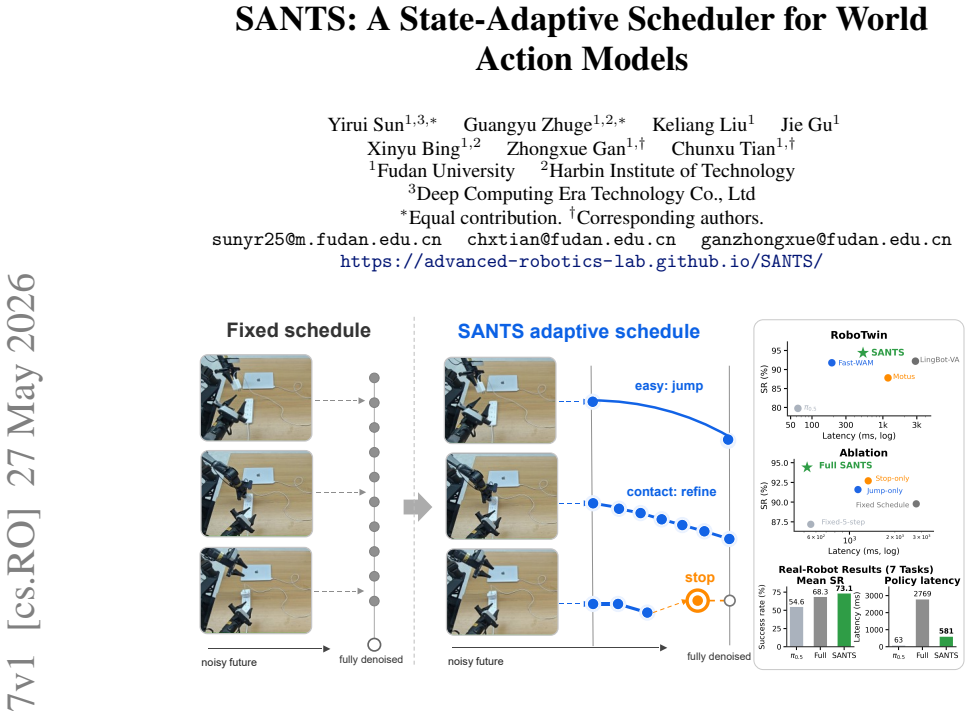
Robot policies that imagine future video need not fully denoise it: a state-dependent intermediate point along the noise path preserves control benefits while cutting most of the cost.
Reviewed by Pith at T0; open to challenge. T0 means a machine referee read the full paper against a public rubric. the ladder, T0–T4 →
T0 review · grok-4.5
2026-07-15 11:03 UTC pith:7RWOUGGA
load-bearing objection Solid systems paper: state-adaptive stop+jump on the video noise path gives a real success–latency win on a frozen WAM; the demo-action reward proxy is a real but not fatal soft spot. the 3 major comments →
SANTS: A State-Adaptive Scheduler for World Action Models
The pith
A machine-rendered reading of the paper's core claim, the machinery that carries it, and where it could break.
Core claim
In pixel-space world action models, the best condition for action generation is a state-dependent intermediate point on the video noise trajectory, not the fully denoised video. A lightweight scheduler that jointly chooses when to stop and how far to progress, trained only for path-level action quality plus update cost, can retain WAM-style control gains while removing most redundant video inference.
What carries the argument
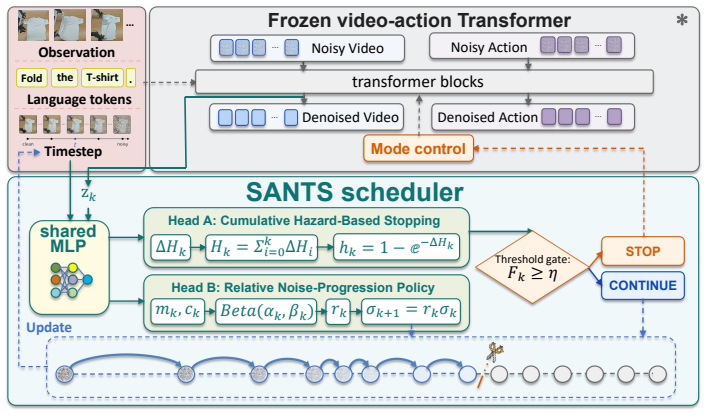
SANTS (State-Adaptive Noise Trajectory Scheduler): at each decision point it predicts a cumulative stopping hazard and a relative noise-progression ratio from the current video-state representation and noise level, then is post-trained with a path-level reward after the frozen action branch emits the final action chunk.
Load-bearing premise
That a path-level reward from demonstration action errors (with two-anchor normalization and an update-cost penalty), with the video–action backbone frozen, is a good enough proxy for real closed-loop success so the small scheduler alone transfers offline path returns into multi-task wins.
What would settle it
On the same frozen backbone and training budget, if a latency-matched fixed few-step schedule (or always-full denoising) matches or exceeds SANTS closed-loop success on RoboTwin and the seven real tasks, or if the offline depth scans show no state-dependent non-monotonic action-error pattern, the central claim fails.
If this is right
- Pixel-space WAMs can keep future-video conditioning without always running to full denoising depth.
- Stopping depth and relative noise jumps must be chosen jointly; either alone is weaker than both.
- Scheduler-only post-training on path rewards can improve success–latency tradeoffs without retraining the video or action heads.
- Coarse free-space motion can stop early; contact, alignment, and placement states should keep finer video updates.
- Inference cost of video-conditioned policies can drop by roughly four-fifths relative to full video denoising while holding or raising success.
Where Pith is reading between the lines
- Any diffusion policy with a costly intermediate generative branch may benefit from reward-driven adaptive schedules keyed to downstream utility rather than reconstruction quality.
- If joint backbone–scheduler training were unlocked, the same hazard-and-jump interface might reallocate budget into action denoising or multi-view perception under a shared cost model.
- Non-monotonic action utility along generative trajectories suggests that ‘more denoising’ is not a universal proxy for better control conditions in other video- or world-model policies.
Editorial analysis
A structured set of objections, weighed in public.
Referee Report
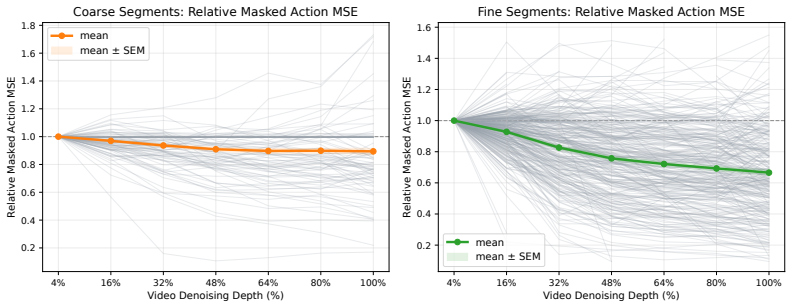
Summary. The paper argues that in pixel-space World Action Models the most useful action condition is often a state-dependent intermediate point on the video noise trajectory, not the fully denoised video. Controlled offline denoising-depth scans on phase-annotated segments show diminishing and sometimes non-monotonic returns of deeper video refinement for action error, with stronger gains in contact/alignment phases than in coarse free-space motion. The authors introduce SANTS, a lightweight plug-in scheduler that, at each video decision point, predicts a cumulative stopping hazard and a relative Beta noise-progression ratio from the current video-state feature and noise level. Only the scheduler is post-trained with PPO on a path-level reward that scores frozen-action-branch chunks against demonstration actions (sequence and temporal-difference errors, two-anchor normalized) while penalizing video-state updates. On RoboTwin 2.0, SANTS reports 94.4% overall success at 523.7 ms versus a same-backbone full-denoising WAM at 92.2% / 2868.4 ms; on seven real-robot tasks it reports 73.1% mean success and a 79% latency cut versus full denoising. Latency-matched fixed schedules and stop-only/jump-only ablations support the adaptive mechanism.
Significance. If the results hold under broader replication, the work is a practically important contribution to efficient WAM inference: it reframes video denoising as action-utility scheduling rather than visual fidelity maximization, and shows large latency reductions without sacrificing—and sometimes improving—closed-loop success. Strengths include (i) an offline diagnostic that falsifiably motivates state dependence (Fig. 3, Table 6), (ii) a latency-matched Fixed-5-step baseline that separates adaptivity from mere step reduction (Table 3), (iii) complementary stop/jump ablations and reward-component ablations (Tables 3 and 8), and (iv) real-robot evaluation on two platforms with a same-backbone full-denoising control. The plug-in, frozen-backbone design is also methodologically clean for attributing gains to scheduling. The paper is systems/empirical rather than theoretical; its value is a better success–latency operating point and a reusable scheduling interface for video-to-action diffusion policies.
major comments (3)
- [§3.3, Appendix D; Table 2] §3.3 and Appendix D define the training objective as path return R(τ) from demonstration action errors (L_seq, L_Δ), two-anchor normalization, and an update-cost penalty, with the backbone frozen. Closed-loop success is the evaluation metric, but the manuscript never reports correlation (or rank agreement) between R(τ) and trial success, nor any comparison to online environment reward or joint backbone–scheduler fine-tuning. Table 2 shows uneven real-robot gains over Full-Denoising WAM (e.g., charger insertion +20 pp, fruit sorting 0 pp). Without a proxy-validation analysis, the claim that SANTS is optimized for “downstream action quality rather than intermediate video fidelity” rests on an untested transfer assumption. Please add at least: (a) scatter or binned analysis of path return vs. closed-loop success on held-out segments/rollouts, and (b) a short discussion of when the demo-acti
- [Appendix D (Hyperparameter Selection and Sensitivity); Table 5] Appendix D states that success and latency are most sensitive to η, σ_early, λ_c, and the difficulty smoother, and that an overly large λ_c causes premature termination in contact phases, but no sensitivity curves, ranges, or multi-seed scheduler results (beyond the three RoboTwin seeds for the full system) are reported. Because these free parameters are selected on a held-out validation split and then fixed globally, the adaptive-scheduling claim needs a compact sensitivity table (e.g., η ∈ {0.7,0.85,0.95}, λ_c ∈ {0.1,0.25,0.5}) reporting overall SR and mean video updates. Without this, it is hard to judge robustness of the 94.4% / 523.7 ms operating point versus hyperparameter choice.
- [§4.2–4.3, Table 1] Table 1 and §4.2 compare SANTS to LingBot-VA, Motus, Fast-WAM, and π0.5 under a “comparable fine-tuning budget,” but only SANTS is described as 30k backbone updates + 3k scheduler-only updates on a Wan2.2-5B video–action policy. For non-identical backbones, budget parity does not equal capacity or pretraining parity. The cleanest claim is the same-backbone Full-Denoising WAM control (Tables 1–2). Please either (i) restrict primary claims to same-backbone full-denoise and fixed-schedule controls, or (ii) add an explicit capacity/pretraining table so cross-method SR gaps are not over-interpreted as pure scheduling gains.
minor comments (5)
- [Figure 1; Tables 1–2] Figure 1 and the abstract report 81.7% and 79.0% latency reductions; Table 1 gives 523.7 vs 2868.4 ms (≈81.7%) and Table 2 581.3 vs 2769.3 ms (≈79.0%). State explicitly whether latency is pure model forward time or end-to-end including action execution/replan, and whether SANTS’s extra MLP cost is included (it should be).
- [§3.2; Appendix B] Notation: σ_term, σ_early, σ_lo, and σ_min appear across §3 and Appendices B–D; a single symbol table would help. Also clarify whether deployment uses F_k ≥ η with deterministic mode m_k exclusively (as stated) in all real-robot runs.
- [§4.1, Figure 3] Figure 3 normalizes action MSE to the 4% depth baseline; state the absolute scale or units of masked action MSE somewhere so readers can judge effect size beyond relative curves.
- [Abstract; §1; References] Typos / polish: “W AMs” spacing artifacts appear repeatedly in the abstract and introduction; “Songling/AgileX” vs “AgileX” naming should be consistent; arXiv IDs in references look future-dated relative to typical citation practice—verify bibliographic metadata.
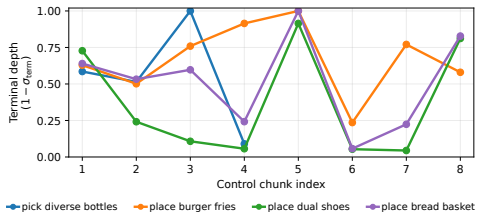
- [Appendix C, Figure 5] Appendix C’s rollout traces (Figure 5) are useful behavioral evidence but lack phase labels; a brief qualitative mapping of shallow vs deep terminal depths to task stages (approach vs contact) would strengthen the link to Figure 3.
Circularity Check
No significant circularity: empirical systems paper with independent offline diagnostics, proxy-reward training, and closed-loop success evaluation.
full rationale
SANTS is not a first-principles derivation that forces its reported success–latency numbers by construction. The offline premise (action utility is state-dependent along the video noise trajectory) is measured by masked action MSE on fixed demonstration segments under scanned depths (Fig. 3, Table 6), which is independent of the later closed-loop success metric. The scheduler is post-trained with a path-level reward R(τ) built from demonstration action errors (L_seq, L_Δ), two-anchor normalization, and an update-cost penalty (Eq. 8; App. D), while the video–action backbone stays frozen; that reward is a training objective, not the reported evaluation quantity. Reported results are task success rates and end-to-end latency on RoboTwin 2.0 and seven real-robot tasks against external and controlled baselines (Tables 1–3), which are not algebraically or statistically forced by the reward definition. Hyperparameters (η, λ_c, etc.) are selected on a held-out validation split and then fixed—standard practice, not a fit renamed as prediction. There is no load-bearing uniqueness theorem, self-citation chain, or ansatz smuggled in as a forced result. Concerns about whether the offline action-error proxy transfers to closed-loop success are correctness/transfer risks, not circularity of the derivation chain.
Axiom & Free-Parameter Ledger
free parameters (5)
- stop threshold η
- compute-cost weight λ_c
- early-stop / shallow anchor noise σ_early (σ_lo)
- reward quality weights w_seq, w_Δ and related key-frame weights
- PPO / regularization knobs (lr, λ_KL, clip, EMA baseline)
axioms (5)
- domain assumption A frozen pretrained video–action diffusion policy exposes intermediate video states z_k and supports nonuniform flow-matching noise updates that remain valid action conditions.
- domain assumption Downstream action quality relative to demonstrations, plus a penalty on video-state updates, is a valid training signal for selecting intermediate video conditions for closed-loop success.
- ad hoc to paper Cumulative hazard parameterization yields a consistent stop/continue policy for training (h_k) and deployment (F_k ≥ η).
- ad hoc to paper Continuation can be modeled as a unimodal Beta relative noise ratio r_k with mode m_k used at deployment.
- standard math Standard flow-matching / rectified-flow first-order update and PPO are valid training/inference tools for this setting.
invented entities (2)
-
SANTS (State-Adaptive Noise Trajectory Scheduler)
no independent evidence
-
Path-level action-quality reward with two-anchor normalization and update cost
no independent evidence
read the original abstract
World Action Models (WAMs) improve robot manipulation by using video-based future representations to condition action generation. In pixel-space WAMs, however, the best action condition is not necessarily the fully denoised video. Controlled denoising-depth scans show that video refinement can reduce action error up to a state-dependent point, after which the gain may saturate or even reverse when late predictions become less action-relevant or physically unreliable. This suggests that action generation should use a state-dependent point along the video noise trajectory rather than a fixed terminal denoising depth. We introduce State-Adaptive Noise Trajectory Scheduler (SANTS), a lightweight scheduler for video-to-action diffusion policies. At each video decision point, SANTS reads the current video-state representation and noise level, then jointly predicts a cumulative stopping hazard and a relative noise-progression ratio. SANTS is post-trained with a path-level reward computed after the frozen action branch generates the final action chunk, so the scheduler is optimized for downstream action quality rather than intermediate video fidelity, while redundant video-state updates are explicitly penalized. Experiments show that SANTS reaches \(94.4\%\) overall success on RoboTwin 2.0 and \(73.1\%\) average success across seven real-robot tasks, while reducing latency by \(81.7\%\) and \(79.0\%\) relative to full video denoising, respectively. These results indicate that adaptive selection along the video noise trajectory can preserve the control benefits of WAM-style future reasoning while removing much of its redundant inference cost.
Figures
Forward citations
Cited by 2 Pith papers
-
Test-Time Scaling for World Action Models via Zero-Shot Geometric Evaluation
Cross-view depth consistency of predicted robot futures selects better rollouts and a cheap action-future gate decides when to sample, improving success on RoboCasa, LIBERO Long, and RoboTwin 2.0.
-
World Action Models: A Survey
A survey that clarifies boundaries and organizes World Action Models by generation requirements and predictive substrates, identifying a trend toward generating less of the future.
Reference graph
Works this paper leans on
-
[1]
S. Wang, J. Shi, Z. Fu, X. He, F. Liu, C. Yang, Y . Zhou, Z. Fei, J. Gong, J. Fu, M. Z. Shou, X. Huang, X. Qiu, and Y .-G. Jiang. World action models: The next frontier in embodied ai,
-
[2]
URLhttps://arxiv.org/abs/2605.12090
-
[3]
C. Zhu, R. Yu, S. Feng, B. Burchfiel, P. Shah, and A. Gupta. Unified world models: Coupling video and action diffusion for pretraining on large robotic datasets, 2025. URLhttps:// arxiv.org/abs/2504.02792
Pith/arXiv arXiv 2025
-
[4]
L. Li, Q. Zhang, Y . Luo, S. Yang, R. Wang, F. Han, M. Yu, Z. Gao, N. Xue, X. Zhu, Y . Shen, and Y . Xu. Causal world modeling for robot control, 2026. URLhttps://arxiv.org/abs/ 2601.21998
Pith/arXiv arXiv 2026
-
[5]
S. Ye, Y . Ge, K. Zheng, S. Gao, S. Yu, G. Kurian, S. Indupuru, Y . L. Tan, C. Zhu, J. Xiang, et al. World action models are zero-shot policies.arXiv preprint arXiv:2602.15922, 2026
Pith/arXiv arXiv 2026
-
[6]
M. J. Kim, Y . Gao, T.-Y . Lin, Y .-C. Lin, Y . Ge, G. Lam, P. Liang, S. Song, M.-Y . Liu, C. Finn, and J. Gu. Cosmos policy: Fine-tuning video models for visuomotor control and planning,
-
[7]
URLhttps://arxiv.org/abs/2601.16163
-
[8]
Y . Hu, Y . Guo, P. Wang, X. Chen, Y .-J. Wang, J. Zhang, K. Sreenath, C. Lu, and J. Chen. Video prediction policy: A generalist robot policy with predictive visual representations. In International Conference on Machine Learning, pages 24328–24346. PMLR, 2025. 9
2025
-
[9]
J. Pai, L. Achenbach, V . Montesinos, B. Forrai, O. Mees, and E. Nava. mimic-video: Video- action models for generalizable robot control beyond vlas, 2025. URLhttps://arxiv.org/ abs/2512.15692
Pith/arXiv arXiv 2025
-
[10]
T. Ma, J. Zheng, Z. Wang, C. Jiang, A. Cui, J. Liang, and S. Yang. Dit4dit: Jointly modeling video dynamics and actions for generalizable robot control, 2026. URLhttps://arxiv. org/abs/2603.10448
arXiv 2026
-
[11]
H. Bi, H. Tan, S. Xie, Z. Wang, S. Huang, H. Liu, R. Zhao, Y . Feng, C. Xiang, Y . Rong, et al. Motus: A unified latent action world model.arXiv preprint arXiv:2512.13030, 2025
Pith/arXiv arXiv 2025
-
[12]
T. Yuan, Z. Dong, Y . Liu, and H. Zhao. Fast-wam: Do world action models need test-time future imagination?, 2026. URLhttps://arxiv.org/abs/2603.16666
Pith/arXiv arXiv 2026
-
[13]
X. Zhang, Z. Xu, Y . Tao, Y . Wang, Y . She, and A. Boularias. Learning visual feature-based world models via residual latent action, 2026. URLhttps://arxiv.org/abs/2605.07079
Pith/arXiv arXiv 2026
-
[14]
A. Sabour, S. Fidler, and K. Kreis. Align your steps: Optimizing sampling schedules in diffu- sion models, 2024. URLhttps://arxiv.org/abs/2404.14507
Pith/arXiv arXiv 2024
-
[15]
C. Esteves and A. Makadia. Spectrally-guided diffusion noise schedules, 2026. URLhttps: //arxiv.org/abs/2603.19222
Pith/arXiv arXiv 2026
-
[16]
S.-A. Yu, F. Gao, Y . Wu, C. Yu, and Y . Wang. D3p: Dynamic denoising diffusion policy via reinforcement learning.arXiv preprint arXiv:2508.06804, 2025
Pith/arXiv arXiv 2025
-
[17]
T. Chen, Z. Chen, B. Chen, Z. Cai, Y . Liu, Z. Li, Q. Liang, X. Lin, Y . Ge, Z. Gu, W. Deng, Y . Guo, T. Nian, X. Xie, Q. Chen, K. Su, T. Xu, G. Liu, M. Hu, H.-a. Gao, K. Wang, Z. Liang, Y . Qin, X. Yang, P. Luo, and Y . Mu. Robotwin 2.0: A scalable data generator and bench- mark with strong domain randomization for robust bimanual robotic manipulation, 2...
Pith/arXiv arXiv 2025
-
[18]
H. Wu, Y . Jing, C. Cheang, G. Chen, J. Xu, X. Li, M. Liu, H. Li, and T. Kong. Unleashing large-scale video generative pre-training for visual robot manipulation, 2023. URLhttps: //arxiv.org/abs/2312.13139
Pith/arXiv arXiv 2023
-
[19]
C.-L. Cheang, G. Chen, Y . Jing, T. Kong, H. Li, Y . Li, Y . Liu, H. Wu, J. Xu, Y . Yang, H. Zhang, and M. Zhu. Gr-2: A generative video-language-action model with web-scale knowledge for robot manipulation, 2024. URLhttps://arxiv.org/abs/2410.06158
Pith/arXiv arXiv 2024
-
[20]
J. Cen, C. Yu, H. Yuan, Y . Jiang, S. Huang, J. Guo, X. Li, Y . Song, H. Luo, F. Wang, D. Zhao, and H. Chen. Worldvla: Towards autoregressive action world model, 2025. URLhttps: //arxiv.org/abs/2506.21539
Pith/arXiv arXiv 2025
-
[21]
Q. Feng, J. Yu, J. Liu, Y . Jia, Z. Wu, H. Chen, Z. Qian, S. Gu, P. Jia, S. Ma, and S. Zhang. Harmowam: Harmonizing generalizable and precise manipulation via adaptive world action models, 2026. URLhttps://arxiv.org/abs/2605.10942
Pith/arXiv arXiv 2026
-
[22]
Finn and S
C. Finn and S. Levine. Deep visual foresight for planning robot motion. InIEEE International Conference on Robotics and Automation, 2017
2017
-
[23]
Y . Li, Y . Zhu, J. Wen, C. Shen, and Y . Xu. Worldeval: World model as real-world robot policies evaluator, 2025. URLhttps://arxiv.org/abs/2505.19017
Pith/arXiv arXiv 2025
-
[24]
J. Yang, K. Lin, J. Li, W. Zhang, T. Lin, L. Wu, Z. Su, H. Zhao, Y .-Q. Zhang, L. Chen, P. Luo, X. Yue, and H. Li. Rise: Self-improving robot policy with compositional world model, 2026. URLhttps://arxiv.org/abs/2602.11075. 10
Pith/arXiv arXiv 2026
-
[25]
Y . Wen, J. Lin, Y . Zhu, J. Han, H. Xu, S. Zhao, and X. Liang. Vidman: Exploiting implicit dynamics from video diffusion model for effective robot manipulation, 2024. URLhttps: //arxiv.org/abs/2411.09153
Pith/arXiv arXiv 2024
-
[26]
Routray, H
S. Routray, H. Pan, U. Jain, S. Bahl, and D. Pathak. Vipra: Video prediction for robot actions,
-
[27]
URLhttps://arxiv.org/abs/2511.07732
-
[28]
Y . Li, B. Zhang, C. Gu, Z. Ma, J. Zhang, J. Deng, X. Zhu, and L. Zhang. From imagined futures to executable actions: Mixture of latent actions for robot manipulation, 2026. URL https://arxiv.org/abs/2605.12167
Pith/arXiv arXiv 2026
-
[29]
Y . Liu, P. Sun, S. Li, Y . Xie, L. Zhang, X. Chao, S. Dong, F. Chen, X.-P. Zhang, and W. Ding. Oa-wam: Object-addressable world action model for robust robot manipulation, 2026. URL https://arxiv.org/abs/2605.06481
Pith/arXiv arXiv 2026
-
[30]
MotuBrain Team, C. Xiang, F. Bao, H. Liu, H. Tan, H. Bi, J. Li, J. Liu, J. Pang, K. Jing, L. Liu, M. Cai, R. Cui, R. Zhao, R. Wang, S. Huang, Y . Feng, Y . Rong, Z. Wang, and J. Zhu. Motubrain: An advanced world action model for robot control, 2026. URLhttps://arxiv. org/abs/2604.27792
Pith/arXiv arXiv 2026
-
[31]
F. Ma, Y . Cheng, X. Jin, W. Chen, J. Ji, C. Wei, Z. Chen, J. Liu, and H. Li. World-guided video- to-action diffusion policy: Efficiently scaling up generalizable robot policies with pretrained video generation models, 2026. URLhttps://arxiv.org/abs/2602.22010
arXiv 2026
-
[32]
H. Yang, Z. Long, Z. Ren, C. Zhou, S. Jin, H. Xu, W. Zhang, B. Cui, and B. Zhou. Being- h0.7: Improving vision-language-action model with video generation, 2026. URLhttps: //arxiv.org/abs/2605.00078
Pith/arXiv arXiv 2026
-
[33]
J. Song, C. Meng, and S. Ermon. Denoising diffusion implicit models, 2020. URLhttps: //arxiv.org/abs/2010.02502
Pith/arXiv arXiv 2020
-
[34]
C. Lu, Y . Zhou, F. Bao, J. Chen, C. Li, and J. Zhu. Dpm-solver: A fast ode solver for dif- fusion probabilistic model sampling in around 10 steps. InAdvances in Neural Information Processing Systems, 2022
2022
-
[35]
C. Lu, Y . Zhou, F. Bao, J. Chen, C. Li, and J. Zhu. Dpm-solver++: Fast solver for guided sampling of diffusion probabilistic models, 2022. URLhttps://arxiv.org/abs/2211. 01095
2022
-
[36]
K. Zheng, C. Lu, J. Chen, and J. Zhu. Dpm-solver-v3: Improved diffusion ode solver with empirical model statistics, 2023. URLhttps://arxiv.org/abs/2310.13268
Pith/arXiv arXiv 2023
-
[37]
J. Guo, Q. Li, P. Li, Z. Chen, N. Sun, Y . Su, H. Wang, Y . Zhang, X. Li, and H. Liu. Unified 4d world action modeling from video priors with asynchronous denoising, 2026. URLhttps: //arxiv.org/abs/2604.26694
Pith/arXiv arXiv 2026
-
[38]
Y . Jia, J. Liu, S. Liu, R. Zhou, W. Yu, Y . Yan, X. Chi, Y . Guo, B. Shi, and S. Zhang. Video2act: A dual-system video diffusion policy with robotic spatio-motional modeling, 2025. URL https://arxiv.org/abs/2512.03044
arXiv 2025
-
[39]
A. Ye, B. Wang, C. Ni, G. Huang, G. Zhao, H. Li, H. Li, J. Li, J. Lv, J. Liu, M. Cao, P. Li, Q. Deng, W. Mei, X. Wang, X. Chen, X. Zhou, Y . Wang, Y . Chang, Y . Li, Y . Zhou, Y . Ye, Z. Liu, and Z. Zhu. Gigaworld-policy: An efficient action-centered world–action model, 2026. URLhttps://arxiv.org/abs/2603.17240
arXiv 2026
-
[40]
X. Liu, C. Gong, and Q. Liu. Flow straight and fast: Learning to generate and transfer data with rectified flow.arXiv preprint arXiv:2209.03003, 2022
Pith/arXiv arXiv 2022
-
[41]
J. Schulman, F. Wolski, P. Dhariwal, A. Radford, and O. Klimov. Proximal policy optimization algorithms.arXiv preprint arXiv:1707.06347, 2017. 11
Pith/arXiv arXiv 2017
-
[42]
T. Wan, A. Wang, B. Ai, B. Wen, C. Mao, C.-W. Xie, D. Chen, F. Yu, H. Zhao, J. Yang, et al. Wan: Open and advanced large-scale video generative models.arXiv preprint arXiv:2503.20314, 2025
Pith/arXiv arXiv 2025
-
[43]
Black, N
K. Black, N. Brown, J. Darpinian, K. Dhabalia, D. Driess, A. Esmail, M. R. Equi, C. Finn, N. Fusai, M. Y . Galliker, et al.π 0.5: A Vision-Language-Action Model with Open-World Generalization. In9th Annual Conference on Robot Learning, 2025
2025
-
[44]
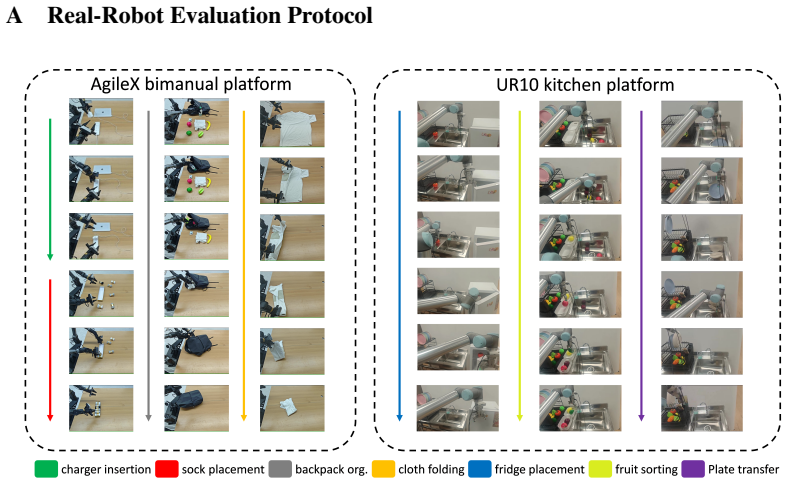
I. Loshchilov and F. Hutter. Decoupled weight decay regularization.arXiv preprint arXiv:1711.05101, 2017. 12 A Real-Robot Evaluation Protocol Figure 4: Real-robot task sequences on the AgileX bimanual and UR10 kitchen platforms. Colored arrows indicate temporal progress for each task. This appendix provides the hardware, observation, control, randomizatio...
Pith/arXiv arXiv 2017
discussion (0)
Sign in with ORCID, Apple, or X to comment. Anyone can read and Pith papers without signing in.