REVIEW 3 major objections 9 minor 177 references
Towards Human-level Dexterity via Robot Learning
T0 review · 3 major / 9 minor · reviewed 2026-08-06 · deepseek-v4-flash
Pith's one-line read A stability-checked planning tree supplies the resets and pre-training data that let reinforcement learning teach a robotic hand to finger-gait using touch alone.
desk verdict The reset-distribution core is real and the hardware results are a genuine step forward, but the main simulation evidence is confounded with reset-state evaluation and the headline claims outrun the evidence. read the letter →
The pith
A machine-rendered reading of the paper's core claim, the machinery that carries it, and where it could break.
The reading
What carries the argument
The load-bearing object is G-RRT, a non-holonomic Rapidly-exploring Random Tree that explores by sampling random actions, simulating them with a physics model, and admitting a new node only if the object remains grasped and undropped after a settling interval—the only manipulation-specific component. From this tree the method extracts paths with the largest object rotation (for finger-gaiting) or paths from the root to displaced nodes (for the go-to-root task), uses the union of nodes as a uniform reset distribution for reinforcement learning, and converts consecutive states into action labels $a_k = \beta(q_{k+1} - q_k)$ for imitation pre-training of the actor, with the critic pre-trained on rollouts of that imitative policy. Around this core sit the hand-centric decomposition of arbitrary reorientation into rotations about cardinal axes, a reward based on angular velocity about the target axis when at least three fingertips are in contact, and an asymmetric actor-critic PPO that gives the critic object pose but the policy only proprioception and binary touch.
What would settle it
Train the R×R method on a hard L-shape with a deliberately weakened planner—for example, pruning all tree paths that break a specific finger contact—and check whether the policy still learns to gait. The paper's own ablations predict near-zero learning below roughly $10^4$ tree nodes, so an even sharper falsifier would be an object where a $10^5$-node tree of stable states gives no improvement over a random stable-grasp reset distribution, indicating that manifold coverage is not the active mechanism.
Extended reading notes
Core claim
The central claim is that sampling-based planning can chart the useful part of the state space for dexterous manipulation—the manifold of stable precision grasps—and that this map is exactly what reinforcement learning needs to explore efficiently. Concretely, G-RRT adds a node only if, after a random action is played out in simulation, the object is still held after a two-second settling interval; this single stability check, with no other manipulation-specific guidance, grows a tree along non-holonomic transitions such as breaking and re-making finger contacts. The paper shows that starting every training episode from a node on a high-rotation path through this tree, together with pre-training the actor on the scaled joint-angle differences between consecutive nodes, lets policy-gradient RL learn finger-gaiting for spheres, cubes, cuboids, and concave L- and U-shapes in tens of millions of steps, and that these policies transfer to a real 15-degree-of-freedom hand with only a curriculum of motor limits, latency, friction, and perturbation forces. The thesis positions this as the first example of sampling-based-planning reset distributions enabling efficient RL for dexterous in-hand manipulation, and the first finger-gaiting of non-convex shapes with purely intrinsic sensing.
Load-bearing premise
The load-bearing premise is that G-RRT, guided only by a stability check, grows a tree dense enough in the stable-manifold state space that its nodes and transitions transfer useful exploration to reinforcement learning; if the tree misses critical regions, the method degrades to random RL with resets.
Editorial extensions
If this is right
- Training times drop from billions to tens of millions of environment steps on the hard manipulation tasks, because the reset distribution guarantees the agent repeatedly starts in states that random exploration would rarely reach.
- Policies relying only on joint positions, setpoints, and binary touch transfer to real hardware without dense camera tracking, and keep working when lighting changes or the palm faces down.
- Non-convex objects such as L-shapes, previously absent from in-hand manipulation demonstrations, become tractable for finger-gaiting in simulation and on the physical hand.
- Imitation pre-training from quasi-static tree transitions speeds convergence, but only when coupled with the tree-based reset distribution; warm-starting from a fixed start state provides little benefit.
- The same two-stage recipe—planner explores, reinforcement learning exploits—is proposed as a template for other hard-exploration motor tasks such as agile locomotion and bimanual manipulation.
Reading between the lines
- A testable corollary the thesis leaves implicit: the reset distribution carries most of the benefit, so replacing G-RRT with any planner that covers the stable manifold—for example a learned generative model of stable grasps—should reproduce much of the gain.
- Because the stability check is a cheap 'object not dropped' oracle, the tree could in principle be grown on a real robot with automatic resets, turning the thesis's simulation-only assumption into a hardware bootstrapping procedure.
- The thesis explicitly flags that simulated motor learning still faces sim-to-real and simulation-scaling costs (Section 6.5); a fair reading is that the exploration benefit must be large enough to justify that infrastructure expense.
- The final chapter's visuo-tactile human demonstrations offer a complementary bootstrap: if human hand data can be mapped into a shared latent action space, combining that route with structured-exploration resets could further cut the number of robot demonstrations needed.
Editorial analysis
A structured set of objections, weighed in public.
Referee Report
Summary. This doctoral thesis develops learning methods for dexterous in-hand manipulation with a fully actuated 15-DoF five-fingered hand, using only intrinsic tactile and proprioceptive sensing. Chapter 3 introduces hand-centric decomposition of reorientation into cardinal-axis tasks and uses stable-grasp sampling (SGS) as an initial-state prior for PPO, achieving simulated finger-gaiting and finger-pivoting. Chapter 4 proposes value-guided exploration (VGE), interleaving simple sub-skill controllers with an off-policy learner to provide action priors. Chapter 5, the core contribution, uses a general non-holonomic RRT (G-RRT) with a stability check to grow a tree of stable fingertip states; task-relevant tree paths provide a reset distribution (R×R) and joint-position differences provide imitation pre-training action labels (R×R+IPT). The method learns finger-gaiting on easy, medium, and hard objects (including concave L- and U-shapes), as well as Go-to-root and Arbitrary Reorientation tasks in simulation, and finger-gaiting transfers to real hardware for cylinder, cube, cuboid, and L-shape objects. Chapters 6 and 7 present preliminary extensions: Diffusion Roadmaps with rapidly-exploring reinforcement learning, and a visuo-tactile human demonstration paradigm using a ViTacT encoder.
Significance. If the central claims hold, this is a meaningful contribution to dexterous manipulation. To my knowledge it is the first demonstration of learned finger-gaiting precision manipulation of concave objects with only intrinsic sensing, including on physical hardware. The core idea — converting sampling-based planning trees into RL reset distributions and pre-training data — is clean and well motivated, with appropriate grounding in reset-distribution analysis (ref [109]) and a strong baseline set (SGS, ER, FI, FI+IPT, GC). The thesis is commendably transparent: algorithmic pseudocode is given for G-RRT, R×R, and IPT; Chapter 5 training curves aggregate three seeds; ablations cover tree size, action scale α, Kmax, and feedback components; and Chapters 6–7 are explicitly labeled preliminary. The main caveat is that the simulation evaluation for all three Chapter 5 tasks is performed from the same reset-state distribution used for training, so the quantitative gains over baselines require a natural-start evaluation to be fully established; the hardware results partially offset this for finger-gaiting but not for the reorientation tasks.
major comments (3)
- [Sec 5.6.1, Fig 5.14, Alg 5] The simulation evaluation for all three tasks is confounded with the training reset distribution. In Alg 5 (line 21), every training rollout starts from x0 drawn from D, where D is built from task-relevant G-RRT tree paths, and Sec 5.6.1 reports training curves only. Fig 5.14's caption is explicit: 'Validation performance is with reset states from paths extracted from the largest tree.' Thus both the reported training returns (Figs 5.3, 5.5, 5.6, 5.8) and the reported validation use the same state distribution on which the policy was trained, so the curves measure competence on reset states rather than on the tasks' natural initial distributions. The reset distribution itself is not circular (G-RRT is task-agnostic and path selection precedes RL), but the evaluation protocol is. For the paper's central claim that SBP-generated reset distributions enable efficient acquisition of finger-gaiting, Go-to-root, and Arbitrary Reorientation, a simulation evaluation from natural starts is needed: e.g., a fixed canonical grasp for finger-gaiting and a uniform or held-out initial pose distribution for the reorientation tasks. The real-hardware trials (Sec 5.6.2) do start from natural grasps and partially support the finger-gaiting claim, but they cover none of the reorientation tasks, leaving the sample-efficiency advantage over baselines potentially attributable in part to the evaluation distribution.
- [Sec 5.6.2, Table 5.1] The hardware evidence underlying the headline claim is reported as a single median over ten consecutive trials per object, with no per-trial distribution, no inter-quartile range, and no statement of the trial protocol (maximum trial duration, definition of a drop, whether the initial grasp was standardized, and how the 'time needed to perform these rotations' was measured across trials of heterogeneous length). For cuboid and L-shape the median is 1.5 revolutions, and a median of 1.5 over ten trials is compatible with a wide range of per-trial outcomes. Please report the full per-trial results (e.g., each trial's revolution count or min/max) and the protocol details; this table is the primary independent support for the claim that finger-gaiting transfers to hardware for non-convex objects.
- [Ch 1 contribution bullet 4; Sec 7.7] The fourth contribution bullet (Chapter 1) states that the visuo-tactile demonstration paradigm introduces a 'first-of-its-kind method' and 'sets a new standard for imitation learning in dexterous manipulation,' but Chapter 7's experimental content contains no policy learning or transfer results: the only evaluation is attention-map visualization on a pick task, and Sec 7.7.2 concludes with 'We hope to achieve this in future work.' As submitted, the experimental evidence does not substantiate the contribution as stated. Either temper the contribution claim to match the preliminary status of Chapter 7, or include at least preliminary fine-tuning/imitation results on the robot demonstrations; note that 20 robot and 500 human demonstrations are collected but no downstream result is reported.
minor comments (9)
- [Sec 1.7] Section 1.7 states that 'Chapter 1 and Chapter 2 present two studies' on state and action priors, but these studies actually appear in Chapters 3 and 4; the thesis summary cross-references are misnumbered and should be corrected.
- [Ch 2, opening paragraph] The opening paragraph of Chapter 2 contains empty in-text cross-references ('Section ,' 'Section ,') left over from the thesis compilation; these placeholders should be resolved or removed.
- [Sec 6.3.2] Section 6.3.2 (Finger-gaiting In-hand Manipulation) appears as a heading with no accompanying text before Section 6.3.3; either add the intended content or delete the heading.
- [Abstract] The abstract's phrase 'contrary to Moravec's paradox' appears to express the opposite of what is intended: Moravec's paradox already asserts that low-level sensorimotor skills are deceptively difficult, which is exactly the observation the thesis makes; the wording should be rephrased.
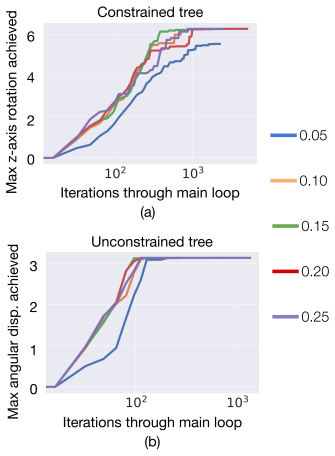
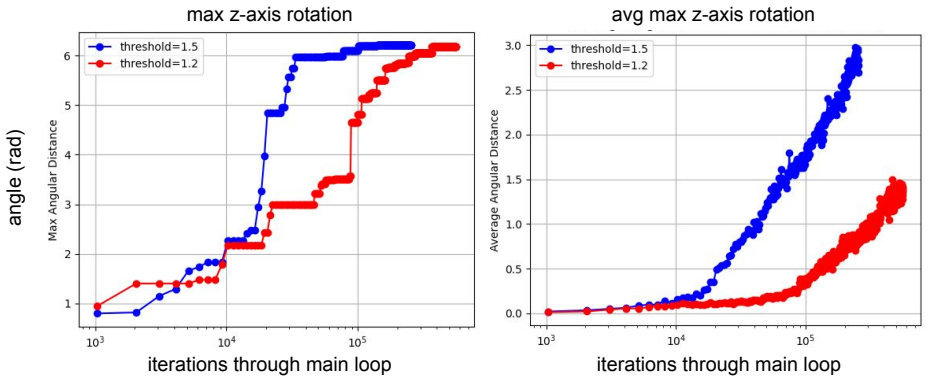
- [Figs 5.3, 5.5, 5.6] The training curves are described as aggregated over three seeds but no variance information (error bars or shading) is shown; given that Chapter 4 reports training robustness across seeds, adding per-seed spread for the Chapter 5 headline comparisons would help assess reliability.
- [Sec 5.6.2, final paragraph] The sentence 'These policies are identical to the policies used for sim-to-real transfer, as per visual comparison in simulation' is unclear: the preceding sentences say the transferred policies were trained with the version of G-RRT using the three-contact constraint, while the current method forgoes that constraint; clarify which tree version generated the deployed policies.
- [Sec 5.4.2, Eq (5.1)] The imitation pre-training action scale β = 2 is a free parameter that is not ablated; given that the paper carefully ablates α, tree size, and Kmax, a small sensitivity study for β (or a justification of the chosen value) would make the IPT contribution self-contained.
- [Sec 5.5.2, Sec 5.6.1] Several numeric values appear to have lost superscript formatting (e.g., '105 nodes,' '2 × 10⁴ nodes,' '104 nodes'); please verify that these render as 10^5, 2 × 10^4, and 10^4 in the published version.
- [Sec 5, contribution bullet 1] The phrase 'reset distributions generated via SBP with kinematic constraints' is imprecise for the current method: G-RRT (Alg 4) imposes a dynamic stability check (two seconds of no-drop simulation), and the three-contact kinematic constraint was explicitly discontinued in Sec 5.3; align the wording with the actual algorithm.
Circularity Check
Simulation validation for Go-to-root is performed on the same reset states used for training and imitation pre-training, so those reported gains are partly by construction; real-hardware finger-gaiting remains independent.
-
fitted input called prediction
[Sec 5.5.1 (Go-to-root), Sec 5.6.1 (Fig. 5.14 caption), Alg. 5 line 21]
""Validation performance is with reset states from paths extracted from the largest tree." (Fig. 5.14 caption) ... "Collect rollout τ with πθ from initial state x0 where x0 ∼ D the buffer of best states from sampling-based planning." (Alg. 5, line 21)"
For Go-to-root, the tree root is the desired canonical orientation and the reset distribution is built by backtracking from nodes with large displacement to that root. Validation is then performed on reset states from the same tree, i.e. the exact distribution used for training and for imitation pre-training, whose action labels come from the same paths (Eq. 5.1: ak = β(qk+1 − qk)). Success from such states is partly forced: the policy is initialized and trained on transitions that connect these states toward the goal, so the reported success/sample-efficiency on these states does not demonstrate acquisition from a natural initial state.
full rationale
Most of the derivation chain is self-contained and not circular. The G-RRT planner (Alg. 4) uses only a stability check and random actions, and the reset distribution is built from the resulting tree rather than fitted to the final policy; the comparison against SGS and other reset baselines is meaningful. The main circularity is in the simulation evaluation protocol: the paper validates final performance using reset states drawn from the same tree paths that define the training reset distribution and the imitation pre-training data. For Go-to-root, where the tree root is the goal and paths are extracted by backtracking toward the root, evaluation on these states is partly a restatement of the training data. The paper explicitly writes that validation performance is measured on reset states from the largest tree, and no natural-start simulation evaluation is provided for Go-to-root or Arbitrary Reorientation. The real-hand finger-gaiting results (Table 5.1) start from natural grasps, so the central hardware claim is not circular. Self-citations to prior work [23, 93] describe methods that are re-derived in the thesis and are not load-bearing for the main result. Overall score reflects partial circularity in the simulation predictions, not a fully forced derivation.
Assumptions & free parameters
free parameters (5)
- r_max, phi_max (reward clipping and axis-alignment threshold) =
0.5, 0.5
- G-RRT action scale alpha =
0.15
- Imitation pre-training action scaling beta =
2
- Tree size and number of reset states =
1e5 nodes; 2e4 reset states
- KL regularization coefficients beta1, beta2 =
not specified
assumptions (5)
- domain assumption MuJoCo and IsaacGym soft-contact simulations accurately model the real hand, fingertips, and object dynamics for training and sim-to-real transfer.
- ad hoc to paper The stability check in G-RRT (2 seconds without the object dropping) is a valid proxy for states that can serve as resets for RL.
- domain assumption The reward functions (angular velocity about an axis, contact count constraints, success heuristics) are appropriate and do not induce degenerate policies.
- ad hoc to paper Action labels for imitation pre-training can be obtained by scaling joint-position differences between tree states by beta=2 (Eq 5.1).
- domain assumption A shared latent action space can be learned across human and robot embodiments from observation-only human demonstrations plus a small set of robot demonstrations.
invented entities (1)
-
ViTacT (Visuo-tactile Transformer)
Cite this review
Pith. "Pith review of Towards Human-level Dexterity via Robot Learning." pith.science (2026). https://pith.science/paper/7RWVNTP2
@misc{pith2026250709117,
  author       = {Pith},
  title        = {Pith review of: Towards Human-level Dexterity via Robot Learning},
  year         = {2026},
  howpublished = {\url{https://pith.science/paper/7RWVNTP2}},
  note         = {Machine review of arXiv:2507.09117}
}
read the original abstract
Dexterous intelligence -- the ability to perform complex interactions with multi-fingered hands -- is a pinnacle of human physical intelligence and emergent higher-order cognitive skills. However, contrary to Moravec's paradox, dexterous intelligence in humans appears simple only superficially. Many million years were spent co-evolving the human brain and hands including rich tactile sensing. Achieving human-level dexterity with robotic hands has long been a fundamental goal in robotics and represents a critical milestone toward general embodied intelligence. In this pursuit, computational sensorimotor learning has made significant progress, enabling feats such as arbitrary in-hand object reorientation. However, we observe that achieving higher levels of dexterity requires overcoming very fundamental limitations of computational sensorimotor learning. I develop robot learning methods for highly dexterous multi-fingered manipulation by directly addressing these limitations at their root cause. Chiefly, through key studies, this disseration progressively builds an effective framework for reinforcement learning of dexterous multi-fingered manipulation skills. These methods adopt structured exploration, effectively overcoming the limitations of random exploration in reinforcement learning. The insights gained culminate in a highly effective reinforcement learning that incorporates sampling-based planning for direct exploration. Additionally, this thesis explores a new paradigm of using visuo-tactile human demonstrations for dexterity, introducing corresponding imitation learning techniques.
Figures


Figures from the paper (43 more)






Reference graph
Works this paper leans on
-
[109]
Optimalityandapproximationwith policy gradient methods in markov decision processes,
A.Agarwal,S.M.Kakade,J.D.Lee,andG.Mahajan,“Optimalityandapproximationwith policy gradient methods in markov decision processes,” inProceedings of Thirty Third Conference on Learning Theory, J. Abernethy and S. Agarwal, Eds., ser. Proceedings of Machine Learning Research, vol. 125, PMLR, 2020, pp. 64–66. 111
work page 2020
-
[1]
Ritter and R
H. Ritter and R. Haschke,Hands, Dexterity, and the Brain. CRC Press/Taylor & Francis, 2015
2015
-
[2]
The coevolution of encephalization and manual dexterity in hominins and other primates,
J. Baker, R. A. Barton, and C. Venditti, “The coevolution of encephalization and manual dexterity in hominins and other primates,”bioRxiv, Sep. 2024
2024
-
[3]
Developmentofin-handmanipulationand relationship with activities,
R.Humphry,K.Jewell,andR.C.Rosenberger,“Developmentofin-handmanipulationand relationship with activities,”Am. J. Occup. Ther., vol. 49, no. 8, pp. 763–771, Sep. 1995
1995
-
[4]
How babies use their hands to learn about objects: Exploration, reach-to-grasp, manipulation, and tool use,
A. W. Needham and E. L. Nelson, “How babies use their hands to learn about objects: Exploration, reach-to-grasp, manipulation, and tool use,”Wiley Interdiscip. Rev. Cogn. Sci., vol. 14, no. 6, e1661, Nov. 2023
2023
-
[5]
Exploring hand dexterity in children with myelomeningocele,
S. Steinhart, E. Kornitzer, P. L. Weiss, and M. Katz-Leurer, “Exploring hand dexterity in children with myelomeningocele,”J. Pediatr. Rehabil. Med., vol. 14, no. 4, pp. 613–619, 2021
2021
-
[6]
The early motor milestones in infancy and later motor skills in toddlers: A structural equation model of motor development,
H. Viholanen, T. Ahonen, M. Cantell, A. Tolvanen, and H. Lyytinen, “The early motor milestones in infancy and later motor skills in toddlers: A structural equation model of motor development,”Phys. Occup. Ther. Pediatr., vol. 26, no. 1-2, pp. 91–113, 2006
2006
-
[7]
Role of uncertainty in sensorimotor control,
R. J. van Beers, P. Baraduc, and D. M. Wolpert, “Role of uncertainty in sensorimotor control,”Philos.Trans.R.Soc.Lond.BBiol.Sci. ,vol.357,no.1424,pp.1137–1145,Aug. 2002
2002
Show all 177 references
-
[8]
A literature review of the universal and atomic elements of complex cognition,
D. Cabrera, L. Cabrera, and E. Cabrera, “A literature review of the universal and atomic elements of complex cognition,”Journal of Systems Thinking, vol. 3, pp. 1–85, Oct. 2023
2023
-
[9]
DIGIT: A novel design for a low-cost compact high-resolution tactile sensor with application to in-hand manipulation,
M. Lambeta et al., “DIGIT: A novel design for a low-cost compact high-resolution tactile sensor with application to in-hand manipulation,”IEEE Robot. Autom. Lett., vol. 5, no. 3, pp. 3838–3845, Jul. 2020
2020
-
[10]
Data-driventactilesensingusingspatiallyoverlappingsignals,
P.Piacenza,“Data-driventactilesensingusingspatiallyoverlappingsignals,”Ph.D.disser- tation, Columbia University, 2020
2020
-
[11]
GelSight: High-resolution robot tactile sensors for estimating geometry and force,
W. Yuan, S. Dong, and E. H. Adelson, “GelSight: High-resolution robot tactile sensors for estimating geometry and force,”Sensors (Basel), vol. 17, no. 12, p. 2762, Nov. 2017
2017
-
[12]
Re-evaluation of the distribution of meissner’s corpuscles in human skin,
S. H. Kim and Y. H. Lee, “Re-evaluation of the distribution of meissner’s corpuscles in human skin,”Anat. Cell Biol., vol. 53, no. 3, pp. 325–329, Sep. 2020. 104
2020
-
[13]
Tactile dexterity: Manipulation primitives with tactile feedback,
F. R. Hogan, J. Ballester, S. Dong, and A. Rodriguez, “Tactile dexterity: Manipulation primitives with tactile feedback,”arXiv [cs.RO], Feb. 2020
2020
-
[14]
Surveyoflearning-basedapproaches for robotic in-hand manipulation,
A.I.Weinberg,A.Shirizly,O.Azulay,andA.Sintov,“Surveyoflearning-basedapproaches for robotic in-hand manipulation,”Front. Robot. AI, vol. 11, p. 1455431, Nov. 2024
2024
-
[15]
In-handmanipulationinyoungchildren: Rotation of an object in the fingers,
C.Pehoski,A.Henderson,andL.Tickle-Degnen,“In-handmanipulationinyoungchildren: Rotation of an object in the fingers,”The American Journal of Occupational Therapy, vol. 51, no. 7, pp. 544–552, 1997
1997
-
[16]
Solving rubik’s cube with a robot hand,
OpenAI et al., “Solving rubik’s cube with a robot hand,”arXiv [cs.LG], Oct. 2019
2019
-
[17]
Dextrous tactile in-hand manipulation using a modular reinforcement learning architecture,
J. Pitz, L. Röstel, L. Sievers, and B. Bäuml, “Dextrous tactile in-hand manipulation using a modular reinforcement learning architecture,”arXiv [cs.RO], Mar. 2023
2023
-
[18]
Learning purely tactile in-hand manipulation with a torque-controlled hand,
L. Sievers, J. Pitz, and B. Bäuml, “Learning purely tactile in-hand manipulation with a torque-controlled hand,” in2022 International Conference on Robotics and Automation (ICRA), May 2022, pp. 2745–2751
2022
-
[19]
AnyRotate: Gravity-invariant in-hand object rotation with sim-to-real touch,
M. Yang et al., “AnyRotate: Gravity-invariant in-hand object rotation with sim-to-real touch,”arXiv [cs.RO], May 2024
2024
-
[20]
Transferring dexterous manipulation from GPU simulation to a remote real-world TriFinger,
A. Allshire et al., “Transferring dexterous manipulation from GPU simulation to a remote real-world TriFinger,”arXiv [cs.RO], Aug. 2021
2021
-
[21]
Visual dexterity: In-hand dexterous manipulation from depth,
T. Chen, M. Tippur, S. Wu, V. Kumar, E. Adelson, and P. Agrawal, “Visual dexterity: In-hand dexterous manipulation from depth,”arXiv [cs.RO], Nov. 2022
2022
-
[22]
In-hand object rotation via rapid motor adaptation,
H. Qi, A. Kumar, R. Calandra, Y. Ma, and J. Malik, “In-hand object rotation via rapid motor adaptation,”arXiv [cs.RO], Oct. 2022
2022
-
[23]
On the feasibility of learning finger- gaiting in-hand manipulation with intrinsic sensing,
G. Khandate, M. Haas-Heger, and M. Ciocarlie, “On the feasibility of learning finger- gaiting in-hand manipulation with intrinsic sensing,” in2022 International Conference on Robotics and Automation (ICRA), May 2022, pp. 2752–2758
2022
-
[24]
Sampling- based exploration for reinforcement learning of dexterous manipulation,
G. Khandate, S. Shang, E. T. Chang, T. L. Saidi, J. Adams, and M. Ciocarlie, “Sampling- based exploration for reinforcement learning of dexterous manipulation,” inRobotics: Science and Systems XIX, vol. 19, Jul. 2023
2023
-
[25]
General in-hand object rotation with vision and touch,
H. Qi et al., “General in-hand object rotation with vision and touch,” Aug. 2023
2023
-
[26]
Rotating without seeing: Towards in-handdexteritythroughtouch,
Z.-H. Yin, B. Huang, Y. Qin, Q. Chen, and X. Wang, “Rotating without seeing: Towards in-handdexteritythroughtouch,”in Robotics:ScienceandSystemsXIX ,vol.19,Jul.2023. 105
2023
-
[27]
Dextroustactilein-handmanipulationusinga modular reinforcement learning architecture,
J.Pitz,L.Röstel,L.Sievers,andB.Bäuml,“Dextroustactilein-handmanipulationusinga modular reinforcement learning architecture,” in2023 IEEE International Conference on Robotics and Automation (ICRA), IEEE, May 2023
2023
-
[28]
Tactile sensing for dexterous in-hand manip- ulation in robotics—a review,
H. Yousef, M. Boukallel, and K. Althoefer, “Tactile sensing for dexterous in-hand manip- ulation in robotics—a review,”Sens. Actuators A Phys., vol. 167, no. 2, pp. 171–187, Jun. 2011
2011
-
[29]
Tactile sensors for friction estimation and incipient slip detection—toward dexterous robotic manipulation: A review,
W. Chen, H. Khamis, I. Birznieks, N. F. Lepora, and S. J. Redmond, “Tactile sensors for friction estimation and incipient slip detection—toward dexterous robotic manipulation: A review,”IEEE Sens. J., vol. 18, no. 22, pp. 9049–9064, Nov. 2018
2018
-
[30]
TEXterity – tactile extrinsic deXterity: Simultaneous tactile estimation and control for extrinsic dexterity,
S. Kim, A. Bronars, P. Patre, and A. Rodriguez, “TEXterity – tactile extrinsic deXterity: Simultaneous tactile estimation and control for extrinsic dexterity,”arXiv [cs.RO], Feb. 2024
2024
-
[31]
Generalizedexplorationinpolicysearch,
H.vanHoof,D.Tanneberg,andJ.Peters,“Generalizedexplorationinpolicysearch,” Mach. Learn., vol. 106, no. 9, pp. 1705–1724, Oct. 2017
2017
-
[32]
Towards learning to play piano with dexterous hands and touch,
H. Xu, Y. Luo, S. Wang, T. Darrell, and R. Calandra, “Towards learning to play piano with dexterous hands and touch,” in2022 IEEE/RSJ International Conference on Intelligent Robots and Systems (IROS), IEEE, Oct. 2022, pp. 10410–10416
2022
-
[33]
Neural feels with neural fields: Visuo-tactile perception for in-hand manipulation,
S. Suresh et al., “Neural feels with neural fields: Visuo-tactile perception for in-hand manipulation,”arXiv [cs.RO], Dec. 2023
2023
-
[34]
Thefutureliesinapairoftactilehands,
N.F.Lepora,“Thefutureliesinapairoftactilehands,” Sci.Robot.,vol.9,no.91,eadq1501, Jun. 2024
2024
-
[35]
DexiTac: Soft dexterous tactile gripping,
C. Lu, K. Tang, M. Yang, T. Yue, and N. F. Lepora, “DexiTac: Soft dexterous tactile gripping,” arXiv [cs.RO], May 2024
2024
-
[36]
Lessons from learning to spin “pens
J. Wang et al., “Lessons from learning to spin “pens”,”arXiv [cs.RO], Jul. 2024
2024
-
[37]
Diffusion policy: Visuomotor policy learning via action diffusion,
C. Chi et al., “Diffusion policy: Visuomotor policy learning via action diffusion,”arXiv [cs.RO], Mar. 2023
2023
-
[38]
Learningfine-grainedbimanualmanipulation with low-cost hardware,
T.Z.Zhao,V.Kumar,S.Levine,andC.Finn,“Learningfine-grainedbimanualmanipulation with low-cost hardware,”arXiv [cs.RO], Apr. 2023
2023
-
[39]
Waypoint-based imitation learning for robotic manipulation,
A. Sharma, L. X. Shi, T. Z. Zhao, and C. Finn, “Waypoint-based imitation learning for robotic manipulation,” Aug. 2023
2023
-
[40]
Learningfine-grainedbimanualmanipulation with low-cost hardware,
T.Z.Zhao,V.Kumar,S.Levine,andC.Finn,“Learningfine-grainedbimanualmanipulation with low-cost hardware,” inRobotics: Science and Systems XIX, vol. 19, Jul. 2023. 106
2023
-
[41]
Diffusion policy: Visuomotor policy learning via action diffusion,
C. Chi et al., “Diffusion policy: Visuomotor policy learning via action diffusion,” in Robotics: Science and Systems XIX, vol. 19, Jul. 2023
2023
-
[42]
RoboAgent: Generalizationandefficiencyinrobotmanipulationviasemanticaugmentationsandaction chunking,
H. Bharadhwaj, J. Vakil, M. Sharma, A. Gupta, S. Tulsiani, and V. Kumar, “RoboAgent: Generalizationandefficiencyinrobotmanipulationviasemanticaugmentationsandaction chunking,”arXiv [cs.RO], Sep. 2023
2023
-
[43]
Learningtograsptheungraspablewithemergentextrinsicdexterity,
W.ZhouandD.Held,“Learningtograsptheungraspablewithemergentextrinsicdexterity,” arXiv [cs.RO], Nov. 2022
2022
-
[44]
Extremeparkourwithleggedrobots,
X.Cheng,K.Shi,A.Agarwal,andD.Pathak,“Extremeparkourwithleggedrobots,” arXiv [cs.RO], Sep. 2023
2023
-
[45]
Learning quadrupedal locomotion over challenging terrain,
J. Lee, J. Hwangbo, L. Wellhausen, V. Koltun, and M. Hutter, “Learning quadrupedal locomotion over challenging terrain,”Sci Robot, vol. 5, no. 47, Oct. 2020
2020
-
[46]
Learning agile and dynamic motor skills for legged robots,
J. Hwangbo et al., “Learning agile and dynamic motor skills for legged robots,”Sci Robot, vol. 4, no. 26, Jan. 2019
2019
-
[47]
Robot parkour learning,
Z. Zhuang et al., “Robot parkour learning,”arXiv [cs.RO], Sep. 2023
2023
-
[48]
BC-Z:Zero-shottaskgeneralizationwithroboticimitationlearning,
E.Jang etal.,“BC-Z:Zero-shottaskgeneralizationwithroboticimitationlearning,” arXiv [cs.RO], Feb. 2022
2022
-
[49]
RT-1:Roboticstransformerforreal-worldcontrolatscale,
A.Brohan etal.,“RT-1:Roboticstransformerforreal-worldcontrolatscale,” arXiv[cs.RO], Dec. 2022
2022
-
[50]
RoboCat: A self-improving foundation agent for robotic manipula- tion,
K. Bousmalis et al., “RoboCat: A self-improving foundation agent for robotic manipula- tion,”arXiv [cs.RO], Jun. 2023
2023
-
[51]
RT-2:Vision-language-actionmodelstransferwebknowledgetorobotic control,
B.Zitkovich etal.,“RT-2:Vision-language-actionmodelstransferwebknowledgetorobotic control,” Aug. 2023
2023
-
[52]
Domainrandomization for transferring deep neural networks from simulation to the real world,
J.Tobin,R.Fong,A.Ray,J.Schneider,W.Zaremba,andP.Abbeel,“Domainrandomization for transferring deep neural networks from simulation to the real world,”arXiv [cs.RO], Mar. 2017
2017
-
[53]
Online vs. offline adaptive domain randomization benchmark,
G. Tiboni, K. Arndt, G. Averta, V. Kyrki, and T. Tommasi, “Online vs. offline adaptive domain randomization benchmark,”arXiv [cs.RO], Jun. 2022
2022
-
[54]
RMA: Rapid motor adaptation for legged robots,
A. Kumar, Z. Fu, D. Pathak, and J. Malik, “RMA: Rapid motor adaptation for legged robots,”arXiv [cs.LG], Jul. 2021
2021
-
[55]
Reconcilingrealitythroughsimulation:Areal-to-sim-to-realapproachfor robust manipulation,
M.Torne etal.,“Reconcilingrealitythroughsimulation:Areal-to-sim-to-realapproachfor robust manipulation,”arXiv [cs.RO], Mar. 2024. 107
2024
-
[56]
Anoverviewofdexterousmanipulation,
A.Okamura,N.Smaby,andM.Cutkosky,“Anoverviewofdexterousmanipulation,” Pro- ceedings 2000 ICRA. Millennium Conference. IEEE International Conference on Robotics and Automation. Symposia Proceedings (Cat. No.00CH37065), vol. 1, 255–262vol.1, Apr. 2000
2000
-
[57]
On dexterity and dexterous manipulation,
R. R. Ma and A. M. Dollar, “On dexterity and dexterous manipulation,” in2011 15th International Conference on Advanced Robotics (ICAR), Jun. 2011, pp. 1–7
2011
-
[58]
Reorientingobjectswitharobothandusinggraspgaits,
S.LeveroniandK.Salisbury,“Reorientingobjectswitharobothandusinggraspgaits,”in Robotics Research, Springer London, 1996, pp. 39–51
1996
-
[59]
Dextrous manipulation by rolling and finger gaiting,
L. Han and J. C. Trinkle, “Dextrous manipulation by rolling and finger gaiting,” in Proceedings. 1998 IEEE International Conference on Robotics and Automation (Cat. No.98CH36146), vol. 1, May 1998, 730–735 vol.1
1998
-
[60]
Manipulation gaits: Sequences of grasp control tasks,
R. Platt, A. H. Fagg, and R. A. Grupen, “Manipulation gaits: Sequences of grasp control tasks,”in IEEEInternationalConferenceonRoboticsandAutomation,2004.Proceedings. ICRA ’04. 2004, vol. 1, Apr. 2004, 801–806 Vol.1
2004
-
[61]
Dexterous manipulation planning using probabilistic roadmaps in continuous grasp subspaces,
J.-P. Saut, A. Sahbani, S. El-Khoury, and V. Perdereau, “Dexterous manipulation planning using probabilistic roadmaps in continuous grasp subspaces,” in2007 IEEE/RSJ Interna- tional Conference on Intelligent Robots and Systems, Oct. 2007, pp. 2907–2912
2007
-
[62]
Regrasps by a multifingered hand based on primitives,
T. Omata and M. A. Farooqi, “Regrasps by a multifingered hand based on primitives,” in Proceedings of IEEE International Conference on Robotics and Automation, vol. 3, Apr. 1996, 2774–2780 vol.3
1996
-
[63]
Chapter 8 markov decision processes,
M. L. Puterman, “Chapter 8 markov decision processes,” inHandbooks in Operations ResearchandManagementScience ,ser.Handbooksinoperationsresearchandmanagement science, vol. 2, Elsevier, Jan. 1990, pp. 331–434
1990
-
[64]
MuJoCo: A physics engine for model-based control,
E. Todorov, T. Erez, and Y. Tassa, “MuJoCo: A physics engine for model-based control,” in 2012 IEEE/RSJ International Conference on Intelligent Robots and Systems, Oct. 2012, pp. 5026–5033
2012
-
[65]
Synthesisandstabilizationofcomplexbehaviorsthrough online trajectory optimization,
Y.Tassa,T.Erez,andE.Todorov,“Synthesisandstabilizationofcomplexbehaviorsthrough online trajectory optimization,” in2012 IEEE/RSJ International Conference on Intelligent Robots and Systems, Oct. 2012, pp. 4906–4913
2012
-
[66]
Discoveryofcomplexbehaviorsthroughcontact- invariant optimization,
I.Mordatch,E.Todorov,andZ.Popović,“Discoveryofcomplexbehaviorsthroughcontact- invariant optimization,”ACM Trans. Graph., vol. 31, no. 4, pp. 1–8, Jul. 2012
2012
-
[67]
Real-time robust finger gaits planning under object shape and dynamics uncertainties,
Y. Fan, T. Tang, H.-C. Lin, Y. Zhao, and M. Tomizuka, “Real-time robust finger gaits planning under object shape and dynamics uncertainties,”arXiv [cs.RO], Oct. 2017. 108
2017
-
[68]
Geometric in-hand regrasp planning: Alternating optimization of finger gaits and in-grasp manipulation,
B. Sundaralingam and T. Hermans, “Geometric in-hand regrasp planning: Alternating optimization of finger gaits and in-grasp manipulation,”arXiv [cs.RO], Apr. 2018
2018
-
[69]
Solvingchallengingdexterousmanipulationtaskswith trajectory optimisation and reinforcement learning,
H.CharlesworthandG.Montana,“Solvingchallengingdexterousmanipulationtaskswith trajectory optimisation and reinforcement learning,”arXiv [cs.RO], Sep. 2020
2020
-
[70]
Complementarity-free multi-contact modeling and optimization for dexterous manipulation,
W. Jin, “Complementarity-free multi-contact modeling and optimization for dexterous manipulation,”arXiv [cs.RO], Aug. 2024
2024
-
[71]
Randomized manipulation planning for a multi-fingered hand by switching contact modes,
M. Yashima, Y. Shiina, and H. Yamaguchi, “Randomized manipulation planning for a multi-fingered hand by switching contact modes,” in2003 IEEE International Conference on Robotics and Automation (Cat. No.03CH37422), vol. 2, Sep. 2003, 2689–2694 vol.2
2003
-
[72]
Finger gaits planning for multifingered manipulation,
J. Xu, T. J. Koo, and Z. Li, “Finger gaits planning for multifingered manipulation,” in 2007 IEEE/RSJ International Conference on Intelligent Robots and Systems, Oct. 2007, pp. 2932–2937
2007
-
[73]
Learning dexterous in-hand manipulation,
OpenAI et al., “Learning dexterous in-hand manipulation,”arXiv [cs.LG], Aug. 2018
2018
-
[74]
Learning complex dexterous manipulation with deep reinforcement learning and demonstrations,
A. Rajeswaran et al., “Learning complex dexterous manipulation with deep reinforcement learning and demonstrations,”arXiv preprint arXiv, Sep. 2017
2017
-
[75]
Dexterousmanipulationwithdeepreinforcement learning: Efficient, general, and low-cost,
H.Zhu,A.Gupta,A.Rajeswaran, etal.,“Dexterousmanipulationwithdeepreinforcement learning: Efficient, general, and low-cost,”on Robotics and ..., 2019
2019
-
[76]
State-only imitation learning for dexter- ous manipulation,
I. Radosavovic, X. Wang, L. Pinto, and J. Malik, “State-only imitation learning for dexter- ous manipulation,” in2021 IEEE/RSJ International Conference on Intelligent Robots and Systems (IROS), Sep. 2021, pp. 7865–7871
2021
-
[77]
Generalizationindexterousmanipulation via geometry-aware multi-task learning,
W.Huang,I.Mordatch,P.Abbeel,andD.Pathak,“Generalizationindexterousmanipulation via geometry-aware multi-task learning,”arXiv [cs.RO], Nov. 2021
2021
-
[78]
Isaac gym: High performance GPU-based physics simulation for robot learning,
V. Makoviychuk et al., “Isaac gym: High performance GPU-based physics simulation for robot learning,”arXiv [cs.RO], Aug. 2021
2021
-
[79]
DeXtreme: Transfer of agile in-hand manipulation from simulation to reality,
A. Handa et al., “DeXtreme: Transfer of agile in-hand manipulation from simulation to reality,”arXiv [cs.RO], Oct. 2022
2022
-
[80]
Precision object manipulation with a multifingered robot hand,
P. Michelman, “Precision object manipulation with a multifingered robot hand,”IEEE Trans. Rob. Autom., vol. 14, no. 1, pp. 105–113, Feb. 1998
1998
-
[81]
Learningrobotin-handmanipulation with tactile features,
H.vanHoof,T.Hermans,G.Neumann,andJ.Peters,“Learningrobotin-handmanipulation with tactile features,” in2015 IEEE-RAS 15th International Conference on Humanoid Robots (Humanoids), ieeexplore.ieee.org, Nov. 2015, pp. 121–127. 109
2015
-
[82]
Melnik, L
A. Melnik, L. Lach, M. Plappert, T. Korthals, R. Haschke, and H. Ritter,Tactile sensing anddeepreinforcementlearningforin-handmanipulationtasks , https://www.ai.rug. nl/oel/papers/tactile_sensing_OEL.pdf, Accessed: 2021-7-22
2021
-
[83]
Using tactile sensing to improve the sample efficiency and performance of deep deterministic policy gradients for simulated in-hand manipulation tasks,
A. Melnik, L. Lach, M. Plappert, T. Korthals, R. Haschke, and H. Ritter, “Using tactile sensing to improve the sample efficiency and performance of deep deterministic policy gradients for simulated in-hand manipulation tasks,”Front Robot AI, vol. 8, p. 538773, Jun. 2021
2021
-
[84]
Deepdynamicsmodelsforlearningdexterous manipulation,
A.Nagabandi,K.Konolige,S.Levine, etal.,“Deepdynamicsmodelsforlearningdexterous manipulation,”Conference on Robot, 2020
2020
-
[85]
Modelpredictiveactor-critic:Acceleratingrobotskillacquisitionwithdeepreinforcement learning,
A. S. Morgan, D. Nandha, G. Chalvatzaki, C. D’Eramo, A. M. Dollar, and J. Peters, “Modelpredictiveactor-critic:Acceleratingrobotskillacquisitionwithdeepreinforcement learning,”arXiv [cs.RO], Mar. 2021
2021
-
[86]
Surprisinglyrobustin-handmanipulation: An empirical study,
A.Bhatt,A.Sieler,S.Puhlmann,andO.Brock,“Surprisinglyrobustin-handmanipulation: An empirical study,”arXiv [cs.RO], Jan. 2022
2022
-
[87]
Onthefeasibilityoflearningfinger-gaiting in-hand manipulation with intrinsic sensing,
G.Khandate,M.Haas-Heger,andM.Ciocarlie,“Onthefeasibilityoflearningfinger-gaiting in-hand manipulation with intrinsic sensing,”arXiv [cs.RO], Sep. 2021
2021
-
[88]
A system for general in-hand object re-orientation,
T. Chen, J. Xu, and P. Agrawal, “A system for general in-hand object re-orientation,” Nov. 2021
2021
-
[89]
Estimator-coupled reinforcement learning for robust purely tactile in-hand manipulation,
L. Röstel, J. Pitz, L. Sievers, and B. Bäuml, “Estimator-coupled reinforcement learning for robust purely tactile in-hand manipulation,”arXiv [cs.RO], Nov. 2023
2023
-
[90]
Rotating without seeing: Towards in-hand dexterity through touch,
Z.-H. Yin, B. Huang, Y. Qin, Q. Chen, and X. Wang, “Rotating without seeing: Towards in-hand dexterity through touch,”arXiv [cs.RO], Mar. 2023
2023
-
[91]
Robot synesthesia: In-hand manipulation with visuotactile sensing,
Y. Yuan et al., “Robot synesthesia: In-hand manipulation with visuotactile sensing,”arXiv [cs.RO], Dec. 2023
2023
-
[92]
Generalin-handobjectrotationwithvisionandtouch,
H.Qi etal.,“Generalin-handobjectrotationwithvisionandtouch,” CoRL,vol.abs/2309.09979, Sep. 2023
2023 arXiv
-
[93]
Sampling-based exploration for reinforcement learning of dexterous manipulation,
G. Khandate et al., “Sampling-based exploration for reinforcement learning of dexterous manipulation,”arXiv [cs.RO], Mar. 2023
2023
-
[94]
Hierarchical tactile-based control decomposition of dexterous in-hand manipulation tasks,
F. Veiga, R. Akrour, and J. Peters, “Hierarchical tactile-based control decomposition of dexterous in-hand manipulation tasks,”Front Robot AI, vol. 7, p. 521448, Nov. 2020
2020
-
[95]
Learninghierarchicalcontrol for robust in-hand manipulation,
T.Li,K.Srinivasan,M.Q.-H.Meng,W.Yuan,andJ.Bohg,“Learninghierarchicalcontrol for robust in-hand manipulation,”arXiv [cs.RO], Oct. 2019. 110
2019
-
[96]
AC-teach: A bayesianactor-criticmethodforpolicylearningwithanensembleofsuboptimalteachers,
A. Kurenkov, A. Mandlekar, R. Martin-Martin, S. Savarese, and A. Garg, “AC-teach: A bayesianactor-criticmethodforpolicylearningwithanensembleofsuboptimalteachers,” arXiv [cs.LG], Sep. 2019
2019
-
[97]
Learningdexterousmanipulationfromsuboptimalexperts,
R.Jeong etal.,“Learningdexterousmanipulationfromsuboptimalexperts,” arXiv[cs.RO], Oct. 2020
2020
-
[98]
Zhang, PEX: Policy expansion for bridging offline-to-online reinforcement learning (ICLR23)
H. Zhang, PEX: Policy expansion for bridging offline-to-online reinforcement learning (ICLR23)
-
[99]
R ×R:RapideXplorationforreinforcementlearningviasampling-based reset distributions and imitation pre-training,
G.Khandate etal.,“R ×R:RapideXplorationforreinforcementlearningviasampling-based reset distributions and imitation pre-training,”arXiv [cs.RO], Jan. 2024
2024
-
[100]
Curiosity-driven exploration by self- supervised prediction,
D. Pathak, P. Agrawal, A. A. Efros, and T. Darrell, “Curiosity-driven exploration by self- supervised prediction,”arXiv [cs.LG], May 2017
2017
-
[101]
Soft actor-critic: Off-policy maximum entropy deep reinforcement learning with a stochastic actor,
T. Haarnoja, A. Zhou, P. Abbeel, and S. Levine, “Soft actor-critic: Off-policy maximum entropy deep reinforcement learning with a stochastic actor,”arXiv [cs.LG], Jan. 2018
2018
-
[102]
A survey of exploration methods in reinforcement learning,
S. Amin, M. Gomrokchi, H. Satija, H. van Hoof, and D. Precup, “A survey of exploration methods in reinforcement learning,”arXiv:2109.00157 [cs], Sep. 2021
2021 arXiv
-
[103]
Parameter space noise for exploration,
M. Plappert et al., “Parameter space noise for exploration,”arXiv [cs.LG], Jun. 2017
2017
-
[104]
Overcoming explo- ration in reinforcement learning with demonstrations,
A. Nair, B. McGrew, M. Andrychowicz, W. Zaremba, and P. Abbeel, “Overcoming explo- ration in reinforcement learning with demonstrations,”arXiv:1709.10089 [cs], Sep. 2017
2017 arXiv
-
[105]
Go-explore: A new approach for hard-exploration problems,
A. Ecoffet, J. Huizinga, J. Lehman, K. O. Stanley, and J. Clune, “Go-explore: A new approach for hard-exploration problems,” arXiv, Jan. 2019
2019
-
[106]
Firstreturn,thenexplore,
A.Ecoffet,J.Huizinga,J.Lehman,K.O.Stanley,andJ.Clune,“Firstreturn,thenexplore,” Nature, vol. 590, no. 7847, pp. 580–586, Feb. 2021
2021
-
[107]
Exploring restart distributions,
A. Tavakoli, V. Levdik, R. Islam, C. M. Smith, and P. Kormushev, “Exploring restart distributions,” arXiv, Nov. 2018
2018
-
[108]
Benchmarking deep rein- forcement learning for continuous control,
Y. Duan, X. Chen, R. Houthooft, J. Schulman, and P. Abbeel, “Benchmarking deep rein- forcement learning for continuous control,”arXiv [cs.LG], Apr. 2016
2016
-
[110]
Rapidly-exploring random trees : A new tool for path planning,
S. LaValle, “Rapidly-exploring random trees : A new tool for path planning,”The annual research report, 1998
1998
-
[111]
Optimal kinodynamic motion planning using incremental sampling-basedmethods,
S. Karaman and E. Frazzoli, “Optimal kinodynamic motion planning using incremental sampling-basedmethods,”in 49thIEEEConferenceonDecisionandControl(CDC) ,Dec. 2010, pp. 7681–7687
2010
-
[112]
Kinodynamic RRT*: Asymptotically optimal motion planning for robots with linear dynamics,
D. J. Webb and J. van den Berg, “Kinodynamic RRT*: Asymptotically optimal motion planning for robots with linear dynamics,” in2013 IEEE International Conference on Robotics and Automation, May 2013, pp. 5054–5061
2013
-
[113]
Probabilistic roadmaps for path planning in high-dimensional configuration spaces,
L. E. Kavraki, P. Svestka, J.-C. Latombe, and M. H. Overmars, “Probabilistic roadmaps for path planning in high-dimensional configuration spaces,”IEEE Trans. Rob. Autom., vol. 12, no. 4, pp. 566–580, Aug. 1996
1996
-
[114]
Analysisofprobabilisticroadmaps for path planning,
L.E.Kavraki,M.N.Kolountzakis,andJ.-C.Latombe,“Analysisofprobabilisticroadmaps for path planning,”IEEE Trans. Rob. Autom., vol. 14, no. 1, pp. 166–171, Feb. 1998
1998
-
[115]
MPC-MPNet: Model-predictive motion planning networks for fast, near-optimal planning under kinodynamic constraints,
L. Li, Y. Miao, A. H. Qureshi, and M. C. Yip, “MPC-MPNet: Model-predictive motion planning networks for fast, near-optimal planning under kinodynamic constraints,”IEEE Robotics and Automation Letters, vol. 6, no. 3, pp. 4496–4503, Jul. 2021
2021
-
[116]
RL-RRT: Kinodynamic mo- tion planning via learning reachability estimators from RL policies,
H.-T. L. Chiang, J. Hsu, M. Fiser, L. Tapia, and A. Faust, “RL-RRT: Kinodynamic mo- tion planning via learning reachability estimators from RL policies,”IEEE Robotics and Automation Letters, vol. 4, no. 4, pp. 4298–4305, Oct. 2019
2019
-
[117]
Long-rangeindoornavigationwithPRM-RL,
A.Francis etal.,“Long-rangeindoornavigationwithPRM-RL,” IEEETrans.Rob. ,vol.36, no. 4, pp. 1115–1134, Aug. 2020
2020
-
[118]
Learning-guided exploration for efficient sampling-based motion planning in high dimensions,
L. Schramm and A. Boularias, “Learning-guided exploration for efficient sampling-based motion planning in high dimensions,” in2022 International Conference on Robotics and Automation (ICRA), IEEE, May 2022
2022
-
[119]
Sample-efficientlearningofnonprehen- sile manipulation policies via physics-based informed state distributions,
L.Pinto,A.Mandalika,B.Hou,andS.Srinivasa,“Sample-efficientlearningofnonprehen- sile manipulation policies via physics-based informed state distributions,”arXiv [cs.RO], Oct. 2018
2018
-
[120]
Reinforcementlearningwithprobabilistically complete exploration,
P.Morere,G.Francis,T.Blau,andF.Ramos,“Reinforcementlearningwithprobabilistically complete exploration,”arXiv [cs.LG], Jan. 2020
2020
-
[121]
Harnessing reinforcement learning for neural motion plan- ning,
T. Jurgenson and A. Tamar, “Harnessing reinforcement learning for neural motion plan- ning,”arXiv [cs.RO], Jun. 2019
2019
-
[122]
Learning a decentralized multi-arm motion planner,
H. Ha, J. Xu, and S. Song, “Learning a decentralized multi-arm motion planner,”arXiv [cs.RO], Nov. 2020. 112
2020
-
[123]
Learning from demonstration,
S. Schaal, “Learning from demonstration,” Advances in Neural Information Processing Systems, vol. 9, 1996
1996
-
[124]
DexPilot: Vision based teleoperation of dexterous robotic hand-arm system,
A. Handa et al., “DexPilot: Vision based teleoperation of dexterous robotic hand-arm system,”arXiv [cs.CV], Oct. 2019
2019
-
[125]
AnyTeleop: A general vision-based dexterous robot arm-hand teleoperation system,
Y. Qin et al., “AnyTeleop: A general vision-based dexterous robot arm-hand teleoperation system,”arXiv [cs.RO], Jul. 2023
2023
-
[126]
Dexterous imitation made easy: A learning-basedframeworkforefficientdexterousmanipulation,
S. P. Arunachalam, S. Silwal, B. Evans, and L. Pinto, “Dexterous imitation made easy: A learning-basedframeworkforefficientdexterousmanipulation,” arXiv[cs.RO],Mar.2022
2022
-
[127]
Implicitbehavioralcloning,
P.Florence etal.,“Implicitbehavioralcloning,”in ConferenceonRobotLearning ,PMLR, Jan. 2022, pp. 158–168
2022
-
[128]
N.M.Shafiullah,Z.J.C.Altanzaya,andL.Pinto, Behaviortransformers:Cloningkmodes with one stone
-
[129]
Dexterity from touch: Self-supervised pre-training of tactile representations with robotic play,
I. Guzey, B. Evans, S. Chintala, and L. Pinto, “Dexterity from touch: Self-supervised pre-training of tactile representations with robotic play,”arXiv [cs.RO], Mar. 2023
2023
-
[130]
Offlinereinforcementlearning:Tutorial,review, and perspectives on open problems,
S.Levine,A.Kumar,G.Tucker,andJ.Fu,“Offlinereinforcementlearning:Tutorial,review, and perspectives on open problems,”arXiv [cs.LG], May 2020
2020
-
[131]
AWAC: Accelerating online reinforcement learning with offline datasets,
A. Nair, A. Gupta, M. Dalal, and S. Levine, “AWAC: Accelerating online reinforcement learning with offline datasets,”arXiv [cs.LG], Jun. 2020
2020
-
[132]
Conservative Q-learning for offline rein- forcementlearning,
A. Kumar, A. Zhou, G. Tucker, and S. Levine, “Conservative Q-learning for offline rein- forcementlearning,” AdvancesinNeuralInformationProcessingSystems ,vol.33,pp.1179– 1191, 2020
2020
-
[133]
ShouldIrunofflinereinforcementlearningor behavioralcloning?
A.Kumar,J.Hong,A.Singh,andS.Levine,“ShouldIrunofflinereinforcementlearningor behavioralcloning?”In InternationalConferenceonLearningRepresentations ,Oct.2021
2021
-
[134]
Concept2Robot: Learning manipulation concepts from instructions and human demonstrations,
L. Shao, T. Migimatsu, Q. Zhang, K. Yang, and J. Bohg, “Concept2Robot: Learning manipulation concepts from instructions and human demonstrations,”Int. J. Rob. Res., vol. 40, no. 12-14, pp. 1419–1434, Dec. 2021
2021
-
[135]
Learning generalizable robotic reward functions from “in-the-wild
A. S. Chen, S. Nair, and C. Finn, “Learning generalizable robotic reward functions from “in-the-wild” human videos,”arXiv [cs.RO], Mar. 2021
2021
-
[136]
Videopredictionmodelsasrewardsforreinforcementlearning,
A.Escontrela etal.,“Videopredictionmodelsasrewardsforreinforcementlearning,” arXiv [cs.LG], May 2023. 113
2023
-
[137]
Cross-domaintransferviasemanticskillimitation,
K.Pertsch etal.,“Cross-domaintransferviasemanticskillimitation,” arXiv[cs.LG],Dec. 2022
2022
-
[139]
XIRL: Cross- embodiment inverse reinforcement learning,
K. Zakka, A. Zeng, P. Florence, J. Tompson, J. Bohg, and D. Dwibedi, “XIRL: Cross- embodiment inverse reinforcement learning,”arXiv [cs.RO], Jun. 2021
2021
-
[140]
XSkill:Crossembodimentskilldiscovery,
M.Xu,Z.Xu,C.Chi,M.Veloso,andS.Song,“XSkill:Crossembodimentskilldiscovery,” arXiv [cs.RO], Jul. 2023
2023
-
[141]
The “something something
R. Goyal et al., “The “something something” video database for learning and evaluating visual common sense,”arXiv [cs.CV], Jun. 2017
2017
-
[142]
2, https://developer.qualcomm
Moving objects dataset: Something-something v. 2, https://developer.qualcomm. com/software/ai-datasets/something-something, Accessed: 2024-2-23
2024
-
[143]
Ego4D: Around the world in 3,000 hours of egocentric video,
K. Grauman et al., “Ego4D: Around the world in 3,000 hours of egocentric video,”arXiv [cs.CV], Oct. 2021
2021
-
[144]
Theunsurprisingeffectiveness of pre-trained vision models for control,
S.Parisi,A.Rajeswaran,S.Purushwalkam,andA.Gupta,“Theunsurprisingeffectiveness of pre-trained vision models for control,”arXiv [cs.CV], Mar. 2022
2022
-
[145]
R3M: A universal visual representation for robot manipulation,
S. Nair, A. Rajeswaran, V. Kumar, C. Finn, and A. Gupta, “R3M: A universal visual representation for robot manipulation,”arXiv [cs.RO], Mar. 2022
2022
-
[146]
Affordances from human videos as a versatile representation for robotics,
S. Bahl, R. Mendonca, L. Chen, U. Jain, and D. Pathak, “Affordances from human videos as a versatile representation for robotics,”arXiv [cs.RO], Apr. 2023
2023
-
[147]
Structured world models from human videos,
R. Mendonca, S. Bahl, and D. Pathak, “Structured world models from human videos,” arXiv [cs.RO], Aug. 2023
2023
-
[148]
Generalflowasfoundationaffordanceforscalable robot learning,
C.Yuan,C.Wen,T.Zhang,andY.Gao,“Generalflowasfoundationaffordanceforscalable robot learning,”arXiv [cs.RO], Jan. 2024
2024
-
[149]
From one hand to multiple hands: Imitation learning for dexterous manipulation from single-camera teleoperation,
Y. Qin, H. Su, and X. Wang, “From one hand to multiple hands: Imitation learning for dexterous manipulation from single-camera teleoperation,”arXiv [cs.RO], Apr. 2022
2022
-
[150]
VideoDex: Learning dexterity from internet videos,
K. Shaw, S. Bahl, and D. Pathak, “VideoDex: Learning dexterity from internet videos,” arXiv [cs.RO], Dec. 2022
2022
-
[151]
Neural dynamic policies for end-to-end sensorimotor learning,
S. Bahl, M. Mukadam, A. Gupta, and D. Pathak, “Neural dynamic policies for end-to-end sensorimotor learning,”arXiv [cs.LG], Dec. 2020. 114
2020
-
[152]
Teach a robot to FISH: Versatile imitation from one minute of demonstrations,
S. Haldar, J. Pari, A. Rai, and L. Pinto, “Teach a robot to FISH: Versatile imitation from one minute of demonstrations,”arXiv [cs.RO], Mar. 2023
2023
-
[153]
MimicPlay: Long-horizon imitation learning by watching human play,
C. Wang et al., “MimicPlay: Long-horizon imitation learning by watching human play,” arXiv [cs.RO], Feb. 2023
2023
-
[154]
Imitating latent policies from observation
A. D. Edwards, H. Sahni, Y. Schroecker, and C. L. Isbell, “Imitating latent policies from observation.”
-
[155]
Learning to act without actions,
D. Schmidt and M. Jiang, “Learning to act without actions,” Oct. 2023
2023
-
[156]
Pushing the limits of cross-embodiment learning for manipulation and navigation,
J. Yang et al., “Pushing the limits of cross-embodiment learning for manipulation and navigation,”arXiv [cs.RO], Feb. 2024
2024
-
[157]
Elastic tactile sensor glove for dexterous teaching by demonstra- tion,
P. Ruppel and J. Zhang, “Elastic tactile sensor glove for dexterous teaching by demonstra- tion,”Sensors (Basel), vol. 24, no. 6, p. 1912, Mar. 2024
1912
-
[158]
Sensory glove for dynamic hand proprioception and tactile sensing,
J. C. S. McCaw, M. C. Yuen, and R. Kramer-Bottiglio, “Sensory glove for dynamic hand proprioception and tactile sensing,” inVolume 2B: 44th Design Automation Conference, American Society of Mechanical Engineers, Aug. 2018, V02BT03A025
2018
-
[160]
Learning the signatures of the human grasp using a scalable tactile glove,
S. Sundaram, P. Kellnhofer, Y. Li, J.-Y. Zhu, A. Torralba, and W. Matusik, “Learning the signatures of the human grasp using a scalable tactile glove,”Nature, vol. 569, no. 7758, pp. 698–702, May 2019
2019
-
[161]
AwearableRObotichandforhand-over-handimitationlearning,
D.WeiandH.Xu,“AwearableRObotichandforhand-over-handimitationlearning,” arXiv [cs.RO], Sep. 2023
2023
-
[162]
Developmentandap- plicationsofhigh-densitytactilesensingglove,
T.Sagisaka,Y.Ohmura,A.Nagakubo,K.Ozaki,andY.Kuniyoshi,“Developmentandap- plicationsofhigh-densitytactilesensingglove,”in Haptics:Perception,Devices,Mobility, and Communication, ser. Lecture notes in computer science, Berlin, Heidelberg: Springer Berlin Heidelberg, 2012, pp. 445–456
2012
-
[163]
Tactile gloves for autonomousgraspingwiththeNASA/DARPArobonaut,
T. B. Martin, R. O. Ambrose, M. A. Diftler, R. Platt, and M. J. Butzer, “Tactile gloves for autonomousgraspingwiththeNASA/DARPArobonaut,”in IEEEInternationalConference onRoboticsandAutomation,2004.Proceedings.ICRA’04.2004 ,vol.2,IEEE,2004,1713– 1718 Vol.2
2004
-
[164]
High-density con- formable tactile sensing glove,
T. Sagisaka, Y. Ohmura, Y. Kuniyoshi, A. Nagakubo, and K. Ozaki, “High-density con- formable tactile sensing glove,” in2011 11th IEEE-RAS International Conference on Hu- manoid Robots, IEEE, Oct. 2011, pp. 537–542. 115
2011
-
[165]
Tactile sensorized glove for force and motion sensing,
J. C. Yeo, C. Lee, Z. Wang, and C. T. Lim, “Tactile sensorized glove for force and motion sensing,” in2016 IEEE SENSORS, IEEE, Oct. 2016, pp. 1–3
2016
-
[166]
A tactile glove design and authoring system for immersive multimedia,
Y. Kim, J. Cha, J. Ryu, and I. Oakley, “A tactile glove design and authoring system for immersive multimedia,”IEEE Multimed., vol. 17, no. 3, pp. 34–45, 2010
2010
-
[167]
On the sample complexity of reinforcement learning,
S. M. Kakade, “On the sample complexity of reinforcement learning,” Ph.D. dissertation, University of London, University College London (United Kingdom), Ann Arbor, United States, 2003
2003
-
[168]
Thelinearprogrammingapproachtoapproximatedynamic programming,
D.P.deFariasandB.VanRoy,“Thelinearprogrammingapproachtoapproximatedynamic programming,”Oper. Res., vol. 51, no. 6, pp. 850–865, Dec. 2003
2003
-
[169]
Proximal policy opti- mization algorithms,
J. Schulman, F. Wolski, P. Dhariwal, A. Radford, and O. Klimov, “Proximal policy opti- mization algorithms,”arXiv [cs.LG], Jul. 2017
2017
-
[170]
Addressing function approximation error in actor-critic methods,
S. Fujimoto, H. van Hoof, and D. Meger, “Addressing function approximation error in actor-critic methods,”arXiv [cs.AI], Feb. 2018
2018
-
[171]
Complexin-handmanipula- tionviacompliance-enabledfingergaitingandmulti-modalplanning,
A.S.Morgan,K.Hang,B.Wen,K.Bekris,andA.M.Dollar,“Complexin-handmanipula- tionviacompliance-enabledfingergaitingandmulti-modalplanning,” IEEERobot.Autom. Lett., vol. 7, no. 2, pp. 4821–4828, Apr. 2022
2022
-
[172]
Rearrangementplanningusingobject-centric and robot-centric action spaces,
J.E.King,M.Cognetti,andS.S.Srinivasa,“Rearrangementplanningusingobject-centric and robot-centric action spaces,” in2016 IEEE International Conference on Robotics and Automation (ICRA), IEEE, May 2016
2016
-
[173]
MoDem:Accelerating visualmodel-basedreinforcementlearningwithdemonstrations,
N.Hansen,Y.Lin,H.Su,X.Wang,V.Kumar,andA.Rajeswaran,“MoDem:Accelerating visualmodel-basedreinforcementlearningwithdemonstrations,” arXiv[cs.LG],Dec.2022
2022
-
[174]
Imitation bootstrapped reinforcement learning,
H. Hu, S. Mirchandani, and D. Sadigh, “Imitation bootstrapped reinforcement learning,” arXiv [cs.LG], Nov. 2023
2023
-
[175]
A sensorized multicurved robot finger with data-driven touch sensing via overlapping light signals,
P. Piacenza, K. Behrman, B. Schifferer, I. Kymissis, and M. Ciocarlie, “A sensorized multicurved robot finger with data-driven touch sensing via overlapping light signals,” arXiv [cs.RO], Apr. 2020
2020
-
[176]
Asymmetric actor critic for image-based robot learning,
L. Pinto, M. Andrychowicz, P. Welinder, W. Zaremba, and P. Abbeel, “Asymmetric actor critic for image-based robot learning,”arXiv [cs.RO], Oct. 2017
2017
-
[177]
Learning dexterous in-hand manipulation,
O. M. Andrychowiczet al., “Learning dexterous in-hand manipulation,”Int. J. Rob. Res., vol. 39, no. 1, pp. 3–20, Jan. 2020. 116
2020
-
[178]
Towards generalization and sim- plicity in continuous control,
A. Rajeswaran, K. Lowrey, E. Todorov, and S. Kakade, “Towards generalization and sim- plicity in continuous control,”Adv. Neural Inf. Process. Syst., vol. abs/1703.02660, Mar. 2017
2017 arXiv
-
[179]
Behavior generation with latent actions,
S. Lee, Y. Wang, H. Etukuru, H. Jin Kim, N. M. M. Shafiullah, and L. Pinto, “Behavior generation with latent actions,”arXiv [cs.LG], Mar. 2024. 117
2024
Reviewed August 6, 2026 · model on record in the stance chip above.
Discussion (0). Continue with ORCID to comment.