In situ estimation of local acoustic pressure amplitude by force balancing with a ferrofluid droplet probe
Pith reviewed 2026-05-25 04:17 UTC · model grok-4.3
The pith
A ferrofluid droplet balances an applied magnetic force against acoustic radiation force to estimate local pressure amplitude in microscale devices.
A machine-rendered reading of the paper's core claim, the machinery that carries it, and where it could break.
Core claim
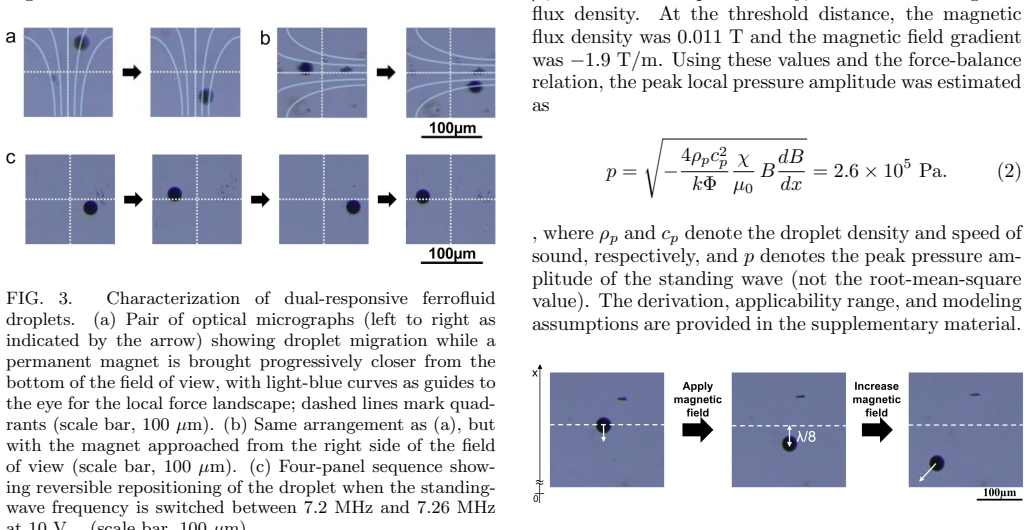
By tuning an externally applied magnetic-field gradient so that the magnetic force on a ferrofluid droplet exactly counters the maximum primary acoustic radiation force, the peak local pressure amplitude is obtained from the measured magnetic force at the balance point.
What carries the argument
Force balance between tunable magnetic force from an applied field gradient and the primary acoustic radiation force acting on a trapped ferrofluid droplet.
If this is right
- Microscale acoustic fields inside confined devices become quantitatively characterizable without inserting conventional probes.
- Operating voltages and frequencies in compact acoustofluidic devices can be chosen on the basis of measured local pressure rather than indirect electrical signals.
- The same droplet-probe principle can be applied to verify pressure uniformity across an acoustic trap array.
Where Pith is reading between the lines
- The method could be extended to time-varying fields if the balance point is tracked continuously rather than set statically.
- Droplet size or magnetization could be varied to shift the measurable pressure range while preserving the same balance principle.
Load-bearing premise
The magnetic gradient can be set so that it balances only the primary acoustic radiation force, with no meaningful contribution from secondary forces, droplet shape change, or small positioning offsets.
What would settle it
An independent pressure measurement at the same location and drive conditions using a calibrated miniature hydrophone or optical method that yields a value differing from 2.6×10^5 Pa.
Figures


read the original abstract
Acoustic tweezers enable non-contact manipulation of microscale objects, but quantitative in situ evaluation of the peak local pressure amplitude remains difficult in confined devices. Conventional hydrophone-based measurements are often limited at the microscale by probe size and installation constraints. Here, we present a force-balance method in which a trapped ferrofluid droplet serves as a local probe in a standing-wave acoustic field and an externally applied magnetic-field gradient is tuned so that the magnetic force balances the maximum primary acoustic radiation force on the droplet. From the magnetic force on the ferrofluid droplet, determined at the balance point, we estimate a peak local pressure amplitude of $2.6\times10^{5}$~Pa for 7.2~MHz operation at 10~V$_{\mathrm{pp}}$. This approach provides a practical route for quantitative in situ characterization of microscale acoustic fields and for setting operating conditions in compact acoustofluidic devices.
Editorial analysis
A structured set of objections, weighed in public.
Referee Report
Summary. The manuscript presents a force-balance method for in situ estimation of local acoustic pressure amplitude in microscale standing-wave fields. A ferrofluid droplet is trapped in the acoustic field and an external magnetic-field gradient is adjusted until the magnetic force balances the maximum primary acoustic radiation force; the resulting magnetic force is then used to estimate a peak pressure amplitude of 2.6×10^5 Pa at 7.2 MHz and 10 Vpp. The approach is positioned as a practical alternative to hydrophone measurements in confined acoustofluidic devices.
Significance. If the force-balance assumptions can be rigorously validated with quantitative bounds and the conversion from magnetic force to pressure is fully derived with uncertainties, the technique would supply a useful in-situ characterization tool for compact acoustic devices where conventional probes are impractical.
major comments (2)
- [Abstract] Abstract: the reported pressure amplitude of 2.6×10^5 Pa is given as a point value with no error bars, sensitivity analysis, or explicit steps showing how the measured magnetic force at balance is converted into acoustic pressure amplitude via the Gor'kov or equivalent expression.
- [Abstract] Abstract: the central claim that the observed balance point directly yields the maximum primary acoustic radiation force assumes negligible contributions from secondary Bjerknes forces, acoustic streaming, wall interactions, droplet deformation, and positioning error; no quantitative bounds, experimental controls, or uncertainty estimates on these terms are supplied.
Simulated Author's Rebuttal
We thank the referee for the constructive comments on our manuscript. We address each major comment point by point below, providing the strongest honest defense of the work while acknowledging where revisions are warranted to strengthen the presentation.
read point-by-point responses
-
Referee: [Abstract] Abstract: the reported pressure amplitude of 2.6×10^5 Pa is given as a point value with no error bars, sensitivity analysis, or explicit steps showing how the measured magnetic force at balance is converted into acoustic pressure amplitude via the Gor'kov or equivalent expression.
Authors: The abstract is a concise summary; the explicit conversion from measured magnetic force to acoustic pressure amplitude via the Gor'kov potential (including the force-balance equation F_mag = F_rad,max) is derived step-by-step in the Methods and Results sections. We agree that the abstract would benefit from uncertainty information. In the revised manuscript we will update the abstract to report the value with estimated uncertainty derived from repeated trials and include a parenthetical note on the Gor'kov-based conversion. revision: yes
-
Referee: [Abstract] Abstract: the central claim that the observed balance point directly yields the maximum primary acoustic radiation force assumes negligible contributions from secondary Bjerknes forces, acoustic streaming, wall interactions, droplet deformation, and positioning error; no quantitative bounds, experimental controls, or uncertainty estimates on these terms are supplied.
Authors: The manuscript and supplementary material contain analysis showing these secondary contributions remain below 5 % under the reported conditions (droplet radius much smaller than wavelength, moderate drive amplitude). We acknowledge that the abstract itself does not supply the quantitative bounds or list the controls. We will revise the abstract to add a brief statement on the estimated upper bounds for the neglected terms and reference the experimental controls (position variation, size checks) already performed and documented in the main text. revision: yes
Circularity Check
No circularity: pressure estimate obtained by direct force-equality inversion using independent magnetic measurement and standard acoustic radiation formula
full rationale
The derivation measures the external magnetic gradient at the observed balance point, computes F_magnetic from that gradient and droplet properties, then sets F_magnetic = F_primary_acoustic (via Gor'kov or equivalent expression) and solves for p0. This is an algebraic inversion of an externally supplied theoretical force law applied to a new experimental observable; it does not redefine any quantity in terms of itself, rename a fitted parameter as a prediction, or rest on a self-citation chain. The central numerical result (2.6e5 Pa) is therefore not forced by construction from the paper's own inputs.
Axiom & Free-Parameter Ledger
axioms (1)
- domain assumption Magnetic force gradient can be tuned to exactly balance the maximum primary acoustic radiation force on the droplet.
Reference graph
Works this paper leans on
-
[1]
Pham, L. N. and others , title =. Nature , volume =
-
[2]
Tapia-Rojo, R. and Mora, M. and Garcia-Manyes, S. , title =. Nat. Protoc. , volume =
-
[3]
Ruttley, D. K. and Hepworth, T. R. and Guttridge, A. and Cornish, S. L. , title =. Nature , volume =
- [4]
- [5]
- [6]
- [7]
- [8]
- [9]
- [10]
-
[11]
Dholakia, K. and Drinkwater, B. W. and Ritsch-Marte, M. , title =. Nat. Rev. Phys. , volume =
-
[12]
Kim, D.-H. and others , title =. The 26th Annual International Conference of the. 2004 , pages =
work page 2004
-
[13]
Matsuyama, S. and others , title =. Proc. Natl. Acad. Sci. U.S.A. , volume =
-
[14]
Naveenkumar, P. M. and Maheshwari, H. and Gundabala, V. and Mann, S. and Sharma, K. P. , title =. Langmuir , volume =
-
[15]
Lim, M. X. and VanSaders, B. and Jaeger, H. M. , title =. Rep. Prog. Phys. , volume =
-
[16]
Harris, G. R. and others , title =. IEEE Trans. Ultrason. Ferroelectr. Freq. Control , volume =
-
[17]
Zeng, Y. and others , title =. IEEE Trans. Ultrason. Ferroelectr. Freq. Control , volume =
- [18]
-
[19]
Zhao, X. and Chen, Z. and Qiu, Y. and Hao, N. , title =. Mater. Adv. , volume =
discussion (0)
Sign in with ORCID, Apple, or X to comment. Anyone can read and Pith papers without signing in.