REVIEW 4 major objections 6 minor 40 references
DreamBoothDPO: Improving Personalized Generation using Direct Preference Optimization
T0 review · 4 major / 6 minor · reviewed 2026-08-07 · deepseek-v4-flash
Pith's one-line read Automatic preference pairs improve personalized image generation on both fidelity and prompt adherence.
desk verdict A practical DPO wrapper for DreamBooth with a genuinely new angle-filtering mechanism, but the 'Pareto frontier' claim is partly circular because training and evaluation share the same CLIP metrics. read the letter →
The pith
A machine-rendered reading of the paper's core claim, the machinery that carries it, and where it could break.
The reading
What carries the argument
The load-bearing mechanism is angle-based pair filtering in score-delta space. Each candidate pair of generated images is summarized by the two deltas ΔTS and ΔIS, the changes in text similarity and image similarity from the worse to the better image, and the angle α = atan2(ΔIS, ΔTS). Only pairs with C1 < α < C2 are kept, instead of thresholding the scalar weighted score λ·TS + (1−λ)·IS. Because the angle distribution is bimodal, this cone selects pairs whose improvement lies in the desired region of the trade-off plane, giving directional control; the same automatic pipeline uses CLIP-based scores to construct pairs and a multi-step regeneration loop to keep the pairs aligned with the evolving model.
What would settle it
A reader could rerun the two-step DreamBoothDPO pipeline with the angle-filtered pairs evaluated by human raters or by an independent image-text scorer that was never used to build the pairs; if human raters or the independent scorer do not reproduce the reported -TS gain on prompt adherence and -IS gain on concept fidelity relative to the base checkpoint, the central claim is false.
Extended reading notes
Core claim
The central claim is that the fidelity-alignment Pareto frontier of personalized generation is not fixed: by applying DPO to synthetic preference pairs built from the model's own outputs, both image similarity to the concept and text similarity to the prompt can be improved at once. The pairs are generated automatically by sampling a diverse prompt set, scoring each image with the CLIP image-similarity and text-similarity measures, and selecting better–worse pairs whose score differences lie in a controlled angular interval. Varying the interval yields three named variants, -TS, -IS, and -MIX, which are shown to steer optimization toward prompt adherence, concept fidelity, or a balance. The paper also claims that regenerating pairs from the evolving model over two to three rounds improves convergence and quality, and that the recipe works with DreamBooth and SVDiff checkpoints on two base architectures.
Load-bearing premise
The whole pipeline rests on the assumption that the CLIP-based image-similarity and text-similarity scores are faithful measures of concept fidelity and prompt adherence, because the same scores choose the training pairs and measure the reported gains.
Editorial extensions
If this is right
- A practitioner can improve both concept fidelity and prompt adherence beyond their starting personalization checkpoint without collecting any human preference labels.
- By choosing the angle bounds, the same pipeline can be pointed toward prompt adherence, concept fidelity, or a balanced mix without retraining from scratch.
- Two DPO rounds with about 1000 prompts and 10 images per prompt recover most of the quality gain at lower compute than a single round with 4000 prompts.
- The automatic pair-construction recipe transfers across the personalization backbones and base architectures tested, including a LoRA-based large-model setting.
- In a side-by-side user study, human assessors preferred the DPO outputs over the baseline more often than the reverse.
Reading between the lines
- Because the same CLIP-based scores build the pairs and evaluate the result, the reported Pareto gains may partly reflect optimizing the evaluation metric itself; a held-out human judgment or an independent scorer would settle how much is real improvement.
- The angle-filtering idea is not tied to CLIP: any pair of quality metrics with a meaningful angle distribution could be used, so the same directional-control mechanism may generalize to other image-quality axes such as photorealism or safety.
- The paper selects two-step training after comparing up to ten rounds, but the long-horizon behavior of repeated self-bootstrapping is not characterized, and it could in principle drift or collapse.
- The method relies on the model's own outputs being diverse enough to form informative pairs; for concepts or prompts where the base model produces nearly identical samples, the preference signal would be weak no matter how the angle filter is set.
Editorial analysis
A structured set of objections, weighed in public.
Referee Report
Summary. The paper proposes DreamBoothDPO, a post-hoc fine-tuning stage for personalized text-to-image models that uses Direct Preference Optimization with automatically generated preference pairs. Pairs are produced by sampling multiple images per prompt from the fine-tuned model, scoring them with CLIP-based Image Similarity and Text Similarity (Eqs. 5–6), and applying an angle-based filter (Eq. 7) that restricts the direction of the preference. A multi-step training scheme periodically refreshes the samples and pairs. The authors report improvements in CLIP-I and CLIP-T over DreamBooth and SVDiff on SD2 and SDXL, with controllable trade-offs between the two metrics, and they support these claims with qualitative examples and a user study.
Significance. If the claims hold, the paper offers a practical, fully automatic method to improve personalized generation without human-annotated preferences, with directional control over fidelity and alignment. The release of source code is a strength. However, the headline claim of surpassing the Pareto frontier is based on the same CLIP-based metrics used as the training reward, and the user study's high 'No Diff' rates provide only weak independent confirmation. The method's core idea is potentially valuable, but the evidence as presented does not yet establish genuine improvements in concept fidelity and prompt adherence beyond metric optimization.
major comments (4)
- [Sections 4.2, 4.4, 5.1, Limitations; Eqs. (5), (6)] The training signal and the headline evaluation are the same CLIP-based IS and TS functions. IS in Eq. (5) is a mean cosine similarity between the generated image and the reference concept images C, and CLIP-I in Section 5.1 is computed against the same C. Consequently, a model that increases IS during DPO training will, by construction, tend to score higher on CLIP-I at evaluation. The Limitations section acknowledges reliance on 'CLIP-style similarity metrics' but this does not mitigate the circularity. The paper should include independent non-CLIP evaluations (e.g., DINO or face-recognition similarity, LPIPS, or a forced-choice user study without a 'Can't decide' option) or a control model that optimizes the same scalar scores via direct RL, to demonstrate that the gains reflect genuine fidelity and alignment rather than reward overfitting to the CLIP metric.
- [Section 3.3, Eq. (4)] The DPO loss is written for a generic generative model p_theta(x|c), but the method is applied to latent diffusion models for which exact image likelihoods are intractable. The paper does not specify how log p_theta(x_w|c)/p_ref(x_l|c) is computed or approximated (e.g., via the denoising-score-matching decomposition of Diffusion-DPO). Without this specification, the training objective is not well-defined and the results are not reproducible. Please provide the exact loss, either by deriving it for the diffusion setting or by explicitly stating that the Diffusion-DPO approximation of Wallace et al. is used and giving the corresponding concrete objective.
- [Section 5.3, Table 1] The user study provides weak support for the main claim. On the TS question, 79.7–89.5% of responses are 'No Diff', with winning margins of only 2.7–11.2 percentage points; the 'All' row shows 47.8–56.0% 'No Diff'. Moreover, the sentence 'users preferred DB-DPO over baseline outputs in a majority of cases, with up to 50% higher preference' is not directly supported by the numbers in Table 1 (e.g., DPO-SDXL-TS 'All' win 31.7% vs. lose 20.5% corresponds to a 55% share of decisive votes, not a 50% increase). The authors should report win rates conditional on a perceived difference, include confidence intervals or significance tests, and precisely define any 'higher preference' claim.
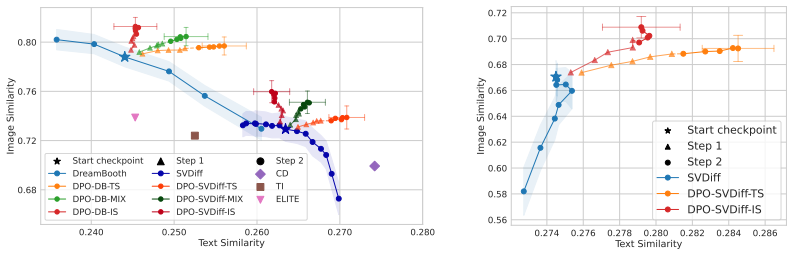
- [Section 5.2, Figures 6 and 7] The claim that the method 'surpasses Pareto frontier' compares DPO points against a few baseline checkpoints (DreamBooth, SVDiff), not against the actual frontier of achievable (IS, TS) trade-offs. A proper test would include common trade-off mechanisms such as sampling-time guidance variation, prompt reweighting, or the authors' own lambda-sweep in Eq. (6). The current figures show only that the DPO variants are northeast of the selected baselines, which is a weaker statement. Please either soften the claim or provide a more complete frontier comparison.
minor comments (6)
- [Section 4.4, after Eq. (7)] The typo 'DreabBoothDPO' should be corrected to 'DreamBoothDPO'.
- [Section 4.4, Figure 4 caption] The reference 'Figure 4(3)' should be 'Figure 4(c)'.
- [Section 3.3 and References] The paper cites both [11] (Rafailov et al.) and [21] (Wallace et al.) for DPO; please clarify which formulation is used for diffusion and ensure the reference numbering is consistent throughout.
- [Section 5.2] The phrase 'DPO-TS significantly boosts TS' uses 'significantly' without a statistical test; please replace it with a precise quantitative claim, especially given the overlapping error bars visible in the figures.
- [Appendix B] The relationship between '500 steps' and 'each preference pair is seen 5 times' is unclear; please specify how the number of training steps relates to epoch counts and how many pairs are in a batch.
- [Eq. (5)] Please explicitly state that CLIP-I and CLIP-T denote the image and text encoders, respectively, to avoid confusion with the scored metrics.
Circularity Check
No significant circularity: the reported CLIP-I/CLIP-T improvements are empirical gains on held-out DreamBench prompts, not a tautological consequence of using the same scores to build preference pairs.
full rationale
The paper's optimization and evaluation share the same CLIP-based IS/TS definitions (Equations 5 and 6), and the paper is transparent about this in the Limitations section: 'the current score functions rely on CLIP-style similarity metrics.' This overlap is not a circular derivation, however. The preference pairs for DPO are generated from 4000 held-out prompts (3000 COCO-derived and 1000 LLM-generated; Section 5.1 and Appendix A), while evaluation is on DreamBench prompts, so the reported CLIP-I/CLIP-T gains are a generalization result rather than a re-statement of the training objective. The DPO update (Equation 4) optimizes a likelihood-ratio objective over selected pairs; it does not directly maximize the scalar score S, and Figure 1(a) shows that optimizing individual objectives can degrade the other, so the simultaneous improvement is not guaranteed by construction. No load-bearing self-citation appears: the only overlapping-author reference is [29], cited in Section 4.1 as one of several techniques that can shift the frontier, and it is incidental. There is no imported uniqueness theorem, no ansatz smuggled in via citation, and no renaming of a known result. The metric-overlap concern is a measurement-validity limitation rather than circularity, and the user study provides independent, though weak, evidence. Therefore no circular step is established.
Assumptions & free parameters
free parameters (6)
- lambda score weights =
sweeps: 0, 0.25, 0.5, 0.75, 1, 0.625, 0.6875, 0.71875
- angle bounds C1, C2 =
(-20,70), (0,90), (-10,80)
- score gap threshold tau =
retains top 56%, 14%, 6%, 3% of pairs
- DPO regularization beta =
5000
- images per prompt M =
10 (4 in ablation)
- number of prompts N and DPO steps =
1000 prompts, 2 DPO steps, each pair seen 5 times
assumptions (4)
- domain assumption CLIP-based IS and TS scores are reliable proxies for concept fidelity and prompt adherence.
- domain assumption The DPO loss for discrete text transfers to continuous diffusion latents as implemented.
- domain assumption Preference pairs generated from the current model's samples are informative beyond the training prompt set.
- domain assumption The reference distribution for DPO can be the personalized checkpoint itself.
Cite this review
Pith. "Pith review of DreamBoothDPO: Improving Personalized Generation using Direct Preference Optimization." pith.science (2026). https://pith.science/paper/7SJ4EU45
@misc{pith2026250520975,
  author       = {Pith},
  title        = {Pith review of: DreamBoothDPO: Improving Personalized Generation using Direct Preference Optimization},
  year         = {2026},
  howpublished = {\url{https://pith.science/paper/7SJ4EU45}},
  note         = {Machine review of arXiv:2505.20975}
}
read the original abstract
Personalized diffusion models have shown remarkable success in Text-to-Image (T2I) generation by enabling the injection of user-defined concepts into diverse contexts. However, balancing concept fidelity with contextual alignment remains a challenging open problem. In this work, we propose an RL-based approach that leverages the diverse outputs of T2I models to address this issue. Our method eliminates the need for human-annotated scores by generating a synthetic paired dataset for DPO-like training using external quality metrics. These better-worse pairs are specifically constructed to improve both concept fidelity and prompt adherence. Moreover, our approach supports flexible adjustment of the trade-off between image fidelity and textual alignment. Through multi-step training, our approach outperforms a naive baseline in convergence speed and output quality. We conduct extensive qualitative and quantitative analysis, demonstrating the effectiveness of our method across various architectures and fine-tuning techniques. The source code can be found at https://github.com/ControlGenAI/DreamBoothDPO.
Figures


Figures from the paper (11 more)




Reference graph
Works this paper leans on
-
[1]
Hierarchical text-conditional image generation with clip latents,
A. Ramesh, P. Dhariwal, A. Nichol, C. Chu, and M. Chen, “Hierarchical text-conditional image generation with clip latents,” arXiv preprint arXiv:2204.06125, vol. 1, no. 2, p. 3, 2022
arXiv 2022
-
[2]
Photorealistic text-to-image diffusion models with deep language understanding,
C. Saharia, W. Chan, S. Saxena, L. Li, J. Whang, E. L. Denton, K. Ghasemipour, R. Gon- tijo Lopes, B. Karagol Ayan, T. Salimans,et al., “Photorealistic text-to-image diffusion models with deep language understanding,” Advances in neural information processing systems, vol. 35, pp. 36479–36494, 2022
work page 2022
-
[3]
High-resolution image synthesis with latent diffusion models,
R. Rombach, A. Blattmann, D. Lorenz, P. Esser, and B. Ommer, “High-resolution image synthesis with latent diffusion models,” inProceedings of the IEEE/CVF conference on computer vision and pattern recognition, pp. 10684–10695, 2022
2022
-
[4]
Dreambooth: Fine tuning text-to-image diffusion models for subject-driven generation,
N. Ruiz, Y . Li, V . Jampani, Y . Pritch, M. Rubinstein, and K. Aberman, “Dreambooth: Fine tuning text-to-image diffusion models for subject-driven generation,” in Proceedings of the IEEE/CVF conference on computer vision and pattern recognition, pp. 22500–22510, 2023
work page 2023
-
[5]
An image is worth one word: Personalizing text-to-image generation using textual inversion,
R. Gal, Y . Alaluf, Y . Atzmon, O. Patashnik, A. H. Bermano, G. Chechik, and D. Cohen-Or, “An image is worth one word: Personalizing text-to-image generation using textual inversion,” 2022
work page 2022
-
[6]
Id-aligner: Enhancing identity- preserving text-to-image generation with reward feedback learning,
W. Chen, J. Zhang, J. Wu, H. Wu, X. Xiao, and L. Lin, “Id-aligner: Enhancing identity- preserving text-to-image generation with reward feedback learning,” 2024
work page 2024
-
[7]
Proximal preference optimization for diffusion models,
F. Deng, Q. Wang, W. Wei, T. Hou, and M. Grundmann, “Proximal preference optimization for diffusion models,” 2024
work page 2024
-
[8]
Versat2i: Improving text-to-image models with versatile reward,
J. Guo, W. Chai, J. Deng, H.-W. Huang, T. Ye, Y . Xu, J. Zhang, J.-N. Hwang, and G. Wang, “Versat2i: Improving text-to-image models with versatile reward,” 2024
work page 2024
Show all 40 references
-
[9]
Imagereward: Learning and evaluating human preferences for text-to-image generation,
J. Xu, X. Liu, Y . Wu, Y . Tong, Q. Li, M. Ding, J. Tang, and Y . Dong, “Imagereward: Learning and evaluating human preferences for text-to-image generation,” 2023
2023
-
[10]
Elucidating optimal reward-diversity tradeoffs in text-to-image diffusion models,
R. Jena, A. Taghibakhshi, S. Jain, G. Shen, N. Tajbakhsh, and A. Vahdat, “Elucidating optimal reward-diversity tradeoffs in text-to-image diffusion models,” 2024
2024
-
[11]
Direct preference optimization: Your language model is secretly a reward model,
R. Rafailov, A. Sharma, E. Mitchell, S. Ermon, C. D. Manning, and C. Finn, “Direct preference optimization: Your language model is secretly a reward model,” 2024
2024
-
[12]
Svdiff: Compact parameter space for diffusion fine-tuning,
L. Han, Y . Li, H. Zhang, P. Milanfar, D. Metaxas, and F. Yang, “Svdiff: Compact parameter space for diffusion fine-tuning,” 2023
2023
-
[13]
Multi-concept customization of text-to-image diffusion,
N. Kumari, B. Zhang, R. Zhang, E. Shechtman, and J.-Y . Zhu, “Multi-concept customization of text-to-image diffusion,” 2023
2023
-
[14]
Idadapter: Learning mixed features for tuning-free personalization of text-to-image models,
S. Cui, J. Guo, X. An, J. Deng, Y . Zhao, X. Wei, and Z. Feng, “Idadapter: Learning mixed features for tuning-free personalization of text-to-image models,” 2024
2024
-
[15]
Elite: Encoding visual concepts into textual embeddings for customized text-to-image generation,
Y . Wei, Y . Zhang, Z. Ji, J. Bai, L. Zhang, and W. Zuo, “Elite: Encoding visual concepts into textual embeddings for customized text-to-image generation,” 2023
2023
-
[16]
Hyperdreambooth: Hypernetworks for fast personalization of text-to-image models,
N. Ruiz, Y . Li, V . Jampani, W. Wei, T. Hou, Y . Pritch, N. Wadhwa, M. Rubinstein, and K. Aberman, “Hyperdreambooth: Hypernetworks for fast personalization of text-to-image models,” 2024
2024
-
[17]
Blip-diffusion: Pre-trained subject representation for controllable text-to-image generation and editing,
D. Li, J. Li, and S. C. H. Hoi, “Blip-diffusion: Pre-trained subject representation for controllable text-to-image generation and editing,” 2023
2023
-
[18]
Subject-diffusion:open domain personalized text-to-image generation without test-time fine-tuning,
J. Ma, J. Liang, C. Chen, and H. Lu, “Subject-diffusion:open domain personalized text-to-image generation without test-time fine-tuning,” 2024
2024
-
[19]
Enhancing diffusion models with text-encoder reinforcement learning,
C. Chen, A. Wang, H. Wu, L. Liao, W. Sun, Q. Yan, and W. Lin, “Enhancing diffusion models with text-encoder reinforcement learning,” 2024. 10
2024
-
[20]
Towards better alignment: Training diffusion models with reinforcement learning against sparse rewards,
Z. Hu, F. Zhang, L. Chen, K. Kuang, J. Li, K. Gao, J. Xiao, X. Wang, and W. Zhu, “Towards better alignment: Training diffusion models with reinforcement learning against sparse rewards,” 2025
2025
-
[21]
Diffusion model alignment using direct preference optimization,
B. Wallace, M. Dang, R. Rafailov, L. Zhou, A. Lou, S. Purushwalkam, S. Ermon, C. Xiong, S. Joty, and N. Naik, “Diffusion model alignment using direct preference optimization,” inPro- ceedings of the IEEE/CVF Conference on Computer Vision and Pattern Recognition, pp. 8228– 8238, 2024
2024
-
[22]
Tuning timestep-distilled diffusion model using pairwise sample optimization,
Z. Miao, Z. Yang, K. Lin, Z. Wang, Z. Liu, L. Wang, and Q. Qiu, “Tuning timestep-distilled diffusion model using pairwise sample optimization,” 2025
2025
-
[23]
Patchdpo: Patch-level dpo for finetuning-free personalized image generation,
Q. Huang, L. Chan, J. Liu, W. He, H. Jiang, M. Song, and J. Song, “Patchdpo: Patch-level dpo for finetuning-free personalized image generation,” 2024
2024
-
[24]
High-resolution image synthesis with latent diffusion models,
R. Rombach, A. Blattmann, D. Lorenz, P. Esser, and B. Ommer, “High-resolution image synthesis with latent diffusion models,” 2022
2022
-
[25]
Auto-encoding variational bayes,
D. P. Kingma and M. Welling, “Auto-encoding variational bayes,” 2022
2022
-
[26]
Denoising diffusion implicit models,
J. Song, C. Meng, and S. Ermon, “Denoising diffusion implicit models,” 2022
2022
-
[27]
Training language models to follow instructions with human feedback,
L. Ouyang, J. Wu, X. Jiang, D. Almeida, C. L. Wainwright, P. Mishkin, C. Zhang, S. Agarwal, K. Slama, A. Ray, J. Schulman, J. Hilton, F. Kelton, L. Miller, M. Simens, A. Askell, P. Welinder, P. Christiano, J. Leike, and R. Lowe, “Training language models to follow instructions...
2022
-
[28]
Realcustom: Narrowing real text word for real-time open-domain text-to-image customization,
M. Huang, Z. Mao, M. Liu, Q. He, and Y . Zhang, “Realcustom: Narrowing real text word for real-time open-domain text-to-image customization,” 2024
2024
-
[29]
Beyond fine-tuning: A systematic study of sampling techniques in personalized image generation,
V . Soboleva, M. Nakhodnov, and A. Alanov, “Beyond fine-tuning: A systematic study of sampling techniques in personalized image generation,” 2025
2025
-
[30]
Photoswap: Personalized subject swapping in images,
J. Gu, Y . Wang, N. Zhao, T.-J. Fu, W. Xiong, Q. Liu, Z. Zhang, H. Zhang, J. Zhang, H. Jung, and X. E. Wang, “Photoswap: Personalized subject swapping in images,” 2023
2023
-
[31]
Enhancing detail preservation for customized text-to- image generation: A regularization-free approach,
Y . Zhou, R. Zhang, T. Sun, and J. Xu, “Enhancing detail preservation for customized text-to- image generation: A regularization-free approach,” 2023
2023
-
[32]
Microsoft coco: Common objects in context,
T.-Y . Lin, M. Maire, S. Belongie, L. Bourdev, R. Girshick, J. Hays, P. Perona, D. Ramanan, C. L. Zitnick, and P. Dollár, “Microsoft coco: Common objects in context,” 2015
2015
-
[33]
Gpt-4 technical report,
OpenAI, J. Achiam, S. Adler, S. Agarwal, L. Ahmad, I. Akkaya, F. L. Aleman, D. Almeida, J. Altenschmidt, S. Altman, S. Anadkat, R. Avila, I. Babuschkin, S. Balaji, V . Balcom, P. Bal- tescu, H. Bao, M. Bavarian, J. Belgum, I. Bello, J. Berdine, G. Bernadett-Shapiro, C. Berner,...
2024
-
[34]
Learning transferable visual models from natural language supervision,
A. Radford, J. W. Kim, C. Hallacy, A. Ramesh, G. Goh, S. Agarwal, G. Sastry, A. Askell, P. Mishkin, J. Clark, G. Krueger, and I. Sutskever, “Learning transferable visual models from natural language supervision,” 2021
2021
-
[35]
Pseudo numerical methods for diffusion models on manifolds,
L. Liu, Y . Ren, Z. Lin, and Z. Zhao, “Pseudo numerical methods for diffusion models on manifolds,” 2022
2022
-
[36]
Elucidating the design space of diffusion-based generative models,
T. Karras, M. Aittala, T. Aila, and S. Laine, “Elucidating the design space of diffusion-based generative models,” 2022
2022
-
[37]
U-net: Convolutional networks for biomedical image segmentation,
O. Ronneberger, P. Fischer, and T. Brox, “U-net: Convolutional networks for biomedical image segmentation,” 2015
2015
-
[38]
Sdxl: Improving latent diffusion models for high-resolution image synthesis,
D. Podell, Z. English, K. Lacey, A. Blattmann, T. Dockhorn, J. Müller, J. Penna, and R. Rom- bach, “Sdxl: Improving latent diffusion models for high-resolution image synthesis,” 2023
2023
-
[39]
Lora: Low-rank adaptation of large language models,
E. J. Hu, Y . Shen, P. Wallis, Z. Allen-Zhu, Y . Li, S. Wang, L. Wang, and W. Chen, “Lora: Low-rank adaptation of large language models,” 2021. 12 A Data collection To ensure sufficient diversity in visual contexts and styles, we collect a total of 4000 prompts per concept: 30...
2021
-
[40]
Which image is more consistent with the text prompt?
"Which image is more consistent with the text prompt?" 2) "Which image better represents the original image?" 3) "Which image is generally better in terms of alignment with the prompt and concept identity preservation?" For each question, users selected one of three responses:...
Reviewed August 7, 2026 · model on record in the stance chip above.
Discussion (0). Sign in to comment.