The dynamic 4.8.8 Floquet code
Pith reviewed 2026-06-27 16:46 UTC · model grok-4.3
The pith
Dynamic 4.8.8 Floquet circuits preserve full spatial distance while achieving a 0.512% error threshold.
A machine-rendered reading of the paper's core claim, the machinery that carries it, and where it could break.
Core claim
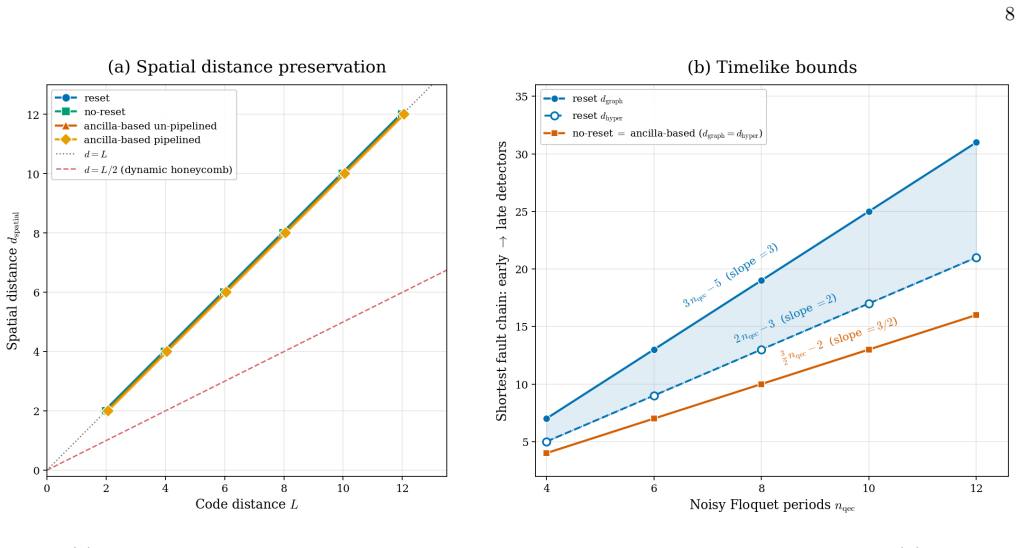
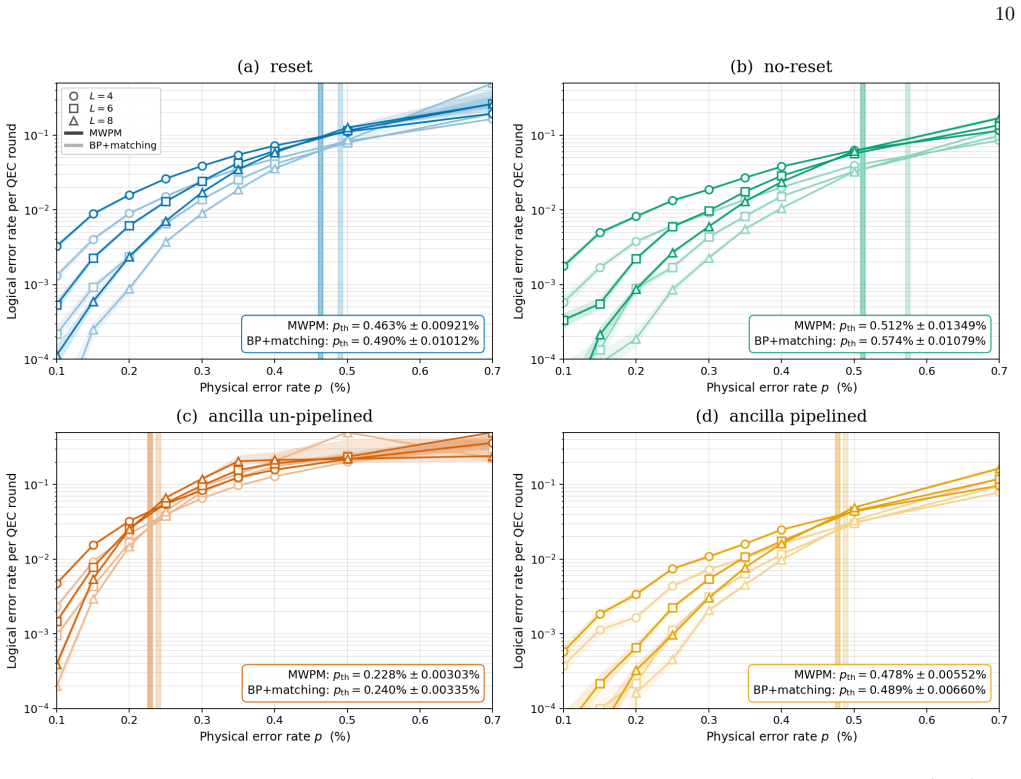
A dynamic measurement schedule for the 4.8.8 Floquet code on the torus preserves the full spatial distance of the CSS code. The no-reset dynamic circuit achieves a per-round threshold of 0.512% (0.574% with BP+matching) under depolarizing noise, higher than the 0.228% of the standard ancilla circuit. The reset dynamic circuit shows timelike distance growing at a rate between 2 and 3 per QEC round, leading to lower spacetime volume in the fast-reset regime.
What carries the argument
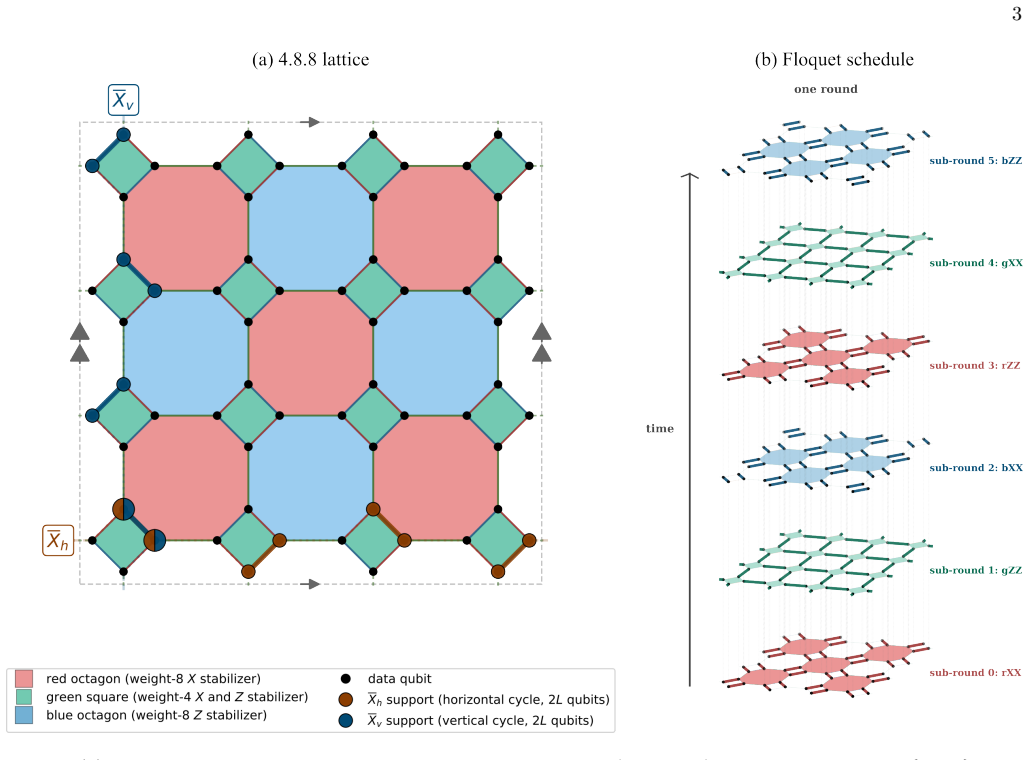
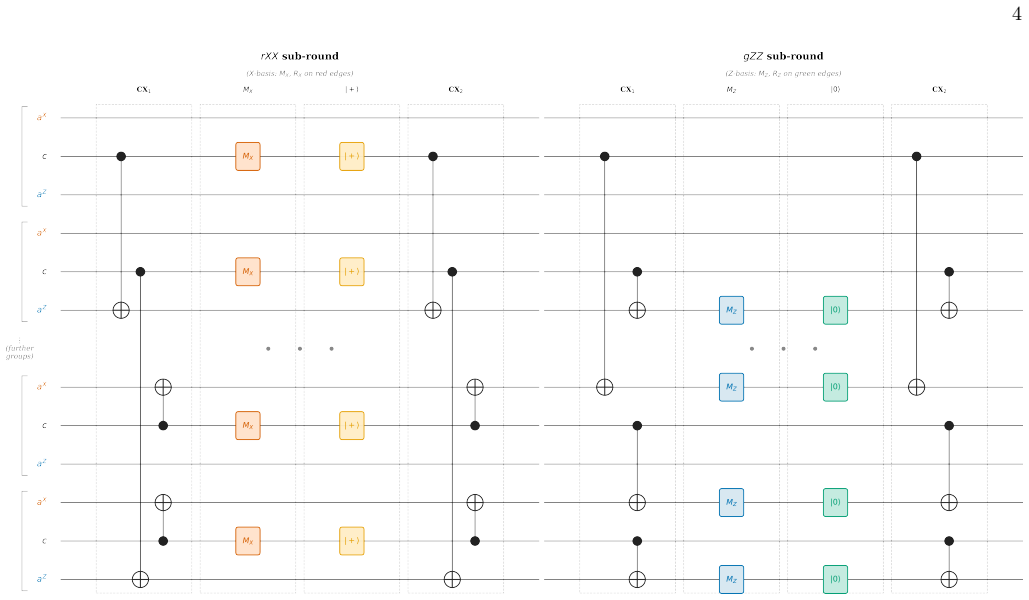
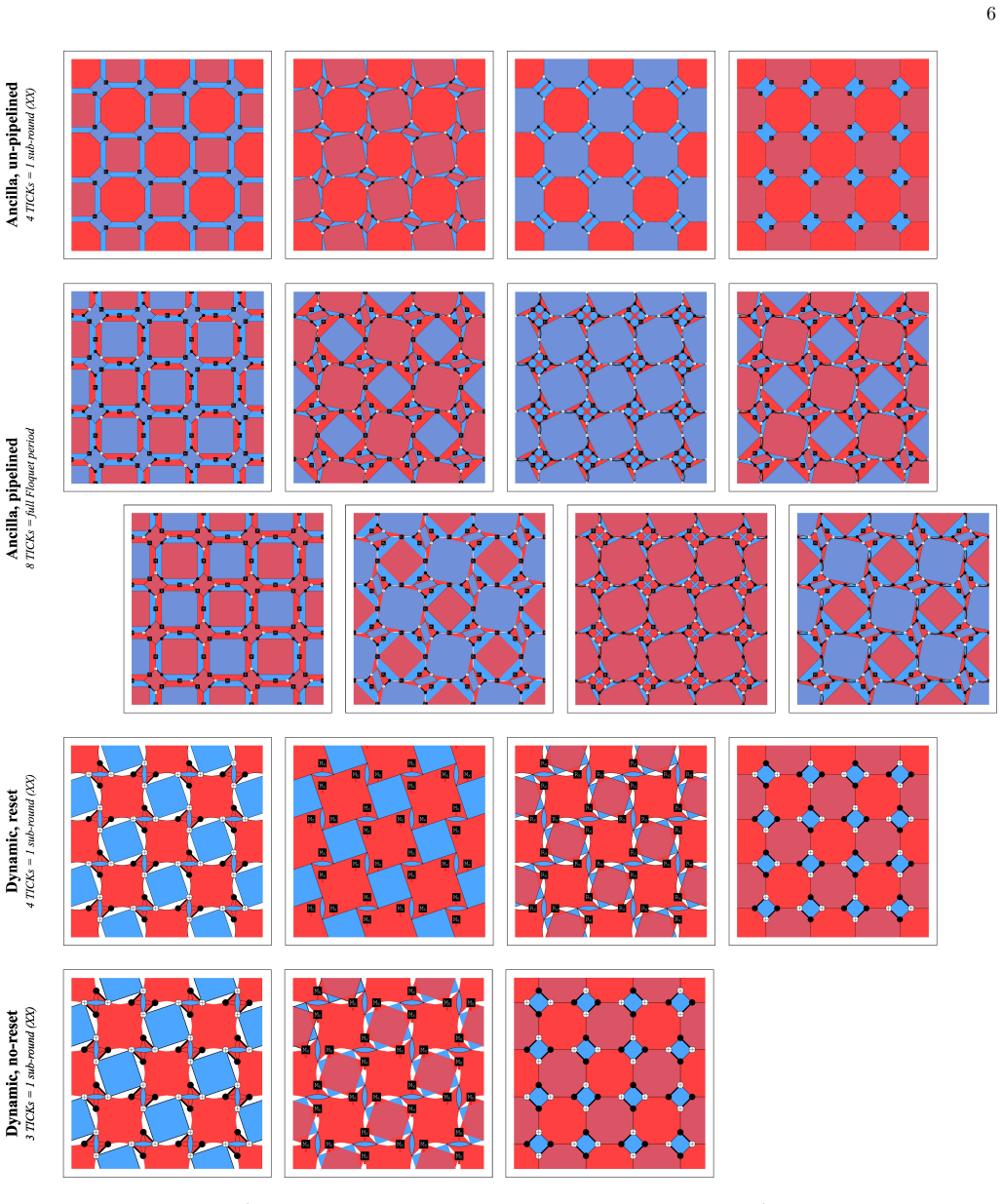
Dynamic measurement schedule for the CSS 4.8.8 Floquet code with and without mid-circuit resets
If this is right
- The reset dynamic circuit has faster timelike distance growth than the other schedules.
- The reset dynamic circuit gives the smallest spacetime volume when mid-circuit resets are fast.
- The no-reset dynamic circuit gives the smallest spacetime volume when resets are slow.
- Dynamic circuits achieve higher thresholds than both standard and pipelined ancilla circuits.
Where Pith is reading between the lines
- The success on the 4.8.8 lattice suggests that lattice geometry plays a key role in whether dynamic schedules can avoid distance penalties.
- Dynamic syndrome extraction could be explored for other types of quantum codes to reduce ancilla overhead.
Load-bearing premise
The 4.8.8 lattice admits a CSS Floquet code whose dynamic measurement schedule preserves the full spatial code distance.
What would settle it
A calculation of the weight of logical operators in the dynamic circuit that finds them shorter than the expected spatial distance of the code.
Figures
read the original abstract
Fault-tolerant quantum memories depend on the syndrome extraction circuit as much as on the underlying code. Ancilla-free or dynamic circuits are an effective way to improve this circuit layer. For the 6.6.6 honeycomb Floquet code, making the circuit dynamic raises the threshold and lowers the qubit overhead, but at the cost of halving the spatial code distance. A dynamic construction for the 4.8.8 lattice layout was conjectured to preserve full distance. I confirm this and give a dynamic measurement circuit for the CSS 4.8.8 Floquet code. To benchmark it, I construct and compare four circuit-level implementations on a torus, including two dynamic variants (with and without mid-circuit resets), the standard ancilla-based circuit, and a pipelined ancilla-based circuit. Under circuit-level depolarising noise, the reset dynamic circuit reaches a per-round threshold of $0.463\%$ $(0.490\%)$ with MWPM (BP+matching), while the no-reset variant reaches the highest threshold of all four circuits at $0.512\%$ $(0.574\%)$. The standard ancilla-based circuit only achieves $0.228\%$ $(0.240\%)$, but the pipelined schedule reaches $0.478\%$ $(0.489\%)$. The reset dynamic circuit also has a faster-growing timelike distance, with $2\le d_t/n_{\mathrm{qec}}\le 3$ asymptotically against a tight $3/2$ for the other three, and running it for fewer rounds gives the smallest spacetime volume in the fast-reset regime, while the no-reset variant is smallest in the slow-reset regime. The 4.8.8 dynamic circuits therefore see the expected threshold gain and overhead reduction without the spatial-distance cost, demonstrating the advantage of dynamic syndrome extraction in Floquet codes.
Editorial analysis
A structured set of objections, weighed in public.
Referee Report
Summary. The paper constructs a dynamic measurement circuit for the CSS 4.8.8 Floquet code on the 4.8.8 lattice, confirming a prior conjecture that this schedule preserves full spatial code distance (unlike the 6.6.6 honeycomb case). It benchmarks four circuit-level implementations on a torus under depolarizing noise—dynamic with resets, dynamic without resets, standard ancilla-based, and pipelined ancilla-based—reporting per-round thresholds of 0.463% (MWPM)/0.490% (BP+matching) for reset-dynamic, 0.512%/0.574% for no-reset dynamic, 0.228%/0.240% for standard, and 0.478%/0.489% for pipelined. It further analyzes timelike distance growth (2 ≤ d_t / n_qec ≤ 3 asymptotically for reset-dynamic vs. tight 3/2 for others) and spacetime volumes in fast- and slow-reset regimes.
Significance. If the distance-preservation claim holds, the work demonstrates that dynamic syndrome extraction can deliver threshold gains and overhead reductions in Floquet codes without the spatial-distance penalty seen in prior lattices, with concrete numerical evidence from circuit-level simulations and explicit comparisons across variants. The no-reset dynamic circuit's superior threshold and the reset variant's faster timelike distance growth are notable strengths for practical implementation.
major comments (1)
- [Circuit construction and distance claim (abstract and the section presenting the dynamic measurement schedule)] The central claim that the dynamic 4.8.8 schedule realizes a CSS Floquet code while preserving full spatial code distance (unlike 6.6.6) is load-bearing yet lacks an explicit verification method. No combinatorial argument, minimum-weight logical operator search over the time-dependent measurement pattern, or check confirming that the schedule does not admit lower-weight logicals consistent with the syndrome rounds is provided; numerical thresholds alone cannot establish this, as they remain consistent with reduced distance at the simulated system sizes.
Simulated Author's Rebuttal
We thank the referee for their careful reading of the manuscript and for highlighting the need for stronger verification of the distance-preservation claim. We address this point below and will revise accordingly.
read point-by-point responses
-
Referee: [Circuit construction and distance claim (abstract and the section presenting the dynamic measurement schedule)] The central claim that the dynamic 4.8.8 schedule realizes a CSS Floquet code while preserving full spatial code distance (unlike 6.6.6) is load-bearing yet lacks an explicit verification method. No combinatorial argument, minimum-weight logical operator search over the time-dependent measurement pattern, or check confirming that the schedule does not admit lower-weight logicals consistent with the syndrome rounds is provided; numerical thresholds alone cannot establish this, as they remain consistent with reduced distance at the simulated system sizes.
Authors: We agree that the distance-preservation claim is central and that numerical thresholds from finite-size simulations, while consistent with full distance, do not by themselves constitute rigorous proof. The manuscript confirms the prior conjecture via circuit-level results on tori, but does not include an explicit combinatorial argument or exhaustive minimum-weight search over the time-dependent schedule. We will revise the section describing the dynamic measurement schedule to add a clear statement of the verification approach used (including any logical-operator weight checks performed) and to explicitly note the limitations of the numerical evidence. If a compact combinatorial argument can be supplied, it will be included; otherwise the text will clarify that the claim rests on the observed scaling of thresholds. revision: yes
Circularity Check
No significant circularity; results from independent Monte Carlo simulations
full rationale
The paper's central results (threshold values under depolarizing noise) are obtained via numerical Monte Carlo sampling with standard decoders (MWPM, BP+matching) on explicit circuit constructions. No equations or definitions reduce these thresholds to parameters fitted from the claimed outcomes themselves. The distance-preservation assertion is presented as confirmation of a prior conjecture via an explicit dynamic measurement schedule; this is a constructive claim rather than a self-definitional loop, fitted-input prediction, or load-bearing self-citation chain that collapses the derivation. The provided abstract and reader summary contain no quoted reduction of the form 'X is defined in terms of Y' or 'prediction equals the fit by construction.'
Axiom & Free-Parameter Ledger
axioms (2)
- domain assumption The 4.8.8 lattice admits a CSS Floquet code whose dynamic measurement schedule preserves full spatial distance.
- domain assumption Circuit-level depolarizing noise accurately models errors during syndrome extraction in the four schedules.
Reference graph
Works this paper leans on
-
[1]
I also drop the topological detectors, those cor- responding to non-contractible loops on the torus that are not useful for memory experiments (Appendix G)
I reduce it using greedyXOR-pairwise reduction, which repeatedly tries to replaceD i withD i ⊕D j if the resulting weight is lower, until no further reduction is possible. I also drop the topological detectors, those cor- responding to non-contractible loops on the torus that are not useful for memory experiments (Appendix G). After reduction and dropping...
-
[2]
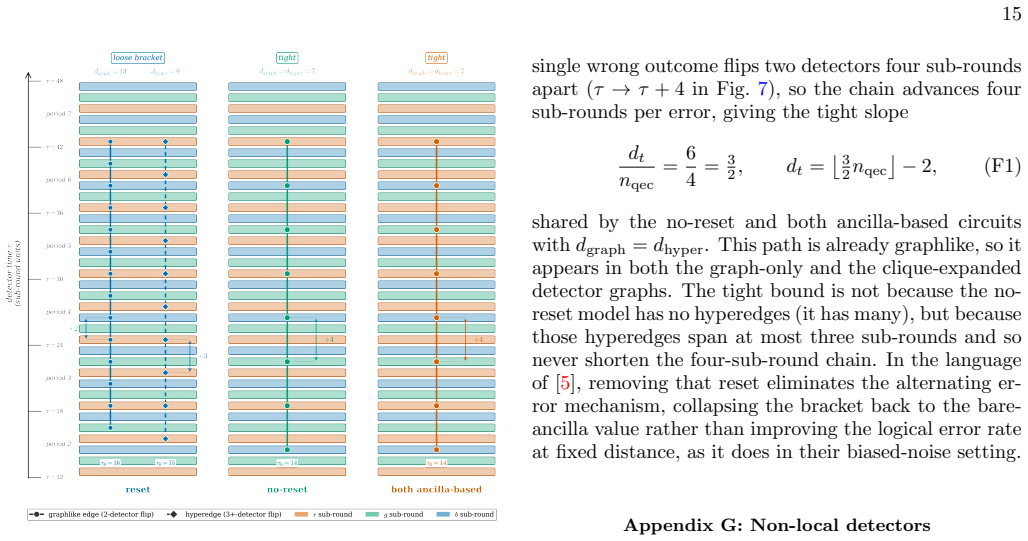
(9) Thus, only the reset dynamic variant shows an increased timelike-distance bound relative to the ancilla-based cir- cuits, with a finite-window gain of 1.33–2×per Floquet period. The reset behaviour is similar to the improve- ment observed when moving from the standard ancilla honeycomb code, though the two codes must be com- pared per sub-round rather...
-
[3]
M. B. Hastings and J. Haah, Dynamically generated log- ical qubits, Quantum5, 564 (2021), arXiv:2107.02194
arXiv 2021
- [4]
-
[5]
A. Paetznick, C. Knapp, N. Delfosse, B. Bauer, J. Haah, M. B. Hastings, and M. Beverland, Performance of planar Floquet codes with Majorana-based qubits, PRX Quan- tum4, 010310 (2023), arXiv:2202.11829
arXiv 2023
-
[6]
M. Davydova, N. Tantivasadakarn, and S. Balasubra- manian, Floquet codes without parent subsystem codes (2022), arXiv:2210.02468 [quant-ph]
arXiv 2022
-
[7]
M. H. Shaw and B. M. Terhal, Optimising quan- tum error correction using morphing circuits (2026), arXiv:2604.09797 [quant-ph]
Pith/arXiv arXiv 2026
- [8]
-
[9]
Eickbuschet al., Demonstrating dynamic surface codes (2025), arXiv:2412.14360 [quant-ph]
A. Eickbuschet al., Demonstrating dynamic surface codes (2025), arXiv:2412.14360 [quant-ph]
arXiv 2025
-
[10]
C. Gidney and C. Jones, New circuits and an open source decoder for the color code (2023), arXiv:2312.08813 [quant-ph]
arXiv 2023
-
[11]
Dennis, A
E. Dennis, A. Kitaev, A. Landahl, and J. Preskill, Topological quantum memory, Journal of Mathematical Physics43, 4452 (2002)
2002
-
[12]
A. G. Fowler, M. Mariantoni, J. M. Martinis, and A. N. Cleland, Surface codes: Towards practical large-scale quantum computation, Phys. Rev. A86, 032324 (2012)
2012
-
[13]
Claes, Dynamic circuit for the honeycomb floquet code, Phys
J. Claes, Dynamic circuit for the honeycomb floquet code, Phys. Rev. A112, 062406 (2025)
2025
-
[14]
A. E. Moylett and B. Jonnadula, Logical gates on flo- quet codes via folds and twists (2026), arXiv:2512.17999 [quant-ph]
arXiv 2026
-
[15]
M. Vasmer and A. Kubica, Morphing quantum codes, PRX Quantum3, 10.1103/prxquantum.3.030319 (2022)
-
[16]
M. S. Alam and E. Rieffel, Dynamical logical qubits in the bacon-shor code, Phys. Rev. A112, 022436 (2025)
2025
-
[17]
M. H. Shaw and B. M. Terhal, Lowering connectiv- ity requirements for bivariate bicycle codes using mor- phing circuits, Phys. Rev. Lett.134, 090602 (2025), arXiv:2407.16336
arXiv 2025
-
[18]
Benito, E
C. Benito, E. L´ opez, B. Peropadre, and A. Bermudez, Comparative study of quantum error correction strate- gies for the heavy-hexagonal lattice, Quantum9, 1623 (2025)
2025
-
[19]
D. M. Debroy, M. McEwen, C. Gidney, N. Shutty, and A. Zalcman, LUCI in the Surface Code with Dropouts, Quantum9, 1936 (2025)
1936
-
[20]
B. Anker and D. M. Debroy, Optimized measurement schedules for the surface code with dropout (2025), arXiv:2512.10871 [quant-ph]
arXiv 2025
-
[21]
S. Wolanski, Automated compilation including dropouts: Tolerating defective components in stabiliser codes (2026), arXiv:2512.01943 [quant-ph]. 12
arXiv 2026
-
[22]
R. Zhou, F. Zhang, H.-H. Zhao, F. Wu, L. Kong, and J. Chen, Louvre: Relaxing hardware requirements of quantum ldpc codes by routing with expanded quantum instruction set (2025), arXiv:2508.20858 [quant-ph]
arXiv 2025
-
[23]
O. Higgott, B. Anker, M. McEwen, and D. M. Debroy, Handling fabrication defects in hex-grid surface codes (2025), arXiv:2508.08116 [quant-ph]
arXiv 2025
-
[24]
M. Davydova, N. Tantivasadakarn, S. Balasubramanian, and D. Aasen, Quantum computation from dynamic au- tomorphism codes (2023), arXiv:2307.10353 [quant-ph]
arXiv 2023
-
[25]
Gidney, Stim: a fast stabilizer circuit simulator, Quan- tum5, 497 (2021), arXiv:2103.02202
C. Gidney, Stim: a fast stabilizer circuit simulator, Quan- tum5, 497 (2021), arXiv:2103.02202
arXiv 2021
-
[26]
O. Higgott and C. Gidney, Sparse blossom: correcting a million errors per core second with minimum-weight matching, Quantum9, 1600 (2025), arXiv:2303.15933
arXiv 2025
-
[27]
Higgott, T
O. Higgott, T. C. Bohdanowicz, A. Kubica, S. T. Flam- mia, and E. T. Campbell, Improved decoding of circuit noise and fragile boundaries of tailored surface codes, Phys. Rev. X13, 031007 (2023)
2023
-
[28]
G. P. Geh´ er, M. Jastrzebski, E. T. Campbell, and O. Crawford, To reset, or not to reset—that is the ques- tion, npj Quantum Information11, 10.1038/s41534-025- 00998-y (2025)
- [29]
-
[30]
Gidney, Stability Experiments: The Overlooked Dual of Memory Experiments, Quantum6, 786 (2022)
C. Gidney, Stability Experiments: The Overlooked Dual of Memory Experiments, Quantum6, 786 (2022)
2022
-
[31]
Appendix A: Sub-threshold scaling Sub-threshold scaling describes how the LER falls with code distance
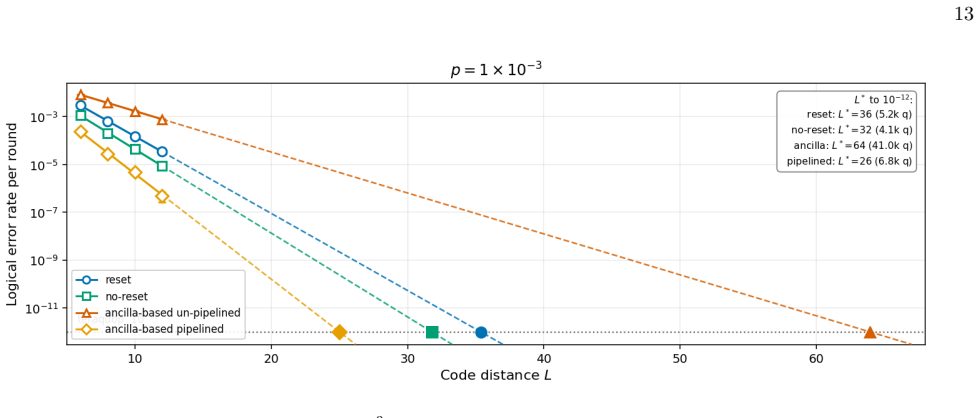
dynamic488 github repository (2026). Appendix A: Sub-threshold scaling Sub-threshold scaling describes how the LER falls with code distance. Below threshold, the standard suppression ansatz is LER(L)≈AΛ −L/2, (A1) where Λ is the logical error suppression factor. Each increase of two in the code distance multiplies the LER by 1/Λ. The exponent isL/2 becaus...
2026
-
[32]
The result is that d=Lat all values ofLon both cycles, all four variants
Stim’sshortest graphlike error, on each of two independent X-cycle observables (horizontal and vertical non-contractible cycles). The result is that d=Lat all values ofLon both cycles, all four variants. 2.search for undetectable logical errorswith no graphlike approximation, at variousLvalues. The result here is also thatd=Lexactly for all four variants....
discussion (0)
Sign in with ORCID, Apple, or X to comment. Anyone can read and Pith papers without signing in.