REVIEW 1 major objections 6 minor 31 references
Generating photon-added states without adding a photon
T0 review · 1 major / 6 minor · reviewed 2026-08-14 · deepseek-v4-flash
Pith's one-line read A post-selected optical parametric amplifier yields a continuous range of nonclassical states, including displaced-number and photon-added states, without adding a photon.
desk verdict A clean analytic result for a tunable post-selected OPA source; the physics is right, the experimental idealization is the main gap. read the letter →
The pith
A machine-rendered reading of the paper's core claim, the machinery that carries it, and where it could break.
The reading
What carries the argument
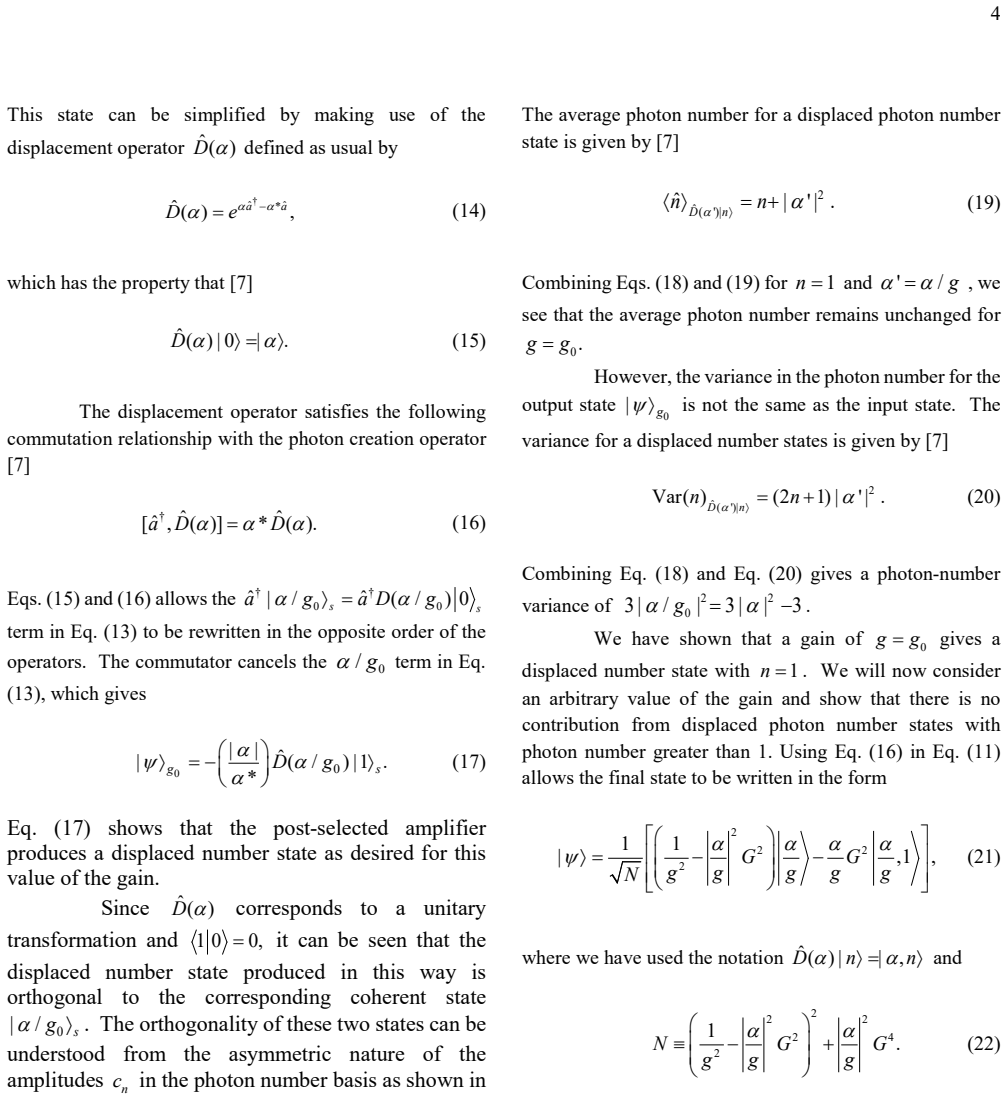
The load-bearing object is the exact factored form of the two-mode squeezing operator (Eq. 1), where the gain $g=\cosh(\kappa t)$ and $G=\sqrt{g^2-1}$ enter separately. Acting on a single idler photon and post-selecting on a single idler photon leaves only two surviving Taylor terms, producing the central identity of Eq. (9)/(21): the output is a two-state superposition of $|\alpha/g\rangle$ and $D(\alpha/g)|1\rangle$. The displacement-operator identity $[a,D(\alpha)]=\alpha^*D(\alpha)$ then converts the superposition into the displaced-number form at $g_0$. The post-selection projection is what does the work: it forbids pair creation and annihilation, and yet the amplitude of each number state is reshaped by the gain, producing the tunable family.
What would settle it
Measure the Wigner function of the post-selected signal output at gain $g_0 = \sqrt{1+1/|\alpha|^2}$; the claim predicts a displaced single-photon Wigner function with a negative region, and if the reconstructed state shows no negativity the central identity is wrong.
Extended reading notes
Core claim
The central claim is that the post-selected signal output is exactly the normalized state $$|\psi\rangle = \frac{1}{N}\left[\left(1-\frac{G}{$g^{2}$}\right)|\$\alpha$/g\rangle - \frac{G}{$g^{2}$}\hat{n}|\$\alpha$/g\rangle\right]$$ or equivalently the two-term superposition of Eq. (21), which lies entirely in the subspace spanned by the attenuated coherent state $|\alpha/g\rangle$ and the displaced single-photon state $D(\alpha/g)|1\rangle$. Choosing the gain $g_0=\sqrt{1+1/|\alpha|^2}$ removes the coherent-state component and leaves exactly $D(\alpha/g_0)|1\rangle$, a displaced number state. In the limit $g\to\infty$ the coherent component is suppressed and the state approaches the photon-added coherent state proportional to $a^\dagger|\alpha/g\rangle$. The same formula gives a coherent state at $g=1$ and, at the gain $g_1$ of Eq. (24), a state orthogonal to a photon-added coherent state; the zeros of the Q-function track this orthogonality.
Load-bearing premise
The argument assumes the optical parametric amplifier is perfectly lossless, single-mode, phase-matched, and undepleted in its pump, so that its evolution is exactly the idealized two-mode squeezing operation used in the calculation.
Editorial extensions
If this is right
- At the gain $g_0=\sqrt{1+1/|\alpha|^2}$, the output is exactly a displaced single-photon state $D(\alpha/g_0)|1\rangle$, orthogonal to the coherent state $|\alpha/g_0\rangle$, so the two states form a ready-made qubit pair.
- In the limit of large gain, the same device produces a photon-added coherent state proportional to $a^\dagger|\alpha/g\rangle$, even though no photon is added.
- At the gain $g_1$ given in Eq. (24), the output is orthogonal to a photon-added coherent state, providing another orthogonal pair for continuous-variable qubits.
- Because the output always lies in the span of $|\alpha/g\rangle$ and $D(\alpha/g)|1\rangle$, simply varying the pump intensity sweeps through the whole family.
- The success probability falls exponentially for large $|\alpha|$, so the method is practical only for moderate coherent-state amplitudes.
Reading between the lines
- A plausible extension is to replace the amplifier with any two-mode unitary whose post-selected subspace is small; the same mechanism would then produce families of 'virtual' state transformations without physical photon addition or subtraction.
- In the displaced-number regime, a practical experiment could first locate the Q-function zero at $\alpha/g_0$ predicted by Eq. (28); finding that zero is a compact test of the two-state structure.
- The continuous tunability suggests a calibration use: the same device could serve as a gain-controlled source for quantum information experiments, with the gain set by pump intensity rather than by swapping optical elements.
- Chaining two post-selected amplifiers, which the authors flag for a separate paper, would plausibly generate entangled macroscopic states whose entanglement properties inherit from the two-dimensional subspace derived here.
Signed reviews
Editorial analysis
A structured set of objections, weighed in public.
Referee Report
Summary. The paper proposes a conditional state-preparation scheme based on an optical parametric amplifier (OPA). A coherent state |α> is injected into the signal mode, a single photon into the idler mode, and the signal output is retained only when a single photon is detected in the output idler mode. Using the factored two-mode squeezing operator (Eq. (1)), the authors derive the unnormalized post-selected signal state (Eqs. (7)-(9)) as proportional to (1 - G n-hat)|α/g>, a superposition of an attenuated coherent state and a photon-added term. They show that this state lies in the two-dimensional subspace spanned by |α/g> and D(α/g)|1> (Eq. (21)). At gain g=1 it reduces to the input coherent state; at g0 = 1/sqrt(1 - 1/|α|^2) it becomes a displaced single-photon state (Eq. (17)); and in the large-gain limit it approaches a photon-added coherent state. The paper also gives the gain g1 at which the output is orthogonal to a photon-added state, plots Q-functions for representative gains, and presents a fidelity analysis for dark counts and loss in the detection paths.
Significance. The central calculation is explicit and self-contained, and the special cases can be checked directly from Eq. (21). If the result holds, the scheme offers a single-knob (pump intensity) method to tune continuously between nonclassical states relevant to continuous-variable quantum information. The paper gives reproducible formulas for the state, the success probability, and the special gains, and the fidelity analysis in Sec. VI is a useful first step. The main caveat is that the experimental analysis assumes an ideal OPA unitary; the practical claims are therefore stronger than what the error model supports.
major comments (1)
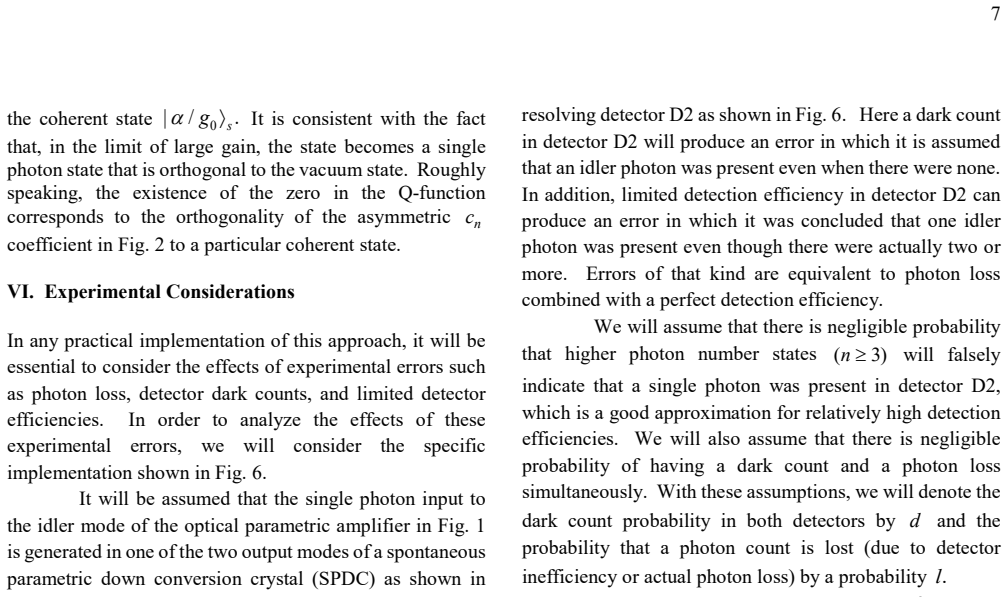
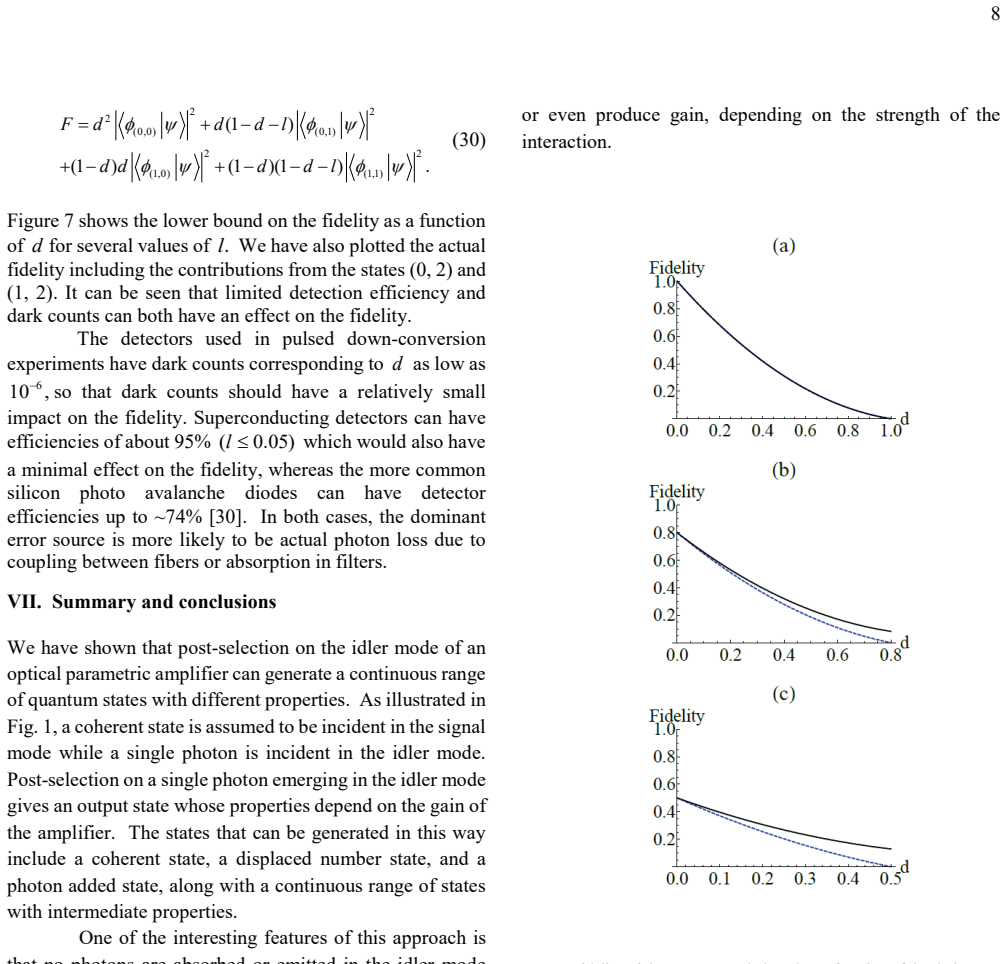
- [Sec. VI, Eqs. (29)-(30) and Fig. 7] The error model tracks only dark counts and losses in the detection record and leaves the OPA evolution as the exact lossless, single-mode, undepleted unitary of Eq. (1). Internal loss in the nonlinear crystal, pump depletion, and spatial/temporal multimode structure would modify the post-selected state itself rather than merely the detection record, so the reported fidelities are not end-to-end fidelities for a realistic amplifier. Since the abstract and title make a practical generation claim, this is a load-bearing gap; please either extend the model to include those imperfections or explicitly scope the claim to the ideal-OPA-plus-detection-errors setting.
minor comments (6)
- [Sec. IV, Eq. (24)] The value of g1 is introduced with 'It can be shown' and no derivation is provided. I reproduced the result by solving the orthogonality condition, but the paper should include the one-line derivation so the reader can verify the claim without re-deriving the algebra.
- [Sec. II, Eq. (10)] The success probability is also stated with 'which can be shown'; please include the norm calculation, since the typeset equation is difficult to verify as printed.
- [Sec. V, Eqs. (27)-(28)] The derivations of the number-basis zero and the Q-function zero are omitted; a short derivation for each would improve reproducibility.
- [Introduction, first paragraph] The sentence 'the post-selection process ensures that no photons were emitted or absorbed in either mode' is misleading, since the OPA unitary can create and annihilate pairs and the post-selection changes the signal-state amplitudes; the later discussion clarifies this, but the early sentence should be softened.
- [Eq. (12)] The displaced-number-state gain g0 is real only for |α|^2 > 1; this condition should be stated explicitly.
- [Fig. 3 caption] The caption 'with 10 ( 100).nα = =' is garbled; please clarify the value of α and the mean photon number used in the plot.
Circularity Check
No significant circularity: the central result is a direct operator calculation from the standard OPA unitary, and the special states follow from derived gain conditions rather than fitted inputs or self-citation.
full rationale
The paper's central derivation starts from the factored two-mode squeezing unitary in Eq. (1), which is an externally established standard result cited to Schumaker-Caves and Caves et al. The post-selected signal state in Eqs. (7)-(9) is obtained by straightforward operator algebra: expanding the exponentials, acting on the input coherent state and single idler photon, and projecting onto a single output idler photon. No parameter is fitted to the target output state, and no empirical data are used. The special cases are derived, not assumed: the displaced number state at g0 follows by inserting Eq. (12) into Eq. (11) and using the standard commutator [a-dagger, D(alpha)]; the photon-added limit at large gain follows from Eq. (9) because the (G/g^2) n-hat term dominates as g grows. The orthogonality claims and Q-function zeros are algebraic consequences of the same expression. The only self-citations are Ref. [22], used in Sec. VI for the noiseless-attenuation error term (0,0), and Ref. [31], mentioned only as a physical analogy in the conclusions; neither is load-bearing for the main claim. The experimental analysis does assume an ideal lossless, single-mode, undepleted-pump OPA, and its fidelity model omits internal loss and pump depletion, but that is an applicability limitation, not circular reasoning. The derivation is self-contained and does not reduce to its inputs by construction.
Assumptions & free parameters
assumptions (4)
- domain assumption The OPA evolution is the exact two-mode squeezing unitary given in Eq. (1).
- domain assumption The input idler is a pure single-photon Fock state and the post-selection is a projection onto a single output idler photon.
- standard math Standard normal-ordering identity for the two-mode squeeze operator and the displacement-operator commutation relation [a-dagger, D(alpha)] = alpha* D(alpha) from Refs. [7,26,27].
- domain assumption In the experimental analysis, the SPDC source produces only one pair at a time, false counts from n>=3 are negligible, and simultaneous dark count and loss are negligible.
Cite this review
Pith. "Pith review of Generating photon-added states without adding a photon." pith.science (2026). https://pith.science/paper/7TURFBJM
@misc{pith2026190808028,
  author       = {Pith},
  title        = {Pith review of: Generating photon-added states without adding a photon},
  year         = {2026},
  howpublished = {\url{https://pith.science/paper/7TURFBJM}},
  note         = {Machine review of arXiv:1908.08028}
}
read the original abstract
We show that a continuous range of nonclassical states of light can be generated using conditional measurements on the idler mode of an optical parametric amplifier. The output state is prepared by introducing a coherent state in the signal mode of the amplifier with a single photon in the idler mode, followed by a conditional measurement of a single photon in the output idler mode. By varying the gain of the amplifier, this approach can produce a coherent state, a photon-added state, a displaced number state, or a continuous range of other nonclassical states with intermediate properties. We note that this approach can generate a photon-added state even though the post-selected amplifier does not add any photons to the signal or idler modes. The ability to generate a continuous range of nonclassical states may have practical applications in quantum information processing.
Figures
Reference graph
Works this paper leans on
-
[1]
G. S. Agarwal and K. Tara, Physical Review A (Atomic, Molecular, and Optical Physics) 43, 492 (1991)
work page 1991
-
[2]
Zavatta, S
A. Zavatta, S. Viciani, and M. Bellini, Science 306, 660 (2004)
2004
- [3]
-
[4]
M. Barbieri, N. Spagnolo, M. G. Genoni, F. Ferreyrol, R. Blandino, M. G. A. Paris, P. Grangier, and R. Tualle-Brouri, Physical Review A (Atomic, Molecular, and Optical Physics) 82, 063833 (2010)
work page 2010
-
[5]
S. N. Filippov, V. I. Man'ko, A. S. Coelho, A. Zavatta, and M. Bellini, Physica Scripta T 2013, 014025 (2013)
work page 2013
-
[6]
M. Boiteux and A. Levelut, Journal of Physics A (Mathematical and General) 6, 589 (1973)
work page 1973
-
[7]
F. A. M. de Oliveira, M. S. Kim, P. L. Knight, and V. Buzek, Physi cal Review A (Atomic, Molecular, and Optical Physics) 41, 2645 (1990)
work page 1990
-
[8]
A. I. Lvovsky and S. A. Babichev, Physical Review A (Atomic, Molecular, and Optical Physics) 66, 011801/1 (2002)
work page 2002
Show all 31 references
-
[9]
S. L. Braunstein and P. van Loock, Reviews of Modern Physics 77, 513 (2005)
2005
-
[10]
Miranda and D
M. Miranda and D. Mundarain, Quantum Information Processing 16, 298 (2017)
2017
-
[11]
W. Dong, L. Mo, Z. Feng, Y. Zhen-Qiang, C. Wei, H. Zheng-Fu, G. Guang-Can, and W. Qin, Physical Review A (Atomic, Molecular, and Optical Physics) 90, 062315 (2014)
2014
-
[12]
K. P. Seshadreesan, J. P. Olson, K. R. Motes, P. P. Rohde, and J. P. Dowling, Physical Review A (Atomic, Molecular, and Optical Physics) 91, 022334 (2015)
2015
-
[13]
C. H. Bennett, G. Brassard, C. Crepeau, R. Jozsa, A. Peres, and W. K. Wootters, P hysical Review Letters 70, 1895 (1993)
1993
-
[14]
Jeong and M
H. Jeong and M. S. Kim, Physical Review A (Atomic, Molecular, and Optical Physics) 65, 042305/1 (2002)
2002
-
[15]
S. A. Podoshvedov, Physical Review A (Atomic, Molecular, and Optical Physics) 79, 012319 (2009)
2009
-
[16]
Sperling, W
J. Sperling, W. Vogel, and G. S. Agarwal, Physical Review A 89, 043829 (2014)
2014
-
[17]
Dakna, L
M. Dakna, L. Knoll, and D. G. Welsch, Optics Communications 145, 309 (1998)
1998
-
[18]
Bimbard, N
E. Bimbard, N. Jain, A. MacRae, and A. I. Lvovsky, Nature Photonics 4, 243 (2010)
2010
-
[19]
D. T. Pegg, L. S. Phillips, and S. M. Barnett, Physical Review Letters 81, 1604 (1998)
1998
-
[20]
Ban, Optics Communications 143, 225 (1997)
M. Ban, Optics Communications 143, 225 (1997)
1997
-
[21]
S. M. Barnett, D. T. Pegg, and J. Jeffers, Optics Communications 172, 55 (1999)
1999
-
[22]
R. A. Brewster, I. C. Nodurft, T. B. Pittman, and J. D. Franson, Physical Review A 96, 042307 (2017)
2017
-
[23]
Sivakumar, Physical Review A (Atomic, Molecular, and Optical Physics) 83, 035802 (2011)
S. Sivakumar, Physical Review A (Atomic, Molecular, and Optical Physics) 83, 035802 (2011)
2011
-
[24]
Luis and J
A. Luis and J. Peřina, Physical Review A 53, 1886 (1996)
1996
-
[25]
Brif and A
C. Brif and A. Mann, Quantum and Semiclassical Optics: Journal of the European Optical Society Part B 9 , 899 (1997)
1997
-
[26]
B. L. Schumaker and C. M. Caves, Physical Review A (General Physics) 31, 3093 (1985)
1985
-
[27]
C. M. Caves, J. Combes, J. Zhang , and S. Pandey, Physical Review A (Atomic, Molecular, and Optical Physics) 86, 063802 (2012)
2012
-
[28]
Husimi, Proceedings of the Physico - Mathematical Society of Japan
K. Husimi, Proceedings of the Physico - Mathematical Society of Japan. 3rd Series 22, 264 (1940)
1940
-
[29]
Kano, Journal of Mathematical Physics 6 , 1913 (1965)
Y. Kano, Journal of Mathematical Physics 6 , 1913 (1965)
1965
-
[30]
M. D. Eisaman, J. Fan, A. Migdall, and S. V. Polyakov, Rev. Sci. Instrum. 82, 071101 (2011)
2011
-
[31]
I. C. Nodurft, R. A. Brewster, T. B. Pittman, and J. D. Franson, Physical Review A 100, 013850 (2019). 10 Appendix The mean and variance of the photon number were briefly discussed in the main text. The purpose of this appendix is to discuss some of their properties in more de...
2019
Reviewed August 14, 2026 · model on record in the stance chip above.
Discussion (0). Continue with ORCID to comment.