REVIEW 2 major objections 5 minor 1 cited by
StaleFlow claims that trajectory-level staleness accounting can replace coarse in-flight limits, letting a disaggregated RL system bound staleness strictly and mitigate data skewness in one design.
Reviewed by Pith at T0; open to challenge. T0 means a machine referee read the full paper against a public rubric. the ladder, T0–T4 →
T0 review · deepseek-v4-flash
2026-08-04 06:19 UTC pith:7U74AWXT
load-bearing objection Serious systems paper with measured throughput gains; the strict-staleness protocol is under-proved and convergence evidence is thin, but both are fixable. the 2 major comments →
StaleFlow: Staleness-Aware Data Management for Mitigating Data Skewness in Fully Disaggregated RL Post-Training
The pith
A machine-rendered reading of the paper's core claim, the machinery that carries it, and where it could break.
Core claim
The central discovery is that staleness can be accounted for at the granularity of a single trajectory while the system retains full freedom to coordinate rollout. Each trajectory is tagged with V_traj, the oldest model version it is allowed to be generated under; each training buffer has a version V_buf; and the invariant V_traj + η ≥ V_buf is the only thing that needs to be maintained. The Reserve/Occupy/Consume primitives plus planned entry movement keep this invariant even when trajectories are interrupted, migrated, aborted, or generated across instances with different model versions. This means the standard "limit in-flight data" approach is not the only way to bound staleness, and the
What carries the argument
Virtual staleness buffer: a per-batch accounting structure holding an entry per trajectory group with metadata (trajectory ID and V_traj), where each buffer has a version V_buf and the invariant V_traj + η ≥ V_buf is enforced by Reserve/Occupy/Consume primitives. The buffer's entry deletion and movement rule — delete a completed reserved entry, then move the earliest admissible reserved entries forward — is what allows Occupy to place completed data in the earliest possible buffer and keeps training batches ready without letting stale data slip through. On the skewness side, the middleware trajectory server and parameter server decouple data movement from rollout instances, and a centralized
Load-bearing premise
The load-bearing assumption is that the buffer bookkeeping rule never admits a stale trajectory and never deadlocks under any interleaving of partial rollout, migration, and abort; the paper does not prove this invariant formally.
What would settle it
Instrument the staleness manager with η=0 and search, through random interleavings of Interrupt, Route, and Abort commands, for a state where an occupied entry has V_buf − V_traj > 0, or where Reserve cannot find an empty entry although total capacity is available. Finding either would break the strict-staleness claim. Short of that, re-running the throughput benchmark on the same 128-GPU setup and comparing tokens/second to the reported 1.17-2.01x average would test the measured gains.
If this is right
- Users get a real knob: set the staleness bound η and know that no consumed trajectory can be more than η model versions old, making the convergence/throughput tradeoff explicit and tunable per job.
- All four rollout coordination techniques work together under one protocol, so skewness mitigation no longer depends on giving up staleness guarantees.
- Larger η yields proportionally larger throughput gains (up to 2.68x), meaning jobs whose convergence tolerates more staleness can put idle GPUs to work.
- The speculative-state snapshot validation prevents command races from causing oscillating routing decisions, which is a necessary condition for the coordinator's decisions to be stable.
- Middleware overhead stays below 3% of step time, so the coordination machinery does not eat the gains it enables.
Where Pith is reading between the lines
- If the buffer invariant is as robust as claimed, the same version-tag accounting could generalize to any asynchronous pipeline where data freshness is a correctness concern, such as federated learning or online data serving, by swapping model versions for data versions.
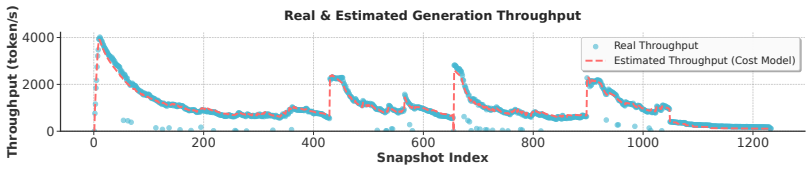
- A natural next test is to make the cost-model coefficients adaptive, replacing offline profiling with runtime estimates; the current design depends on coefficients that may change with hardware or batch composition.
- The convergence evidence is limited to math-reasoning RL with one training algorithm; extending the same staleness bound to general chat or agent RL would test whether the buffer protocol itself, rather than the algorithm's tolerance, is what preserves convergence.
- The main throughput comparisons exclude redundant rollout; a head-to-head study with redundant rollout enabled could show whether the protocol's accommodation of redundancy translates into an independent, additional speedup.
Editorial analysis
A structured set of objections, weighed in public.
Referee Report
Summary. StaleFlow is a fully disaggregated RL post-training system that claims to jointly enforce a user-specified trajectory-level staleness bound (η) and mitigate data skewness. The system introduces a global consistency protocol built on a virtual "staleness buffer" with Reserve/Occupy/Consume primitives, plus two middleware data servers (trajectory server and parameter server) and a centralized coordinator that executes routing, synchronization, and migration strategies. The paper's central claims are (i) strict adherence to the global staleness constraint while supporting partial rollout, redundant rollout, multi-version instances, and migration, and (ii) throughput gains of up to 1.42–2.68× over state-of-the-art systems without compromising convergence. The evaluation is performed on a 128-GPU H20 cluster across four Qwen models, with convergence shown over 50–100 training steps.
Significance. If the protocol is correct and reproducible, StaleFlow is a meaningful systems contribution: it targets a real tension in disaggregated RL post-training and proposes a concrete architectural solution. The paper's empirical work is a strength: measured throughput on a 128-GPU cluster, a detailed ablation isolating the routing/synchronization/migration strategies, a cost model with a reported 10.52% average estimation error, and a time breakdown showing command overhead below 3%. The authors also state that source code is available. However, the central differentiator — the strict staleness guarantee — rests on an informally described buffer protocol with no invariant or liveness proof. Because the throughput measurements stand independently of that proof, the paper's usefulness would survive a fix, but the guarantee as stated is not currently established.
major comments (2)
- [§4.2, Figure 7 (right)] The strict-staleness guarantee is load-bearing, yet the Reserve/Occupy/movement procedure is only described informally. In particular, step (3) moves a reserved entry C into B's former buffer position without stating that C satisfies V_C + η ≥ V_buf at that newer buffer. Since the invariant is V_traj + η ≥ V_buf for every entry, moving C to a later buffer can violate the constraint if V_C is not large enough. The paper also does not prove that, under all interleavings of Reserve/Occupy/Abort and buffer advancement, Occupy always finds an admissible empty slot and the system never deadlocks (e.g., a Stuck buffer with aborted-but-not-cleaned reservations). I am not claiming the protocol is wrong; I am claiming the proof is missing, and the text as written is at least incomplete. This needs a formal invariant, a liveness argument, or an explicit enumeration of all transition cases.
- [§6.3, Figure 14] The claim "without compromising convergence" is supported only by 50–100 training steps on two models, with no repeated seeds or confidence intervals. The paper does show that η=1–3 matches VeRL's reward curve in that short horizon and that η=10 collapses, which is useful evidence. But the abstract and conclusion state the convergence claim as unconditional. Either extend the training horizon, add seed variance, or soften the claim to "on the tested horizon, no degradation was observed." As written, the convergence claim is stronger than the evidence.
minor comments (5)
- [Abstract / Conclusion] The throughput numbers are inconsistent: the abstract reports 1.18–1.91× average, while the full text and §6.2 report 1.17–2.01× average. Please reconcile.
- [Abstract / Artifact] The source-code link in the abstract points to github.com/psrl-project/psrl, but the paper is named StaleFlow. Please verify that this is the correct repository or provide a StaleFlow-specific link.
- [Figure 7 (right)] The four-step transition is hard to follow because the figure labels B and C in a way that does not unambiguously indicate buffer indices and version values. A small example with concrete (V_traj, V_buf) values would improve clarity and would also help the reader verify the invariant.
- [§6.1 / Figure 13] The text says red crosses denote NCCL timeouts in baselines, but the figure caption only says "Red crosses denote unsupported configurations." Please move the explanation into the caption or the body so readers understand the meaning of the crosses.
- [§2.2 / References] The paper categorizes VeRL-Async as "strict staleness control," citing a GitHub recipe rather than a peer-reviewed publication. This is acceptable, but the reference should be marked clearly as a repository/recipe, and the same applies to other non-archival citations.
Circularity Check
No significant circularity: headline results are empirical measurements against external baselines; the unproved buffer protocol is a correctness concern, not a circularity.
full rationale
StaleFlow's central claims rest on empirical measurements against external baselines (VeRL, VeRL-Pipeline, VeRL-Async, AReaL, Roll Flash) and on ablations that vary its own strategies while holding the system fixed; these are not derived from the cost model whose coefficients k1–k5 are regression-fitted. The cost model is used to steer routing decisions, and its accuracy is validated independently against measured throughput (Appendix B.2, Fig. 24, avg error 10.52%), but the headline 1.42–2.68x gains are measured end-to-end, not predicted by the model. The 'global consistency protocol' is a design artifact: the invariant V_traj+eta>=V_buf is the admission rule enforced by Reserve/Occupy; observing that measured trajectories satisfy it (Fig. 18) is a sanity check of the implementation, not a separate derivation. The informal buffer-movement step is a potential correctness gap (no proof that moving entry C preserves the invariant), but an unproved liveness/invariant claim is not circularity. Self-citations (prior PKU/SJTU parallel-training systems) appear only in related-work contexts and are not load-bearing. Hence no prediction or first-principles result reduces to its inputs by construction.
Axiom & Free-Parameter Ledger
free parameters (6)
- staleness bound eta =
1, 2, 3, 10 (evaluated)
- cost model coefficients k1-k4 =
Table 4: 7.28e-8, 1.72e-3, 1.25e-4, 1.07e-2 for Qwen3-30B-A3B
- per-token KV cache footprint k5 =
not stated numerically
- routing acceptance threshold mu =
0.3
- migration wait threshold phi_wait =
3
- throughput imbalance threshold phi_throughput =
5
axioms (4)
- domain assumption RL algorithms tolerate model mismatch up to staleness bound eta via importance sampling or additional corrections
- domain assumption The constraint V_traj + eta >= V_buf is sufficient to control convergence
- domain assumption The cost model T_i(S) accurately estimates instance throughput
- ad hoc to paper The virtual staleness buffer Reserve/Occupy/movement procedure maintains the global bound and does not deadlock
read the original abstract
Reinforcement learning (RL) post-training has become pivotal for enhancing the capabilities of modern large models. A recent trend is to develop RL systems with a fully disaggregated architecture, which decouples the three RL phases (rollout, reward, and training) onto separate resources and executes them asynchronously. However, two critical data-level concerns arise: (1) asynchronous execution leads to data staleness in trajectories (the data generated by rollout) as the model parameters used in rollout may not be up to date, which impairs RL convergence; and (2) the length variation of trajectories introduces severe data skewness, leading to workload imbalance and degraded system performance. Existing systems fail to address these two concerns in a unified manner. Techniques that tightly control data staleness often constrain effective data skewness mitigation, while aggressive data skewness mitigation tends to exacerbate data staleness. As a result, systems are forced to trade off convergence for performance, or vice versa. To address this, we propose StaleFlow, an RL post-training system that jointly tackles data staleness and skewness. First, to control staleness, StaleFlow introduces a global consistency protocol that tracks the full lifecycle of each trajectory and constrains staleness. Second, to mitigate skewness, StaleFlow re-designs the RL system architecture by constructing data servers for trajectories and parameters to achieve flexible rollout coordination. Subsequently, we develop a suite of staleness-aware, throughput-oriented strategies to enhance system performance. Evaluations show that StaleFlow achieves up to 1.42-2.68$\times$ (1.18-1.91$\times$ on average) higher throughput than state-of-the-art systems, without compromising convergence. Our source code is available: https://github.com/psrl-project/psrl.
Figures






Forward citations
Cited by 1 Pith paper
-
Harnessing Routing Foresight for Micro-step-level MoE load balancing in RL Post-training
ForeMoE uses routing foresight from the rollout stage to enable micro-step load balancing in MoE RL post-training via a hierarchical planner and transfer engine, claiming up to 1.45x speedup on 64 GPUs.
Reference graph
Works this paper leans on
-
[1]
Taming Throughput-Latency tradeoff in LLM inference with Sarathi-Serve
Amey Agrawal, Nitin Kedia, Ashish Panwar, Jayashree Mohan, Nipun Kwa- tra, Bhargav Gulavani, Alexey Tumanov, and Ramachandran Ramjee. Taming Throughput-Latency tradeoff in LLM inference with Sarathi-Serve. In18th USENIX Symposium on Operating Systems Design and Implementation (OSDI 24),
-
[2]
Longalign: A recipe for long context alignment of large language models, 2024
Yushi Bai, Xin Lv, Jiajie Zhang, Yuze He, Ji Qi, Lei Hou, Jie Tang, Yuxiao Dong, and Juanzi Li. Longalign: A recipe for long context alignment of large language models, 2024. https://arxiv.org/abs/2401.18058
Pith/arXiv arXiv 2024
-
[3]
Weilin Cai, Juyong Jiang, Fan Wang, Jing Tang, Sunghun Kim, and Jiayi Huang. A survey on mixture of experts in large language models.IEEE Transactions on Knowledge and Data Engineering, 2025. http://dx.doi.org/10.1109/TKDE.2025. 3554028
-
[4]
Respec: Towards optimizing speculative decoding in reinforcement learning systems, 2025
Qiaoling Chen, Zijun Liu, Peng Sun, Shenggui Li, Guoteng Wang, Ziming Liu, Yonggang Wen, Siyuan Feng, and Tianwei Zhang. Respec: Towards optimizing speculative decoding in reinforcement learning systems, 2025. https://arxiv.org/ abs/2510.26475
arXiv 2025
-
[5]
Deepseek-r1: Incentivizing reasoning capability in llms via reinforcement learning, 2025
DeepSeek-AI, Daya Guo, Dejian Yang, et al. Deepseek-r1: Incentivizing reasoning capability in llms via reinforcement learning, 2025. https://arxiv.org/abs/2501. 12948
2025
-
[6]
Dong Du, Shulin Liu, Tao Yang, Shaohua Chen, and Yang Li. Ulorl:an ultra-long output reinforcement learning approach for advancing large language models’ reasoning abilities, 2025. https://arxiv.org/abs/2507.19766
Pith/arXiv arXiv 2025
-
[7]
Advances in importance sampling.Wiley Stat- sRef: Statistics Reference Online, 2021
Víctor Elvira and Luca Martino. Advances in importance sampling.Wiley Stat- sRef: Statistics Reference Online, 2021. http://dx.doi.org/10.1002/9781118445112. stat08284
-
[8]
Aime24 dataset, 2025
Hugging Face. Aime24 dataset, 2025. https://huggingface.co/datasets/math- ai/aime24
2025
-
[9]
Dapo-math-17k dataset, 2025
Hugging Face. Dapo-math-17k dataset, 2025. https://huggingface.co/datasets/ BytedTsinghua-SIA/DAPO-Math-17k. 13
2025
-
[10]
Areal: A large-scale asynchronous reinforcement learning system for language reasoning, 2025
Wei Fu, Jiaxuan Gao, Xujie Shen, Chen Zhu, Zhiyu Mei, Chuyi He, Shusheng Xu, Guo Wei, Jun Mei, Jiashu Wang, Tongkai Yang, Binhang Yuan, and Yi Wu. Areal: A large-scale asynchronous reinforcement learning system for language reasoning, 2025. https://arxiv.org/abs/2505.24298
Pith/arXiv arXiv 2025
-
[11]
Apt-serve: Adaptive request scheduling on hybrid cache for scalable llm inference serving.Proc
Shihong Gao, Xin Zhang, Yanyan Shen, and Lei Chen. Apt-serve: Adaptive request scheduling on hybrid cache for scalable llm inference serving.Proc. ACM Manag. Data, 2025. https://doi.org/10.1145/3725394
doi:10.1145/3725394 2025
-
[12]
Rollpacker: Mitigating long-tail rollouts for fast, synchronous rl post-training, 2025
Wei Gao, Yuheng Zhao, Dakai An, Tianyuan Wu, Lunxi Cao, Shaopan Xiong, Ju Huang, Weixun Wang, Siran Yang, Wenbo Su, Jiamang Wang, Lin Qu, Bo Zheng, and Wei Wang. Rollpacker: Mitigating long-tail rollouts for fast, synchronous rl post-training, 2025. https://arxiv.org/abs/2509.21009
arXiv 2025
-
[13]
Enabling parallelism hot switching for efficient training of large language models
Hao Ge, Fangcheng Fu, Haoyang Li, Xuanyu Wang, Sheng Lin, Yujie Wang, Xiaonan Nie, Hailin Zhang, Xupeng Miao, and Bin Cui. Enabling parallelism hot switching for efficient training of large language models. InProceedings of the ACM SIGOPS 30th Symposium on Operating Systems Principles, 2024. https: //doi.org/10.1145/3694715.3695969
arXiv 2024
-
[14]
Search and score-based waterfall auction optimization
Dan Halbersberg, Matan Halevi, and Moshe Salhov. Search and score-based waterfall auction optimization. InLearning and Intelligent Optimization: 16th International Conference, LION 16, Milos Island, Greece, June 5–10, 2022, Revised Selected Papers, 2022. https://doi.org/10.1007/978-3-031-24866-5_27
-
[15]
Asyncflow: An asynchronous streaming rl framework for efficient llm post-training, 2025
Zhenyu Han, Ansheng You, Haibo Wang, Kui Luo, Guang Yang, Wenqi Shi, Menglong Chen, Sicheng Zhang, Zeshun Lan, Chunshi Deng, Huazhong Ji, Wenjie Liu, Yu Huang, Yixiang Zhang, Chenyi Pan, Jing Wang, Xin Huang, Chunsheng Li, and Jianping Wu. Asyncflow: An asynchronous streaming rl framework for efficient llm post-training, 2025. https://arxiv.org/abs/2507.01663
Pith/arXiv arXiv 2025
-
[16]
History rhymes: Accelerating llm reinforcement learning with rhymerl, 2025
Jingkai He, Tianjian Li, Erhu Feng, Dong Du, Qian Liu, Tao Liu, Yubin Xia, and Haibo Chen. History rhymes: Accelerating llm reinforcement learning with rhymerl, 2025. https://arxiv.org/abs/2508.18588
Pith/arXiv arXiv 2025
-
[17]
Verl recipe: Fully async policy trainer, 2025
https://github.com/meituan search. Verl recipe: Fully async policy trainer, 2025. https://verl.readthedocs.io/en/latest/advance/fully_async.html
2025
-
[18]
Verl recipe: One step off policy async trainer,
https://github.com/meituan search. Verl recipe: One step off policy async trainer,
-
[19]
Openrlhf: An easy-to-use, scalable and high-performance rlhf framework, 2025
Jian Hu, Xibin Wu, Wei Shen, Jason Klein Liu, Zilin Zhu, Weixun Wang, Songlin Jiang, Haoran Wang, Hao Chen, Bin Chen, Weikai Fang, Xianyu, Yu Cao, Haotian Xu, and Yiming Liu. Openrlhf: An easy-to-use, scalable and high-performance rlhf framework, 2025. https://arxiv.org/abs/2405.11143
Pith/arXiv arXiv 2025
-
[20]
Demystifying nccl: An in-depth analysis of gpu communication protocols and algorithms, 2025
Zhiyi Hu, Siyuan Shen, Tommaso Bonato, Sylvain Jeaugey, Cedell Alexander, Eric Spada, James Dinan, Jeff Hammond, and Torsten Hoefler. Demystifying nccl: An in-depth analysis of gpu communication protocols and algorithms, 2025. https://arxiv.org/abs/2507.04786
arXiv 2025
-
[21]
Qerl: Beyond efficiency – quantization-enhanced reinforcement learning for llms, 2025
Wei Huang, Yi Ge, Shuai Yang, Yicheng Xiao, Huizi Mao, Yujun Lin, Hanrong Ye, Sifei Liu, Ka Chun Cheung, Hongxu Yin, Yao Lu, Xiaojuan Qi, Song Han, and Yukang Chen. Qerl: Beyond efficiency – quantization-enhanced reinforcement learning for llms, 2025. https://arxiv.org/abs/2510.11696
arXiv 2025
-
[22]
Le, and Yonghui Chen
Yanping Huang, Youlong Cheng, Ankur Bapna, Orhan Firat, Mia Xu Chen, Zhifeng Chen, Yanping Hu, Maxim Krikun, Quoc V. Le, and Yonghui Chen. Gpipe: Efficient training of giant neural networks using pipeline parallelism. InAdvances in Neural Information Processing Systems (NeurIPS), 2019. https://proceedings. neurips.cc/paper/2019/file/093f65e080a295f8076b1c...
2019
-
[23]
System optimizations for enabling training of extreme long sequence transformer models
Sam Ade Jacobs, Masahiro Tanaka, Chengming Zhang, Minjia Zhang, Reza Yaz- dani Aminadabi, Shuaiwen Leon Song, Samyam Rajbhandari, and Yuxiong He. System optimizations for enabling training of extreme long sequence transformer models. InProceedings of the 43rd ACM Symposium on Principles of Distributed Computing, 2024. https://doi.org/10.1145/3662158.3662806
arXiv 2024
-
[24]
Dynapipe: Optimizing multi-task training through dynamic pipelines
Chenyu Jiang, Zhen Jia, Shuai Zheng, Yida Wang, and Chuan Wu. Dynapipe: Optimizing multi-task training through dynamic pipelines. InProceedings of the Nineteenth European Conference on Computer Systems (EuroSys), 2024. https: //doi.org/10.1145/3627703.3629585
arXiv 2024
-
[25]
Dhillon, David Brandfonbrener, and Rishabh Agarwal
Devvrit Khatri, Lovish Madaan, Rishabh Tiwari, Rachit Bansal, Sai Surya Duvvuri, Manzil Zaheer, Inderjit S. Dhillon, David Brandfonbrener, and Rishabh Agarwal. The art of scaling reinforcement learning compute for llms, 2025. https://arxiv. org/abs/2510.13786
Pith/arXiv arXiv 2025
-
[26]
Muthukrishnan, Zheng Wen, and Yikun Xian
Branislav Kveton, Saied Mahdian, S. Muthukrishnan, Zheng Wen, and Yikun Xian. Waterfall bandits: Learning to sell ads online, 2019. https://arxiv.org/abs/ 1904.09404
Pith/arXiv arXiv 2019
-
[27]
Efficient mem- ory management for large language model serving with pagedattention
Woosuk Kwon, Zhuohan Li, Siyuan Zhuang, Ying Sheng, Lianmin Zheng, Cody Hao Yu, Joseph Gonzalez, Hao Zhang, and Ion Stoica. Efficient mem- ory management for large language model serving with pagedattention. In Proceedings of the 29th Symposium on Operating Systems Principles, 2023. https: //doi.org/10.1145/3600006.3613165
arXiv 2023
-
[28]
Puzzle: efficiently aligning large language models through light-weight context switch
Kinman Lei, Yuyang Jin, Mingshu Zhai, Kezhao Huang, Haoxing Ye, and Jidong Zhai. Puzzle: efficiently aligning large language models through light-weight context switch. InProceedings of the 2024 USENIX Conference on Usenix Annual Technical Conference, 2024
2024
-
[29]
{GS}hard: Scaling giant models with conditional computation and automatic sharding
Dmitry Lepikhin, HyoukJoong Lee, Yuanzhong Xu, Dehao Chen, Orhan Firat, Yanping Huang, Maxim Krikun, Noam Shazeer, and Zhifeng Chen. {GS}hard: Scaling giant models with conditional computation and automatic sharding. In International Conference on Learning Representations, 2021. https://openreview. net/forum?id=qrwe7XHTmYb
2021
-
[30]
Fast inference from transform- ers via speculative decoding
Yaniv Leviathan, Matan Kalman, and Yossi Matias. Fast inference from transform- ers via speculative decoding. InProceedings of the 40th International Conference on Machine Learning, 2023. https://dl.acm.org/doi/10.5555/3618408.3619203
arXiv 2023
-
[31]
Hetu v2: A general and scalable deep learning system with hierarchical and heterogeneous single program multiple data annotations,
Haoyang Li, Fangcheng Fu, Hao Ge, Sheng Lin, Xuanyu Wang, Jiawen Niu, Xupeng Miao, and Bin Cui. Hetu v2: A general and scalable deep learning system with hierarchical and heterogeneous single program multiple data annotations,
-
[32]
Haoyang Li, Fangcheng Fu, Hao Ge, Sheng Lin, Xuanyu Wang, Jiawen Niu, Yujie Wang, Hailin Zhang, Xiaonan Nie, and Bin Cui. Malleus: Straggler-resilient hybrid parallel training of large-scale models via malleable data and model parallelization.Proc. ACM Manag. Data, 2025. https://doi.org/10.1145/3725322
-
[33]
Haoyang Li, Fangcheng Fu, Sheng Lin, Hao Ge, Xuanyu Wang, Jiawen Niu, Jinbao Xue, Yangyu Tao, Di Wang, Jie Jiang, and Bin Cui. Hydraulis: Balancing large transformer model training via co-designing parallel strategies and data assignment.Proc. ACM Manag. Data, 2025. https://doi.org/10.1145/3769802
doi:10.1145/3769802 2025
-
[34]
https://arxiv.org/abs/2504.20490
-
[35]
Let’s verify step by step
Hunter Lightman, Vineet Kosaraju, Yuri Burda, Harrison Edwards, Bowen Baker, Teddy Lee, Jan Leike, John Schulman, Ilya Sutskever, and Karl Cobbe. Let’s verify step by step. InThe Twelfth International Conference on Learning Representations,
-
[36]
Lobra: Multi-tenant fine-tuning over heterogeneous data.Proc
Sheng Lin, Fangcheng Fu, Haoyang Li, Hao Ge, Xuanyu Wang, Jiawen Niu, Yaofeng Tu, and Bin Cui. Lobra: Multi-tenant fine-tuning over heterogeneous data.Proc. VLDB Endow., 2025. https://doi.org/10.14778/3742728.3742752
arXiv 2025
-
[37]
Yuhang Li, Rong Gu, Chengying Huan, Zhibin Wang, Renjie Yao, Chen Tian, and Guihai Chen. Hotprefix: Hotness-aware kv cache scheduling for efficient prefix sharing in llm inference systems.Proc. ACM Manag. Data. https://doi.org/ 10.1145/3749168
-
[38]
Ringattention with blockwise trans- formers for near-infinite context
Hao Liu, Matei Zaharia, and Pieter Abbeel. Ringattention with blockwise trans- formers for near-infinite context. InThe Twelfth International Conference on Learning Representations, 2024. https://openreview.net/forum?id=WsRHpHH4s0
2024
-
[39]
https://openreview.net/forum?id=v8L0pN6EOi
-
[40]
Flashrl: 8bit rollouts, full power rl, 2025
Liyuan Liu, Feng Yao, Dinghuai Zhang, Chengyu Dong, Jingbo Shang, and Jianfeng Gao. Flashrl: 8bit rollouts, full power rl, 2025. https://fengyao.notion. site/flash-rl
2025
-
[41]
Spec-rl: Accelerating on-policy reinforce- ment learning with speculative rollouts, 2026
Bingshuai Liu, Ante Wang, Zijun Min, Liang Yao, Haibo Zhang, Yang Liu, Xu Han, Peng Li, Anxiang Zeng, and Jinsong Su. Spec-rl: Accelerating on-policy reinforce- ment learning with speculative rollouts, 2026. https://arxiv.org/abs/2509.23232
arXiv 2026
-
[42]
Deepcoder: A fully open-source 14b coder at o3- mini level, 2025
Michael Luo, Sijun Tan, Roy Huang, Ameen Patel, Alpay Ariyak, Qingyang Wu, Xiaoxiang Shi, Rachel Xin, Colin Cai, Maurice Weber, Ce Zhang, Li Erran Li, Raluca Ada Popa, and Ion Stoica. Deepcoder: A fully open-source 14b coder at o3- mini level, 2025. https://pretty-radio-b75.notion.site/DeepCoder-A-Fully-Open- Source-14B-Coder-at-O3-mini-Level-1cf81902c146...
2025
-
[43]
When speed kills stability: Demystifying rl collapse from the inference- training mismatch, 2025
Jiacai Liu, Yingru Li, Yuqian Fu, Jiawei Wang, Qian Liu, and Yu Shen. When speed kills stability: Demystifying rl collapse from the inference- training mismatch, 2025. https://yingru.notion.site/When-Speed-Kills- Stability-Demystifying-RL-Collapse-from-the-Inference-Training-Mismatch- 271211a558b7808d8b12d403fd15edda
2025
-
[44]
Galvatron: Efficient transformer training over multiple gpus using automatic parallelism.Proc
Xupeng Miao, Yujie Wang, Youhe Jiang, Chunan Shi, Xiaonan Nie, Hailin Zhang, and Bin Cui. Galvatron: Efficient transformer training over multiple gpus using automatic parallelism.Proc. VLDB Endow., 2022. https://doi.org/10.14778/3570690. 3570697
-
[45]
Part ii: Roll flash – accelerating rlvr and agentic training with asynchrony, 2025
Han Lu, Zichen Liu, Shaopan Xiong, Yancheng He, Wei Gao, Yanan Wu, Weixun Wang, Jiashun Liu, Yang Li, Haizhou Zhao, Ju Huang, Siran Yang, Xiaoyang Li, Yijia Luo, Zihe Liu, Ling Pan, Junchi Yan, Wei Wang, Wenbo Su, Jiamang Wang, Lin Qu, and Bo Zheng. Part ii: Roll flash – accelerating rlvr and agentic training with asynchrony, 2025. https://arxiv.org/abs/2...
arXiv 2025
-
[46]
Deepak Narayanan, Aaron Harlap, Amar Phanishayee, Vivek Seshadri, Nikhil R. Devanur, Gregory R. Ganger, Phillip B. Gibbons, and Matei Zaharia. Pipedream: generalized pipeline parallelism for dnn training. InProceedings of the 27th ACM Symposium on Operating Systems Principles, 2019. https://doi.org/10.1145/ 3341301.3359646
arXiv 2019
-
[47]
Real: Efficient RLHF training of large language models with parameter reallocation
Zhiyu Mei, Wei Fu, Kaiwei Li, Guangju Wang, Huanchen Zhang, and Yi Wu. Real: Efficient RLHF training of large language models with parameter reallocation. InEighth Conference on Machine Learning and Systems, 2025. https://openreview. net/forum?id=yLU1zRf95d
2025
-
[48]
Asynchronous rlhf: Faster and more efficient off-policy rl for language models, 2025
Michael Noukhovitch, Shengyi Huang, Sophie Xhonneux, Arian Hosseini, Rishabh Agarwal, and Aaron Courville. Asynchronous rlhf: Faster and more efficient off-policy rl for language models, 2025. https://arxiv.org/abs/2410.18252
Pith/arXiv arXiv 2025
-
[49]
A comprehensive survey of mixture-of-experts: Algo- rithms, theory, and applications, 2025
Siyuan Mu and Sen Lin. A comprehensive survey of mixture-of-experts: Algo- rithms, theory, and applications, 2025. https://arxiv.org/abs/2503.07137
arXiv 2025
-
[50]
Nvidia inference xfer library (nixl), 2025
NVIDIA. Nvidia inference xfer library (nixl), 2025. https://github.com/ai- dynamo/nixl
2025
-
[51]
Effi- cient large-scale language model training on gpu clusters using megatron-lm
Deepak Narayanan, Mohammad Shoeybi, Jared Casper, Patrick LeGresley, Mostofa Patwary, Vijay Korthikanti, Dmitri Vainbrand, Prethvi Kashinkunti, Julie Bernauer, Bryan Catanzaro, Amar Phanishayee, and Matei Zaharia. Effi- cient large-scale language model training on gpu clusters using megatron-lm. InProceedings of the International Conference for High Perfo...
arXiv 2021
-
[52]
Unified communication x, 2025
openucx. Unified communication x, 2025. https://github.com/openucx/ucx
2025
-
[53]
Nvidia collective communication library (nccl) documentation, 2025
NVIDIA. Nvidia collective communication library (nccl) documentation, 2025. https://docs.nvidia.com/deeplearning/nccl/user-guide/docs/index.html. 14
2025
-
[54]
Seer: Online context learning for fast synchronous llm reinforcement learning, 2025
Ruoyu Qin, Weiran He, Weixiao Huang, Yangkun Zhang, Yikai Zhao, Bo Pang, Xinran Xu, Yingdi Shan, Yongwei Wu, and Mingxing Zhang. Seer: Online context learning for fast synchronous llm reinforcement learning, 2025. https: //arxiv.org/abs/2511.14617
Pith/arXiv arXiv 2025
-
[55]
Openai o1 system card,
OpenAI, :, Aaron Jaech, Adam Kalai, Adam Lerer, et al. Openai o1 system card,
-
[56]
https://arxiv.org/abs/2412.16720
-
[57]
Z. Rosberg and I. Adiri. Multilevel queues with extremal priorities.J. ACM, 1976. https://doi.org/10.1145/321978.321986
arXiv 1976
-
[58]
Multi-step reasoning with large language models, a survey.ACM Comput
Aske Plaat, Annie Wong, Suzan Verberne, Joost Broekens, Niki Van Stein, and Thomas Bäck. Multi-step reasoning with large language models, a survey.ACM Comput. Surv., 2025. https://doi.org/10.1145/3774896
doi:10.1145/3774896 2025
-
[59]
Proximal policy optimization algorithms, 2017
John Schulman, Filip Wolski, Prafulla Dhariwal, Alec Radford, and Oleg Klimov. Proximal policy optimization algorithms, 2017. https://arxiv.org/abs/1707.06347
Pith/arXiv arXiv 2017
-
[60]
Qwen2.5 technical report,
Qwen, :, An Yang, Baosong Yang, Beichen Zhang, et al. Qwen2.5 technical report,
-
[61]
https://arxiv.org/abs/2412.15115
-
[62]
Zero: Memory optimizations toward training trillion parameter models, 2020
Samyam Rajbhandari, Jeff Rasley, Olatunji Ruwase, and Yuxiong He. Zero: Memory optimizations toward training trillion parameter models, 2020. https: //arxiv.org/abs/1910.02054
Pith/arXiv arXiv 2020
-
[63]
Hybridflow: A flexible and efficient rlhf framework
Guangming Sheng, Chi Zhang, Zilingfeng Ye, Xibin Wu, Wang Zhang, Ru Zhang, Yanghua Peng, Haibin Lin, and Chuan Wu. Hybridflow: A flexible and efficient rlhf framework. InProceedings of the Twentieth European Conference on Computer Systems, 2025. http://dx.doi.org/10.1145/3689031.3696075
arXiv 2025
-
[64]
Trust region policy optimization
John Schulman, Sergey Levine, Philipp Moritz, Michael Jordan, and Pieter Abbeel. Trust region policy optimization. InProceedings of the 32nd Inter- national Conference on International Conference on Machine Learning, 2015. https://dl.acm.org/doi/10.5555/3045118.3045319
arXiv 2015
-
[65]
Zelin Tan, Hejia Geng, Mulei Zhang, Xiaohang Yu, Guancheng Wan, Yifan Zhou, Qiang He, Xiangyuan Xue, Heng Zhou, Yutao Fan, Zhongzhi Li, Zaibin Zhang, Guibin Zhang, Chen Zhang, Zhenfei Yin, and Lei Bai. Scaling behaviors of llm reinforcement learning post-training: An empirical study in mathematical reasoning, 2025. https://arxiv.org/abs/2509.25300
Pith/arXiv arXiv 2025
-
[66]
Beat the long tail: Distribution-aware speculative decoding for rl training, 2025
Zelei Shao, Vikranth Srivatsa, Sanjana Srivastava, Qingyang Wu, Alpay Ariyak, Xiaoxia Wu, Ameen Patel, Jue Wang, Percy Liang, Tri Dao, Ce Zhang, Yiying Zhang, Ben Athiwaratkun, Chenfeng Xu, and Junxiong Wang. Beat the long tail: Distribution-aware speculative decoding for rl training, 2025. https://arxiv.org/ abs/2511.13841
arXiv 2025
-
[67]
Zhihong Shao, Peiyi Wang, Qihao Zhu, Runxin Xu, Junxiao Song, Xiao Bi, Haowei Zhang, Mingchuan Zhang, Y. K. Li, Y. Wu, and Daya Guo. Deepseekmath: Pushing the limits of mathematical reasoning in open language models, 2024. https://arxiv.org/abs/2402.03300
Pith/arXiv arXiv 2024
-
[68]
Laminar: A scalable asynchronous rl post-training framework, 2025
Guangming Sheng, Yuxuan Tong, Borui Wan, Wang Zhang, Chaobo Jia, Xibin Wu, Yuqi Wu, Xiang Li, Chi Zhang, Yanghua Peng, Haibin Lin, Xin Liu, and Chuan Wu. Laminar: A scalable asynchronous rl post-training framework, 2025. https://arxiv.org/abs/2510.12633
arXiv 2025
-
[69]
A survey on large language models for mathematical reasoning.ACM Comput
Peng-Yuan Wang, Tian-Shuo Liu, Chenyang Wang, Ziniu Li, Yidi Wang, Shu Yan, Chengxing Jia, Xu-Hui Liu, Xinwei Chen, Jiacheng Xu, and Yang Yu. A survey on large language models for mathematical reasoning.ACM Comput. Surv., 2025. https://doi.org/10.1145/3786333
doi:10.1145/3786333 2025
-
[70]
Megatron-lm: Training multi-billion parameter language models using model parallelism, 2020
Mohammad Shoeybi, Mostofa Patwary, Raul Puri, Patrick LeGresley, Jared Casper, and Bryan Catanzaro. Megatron-lm: Training multi-billion parameter language models using model parallelism, 2020. https://arxiv.org/abs/1909.08053
Pith/arXiv arXiv 2020
-
[71]
Yujie Wang, Youhe Jiang, Xupeng Miao, Fangcheng Fu, Shenhan Zhu, Xiaonan Nie, Yaofeng Tu, and Bin Cui. Improving automatic parallel training via balanced memory workload optimization.IEEE Transactions on Knowledge and Data Engineering, August 2024. http://dx.doi.org/10.1109/TKDE.2024.3370614
arXiv 2024
-
[72]
Kimi k2: Open agentic intelligence, 2025
Kimi Team, Yifan Bai, Yiping Bao, et al. Kimi k2: Open agentic intelligence, 2025. https://arxiv.org/abs/2507.20534
Pith/arXiv arXiv 2025
-
[73]
Kimi k1.5: Scaling reinforcement learning with llms, 2025
Kimi Team, Angang Du, Bofei Gao, et al. Kimi k1.5: Scaling reinforcement learning with llms, 2025. https://arxiv.org/abs/2501.12599
Pith/arXiv arXiv 2025
-
[74]
Surya T. Tokdar and Robert E. Kass. Importance sampling: a review.WIREs Comput. Stat., 2010. https://doi.org/10.1002/wics.56
doi:10.1002/wics.56 2010
-
[75]
Loongserve: Efficiently serving long-context large language models with elastic sequence parallelism
Bingyang Wu, Shengyu Liu, Yinmin Zhong, Peng Sun, Xuanzhe Liu, and Xin Jin. Loongserve: Efficiently serving long-context large language models with elastic sequence parallelism. InProceedings of the ACM SIGOPS 30th Symposium on Operating Systems Principles, 2024
2024
-
[76]
Weixun Wang, Shaopan Xiong, Gengru Chen, Wei Gao, et al. Reinforcement learning optimization for large-scale learning: An efficient and user-friendly scaling library, 2025. https://arxiv.org/abs/2506.06122
Pith/arXiv arXiv 2025
-
[77]
An adaptive placement and parallelism framework for accelerating rlhf training, 2024
Youshao Xiao, Zhenglei Zhou, Fagui Mao, Weichang Wu, Shangchun Zhao, Lin Ju, Lei Liang, Xiaolu Zhang, and Jun Zhou. An adaptive placement and parallelism framework for accelerating rlhf training, 2024. https://arxiv.org/abs/2312.11819
Pith/arXiv arXiv 2024
-
[78]
Flexsp: Accelerating large language model training via flexible sequence parallelism
Yujie Wang, Shiju Wang, Shenhan Zhu, Fangcheng Fu, Xinyi Liu, Xuefeng Xiao, Huixia Li, Jiashi Li, Faming Wu, and Bin Cui. Flexsp: Accelerating large language model training via flexible sequence parallelism. InProceedings of the 30th ACM International Conference on Architectural Support for Programming Languages and Operating Systems, Volume 2, 2025. http...
arXiv 2025
-
[79]
Xumeng Wen, Zihan Liu, Shun Zheng, Shengyu Ye, Zhirong Wu, Yang Wang, Zhijian Xu, Xiao Liang, Junjie Li, Ziming Miao, Jiang Bian, and Mao Yang. Re- inforcement learning with verifiable rewards implicitly incentivizes correct reasoning in base llms, 2025. https://arxiv.org/abs/2506.14245
Pith/arXiv arXiv 2025
-
[80]
The multiqueue: A simple and fast relaxed concurrent priority queue.ACM Trans
Marvin Williams and Peter Sanders. The multiqueue: A simple and fast relaxed concurrent priority queue.ACM Trans. Parallel Comput., 2025. https://doi.org/ 10.1145/3771738
discussion (0)
Sign in with ORCID, Apple, or X to comment. Anyone can read and Pith papers without signing in.