REVIEW 4 major objections 6 minor 12 references
Cryogenic Materials Repository: A Public Resource and New Measurements for Cryogenic Research Applications
T0 review · 4 major / 6 minor · reviewed 2026-08-04 · deepseek-v4-flash
Pith's one-line read The paper presents a public repository of cryogenic thermal-conductivity data and fits, and new sub-kelvin measurements of two CFRP tube types and three aluminum alloys that agree with prior results while reaching lower temperatures.
desk verdict A genuinely useful repository paper with solid new sub-Kelvin measurements; the aluminum fitting method is underdescribed and needs clarification, but the core resource stands. read the letter →
The pith
A machine-rendered reading of the paper's core claim, the machinery that carries it, and where it could break.
The reading
What carries the argument
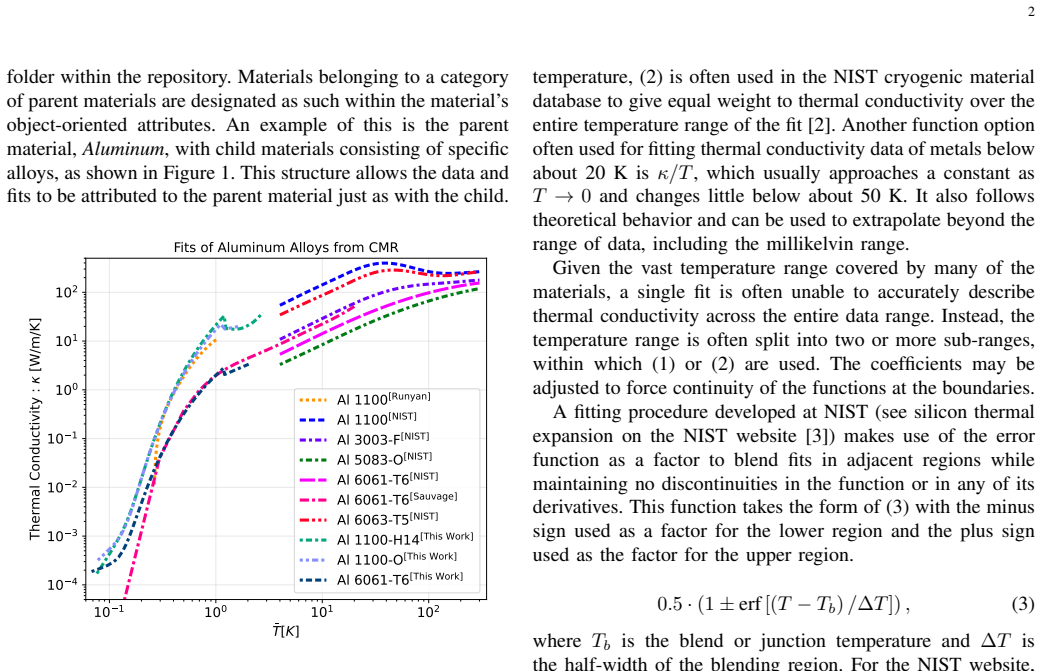
The load-bearing piece of the repository is its fitting pipeline: polynomial and log-polynomial fits (Eqs. 1–2) over temperature sub-ranges, joined by an error-function blending factor (Eq. 4) that guarantees a continuous function with continuous derivatives at the junction. The load-bearing piece of the aluminum measurements is the superconducting conductivity form κ(T) = αT^β + γT e^{δ/T} (Eq. 10): because it integrates in closed form against temperature (Eqs. 11–12), the authors can fit the measured heater power versus thermometer temperature directly, extracting the conductivity parameters and the parasitic power offset simultaneously and skipping the small-ΔT approximation used for the
What would settle it
Re-measure aluminum 6061-T6 from about 50 mK to 3 K with a parasitic load reduced well below the current 17–29 nW (for instance, by heat-sinking or removing the housekeeping wires) and with an independently calibrated thermometer, then compare the conductivity inferred at 70–100 mK against the paper's fit; a deviation beyond the quoted uncertainty would indict the parasitic model or the superconducting fit form. A second check requires no new apparatus: run the same heater-and-thermometer assembly with no sample mounted and see whether the measured baseline power equals the quadratic-fit conve
Extended reading notes
Core claim
On the paper's own terms, the central contribution is a working public repository organized around raw data rather than only curated fits: hundreds of datasets covering more than 80 materials are stored individually, materials are arranged in parent/child alloy hierarchies, default fits are computed from all available data using polynomial and log-polynomial functions joined by an error-function blend that keeps the fit and its derivatives continuous, and each fit is exported to a compilation CSV from which it can be exactly reconstructed. The measurement results extend the same resource: the two CFRP tube types show essentially equal thermal conductivity, so the roughly 2.1-times-larger con
Load-bearing premise
The reported conductivities rest on three linked assumptions: the steady-state approximation (Eq. 6) is accurate for the measured temperature spans, the parasitic power found from the convergence point of quadratic power-versus-temperature fits is the true background, and the superconducting form αT^β + γT e^{δ/T} correctly describes the aluminum alloys from 0.07 to 2.8 K; if any of these fails, the fitted curves and their low-temperature extrapolations are biased.
Editorial extensions
If this is right
- Instrument designers can reconstruct any material curve from the exported CSV fit parameters and integrate it directly into thermal-load codes, replacing hand-digitized or opaque fits.
- Separate electron and phonon curves for aluminum down to ~70 mK give a physically grounded route to extrapolate conductivity to still lower temperatures in design studies.
- Because the two CFRP products have essentially equal conductivity, the ~2.1× conductance difference between them is geometry: structural supports can be selected on cross-section and heat-load budget, not on material identity.
- The default practice of fitting all stored data, with no quality cuts and user-selectable subsets, turns conflicting published measurements into an explicit, resolvable comparison rather than a hidden choice.
- The same repository structure is built to absorb more materials, more properties (specific heat, thermal expansion), and custom components such as heat straps, so future measurements inherit the same fit pipeline.
Reading between the lines
- If the repository becomes the field's default reference, the recurring cost of re-curating material data for each new instrument disappears; the largest payoff would be for 100-mK focal-plane designs, where the sub-kelvin regime is the least populated in published data.
- A flattening of aluminum conductivity driven by phonons below ~1 K, if it persists below 50 mK, implies lattice rather than electron transport at detector operating temperatures, which would change how superconducting readout stages are heat-sunk.
- The unexplained spread in the pultruded CFRP results is directly testable: re-measuring the same commercial product with identical geometry would show whether the spread is measurement-dependent or genuine batch variation.
- The parasitic-power model is testable on its own: running a null sample with no test piece should reproduce the quadratic-fit convergence value; any mismatch would shift the coldest conductivity points more than their quoted uncertainties.
Signed reviews
Editorial analysis
A structured set of objections, weighed in public.
Referee Report
Summary. The paper presents the Cryogenic Materials Repository (CMR), a public GitHub repository of thermal conductivity data and fits for cryogenic applications, together with new sub-kelvin thermal conductivity measurements for two CFRP materials (DPP and Clearwater) and three aluminum alloys (6061-T6, 1100-O, 1100-H14). The repository stores datasets, fit functions, and tools; the measurements were made in a Bluefors LD400 dilution refrigerator using a steady-state method with two ruthenium-oxide thermometers. For the aluminum samples, the authors propose physically motivated superconducting/normal-state thermal conductivity models and state that the fit parameters are obtained directly from the measured power and thermometer temperatures using integrated forms, thereby avoiding the ΔT approximation. The reported results are compared with prior data and are said to extend coverage to temperatures near 70 mK.
Significance. If the fitting methodology is sound, the CMR is a genuinely useful community resource: it is transparent, machine-readable, version-controlled, and includes documented source code and referenced datasets. The new aluminum and CFRP measurements fill a gap below 1 K for materials relevant to sub-kelvin detector systems, and the physically motivated functional forms allow extrapolation to lower temperatures. The paper is honest about some limitations, such as unexplained sample-to-sample variation for DPP CFRP. However, the central quantitative product—the aluminum fit parameters in Table III—is currently not fully reproducible because of an internal ambiguity in the fitting procedure and the absence of parameter uncertainties. These issues must be resolved before the fits can be used with confidence.
major comments (4)
- [§III.D and §IV.B] The paper contains a load-bearing ambiguity about how the aluminum fits are actually computed. §III.D states that the parameters in Eqs. (11) and (12) are determined directly from measured T, Q, and geometry, 'thereby not relying on the ΔT approximation.' But §IV.B says: 'To obtain the thermal conductivity fit parameters for the three aluminum alloys, the power, Q, is fit as a function of the average temperature of the thermometers, Tbar.' These two statements conflict. If the model is evaluated at κ(Tbar)·ΔT, then the claimed advantage of the integral method disappears, and the parasitic term Q0 can absorb any model mismatch. The authors should specify the exact objective function minimized, state whether T1 and T2 are used frame-by-frame, and provide the fitting code or a pseudocode snippet. In addition, the two-regime model is not constrained to be continuous at Tc; for 6061-T6 the im
- [§III.B and Table III] The fit parameters in Table III are presented without uncertainties. The text gives uncertainties for the parasitic power (29.4±9.0 nW and 17±6.3 nW) and for thermometer calibrations, but there is no statement of how these propagate into a, b, c, d, α, β, γ, δ, or Q0. Since Table III is the main quantitative result and is used for extrapolation, the absence of parameter uncertainties and goodness-of-fit metrics makes the agreement with prior data unquantifiable. Please provide the covariance matrix (or at least parameter standard errors), the fit residuals, and a description of how thermometry, current, geometry, and parasitic-power uncertainties are propagated.
- [Eq. (9)] Equation (9) is printed as κ_normal = aT^b + cT^b, which makes the second term redundant and is inconsistent with Table III, where the parameters are a, b, c, d. It should presumably be aT^b + cT^d. If the code actually uses cT^d, then Eq. (9) is a typo; if the code uses cT^b, the table is misleading. This must be corrected and the code verified.
- [§IV.A] The paper reports that the DPP CFRP results 'lie between the range of previous results' from [6] and [7], and that the variation is 'currently unexplained.' Since one of the paper's empirical claims is agreement with prior measurements, this unexplained scatter should be quantified and discussed more specifically. For example, state the ratio of this work's conductivity to each prior set at a common temperature, and discuss whether differences in sample geometry, surface preparation, or measurement technique are plausible causes. As written, the claim of agreement is too weak to support the conclusion that the new DPP data extend the prior measurements reliably.
minor comments (6)
- [§II.B, Eq. (4)] The factor 15 in Eq. (4) is said to be 'chosen for all fits to provide a reasonable half-width blending region (about 18% of T_b).' Please state how this value was selected and whether the results are sensitive to it.
- [§II.B] The statement that N 'must be less than the number of data points (usually less than 1/3 to 1/2)' is vague. It would be helpful to give a concrete rule, e.g., N ≤ floor(N_data/3), and to describe any cross-validation or overfitting checks.
- [§II.A] The repository is described as containing 'hundreds of datasets' and 'more than 80 materials.' A precise count and a version/DOI for the repository would help readers cite and reproduce the compilation.
- [Fig. 6] The data points in Figure 6 do not appear to show error bars. If uncertainties are available, they should be plotted; if not, the figure should state that they are omitted.
- [§III.B] The description of the data-cleaning cuts ('unstable currents', 'thermometer temperatures cannot be determined', 'mixing chamber was unstable') is qualitative. Please define each cut operationally, including thresholds, so that the ~5% removal is reproducible.
- [§III.B] The parasitic-power estimation from 'the point of convergence of these quadratic fits' is underspecified. It would be clearer to give the functional form used for each thermometer and the exact definition of the convergence point, along with the resulting uncertainty.
Circularity Check
No significant circularity: the paper is an empirical data-and-fit contribution checked against independent benchmarks.
full rationale
The paper's two contributions are a data repository of thermal-conductivity fits and new sub-Kelvin measurements. The repository fits are explicitly fits to stored CSV data, and no fitted constant is relabeled as a prediction. The aluminum analysis fits physically motivated functional forms (Eqs. 11/12) to measured Q, T, and geometry, with Q0 as an estimated parasitic-power nuisance parameter; the reported kappa(T) curves are the fitted model itself, not an independent prediction derived from itself. The functional forms are attributed to external superconductivity literature, not to a self-citation chain. Comparisons to prior CFRP and aluminum data (NIST, Runyan & Jones, Crowley et al., Sauvage et al.) provide external benchmarks; the fact that one prior CFRP paper shares an author is not load-bearing. The possible ambiguity between the claimed integral method and the statement that the fit is performed 'as a function of the average temperature Tbar' is a reproducibility or correctness concern, not circularity: even if the code approximated the integral by kappa(Tbar)*DeltaT, the fitted parameters would still derive from measured data rather than being equal to an input by construction. No circular step can be quoted and exhibited, so the appropriate score is 0.
Assumptions & free parameters
free parameters (4)
- Aluminum fit parameters a,b,c,d,alpha,beta,gamma,delta =
Table III values
- Parasitic power Q0 =
estimated from quadratic fits; e.g., 29.4 +/- 9.0 nW and 17 +/- 6.3 nW for CFRP runs
- Blend temperature T_b in repository fits =
varied to give minimum percent uncertainty
- Factor 15 in Eq. (4) =
15
assumptions (5)
- domain assumption Steady-state approximation Eq. (6) is valid for the tested temperature ranges.
- domain assumption The functional form Eq. (10) kappa_superconducting = alpha T^beta + gamma T e^{delta/T} describes the thermal conductivity of the aluminum alloys over 0.07-2.8 K.
- domain assumption The transition temperature between normal and superconducting fits is 1.2 K for all three alloys.
- domain assumption All datasets in the CMR are used without quality cuts, so the compiled fits inherit any errors in the original publications.
- domain assumption The thermometer calibration and the asymptotic regression (Eq. 8) correctly extract steady-state temperatures for frames that do not reach equilibrium.
Cite this review
Pith. "Pith review of Cryogenic Materials Repository: A Public Resource and New Measurements for Cryogenic Research Applications." pith.science (2026). https://pith.science/paper/7UVA5AYY
@misc{pith2026250923422,
  author       = {Pith},
  title        = {Pith review of: Cryogenic Materials Repository: A Public Resource and New Measurements for Cryogenic Research Applications},
  year         = {2026},
  howpublished = {\url{https://pith.science/paper/7UVA5AYY}},
  note         = {Machine review of arXiv:2509.23422}
}
read the original abstract
Low-temperature systems play a vital role in a variety of scientific research applications, including the next generation of cosmology and astrophysics telescopes. More ambitious cryogenic applications require precise estimates of the thermal conductivity of materials and thermal joints to meet project goals. We present the development of the Cryogenic Material Repository (CMR), a public GitHub repository of cryogenic material properties data created to support and enable researchers across scientific disciplines to accurately and efficiently design and assess cryogenic systems. We also present updated sub-Kelvin thermal conductivity results for select carbon fiber reinforced polymer and aluminum alloy samples.
Figures


Figures from the paper (4 more)


Reference graph
Works this paper leans on
-
[6]
B. J. Koopman, S. Bhimani, N. Galitzki, M. Hasselfield, J. Lashner, H. Nakata, L. Newburgh, D. V. Nguyen, T. Sakuma, and K. Yamada, ``The Simons Observatory : Deployment of the observatory control system and supporting infrastructure,'' June 2024. arXiv:2406.15703 [astro-ph]
arXiv 2024
-
[7]
K. D. Crowley, P. Dow, J. E. Shroyer, J. C. Groh, B. Dober, J. Spisak, N. Galitzki, T. Bhandarkar, M. J. Devlin, S. Dicker, P. A. Gallardo, K. Harrington, J. Iuliano, B. R. Johnson, D. Johnson, A. M. Kofman, A. Kusaka, A. Lee, M. Limon, F. Nati, J. Orlowski-Scherer, L. Page, M. Randall, G. Teply, T. Tsan, E. J. Wollack, Z. Xu, and N. Zhu, ``The Simons Obs...
2022
-
[1]
11em plus .33em minus .07em 4000 4000 100 4000 4000 500 `\.=1000 = #1 \@IEEEnotcompsoconly \@IEEEcompsoconly #1 * [1] 0pt [0pt][0pt] #1 * [1] 0pt [0pt][0pt] #1 * \| ** #1 \@IEEEauthorblockNstyle \@IEEEcompsocnotconfonly \@IEEEauthorblockAstyle \@IEEEcompsocnotconfonly \@IEEEcompsocconfonly \@IEEEauthordefaulttextstyle \@IEEEcompsocnotconfonly \@IEEEauthor...
arXiv 2024
-
[2]
A. L. Woodcraft, A. Gray, B. Young, B. Cabrera, and A. Miller, ``A low temperature thermal conductivity database,'' in The Thirteenth International Workshop on Low Temperature Detectors LTD13 , AIP Conference Proceedings , pp. 681--684, AIP, 2009
2009
-
[3]
Marquardt, J
E. Marquardt, J. Le, and R. Radebaugh, ``Cryogenic Material Properties Database ,'' International Cryocooler Conference , no. 11th, 2000
2000
-
[4]
C. T. G. NIST, ``Cryogenics,'' 2009. Type: WEBSITE
2009
-
[5]
J. G. Hust and A. B. Lankford, ``Comments on the measurement of thermal conductivity and presentation of a thermal conductivity integral method,'' Int J Thermophys , vol. 3, pp. 67--77, Mar. 1982
1982
-
[8]
Sauvage, C
V. Sauvage, C. D. Jabrun, M. Bouzit, R. Gazizulin, B. Maffei, and A. Philippon, ``A new thermo-mechanical structure design for space qualified close-cycle dilution refrigerator,'' in Millimeter, Submillimeter , and Far - Infrared Detectors and Instrumentation for Astronomy XI , vol. 12190, pp. 1061--1072, SPIE, Aug. 2022
2022
Show all 12 references
-
[9]
A. C. Rose-Innes and E. H. Rhoderick, Introduction to superconductivity . [2nd ed.] ed., 1978
1978
-
[10]
S. G. O'Hara and A. C. Anderson, ``Resonant scattering of thermal phonons by dislocations in superconducting aluminum,'' Phys. Rev. B , vol. 9, pp. 3730--3734, May 1974
1974
-
[11]
Ventura, A
G. Ventura, A. Bonetti, L. Lanzi, I. Peroni, A. Peruzzi, and G. Ponti, ``Thermal conductivity of the normal and superconducting Al / Si 1\
-
[12]
M. C. Runyan and W. C. Jones, ``Thermal conductivity of thermally-isolating polymeric and composite structural support materials between 0.3 and 4 K ,'' Cryogenics , vol. 48, pp. 448--454, Sept. 2008
2008
Reviewed August 4, 2026 · model on record in the stance chip above.
Discussion (0). Continue with ORCID to comment.