REVIEW 4 major objections 6 minor 78 references
Comparing quantum, molecular and continuum models for graphene at large deformations
T0 review · 4 major / 6 minor · reviewed 2026-08-14 · deepseek-v4-flash
Pith's one-line read Compared against density functional theory, the MM3 potential reproduces graphene's large-deformation response up to the instability point, while REBO+LJ and Tersoff agree only at small strains, and the DFT-calibrated continuum shell…
desk verdict A useful three-potential benchmark whose headline 'continuum agrees with DFT' is circular and whose 'uniaxial' loading is actually laterally clamped; deserves review after major revision. read the letter →
The pith
A machine-rendered reading of the paper's core claim, the machinery that carries it, and where it could break.
The reading
What carries the argument
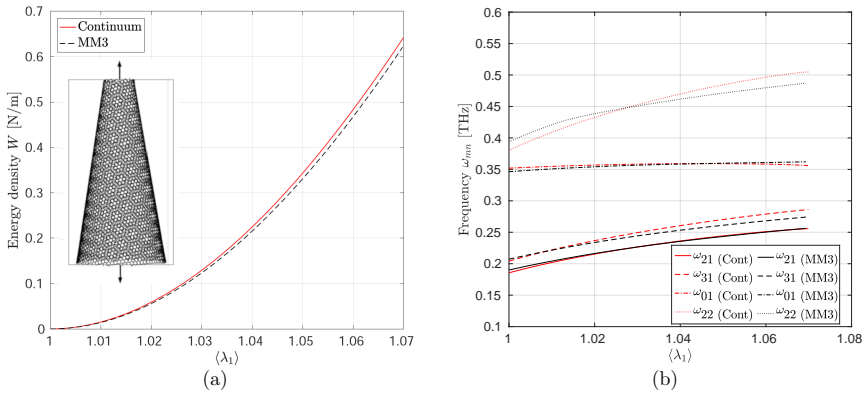
The load-bearing object is the anisotropic hyperelastic strain-energy density $W(J_1,J_2,J_3)$ of the continuum model, written as a sum of dilatational, deviatoric, and bending parts: $W = W_{\mathrm{dil}}(J_1) + W_{\mathrm{dev}}(J_2,J_3;J_1) + W_b(\kappa_1,\kappa_2;J_1)$. The invariants enter as $J_1 = \ln J$ (logarithmic area change), $J_2$ (isotropic shear), and $J_3 = \tfrac{1}{8}(\lambda_1/\lambda_2 - \lambda_2/\lambda_1)^3\cos(6\theta)$ (directional shear relative to the armchair direction), with $\kappa_1,\kappa_2$ the principal curvatures entering the bending energy. The material constants are fitted to DFT data, and the model is discretized with a rotation-free isogeometric Kirchhoff–Love thin-shell finite element formulation. This energy carries the argument because stresses come from its derivatives with respect to the surface metric, bending moments from its curvature derivatives, and the pre-stretched vibration frequencies from the tangent stiffness and mass matrix through the eigenvalue problem $K\Delta\bar{u} = \omega^2 M\Delta\bar{u}$. The common loading protocol, an affine stretch of the edge atoms with the lateral stretch fixed at $\lambda_2 = 1$ for uniaxial loading, is what allows the three atomistic potentials and the shell model to be compared on the same footing as the DFT reference.
What would settle it
Recompute the uniaxial stretch of a graphene supercell with DFT under a free lateral boundary condition (transverse stress relaxed to zero) and compare the resulting stress–strain curve with the fixed-lateral-stretch DFT data used in the paper; if the two protocols diverge materially beyond $\lambda_1 \approx 1.1$, the reported MM3 and continuum agreement is an artifact of boundary-condition matching rather than a statement about potential accuracy.
Extended reading notes
Core claim
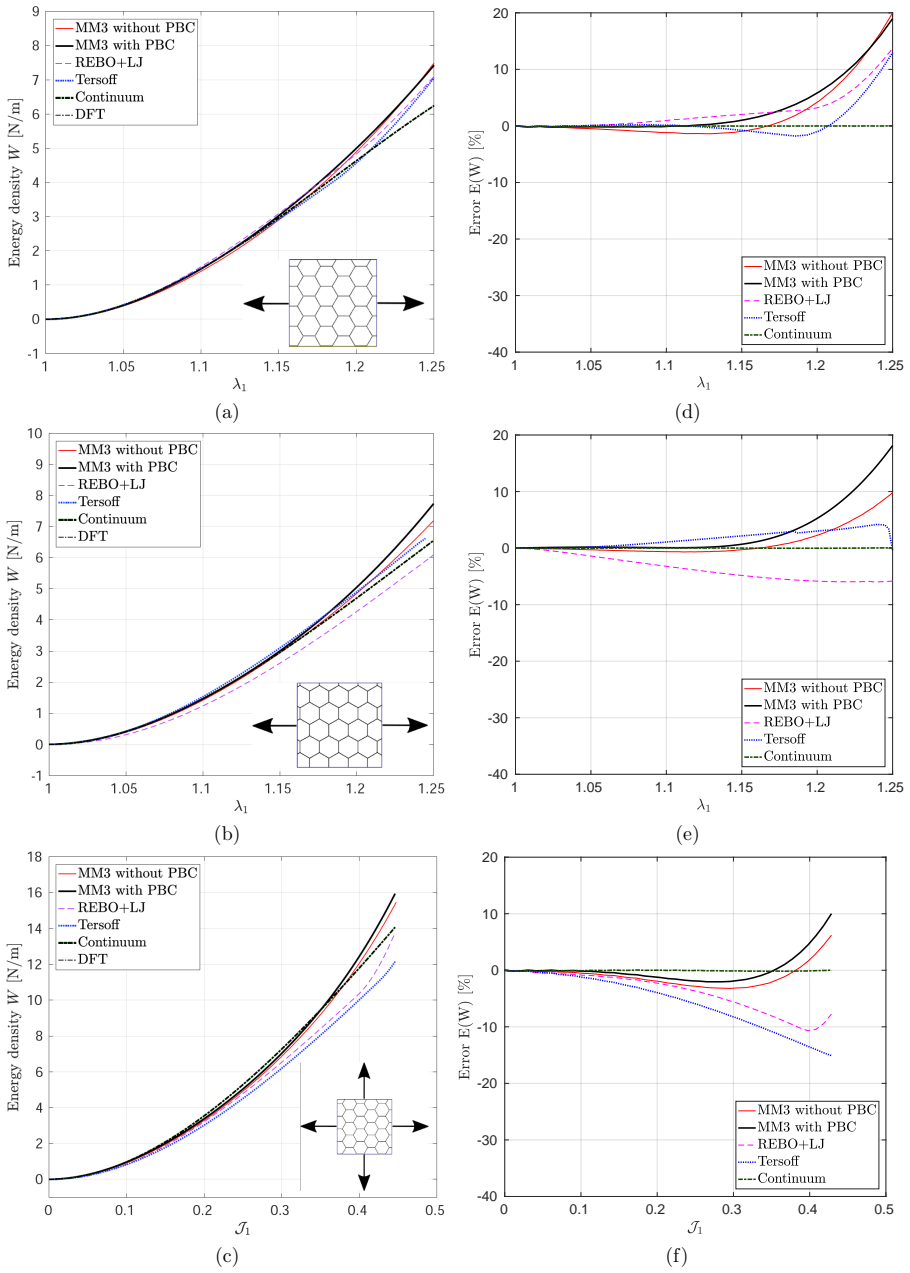
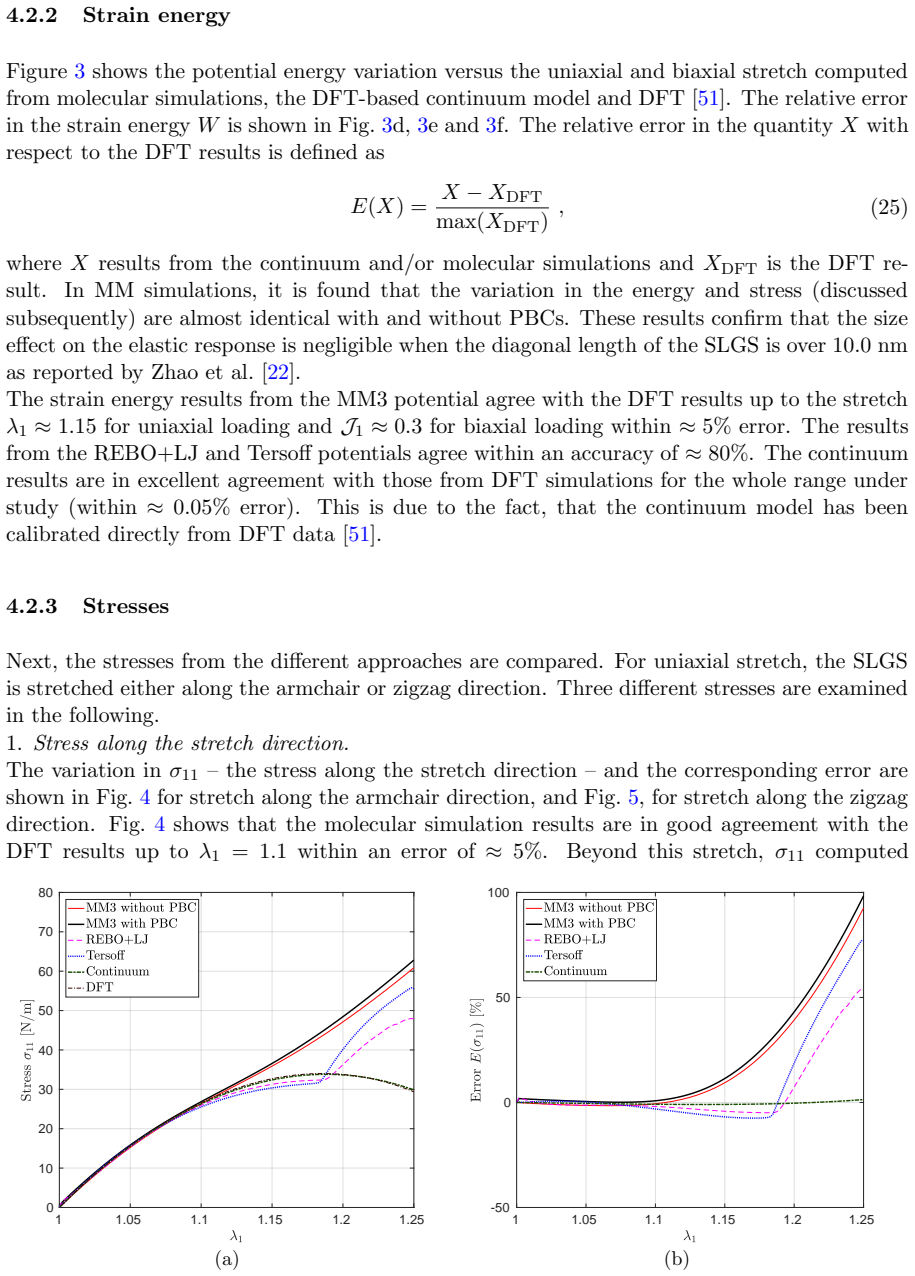
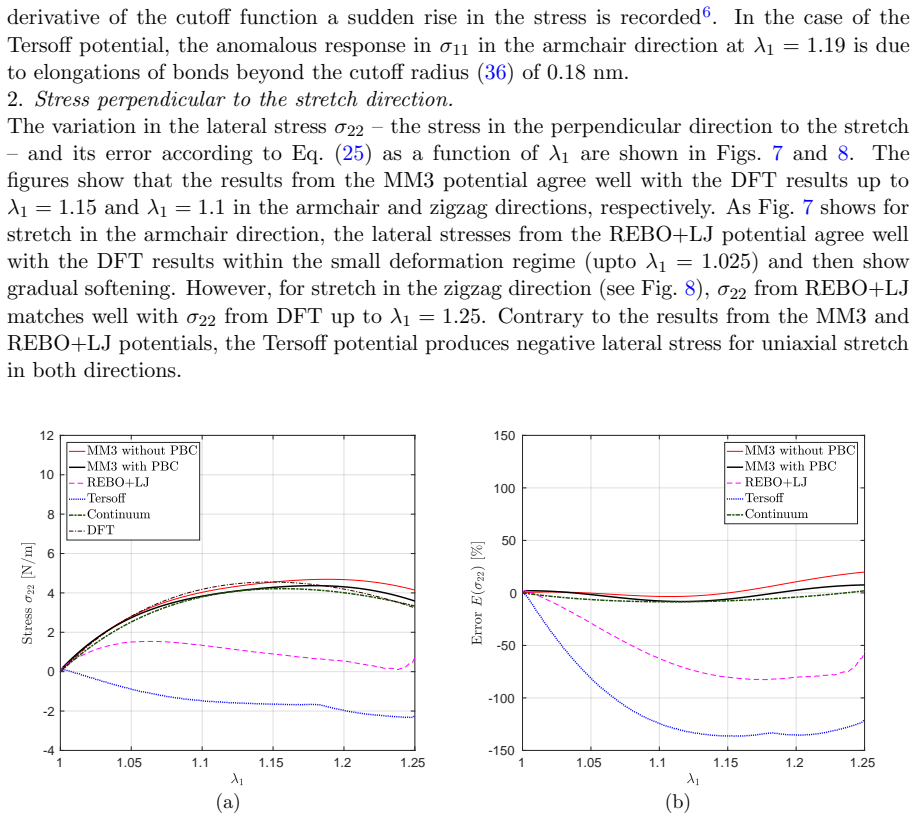
On the paper's own terms, the discovery is a validity map for graphene models at large deformation. For a 10 nm × 10 nm single-layer graphene sheet under uniaxial stretch, the DFT-calibrated continuum model reproduces the DFT strain energy and stresses over the whole range considered, while MM3 agrees with DFT within about 5% up to a stretch of roughly $\lambda_1 \approx 1.15$ in uniaxial loading and $J_1 \approx 0.3$ in biaxial loading, after which MM3 hardens; REBO+LJ and Tersoff agree with DFT only in the small-deformation regime and then deviate sharply because their switching or cutoff functions activate once bonds stretch beyond about 0.17–0.18 nm. Only the Tersoff potential produces negative lateral stress, an auxetic response, under uniaxial stretch. For pure bending, all three potentials give bending stiffnesses above the DFT value of 1.49 eV, with MM3 showing the largest deviation in bending energy for carbon nanotubes. For vibrations, the transverse frequencies of a pre-stretched graphene sheet and a carbon nanocone computed with MM3 and the continuum model agree within about 95%, though at zero strain the molecular frequencies are roughly 15% higher, which the paper attributes to residual stresses absent in the continuum model. The paper also reports a chirality disagreement: molecular simulations make the armchair direction stiffer, while DFT and the continuum model make the zigzag direction stiffer, an effect traced to angle-bending energy at large deformation.
Load-bearing premise
The ranking rests on treating the DFT data used in the paper as the true answer for graphene at large stretch, and on assuming that the loading in Eq. (24)—where the lateral stretch is held fixed at $\lambda_2 = 1$ during uniaxial stretching—imposes the same deformation state as the DFT calculations; if the quantum reference used a different strain control, the error levels and the MM3-versus-Tersoff ranking could change.
Editorial extensions
If this is right
- MM3 can be trusted for large-deformation graphene simulations up to the onset of instability, roughly 10–15 percent stretch, making it the safest of the three potentials for studies of bending and pre-stretched vibration.
- REBO+LJ and Tersoff should be confined to small strains when quantitative agreement with quantum results is required, because their switching and cutoff functions introduce artifacts once bonds stretch beyond about 0.17–0.18 nm.
- The DFT-calibrated anisotropic shell model can stand in for DFT in nonlinear membrane problems and in computing how vibration frequencies change with pre-stretch, with about 95 percent agreement against MM3 for the modes studied.
- Any auxetic claim for graphene under uniaxial tension should be treated with suspicion, since in this comparison only the Tersoff potential produces a negative Poisson ratio, against DFT, MM3, REBO+LJ, and the continuum model.
- Pre-stretch monotonically increases transverse vibration frequencies in both the atomistic and continuum descriptions, and the zero-stretch offset between them points to residual stresses that continuum models should account for.
Reading between the lines
- Because the continuum model was calibrated on the same DFT data it is checked against, its close agreement is partly by construction; a true validation would predict DFT results at deformation states not used in the fit, or compare with independent experimental stress–strain data.
- The cutoff-induced stress jumps in REBO+LJ and Tersoff suggest the ranking could change if smoother switching functions or different cutoff parameters were used, so the conclusion is specific to these standard parameterizations rather than to the general potential forms.
- The discrepancy in chirality ranking—molecular models finding the armchair direction stiffer while DFT and the continuum model find the zigzag direction stiffer—means large-strain anisotropy conclusions depend on model choice; experimental measurement of direction-dependent strength would arbitrate.
- The study is quasi-static and near zero Kelvin; extending the same comparison to finite temperature, which the paper flags as future work, would test whether MM3's advantage survives thermal activation and whether the Tersoff auxetic response persists.
Signed reviews
Editorial analysis
A structured set of objections, weighed in public.
Referee Report
Summary. The paper compares three interatomic potentials (MM3, REBO+LJ, and Tersoff) and a DFT-calibrated hyperelastic shell model for single-layer graphene under uniaxial-like and biaxial in-plane stretching and pure bending, and it reports modal analyses of a pre-stretched graphene sheet and a carbon nanocone. The central empirical claims are that the continuum model reproduces DFT reference data, that MM3 is accurate up to the material instability point, that REBO+LJ and Tersoff are accurate only for small deformations, and that Tersoff uniquely predicts auxetic behavior. The paper also reports that MM3 and the continuum model predict transverse frequency variations within about 95% agreement.
Significance. If the potential ranking holds, the paper provides useful practical guidance for choosing an empirical potential for large-deformation graphene simulations, and the parameter tables for the potentials and the material model are valuable. The manuscript is transparent that the continuum model's membrane constants were calibrated directly from the same DFT data used for comparison, so the reported 'excellent agreement' of the continuum model is a check of the fit rather than an independent validation. The independent content is mainly the MM3-versus-REBO/LJ/Tersoff comparison, and the strength of that comparison depends on whether the molecular boundary conditions reproduce the DFT deformation protocol. The modal analysis is a consistency check between two models rather than an independent test against quantum data.
major comments (4)
- [Section 4.2.1, Eq. (24)] The boundary condition called 'uniaxial' fixes the lateral stretch at λ2 = 1, so the molecular and continuum simulations actually produce a biaxial-clamped deformation state. The paper does not document the strain control used in the DFT reference data of Ref. [51]. If those DFT calculations imposed a different lateral condition, such as a stress-free contraction, then the energy, stresses, and error metric E(X) in Eq. (25) compare different thermodynamic paths, and the quantitative agreement claims (e.g., 'within about 5% up to λ1 = 1.15' and 'excellent agreement' for the continuum model) are not supported. The authors should either reproduce the DFT cell and strain protocol or recompute the comparisons under the exact lateral constraint used by Shirazian et al.
- [Section 4.2.2, Table 2] The continuum model's membrane constants in Table 2 are fitted to DFT data from Ref. [51] and Ref. [62], and the paper then reports agreement with the same DFT data to within about 0.05%. As the text itself states, this agreement is a direct consequence of the calibration. The abstract and conclusions should not present the continuum-DFT agreement as independent predictive validation; an out-of-sample test, for example against DFT data not used in the calibration or against a different loading path, is needed to support the claim that the continuum model is a generally reliable surrogate for DFT.
- [Abstract and Section 4.2.3, Figs. 4 and 5] The abstract claim that REBO+LJ and Tersoff 'agree only for small deformations' is inconsistent with the paper's own stress results. In Fig. 4, σ11 from REBO+LJ and Tersoff follows DFT up to λ1 = 1.19 in the armchair direction, and in Fig. 5 it follows DFT up to λ1 = 1.25 in the zigzag direction, while MM3 deviates earlier in the zigzag case beyond λ1 = 1.13. The ranking of the potentials therefore depends on whether one considers strain energy, longitudinal stress, or lateral stress, and on the loading direction. The summary in Section 4.5 and the conclusions should be qualified to avoid over-generalizing the ranking.
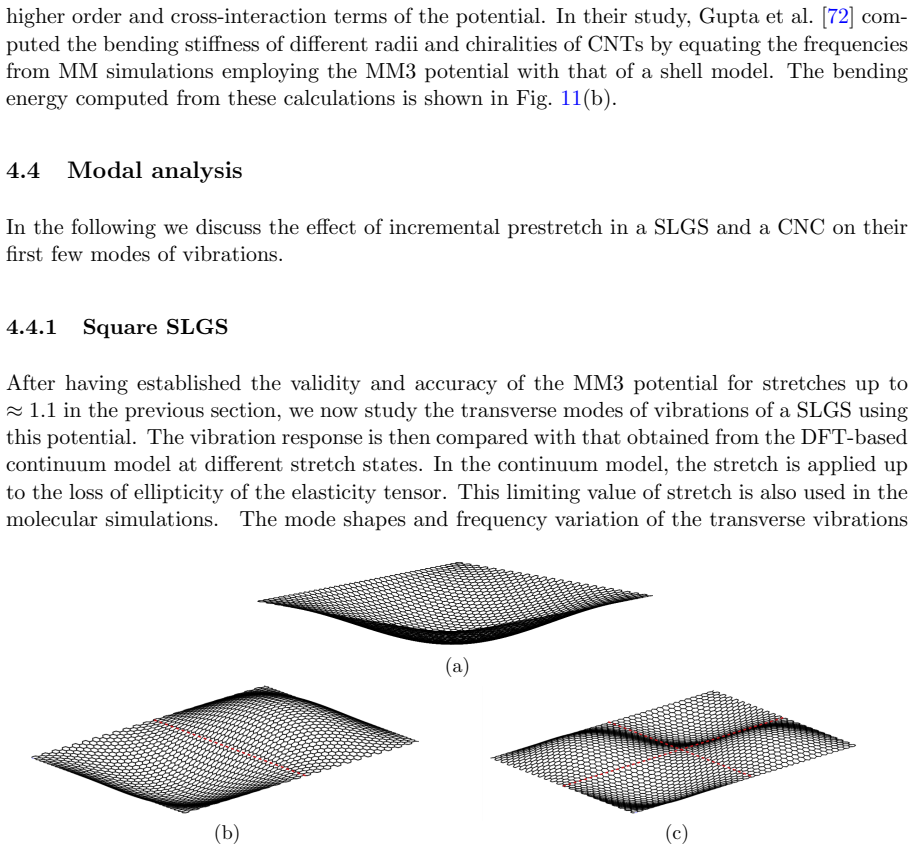
- [Section 4.4.1] The modal analysis compares MM3 frequencies with the continuum model using a bending stiffness taken from Table 3 (QM value 0.238 nN·nm ≈ 1.49 eV), whereas the MM3-based bending stiffness computed in Table 4 is 2.11 eV. The paper attributes the ≈15% zero-strain frequency difference to residual stresses not present in the continuum model, but the two models also differ in their bending stiffness. Because the continuum model is calibrated to DFT membrane data, the reported frequency-variation agreement is a consistency check between MM3 and the continuum model rather than an independent validation of MM3 against DFT; the text should state this limitation explicitly.
minor comments (6)
- [Section 4.2.1] The text states that the periodic box is deformed with a stretch increment of 0.1 Å; a stretch increment should be dimensionless, or the sentence should be rephrased in terms of strain.
- [Section 4.2.3, Eq. (25)] The error metric E(X) normalizes by max(X_DFT), which can produce very large or misleading errors when the DFT reference quantity crosses zero, as happens for σ22; the metric should be defined more robustly or its limitations should be stated.
- [Section 4.3, Table 5] The paper appropriately notes that the CNT-based approach to bending stiffness is problematic because relaxed CNTs change radius, but it still reports Table 5 without a correction; the discussion should be moved into the main text or the table should be removed.
- [Reference [51]] The DFT reference [51] is a short PAMM abstract; the authors should cite the underlying original DFT computations or provide the computational details, including functional, k-point sampling, cell size, and strain control, so that the protocol match can be checked.
- [Section 4.4.1, Fig. 13] The caption of Fig. 13 says 'all-edge-clamped', but Eq. (24) prescribes edge displacements; please clarify whether rotational degrees of freedom are also constrained in the molecular and continuum models.
- [General] There are several typos, including 'discusssed' in Section 4.2.3, 'anisotory' in Section 4.2.3, and 'isotopic' in Table 1, which should be 'isotropic'.
Circularity Check
Continuum-model agreement with DFT is an in-sample fit check; the MM3-vs-DFT ranking remains independent.
-
fitted input called prediction
[Table 2 caption; Sec. 4.2.2 (Eq. (25) error metric)]
"Table 2 caption: 'Hyperelastic material constants determined by fitting to DFT calculations based on generalized gradient approximation (GGA) according to Kumar and Parks [62] and Shirazian et al. [51].' Sec. 4.2.2: 'The continuum results are in excellent agreement with those from DFT simulations for the whole range under study (within ≈ 0.05% error). This is due to the fact, that the continuum model has been calibrated directly from DFT data [51].'"
The membrane constants of the continuum model (α̂, ε, μ0, μ1, β̂, η0, η1) are determined by fitting to the DFT data of [51]/[62]. Section 4.2.2 then compares the same continuum response with that identical DFT set through Eq. (25) and reports nearly perfect agreement as evidence of the model's validity. That agreement is mathematically the in-sample residual of the fit, so the claimed 'result' that the continuum model agrees with DFT is true by construction, not an independent confirmation.
full rationale
The molecular-potential ranking is a genuinely independent part of the paper. The MM3, REBO+LJ, and Tersoff parameters are not fitted to the DFT data of Shirazian et al. [51] or Kumar & Parks [62], so the findings that MM3 agrees up to about 1.15 stretch, that REBO+LJ and Tersoff agree only for small deformations, and that Tersoff gives auxetic response are empirical results from the paper's own simulations. The DFT reference, although produced partly by the same group in [51], is an ab initio calculation and therefore counts as external evidence under the rules; no uniqueness theorem or ansatz is smuggled in via self-citation. The one clear circular step is the continuum-model 'validation': Table 2 says the membrane constants were fitted to DFT data, and Sec. 4.2.2 reports excellent agreement with those same data as evidence of validity. The bending stiffness in Table 3 comes from external QM values, and the modal analyses are cross-model consistency checks rather than circular predictions. Because the continuum-versus-DFT agreement reduces to a fit check but the main molecular-potential claims and the auxetic finding stand independently, the appropriate score is 6: partial circularity confined to one fitted comparison.
Assumptions & free parameters
free parameters (2)
- Continuum membrane constants {alpha, epsilon, mu0, mu1, beta, eta0, eta1} =
Kumar-Parks set: 1.53, 93.84 N/m, 172.18 N/m, 27.03, 5.16, 94.65 N/m, 4393.26 N/m; Shirazian set: 1.435, 103.9 N/m…
- Bending stiffness cb =
0.133, 0.225, 0.238 nN nm (from literature, Table 3)
assumptions (5)
- domain assumption DFT calculations of Shirazian et al. [51] and Kumar & Parks [62] provide accurate reference energies and stresses for graphene at large strain
- domain assumption The constitutive form W(J1, J2, J3) in Eqs. (9)-(13) can represent graphene's anisotropic hyperelastic response
- domain assumption Applying affine edge displacements Eq. (24) with fixed lateral stretch produces the same deformation state as the periodic DFT cell used to fit the continuum model
- domain assumption Virial stress averaged per atom with area AI (Eqs. (3)-(4)) equals the continuum Cauchy stress
- domain assumption Lowest eigenfrequencies of the mass-weighted Hessian from MM (Tinker Vibrate) correspond to continuum shell eigenfrequencies from Eq. (23) under the same boundary conditions
Cite this review
Pith. "Pith review of Comparing quantum, molecular and continuum models for graphene at large deformations." pith.science (2026). https://pith.science/paper/7V2W7HR5
@misc{pith2026190805090,
  author       = {Pith},
  title        = {Pith review of: Comparing quantum, molecular and continuum models for graphene at large deformations},
  year         = {2026},
  howpublished = {\url{https://pith.science/paper/7V2W7HR5}},
  note         = {Machine review of arXiv:1908.05090}
}
read the original abstract
In this paper, the validity and accuracy of three interatomic potentials and the continuum shell model of Ghaffari and Sauer [1] are investigated. The mechanical behavior of single-layered graphene sheets (SLGSs) under uniaxial stretching, biaxial stretching and pure bending is studied for this comparison. The validity of the molecular and continuum models is assessed by direct comparison with density functional theory (DFT) data available in the literature. The molecular simulations are carried out employing the MM3, Tersoff and REBO+LJ potentials. The continuum formulation uses an anisotropic hyperelastic material model in the framework of the geometrically exact Kirchhoff-Love shell theory and isogeometric finite elements. Results from the continuum model are in good agreement with those from DFT. The results from the MM3 potential agree well up to the point of material instability, whereas those from the REBO+LJ and Tersoff potentials agree only for small deformations. Only the Tersoff potential is found to yield auxetic response in SLGSs under uniaxial stretch. Additionally, the transverse vibration frequencies of a pre-stretched graphene sheet and a carbon nanocone are obtained using the continuum model and molecular simulations with the MM3 potential. The variations of the frequencies from these approaches agree within an error of 5%.
Figures


Figures from the paper (12 more)






Reference graph
Works this paper leans on
-
[51]
F. Shirazian, R. Ghaffari, M. Hu, and R.A. Sauer. Hyperelastic material modeling of graphene based on density functional calculations. PAMM, 18(1):e201800419, 2018. doi: 10.1002/pamm.201800419. URL https://onlinelibrary.wiley.com/doi/abs/10. 1002/pamm.201800419
-
[62]
S. Kumar and D.M. Parks. On the hyperelastic softening and elastic instabilities in graphene. Proc. Royal Soc. Lond. A: Math. Phys. Eng. Sci. , 471(2173), 2014. ISSN 1364-5021. doi: 10.1098/rspa.2014.0567. URL http://rspa.royalsocietypublishing. org/content/471/2173/20140567. DOI: 10.1098/rspa.2014.0567
-
[1]
R. Ghaffari and R.A. Sauer. A new efficient hyperelastic finite element model for graphene and its application to carbon nanotubes and nanocones. Finite Elem Anal Des , 146: 42--61, 2018. ISSN 0168-874X. doi: https://doi.org/10.1016/j.finel.2018.04.001. URL http://www.sciencedirect.com/science/article/pii/S0168874X17309782
-
[2]
K.S. Novoselov, A.K. Geim, S.V. Morozov, D. Jiang, Y. Zhang, S.V. Dubonos, I.V. Grigorieva, and A.A. Firsov. Electric field effect in atomically thin carbon films. Sci- ence, 306(5696):666--669, 2004. ISSN 0036-8075. doi: 10.1126/science.1102896. URL https://science.sciencemag.org/content/306/5696/666
-
[3]
C. Lee, X. Wei, J.W. Kysar, and J. Hone. Measurement of the elastic properties and intrinsic strength of monolayer graphene. Science, 321(5887):385--388, 2008. ISSN 0036-
work page 2008
-
[4]
L. Tang, Y. Wang, Y. Li, H. Feng, J. Lu, and J. Li. Preparation, structure, and electrochemical properties of reduced graphene sheet films. Adv. Funct. Mater. , 19 (17):2782--2789, 2009. ISSN 1616301X. doi: 10.1002/adfm.200900377. URL https: //onlinelibrary.wiley.com/doi/abs/10.1002/adfm.200900377
-
[5]
S. Stankovich, D.A. Dikin, G.H.B. Dommett, K.M. Kohlhaas, E.J. Zimney, E.A Stach, R.D. Piner, S.B.T. Nguyen, and R.S. Ruoff. Graphene-based composite materials. Nature, 442(7100):282--286, 2006. ISSN 00280836. doi: 10.1038/nature04969. URL https://doi. org/10.1038/nature04969
-
[6]
J.S. Bunch, A.M. van der Zande, S.S. Verbridge, I.W. Frank, D.M. Tanenbaum, J.M. Parpia, H.G. Craighead, and P.L. McEuen. Electromechanical resonators from graphene sheets. Science, 315(5811):490--493, 2007. ISSN 0036-8075. doi: 10.1126/science.1136836. URL http://science.sciencemag.org/content/315/5811/490
Show all 78 references
-
[7]
Westervelt
R.M. Westervelt. Graphene nanoelectronics. Science (New York, N.Y.), 320(5874):324--5,
-
[8]
Ge and K
M. Ge and K. Sattler. Observation of fullerene cones. Chem. Phys. Lett. , 220(3):192-- 196, 1994. ISSN 0009-2614. doi: https://doi.org/10.1016/0009-2614(94)00167-7. URL http://www.sciencedirect.com/science/article/pii/0009261494001677. 22
1994
-
[9]
Liu and B.I
Y. Liu and B.I. Yakobson. Cones, pringles, and grain boundary landscapes in graphene topology. Nano Lett., 10(6):2178--2183, 2010. doi: 10.1021/nl100988r. URL https://doi. org/10.1021/nl100988r. PMID: 20481585
2010 doi
-
[10]
Charlier and G.M
J.C. Charlier and G.M. Rignanese. Electronic structure of carbon nanocones. Phys. Rev. Lett., 86:5970--5973, Jun 2001. doi: 10.1103/PhysRevLett.86.5970. URL https://link. aps.org/doi/10.1103/PhysRevLett.86.5970
2001 doi
-
[11]
Adisa, B.J
O.O. Adisa, B.J. Cox, and J.M. Hill. Open carbon nanocones as candidates for gas storage. J. Phys. Chem. C , 115(50):24528--24533, 2011. doi: 10.1021/jp2069094. URL https: //doi.org/10.1021/jp2069094
2011 doi
-
[12]
Z. Xu, D. Zheng, B. Ai, and W. Zhong. Autonomous pump against concentration gra- dient. Sci. Rep., 6(1), 2016. doi: 10.1038/srep23414. URL https://doi.org/10.1038/ srep23414
2016 doi
-
[13]
Kudin, G.E
K.N. Kudin, G.E. Scuseria, and B.I. Yakobson. C 2F, BN, and C nanoshell elasticity from ab initio computations. Phys. Rev. B , 64:235406, Nov 2001. doi: 10.1103/PhysRevB.64. 235406. URL http://link.aps.org/doi/10.1103/PhysRevB.64.235406
2001 doi
-
[14]
Z. Ni, H. Bu, M. Zou, H. Yi, K. Bi, and Y. Chen. Anisotropic mechanical proper- ties of graphene sheets from molecular dynamics. Physica B , 405(5):1301--1306, 2010. ISSN 09214526. doi: 10.1016/j.physb.2009.11.071. URL http://dx.doi.org/10.1016/j. physb.2009.11.071
2010 doi
-
[15]
Van Lier, C
G. Van Lier, C. Van Alsenoy, V. Van Doren, and P. Geerlings. Ab initio study of the elastic properties of single-walled carbon nanotubes and graphene. Chem. Phys. Lett., 326 (1-2):181--185, 2000. ISSN 00092614. doi: 10.1016/S0009-2614(00)00764-8. URL http: //www.sciencedirect....
-
[16]
Reddy, S
C.D. Reddy, S. Rajendran, and K.M. Liew. Equilibrium configuration and contin- uum elastic properties of finite sized graphene. Nanotechnology, 17(3):864--870, 2006. ISSN 09574484. doi: 10.1088/0957-4484/17/3/042. URL https://doi.org/10.1088\% 2F0957-4484\%2F17\%2F3\%2F042
2006 doi
-
[17]
Konstantinova, S.O
E. Konstantinova, S.O. Dantas, and P.M.V.B. Barone. Electronic and elastic properties of two-dimensional carbon planes. Phys. Rev. B , 74:035417, Jul 2006. doi: 10.1103/ PhysRevB.74.035417. URL https://link.aps.org/doi/10.1103/PhysRevB.74.035417
2006 doi
-
[18]
F. Liu, P. Ming, and J. Li. Ab initio calculation of ideal strength and phonon instability of graphene under tension. Phys. Rev. B , 76:064120, Aug 2007. doi: 10.1103/PhysRevB. 76.064120. URL https://link.aps.org/doi/10.1103/PhysRevB.76.064120
2007 doi
-
[19]
Faccio, P.A
R. Faccio, P.A. Denis, H. Pardo, C. Goyenola, and A.W. Mombr\' u. Mechanical properties of graphene nanoribbons. Phys. Rev. B: Condens. Matter , 21(28):285304, 2009. URL http://stacks.iop.org/0953-8984/21/i=28/a=285304
2009
-
[20]
Sakhaee-Pour
A. Sakhaee-Pour. Elastic properties of single-layered graphene sheet. Solid State Commun., 149(1-2):91--95, 2009. ISSN 00381098. doi: 10.1016/j.ssc.2008.09.050. URL http://dx. doi.org/10.1016/j.ssc.2008.09.050
2009 doi
-
[21]
Gao and P
Y. Gao and P. Hao. Mechanical properties of monolayer graphene under tensile and compressive loading. Physica E Low Dimens. Syst. Nanostruct. , 41(8):1561--1566, 2009. ISSN 13869477. doi: 10.1016/j.physe.2009.04.033. URL http://dx.doi.org/10.1016/j. physe.2009.04.033. 23
2009 doi
-
[22]
H. Zhao, K. Min, and N.R. Aluru. Size and chirality dependent elastic properties of graphene nanoribbons under uniaxial tension. Nano Lett. , 9(8):3012--3015, 2009. ISSN 15306984. doi: 10.1021/nl901448z. URL https://doi.org/10.1021/nl901448z
2009 doi
-
[23]
Scarpa, S
F. Scarpa, S. Adhikari, and A.S. Phani. Effective elastic mechanical properties of single layer graphene sheets. Nanotechnology, 20(6), 2009. ISSN 09574484. doi: 10.1088/0957-4484/20/6/065709. URL https://doi.org/10.1088\%2F0957-4484\%2F20\% 2F6\%2F065709
2009 doi
-
[24]
Pei, Y.W
Q.X. Pei, Y.W. Zhang, and V.B. Shenoy. A molecular dynamics study of the mechani- cal properties of hydrogen functionalized graphene. Carbon, 48(3):898--904, 2010. ISSN 00086223. doi: 10.1016/j.carbon.2009.11.014. URL http://dx.doi.org/10.1016/j. carbon.2009.11.014
2010 doi
-
[25]
Georgantzinos, G.I
S.K. Georgantzinos, G.I. Giannopoulos, and N.K. Anifantis. Numerical investigation of elastic mechanical properties of graphene structures. Mater. Des., 31(10):4646--4654, 2010. ISSN 02641275. doi: 10.1016/j.matdes.2010.05.036. URL http://dx.doi.org/10.1016/ j.matdes.2010.05.036
2010 doi
-
[26]
Gupta and R.C
S.S. Gupta and R.C. Batra. Elastic properties and frequencies of free vibrations of single- layer graphene sheets. J. Comput. Theoretical Nanosci. , 7(10):2151--2164, 2010. ISSN 15461955. doi: 10.1166/jctn.2010.1598. URL https://doi.org/10.1166/jctn.2010. 1598
2010
-
[27]
Liu, C.W
T.H. Liu, C.W. Pao, and C.C. Chang. Effects of dislocation densities and distributions on graphene grain boundary failure strengths from atomistic simulations. Carbon, 50 (10):3465--3472, 2012. ISSN 00086223. doi: 10.1016/j.carbon.2012.03.012. URL http: //dx.doi.org/10.1016/j....
2012 doi
-
[28]
Kalosakas, N.N
G. Kalosakas, N.N. Lathiotakis, C. Galiotis, and K. Papagelis. In-plane force fields and elastic properties of graphene. J. Appl. Phys. , 113(13), 2013. ISSN 00218979. doi: 10. 1063/1.4798384. URL https://doi.org/10.1063/1.4798384
2013 doi
-
[29]
Alzebdeh
K.I. Alzebdeh. An atomistic-based continuum approach for calculation of elastic properties of single-layered graphene sheet. Solid State Commun. , 177:25--28, 2014. ISSN 0038-1098. doi: https://doi.org/10.1016/j.ssc.2013.09.017. URL http://www.sciencedirect.com/ science/articl...
2014 doi
-
[30]
Genoese, N.L
A.Genoese, A. Genoese, N.L. Rizzi, and G. Salerno. On the derivation of the elastic properties of lattice nanostructures: The case of graphene sheets. Compos. B Eng. , 115: 316--329, 2017. ISSN 1359-8368. doi: https://doi.org/10.1016/j.compositesb.2016.09.064. URL http://www.s...
2017 doi
-
[31]
Singh and B.P
S. Singh and B.P. Patel. Nonlinear elastic properties of graphene sheet using mm3 poten- tial under finite deformation. Compos. B Eng. , 136:81--91, 2018. ISSN 1359-8368. doi: https://doi.org/10.1016/j.compositesb.2017.10.024. URL http://www.sciencedirect. com/science/article/...
2018 doi
-
[32]
Allinger, Y.H
N.L. Allinger, Y.H. Yuh, and J.H. Lii. Molecular mechanics. the mm3 force field for hydrocarbons. 1. J. Am. Chem. Soc., 111(23):8551--8566, 1989. doi: 10.1021/ja00205a001. URL https://doi.org/10.1021/ja00205a001
1989 doi
-
[33]
J. Tersoff. Modeling solid-state chemistry: Interatomic potentials for multicomponent systems. Phys. Rev. B , 39:5566--5568, Mar 1989. doi: 10.1103/PhysRevB.39.5566. URL https://link.aps.org/doi/10.1103/PhysRevB.39.5566. 24
1989 doi
-
[34]
D.W. Brenner. Empirical potential for hydrocarbons for use in simulating the chemical vapor deposition of diamond films. Phys. Rev. B , 42:9458--9471, Nov 1990. doi: 10.1103/ PhysRevB.42.9458. URL https://link.aps.org/doi/10.1103/PhysRevB.42.9458
1990 doi
-
[35]
Brenner, O.A
D.W. Brenner, O.A. Shenderova, J.A. Harrison, S.J. Stuart, B. Ni, and S.B. Sinnott. A second-generation reactive empirical bond order (REBO) potential energy expression for hydrocarbons. J. Phys.: Condens. Matter , 14(4):783--802, 2002. ISSN 09538984. doi: 10.1088/0953-8984/14...
2002 doi
-
[36]
Stuart, A.B
S.J. Stuart, A.B. Tutein, and J.A. Harrison. A reactive potential for hydrocarbons with intermolecular interactions. J. Chem. Phys. , 112(14):6472--6486, 2000. doi: 10.1063/1. 481208. URL https://doi.org/10.1063/1.481208
-
[37]
Chenoweth, A.C.T van Duin, and W.A Goddard
K. Chenoweth, A.C.T van Duin, and W.A Goddard. ReaxFF Reactive Force Field for Molecular Dynamics Simulations of Hydrocarbon Oxidation. J. Phys. Chem. A , 112(5): 1040--1053, 2008. ISSN 1089-5639. doi: 10.1021/jp709896w. URL http://pubs.acs.org/ doi/abs/10.1021/jp709896w
2008 doi
-
[38]
Lebedeva, A.S
I.V. Lebedeva, A.S. Minkin, A.M. Popov, and A.A. Knizhnik. Elastic constants of graphene: Comparison of empirical potentials and DFT calculations. Physica E Low Dimens. Syst. Nanostruct. , 108:326--338, 2019. ISSN 1386-9477. doi: https://doi.org/ 10.1016/j.physe.2018.11.025. U...
2019 doi
-
[39]
Liao, C.H
M.L. Liao, C.H. Cheng, and Y.P Lin. Tensile and compressive behaviors of open- tip carbon nanocones under axial strains. J. Mater. Res. , 26(13):1577--1584, 2011. doi: 10.1557/jmr.2011.160. URL https://www.cambridge.org/core/article/ tensile-and-compressive-behaviors-of-openti...
2011 doi
-
[40]
Kitipornchai, X.Q
S. Kitipornchai, X.Q. He, and K.M. Liew. Continuum model for the vibration of multi- layered graphene sheets. Phys. Rev. B: Condens. Matter Mater. Phys. , 72(7):1--6, 2005. ISSN 10980121. doi: 10.1103/PhysRevB.72.075443. URL https://link.aps.org/doi/ 10.1103/PhysRevB.72.075443
2005 doi
-
[41]
Jiang, S
S. Jiang, S. Shi, and X. Wang. Nanomechanics and vibration analysis of graphene sheets via a 2D plate model. J. Phys. D: Appl. Phys. , 47(4), 2014. ISSN 00223727. doi: 10.1088/0022-3727/47/4/045104. URL https://doi.org/10.1088\%2F0022-3727\%2F47\% 2F4\%2F045104
2014 doi
-
[42]
Chowdhury, S
R. Chowdhury, S. Adhikari, F. Scarpa, and M.I. Friswell. Transverse vibration of single- layer graphene sheets. J. Phys. D: Appl. Phys. , 44(20):205401, 2011. ISSN 0022-3727. doi: 10.1088/0022-3727/44/20/205401. URL http://stacks.iop.org/0022-3727/44/i= 20/a=205401?key=crossre...
2011 doi
-
[43]
Atalaya, A
J. Atalaya, A. Isacsson, and J.M. Kinaret. Continuum elastic modeling of graphene resonators. Nano Lett. , 8(12):4196--4200, 2008. doi: 10.1021/nl801733d. URL https: //doi.org/10.1021/nl801733d. PMID: 18956921
2008 doi
-
[44]
M.D Dai, C.W Kim, and K. Eom. Nonlinear vibration behavior of graphene resonators and their applications in sensitive mass detection. Nanoscale Res. Lett. , 7(1):499, Sep
-
[45]
Khani, and S
M.M.S Fakhrabadi, N. Khani, and S. Pedrammehr. Vibrational analysis of single- walled carbon nanocones using molecular mechanics approach. Physica E Low Di- mens. Syst. Nanostruct. , 44(7):1162--1168, 2012. ISSN 1386-9477. doi: https://doi.org/ 10.1016/j.physe.2012.01.004. URL...
2012 doi
-
[46]
Y.G. Hu, K.M. Liew, X.Q. He, Z. Li, and J. Han. Free transverse vibration of single-walled carbon nanocones. Carbon, 50(12):4418--4423, 2012. ISSN 0008-6223. doi: https://doi.org/ 10.1016/j.carbon.2012.04.072. URL http://www.sciencedirect.com/science/article/ pii/S0008622312004484
2012 doi
-
[47]
Ansari, H
R. Ansari, H. Rouhi, and A. Nasiri Rad. Vibrational analysis of carbon nanocones under different boundary conditions: An analytical approach. Mech. Res. Commun. , 56:130-- 135, 2014. ISSN 0093-6413. doi: https://doi.org/10.1016/j.mechrescom.2013.12.010. URL http://www.scienced...
2014 doi
-
[48]
Sakhaee-Pour, M.T
A. Sakhaee-Pour, M.T. Ahmadian, and R. Naghdabadi. Vibrational analysis of single- layered graphene sheets. Nanotechnology, 19(8):085702, 2008. ISSN 0957-4484. doi: 10.1088/0957-4484/19/8/085702. URL http://stacks.iop.org/0957-4484/19/i=8/a= 085702?key=crossref.0e1f876493937bb...
2008 doi
-
[49]
Singh and B.P
S. Singh and B.P. Patel. Effect of initial strain and material nonlinearity on the non- linear static and dynamic response of graphene sheets. J. Sound Vib. , 423:373--400,
-
[50]
Singh and B.P
S. Singh and B.P. Patel. Nonlinear elastic properties of graphene sheet under finite deforma- tion. Compos. Struct, 119:412--421, 2015. ISSN 0263-8223. doi: https://doi.org/10.1016/j. compstruct.2014.09.021. URL http://www.sciencedirect.com/science/article/pii/ S0263822314004644
2015 doi
-
[52]
Nocedal and S.J
J. Nocedal and S.J. Wright. Numerical optimization. Springer, 1999
1999
-
[53]
Computer Code Tinker Molecular Modelling Package 4.2
J.W Ponder. Computer Code Tinker Molecular Modelling Package 4.2. 2004
2004
-
[54]
Polak and G
E. Polak and G. Ribiere. Note sur la convergence de m\' ethodes de directions conjugu\' ees. ESAIM: Math. Model. Num. - Mod\' elisation Math\' ematique et Analyse Num\' erique, 3(R1): 35--43, 1969. URL http://www.numdam.org/item/M2AN\.1969\.\.3\.1\.35\.0
1969
-
[55]
Evans and B.L
D.J. Evans and B.L. Holian. The nose--hoover thermostat. J. Chem. Phys. , 83(8):4069-- 4074, 1985. doi: 10.1063/1.449071. URL https://doi.org/10.1063/1.449071
1985 doi
-
[56]
Fast parallel algorithms for short-range molecular dynamics
Steve P. Fast parallel algorithms for short-range molecular dynamics. J. Comput. Phys. , 117(1):1--19, 1995. ISSN 0021-9991. doi: https://doi.org/10.1006/jcph.1995.1039. URL http://www.sciencedirect.com/science/article/pii/S002199918571039X
1995
-
[57]
D.H. Tsai. The virial theorem and stress calculation in molecular dynamics. The Journal of Chemical Physics , 70(3):1375--1382, 1979. doi: 10.1063/1.437577. URL https://doi. org/10.1063/1.437577. 26
1979 doi
-
[58]
R.J. Swenson. Comments on virial theorems for bounded systems. Am. J. Phys. , 51(10): 940--942, 1983. ISSN 0002-9505. doi: 10.1119/1.13390. URL http://aapt.scitation. org/doi/10.1119/1.13390
1983 doi
-
[59]
J.E. Jones. On the determination of molecular fields.ii. from the equation of state of a gas. Proc. R. Soc. A , 106(738):463--477, 1924. doi: 10.1098/rspa.1924.0082. URL https://royalsocietypublishing.org/doi/abs/10.1098/rspa.1924.0082
1924
-
[60]
Duong, F
T.X. Duong, F. Roohbakhshan, and R.A. Sauer. A new rotation-free isogeometric thin shell formulation and a corresponding continuity constraint for patch boundaries. Comput. Methods in Appl. Mech. Eng. , 316(Supplement C):43--83, 2017. ISSN 0045-
2017
-
[61]
Ghaffari, T.X
R. Ghaffari, T.X. Duong, and R.A. Sauer. A new shell formulation for graphene structures based on existing ab-initio data. Int. J. Solids Struct. , 135:37--60, 2018. ISSN 0020-7683. doi: https://doi.org/10.1016/j.ijsolstr.2017.11.008. URL http://www.sciencedirect. com/science/...
2018 doi
-
[63]
Q. Lu, M. Arroyo, and R. Huang. Elastic bending modulus of monolayer graphene. J. Phys. D: Appl. Phys. , 42(10):102002, 2009. URL http://stacks.iop.org/0022-3727/ 42/i=10/a=102002
2009
-
[64]
Ghaffari and R.A
R. Ghaffari and R.A. Sauer. A nonlinear thermomechanical formulation for anisotropic volume and surface continua. arXiv e-prints, abs/1901.00917, 2019. URL http://arxiv. org/abs/1901.00917
1901 arXiv
-
[65]
Ghaffari and R.A
R. Ghaffari and R.A. Sauer. Modal analysis of graphene-based structures for large deforma- tions, contact and material nonlinearities. J. Sound Vib. , 423:161--179, 2018. ISSN 0022- 460X. doi: https://doi.org/10.1016/j.jsv.2018.02.051. URL https://www.sciencedirect. com/scienc...
2018 doi
-
[66]
Bosak, M
A. Bosak, M. Krisch, M. Mohr, J. Maultzsch, and C. Thomsen. Elasticity of single- crystalline graphite: Inelastic x-ray scattering study. Phys. Rev. B , 75:153408, Apr
-
[67]
Berinskii and A.M
I.E. Berinskii and A.M. Krivtsov. On using many-particle interatomic potentials to com- pute elastic properties of graphene and diamond. Mech. Solids, 45(6):815--834, Dec 2010. ISSN 1934-7936. doi: 10.3103/S0025654410060063. URL https://doi.org/10.3103/ S0025654410060063
2010 doi
-
[68]
Sgouros, G
A.P. Sgouros, G. Kalosakas, C. Galiotis, and K. Papagelis. Uniaxial compression of sus- pended single and multilayer graphenes. 2D Mater. , 3(2):025033, jun 2016. doi: 10. 1088/2053-1583/3/2/025033. URL https://doi.org/10.1088\%2F2053-1583\%2F3\%2F2\% 2F025033. 27
2016
-
[69]
Timoshenko and S
S. Timoshenko and S. Woinowsky-Krieger. Theory of plates and shells . Engineering societies monographs. McGraw-Hill, 1959. URL https://books.google.de/books?id= rTQFAAAAMAAJ
1959
-
[70]
Robert D. Blevins. Formulas for natural frequency and mode shapes . Van Nostrand Rein- hold Co., 1979
1979
-
[71]
Huang, J
Y. Huang, J. Wu, and K. C. Hwang. Thickness of graphene and single-wall carbon nan- otubes. Phys. Rev. B , 74:245413, Dec 2006. doi: 10.1103/PhysRevB.74.245413. URL https://link.aps.org/doi/10.1103/PhysRevB.74.245413
2006 doi
-
[72]
Gupta, F.G
S.S. Gupta, F.G. Bosco, and R.C. Batra. Wall thickness and elastic moduli of single- walled carbon nanotubes from frequencies of axial, torsional and inextensional modes of vibration. Comput. Mater. Sci. , 47(4):1049--1059, 2010. ISSN 0927-0256. doi: https://doi. org/10.1016/j...
2010 doi
-
[2007]
URL https://link.aps.org/doi/10.1103/ PhysRevB.75.153408
doi: 10.1103/PhysRevB.75.153408. URL https://link.aps.org/doi/10.1103/ PhysRevB.75.153408
-
[2008]
doi: 10.1126/science.1156936
ISSN 1095-9203. doi: 10.1126/science.1156936. URL http://www.ncbi.nlm.nih. gov/pubmed/18420920
-
[2012]
doi: 10.1186/1556-276X-7-499
ISSN 1556-276X. doi: 10.1186/1556-276X-7-499. URL https://doi.org/10.1186/ 1556-276X-7-499. 25
-
[2018]
doi: https://doi.org/10.1016/j.jsv.2018.02.059
ISSN 0022-460X. doi: https://doi.org/10.1016/j.jsv.2018.02.059. URL http: //www.sciencedirect.com/science/article/pii/S0022460X1830155X
2018 doi
-
[7825]
URL http://www.sciencedirect
doi: https://doi.org/10.1016/j.cma.2016.04.008. URL http://www.sciencedirect. com/science/article/pii/S0045782516301657. Special Issue on Isogeometric Analysis: Progress and Challenges
2016 doi
-
[8075]
URL https://science.sciencemag.org/content/ 321/5887/385
doi: 10.1126/science.1157996. URL https://science.sciencemag.org/content/ 321/5887/385
Reviewed August 14, 2026 · model on record in the stance chip above.
Discussion (0). Continue with ORCID to comment.