REVIEW 4 major objections 5 minor 53 references
Saturn's south polar cloud composition and structure inferred from 2006 Cassini/VIMS spectra and ISS images
T0 review · 4 major / 5 minor · reviewed 2026-08-14 · deepseek-v4-flash
Pith's one-line read Saturn’s south polar clouds expose ammonia ice through a thin upper haze, and the polar shadows come from step changes in translucent layers, not eyewalls.
desk verdict Solid retrieval paper that credibly explains ammonia visibility without convection, while the shadow/antishadow step-change claim is honestly caveated in the text but stated a bit too firmly in the abstract. read the letter →
The pith
A machine-rendered reading of the paper's core claim, the machinery that carries it, and where it could break.
The reading
What carries the argument
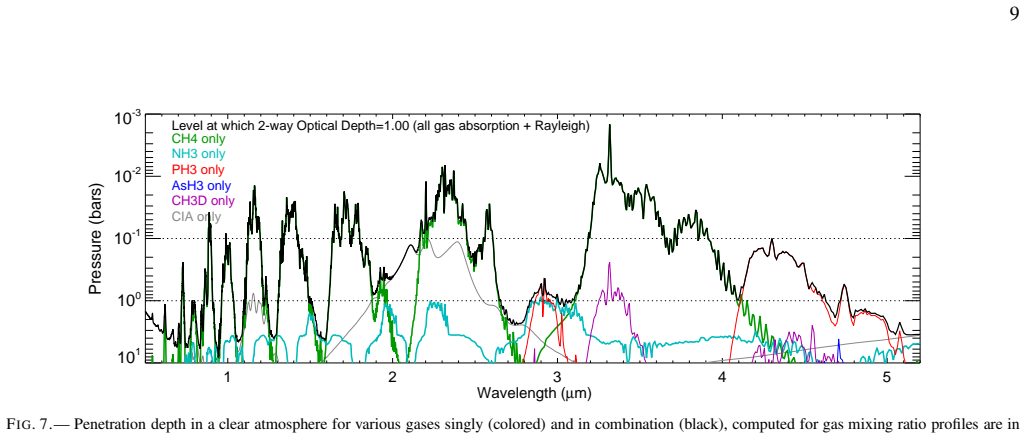
The load-bearing object is a four-layer sheet-cloud radiative transfer model, in which each of the top three layers is described by a fitted base pressure, particle radius, and $2\,\mu$m optical depth, with spherical scattering particles and a doubling-adding multiple-scattering treatment that includes gas absorption and thermal emission. The model is the device that converts VIMS spectra into the claim that the upper tropospheric layer is tenuous and that no cloud layer disappears or becomes an optically thick wall at the polar boundaries. The shadow mechanism is carried by a geometric and photometric test: a step change in the optical depth of a translucent layer predicts an antishadow on the opposite side of the pole, while an illuminated eyewall predicts a bright feature extending toward the pole, and ISS images at 728 nm, 752 nm, and 890 nm are used to distinguish the two outcomes.
What would settle it
A three-dimensional radiative transfer simulation using the paper's retrieved optical-depth steps should reproduce both the shadow and the opposite-side antishadow amplitudes at 752 nm; if the simulated feature instead appears as a bright structure extending toward the pole, or has the wrong amplitude, the step-change mechanism is falsified.
Extended reading notes
Core claim
The central discovery is that a four-layer plane-parallel radiative transfer model, with a stratospheric haze near 50 mbar, a non-absorbing upper tropospheric layer near 300 mbar (probably diphosphine or phosphorus), an ammonia ice layer near 900 to 980 mbar, and a deep cloud extending from 5 bars up to 2 to 4 bars, fits VIMS spectra of reflected sunlight and thermal emission from $71^\circ$S to $90^\circ$S. The upper tropospheric layer has a fitted optical depth well below unity, and that is what allows the ammonia ice signature to become apparent: ammonia need not be carried to the visible cloud top by convection. The same models contain no optically thick vertical walls; instead, the fitted optical depths of the stratospheric haze and the putative diphosphine layer drop in sharp steps near the latitudes of the observed shadows. Because the same boundaries, on the opposite side of the pole, show bright features extending away from the pole rather than toward it, the paper concludes that both shadows and antishadows are produced by step changes in the optical depth of translucent layers.
Load-bearing premise
The claim depends on each cloud layer being horizontally uniform across the area sampled by a single spectrum, and the paper states that this assumption breaks down near the very step changes invoked to produce the shadows.
Editorial extensions
If this is right
- Ammonia ice spectral signatures at $3\,\mu$m no longer imply convective penetration; a thin overlying haze anywhere on a giant planet should expose the underlying ammonia layer.
- The 'eyewall' interpretation of Saturn's polar ring shadows is replaced by step changes in translucent haze optical depth, with a step near $87.9^\circ$S in the stratospheric haze and a step near $88.9^\circ$S in the putative diphosphine layer.
- The rise in the fitted phosphine break-point pressure from about 200 mbar to 400 mbar, together with the decline in arsine mixing ratio toward the pole, supports subsidence within $2^\circ$ of the pole.
- Ammonia-signature cloud structures have elevated and thickened ammonia layers, and deep cloud tops about 1 bar higher than in the background, suggesting deep convection that lifts the overlying column without delivering material to the visible cloud deck.
- The south polar background structure, with optical depths of about 0.023, 0.72, and 0.80 for the top three layers at $2\,\mu$m, provides a cleaner view of Saturn's main cloud layers than most of the planet, where an optically thick upper haze hides them.
Reading between the lines
- If the step-change mechanism is generic, analogous shadow and antishadow pairs on other rapidly rotating planets could be read as horizontal optical-depth gradients rather than vertical cloud walls, at least where no lightning is present.
- The composition of the upper tropospheric layer remains unconfirmed because laboratory optical constants for diphosphine under Saturn conditions are still lacking; measurements of P$_2$H$_4$ absorption near $4.3\,\mu$m would turn the 'putative diphosphine' label into a testable identification.
- The paper's own caveat that horizontal homogeneity fails near the steps implies that the retrieved step amplitudes near the boundaries are the least certain numbers; a three-dimensional model with the same retrieved steps could quantify that bias.
- Because the 2006 data are a single snapshot, the inferred polar downwelling and haze thinning may be seasonal; repeated high-resolution observations across the southern summer would test whether the steps and ammonia visibility track the seasonal insolation cycle.
Signed reviews
Editorial analysis
A structured set of objections, weighed in public.
Referee Report
Summary. The paper retrieves the vertical cloud structure and composition of Saturn's south polar region from 2006 Cassini VIMS near-infrared spectra and ISS images, using a four-layer plane-parallel radiative transfer model with adjustable optical depths, pressures, particle radii, and gas abundances. The authors report that the upper tropospheric (putative diphosphine) layer has a much lower optical depth than at non-polar latitudes, exposing an ammonia ice layer whose 3-micron absorption is visible without penetrating convection. They also report latitude variations in PH3 and AsH3 consistent with polar downwelling, and interpret the observed polar shadows and 'antishadows' as caused by small step decreases in the optical depth of the stratospheric haze near 87.9S and of the putative diphosphine layer near 88.9S, rather than by optically thick eyewalls.
Significance. If the retrieval and the shadow mechanism hold, the paper overturns the previous eyewall interpretation of Saturn's south polar rings, provides a structurally simple explanation for the otherwise surprising visibility of ammonia ice without lightning, and supplies new constraints on polar dynamics through PH3 and AsH3. The analysis is unusually transparent: the paper reports chi2/NF near unity for most fits, gives 1-sigma parameter uncertainties, shows logarithmic-derivative sensitivity spectra, performs initial-guess perturbation tests, and states that tabular data and calibrated spectra are archived on the PDS. The central shadow-production claim, however, depends on step changes that the paper itself acknowledges cannot be firmly inferred from the plane-parallel retrievals, and on a companion paper that is cited as submitted; this weakens the conclusiveness of the headline result as presented here.
major comments (4)
- [Sec. 5.1 and Abstract] The abstract and summary state that the paper found evidence for step-wise decreases in optical depth near 87.9S and 88.9S and that these are the likely causes of the shadows and antishadows, but Sec. 5.1 explicitly concedes that 'the existence of step changes cannot be firmly inferred from that analysis' because the plane-parallel, horizontally homogeneous model cannot properly model radiative transfer close to a step and because the parameter uncertainties are too large to define a step over a small spatial region. Since the retrieved 2-micron optical depths are small and are extrapolated to 752 nm using Mie assumptions, and since the VIMS footprint (about 145 km) is comparable to the latitude separation of the fitted points, a homogeneous retrieval of an inhomogeneous scene could plausibly produce a spurious step of the 0.1-0.2 optical depth required. Please add a synthetic or two-dimensional/three-dimensional forward test demonstrating that the retrieved steps are not an artifact of footprint mixing and plane-parallel assumptions, or explicitly downgrade the abstract and summary claims to say that the steps are provisional and not fully established by this paper alone.
- [Sec. 4.5, Figs. 13 and 14] The logarithmic derivatives show that the spectral effect of the PH3 break-point pressure pb and the PH3 scale-height ratio f are nearly indistinguishable, and the paper fixes f = 0.1 and fits only pb. The retrieved increase in pb from about 200 mbar near 86S to about 400 mbar near the pole is then used as evidence for downwelling, but this trend could be an artifact of the assumed f value. Please show how the retrieved pb values and their uncertainties change for plausible alternative fixed values of f, or present a combined two-parameter constraint, before using the pb trend as support for the downwelling interpretation.
- [Sec. 3.4 and Table 2] Several model elements that are load-bearing for the central claims are fixed a priori and are admitted to be arbitrary or weakly constrained: the sheet-cloud top pressure fractions of 0.8 and 0.9, the PH3 scale-height ratio f = 0.1, the deep cloud radius r4 = 2 microns, the deep cloud optical density dtau4/dp = 20/bar, and the adopted refractive indices of layers 2 and 4. Because the conclusion that layer 2 has a uniquely low optical depth, and the conclusion that layers 1 and 2 contain sharp steps, depend on absolute optical depth and pressure determinations, the paper should include sensitivity tests that vary these fixed parameters (or otherwise bound their influence) for at least the background fits that define the polar structure and the step-change inference.
- [Sec. 4.2, Tables 6 and 7] The existence of two comparably good solutions for the ammonia-signature clouds (small r3 and large r3) with markedly different gas retrievals, especially PH3 deep mixing ratios differing by factors of two to three, is a genuine non-uniqueness that should be carried into the conclusions. The paper states that the large-r3 solution fits better but keeps both because the differences are sometimes insignificant; however, the large-r3 solutions are used in Sec. 5.3 and in the summary to characterize ammonia-signature structures and their gas abundances. Please provide an explicit criterion for preferring one solution, or present the gas-profile and downwelling conclusions as conditional on the r3 ambiguity.
minor comments (5)
- [Summary and Conclusions] The word 'diphosine' appears in the sixth paragraph of the summary and should be 'diphosphine'.
- [Sec. 4.6, Fig. 15] The caption and text contain the typo 'inital' for 'initial'; please correct it.
- [Sec. 2.2] The description of the line-spread-function treatment says that opacity values are 'sorted and refit to ten terms again,' but it is not clear what the ten terms are; please clarify whether these are correlated-k terms or some other expansion.
- [Fig. 18] The labels 'X 8.0' and 'X 3.0' in the lower panels of Fig. 18 are not explained in the caption or text; please define these multipliers.
- [References] Sromovsky et al. (2019) is cited as 'submitted' and is the quantitative basis for the shadow mechanism; please update the reference to its published status if available, or state where the companion analysis can be obtained.
Circularity Check
Retrieval is self-contained; the only substantive circularity is that the uniqueness and quantitative confirmation of the step-change shadow mechanism are imported from the authors' own companion paper.
-
uniqueness imported from authors
[Section 5.1 ('Vertical structure in the "eyewall" regions'), paragraphs discussing step changes; also Summary and Conclusions]
"This mechanism and others are evaluated in a companion paper (Sromovsky et al. 2019), which concludes that it is the only one plausibly consistent with the observations. ... As confirmed by a simplified Monte Carlo analysis presented in our companion paper (Sromovsky et al. 2019), these optical depth transitions are probably large enough and sharp enough to produce shadows and antishadows of roughly the observed magnitudes."
The paper's own retrieval cannot firmly establish the step changes; it explicitly states that 'the existence of step changes cannot be firmly inferred from that analysis' because the model assumes horizontal homogeneity and parameter uncertainties are too large. The uniqueness of the step-change shadow mechanism ('the only one plausibly consistent with the observations') and the quantitative adequacy of the steps ('large enough and sharp enough') are then assigned to a companion paper by the same authors (Sromovsky, Fry, and Baines 2019, submitted). Thus the strong form of the central claim—that shadows and antishadows are produced by small step changes in optical depth rather than eyewalls—is forced in part by a same-author citation chain rather than derived in this paper.
full rationale
This is a retrieval analysis: cloud pressures, optical depths, particle radii, and gas abundances are fitted to VIMS spectra with a doubling-adding radiative-transfer code and χ2 minimization, and no fitted parameter is renamed as a prediction. The conclusion that a thin upper tropospheric layer exposes the NH3 ice signature is supported by independent forward sensitivity calculations (Fig. 20) using externally published refractive indices, so that step is not circular. The shadow/antishadow interpretation has independent qualitative content within the paper: ISS images show bright features extending away from the pole on the anti-sunward side, opposite to the eyewall expectation, and tracing-paper physical models illustrate the mechanism. The main circularity concern is concentrated in Section 5.1 and the Summary: the paper imports from the authors' own companion paper (Sromovsky et al. 2019, submitted) both the uniqueness judgment that the step-change mechanism is 'the only one plausibly consistent with the observations' and the Monte Carlo confirmation that the retrieved steps are 'probably large enough and sharp enough' to produce the observed shadows. Because the present retrieval is explicitly acknowledged to be unable to firmly establish the step changes, this self-citation is load-bearing for the strong form of the central claim. The explicit horizontal-homogeneity caveat ('we cannot properly model radiative transfer in close proximity to such a step change') is a correctness risk rather than a circularity, but it strengthens the concern that the step-change conclusion leans on the companion paper. Overall, the core retrieval is self-contained, while the uniqueness and quantitative shadow-production claims are partially circular through the same-author citation chain.
Assumptions & free parameters
free parameters (17)
- p1: stratospheric haze base pressure =
~0.05-0.07 bar
- tau1: stratospheric haze optical depth at 2 micron =
~0.023 (outer region)
- r1: stratospheric particle radius =
~0.19 micron
- p2: upper tropospheric (diphosphine) layer base pressure =
~0.32 bar
- tau2: upper tropospheric layer optical depth at 2 micron =
~0.72 (outer region)
- r2: upper tropospheric particle radius =
~0.6 micron
- p3: ammonia cloud base pressure =
~0.98 bar background, ~0.7-0.8 bar for NH3-signature clouds
- tau3: ammonia cloud optical depth at 2 micron =
~0.8 background, ~1.2-1.3 for NH3-signature clouds
- r3: ammonia particle radius =
~1.6 micron (small solution) or 9-15 micron (large solution)
- p4t: deep cloud top pressure =
~3.4 bar background, ~1.9-2.1 bar for NH3-signature clouds
- alpha0: deep PH3 mixing ratio =
~4.3 ppm background, up to 12.9 ppm for large-r3 NH3-signature fits
- pb: PH3 break point pressure =
~0.18 bar background, 0.2-0.4 bar near pole
- AsH3v: arsine volume mixing ratio =
~1.8 ppb background, ~1.1 ppb near pole
- f: PH3 scale height ratio above break point =
0.1 (fixed)
- Deep cloud layer fixed properties (r4, n4, dtau4/dp) =
r4=2 micron, n4=2+0.03i, dtau4/dp=20/bar
- Sheet cloud top pressure fractions =
0.8 (layer 1), 0.9 (layers 2 and 3)
- NH3 vertical profile =
deep 400 ppm, break at 4 bar to 3 ppm, saturation above
assumptions (8)
- standard math Plane-parallel radiative transfer with multiple scattering (doubling-adding) accurately models VIMS reflectivities.
- domain assumption Each of the four cloud layers is horizontally homogeneous over the spectral footprint and can be approximated as a sheet of spherical particles with a gamma size distribution.
- ad hoc to paper The upper tropospheric layer (layer 2) has no significant 3-micron absorption and its refractive index is approximated as 1.82 + 0.1i*Noy.
- domain assumption The stratospheric haze is conservative with real refractive index 1.4.
- ad hoc to paper The deep cloud layer is characterized by refractive index 2+0.03i and fixed density, radius, and base pressure.
- domain assumption Adopted temperature profile from Lindal et al. (1985) with dry adiabatic extension is adequate, despite CIRS polar warm anomalies of 5-15 K.
- domain assumption The fixed NH3 vertical profile, based on Briggs and Sackett (1989), is approximately correct.
- domain assumption Gas absorption models (correlated-k) for CH4, NH3, PH3, AsH3, CIA are accurate.
Cite this review
Pith. "Pith review of Saturn's south polar cloud composition and structure inferred from 2006 Cassini/VIMS spectra and ISS images." pith.science (2026). https://pith.science/paper/7V35LKDP
@misc{pith2026190808092,
  author       = {Pith},
  title        = {Pith review of: Saturn's south polar cloud composition and structure inferred from 2006 Cassini/VIMS spectra and ISS images},
  year         = {2026},
  howpublished = {\url{https://pith.science/paper/7V35LKDP}},
  note         = {Machine review of arXiv:1908.08092}
}
read the original abstract
We used 0.85 - 5.1 micron 2006 observations by Cassini's Visual and Infrared Mapping Spectrometer (VIMS) to constrain the unusual vertical structure and compositions of cloud layers in Saturn's south polar region, the site of a powerful vortex circulation, shadow-casting cloud bands, and spectral evidence of ammonia ice clouds without the lightning usually associated with such features. We modeled spectral observations with a 4-layer model that includes (1) a stratospheric haze, (2) a top tropospheric layer of non-absorbing (possibly diphosphine) particles near 300 mbar, with a fraction of an optical depth (much less than found elsewhere on Saturn), (3) a moderately thicker layer (1 - 2 optical depths) of ammonia ice particles near 900 mbar, and (4) extending from 5 bars up to 2-4 bars, an assumed optically thick layer where NH4SH and H20 are likely condensables. What makes the 3-micron absorption of ammonia ice unexpectedly apparent in these polar clouds, is not penetrating convection, but instead the relatively low optical depth of the top tropospheric cloud layer, perhaps because of polar downwelling and/or lower photochemical production rates. We did not find any evidence for optically thick eyewalls that were previously thought to be responsible for the observed shadows. Instead, we found evidence for small step-wise decreases in optical depth of the stratospheric haze near 87.9 deg S and in the putative diphosphine layer near 88.9 deg S, which are the likely causes of shadows and bright features we call antishadows. We found changes as a function of latitude in the phosphine vertical profile and in the arsine mixing ratio that support the existence of downwelling within 2 deg of the pole.
Figures
Reference graph
Works this paper leans on
- [1]
-
[2]
Anderson , J. A., Sides , S. C., Soltesz , D. L., Sucharski , T. L., Becker , K. J., 2004. Modernization of the Integrated Software for Imagers and Spectrometers . In: Mackwell , S., Stansbery , E. (Eds.), Lunar and Planetary Science Conference. Vol. 35 of Lunar and Planetary Science Conference. p. 2039
work page 2004
-
[3]
Atreya , S. K., Wong , A., 2005. Coupled Clouds and Chemistry of the Giant Planets - A Case for Multiprobes . Space Sci. Rev. 116, 121--136
work page 2005
-
[4]
Baines , K. H., Delitsky , M. L., Momary , T. W., Brown , R. H., Buratti , B. J., Clark , R. N., Nicholson , P. D., 2009. Storm clouds on Saturn: Lightning-induced chemistry and associated materials consistent with Cassini/VIMS spectra . 57, 1650--1658
work page 2009
-
[5]
Baines , K. H., Momary , T. W., Kim , J. H., Roos-Serote , M., Showman , A. P., Atreya , S. K., Brown , R. H., Buratti , B. J., Clark , R. N., Nicholson , P. D., 2008. Saturn's dynamic atmosphere at depth: Physical characteristics, winds, and spatial constraints on trace gas variability near the 3-bar level and their dynamical implications from Cassini-Hy...
work page 2008
-
[6]
Baines , K. H., Sromovsky , L. A., Fry , P. M., Momary , T. W., Brown , R. H., Buratti , B. J., Clark , R. N., Nicholson , P. D., Sotin , C., 2018. The Eye of Saturn's North Polar Vortex: Unexpected Cloud Structures Observed at High Spatial Resolution by Cassini/VIMS . 45, 5867--5875
work page 2018
-
[7]
Barstow , J. K., Irwin , P. G. J., Fletcher , L. N., Giles , R. S., Merlet , C., 2016. Probing Saturn's tropospheric cloud with Cassini/VIMS . Icarus 271, 400--417
work page 2016
- [8]
Show all 53 references
-
[9]
Modeling of collision-induced infrared absorption spectra of H _2 -H _2 pairs in the fundamental band at temperatures from 20 to 300 K
Borysow , A., 1991. Modeling of collision-induced infrared absorption spectra of H _2 -H _2 pairs in the fundamental band at temperatures from 20 to 300 K . Icarus 92, 273--279
1991
-
[10]
New model of collision-induced infrared absorption spectra of H _2 -He pairs in the 2-2.5 micron range at temperatures from 20 to 300 K - an update
Borysow , A., 1992. New model of collision-induced infrared absorption spectra of H _2 -He pairs in the 2-2.5 micron range at temperatures from 20 to 300 K - an update . Icarus 96, 169--175
1992
-
[11]
Borysow , A., 1993. Erratum . Icarus 106, 614
1993
-
[12]
Band parameters for self-broadened ammonia gas in the range 0.74 to 5.24 m to support measurements of the atmosphere of the planet Jupiter
Bowles , N., Calcutt , S., Irwin , P., Temple , J., 2008. Band parameters for self-broadened ammonia gas in the range 0.74 to 5.24 m to support measurements of the atmosphere of the planet Jupiter . Icarus 196, 612--624
2008
-
[13]
H., Sackett , P
Briggs , F. H., Sackett , P. D., 1989. Radio observations of Saturn as a probe of its atmosphere and cloud structure . Icarus 80, 77--103
1989
-
[14]
H., Baines , K
Brown , R. H., Baines , K. H., Bellucci , G., Bibring , J.-P., Buratti , B. J., Capaccioni , F., Cerroni , P., Clark , R. N., Coradini , A., Cruikshank , D. P., Drossart , P., Formisano , V., Jaumann , R., Langevin , Y., Matson , D. L., McCord , T. B., Mennella , V., Miller , ...
2004
-
[15]
L., Miller , R
Clapp , M. L., Miller , R. E., 1996. Complex Refractive Indices of Crystalline Hydrazine from Aerosol Extinction Spectra . Icarus 123, 396--403
1996
-
[16]
N., Cruikshank , D
Clark , R. N., Cruikshank , D. P., Jaumann , R., Brown , R. H., Stephan , K., Dalle Ore , C. M., Eric Livo , K., Pearson , N., Curchin , J. M., Hoefen , T. M., Buratti , B. J., Filacchione , G., Baines , K. H., Nicholson , P. D., 2012. The surface composition of Iapetus: Mappi...
2012
-
[17]
The extraterrestrial solar spectrum
Drummond, A., Thekaekara, M., 1973. The extraterrestrial solar spectrum. Institute of Environmental Sciences, Mt. Prospect Illinois
1973
-
[18]
A., Ingersoll , A
Dyudina , U. A., Ingersoll , A. P., Ewald , S. P., Vasavada , A. R., West , R. A., Baines , K. H., Momary , T. W., Del Genio , A. D., Barbara , J. M., Porco , C. C., Achterberg , R. K., Flasar , F. M., Simon-Miller , A. A., Fletcher , L. N., 2009. Saturn's south polar vortex c...
2009
-
[19]
A., Ingersoll , A
Dyudina , U. A., Ingersoll , A. P., Ewald , S. P., Vasavada , A. R., West , R. A., Del Genio , A. D., Barbara , J. M., Porco , C. C., Achterberg , R. K., Flasar , F. M., Simon-Miller , A. A., Fletcher , L. N., 2008. Dynamics of Saturn's South Polar Vortex . Science 319, 1801
2008
-
[20]
N., Baines , K
Fletcher , L. N., Baines , K. H., Momary , T. M., Showman , A. S., Irwin , P. G. J., Orton , G. S., Roose-Serote , M. R., Merlit , C., 2011. Saturn's tropospheric composition and clouds from Cassini/VIMS 4.6 -- 5.1 m nightside spectroscopy . Icarus 214, 510--533
2011
-
[21]
N., Irwin , P
Fletcher , L. N., Irwin , P. G. J., Orton , G. S., Teanby , N. A., Achterberg , R. K., Bjoraker , G. L., Read , P. L., Simon-Miller , A. A., Howett , C., de Kok , R., Bowles , N., Calcutt , S. B., Hesman , B., Flasar , F. M., 2008. Temperature and Composition of Saturn's Polar...
2008
-
[22]
N., Orton , G
Fletcher , L. N., Orton , G. S., Teanby , N. A., Irwin , P. G. J., 2009 a . Phosphine on Jupiter and Saturn from Cassini/CIRS . Icarus 202, 543--564
2009
-
[23]
N., Orton , G
Fletcher , L. N., Orton , G. S., Teanby , N. A., Irwin , P. G. J., Bjoraker , G. L., 2009 b . Methane and its isotopologues on Saturn from Cassini/CIRS observations . Icarus 199, 351--367
2009
-
[24]
I., Conrath , B
Fouchet , T., Moses , J. I., Conrath , B. J., 2009. Saturn: Composition and Chemistry . In: Dougherty , M. K., Esposito , L. W., Krimigis , S. M. (Eds.), Saturn from Cassini-Huygens. Springer Dordrecht Heidelberg London New York, pp. 83--112
2009
-
[25]
G., 1968
Frankiss , S. G., 1968. Vibrational Spectrum and Structure of Solid Diphosphine . Inorg. Chem. 7, 1931--1933
1968
-
[26]
E., Travis , L
Hansen , J. E., Travis , L. D., 1974. Light scattering in planetary atmospheres . Space Sci. Rev. 16, 527--610
1974
-
[27]
On the circulation of the atmospheres of Jupiter and Saturn
Hide , R., 1966. On the circulation of the atmospheres of Jupiter and Saturn . 14, 669
1966
-
[28]
Howett , C. J. A., Carlson , R. W., Irwin , P. G. J., Calcutt , S. B., 2007. Optical constants of ammonium hydrosulfide ice and ammonia ice . Journal of the Optical Society of America B Optical Physics 24, 126--136
2007
-
[29]
G., 2010
Karkoschka , E., Tomasko , M. G., 2010. Methane absorption coefficients for the jovian planets from laboratory, Huygens, and HST data . Icarus 205, 674--694
2010
-
[30]
F., Sweetnam , D
Lindal , G. F., Sweetnam , D. N., Eshleman , V. R., 1985. The atmosphere of Saturn - an analysis of the Voyager radio occultation measurements . 90, 1136--1146
1985
-
[31]
V., Orton , G
Martonchik , J. V., Orton , G. S., Appleby , J. F., 1984. Optical properties of NH _3 ice from the far infrared to the near ultraviolet . Appl. Optics 23, 541--547
1984
-
[32]
A., Klein , G., Juergens , D
Miller , E. A., Klein , G., Juergens , D. W., Mehaffey , K., Oseas , J. M., Garcia , R. A., Giandomenico , A., Irigoyen , R. E., Hickok , R., Rosing , D., Sobel , H. R., Bruce , C. F., Flamini , E., Devidi , R., Reininger , F. M., Dami , M., Soufflot , A., Langevin , Y., Huntz...
1996
-
[33]
R., 1956
Nixon , E. R., 1956. The Infrared Spectrum of Biphosphine . J. Phys. Chem. 60, 1054--1059
1956
-
[34]
S., Geballe , T
Noll , K. S., Geballe , T. R., Knacke , R. F., 1989. Arsine in Saturn and Jupiter . 338, L71--L74
1989
-
[35]
Photochemistry of phosphine and Jupiter's Great Red Spot
Noy , N., Podolak , M., Bar-Nun , A., 1981. Photochemistry of phosphine and Jupiter's Great Red Spot . 86, 11985--11988
1981
-
[36]
Geophysical fluid dynamics
Pedlosky , J., 1982. Geophysical fluid dynamics . New York and Berlin, Springer-Verlag, 1982. 636 p
1982
-
[37]
G., Rojas , J
P \'e rez-Hoyos , S., S \'a nchez-Lavega , A., French , R. G., Rojas , J. F., 2005. Saturn's cloud structure and temporal evolution from ten years of Hubble Space Telescope images (1994 -- 2003) . Icarus 176, 155--174
2005
-
[38]
F., S \'a nchez-Lavega , A., Irwin , P
P \'e rez-Hoyos , S., Sanz-Requena , J. F., S \'a nchez-Lavega , A., Irwin , P. G. J., Smith , A., 2016. Saturn's tropospheric particles phase function and spatial distribution from Cassini ISS 2010-11 observations . Icarus 277, 1--18
2016
-
[39]
C., West , R
Porco , C. C., West , R. A., Squyres , S., McEwen , A., Thomas , P., Murray , C. D., Delgenio , A., Ingersoll , A. P., Johnson , T. V., Neukum , G., Veverka , J., Dones , L., Brahic , A., Burns , J. A., Haemmerle , V., Knowles , B., Dawson , D., Roatsch , T., Beurle , K., Owen...
2004
-
[40]
H., Teukolsky , S
Press , W. H., Teukolsky , S. A., Vetterling , W. T., Flannery , B. P., 1992. Numerical recipes in FORTRAN. The art of scientific computing, 2nd ed. Cambridge: University Press
1992
-
[41]
G., Lewis , J
Prinn , R. G., Lewis , J. S., 1975. Phosphine on Jupiter and implications for the Great Red Spot . Science 190, 274--276
1975
-
[42]
A., Wood , B
Roux , J. A., Wood , B. E., Smith , A. M., 1979. Optical properties of thin H _2 0, NH _3 , and CO _2 cryofilms. AEDC-TR-79-57 . Arnold Engineering Development Center, Tennessee
1979
-
[43]
A., Baines , K
Sromovsky , L. A., Baines , K. H., Fry , P. M., 2013. Saturn's Great Storm of 2010-2011: Evidence for ammonia and water ices from analysis of VIMS spectra . Icarus 226, 402--418
2013
-
[44]
A., Baines , K
Sromovsky , L. A., Baines , K. H., Fry , P. M., 2018. Models of bright storm clouds and related dark ovals in Saturn's Storm Alley as constrained by 2008 Cassini/VIMS spectra . Icarus 302, 360--385
2018
-
[45]
A., Baines , K
Sromovsky , L. A., Baines , K. H., Fry , P. M., Momary , T. W., 2016. Cloud clearing in the wake of Saturn's Great Storm of 2010-2011 and suggested new constraints on Saturn's He/H _ 2 ratio . Icarus 276, 141--162
2016
-
[46]
A., Fry , P
Sromovsky , L. A., Fry , P. M., 2010. The source of 3- m absorption in Jupiter's clouds: Reanalysis of ISO observations using new NH _ 3 absorption models . Icarus 210, 211--229
2010
-
[47]
A., Fry , P
Sromovsky , L. A., Fry , P. M., Baines , K. H., 2019. Interpretation of south polar cloud shadows and antishadows on Saturn . Icarus, submitted
2019
-
[48]
A., Fry , P
Sromovsky , L. A., Fry , P. M., Boudon , V., Campargue , A., Nikitin , A., 2012. Comparison of line-by-line and band models of near-IR methane absorption applied to outer planet atmospheres . Icarus 218, 1--23
2012
-
[49]
D., Moses , J
Visscher , C., Sperier , A. D., Moses , J. I., Keane , T. C., 2009. Phosphine and Ammonia Photochemistry in Jupiter's Troposphere . In: Lunar and Planetary Science Conference. Vol. 40 of Lunar and Planetary Science Conference. p. 1201
2009
-
[50]
G., 1984
Warren , S. G., 1984. Optical constants of ice from the ultraviolet to the microwave . Appl. Optics 23, 1206--1225
1984
-
[51]
J., Lewis , J
Weidenschilling , S. J., Lewis , J. S., 1973. Atmospheric and cloud structures of the jovian planets . Icarus 20, 465--476
1973
-
[52]
Wohlfarth, C., 2008. Refractive index of diphosphine: Datasheet from landolt-b \"o rnstein - group iii condensed matter volume 47: ``refractive indices of pure liquids and binary liquid mixtures (supplement to iii/38)'' in springermaterials). Copyright 2008 Springer-Verlag Ber...
2008
-
[53]
Modeling of collision-induced infrared absorption spectra of H _2 pairs in the first overtone band at temperatures from 20 to 500 K
Zheng , C., Borysow , A., 1995. Modeling of collision-induced infrared absorption spectra of H _2 pairs in the first overtone band at temperatures from 20 to 500 K . Icarus 113, 84--90
1995
Reviewed August 14, 2026 · model on record in the stance chip above.
Discussion (0). Continue with ORCID to comment.