REVIEW 2 major objections 4 minor 1 cited by
Optical Response by Time-Varying Plasmonic Nanoparticles
T0 review · 2 major / 4 minor · reviewed 2026-08-05 · deepseek-v4-flash
Pith's one-line read A time-varying plasmonic nanosphere develops an amplifying resonance—a Floquet replica of its localized surface plasmon—and a two-band Drude-Lorentz dipole model predicts the gain threshold analytically.
desk verdict A useful two-band effective polarizability for time-modulated plasmonic nanospheres, honestly benchmarked against Floquet-Mie, but the equal-modulation assumption for the effective Drude-Lorentz parameters is a real quantitative soft spot at larger radii. read the letter →
The pith
A machine-rendered reading of the paper's core claim, the machinery that carries it, and where it could break.
The reading
What carries the argument
The engine of the paper is the parametric Drude-Lorentz point-dipole model, Eq. (33): a single dipole oscillator whose squared resonance frequency and squared plasma frequency both inherit the harmonic modulation α_e cos(Ωt) of the carrier density. Keeping only the fundamental and first negative Floquet harmonics converts the oscillator equation into a 2×2 inverse-polarizability matrix, Eq. (39), whose off-diagonal entries are set by the modulation strength. Diagonalizing this matrix yields the two complex eigenfrequencies—the localized surface plasmon and its amplifying replica—and the closed-form conditions (42)-(43) for their coalescence into an exceptional point and for parametric amplif
What would settle it
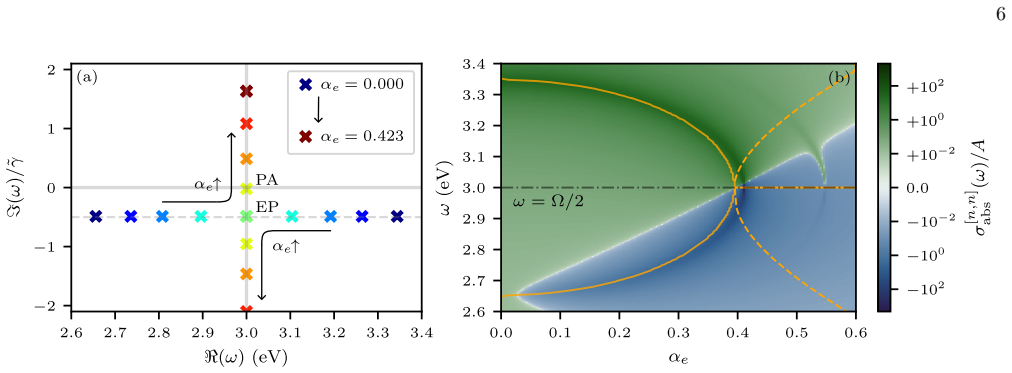
Measure the absorption spectrum of a silver nanosphere with radius around 10 nm under carrier-density modulation at Ω = 6 eV: the two-band model predicts a negative absorption dip at ω ≈ Ω/2 = 3 eV only once the modulation strength exceeds α_PA ≈ 0.4096. If gain appears at a significantly lower modulation strength, at a clearly different frequency, or if the exceptional point is absent from the spectrum, the two-band truncation is wrong.
Extended reading notes
Core claim
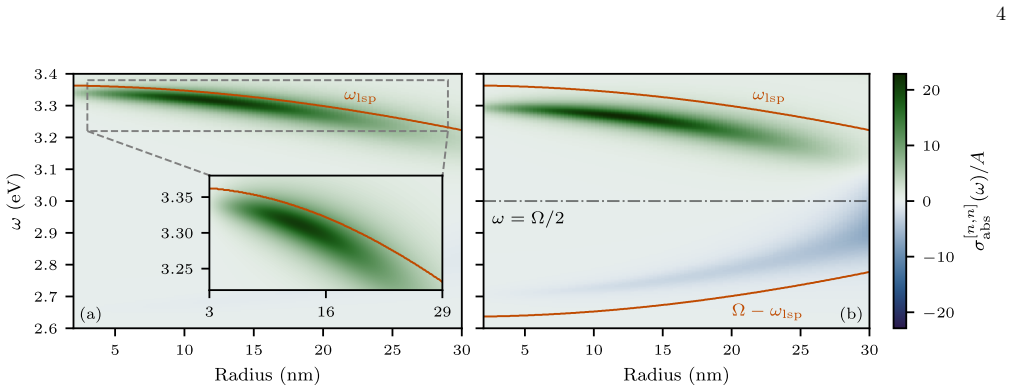
The central claim is that temporal modulation of the carrier density of a subwavelength plasmonic nanosphere makes the negative-frequency copy of the localized surface plasmon resonance observable as an amplifying resonance at ω = Ω − ω_lsp(R). The paper derives a two-band model, Eqs. (38)-(39), in which the nanoparticle is represented by a parametric Drude-Lorentz dipole whose resonance and plasma frequencies oscillate in time with the same relative amplitude as the bulk plasma frequency. The resulting 2×2 effective polarizability matrix connects the fundamental and first negative Floquet harmonics and encodes both the conventional absorption peak and the gain dip, including their frequency
Load-bearing premise
The load-bearing premise is that a subwavelength modulated nanoparticle can be represented by a point dipole whose effective resonance and plasma frequencies oscillate in time with the same relative strength as the bulk carrier density, and that only the fundamental and first negative Floquet harmonics matter.
Editorial extensions
If this is right
- A single subwavelength time-modulated nanosphere can amplify light at optical frequencies when the modulation strength exceeds the threshold α_PA, even though the material is passive; the amplification appears as a negative absorption cross-section.
- The exceptional point where the localized surface plasmon and its replica coalesce is a generic feature of the two-band model, and its position is controlled analytically by the sphere radius, modulation frequency, and loss.
- The two-frequency effective polarizability can be used directly in the dipole cross-section formulas, Eqs. (31)-(32), to compute scattering and extinction without solving the full Mie problem.
- For stronger modulation, higher-order Floquet replicas create additional amplification windows at lower modulation frequencies, extending parametric gain beyond the first replica.
Reading between the lines
- Because the two-band reduction depends only on the Drude-Lorentz pole structure, the same effective polarizability should apply to other Lorentz-type resonances (e.g., phonon polaritons or excitons) whose resonance frequency is modulated, not just free-electron plasmons.
- The effective polarizability matrix is the natural input for coupled-dipole models of time-varying nanoparticle arrays, so collective effects such as lattice resonances or non-reciprocal propagation could be predicted without full T-matrix simulations.
- A direct experimental test could be made by measuring near-field scattering spectra of a modulated nanosphere: at the predicted α_PA, field enhancement should jump by roughly two orders of magnitude relative to the static case.
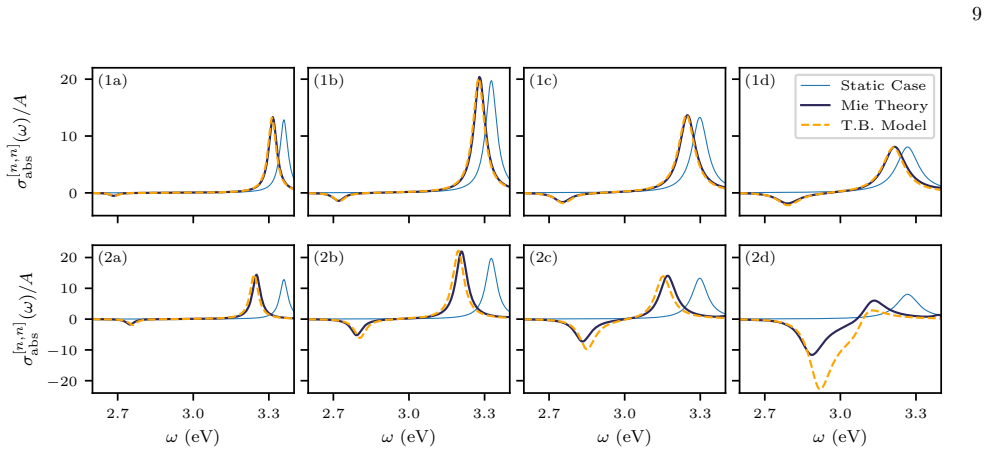
- The breakdown at large radius and strong modulation, seen in Fig. 6, suggests that a three- or four-band extension would be needed for larger particles, and this failure could be turned into a quantitative criterion for when the two-harmonic truncation stops being valid.
Editorial analysis
A structured set of objections, weighed in public.
Referee Report
Summary. The paper studies the optical response of a subwavelength silver nanosphere whose carrier density is periodically modulated in time. The authors compute absorption spectra with a full Floquet–Mie T-matrix formalism and show that the modulation creates a Floquet replica of the localized surface plasmon, which can produce a negative absorption cross-section (amplification). They then propose a point-dipole description: a Drude–Lorentz oscillator whose resonance frequency and effective plasma frequency are both assumed to be modulated with the same relative amplitude α_e as the bulk plasma frequency. Truncating to the fundamental and first negative Floquet harmonics yields a 2×2 effective polarizability (Eqs. 38–39), from which analytical exceptional-point and parametric-amplification conditions are derived (Eqs. 42–43). The two-band model is validated against full Floquet–Mie calculations for a range of radii and modulation strengths, and its breakdown at larger radii and stronger modulation is shown explicitly in Fig. 6.
Significance. If correct, the two-frequency effective polarizability is a valuable reduced description for time-modulated plasmonic nanoparticles and for future studies of arrays or metasurfaces built from them. The paper has clear strengths: it provides an analytical two-band model with closed-form EP and amplification conditions, it tests the model against full Floquet–Mie T-matrix computations over a nontrivial parameter range, and it openly reports the parameter region where the model fails. The qualitative phenomenology—amplifying Floquet replicas, mode coalescence, and parametric gain—is physically interesting and well illustrated. However, the central analytical results rest on an equal-modulation assumption that is not exact at finite radius, and one of the key printed formulas (Eq. 42a) is dimensionally inconsistent with the paper's own numerical values. These issues are load-bearing because they directly affect the claimed range of validity and the quantitative accuracy of the analytical conditions.
major comments (2)
- [Sec. IV, Eqs. (35)–(36), and Appendix A] The equal-modulation assumption is an uncontrolled approximation for finite-radius nanoparticles. In the quasistatic limit R→0, ω_lsp^2 ∝ ω_p^2 and ω~_ps^2 ∝ ω_lsp^4/ω_p^2 ∝ ω_p^2, so both effective parameters indeed modulate with amplitude α_e. For finite R, however, Eq. (A10) gives ω_lsp^2 as a nonlinear function of ω_p^2. Expanding Eq. (A10) for silver (ω_ps = 8.9 eV, ε∞ = 5) at R = 25 nm yields a = d ln ω_lsp^2 / d ln ω_p^2 ≈ 0.94, so the correct modulation amplitudes should be a α_e ≈ 0.94 α_e for ω~_r^2 and (2a−1) α_e ≈ 0.88 α_e for ω~_p^2, not α_e. This 6–12% mismatch directly affects the off-diagonal coupling terms in Eq. (39) and grows with R. The paper attributes the failures in Fig. 6(2c,2d) exclusively to higher-order Floquet harmonics, but the equal-modulation assumption is an untested alternative source of error of the same order. Since Eqs. (42)–(43) are derived from this
- [Eq. (42a)] As printed, Eq. (42a) is inverted and gives values that contradict the paper's own Fig. 3. For R = 10 nm, Ω = 6 eV, and ω~_rs ≈ 3.36 eV (the quasistatic value), the printed formula α_EP^2 = 4 ω~_rs^4 / [ω~_rs^2 − (Ω^2+γ^2)/4]^2 yields α_EP ≈ 10, whereas Fig. 3 and the text report α_EP ≈ 0.409. The correct small-damping expression should be α_EP^2 = 4 [ω~_rs^2 − (Ω^2+γ^2)/4]^2 / ω~_rs^4 (up to corrections from the equal-modulation issue raised above). Equation (42b) inherits the error because it is written as α_PA^2 = α_EP^2 + ... . This is not a mere typo in an ancillary formula; it is one of the paper's key analytical results. Please correct, re-derive, and re-check both formulas against the numerically obtained EP/PA values.
minor comments (4)
- [Eq. (33)] The right-hand side of Eq. (33) is written as ε0 ω~_p(t) E, but Eq. (36) defines ω~_p^2(t) and Eq. (41) uses ω~_ps^2 in the static polarizability. As written, Eq. (33) is dimensionally inconsistent for a point dipole; it should presumably be ε0 ω~_p^2(t) E. Please correct.
- [Fig. 3(a) and surrounding text] The text says the EP appears 'at R(ω) = Ω/2'; this should be 'Re(ω) = Ω/2'.
- [Eq. (37) and notation] The quantity ω~_ps^2 defined by Eq. (37) does not have the units of a frequency squared; it carries the nanoparticle volume. Calling it an 'effective plasma frequency' is misleading. Please clarify that this is an effective coupling parameter with dimensions suited to the point-dipole equation, even though the notation suggests a frequency.
- [Abstract and Conclusions] The phrase 'fully captures ... in the subwavelength regime' is too strong in light of Fig. 6(2c,2d), where the model visibly fails. The authors do report the limitations later, so a more guarded wording (e.g., 'accurately captures ... in the subwavelength regime for moderate modulation strengths and radii') would better match the evidence.
Circularity Check
No significant circularity; the two-band model is an independent approximation whose parameters are fixed by the static Mie response, and its modulated predictions are checked against full Floquet-Mie calculations.
full rationale
The derivation chain is not circular. The two-band model parameters (tilde-omega_rs and tilde-omega_ps) are established in Appendix A by matching the static sphere's Mie scattering cross-section to a time-independent Drude-Lorentz dipole (Eqs. A12-A15). They are not fitted to any time-modulated data. The modulated response, including the LSP redshift, the amplifying replica, the exceptional point, and the parametric amplification conditions (Eqs. 42-43), is then obtained by solving the parametric Drude-Lorentz equation (Eq. 33) under a two-harmonic truncation. This is a genuine prediction, subsequently compared against the full Floquet-Mie T-matrix calculations in Figs. 3, 5, and 6. Eq. 29 is an exact identity connecting the two-time polarizability to the Floquet T-matrix under the dipole approximation; it is used to validate the model, not to construct it. The only self-citations (refs. [18], [42], [48]) provide background and are not load-bearing. The equal-modulation assumption in Eqs. 35-36, justified only in the quasistatic limit and then extended to the subwavelength regime ('To derive the two-band description introduced in Sec. IV we assume that this temporal dependence holds in the subwavelength regime'), is an explicit approximation and a potential source of error at larger radii, as the skeptic notes. However, this is a correctness/validity concern, not circularity: the model's predictions are still computed from an independent differential equation and explicitly checked against the exact T-matrix, with the paper itself reporting the breakdown in Fig. 6(2c,2d). No step in the paper reduces by construction to its own inputs.
Assumptions & free parameters
assumptions (5)
- domain assumption The polarization density obeys a Drude-like transport equation with a time-varying plasma frequency (Eqs. 3-4).
- domain assumption The effective Drude-Lorentz dipole parameters (resonant and plasma frequencies) modulate with the same relative modulation alpha_e as the bulk plasma frequency.
- domain assumption The optical response is governed by only the fundamental and first negative Floquet harmonics (two-band truncation).
- domain assumption The subwavelength condition x_n << 1 holds for all relevant Floquet harmonics (Eq. 21).
- standard math Maxwell's equations, vector spherical harmonics, and standard Floquet theory are valid for this system.
Cite this review
Pith. "Pith review of Optical Response by Time-Varying Plasmonic Nanoparticles." pith.science (2026). https://pith.science/paper/7VB74BOT
@misc{pith2026250821009,
  author       = {Pith},
  title        = {Pith review of: Optical Response by Time-Varying Plasmonic Nanoparticles},
  year         = {2026},
  howpublished = {\url{https://pith.science/paper/7VB74BOT}},
  note         = {Machine review of arXiv:2508.21009}
}
read the original abstract
The temporal modulation of material parameters enables optical amplification within linear media. Here we consider the fundamental building block of plasmonics, a subwavelength metal nanoparticle, and study how temporal modulation alters the optical response of the frequency-dispersive scatterers. We show that modulating in time leads to Floquet replicas of the localized surface plasmon resonance of the nanoparticle, which can result in light amplification. We propose a model based on a point-like dipole description of the time-varying frequency-dispersive nanoparticle that fully captures the radiative and amplifying properties of the system in the subwavelength regime. By comparing our simplified model to full Floquet-Mie scattering calculations, we demonstrate that the optical scattering by the nanoparticle is accurately described by an analytical two-band model. This allows us to introduce a two-frequency effective polarizability that fully incorporates the properties of the localized surface plasmon and its amplifying replica, as well as their interaction. In addition, we analyze the emergence of the parametric amplification condition for the modulated nanoparticle, showing that amplification can be obtained in a broad range of parameters.
Figures

Figures from the paper (3 more)


Forward citations
Cited by 1 Pith paper
-
Microscopic quantum description of surface plasmon polaritons: Revealing intrinsic ultrastrong light-matter coupling
A PZW-based microscopic quantization of surface plasmons recovers classical LSP and PSP results and predicts ground-state bulk-plasmon populations that are labeled intrinsic ultrastrong coupling.
Reference graph
Works this paper leans on
-
[1]
E. Galiffi, R. Tirole, S. Yin, H. Li, S. Vezzoli, P. A. Huidobro, M. G. Silveirinha, R. Sapienza, A. Al` u, and J. B. Pendry, Photonics of time-varying media, Advanced Photonics 4, 10.1117/1.ap.4.1.014002 (2022)
-
[2]
V. Pacheco-Pe˜ na, D. M. Sol ´ ıs, and N. Engheta, Time- varying electromagnetic media: opinion, Optical Materi- als Express 12, 3829 (2022)
work page 2022
-
[3]
Engheta, Four-dimensional optics using time-varying metamaterials, Science 379, 1190 (2023)
N. Engheta, Four-dimensional optics using time-varying metamaterials, Science 379, 1190 (2023)
2023
-
[4]
Morgenthaler, Velocity modulation of electromagnetic waves, IRE Transactions on Microwave Theory and Tech- niques 6, 167 (1958)
F. Morgenthaler, Velocity modulation of electromagnetic waves, IRE Transactions on Microwave Theory and Tech- niques 6, 167 (1958)
1958
-
[5]
Felsen and G
L. Felsen and G. Whitman, Wave propagation in time- varying media, IEEE Transactions on Antennas and Propagation 18, 242 (1970)
1970
-
[6]
J. T. Mendon¸ ca and P. K. Shukla, Time Refraction and Time Reflection: Two Basic Concepts, Physica Scripta 65, 160 (2002)
work page 2002
- [7]
-
[8]
D. L. Sounas and A. Al` u, Non-reciprocal photonics based on time modulation, Nature Photonics 11, 774 (2017)
work page 2017
Show all 60 references
-
[9]
Galiffi, P
E. Galiffi, P. A. Huidobro, and J. B. Pendry, Broadband Nonreciprocal Amplification in Luminal Metamaterials, Physical Review Letters 123 (2019)
2019
-
[10]
Y. Zhou, M. Z. Alam, M. Karimi, J. Upham, O. Reshef, C. Liu, A. E. Willner, and R. W. Boyd, Broadband frequency translation through time refraction in an epsilon-near-zero material, Nature Communications 11, 10.1038/s41467-020-15682-2 (2020)
2020 doi
-
[11]
J. S. Mart ´ ınez-Romero and P. Halevi, Parametric reso- nances in a temporal photonic crystal slab, Physical re- view. A/Physical review, A 98 (2018)
2018
-
[12]
M. M. Asgari, P. Garg, X. Wang, M. S. Mirmoosa, C. Rockstuhl, and V. Asadchy, Theory and applications of photonic time crystals: a tutorial, Adv. Opt. Photon. 16, 958 (2024)
2024
-
[13]
Boltasseva, V
A. Boltasseva, V. M. Shalaev, and M. Segev, Photonic time crystals: from fundamental insights to novel ap- plications: opinion, Optical Materials Express 14, 592 (2024)
2024
-
[14]
Lyubarov, Y
M. Lyubarov, Y. Lumer, A. Dikopoltsev, E. Lustig, Y. Sharabi, and M. Segev, Amplified emission and las- ing in photonic time crystals, Science 377, 425 (2022)
2022
-
[15]
J. G. Gaxiola-Luna and P. Halevi, Growing fields in a temporal photonic (time) crystal with a square profile of the permittivity ε(t), Applied Physics Letters 122 (2023)
2023
-
[16]
J. T. Mendon¸ ca, A. Guerreiro, and A. M. Martins, Quan- tum theory of time refraction, Physical Review A 62 (2000)
2000
-
[17]
Ganfornina-Andrades, J
A. Ganfornina-Andrades, J. E. V´ azquez-Lozano, and I. Liberal, Quantum vacuum amplification in time- varying media with arbitrary temporal profiles, Physical Review Research 6 (2024)
2024
-
[18]
J. E. Sustaeta-Osuna, F. J. Garc ´ ıa-Vidal, and P. A. Huidobro, Quantum Theory of Photon Pair Creation in Photonic Time Crystals, ACS Photonics (2025)
2025
-
[19]
X. Wang, M. S. Mirmoosa, V. S. Asadchy, C. Rockstuhl, S. Fan, and S. A. Tretyakov, Metasurface-based realiza- tion of photonic time crystals, Science Advances9 (2023)
2023
-
[20]
J. R. Reyes-Ayona and P. Halevi, Observation of genuine wave vector (k or β) gap in a dynamic transmission line and temporal photonic crystals, Applied Physics Letters 107 (2015)
2015
-
[21]
Zhang, X
L. Zhang, X. Q. Chen, S. Liu, Q. Zhang, J. Zhao, J. Y. Dai, G. D. Bai, X. Wan, Q. Cheng, G. Castaldi, V. Galdi, and T. J. Cui, Space-time-coding digital metasurfaces, Nature Communications 9, 10.1038/s41467-018-06802-0 (2018)
2018 doi
-
[22]
J. Zhao, X. Yang, J. Y. Dai, Q. Cheng, X. Li, N. H. Qi, J. C. Ke, G. D. Bai, S. Liu, S. Jin, A. Al` u, and T. J. Cui, Programmable time-domain digital-coding metasur- face for non-linear harmonic manipulation and new wire- less communication systems, National Science Review 6,...
2018
-
[23]
M. Z. Alam, I. De Leon, and R. W. Boyd, Large optical nonlinearity of indium tin oxide in its epsilon-near-zero region, Science 352, 795 (2016)
2016
-
[24]
Tirole, S
R. Tirole, S. Vezzoli, E. Galiffi, I. Robertson, D. Maurice, B. Tilmann, S. A. Maier, J. B. Pendry, and R. Sapienza, Double-slit time diffraction at optical frequencies, Nature Physics 19, 999 (2023)
2023
-
[25]
Vezzoli, V
S. Vezzoli, V. Bruno, C. DeVault, T. Roger, V. M. Sha- laev, A. Boltasseva, M. Ferrera, M. Clerici, A. Dubi- etis, and D. Faccio, Optical Time Reversal from Time- Dependent Epsilon-Near-Zero Media, Physical Review Letters 120 (2018)
2018
-
[26]
Lobet, N
M. Lobet, N. Kinsey, I. Liberal, H. Caglayan, P. A. Huidobro, E. Galiffi, J. R. Mej ´ ıa-Salazar, G. Palermo, Z. Jacob, and N. Maccaferri, New Horizons in Near-Zero Refractive Index Photonics and Hyperbolic Metamateri- als, ACS Photonics 10, 3805 (2023)
2023
-
[27]
W. L. Barnes, A. Dereux, and T. W. Ebbesen, Surface plasmon subwavelength optics, Nature 424, 824 (2003)
2003
-
[28]
K¨ uhn, U
S. K¨ uhn, U. H ˚ akanson, L. Rogobete, and V. Sandogh- dar, Enhancement of Single-Molecule Fluorescence Using a Gold Nanoparticle as an Optical Nanoantenna, Phys- ical Review Letters 97, 10.1103/physrevlett.97.017402 (2006)
2006 doi
-
[29]
K. R. Catchpole and A. Polman, Plasmonic solar cells, Optics Express 16, 21793 (2008)
2008
-
[30]
F. J. Garcia-Vidal, L. Martin-Moreno, T. W. Ebbesen, and L. Kuipers, Light passing through subwavelength apertures, Reviews of Modern Physics 82, 729 (2010)
2010
-
[31]
M. B. Ross, C. A. Mirkin, and G. C. Schatz, Optical Properties of One-, Two-, and Three-Dimensional Arrays of Plasmonic Nanostructures, The Journal of Physical Chemistry C 120, 816 (2015)
2015
-
[32]
A. I. Fern´ andez-Dom ´ ınguez, F. J. Garc ´ ıa-Vidal, and L. Mart ´ ın-Moreno, Unrelenting plasmons, Nature Pho- tonics 11, 8 (2017)
2017
-
[33]
S. A. Maier and H. A. Atwater, Plasmonics: Lo- calization and guiding of electromagnetic energy in metal/dielectric structures, Journal of Applied Physics 98, 10.1063/1.1951057 (2005)
2005 doi
-
[34]
S. A. Maier, Plasmonics: Fundamentals and Applications (2007)
2007
-
[35]
Giannini, A
V. Giannini, A. I. Fern´ andez-Dom ´ ınguez, Y. Sonnefraud, T. Roschuk, R. Fern´ andez-Garc ´ ıa, and S. A. Maier, Con- trolling Light Localization and Light–Matter Interactions 12 with Nanoplasmonics, Small 6, 2498 (2010)
2010
-
[36]
Pacheco-Pe˜ na and N
V. Pacheco-Pe˜ na and N. Engheta, Temporal equivalent of the Brewster angle, Physical review. B./Physical review. B 104, 10.1103/physrevb.104.214308 (2021)
2021 doi
-
[37]
Galiffi, P
E. Galiffi, P. A. Huidobro, and J. B. Pendry, An Archimedes’ screw for light, Nature Communications 13 (2022)
2022
-
[38]
Stefanou, P
I. Stefanou, P. A. Pantazopoulos, and N. Stefanou, Light scattering by a spherical particle with a time-periodic re- fractive index, Journal of the Optical Society of America B 38, 407 (2020)
2020
-
[39]
Globosits, J
D. Globosits, J. H¨ upfl, and S. Rotter, Pseudounitary Flo- quet scattering matrix for wave-front shaping in time- periodic photonic media, Physical review. A/Physical re- view, A 110 (2024)
2024
-
[40]
M. M. Sadafi, A. F. Da Mota, and H. Mosallaei, Time- varying Mie resonators for real-time manipulation of quantum emitter radiation, Physical review. B./Physical review. B 111 (2025)
2025
-
[41]
A. C. Valero, S. Gladyshev, D. Globosits, S. Rotter, E. A. Muljarov, and T. Weiss, Resonant states of struc- tured photonic time crystals (2025), arXiv:2506.01472 [physics.optics]
2025 arXiv
-
[42]
Galiffi, Y.-T
E. Galiffi, Y.-T. Wang, Z. Lim, J. B. Pendry, A. Al` u, and P. A. Huidobro, Wood Anomalies and Surface-Wave Excitation with a Time Grating, Physical Review Letters 125 (2020)
2020
-
[43]
S. A. R. Horsley, E. Galiffi, and Y.-t. Wang, Eigenpulses of Dispersive Time-Varying Media, Physical Review Let- ters 130 (2023)
2023
-
[44]
Ptitcyn, A
G. Ptitcyn, A. Lamprianidis, T. Karamanos, V. Asad- chy, R. Alaee, M. M¨ uller, M. Albooyeh, M. S. Mirmoosa, S. Fan, S. Tretyakov, and C. Rockstuhl, Floquet–Mie Theory for Time-Varying Dispersive Spheres, Laser & Photonics Review 17 (2022)
2022
-
[45]
Asadchy, A
V. Asadchy, A. Lamprianidis, G. Ptitcyn, M. Albooyeh, N. Rituraj, T. Karamanos, R. Alaee, S. Tretyakov, C. Rockstuhl, and S. Fan, Parametric Mie Resonances and Directional Amplification in Time-Modulated Scat- terers, Physical Review Applied 18 (2022)
2022
-
[46]
Sloan, N
J. Sloan, N. Rivera, J. D. Joannopoulos, and M. Soljacic, Optical Properties of Dispersive Time-Dependent Mate- rials, ACS Photonics 11, 950 (2024)
2024
-
[47]
T. V. Raziman, M. Touboul, R. Sapienza, R. V. Craster, and F. J. Rodr ´ ıguez-Fortu˜ no, Surface plasmon polariton excitation in time-modulated media (2025), arXiv:2507.05126 [physics.optics]
2025 arXiv
-
[48]
T. F. Allard, J. E. Sustaeta-Osuna, F. J. Garc ´ ıa-Vidal, and P. A. Huidobro, Broadband dipole absorption in dis- persive photonic time crystals (2025), arXiv:2508.04619 [physics.optics]
2025
-
[49]
X. Wang, P. Garg, M. S. Mirmoosa, A. G. Lamprianidis, C. Rockstuhl, and V. S. Asadchy, Expanding momentum bandgaps in photonic time crystals through resonances, Nature Photonics (2024)
2024
-
[50]
P. Garg, A. G. Lamprianidis, D. Beutel, T. Kara- manos, B. Verf¨ urth, and C. Rockstuhl, Modeling four- dimensional metamaterials: a T-matrix approach to de- scribe time-varying metasurfaces, Optics Express 30, 45832 (2022)
2022
-
[51]
N. S. Stepanov, Dielectric constant of unsteady plasma, Radiophysics and Quantum Electronics 19, 683 (1976)
1976
-
[52]
M. S. Mirmoosa, T. T. Koutserimpas, G. A. Ptitcyn, S. A. Tretyakov, and R. Fleury, Dipole polarizability of time-varying particles, New Journal of Physics 24, 063004 (2022)
2022
-
[53]
M. I. Mishchenko, A. A. Lacis, and L. D. Travis, Scat- tering, Absorption, and Emission of Light by Small Par- ticles (2002)
2002
-
[54]
C. F. Bohren and D. R. Huffman, Absorption and Scat- tering of Light by Small Particles (1998)
1998
-
[55]
H. U. Yang, J. D’Archangel, M. L. Sundheimer, E. Tucker, G. D. Boreman, and M. B. Raschke, Opti- cal dielectric function of silver, Physical Review B 91 (2015)
2015
-
[56]
Striebel, J
M. Striebel, J. Wrachtrup, and I. Gerhardt, Absorption and Extinction Cross Sections and Photon Streamlines in the Optical Near-field, Scientific Reports 7 (2017)
2017
-
[57]
V. G. Kravets, A. V. Kabashin, W. L. Barnes, and A. N. Grigorenko, Plasmonic Surface Lattice Resonances: A Review of Properties and Applications, Chemical Re- views 118, 5912 (2018)
2018
-
[58]
Meier and A
M. Meier and A. Wokaun, Enhanced fields on large metal particles: dynamic depolarization, Optics Letters 8, 581 (1983)
1983
-
[59]
Globosits et al
D. Globosits et al. , To be determined (2025)
2025
-
[60]
X. Fan, W. Zheng, and D. J. Singh, Light scattering and surface plasmons on small spherical particles, Light Sci- ence & Applications 3, e179 (2014)
2014
Reviewed August 5, 2026 · model on record in the stance chip above.
Discussion (0). Sign in to comment.