REVIEW 3 major objections 5 minor 43 references
From Coarse to Fine: Learnable Discrete Wavelet Transforms for Efficient 3D Gaussian Splatting
T0 review · 3 major / 5 minor · reviewed 2026-08-06 · deepseek-v4-flash
Pith's one-line read A wavelet-based training schedule cuts 3D Gaussian Splatting's primitive count by about a fifth without hurting image quality.
desk verdict The Gaussian count reduction is real, but the mechanism is misattributed: the effect comes from a permanently low-pass filtered training target, not a coarse-to-fine schedule. read the letter →
The pith
A machine-rendered reading of the paper's core claim, the machinery that carries it, and where it could break.
The reading
What carries the argument
The mechanism is a pair of learnable Forward and Inverse Discrete Wavelet Transforms inserted in front of the 3DGS loss. The low-pass analysis filter is fixed, the high-pass analysis filter is trainable and initialized to zero, and the inverse transform reconstructs the input image from its subbands; an auxiliary loss pulls the high-pass filter toward the orthogonal Haar high-pass reference, so high frequencies enter progressively during training. The authors derive the gradient of the total loss with respect to the high-pass filters, and an adaptive weight scales the wavelet loss by how strongly the rendered image's HH subband deviates from the ground truth's HH subband.
What would settle it
Train 3DGS with the high-pass filter learning rate set to zero for the entire run, so every input is the blurred reconstruction; the premise predicts the peak Gaussian count should stay low while PSNR drops steeply. A complementary check is to reverse the schedule, starting with sharp images and ending coarse, and see whether the Gaussian reduction persists.
Extended reading notes
Core claim
The central claim is that monotonically sharpening the input images during 3DGS training, implemented with a differentiable learnable wavelet transform, delays the creation of fine Gaussians and thus yields a sparser scene representation without a visible quality penalty. The paper shows that initializing the high-pass wavelet filters to zero and letting them converge toward the orthogonal Haar references produces a dataset-adaptive coarse-to-fine schedule that replaces the manually chosen blurring schedule of the predecessor Opti3DGS. Experiments on 3-view LLFF and 12-view Mip-NeRF 360 report peak Gaussian reductions of roughly 18–23% relative to vanilla 3DGS at near-equal PSNR, with further reductions when stacked on Mini-Splatting and Compact-3DGS. The ablation study also finds that constraining the learned filter toward the Haar reference increases Gaussian counts without improving quality, which the authors read as evidence that the learnable transform discovers a representation better suited to 3DGS than the original sharp images.
Load-bearing premise
The entire reduction hinges on the premise that feeding 3DGS progressively sharper images changes its densification behavior, so that coarse inputs produce coarse Gaussians rather than just worse reconstructions; if that premise fails, the Gaussian savings collapse along with the method.
Editorial extensions
If this is right
- On the reported benchmarks, AutoOpti3DGS reduces peak Gaussian counts by roughly 18–23% relative to vanilla 3DGS while keeping PSNR, SSIM, and LPIPS nearly unchanged.
- When stacked on Mini-Splatting or Compact-3DGS, the input-image modulation further lowers Gaussian counts beyond either efficient framework alone, showing complementarity with architecture-level pruning.
- The method removes the need to hand-pick blur kernel types, sizes, and schedules; only the high-pass filter learning rate needs to be set.
- Training time rises by roughly 20–25% because the wavelet transform runs every iteration, a cost the authors expect lazy regularization to largely recover.
Reading between the lines
- If the coarse-to-fine ordering is the active ingredient, the same input-image modulation could transfer to other radiance-field methods that employ adaptive density control, not only 3DGS.
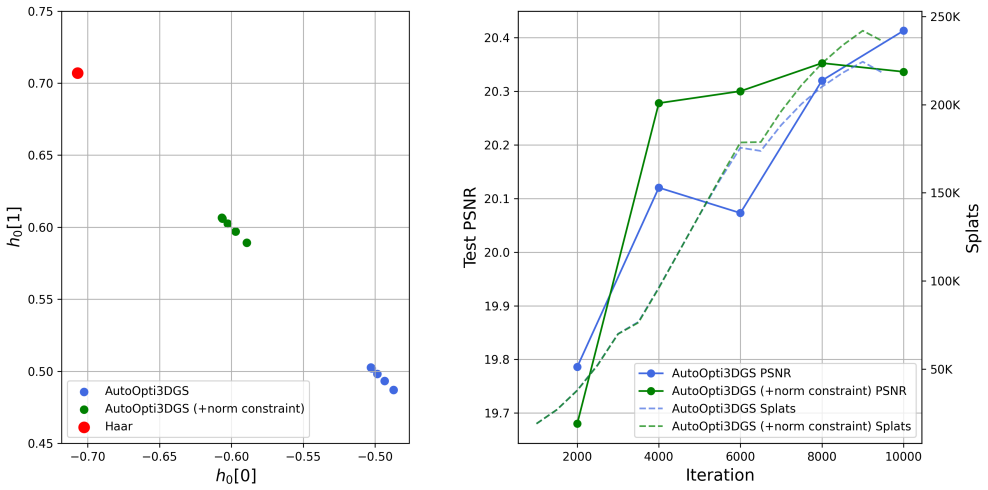
- The learned high-pass filter settles near, but not exactly at, the Haar reference, suggesting the method is implicitly selecting a frequency band; one testable extension is to measure how the optimal filter coefficients vary across scene content.
- A multi-level DWT extension, which the authors list as future work, should produce even coarser initial images and could be used to probe how far Gaussian counts can fall before quality breaks.
Editorial analysis
A structured set of objections, weighed in public.
Referee Report
Summary. AutoOpti3DGS proposes to reduce the number of Gaussians in 3D Gaussian Splatting by feeding training images through a learnable Discrete Wavelet Transform (DWT) that starts with zero high-pass filters and gradually activates high-frequency content. The paper claims this wavelet-driven coarse-to-fine modulation delays the formation of redundant fine Gaussians, thereby reducing Gaussian counts while maintaining rendering quality. The method is evaluated on LLFF and Mip-NeRF 360 datasets, applied on top of Vanilla 3DGS, Mini-Splatting, and Compact-3DGS, and consistently reports lower peak Gaussian counts compared to the corresponding baselines. An auxiliary loss pushes the learnable high-pass filters toward Haar wavelet references, and an ablation shows that enforcing a norm constraint closer to perfect reconstruction increases Gaussian counts.
Significance. If the claims were fully substantiated, the paper would offer a practical, training-time, plug-in method to reduce Gaussian counts by roughly 18-23% on LLFF and by smaller margins on Mip-NeRF 360, while integrating with existing efficient 3DGS frameworks. The main strengths are the consistent Gaussian-count reductions across two datasets and three base frameworks, the explicit gradient derivation for learnable DWT filters, and the release of code. However, the significance is substantially weakened by two issues: the paper's own quantitative tables contradict the 'without sacrificing visual fidelity' claim, and the internal evidence does not support the proposed coarse-to-fine mechanism as the cause of the reductions. After reframing and additional analysis, the empirical observation that a learnable low-pass input filter reduces Gaussian counts at a modest quality cost could still be a useful contribution.
major comments (3)
- [Section 4, Eq. (7), Figure 5, Section 5.3] The proposed temporal coarse-to-fine mechanism is not supported by the paper's own formulation and results. The adaptive weight in Eq. (7), lambda_H = ||Xhat_HH - Xgt_HH||1 / ||Xgt_HH||1, is largest early in training because the rendered images are coarse and Xhat_HH is near zero; consequently, L_wavelet in Eq. (5) pushes the high-pass filter hardest toward the Haar reference (perfect reconstruction) exactly at the start of training, which is the opposite of a delayed activation of fine frequencies. Moreover, the main configuration never reaches perfect reconstruction: the learned filter converges to [-0.5029, 0.5027] versus the Haar [-0.7071, 0.7071] (Section 5.3), so the 3DGS model is permanently fitting a low-pass filtered target rather than experiencing a temporal schedule. The ablation in Table 3 directly supports this alternative reading: adding the norm constraint moves the filter closer to perfect reconstruction ([-0.6062, 0.6061]) and raises the peak Gaussian count from 224K to 242K while slightly lowering PSNR. Thus the Gaussian reduction appears to be a consequence of static high-frequency attenuation, not of delaying fine Gaussian formation. The authors should either provide direct evidence of a temporal schedule (e.g., measure when fine Gaussians emerge relative to vanilla 3DGS) or reframe the contribution as a learned static low-pass input filter.
- [Abstract, Section 5.2, Tables 1 and 2] The claim that AutoOpti3DGS maintains rendering quality 'without sacrificing visual fidelity' or 'comparable to 3DGS' is contradicted by the paper's own tables. On Mip-NeRF 360 (Table 2), AutoOpti3DGS achieves PSNR 19.24 vs 19.30, SSIM 0.537 vs 0.564, and LPIPS 0.388 vs 0.352 compared to vanilla 3DGS, clear degradation especially in SSIM and LPIPS. On LLFF (Table 1), LPIPS degrades from 0.197 to 0.215. These differences are not negligible for perceptual quality. The paper should explicitly acknowledge this as a quality-sparsity tradeoff and soften the fidelity claims accordingly. If the authors wish to retain the claim, they need statistical significance tests and separate perceptual evaluations.
- [Tables 1-3, Section 5.1] The paper reports only averages over scenes without standard deviations, confidence intervals, or per-scene results. Since several central comparisons involve small differences (e.g., PSNR 19.24 vs 19.30 in Table 2; PSNR 20.39 vs 20.40 in Table 1), the absence of variance information makes it impossible to assess whether the reported quality changes are meaningful or within run-to-run variability. The authors should include per-scene breakdowns or error bars, especially for the metrics that contradict the 'no sacrifice' claim.
minor comments (5)
- [Eq. (4)] The second gradient expression uses inconsistent notation 'XT LT 0' and 'XT HT 0' instead of the matrix notation used in the first expression; please write both gradients with unified transpose and subscript conventions.
- [Section 5.1 and Figure 3] The paper states that AutoOpti3DGS 'only requires setting the learning rate for the high-pass filter', but the method also involves the choice of DWT level, filter taps, the norm loss weight lambda_H_norm in Eq. (9), and the threshold at which the norm loss is applied (5K iterations). Please clarify which of these are fixed defaults versus hyperparameters that require tuning.
- [Figure 5] The left panel of Figure 5 shows dots only for iterations 8.5K-10K in 0.5K increments; it would be helpful to show the full convergence trajectory from initialization to explain how the filter evolves over the 10K iterations.
- [References] References [15] and [33] both refer to Papantonakis et al., 'Reducing the memory footprint of 3D Gaussian Splatting', which creates duplicate entries and numbering confusion. Please consolidate them.
- [Section 4] The text says the high-pass synthesis matrices 'can be learnt in a similar fashion' and mentions a supplementary ablation, but the main text does not state whether the main configuration learns both analysis and synthesis high-pass filters or only the analysis filters. Please state explicitly which filters are learned in the reported experiments.
Circularity Check
No material circularity: the Gaussian-count results are measured against external baselines, and the DWT coarse-to-fine mechanism is implemented by the training objective rather than defined by the claimed outcome.
full rationale
The paper's central claim is that a learnable DWT with zero-initialized high-pass filters modulates input image frequencies coarse-to-fine and thereby reduces Gaussian counts while maintaining rendering quality. This claim is tested empirically on standard LLFF and Mip-NeRF 360 benchmarks against 3DGS, Opti3DGS, Mini-Splatting, and Compact-3DGS, with peak Gaussian counts reported as measured outcomes. The high-pass filters are optimized via an auxiliary wavelet loss (Eq. 5) toward fixed Haar references, not fitted to peak Gaussian counts; the only hyperparameter is the filter learning rate, and the main result is not statistically forced by the construction. The ablation in Table 3 is an empirically disconfirmable test: moving the learned filter closer to perfect reconstruction via a norm constraint increases peak Gaussian counts from 224K to 242K, which is consistent with the mechanism but not tautological. Author-overlapping citations (DWTNeRF [29], uWu [23], lattice wavelet works [24,25], and the Strang-Nguyen textbook [20]) appear in related-work or background contexts and are not load-bearing; the Haar reference is a standard fixed wavelet rather than an unverified prior claim by the authors. The statement that 'Coarse images correspond to coarse Gaussians' is an assumption inherited from Opti3DGS, but the paper does not redefine its target outcome into that assumption; whether the mechanism truly explains the savings is a correctness concern, not a circularity concern. Overall, the derivation is self-contained against external benchmarks, with only minor non-load-bearing self-citations.
Assumptions & free parameters
free parameters (4)
- Learnable high-pass analysis filter coefficients H0, H1 =
≈ [-0.5029, 0.5027] (row-averaged, LLFF no-norm variant)
- High-pass filter learning rate =
1e-3
- Norm loss weight λH_norm =
0.01
- DWT level and filter taps =
1 level, 2-tap Haar
assumptions (5)
- domain assumption Coarse or blurry input images during early training suppress unnecessary Gaussian densification
- ad hoc to paper The Haar orthogonal wavelet reference is a suitable target for the high-pass filters and PR is the correct end state
- domain assumption Peak number of Gaussians during training is a faithful proxy for memory and storage savings
- domain assumption DWT-modified training images remain a valid training signal for 3DGS
- domain assumption DropGaussian and the 10K-iteration training protocol interact fairly with all compared methods
Cite this review
Pith. "Pith review of From Coarse to Fine: Learnable Discrete Wavelet Transforms for Efficient 3D Gaussian Splatting." pith.science (2026). https://pith.science/paper/7VKIVVCS
@misc{pith2026250623042,
  author       = {Pith},
  title        = {Pith review of: From Coarse to Fine: Learnable Discrete Wavelet Transforms for Efficient 3D Gaussian Splatting},
  year         = {2026},
  howpublished = {\url{https://pith.science/paper/7VKIVVCS}},
  note         = {Machine review of arXiv:2506.23042}
}
read the original abstract
3D Gaussian Splatting has emerged as a powerful approach in novel view synthesis, delivering rapid training and rendering but at the cost of an ever-growing set of Gaussian primitives that strains memory and bandwidth. We introduce AutoOpti3DGS, a training-time framework that automatically restrains Gaussian proliferation without sacrificing visual fidelity. The key idea is to feed the input images to a sequence of learnable Forward and Inverse Discrete Wavelet Transforms, where low-pass filters are kept fixed, high-pass filters are learnable and initialized to zero, and an auxiliary orthogonality loss gradually activates fine frequencies. This wavelet-driven, coarse-to-fine process delays the formation of redundant fine Gaussians, allowing 3DGS to capture global structure first and refine detail only when necessary. Through extensive experiments, AutoOpti3DGS requires just a single filter learning-rate hyper-parameter, integrates seamlessly with existing efficient 3DGS frameworks, and consistently produces sparser scene representations more compatible with memory or storage-constrained hardware.
Figures


Figures from the paper (2 more)

Reference graph
Works this paper leans on
-
[1]
3d gaussian splatting for real-time radiance field rendering,
B. Kerbl, G. Kopanas, T. Leimk¨uhler, and G. Drettakis, “3d gaussian splatting for real-time radiance field rendering,” ACM Transactions on Graphics, vol. 42, no. 4, July 2023. 8 [Online]. Available: https://repo-sam.inria.fr/fungraph/3d- gaussian-splatting/ 1, 2, 3, 5, 8
work page 2023
-
[2]
Optimized 3d gaussian splatting using coarse-to-fine image frequency modulation,
U. Farooq, J.-Y . Guillemaut, A. Hilton, and M. V olino, “Optimized 3d gaussian splatting using coarse-to-fine image frequency modulation,” 2025. [Online]. Available: https://arxiv.org/abs/2503.14475 1, 2, 3, 5, 6, 7, 8
-
[3]
Radiative gaussian splatting for efficient x-ray novel view synthesis,
Y . Cai, Y . Liang, J. Wang, A. Wang, Y . Zhang, X. Yang, Z. Zhou, and A. Yuille, “Radiative gaussian splatting for efficient x-ray novel view synthesis,” inECCV, 2024. 2
work page 2024
-
[4]
R2- gaussian: Rectifying radiative gaussian splatting for tomo- graphic reconstruction,
R. Zha, T. J. Lin, Y . Cai, J. Cao, Y . Zhang, and H. Li, “R2- gaussian: Rectifying radiative gaussian splatting for tomo- graphic reconstruction,” in NeurIPS, 2024. 2
work page 2024
-
[5]
Gs-slam: Dense visual slam with 3d gaussian splatting,
C. Yan, D. Qu, D. Xu, B. Zhao, Z. Wang, D. Wang, and X. Li, “Gs-slam: Dense visual slam with 3d gaussian splatting,” in CVPR, 2024. 2
work page 2024
-
[6]
R. B. Li, M. Shaghaghi, K. Suzuki, X. Liu, V . Moparthi, B. Du, W. Curtis, M. Renschler, K. M. B. Lee, N. Atanasov, and T. Nguyen, “Dynagslam: Real-time gaussian-splatting slam for online rendering, tracking, motion predictions of moving objects in dynamic scenes,” 2025. [Online]. Available: https://arxiv.org/abs/2503.11979 2
arXiv 2025
-
[7]
VRSplat: Fast and Robust Gaussian Splatting for Virtual Reality
X. Tu, L. Radl, M. Steiner, M. Steinberger, B. Kerbl, and F. de la Torre, “Vrsplat: Fast and robust gaussian splatting for virtual reality,” 2025. [Online]. Available: https://arxiv.org/abs/2505.10144 2
work page Pith review arXiv 2025
-
[8]
Vr-splatting: Foveated radiance field rendering via 3d gaussian splatting and neural points,
L. Franke, L. Fink, and M. Stamminger, “Vr-splatting: Foveated radiance field rendering via 3d gaussian splatting and neural points,” Proceedings of the ACM on Computer Graphics and Interactive Techniques, vol. 8, no. 1, p. 1–21, May 2025. [Online]. Available: http://dx.doi.org/10.1145/ 3728302
work page 2025
Show all 43 references
-
[9]
Splatsdf: Boosting neural implicit sdf via gaussian splatting fusion,
R. B. Li, K. Suzuki, B. Du, K. M. B. Lee, N. Atanasov, and T. Nguyen, “Splatsdf: Boosting neural implicit sdf via gaussian splatting fusion,” 2024. [Online]. Available: https://arxiv.org/abs/2411.15468
2024
-
[10]
Mono- selfrecon: Purely self-supervised explicit generalizable 3d reconstruction of indoor scenes from monocular rgb views,
R. Li, U. Mahbub, V . Bhaskaran, and T. Nguyen, “Mono- selfrecon: Purely self-supervised explicit generalizable 3d reconstruction of indoor scenes from monocular rgb views,” in Proceedings of the IEEE/CVF Conference on Computer Vi- sion and Pattern Recognition (CVPR) Workshops...
2024
-
[11]
S3gaussian: Self-supervised street gaussians for autonomous driving,
N. Huang, X. Wei, W. Zheng, P. An, M. Lu, W. Zhan, M. Tomizuka, K. Keutzer, and S. Zhang, “ S3gaussian: Self-supervised street gaussians for autonomous driving,”
-
[12]
Rad: Training an end-to-end driving policy via large-scale 3dgs-based reinforcement learning,
H. Gao, S. Chen, B. Jiang, B. Liao, Y . Shi, X. Guo, Y . Pu, H. Yin, X. Li, X. Zhang, Y . Zhang, W. Liu, Q. Zhang, and X. Wang, “Rad: Training an end-to-end driving policy via large-scale 3dgs-based reinforcement learning,” 2025. [Online]. Available: https://arxiv.org/abs/2502.13144 2
2025
-
[13]
Nerf: Representing scenes as neural radiance fields for view synthesis,
B. Mildenhall, P. P. Srinivasan, M. Tancik, J. T. Barron, R. Ra- mamoorthi, and R. Ng, “Nerf: Representing scenes as neural radiance fields for view synthesis,” in ECCV, 2020. 2
2020
-
[14]
Com- pressed 3d gaussian splatting for accelerated novel view syn- thesis,
S. Niedermayr, J. Stumpfegger, and R. Westermann, “Com- pressed 3d gaussian splatting for accelerated novel view syn- thesis,” in Proceedings of the IEEE/CVF Conference on Com- puter Vision and Pattern Recognition (CVPR), June 2024, pp. 10 349–10 358. 2
2024
-
[16]
Langsplat: 3d language gaussian splatting,
M. Qin, W. Li, J. Zhou, H. Wang, and H. Pfister, “Langsplat: 3d language gaussian splatting,” 2024. [Online]. Available: https://arxiv.org/abs/2312.16084 2
2024 arXiv
-
[17]
Language embedded 3d gaussians for open-vocabulary scene under- standing,
J.-C. Shi, M. Wang, H.-B. Duan, and S.-H. Guan, “Language embedded 3d gaussians for open-vocabulary scene under- standing,” arXiv preprint arXiv:2311.18482, 2023. 2
2023 arXiv
-
[18]
WildGaussians: 3D gaussian splatting in the wild,
J. Kulhanek, S. Peng, Z. Kukelova, M. Pollefeys, and T. Sat- tler, “WildGaussians: 3D gaussian splatting in the wild,” NeurIPS, 2024. 2
2024
-
[19]
Per- gaussian embedding-based deformation for deformable 3d gaussian splatting,
J. Bae, S. Kim, Y . Yun, H. Lee, G. Bang, and Y . Uh, “Per- gaussian embedding-based deformation for deformable 3d gaussian splatting,” in European Conference on Computer Vision (ECCV), 2024. 2
2024
-
[20]
Strang and T
G. Strang and T. Nguyen, Wavelets and filter banks. SIAM,
-
[21]
Efficient multi-scale network with learnable discrete wavelet transform for blind motion deblurring,
X. Gao, T. Qiu, X. Zhang, H. Bai, K. Liu, X. Huang, H. Wei, G. Zhang, and H. Liu, “Efficient multi-scale network with learnable discrete wavelet transform for blind motion deblurring,” 2024. [Online]. Available: https://arxiv.org/abs/2401.00027 2
2024 arXiv
-
[22]
Learnable discrete wavelet pooling (ldw-pooling) for convolutional networks,
B.-S. Wang, J.-W. Hsieh, M.-C. Chang, P.-Y . Chen, L. Ke, and S. Lyu, “Learnable discrete wavelet pooling (ldw-pooling) for convolutional networks,” 2021. [Online]. Available: https://arxiv.org/abs/2109.06638 2
2021 arXiv
-
[23]
A novel learn- able orthogonal wavelet unit neural network with perfection reconstruction constraint relaxation for image classification,
A. D. Le, S. Jin, Y . S. Bae, and T. Nguyen, “A novel learn- able orthogonal wavelet unit neural network with perfection reconstruction constraint relaxation for image classification,” in 2023 IEEE International Conference on Visual Communi- cations and Image Processing (VCIP)...
2023
-
[24]
A lattice- structure-based trainable orthogonal wavelet unit for image classification,
A. D. Le, S. Jin, Y .-S. Bae, and T. Q. Nguyen, “A lattice- structure-based trainable orthogonal wavelet unit for image classification,” IEEE Access, vol. 12, pp. 88 715–88 727, 2024. 2
2024
-
[25]
Biorthogonal lattice tunable wavelet units and their imple- mentation in convolutional neural networks for computer vi- sion problems,
A. D. Le, S. Jin, S. Seo, Y .-S. Bae, and T. Q. Nguyen, “Biorthogonal lattice tunable wavelet units and their imple- mentation in convolutional neural networks for computer vi- sion problems,” IEEE Open Journal of Signal Processing, pp. 1–16, 2025. 2
2025
-
[26]
Masked wavelet representation for compact neural radiance fields,
D. Rho, B. Lee, S. Nam, J. C. Lee, J. H. Ko, and E. Park, “Masked wavelet representation for compact neural radiance fields,” in Proceedings of the IEEE/CVF Conference on Com- puter Vision and Pattern Recognition (CVPR), June 2023, pp. 20 680–20 690. 2
2023
-
[27]
Wavenerf: Wavelet-based generalizable neural radiance fields,
M. Xu, F. Zhan, J. Zhang, Y . Yu, X. Zhang, C. Theobalt, L. Shao, and S. Lu, “Wavenerf: Wavelet-based generalizable neural radiance fields,” 2023. [Online]. Available: https: //arxiv.org/abs/2308.04826 2
2023 arXiv
-
[28]
Trinerflet: A wavelet based triplane nerf representation,
R. Khatib and R. Giryes, “Trinerflet: A wavelet based triplane nerf representation,” 2024. [Online]. Available: https://arxiv.org/abs/2401.06191 2
2024 arXiv
-
[29]
Dwtnerf: Boosting few-shot neural radiance fields via discrete wavelet transform,
H. Nguyen, B. R. Li, and T. Nguyen, “Dwtnerf: Boosting few-shot neural radiance fields via discrete wavelet transform,”
-
[30]
Instant neural graphics primitives with a multiresolution hash encoding,
T. M ¨uller, A. Evans, C. Schied, and A. Keller, “Instant neural graphics primitives with a multiresolution hash encoding,” ACM Trans. Graph. , vol. 41, no. 4, pp. 102:1–102:15, Jul. 2022. [Online]. Available: https: //doi.org/10.1145/3528223.3530127 2
2022
-
[31]
Micro-macro wavelet-based gaussian splatting for 3d reconstruction from unconstrained images,
Y . Li, C. Lv, H. Yang, and D. Huang, “Micro-macro wavelet-based gaussian splatting for 3d reconstruction from unconstrained images,” 2025. [Online]. Available: https://arxiv.org/abs/2501.14231 2
2025 arXiv
-
[32]
Taming 3dgs: High-quality radiance fields with limited resources,
S. S. Mallick, R. Goel, B. Kerbl, M. Steinberger, F. V . Carrasco, and F. De La Torre, “Taming 3dgs: High-quality radiance fields with limited resources,” in SIGGRAPH Asia 2024 Conference Papers , ser. SA ’24. New York, NY , USA: Association for Computing Machinery, 2024. [Onl...
2024
-
[33]
Reducing the memory footprint of 3d gaussian splatting,
P. Papantonakis, G. Kopanas, B. Kerbl, A. Lanvin, and G. Drettakis, “Reducing the memory footprint of 3d gaussian splatting,” Proceedings of the ACM on Computer Graphics and Interactive Techniques, vol. 7, no. 1, p. 1–17, May 2024. [Online]. Available: http://dx.doi.org/10.114...
2024 doi
-
[34]
Mini-splatting: Representing scenes with a constrained number of gaussians,
G. Fang and B. Wang, “Mini-splatting: Representing scenes with a constrained number of gaussians,” 2024. [Online]. Available: https://arxiv.org/abs/2403.14166 3, 5, 7
2024 arXiv
-
[35]
Compact 3d gaussian representation for radiance field,
J. C. Lee, D. Rho, X. Sun, J. H. Ko, and E. Park, “Compact 3d gaussian representation for radiance field,” in Proceedings of the IEEE/CVF Conference on Computer Vision and Pattern Recognition (CVPR), 2024, pp. 21 719–21 728. 3, 5, 7
2024
-
[36]
Image quality assessment: from error visibility to structural similar- ity,
Z. Wang, A. Bovik, H. Sheikh, and E. Simoncelli, “Image quality assessment: from error visibility to structural similar- ity,”IEEE Transactions on Image Processing, vol. 13, no. 4, pp. 600–612, 2004. 3, 6
2004
-
[37]
Local light field fusion: Practical view synthesis with prescriptive sampling guidelines,
B. Mildenhall, P. P. Srinivasan, R. Ortiz-Cayon, N. K. Kalan- tari, R. Ramamoorthi, R. Ng, and A. Kar, “Local light field fusion: Practical view synthesis with prescriptive sampling guidelines,” ACM Transactions on Graphics (TOG), 2019. 3, 5, 6, 7, 8
2019
-
[38]
Wavecnet: Wavelet integrated cnns to suppress aliasing effect for noise-robust im- age classification,
Q. Li, L. Shen, S. Guo, and Z. Lai, “Wavecnet: Wavelet integrated cnns to suppress aliasing effect for noise-robust im- age classification,” IEEE Transactions on Image Processing, vol. 30, pp. 7074–7089, 2021. 3
2021
-
[39]
Mip-nerf 360: Unbounded anti-aliased neural radiance fields,
J. T. Barron, B. Mildenhall, D. Verbin, P. P. Srinivasan, and P. Hedman, “Mip-nerf 360: Unbounded anti-aliased neural radiance fields,” CVPR, 2022. 5, 6
2022
-
[40]
The unreasonable effectiveness of deep features as a percep- tual metric,
R. Zhang, P. Isola, A. A. Efros, E. Shechtman, and O. Wang, “The unreasonable effectiveness of deep features as a percep- tual metric,” in CVPR, 2018. 6
2018
-
[41]
Dropgaussian: Structural regularization for sparse-view gaussian splatting,
H. Park, G. Ryu, and W. Kim, “Dropgaussian: Structural regularization for sparse-view gaussian splatting,” 2025. [Online]. Available: https://arxiv.org/abs/2504.00773 7
2025 arXiv
-
[42]
Analyzing and improving the image quality of stylegan,
T. Karras, S. Laine, M. Aittala, J. Hellsten, J. Lehtinen, and T. Aila, “Analyzing and improving the image quality of stylegan,” 2020. [Online]. Available: https: //arxiv.org/abs/1912.04958 7 10
2020 arXiv
-
[2024]
Available: https://arxiv.org/abs/2405.20323 2
[Online]. Available: https://arxiv.org/abs/2405.20323 2
-
[2025]
Available: https://arxiv.org/abs/2501.12637 2 9
[Online]. Available: https://arxiv.org/abs/2501.12637 2 9
Reviewed August 6, 2026 · model on record in the stance chip above.
Discussion (0). Sign in to comment.