Shear shock evolution in incompressible soft solids
Pith reviewed 2026-05-24 20:57 UTC · model grok-4.3
The pith
Closed-form expressions for shear shock formation distance are derived for incompressible hyperelastic materials and assembled into phase maps that identify when shocks occur.
A machine-rendered reading of the paper's core claim, the machinery that carries it, and where it could break.
Core claim
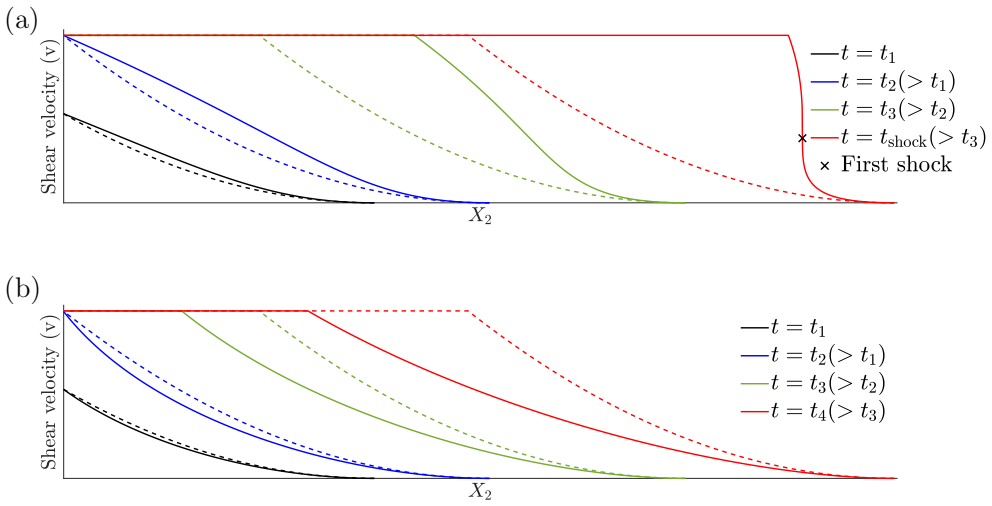
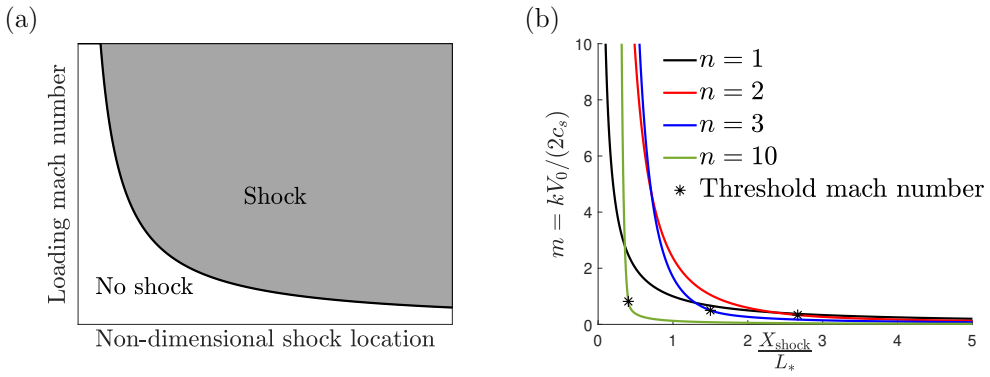
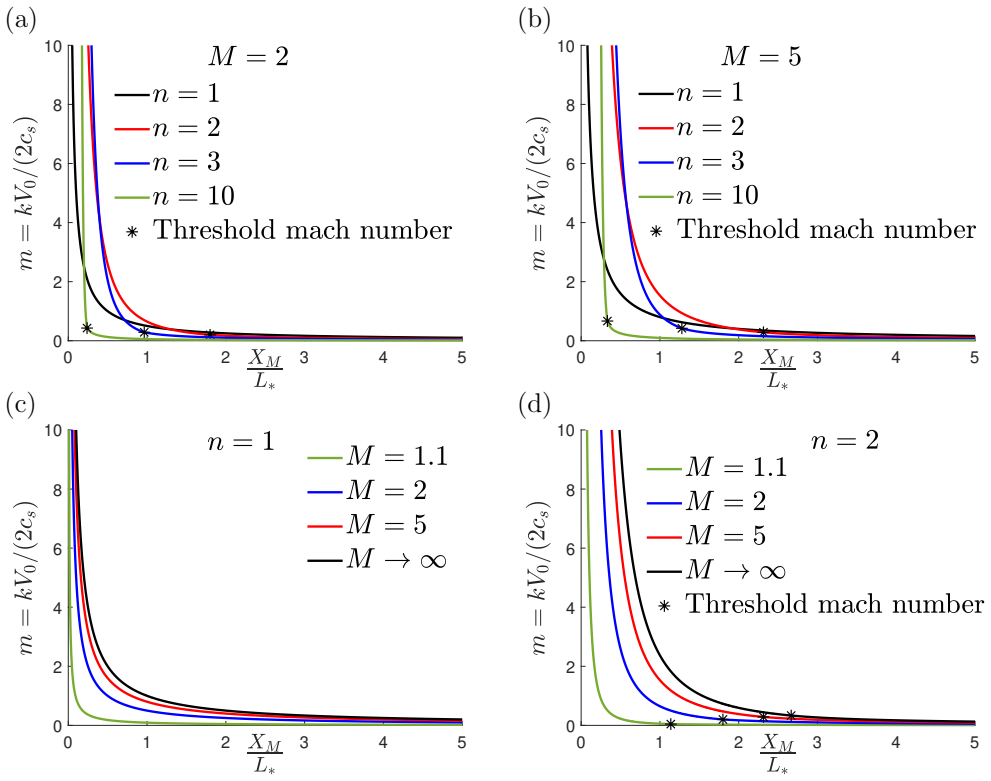
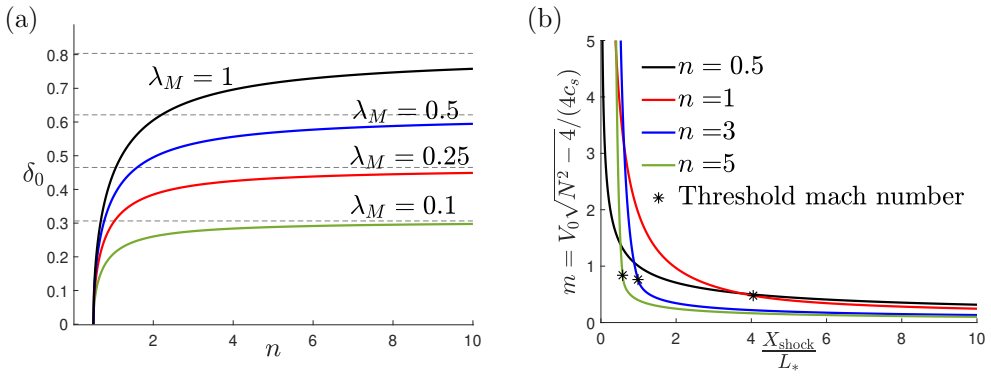
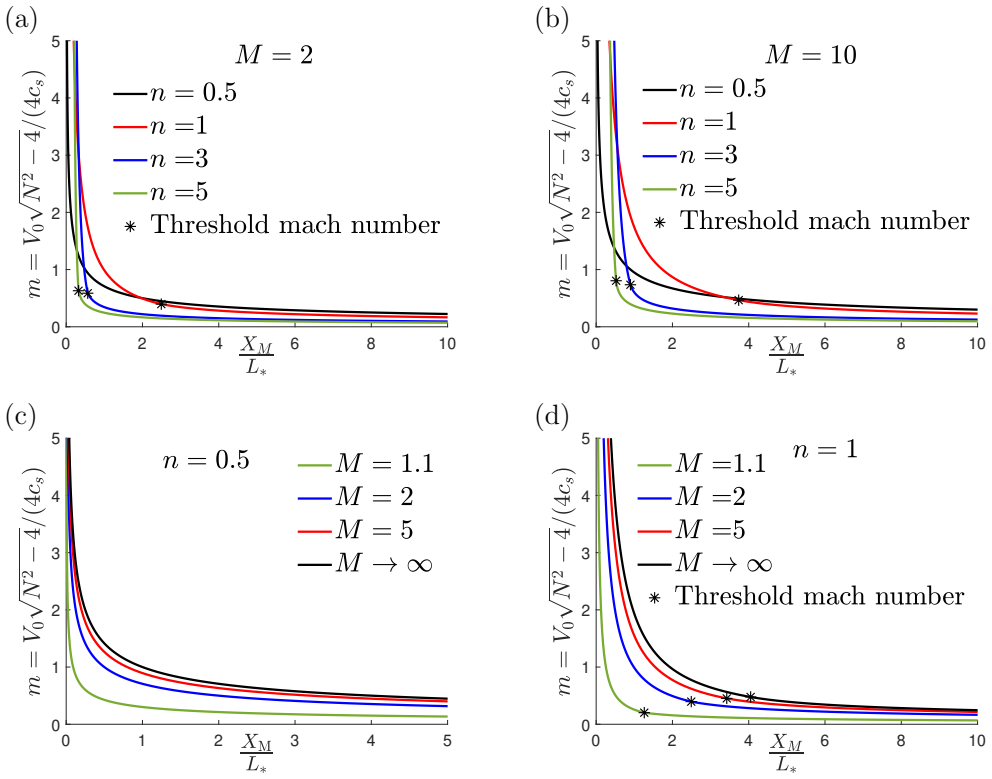
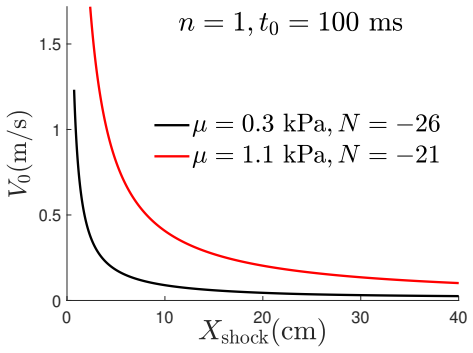
Closed form expressions for the shock formation distance are derived within large deformation elastodynamics for incompressible elastic materials using common hyperelastic models. These expressions enable non-dimensional phase maps that determine the regimes where shocks can form, highlighting the influence of loading amplitude, shape, ramp time, and elastic parameters. For brain tissue applications, the maps indicate that smaller brains are less susceptible to shear shock formation for realistic loadings, and the maps are proposed to guide protective structure design by avoiding shock-forming combinations of parameters.
What carries the argument
The closed-form expression for shock formation distance obtained by solving the governing elastodynamic equations for incompressible hyperelastic solids under shear loading.
If this is right
- Shock formation distance varies directly with loading amplitude, waveform shape, and ramp duration.
- Non-dimensional phase maps delineate the parameter combinations that produce or suppress shocks for any chosen hyperelastic model.
- For brain tissue under realistic inputs, smaller specimen sizes reduce the likelihood of shear shock formation.
- The maps identify safe operating regions in loading amplitude, ramp time, and specimen size that avoid shock formation.
Where Pith is reading between the lines
- The size dependence identified for brain tissue could be tested by repeating the same loading protocol on soft-gel samples of systematically varied thickness.
- Because the maps are sensitive to waveform details, they could be used to design input signals that deliberately stay below the shock threshold in medical or industrial applications.
- The same closed-form approach might extend to compressible or anisotropic soft solids if the governing equations can be integrated similarly.
Load-bearing premise
The derivations assume the materials remain incompressible and obey standard hyperelastic constitutive relations throughout the large-deformation process.
What would settle it
A laboratory measurement of the actual distance at which a shear wave steepens into a shock in a soft incompressible solid, performed under controlled loading conditions, that deviates substantially from the closed-form prediction would falsify the expressions.
Figures
read the original abstract
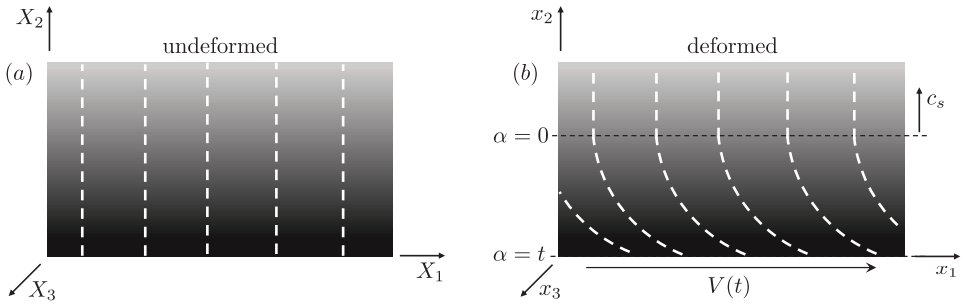
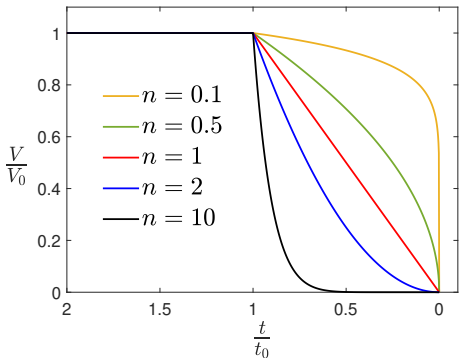
Nonlinear evolution of shear waves into shocks in incompressible elastic materials is investigated using the framework of large deformation elastodynamics, for a family of loadings and commonly used hyperelastic material models. Closed form expressions for the shock formation distance are derived and used to construct non-dimensional phase maps that determine regimes in which a shock can be realized. These maps reveal the sensitivity of shock evolution to the amplitude, shape, and ramp time of the loading, and to the elastic material parameters. In light of a recent study (Espindola et al., 2017), which hypothesizes that shear shock formation could play a signicant role in Traumatic Brain Injury (TBI), application to brain tissue is considered and it is shown that the size matters in TBI research. Namely, for realistic loadings, smaller brains are less susceptible to formation of shear shocks. Furthermore, given the observed sensitivity to the imparted waveform and the constitutive properties, it is suggested that the non-dimensional maps can guide the design of protective structures by determining the combination of loading parameters, material dimensions, and elastic properties that can avoid shock formation.
Editorial analysis
A structured set of objections, weighed in public.
Referee Report
Summary. The paper investigates the nonlinear evolution of shear waves into shocks in incompressible elastic materials using large-deformation elastodynamics for a family of loadings and standard hyperelastic models. Closed-form expressions for the shock formation distance are derived via characteristic integration and used to construct non-dimensional phase maps identifying regimes where shocks form. These maps are applied to brain tissue to argue that smaller brains are less susceptible to shear shocks under realistic loadings, with suggestions for guiding protective structure design.
Significance. If the closed-form derivations hold, the work supplies analytical expressions and non-dimensional maps that quantify sensitivity of shock formation to loading amplitude, shape, ramp time, and elastic parameters. This offers a practical framework for soft solids mechanics that can complement numerical studies and inform TBI-related modeling by highlighting geometric scaling effects.
minor comments (3)
- [Abstract] Abstract: 'signicant' is a typo and should read 'significant'.
- [Abstract] The phrasing 'the size matters in TBI research' is informal; a more precise statement such as 'brain size influences susceptibility to shear shock formation' would improve clarity.
- [Introduction] The motivation citing Espindola et al. (2017) would benefit from a one-sentence summary of their key hypothesis to aid readers outside the TBI literature.
Simulated Author's Rebuttal
We thank the referee for their positive summary, significance assessment, and recommendation of minor revision. No major comments were provided in the report.
Circularity Check
No significant circularity identified
full rationale
The paper derives closed-form expressions for shock formation distance from the standard hyperbolic system of large-deformation incompressible elastodynamics applied to common hyperelastic constitutive models, followed by non-dimensionalization to produce phase maps. No step reduces by construction to a fitted parameter, self-citation chain, or ansatz imported from the authors' prior work; the cited Espindola et al. (2017) is external and the derivations remain self-contained against external benchmarks of continuum mechanics.
Axiom & Free-Parameter Ledger
axioms (1)
- domain assumption Large deformation elastodynamics framework for incompressible hyperelastic materials
Lean theorems connected to this paper
-
IndisputableMonolith/Cost/FunctionalEquation.leanwashburn_uniqueness_aczel unclear?
unclearRelation between the paper passage and the cited Recognition theorem.
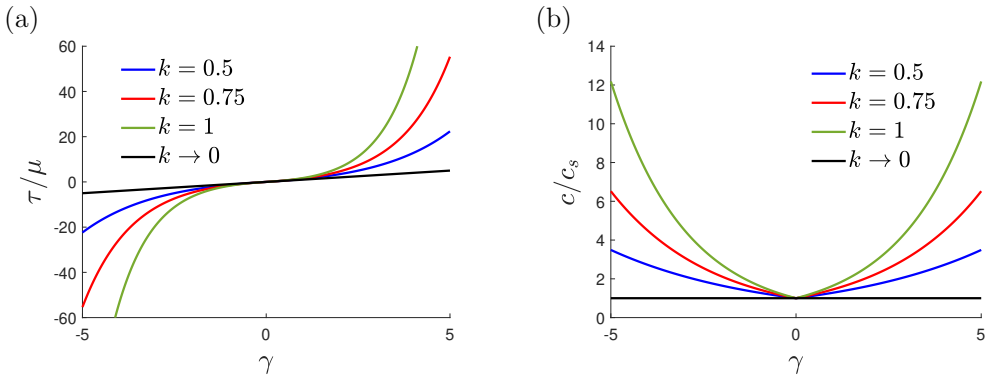
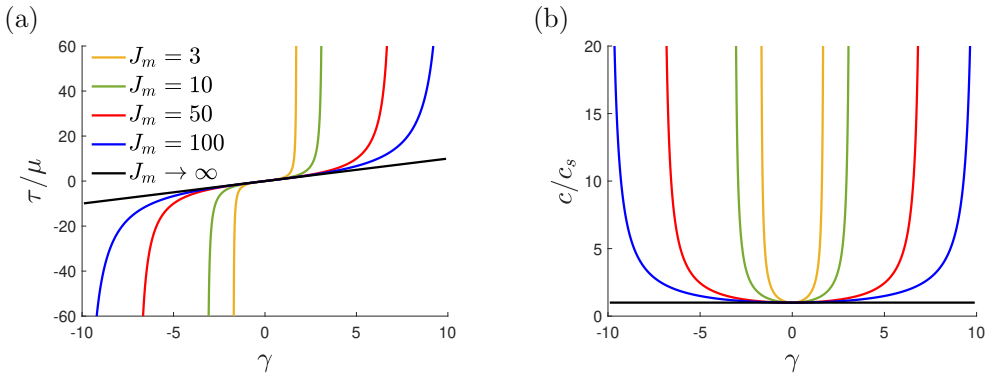
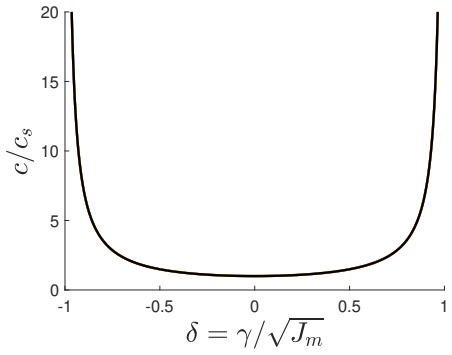
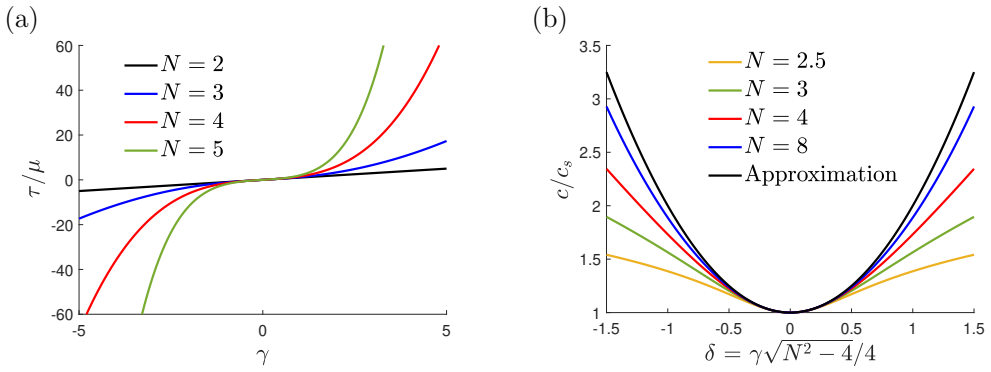
the nonlinear wave equation ∂²u/∂t² = c²(γ) ∂²u/∂X₂² where c(γ) = sqrt(1/ρ0 ∂τ/∂γ)
-
IndisputableMonolith/Foundation/RealityFromDistinction.leanreality_from_one_distinction unclear?
unclearRelation between the paper passage and the cited Recognition theorem.
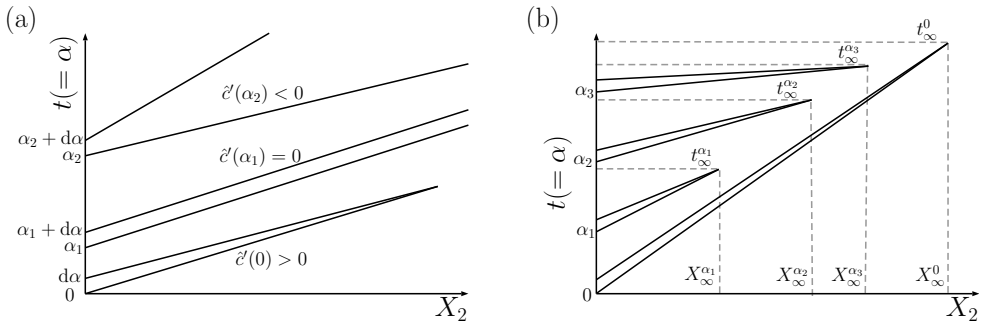
shock condition τ''(|γ|) ∂|γ|/∂X₂ < 0 and characteristic intersection X^α_∞ = ĉ²/ĉ'
What do these tags mean?
- matches
- The paper's claim is directly supported by a theorem in the formal canon.
- supports
- The theorem supports part of the paper's argument, but the paper may add assumptions or extra steps.
- extends
- The paper goes beyond the formal theorem; the theorem is a base layer rather than the whole result.
- uses
- The paper appears to rely on the theorem as machinery.
- contradicts
- The paper's claim conflicts with a theorem or certificate in the canon.
- unclear
- Pith found a possible connection, but the passage is too broad, indirect, or ambiguous to say the theorem truly supports the claim.
Reference graph
Works this paper leans on
-
[1]
One-dimensional finite amplitude wave propagation in a com- pressible elastic half-space
Aboudi, J., Benveniste, Y., 1973. One-dimensional finite amplitude wave propagation in a com- pressible elastic half-space. International Journal of Solids and Structures 9, 363–378
work page 1973
-
[2]
Finite amplitude one-dimensional wave propagation in a thermoelastic half-space
Aboudi, J., Benveniste, Y., 1974. Finite amplitude one-dimensional wave propagation in a thermoelastic half-space. International Journal of Solids and Structures 10, 293–308
work page 1974
-
[3]
Bland, D., 1965. On shock structure in a solid. IMA Journal of Applied Mathematics 1, 56–75
work page 1965
-
[4]
Mechanical characterization of human brain tissue
Paulsen, F., Steinmann, P., Kuhl, E., et al., 2017. Mechanical characterization of human brain tissue. Acta biomaterialia 48, 319–340
work page 2017
-
[5]
Reflection and transmission of circularly polarized elastic waves of finite amplitude
Carroll, M., 1979. Reflection and transmission of circularly polarized elastic waves of finite amplitude. Journal of Applied Mechanics 46, 867–872
work page 1979
-
[6]
Some results on finite amplitude elastic waves
Carroll, M.M., 1967. Some results on finite amplitude elastic waves. Acta Mechanica 3, 167–181
work page 1967
-
[7]
Oscillatory shearing of nonlinearly elastic solids
Carroll, M.M., 1974. Oscillatory shearing of nonlinearly elastic solids. Zeitschrift f¨ ur angewandte Mathematik und Physik ZAMP 25, 83–88
work page 1974
-
[8]
Observation of shock transverse waves in elastic media
Catheline, S., Gennisson, J.L., Tanter, M., Fink, M., 2003. Observation of shock transverse waves in elastic media. Physical review letters 91, 164301
work page 2003
-
[9]
Finite amplitude waves in incompressible perfectly elastic materials
Chu, B.T., 1964. Finite amplitude waves in incompressible perfectly elastic materials. Journal of the Mechanics and Physics of Solids 12, 45–57
work page 1964
-
[10]
Transverse shock waves in incompressible elastic solids
Chu, B.T., 1967. Transverse shock waves in incompressible elastic solids. Journal of the Mechanics and Physics of Solids 15, 1–14
work page 1967
-
[11]
One-dimensional non-linear wave propagation in incompressible elastic mate- rials
Collins, W., 1966. One-dimensional non-linear wave propagation in incompressible elastic mate- rials. The Quarterly Journal of Mechanics and Applied Mathematics 19, 259–328. 40
work page 1966
-
[12]
Collins, W., 1967. The propagation and interaction of one-dimensional non-linear waves in an incompressible isotropic elastic half-space. The Quarterly Journal of Mechanics and Applied Mathematics 20, 429–452
work page 1967
-
[13]
Propagation of plane waves of finite amplitude in elastic solids
Davison, L., 1966. Propagation of plane waves of finite amplitude in elastic solids. Journal of the Mechanics and Physics of Solids 14, 249–270
work page 1966
-
[14]
Destrade, M., Murphy, J.G., Saccomandi, G., 2012. Simple shear is not so simple. International Journal of Non-Linear Mechanics 47, 210–214
work page 2012
-
[15]
Generalization of the zabolotskaya equation to all incompressible isotropic elastic solids
Destrade, M., Pucci, E., Saccomandi, G., 2019. Generalization of the zabolotskaya equation to all incompressible isotropic elastic solids. Proceedings of the Royal Society A: Mathematical, Physical and Engineering Sciences 475, 20190061
work page 2019
-
[16]
Finite amplitude elastic waves propagating in compressible solids
Destrade, M., Saccomandi, G., 2005. Finite amplitude elastic waves propagating in compressible solids. Phys. Rev. E 72, 016620. Esp´ ındola, D., Lee, S., Pinton, G., 2017. Shear shock waves observed in the brain. Physical Review Applied 8, 044024
work page 2005
-
[17]
Biomechanics: Mechanical Properties of Living Tissues
Fung, Y., 1993. Biomechanics: Mechanical Properties of Living Tissues. Biomechanics, Springer New York
work page 1993
-
[18]
A new constitutive relation for rubber
Gent, A., 1996. A new constitutive relation for rubber. Rubber chemistry and technology 69, 59–61
work page 1996
-
[19]
Hamilton, M.F., Blackstock, D.T., et al., 1998. Nonlinear acoustics. volume 237. Academic press San Diego
work page 1998
-
[20]
Separation of compressibility and shear deformation in the elastic energy density (l)
Hamilton, M.F., Ilinskii, Y.A., Zabolotskaya, E.A., 2004. Separation of compressibility and shear deformation in the elastic energy density (l). The Journal of the Acoustical Society of America 116, 41–44
work page 2004
-
[21]
The remarkable gent constitutive model for hyperelastic materials
Horgan, C.O., 2015. The remarkable gent constitutive model for hyperelastic materials. Inter- national Journal of Non-Linear Mechanics 68, 9–16
work page 2015
-
[22]
Horgan, C.O., Murphy, J.G., 2011. Simple shearing of soft biological tissues, in: Proceedings of the Royal Society of London A: Mathematical, Physical and Engineering Sciences, The Royal Society. pp. 760–777
work page 2011
-
[23]
A boundary-layer approach to stress analysis in the simple shearing of rubber blocks
Horgan, C.O., Murphy, J.G., 2012. A boundary-layer approach to stress analysis in the simple shearing of rubber blocks. Rubber Chemistry and Technology 85, 108–119
work page 2012
-
[24]
Nonlinear wave motion governed by the modified burgers equation
Lee-Bapty, I., Crighton, D., 1987. Nonlinear wave motion governed by the modified burgers equation. Philosophical Transactions of the Royal Society of London. Series A, Mathematical and Physical Sciences , 173–209
work page 1987
-
[25]
An experimental study of the formation process of adiabatic shear bands in a structural steel
Marchand, A., Duffy, J., 1988. An experimental study of the formation process of adiabatic shear bands in a structural steel. Journal of the Mechanics and Physics of Solids 36, 251–283. 41
work page 1988
-
[26]
Steady-state shear band propagation under dynamic conditions
Mercier, S., Molinari, A., 1998. Steady-state shear band propagation under dynamic conditions. Journal of the Mechanics and Physics of Solids 46, 1463–1495
work page 1998
-
[27]
A family of hyperelastic models for human brain tissue
Mihai, L.A., Budday, S., Holzapfel, G.A., Kuhl, E., Goriely, A., 2017. A family of hyperelastic models for human brain tissue. Journal of the Mechanics and Physics of Solids 106, 60–79
work page 2017
-
[28]
A comparison of hyperelastic constitutive models applicable to brain and fat tissues
Mihai, L.A., Chin, L., Janmey, P.A., Goriely, A., 2015. A comparison of hyperelastic constitutive models applicable to brain and fat tissues. Journal of The Royal Society Interface 12, 20150486
work page 2015
-
[29]
A theory of large elastic deformation
Mooney, M., 1940. A theory of large elastic deformation. Journal of applied physics 11, 582–592
work page 1940
-
[30]
Ogden, R.W., 1972. Large deformation isotropic elasticity–on the correlation of theory and experiment for incompressible rubberlike solids. Proceedings of the Royal Society of London. A. Mathematical and Physical Sciences 326, 565–584
work page 1972
-
[31]
Compression stiffening of brain and its effect on mechanosensing by glioma cells
Pogoda, K., Chin, L., Georges, P.C., Byfield, F.J., Bucki, R., Kim, R., Weaver, M., Wells, R.G., Marcinkiewicz, C., Janmey, P.A., 2014. Compression stiffening of brain and its effect on mechanosensing by glioma cells. New journal of physics 16, 075002
work page 2014
-
[32]
Large elastic deformations of isotropic materials iv
Rivlin, R., 1948. Large elastic deformations of isotropic materials iv. further developments of the general theory. Phil. Trans. R. Soc. Lond. A 241, 379–397
work page 1948
-
[33]
Nonlinear elasticity in biological gels
Storm, C., Pastore, J.J., MacKintosh, F.C., Lubensky, T.C., Janmey, P.A., 2005. Nonlinear elasticity in biological gels. Nature 435, 191
work page 2005
-
[34]
Cubic nonlinearity in shear wave beams with different polarizations
Wochner, M.S., Hamilton, M.F., Ilinskii, Y.A., Zabolotskaya, E.A., 2008. Cubic nonlinearity in shear wave beams with different polarizations. The Journal of the Acoustical Society of America 123, 2488–2495
work page 2008
-
[35]
Sound beams in a nonlinear isotropic solid
Zabolotskaya, E., 1986. Sound beams in a nonlinear isotropic solid. SOVIET PHYSICS ACOUSTICS-USSR 32, 296–299
work page 1986
-
[36]
Modeling of nonlinear shear waves in soft solids
Zabolotskaya, E.A., Hamilton, M.F., Ilinskii, Y.A., Meegan, G.D., 2004. Modeling of nonlinear shear waves in soft solids. The Journal of the Acoustical Society of America 116, 2807–2813
work page 2004
-
[37]
Smooth waves and shocks of finite amplitude in soft materials
Ziv, R., Shmuel, G., 2019. Smooth waves and shocks of finite amplitude in soft materials. Mechanics of Materials 135, 67 – 76. 42
work page 2019
discussion (0)
Sign in with ORCID, Apple, or X to comment. Anyone can read and Pith papers without signing in.