REVIEW 3 major objections 3 minor 1 cited by
This paper claims that a wireless image codec can preserve scenario-relevant objects at lower bandwidth than static-importance baselines by distilling a multimodal language model's importance judgments into its rate allocation and training
Reviewed by Pith at T0; open to challenge. T0 means a machine referee read the full paper against a public rubric. the ladder, T0–T4 →
A semantic communication framework uses MLLM-derived scenario-aware importance labels to allocate coding resources, improving PSNR of important image regions at comparable or lower bandwidth than prior JSCC systems.
T0 review reviewed 2026-08-04 challenge →
load-bearing objection Useful dataset and coherent framework, but the headline efficiency claim is partly powered by direct oracle labels, not a learned capability; substantially the paper needs ablations, error bars, and a downstream task metric before that claim is accepted. the 3 major comments →
SA-OOSC: A Multimodal LLM-Distilled Semantic Communication Framework for Enhanced Coding Efficiency with Scenario Understanding
The pith
A machine-rendered reading of the paper's core claim, the machinery that carries it, and where it could break.
The reading
Core claim
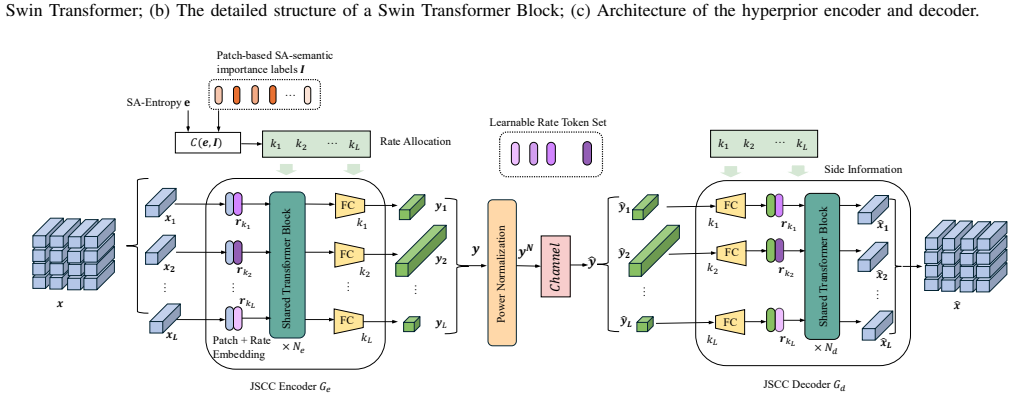
SA-OOSC's claim: an object's contextual importance, not its class, should decide its channel-symbol allocation, and a multimodal language model can supply that judgment. YOLOv11x detection, GPT-4V importance labels, and patch-level conversion feed distillation training of a hyperprior vectorization model and a JSCC codec. SA entropy (scenario importance plus texture) and an auxiliary importance term drive the rate rule; training minimizes SAD, an importance-weighted PSNR. On Cityscapes, SA-OOSC uses the lowest bandwidth (CBR 0.0201) while best reconstructing high- and medium-importance patches: 35.55 dB non-background PSNR versus 35.01 (OOSC), 31.68 (NTSCC), 29.24 (Deep JSCC).
What carries the argument
(1) the MLLM labeling pipeline: YOLOv11x detection plus a GPT-4V prompt with rule-based constraints (nearby objects always 'high', ego-relevant traffic lights 'high'), converted to patch level by taking each patch's most important object; (2) SA entropy: a hyperprior variational vectorization output trained with the SAD loss so the entropy estimate reflects scenario importance as well as texture; (3) the rate rule k_i = Q0[C1(e_i) + C2(I_i)], making each patch's channel symbols proportional to SA entropy plus an importance bias (+α high, −α low) that hedges out-of-distribution objects; (4) SAD, an importance-weighted PSNR (weights 2^{I_i}/Σ_j 2^{I_j}) that carries MLLM knowledge into every l
Load-bearing premise
The framework's gains rest on the premise that GPT-4V's importance labels—produced with hand-written prompt rules such as 'every nearby object is high importance'—are a valid and stable ground truth for what matters in a driving scene, and that raising PSNR in those labeled regions actually improves driving decisions; if the labels misorder importance in scenes the prompt did not anticipate, the reported efficiency gains do not translate into real-world benefit.
What would settle it
Compare SA-OOSC against two ablations at matched CBR on the released benchmark: one trained with the same rate and SAD machinery but uniform importance labels, and one with importance labels from the prompt's hard rules alone, without GPT-4V. If the full MLLM-distilled model does not beat the rule-only variant on high-importance PSNR, scenario understanding is not the source of the gain. Separately, feed SA-OOSC and OOSC reconstructions into a real driving-planner or object-tracker: if equal or better importance-region PSNR does not improve task success, the SAD proxy is not capturing communic
If this is right
- If SA-OOSC is right, rate allocation in semantic communication can be scenario-adaptive: the same object class (a vehicle, a pedestrian) should receive different bandwidth in different contexts, and an MLLM can supply the context judgment at scale.
- Distilling MLLM importance labels into both the entropy model and the JSCC rate rule means important regions survive noisy channels at lower total bandwidth—the reported CBR is the lowest among all compared schemes.
- The auxiliary importance bias C2(I_i) gives the codec a safety margin for out-of-distribution objects that the entropy model alone would under-rate, because the MLLM labels act as an external check.
- The released MLLM-annotated, human-verified Cityscapes importance benchmark gives later systems a common training and evaluation target for scenario-aware importance.
Where Pith is reading between the lines
- Because the same MLLM labels that guide training also define the evaluation strata, the reported gains are partly the system optimizing its own objective. Two checks would separate the contributions: stratify reconstruction quality by the released human annotations on the 100-image subset, and ablate GPT-4V labels against rule-only labels at matched CBR.
- A task-level test—feeding reconstructions to a downstream planner or tracker instead of measuring PSNR—would show whether importance-weighted pixel fidelity actually improves driving decisions, the ultimate benefit the bandwidth-versus-PSNR trade stands in for.
- The pipeline should transfer to other tasks where an MLLM can rank region importance (surveillance, remote inspection, augmented reality), provided the importance labels stay stable across the deployment distribution; the reported 92.57% agreement with human drivers on 100 images is the current evidence for that stability.
- One manuscript artifact bears noting: Appendix C contains the leftover editorial note '(to be replaced with your actual citation)' where the hyperprior vectorization architecture is attributed; the intended source is evidently the scale-hyperprior work, but the provenance of that architecture description should be verified in the released version.
Editorial analysis
A structured set of objections, weighed in public.
Referee Report
Summary. The paper proposes SA-OOSC, a semantic communication framework for image transmission in autonomous driving scenarios. A GPT-4V-based labeling module (with YOLOv11x object detection) assigns scenario-augmented semantic importance labels to image patches. These labels are used in two ways: as weights in a semantic-aware distortion metric (SAD) that enters the training losses of the HV vectorization network and the variable-length JSCC codec, and, at inference time, as a direct additive adjustment C2(I_i) to the per-patch channel-symbol allocation in Eq. (1). Experiments on Cityscapes compare SA-OOSC against Deep JSCC, NTSCC, and OOSC in terms of CBR and category-level PSNR, reporting higher PSNR in high- and medium-importance regions at slightly lower or comparable CBR. The paper also releases MLLM-annotated and human-verified importance labels.
Significance. The scenario-aware importance idea is timely and the open-sourced MLLM-annotated dataset is a useful community resource. The human-consistency study in Appendix I (92.57% overall agreement) adds credibility to the labeling procedure. If the reported gains were isolated to the proposed learned components, the framework would be a meaningful advance in variable-length JSCC. However, the central claim of knowledge distillation is not yet supported: the test-time rate allocation uses the MLLM labels as oracle side information, and the evaluation metric is closely aligned with the training objective. These issues are fixable in a revision, so the work has value but needs substantial additional evidence.
major comments (3)
- [§III, Eq. (1) and Appendix F, Eq. (15)] The paper claims that through knowledge distillation the vectorization and JSCC networks 'learn to dynamically allocate coding resources based on contextual significance.' But the test-time rate allocation is ki = Q0[C1(ei) + C2(Ii)], where C2(Ii) is a hand-coded mapping (+alpha, 0, -alpha, 0) and Ii is the GPT-4V label obtained at inference (Fig. 3, red arrow). Thus the scenario-aware component of the rate allocation is oracle teacher input, not a learned student capability. To substantiate the distillation claim, the authors should ablate C2(Ii), compare against a variant that predicts Ii from the student network, and report CBR/PSNR without the auxiliary term. Without this, the reported gains may be due to direct label injection rather than MLLM-distilled knowledge.
- [§V and Appendix B, Eqs. (4)-(6), (13), (19), (20)] The evaluation is partly self-referential. SAD (Eq. 6) is the training objective in L_hv, L_JSCC, and L_overall; the category-level PSNR bars in Figs. 5 and 6 are exactly the components of SAD aggregated by importance class, with the same importance labels also used for rate allocation (Eq. 15). A model explicitly optimized to maximize PSNR in high-importance patches is then evaluated on high-importance PSNR. The paper should report independent task-level metrics (e.g., detection/segmentation performance on reconstructed images, or downstream driving-decision accuracy) and unweighted full-image distortion at matched rates, plus repeated-run statistics (error bars or significance tests). This is load-bearing because the central claim of 'preserving important information' is measured with a metric the system was directly trained to maximize.
- [§V, Figs. 5-6] There are no ablations isolating the proposed components (C2, SAD weighting, alpha, eta, lambda) and no rate-distortion curves spanning multiple operating points. The headline comparison uses slightly different CBR values (0.0201 vs. 0.0204 vs. 0.0203 for Fig. 5) and reports margins as small as ~0.5 dB overall (35.55 vs. 35.01 dB in non-background PSNR). Without ablations, sensitivity analysis, or confidence intervals, the conclusion that 'scenario-aware importance allocation' causes the gains is not established. Adding an ablation that removes C2 and/or replaces SAD with unweighted MSE would directly test the causal role of the new mechanism.
minor comments (3)
- [Appendix A] The prompt engineering description reveals that importance labels are heavily rule-based (e.g., 'if objects are very close to you, you should allocate 3 to them, even if they are parked'). The paper should qualify claims about 'MLLM scenario understanding' and discuss how much of the performance comes from these hand-crafted rules rather than from emergent reasoning.
- [Fig. 5] The bar chart is difficult to read from the text alone; the numerical values for each importance category should be given in a table or in the caption. Also, the x-axis ordering is non-standard.
- [General] There are frequent references to 'Appendixes B to H' as if space-constrained; the appendices are extensive but some notation is inconsistent (e.g., SAD formula in Appendix B appears garbled in the text extraction). Please proofread the equations and ensure all symbols (theta_f, phi_g, etc.) are defined where first used.
Circularity Check
Test-time rate allocation injects MLLM labels directly (Eq. 1/15), and the evaluation metric is the same SAD loss (Eq. 6/19), making the importance-weighted gains partly self-referential; human-validated labels give partial independent grounding.
specific steps
-
fitted input called prediction
[Section III, Eq. (1); Appendix F, Eq. (15); Fig. 3 caption]
"for each patch i, we jointly utilize its SA-entropy ei and SA-semantic importance label Ii to determine ki, the length of vector yi. Specifically, we let ki =Q0[C1(ei)+C2(Ii)],(1) ... C2(Ii) = +α, Ii=3; 0, Ii=2; −α, Ii=1; 0, Ii=0 (15)"
At test time the 'scenario-aware' part of the allocation is not produced by the distilled student networks: C2(Ii) is a hand-coded mapping that directly adds +α, 0, −α, or 0 depending on the MLLM label Ii. The labeling module is explicitly involved in 'the transmission of a tested image (red arrow)' in Fig. 3. Thus the claim that the vectorization/JSCC networks 'learn to dynamically allocate coding resources based on contextual significance' is not isolated: the teacher labels are injected as oracle side information at inference. Any gain caused by C2 is given by the input, not by learned scenario understanding.
-
self definitional
[Appendix B, Eq. (6); Appendix G, Eq. (19); Section V, Fig. 5]
"The overall distortion metric for the image is then obtained by computing the weighted average of the PSNR values of all patches: SAD = PL i=1 wi ·PSNRi,(6) ... LJSCC = λ||k||1 + SAD(S, ˆS)(19)"
The evaluation metric groups PSNR by the same SA-semantic importance labels that define the training loss. Eq. (4) sets wi = 2^{Ii}/sum 2^{Ij}, so SAD is a weighted PSNR that increases with Ii; Eq. (19) trains the whole system to minimize SAD, and Eq. (15) adds extra channel symbols to the same high-importance patches. The reported superiority in high/medium-importance PSNR (Figs. 5-6) is therefore partly expected by construction: the system is explicitly optimized and rate-allocated for the labels on which it is then evaluated. The human-annotation agreement (Appendix I) validates the labels themselves, giving independent support for label quality, but not for coding-efficiency superiority.
full rationale
The strongest circularity is the test-time oracle: Eq. (1) with Eq. (15) feeds the MLLM importance label Ii directly into the rate allocation, so the 'scenario-aware importance allocation' attributed to knowledge distillation is partially supplied by the teacher, not learned. The evaluation is also self-referential because the SAD loss (Eq. 19) is defined as an importance-weighted PSNR (Eq. 6) over the very labels used for the test-time allocation, and the headline results are PSNR decomposed by those same labels. This makes the high-importance PSNR gains largely a direct consequence of optimizing SAD and hand-coding C2, rather than an independent confirmation of coding efficiency. However, the paper is not wholly circular: it compares against standard baselines (NTSCC, OOSC, Deep JSCC) at similar CBR, it has a learned SA-entropy component (C1(ei)), and the MLLM labels are cross-validated against human annotations (Appendix I, 92.57% overall accuracy). Those elements give the framework some independent content, so a moderate score of 5 is appropriate rather than a full 6-10 reduction-to-fit verdict.
Axiom & Free-Parameter Ledger
free parameters (5)
- η (scaling factor)
- α (auxiliary rate adjustment)
- λ (rate-distortion Lagrange multiplier)
- Quantization set V =
16 values uniformly between 16 and 256
- Prompt rules for importance labeling =
nearby objects always high; traffic lights relevant to ego car high
axioms (5)
- domain assumption GPT-4V importance labels, under the engineered prompt, are a valid teacher for task-relevant importance.
- domain assumption Patch importance can be reduced to the maximum importance of contained objects, with undetected patches treated as background.
- domain assumption PSNR, computed per importance category, is an adequate measure of semantic communication quality for the driving task.
- domain assumption The AWGN channel model (Eq 3) is representative for evaluating the proposed scheme.
- ad hoc to paper The rate-distortion training objectives (Eqs 13, 19, 20) with SAD are the correct optimization targets.
invented entities (2)
-
Scenario-augmented (SA) semantic importance labels
independent evidence
-
SA entropy
no independent evidence
Cite this review
Pith. "Pith review of SA-OOSC: A Multimodal LLM-Distilled Semantic Communication Framework for Enhanced Coding Efficiency with Scenario Understanding." pith.science (2026). https://pith.science/paper/7VZYPFBP
@misc{pith2026250907436,
  author       = {Pith},
  title        = {Pith review of: SA-OOSC: A Multimodal LLM-Distilled Semantic Communication Framework for Enhanced Coding Efficiency with Scenario Understanding},
  year         = {2026},
  howpublished = {\url{https://pith.science/paper/7VZYPFBP}},
  note         = {Machine review of arXiv:2509.07436}
}
read the original abstract
This paper introduces SA-OOSC, a multimodal large language models (MLLM)-distilled semantic communication framework that achieves efficient semantic coding with scenario-aware importance allocations. This approach addresses a critical limitation of existing object-oriented semantic communication (OOSC) systems - assigning static importance values to specific classes of objects regardless of their contextual relevance. Our framework utilizes MLLMs to identify the scenario-augmented (SA) semantic importance for objects within the image. Through knowledge distillation with the MLLM-annotated data, our vectorization/de-vectorization networks and JSCC encoder/decoder learn to dynamically allocate coding resources based on contextual significance, i.e., distinguishing between high-importance objects and low-importance according to the SA scenario information of the task. The framework features three core innovations: a MLLM-guided knowledge distillation pipeline, an importance-weighted variable-length JSCC framework, and novel loss function designs that facilitate the knowledge distillation within the JSCC framework. Experimental validation demonstrates our framework's superior coding efficiency over conventional semantic communication systems, with open-sourced MLLM-annotated and human-verified datasets established as new benchmarks for future research in semantic communications.
Figures



Forward citations
Cited by 1 Pith paper
-
LLM-Powered Virtual Patient Agents for Interactive Clinical Skills Training with Automated Feedback
The stated central claim, an LLM-powered virtual-patient OSCE trainer with automated feedback, has no supporting content in the full text, which is an unrelated IoT automation paper.
Reference graph
Works this paper leans on
-
[1]
Enabling massive IoT toward 6G: A comprehensive survey,
F. Guo, F. R. Yu, H. Zhang, X. Li, H. Ji, and V . C. Leung, “Enabling massive IoT toward 6G: A comprehensive survey,”IEEE Internet Things J., vol. 8, no. 15, pp. 11 891–11 915, 2021
work page 2021
-
[2]
Virtual reality: A survey of enabling technologies and its applications in IoT,
M. Hu, X. Luo, J. Chen, Y . C. Lee, Y . Zhou, and D. Wu, “Virtual reality: A survey of enabling technologies and its applications in IoT,”Journal of Network and Computer Applications, vol. 178, p. 102970, 2021
work page 2021
-
[3]
AR enabled IoT for a smart and interactive environment: A survey and future directions,
D. Jo and G. J. Kim, “AR enabled IoT for a smart and interactive environment: A survey and future directions,”Sensors, vol. 19, no. 19, p. 4330, 2019
work page 2019
-
[4]
Y . Du, Q. Yang, L. Wang, J. Lin, H. Cui, and S. C. Liew, “Llmind 2.0: Distributed iot automation with natural language m2m communication and lightweight llm agents,” 2025. [Online]. Available: https://arxiv.org/abs/2508.13920
-
[5]
Channel polarization: A method for constructing capacity- achieving codes for symmetric binary-input memoryless channels,
E. Arikan, “Channel polarization: A method for constructing capacity- achieving codes for symmetric binary-input memoryless channels,”IEEE Trans. Inf. Theory, vol. 55, no. 7, pp. 3051–3073, 2009
2009
-
[6]
Semantic communication: A survey on research landscape, challenges, and future directions,
T. M. Getu, G. Kaddoum, and M. Bennis, “Semantic communication: A survey on research landscape, challenges, and future directions,” Proceedings of the IEEE, vol. 112, no. 11, pp. 1649–1685, 2024
work page 2024
-
[7]
Semantic communications for future internet: Fundamentals, applications, and challenges,
W. Yang, H. Du, Z. Q. Liew, W. Y . B. Lim, Z. Xiong, D. Niyato, X. Chi, X. Shen, and C. Miao, “Semantic communications for future internet: Fundamentals, applications, and challenges,”IEEE Communications Surveys & Tutorials, vol. 25, no. 1, pp. 213–250, 2023
work page 2023
-
[8]
A theory of semantic communication,
Y . Shao, Q. Cao, and D. G¨und¨uz, “A theory of semantic communication,” IEEE Trans. Mob. Comput., 2024
work page 2024
-
[9]
Beyond transmitting bits: Context, semantics, and task-oriented communications,
D. G ¨und¨uz, Z. Qin, I. E. Aguerri, H. S. Dhillon, Z. Yang, A. Yener, K. K. Wong, and C.-B. Chae, “Beyond transmitting bits: Context, semantics, and task-oriented communications,”IEEE J. Sele. Areas Commu., vol. 41, no. 1, pp. 5–41, 2022
work page 2022
-
[10]
Deep joint source- channel coding for wireless image transmission,
E. Bourtsoulatze, D. B. Kurka, and D. G ¨und¨uz, “Deep joint source- channel coding for wireless image transmission,” inICASSP 2019 - 2019 IEEE International Conference on Acoustics, Speech and Signal Processing (ICASSP), 2019, pp. 4774–4778
work page 2019
-
[11]
Nonlinear transform source-channel coding for semantic communications,
J. Dai, S. Wang, K. Tan, Z. Si, X. Qin, K. Niu, and P. Zhang, “Nonlinear transform source-channel coding for semantic communications,”IEEE Journal on Selected Areas in Communications, vol. 40, no. 8, pp. 2300– 2316, 2022
2022
-
[12]
Variational image compression with a scale hyperprior,
J. Ball ´e, D. Minnen, S. Singh, S. J. Hwang, and N. Johnston, “Variational image compression with a scale hyperprior,” 2018. [Online]. Available: https://arxiv.org/abs/1802.01436
Pith/arXiv arXiv 2018
-
[13]
Toward semantic communications: Deep learning-based image semantic coding,
D. Huang, F. Gao, X. Tao, Q. Du, and J. Lu, “Toward semantic communications: Deep learning-based image semantic coding,”IEEE Journal on Selected Areas in Communications, vol. 41, no. 1, pp. 55–71, 2023
work page 2023
-
[14]
Semantic segmentation-based semantic communication system for image transmission,
J. Wu, C. Wu, Y . Lin, T. Yoshinaga, L. Zhong, X. Chen, and Y . Ji, “Semantic segmentation-based semantic communication system for image transmission,”Digital Communications and Networks, vol. 10, no. 3, pp. 519–527, 2024. [Online]. Available: https://www.sciencedirect.com/science/article/pii/S235286482300041X
work page 2024
-
[15]
Feature importance-aware task-oriented semantic transmission and optimization,
Y . Wang, S. Han, X. Xu, H. Liang, R. Meng, C. Dong, and P. Zhang, “Feature importance-aware task-oriented semantic transmission and optimization,”IEEE Transactions on Cognitive Communications and Networking, vol. 10, no. 4, pp. 1175–1189, 2024
work page 2024
-
[16]
Privacy-preserving task-oriented semantic communications against model inversion attacks,
Y . Wang, S. Guo, Y . Deng, H. Zhang, and Y . Fang, “Privacy-preserving task-oriented semantic communications against model inversion attacks,”
-
[17]
Beamforming and scalable image processing in vehicle-to-vehicle networks,
H. Ngo, H. Fang, and H. Wang, “Beamforming and scalable image processing in vehicle-to-vehicle networks,”J. Signal Process. Syst., vol. 94, no. 5, p. 445–454, May 2022. [Online]. Available: https://doi.org/10.1007/s11265-021-01696-6
-
[18]
Cooperative perception with v2v communication for autonomous vehicles,
——, “Cooperative perception with v2v communication for autonomous vehicles,”IEEE Transactions on V ehicular Technology, vol. 72, no. 9, pp. 11 122–11 131, 2023
work page 2023
-
[19]
Vehicle position and context detection using v2v communication,
P. Watta, X. Zhang, and Y . L. Murphey, “Vehicle position and context detection using v2v communication,”IEEE Transactions on Intelligent V ehicles, vol. 6, no. 4, pp. 634–648, 2021
work page 2021
-
[20]
Overview of v2v and v2i wireless communication for cooperative vehicle infrastructure systems,
W. He, H. Li, X. Zhi, X. Li, J. Zhang, Q. Hou, and Y . Li, “Overview of v2v and v2i wireless communication for cooperative vehicle infrastructure systems,” in2019 IEEE 4th Advanced Information Technology, Electronic and Automation Control Conference (IAEAC), 2019, pp. 127–134
work page 2019
-
[21]
The cityscapes dataset for semantic urban scene understanding,
M. Cordts, M. Omran, S. Ramos, T. Rehfeld, M. Enzweiler, R. Benenson, U. Franke, S. Roth, and B. Schiele, “The cityscapes dataset for semantic urban scene understanding,” inProc. of the IEEE Conference on Computer Vision and Pattern Recognition (CVPR), 2016
2016
-
[22]
LLM-Assisted Multi-Teacher Continual Learning for Visual Question Answering in Robotic Surgery
Y . Du, K. Chen, Y . Zhan, C. H. Low, T. You, M. Islam, Z. Guo, Y . Jin, G. Chen, and P.-A. Heng, “Llm-assisted multi-teacher continual learning for visual question answering in robotic surgery,” 2024. [Online]. Available: https://arxiv.org/abs/2402.16664
work page internal anchor Pith review Pith/arXiv arXiv 2024
-
[23]
A survey on knowledge distillation of large language models,
X. Xu, M. Li, C. Tao, T. Shen, R. Cheng, J. Li, C. Xu, D. Tao, and T. Zhou, “A survey on knowledge distillation of large language models,”
-
[24]
L. Wang, Y . Du, J. Lin, K. Chen, and S. C. Liew, “Rephrase and contrast: Fine-tuning language models for enhanced understanding of communication and computer networks,” in2025 International Conference on Computing, Networking and Communications (ICNC). IEEE, 2025, pp. 588–594
work page 2025
-
[25]
Minillm: Knowledge distillation of large language models,
Y . Gu, L. Dong, F. Wei, and M. Huang, “Minillm: Knowledge distillation of large language models,” 2024. [Online]. Available: https://arxiv.org/abs/2306.08543
Pith/arXiv arXiv 2024
-
[26]
Improved nonlinear transform source-channel coding to catalyze semantic communications,
S. Wang, J. Dai, X. Qin, Z. Si, K. Niu, and P. Zhang, “Improved nonlinear transform source-channel coding to catalyze semantic communications,”
-
[27]
Towards out-of-distribution generalization: A survey,
J. Liu, Z. Shen, Y . He, X. Zhang, R. Xu, H. Yu, and P. Cui, “Towards out-of-distribution generalization: A survey,”arXiv preprint arXiv:2108.13624, 2021
Pith/arXiv arXiv 2021
-
[28]
F. Zhang, Y . Du, K. Chen, Y . Shao, and S. C. Liew, “Out-of-distribution in image semantic communication: A solution with multimodal large language models,”IEEE Transactions on Machine Learning in Commu- nications and Networking, pp. 997–1013, 2025
work page 2025
-
[29]
Improved Nonlinear Transform Source-Channel Coding to Catalyze Semantic Communications
[Online]. Available: https://arxiv.org/abs/2303.14637
work page internal anchor Pith review Pith/arXiv arXiv
-
[30]
OpenAI, “Gpt-4 technical report,” https://cdn.openai.com/papers/gpt-4. pdf, 2023
work page 2023
-
[31]
End-to-end optimized image compression,
J. Ball ´e, V . Laparra, and E. P. Simoncelli, “End-to-end optimized image compression,” 2017. [Online]. Available: https://arxiv.org/abs/1611.01704
Pith/arXiv arXiv 2017
- [32]
-
[33]
Swin transformer: Hierarchical vision transformer using shifted windows,
Z. Liu, Y . Lin, Y . Cao, H. Hu, Y . Wei, Z. Zhang, S. Lin, and B. Guo, “Swin transformer: Hierarchical vision transformer using shifted windows,” 2021. [Online]. Available: https://arxiv.org/abs/2103.14030
Pith/arXiv arXiv 2021
-
[34]
Dynamic Neural Networks: A Survey
Y . Han, G. Huang, S. Song, L. Yang, H. Wang, and Y . Wang, “Dynamic neural networks: A survey,” 2021. [Online]. Available: https://arxiv.org/abs/2102.04906
work page internal anchor Pith review Pith/arXiv arXiv 2021
-
[35]
Auto-encoding variational bayes,
D. P. Kingma and M. Welling, “Auto-encoding variational bayes,” 2022. [Online]. Available: https://arxiv.org/abs/1312.6114
Pith/arXiv arXiv 2022
-
[36]
Adam: A method for stochastic optimization,
D. P. Kingma and J. Ba, “Adam: A method for stochastic optimization,”
-
[37]
Pytorch: An imperative style, high-performance deep learning library,
A. Paszke, S. Gross, F. Massa, A. Lerer, J. Bradbury, G. Chanan, T. Killeen, Z. Lin, N. Gimelshein, L. Antiga, A. Desmaison, A. K ¨opf, E. Yang, Z. DeVito, M. Raison, A. Tejani, S. Chilamkurthy, B. Steiner, L. Fang, J. Bai, and S. Chintala, “Pytorch: An imperative style, high-performance deep learning library,” 2019. [Online]. Available: https://arxiv.org...
Pith/arXiv arXiv 2019
-
[38]
A. Vaswani, N. Shazeer, N. Parmar, J. Uszkoreit, L. Jones, A. N. Gomez, L. Kaiser, and I. Polosukhin, “Attention is all you need,” 2023. [Online]. Available: https://arxiv.org/abs/1706.03762
Pith/arXiv arXiv 2023
-
[2017]
Available: https://arxiv.org/abs/1412.6980
[Online]. Available: https://arxiv.org/abs/1412.6980
-
[2023]
Privacy-Preserving Task-Oriented Semantic Communications Against Model Inversion Attacks
[Online]. Available: https://arxiv.org/abs/2312.03252
work page internal anchor Pith review Pith/arXiv arXiv
-
[2024]
Available: https://arxiv.org/abs/2402.13116
[Online]. Available: https://arxiv.org/abs/2402.13116
This paper was first reviewed by deepseek-v4-flash on August 4, 2026.
discussion (0)
Sign in with ORCID, Apple, or X to comment. Anyone can read and Pith papers without signing in.