Realizing tunable non-Hermitian skin effects in dynamical quantum systems via the relative phase between multiple time-periodic driving
Pith reviewed 2026-05-22 06:07 UTC · model grok-4.3
The pith
The relative phase between multiple time-periodic drives controls the emergence and localization direction of non-Hermitian skin modes.
A machine-rendered reading of the paper's core claim, the machinery that carries it, and where it could break.
Core claim
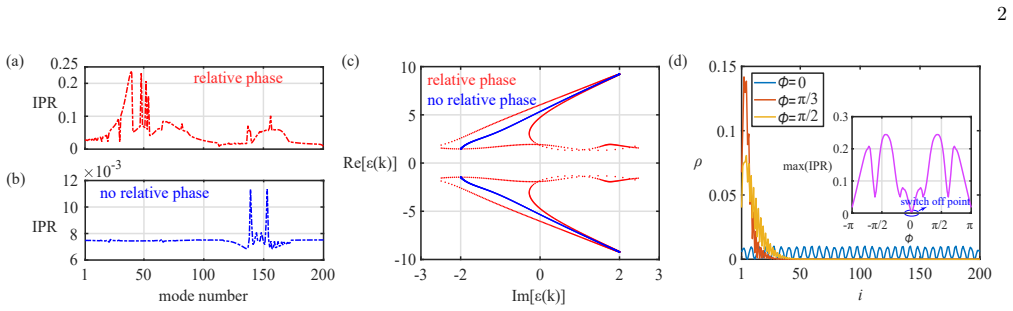
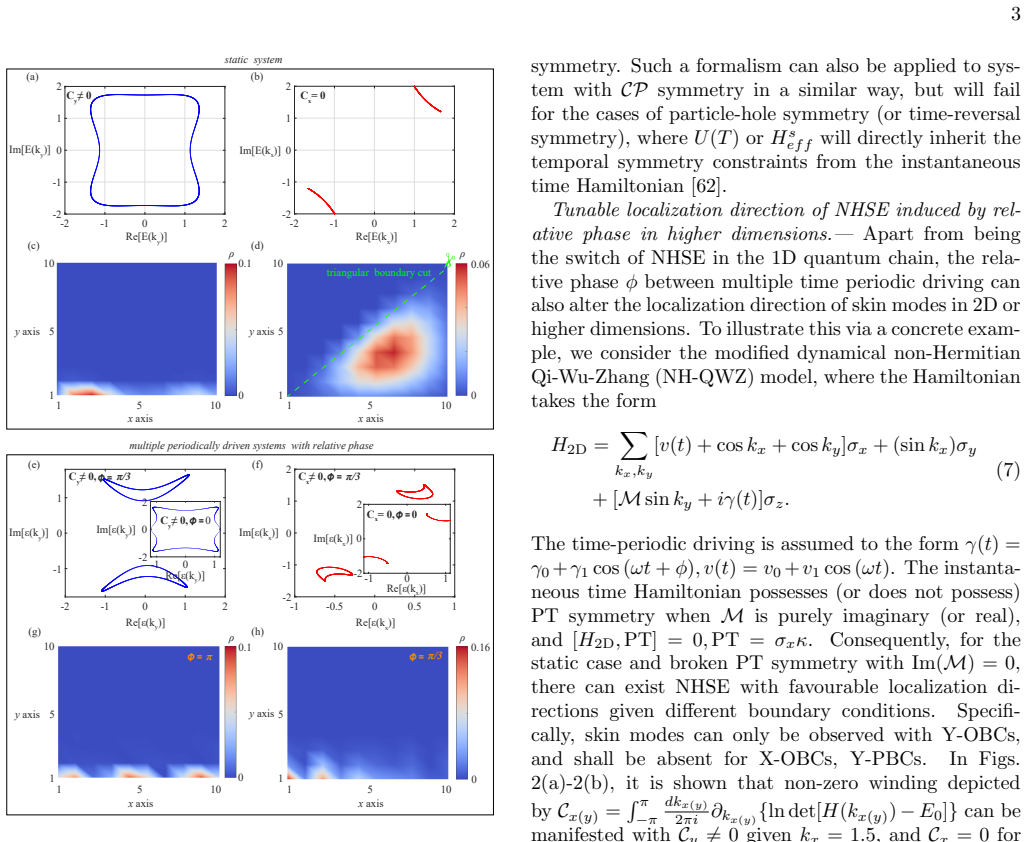
For the static non-Hermitian quantum chain with parity time symmetry, non-Hermitian skin effects can be prohibited. As the dynamical driving is turned on, NHSEs get artificially reactivated, where the relative phase can serve as the controlling switch by breaking the temporal symmetry constraints. Meanwhile, a change of relative phase can also alter the spatial structures of the long-time averaged effective Hamiltonian, which will consequently lead to the variation of skin localization direction for systems of higher dimensions.
What carries the argument
The relative phase between multiple time-periodic driving, which serves as a controlling switch to reactivate and direct non-Hermitian skin effects by breaking temporal symmetry constraints and reshaping the effective Hamiltonian.
If this is right
- Non-Hermitian skin effects can be reactivated in PT-symmetric systems where they are prohibited in the static case.
- The relative phase acts as a switch for the emergence of skin modes.
- Localization direction varies in higher dimensions when the relative phase changes.
- This provides a general formalism realizable in optical and mechanical platforms for tunable skin density profiles.
Where Pith is reading between the lines
- This phase control could be used to dynamically switch localization properties during system operation.
- Similar mechanisms might be explored in other symmetry-protected non-Hermitian phenomena.
- Applications in designing tunable boundary-localized states for quantum information processing could follow.
Load-bearing premise
The long-time averaged effective Hamiltonian fully determines the skin localization direction and the relative phase reliably breaks the temporal symmetry constraints that prohibit NHSE in the static PT-symmetric case.
What would settle it
Varying the relative phase in a multiple-driven PT-symmetric quantum chain and observing whether the skin modes appear or change direction as predicted by the averaged effective Hamiltonian.
Figures
read the original abstract
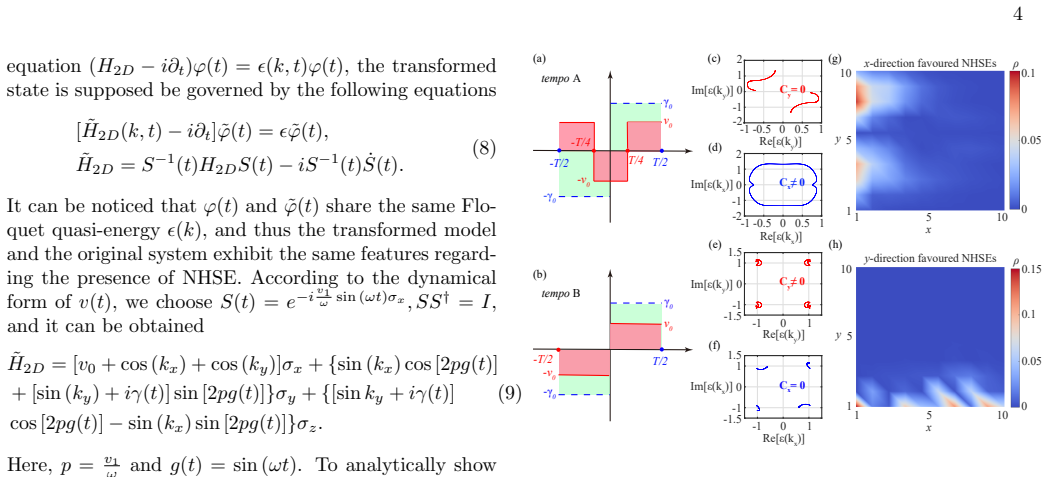
We demonstrate how the relative phase between the multiple time periodic driving can decide the emergence and the favorable localization direction of non-Hermitian skin modes. For the static non-Hermitian quantum chain with parity time symmetry, non-Hermitian skin effects (NHSEs) can be prohibited. As the dynamical driving is turned on, NHSEs get artificially reactivated, where the relative phase can serve as the controlling switch by breaking the temporal symmetry constraints. Meanwhile, a change of relative phase can also alter the spatial structures of the long-time averaged effective Hamiltonian, which will consequently lead to the variation of skin localization direction for systems of higher dimensions. Our formalisms can be generally realized in diverse optical and mechanical platforms, and will pave the way for realizing tunable skin density profiles.
Editorial analysis
A structured set of objections, weighed in public.
Referee Report
Summary. The manuscript claims that the relative phase between multiple time-periodic drivings can control the emergence and favorable localization direction of non-Hermitian skin modes in dynamical quantum systems. In static PT-symmetric non-Hermitian chains, NHSE is prohibited by symmetry, but turning on periodic driving reactivates it, with the relative phase serving as a switch that breaks temporal symmetry constraints. A change in relative phase is further said to alter the spatial structure of the long-time averaged effective Hamiltonian, thereby varying the skin localization direction in higher-dimensional systems. The approach is presented as generally realizable in optical and mechanical platforms.
Significance. If the claims hold after verification, the work would offer a dynamical route to tunable NHSE that bypasses static symmetry prohibitions, extending control over skin-mode localization via driving phases. This could be useful for engineering non-Hermitian phenomena in Floquet systems and for applications in sensing or wave manipulation. The linkage of relative phase to changes in the averaged Hamiltonian's spatial structure provides a concrete handle, though its robustness depends on the validity of the averaging approximation.
major comments (1)
- [Sections deriving the long-time averaged effective Hamiltonian and NHSE localization analysis] The central claim that skin-mode emergence and direction are controlled by the relative phase through its effect on the long-time averaged effective Hamiltonian (discussed in the sections deriving the effective model and analyzing localization): this assumes the averaging procedure (high-frequency or Magnus expansion) produces a static non-Hermitian operator whose eigenstates faithfully encode localization without residual time-periodic corrections or Floquet quasienergy contributions altering boundary accumulation. When the driving frequency is not parametrically large compared to hopping or gain/loss rates, such corrections could persist and undermine the asserted control, particularly for the direction variation in higher dimensions. Explicit checks or bounds on the approximation error are needed to support the claim.
minor comments (1)
- [Abstract] The abstract states that the formalism 'can be generally realized in diverse optical and mechanical platforms' but provides no concrete experimental parameters, platform-specific mappings, or references to prior realizations of similar driven non-Hermitian systems.
Simulated Author's Rebuttal
We thank the referee for the detailed and constructive report. The concern regarding the validity of the long-time averaging approximation is well taken, and we address it directly below with clarifications and revisions to the manuscript.
read point-by-point responses
-
Referee: The central claim that skin-mode emergence and direction are controlled by the relative phase through its effect on the long-time averaged effective Hamiltonian (discussed in the sections deriving the effective model and analyzing localization): this assumes the averaging procedure (high-frequency or Magnus expansion) produces a static non-Hermitian operator whose eigenstates faithfully encode localization without residual time-periodic corrections or Floquet quasienergy contributions altering boundary accumulation. When the driving frequency is not parametrically large compared to hopping or gain/loss rates, such corrections could persist and undermine the asserted control, particularly for the direction variation in higher dimensions. Explicit checks or bounds on the approximation error are needed to support the claim.
Authors: We agree that explicit validation of the averaging approximation is necessary to support the central claims. In the revised manuscript we have added a dedicated subsection (now Section III.C) that derives error bounds for the Magnus expansion of the time-periodic Hamiltonian. We show that the leading correction terms scale as O(1/ω) where ω is the driving frequency, and we provide a quantitative criterion (ω ≫ max{|t|, |γ|}) under which residual time-periodic and Floquet contributions remain negligible for the localization properties. To address the higher-dimensional direction variation, we include direct numerical comparisons between the eigenstates of the averaged effective Hamiltonian and the long-time stroboscopic evolution of the full time-dependent system for several representative frequencies. These checks confirm that the relative-phase-induced changes in the spatial structure of the averaged Hamiltonian continue to dictate the skin localization direction once the stated frequency condition is satisfied. We have also added a brief discussion of the regime where the approximation begins to degrade. revision: yes
Circularity Check
No significant circularity; derivation is self-contained
full rationale
The paper constructs a time-periodic driving protocol on a PT-symmetric non-Hermitian chain, derives the long-time averaged effective Hamiltonian via standard averaging (high-frequency or Magnus), and numerically or analytically shows that the relative phase between drives alters the effective Hamiltonian's spatial structure to control NHSE emergence and direction. No equations reduce a claimed prediction to a fitted input by construction, no self-citation forms the load-bearing premise, and no uniqueness theorem or ansatz is smuggled in. The central claim rests on explicit model construction and effective-Hamiltonian eigenmode analysis that is independent of the target result.
Axiom & Free-Parameter Ledger
axioms (2)
- domain assumption Parity-time symmetry prohibits NHSE in the static non-Hermitian quantum chain
- domain assumption Long-time averaged effective Hamiltonian governs the skin localization direction
Reference graph
Works this paper leans on
- [1]
-
[2]
T. E. Lee, Anomalous edge state in a non-hermitian lat- tice , Phys. Rev. Lett.116, 133903 (2016)
work page 2016
- [3]
-
[4]
Longhi, Self-healing of non-hermitian topological skin modes , Phys
S. Longhi, Self-healing of non-hermitian topological skin modes , Phys. Rev. Lett.128, 157601 (2022)
work page 2022
-
[5]
L. H. Zhou, H. W. Li, W. Yi, and X. L. Cui, Engineering non-hermitian skin effect with band topology in ultracold gases , Commun. Phys.5, 252 (2022)
work page 2022
-
[6]
Roccati, Non-hermitian skin effect as an impurity problem , Phys
F. Roccati, Non-hermitian skin effect as an impurity problem , Phys. Rev. A104, 022215 (2021)
work page 2021
-
[7]
H.-Y. Wang and W.-M. Liu, Tightly bound states in a uniform field with asymmetric tunneling , Phys. Rev. A 106, 052216 (2022)
work page 2022
- [8]
-
[9]
H.-Y. Wang, J. Li, W.-M. Liu, L. Wen, and X.-F. Zhang, Localization properties of non-hermitian bound states in the nonreciprocal two-particle hubbard model , Phys. Rev. B113, 125434 (2026)
work page 2026
-
[10]
F. K. Kunst and V. Dwivedi, Non-hermitian systems and topology: A transfer-matrix perspective , Phys. Rev. B 99, 245116 (2019)
work page 2019
-
[11]
N. Hatano and D. R. Nelson, Localization transitions in non-hermitian quantum mechanics , Phys. Rev. Lett.77, 570 (1996)
work page 1996
-
[12]
T. Yoshida, S.-B. Zhang, T. Neupert, and N. Kawakami, Non-hermitian mott skin effect , Phys. Rev. Lett.133, 076502 (2024)
work page 2024
-
[13]
C. H. Lee, L. Li, and J. Gong, Hybrid higher-order skin- topological modes in nonreciprocal systems , Phys. Rev. Lett.123, 016805 (2019)
work page 2019
-
[14]
M. Sanahal, S. Panda, and S. Nandy, Gauge field induced skin effect in spinful non-hermitian systems , Phys. Rev. B112, 125149 (2025)
work page 2025
-
[15]
Y. Li, L. Li, and Z. Xu, Size-dependent skin effect transi- tions in weakly coupled nonreciprocal chains , Phys. Rev. B112, 235122 (2025)
work page 2025
- [16]
- [17]
- [18]
-
[19]
S. Yao, F. Song, and Z. Wang, Non-hermitian chern bands , Phys. Rev. Lett.121, 136802 (2018). 6
work page 2018
-
[20]
F. K. Kunst, E. Edvardsson, J. C. Budich, and E. J. Bergholtz, Biorthogonal bulk-boundary correspondence in non-hermitian systems , Phys. Rev. Lett.121, 026808 (2018)
work page 2018
-
[21]
Z. Gong, Y. Ashida, K. Kawabata, K. Takasan, S. Hi- gashikawa, and M. Ueda, Topological phases of non- hermitian systems , Phys. Rev. X8, 031079 (2018)
work page 2018
-
[22]
Z. Yang, K. Zhang, C. Fang, and J. Hu, Non-hermitian bulk-boundary correspondence and auxiliary generalized brillouin zone theory , Phys. Rev. Lett.125, 226402 (2020)
work page 2020
-
[23]
J. Bartlett and E. Zhao, Unravelling the edge spectra of non-hermitian chern insulators , Phys. Rev. B107, 035101 (2023)
work page 2023
-
[24]
K. Yokomizo and S. Murakami, Non-bloch bands in two- dimensional non-hermitian systems , Phys. Rev. B107, 195112 (2023)
work page 2023
-
[25]
K. Yokomizo and S. Murakami, Non-bloch band theory of non-hermitian systems , Phys. Rev. Lett.123, 066404 (2019)
work page 2019
-
[26]
K. Kawabata, K. Shiozaki, M. Ueda, and M. Sato, Sym- metry and topology in non-hermitian physics , Phys. Rev. X9, 041015 (2019)
work page 2019
-
[27]
H. Y. Wang, Z. B. Yang, and W. M. Liu, Bulk-boundary correspondence in topological systems with the momen- tum dependent energy shift , Quantum Sci. Technol.9, 025019 (2024)
work page 2024
-
[28]
Longhi, Probing non-hermitian skin effect and non- bloch phase transitions , Phys
S. Longhi, Probing non-hermitian skin effect and non- bloch phase transitions , Phys. Rev. Res.1, 023013 (2019)
work page 2019
-
[29]
D. S. Borgnia, A. J. Kruchkov, and R.-J. Slager, Non- hermitian boundary modes and topology , Phys. Rev. Lett.124, 056802 (2020)
work page 2020
-
[30]
Xiong, Why does bulk boundary correspondence fail in some non-hermitian topological models , J
Y. Xiong, Why does bulk boundary correspondence fail in some non-hermitian topological models , J. Phys. Com- mun.2, 035043 (2018)
work page 2018
-
[31]
P. Molignini, O. Arandes, and E. J. Bergholtz, Anoma- lous skin effects in disordered systems with a single non- hermitian impurity , Phys. Rev. Res.5, 033058 (2023)
work page 2023
- [32]
-
[33]
L. Xiao, W.-T. Xue, F. Song, Y.-M. Hu, W. Yi, Z. Wang, and P. Xue, Observation of non-hermitian edge burst in quantum dynamics , Phys. Rev. Lett.133, 070801 (2024)
work page 2024
-
[34]
H.-Y. Wang and W.-M. Liu, Gapless topological dou- blons in the periodically driven extended non-hermitian two-particle bose-hubbard model , Phys. Rev. A113, 043506 (2026)
work page 2026
-
[35]
L. Xiao, T. S. Deng, K. K. Wang, G. Y. Zhu, Z. Wang, W. Yi, and P. Xue, Non-hermitian bulk¨cboundary cor- respondence in quantum dynamics , Nat. Phys.16, 761 (2020)
work page 2020
-
[36]
Q. Lin, W. Yi, and P. Xue, Manipulating directional flow in a two-dimensional photonic quantum walk under a synthetic magnetic field , Nat. Commun.14, 6283 (2023)
work page 2023
- [37]
- [38]
-
[39]
Y. Sun, X. Hou, T. Wan, F. Wang, S. Zhu, Z. Ruan, and Z. Yang, Photonic floquet skin-topological effect , Phys. Rev. Lett.132, 063804 (2024)
work page 2024
-
[40]
C. Shu, K. Zhang, and K. Sun, Loss-induced universal one-way transport in periodically driven systems , Phys. Rev. B109, 184302 (2024)
work page 2024
-
[41]
X. Y. Zheng, M. J. Mehrabad, J. Vannucci, K. Li, A. Dutt, M. Hafezi, S. Mittal, and E. Waks, Dy- namic control of 2d non-hermitian photonic corner skin modes in synthetic dimensions , Nat. Commun.15, 10881 (2024)
work page 2024
-
[42]
E. L. Pereira, H. Li, A. Blanco-Redondo, and J. L. Lado, Non-hermitian topology and criticality in photonic arrays with engineered losses , Phys. Rev. Res.6, 023004 (2024)
work page 2024
-
[43]
Z.-F. Cai, T. Liu, and Z. Yang, Non-hermitian skin effect in periodically driven dissipative ultracold atoms , Phys. Rev. A109, 063329 (2024)
work page 2024
-
[44]
Zhou, Entanglement phase transitions in non- hermitian floquet systems , Phys
L. Zhou, Entanglement phase transitions in non- hermitian floquet systems , Phys. Rev. Res.6, 023081 (2024)
work page 2024
-
[45]
Z. Lin, W. Song, L.-W. Wang, H. Xin, J. Sun, S. Wu, C. Huang, S. Zhu, J.-H. Jiang, and T. Li, Observation of topological transition in floquet non-hermitian skin ef- fects in silicon photonics , Phys. Rev. Lett.133, 073803 (2024)
work page 2024
-
[46]
K. Roy, D. Halder, K. Gogoi, B. Tanatar, and S. Basu, Floquet non-bloch formalism for a non-hermitian lad- der: From theoretical framework to topolectrical circuits , Phys. Rev. Res.7, 043331 (2025)
work page 2025
-
[47]
H. Xin, W. Song, S. Wu, Z. Lin, S. Zhu, and T. Li, Manipulating the non-hermitian skin effect in optical ring resonators , Phys. Rev. B107, 165401 (2023)
work page 2023
-
[48]
M. Miri and A. Alu, Exceptional points in optics and photonics , Science363, 42 (2019)
work page 2019
-
[49]
K. Wang, T. Li, L. Xiao, Y. Han, W. Yi, and P. Xue, Detecting non-bloch topological invariants in quantum dynamics , Phys. Rev. Lett.127, 270602 (2021)
work page 2021
-
[50]
T. Kitagawa, E. Berg, M. Rudner, and E. Demler, Topo- logical characterization of periodically driven quantum systems , Phys. Rev. B82, 235114 (2010)
work page 2010
-
[51]
M. S. Rudner, N. H. Lindner, E. Berg, and M. Levin, Anomalous edge states and the bulk-edge correspondence for periodically driven two-dimensional systems , Phys. Rev. X3, 031005 (2013)
work page 2013
-
[52]
M. S. Rudner and N. H. Linder, Band structure engineer- ing and non-equilibrium dynamics in floquet topological insulators , Nat. Rev. Phys.2, 229 (2020)
work page 2020
-
[53]
H. Qiu, S. Tong, Q. Zhang, K. Zhang, and C. Qiu, Ob- servation of anomalous floquet non-abelian topological insulators , Phys. Rev. X16, 011061 (2026)
work page 2026
-
[54]
T. Morimoto, H. C. Po, and A. Vishwanath, Floquet topological phases protected by time glide symmetry , Phys. Rev. B95, 195155 (2017)
work page 2017
- [55]
-
[56]
S. Yao, Z. Yan, and Z. Wang, Topological invariants of floquet systems: General formulation, special properties, and floquet topological defects , Phys. Rev. B96, 195303 (2017)
work page 2017
-
[57]
C.-H. Liu, H. Hu, and S. Chen, Symmetry and topologi- cal classification of floquet non-hermitian systems , Phys. Rev. B105, 214305 (2022). 7
work page 2022
-
[58]
Z. Zhou, I. I. Satija, and E. Zhao, Floquet edge states in a harmonically driven integer quantum hall system , Phys. Rev. B90, 205108 (2014)
work page 2014
-
[59]
A. K. Ghosh, G. C. Paul, and A. Saha, Higher order topological insulator via periodic driving , Phys. Rev. B 101, 235403 (2020)
work page 2020
-
[60]
H. Hu, B. Huang, E. Zhao, and W. V. Liu, Dynamical singularities of floquet higher-order topological insulators , Phys. Rev. Lett.124, 057001 (2020)
work page 2020
-
[61]
R.-X. Zhang and S. Das Sarma, Anomalous floquet chiral topological superconductivity in a topological insulator sandwich structure , Phys. Rev. Lett.127, 067001 (2021)
work page 2021
-
[62]
See supplementary materials for details
-
[63]
C. E. Creffield, G. Pieplow, F. Sols, and N. Goldman, Realization of uniform synthetic magnetic fields by peri- odically shaking an optical square lattice , New J. Phys. 18, 093013 (2016)
work page 2016
- [64]
-
[65]
T. Zhou, Z. Yu, Z. Li, X. Chen, and X. Zhou, Simulation of a nodal-line semimetal in amplitude-shaken optical lat- tices , Phys. Rev. A102, 023328 (2020)
work page 2020
-
[66]
W. Zheng and H. Zhai, Floquet topological states in shaking optical lattices , Phys. Rev. A89, 061603(R) (2014)
work page 2014
-
[67]
M. Aidelsburger, M. Atala, M. Lohse, J. T. Barreiro, B. Paredes, and I. Bloch, Realization of the hofstadter hamiltonian with ultracold atoms in optical lattices , Phys. Rev. Lett.111, 185301 (2013)
work page 2013
- [68]
-
[69]
A. J. Daley, Quantum trajectories and open many-body quan tum systems , Adv. Phys.63, 77 (2014)
work page 2014
-
[70]
L. Xiao, X. Zhan, Z. H. Bian, K. K. Wang, X. Zhang, X. P. Wang, J. Li, K. Mochizuki, D. Kim, N. Kawakami, W. Yi, H. Obuse, B. C. Sanders, and P. Xue, Observa- tion of topological edge states in parity¨ctime-symmetric quantum walks , Nat. Phys.13, 1117 (2017)
work page 2017
-
[71]
N. B. Lovett, S. Cooper, M. Everitt, M. Trevers, and V. Kendon, Universal quantum computation using the discrete-time quantum walk , Phys. Rev. A81, 042330 (2010)
work page 2010
-
[72]
M. Chitsazi, H. Li, F. M. Ellis, and T. Kottos, Exper- imental realization of floquetPT-symmetric systems , Phys. Rev. Lett.119, 093901 (2017)
work page 2017
-
[73]
S. S. Dabiri and H. Cheraghchi, Electric circuit simula- tion of floquet topological insulators in fourier space , J. Appl. Phys.134, 084303 (2023)
work page 2023
-
[74]
A. Stegmaier, A. Fritzsche, R. Sorbello, M. Greiter, H. Brand, C. Barko, M. Hofer, U. Schwingenschl¨ ogl, R. Moessner, C. H. Lee, A. Szameit, A. Al` u, T. Kießling, and R. Thomale, Topological edge states in the frequency dimension and their realization with floquet electrical cir- cuits , Phys. Rev. Res.7, 043118 (2025)
work page 2025
-
[75]
Q.-B. Zeng and R. L¨ u, Evolution of spectral topology in one-dimensional long-range nonreciprocal lattices , Phys. Rev. A105, 042211 (2022)
work page 2022
-
[76]
M. Sameti and M. J. Hartmann, Floquet engineering in superconducting circuits: From arbitrary spin-spin inter- actions to the kitaev honeycomb model , Phys. Rev. A 99, 012333 (2019)
work page 2019
discussion (0)
Sign in with ORCID, Apple, or X to comment. Anyone can read and Pith papers without signing in.