REVIEW 1 major objections 2 minor 45 references
Roles with Rails: Contract-Preserving Role Evolution in Multi-Agent Structured Reasoning
T0 review · 1 major / 2 minor · reviewed 2026-06-29 · grok-4.3
Pith's one-line read Multi-agent LLM systems can evolve their role pools while preserving five structural contracts on capability, communication, validation, aggregation and output protocols.
desk verdict The paper frames role evolution in multi-agent LLMs as contract-preserving edits and builds SERO around credit-guided retrieval, a ranked DAG, validator repair, and a bandit controller that only commits safe changes. read the letter →
The pith
A machine-rendered reading of the paper's core claim, the machinery that carries it, and where it could break.
The reading
What carries the argument
Contract-preserving role evolution, which mechanically checks the five structural contracts on every LLM-proposed change to the typed role-card pool before any commitment.
What would settle it
An observed case in which a proposed edit violates one contract, such as the aggregation contract, yet is still committed and produces inconsistent or malformed final answers on the benchmarks.
Extended reading notes
Core claim
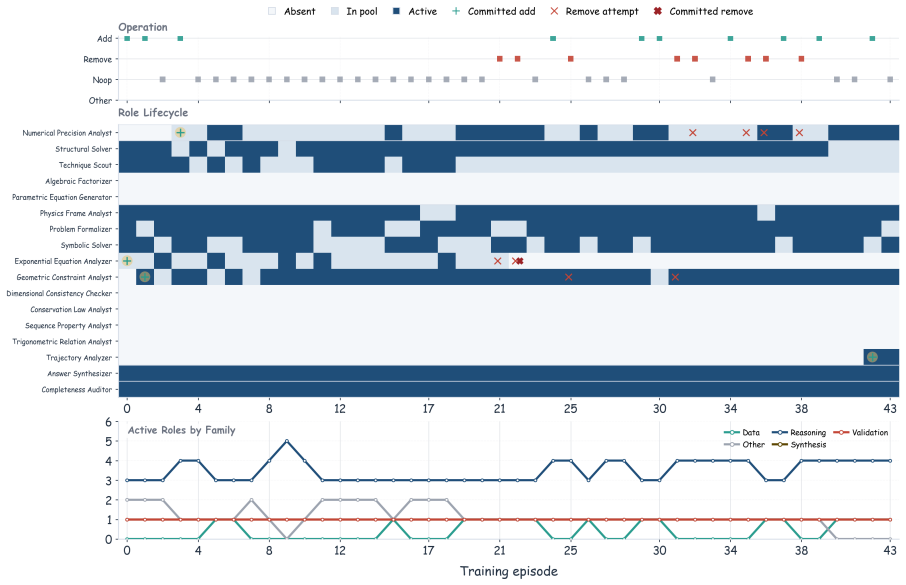
The paper claims that role evolution in multi-agent LLM systems must be contract-preserving: every committed edit to a typed role-card pool is required to maintain five structural contracts (capability, communication, validation, aggregation, output protocol) and is accepted only when it also improves task score. This requirement is instantiated in SERO through credit-guided retrieval, a credit-ranked communication DAG with protected terminal aggregator and conditional validator repair, and a contextual-bandit controller whose LLM-proposed edits are committed solely when the contracts hold and the score rises. Experiments across real-world reasoning benchmarks and three LLM backbones confirm
Load-bearing premise
The five structural contracts can be formally specified and mechanically checked during every proposed edit without missing critical obligations that would break answer correctness.
Editorial extensions
If this is right
- Role pools can change to match new tasks without eliminating structurally necessary roles.
- Answer correctness is protected because every accepted edit must satisfy the contracts on capability, communication, validation, aggregation, and output protocol.
- Performance improvements occur only through edits that both preserve contracts and raise task scores.
- The same contract checks apply across multiple LLM backbones on reasoning benchmarks.
Reading between the lines
- The contract-checking discipline could be applied to other structured multi-agent systems that rely on typed components beyond roles.
- Mechanical verification of obligations might reduce reliance on post-hoc human review of agent outputs.
- Bandit-driven edit proposals combined with contract gates suggest a route to scaling the role pool size while retaining guarantees.
Signed reviews
Editorial analysis
A structured set of objections, weighed in public.
Referee Report
Summary. The paper formulates contract-preserving role evolution for LLM multi-agent systems, requiring every committed edit to preserve five structural contracts (capability, communication, validation, aggregation, output protocol). It instantiates the formulation in the SERO framework, which evolves a typed role-card pool via credit-guided retrieval, a credit-ranked communication DAG with protected terminal aggregator and conditional validator repair, and a contextual-bandit controller that commits LLM-proposed edits only when contracts are preserved and task score improves. Experiments on real-world reasoning benchmarks across three LLM backbones are reported to confirm the value of the approach.
Significance. If the contract-checking mechanisms are robustly implemented and the experiments demonstrate that contract preservation yields measurable gains over unconstrained evolution without sacrificing correctness, the work would provide a principled method for maintaining structural integrity in adaptive multi-agent systems. The explicit commit-only-on-preservation rule and credit-based selection are clear strengths that distinguish it from prompt-optimization baselines.
major comments (1)
- [§4 (or equivalent section on validator repair and contract checking)] The central claim rests on the five contracts being formally specifiable and mechanically checkable at every edit. The manuscript should provide, in the section describing the validator (likely §4), explicit definitions, pseudocode, or examples showing how each contract (capability coverage, message compatibility, etc.) is encoded and verified without missing obligations that affect answer correctness.
minor comments (2)
- [Experiments section] Clarify in the experimental section how the credit-ranked DAG and terminal aggregator are implemented to ensure the protected terminal property holds across all reported runs.
- [Experiments section] Add a baseline that performs unconstrained role generation (without contract checks) to isolate the contribution of the preservation rule.
Simulated Author's Rebuttal
We thank the referee for the positive evaluation and the constructive suggestion regarding the contract-checking mechanisms. We address the major comment below and will revise the manuscript accordingly.
read point-by-point responses
-
Referee: [§4 (or equivalent section on validator repair and contract checking)] The central claim rests on the five contracts being formally specifiable and mechanically checkable at every edit. The manuscript should provide, in the section describing the validator (likely §4), explicit definitions, pseudocode, or examples showing how each contract (capability coverage, message compatibility, etc.) is encoded and verified without missing obligations that affect answer correctness.
Authors: We agree that explicit formalization strengthens the central claim. In the revised manuscript we will expand the validator subsection (currently §4.3) with: (i) precise definitions of all five contracts (capability coverage as a set-inclusion check over required skills; communication as DAG edge-type compatibility; validation as conditional repair rules; aggregation as protected terminal-node invariants; output protocol as parser-schema conformance); (ii) pseudocode for the check_and_repair procedure that is invoked on every LLM-proposed edit before the contextual-bandit commit decision; and (iii) a worked example drawn from one of the reasoning benchmarks showing how each contract is evaluated and how the repair step prevents correctness-affecting omissions. These additions will be placed immediately before the description of the credit-ranked DAG and will not change any experimental results or claims. revision: yes
Circularity Check
No significant circularity; derivation is self-contained formulation plus instantiation
full rationale
The paper defines contract-preserving role evolution by enumerating five structural contracts and then describes an independent framework (SERO) that enforces them via credit-guided retrieval, DAG construction, validator repair, and a commit-only-on-preservation rule. No equations reduce a claimed prediction to a fitted input, no load-bearing premise rests on self-citation, and the central claim is an engineering instantiation rather than a re-derivation of prior results. The abstract and described structure contain no self-definitional loops or renamed known results.
Assumptions & free parameters
assumptions (1)
- domain assumption Roles carry structural obligations including capability coverage, message compatibility, validation, final-answer aggregation, and parser-compatible output protocols.
invented entities (1)
-
SERO framework
Cite this review
Pith. "Pith review of Roles with Rails: Contract-Preserving Role Evolution in Multi-Agent Structured Reasoning." pith.science (2026). https://pith.science/paper/7WI2TUWV
@misc{pith2026260528433,
  author       = {Pith},
  title        = {Pith review of: Roles with Rails: Contract-Preserving Role Evolution in Multi-Agent Structured Reasoning},
  year         = {2026},
  howpublished = {\url{https://pith.science/paper/7WI2TUWV}},
  note         = {Machine review of arXiv:2605.28433}
}
read the original abstract
Role-based LLM multi-agent systems need adaptive role pools, yet adapting such systems is not merely a matter of prompt optimization: roles often carry structural obligations, including capability coverage, message compatibility, validation, final-answer aggregation, and parser-compatible output protocols. Existing systems either fix the role inventory and lose adaptivity, or allow unconstrained generation to induce role drift, removing structurally necessary roles and breaking answer contracts. We formulate this as contract-preserving role evolution, requiring every committed edit to preserve five structural contracts (capability, communication, validation, aggregation, output protocol). We instantiate this formulation in SERO, a Self-Evolving Role Orchestration framework that evolves a typed role-card pool through credit-guided retrieval, a credit-ranked communication DAG with a protected terminal aggregator and conditional validator repair, and a contextual-bandit controller whose LLM-proposed edits are committed only when they preserve the contracts and improve task score. Experiments on real-world reasoning benchmarks across three LLM backbones confirm the value of contract-preserving role evolution.
Figures


Figures from the paper (20 more)




Reference graph
Works this paper leans on
-
[1]
AutoGen: Enabling Next-Gen LLM Applications via Multi-Agent Conversation
Autogen: Enabling next-gen llm applica- tions via multi-agent conversation.arXiv preprint arXiv:2308.08155. Xianjie Wu, Jian Yang, Linzheng Chai, Ge Zhang, Jia- heng Liu, Xeron Du, Di Liang, Daixin Shu, Xianfu Cheng, Tianzhen Sun, Guanglin Niu, Tongliang Li, and Zhoujun Li. 2025. Tablebench: A comprehen- sive and complex benchmark for table question an- s...
work page Pith review arXiv 2025
-
[2]
Extract required cities, stay durations, total trip days, direct flights, and day-window anchors
-
[3]
Build the flight adjacency list and propose a city order using only direct flights
-
[4]
Preserve every required city exactly once; do not invent flights
-
[5]
Assign day ranges with shared flight-day arithmetic: sum(stays) - (cities - 1) = total days
-
[6]
and **Day Z:** Fly from CityA to CityB
If you fly on Day X, the next city visit starts on Day X, not Day X+1 Draft the trip answer using the exact lines: **Day X-Y:** Visit CityName for N days. and **Day Z:** Fly from CityA to CityB. /cogsCalendar Specialist name: ’Calendar Specialist’ capability_tags: [’calendar’, ’availability’, ’hard-constraints’, ’formatting’] system_prompt: If the parser ...
-
[7]
For each participant, list busy blocks and derived free windows within working hours
-
[8]
Treat all preferences as HARD constraints, including avoid-day and avoid-after-time rules
Show all 45 references
-
[9]
Boundary rule: busy 9:00-11:00 means free at exactly 11:00
-
[10]
Intersect all participants’ free windows per day and keep every candidate of required duration
-
[11]
Sort valid slots by day/time; if earliest availability is requested, choose earliest; otherwise follow task preference Draft exactly one proposed slot in 24-hour format: Here is the proposed time: <Day>, HH:MM - HH:MM Figure 10: Static DAG MAS baseline for NATURALPLAN(part 2/4...
-
[12]
Start at the stated location and time
-
[13]
Use exact travel times from the distance matrix
-
[14]
Travel only to locations where a meeting happens
-
[15]
If arrival is before a person’s availability window, insert a wait step until the window start
-
[16]
Each meeting must start within the window and last at least the required minimum duration
-
[17]
/cogsCandidate Synthesizer name: ’Candidate Synthesizer’ capability_tags: [’selection’, ’construction’, ’repair’] system_prompt: Use the parser’s subtask decision
Maximize feasible meetings without illegal transitions or overlaps Draft only step lines in 12-hour AM/PM format: travel, wait, and meet templates. /cogsCandidate Synthesizer name: ’Candidate Synthesizer’ capability_tags: [’selection’, ’construction’, ’repair’] system_prompt: ...
-
[18]
Required cities and requested stay durations
-
[19]
Time-window constraints and mandatory day anchors
-
[20]
Direct-flight list and whether edges are one-way or usable in both directions
-
[21]
Example: 2+2+3 stays across 3 cities gives 2+2+3-2=5 total days
The shared flight-day arithmetic requirement: sum(city stays) - (number_of_cities - 1) must equal total trip days Use the actual sum of stays in that formula. Example: 2+2+3 stays across 3 cities gives 2+2+3-2=5 total days. Adjacent city ranges sharing a flight day are valid a...
-
[22]
Build the usable adjacency list: ’A and B’ is bidirectional, but ’from A to B’ is one-way
-
[23]
Propose one or two feasible city orders using only direct flights
-
[24]
Preserve every required city exactly once
-
[25]
Place event-window cities so their visit ranges can cover the required days
-
[26]
Flag impossible consecutive city pairs, bottleneck transitions, and fragile route choices
-
[27]
Focus on route feasibility
Do not invent unsupported flight edges Do not write the final formatted itinerary yet. Focus on route feasibility. /cogsTrip Day Logistics Formatter name: ’Trip Day Logistics Formatter’ role_type: ’specialist’ protected: False temperature: 0.0 capability_family: ’trip-formatti...
-
[28]
List all busy blocks exactly as stated: day, start time, end time
-
[29]
Derive free windows within working hours, preserving day names and 24-hour times
-
[30]
Extract duration, day exclusions, time-of-day exclusions, earliest/latest preferences, and state- ments such as ’avoid Monday after 14:30
Keep each person’s schedule separate Preferences are HARD CONSTRAINTS. Extract duration, day exclusions, time-of-day exclusions, earliest/latest preferences, and state- ments such as ’avoid Monday after 14:30. Tuesday. Wednesday.’ as separate hard filters. Boundary rule: if so...
-
[31]
For each day, intersect every participant’s free windows
-
[32]
Use half-open intervals [start, end): intersection_start = max(free_window_starts), intersection_end = min(free_window_ends); the overlap is valid only if intersection_end - intersection_start is at least the required duration
-
[33]
A slot may start exactly when a busy block ends and may end exactly when a busy block starts; for example [9:30, 10:30) intersect [10:00, 11:00) is [10:00, 10:30), not [10:30, 11:00)
-
[34]
Apply all preferences as HARD constraints: avoid day X excludes all of X; avoid day X after HH:MM excludes slots starting >= HH:MM
-
[35]
Figure 15: NATURALPLANseed pool (part 3/6): calendar parser and calendar slot checker
Output a sorted table: Day | Time Slot | VALID/INVALID | Reason, and mark the earliest valid slot as RECOMMENDED unless the task explicitly asks for another preference Do not output the final proposed-time line unless asked by the final aggregator. Figure 15: NATURALPLANseed p...
-
[36]
Starting location and start time
-
[37]
Each person, location, availability window, minimum duration, latest feasible start, and slack
-
[38]
Relevant travel times from the start location and between candidate meeting locations
-
[39]
Do not propose the final schedule
Tight windows, impossible pairings, and transitions likely to force waiting Use exact travel times from the task. Do not propose the final schedule. /cogsMeeting Route Scheduler name: ’Meeting Route Scheduler’ role_type: ’specialist’ protected: False temperature: 0.0 capabilit...
-
[40]
Start from the given starting location and time
-
[41]
Travel only to locations where a meeting actually happens
-
[42]
arrival_time = previous_end_time + exact travel_minutes
-
[43]
meeting_start = max(arrival_time, person’s window_start); if arrival is early, insert a wait step
-
[44]
meeting_end = meeting_start + minimum duration, and meeting_end must be <= window_end
-
[45]
Figure 16: NATURALPLANseed pool (part 4/6): meeting window analyzer and meeting route scheduler
Use 12-hour AM/PM time with no spaces Output candidate travel / wait / meet steps, not prose. Figure 16: NATURALPLANseed pool (part 4/6): meeting window analyzer and meeting route scheduler. E.4 Credit and Topology Alignment Credit / DAG Alignment. Table 10tests whether SERO’s...
Reviewed June 29, 2026 · model on record in the stance chip above.
Discussion (0). Continue with ORCID to comment.