Bargmann Scenarios
Pith reviewed 2026-05-21 00:19 UTC · model grok-4.3
The pith
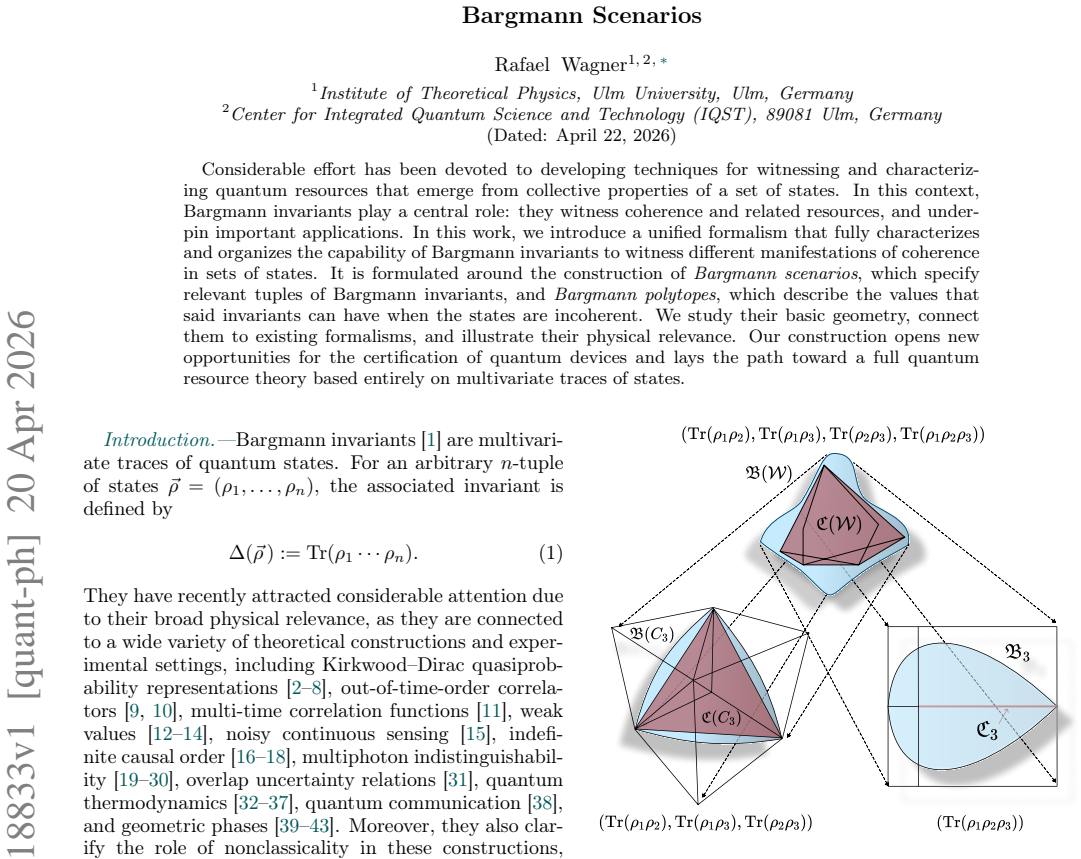
Bargmann scenarios and polytopes fully characterize how invariants witness coherence in sets of quantum states.
A machine-rendered reading of the paper's core claim, the machinery that carries it, and where it could break.
Core claim
The authors introduce Bargmann scenarios that specify relevant tuples of Bargmann invariants and Bargmann polytopes that bound the values these invariants can take for incoherent states, thereby fully determining the capability of any chosen tuple to witness coherence manifestations.
What carries the argument
Bargmann scenarios and Bargmann polytopes, where scenarios are tuples of invariants and polytopes are the convex sets bounding incoherent state values.
If this is right
- It enables systematic organization of coherence witnessing power for different manifestations.
- It connects the invariants to existing resource theory formalisms.
- It supports certification of quantum devices through targeted invariant measurements.
- It paves the way for a complete quantum resource theory based on multivariate traces of states.
Where Pith is reading between the lines
- This framework might allow for dimension-independent certification protocols.
- Similar polytopes could be constructed for other quantum resources like entanglement.
- Experimental tests could involve preparing incoherent states and checking if their invariant values stay within the predicted bounds.
Load-bearing premise
The geometric bounds of the Bargmann polytopes are assumed to be both necessary and sufficient to determine the witnessing capability without extra constraints from the Hilbert space dimension.
What would settle it
A counterexample would be a set of incoherent states whose Bargmann invariant tuple lies outside the proposed polytope or a coherent state inside it despite the bounds.
Figures

read the original abstract
Considerable effort has been devoted to developing techniques for witnessing and characterizing quantum resources that emerge from collective properties of a set of states. In this context, Bargmann invariants play a central role: they witness coherence and related resources, and underpin important applications. In this work, we introduce a unified formalism that fully characterizes and organizes the capability of Bargmann invariants to witness different manifestations of coherence in sets of states. It is formulated around the construction of Bargmann scenarios, which specify relevant tuples of Bargmann invariants, and Bargmann polytopes, which bound the values that said invariants can have when the states are incoherent. We study their basic geometry, connect them to existing formalisms, and illustrate their physical relevance. Our construction opens new opportunities for the certification of quantum devices and lays the path toward a full quantum resource theory based entirely on multivariate traces of states.
Editorial analysis
A structured set of objections, weighed in public.
Referee Report
Summary. The paper introduces a unified formalism to characterize and organize the capability of Bargmann invariants for witnessing different manifestations of coherence in sets of quantum states. Central elements are Bargmann scenarios (tuples of invariants) and Bargmann polytopes (bounds on those invariants for incoherent states), with analysis of their geometry, connections to prior work, and illustrations of physical relevance for quantum device certification.
Significance. If the geometric bounds and characterization hold, the framework could unify disparate coherence-witnessing techniques under a single polytope-based organization and support a resource theory grounded in multivariate traces. The explicit construction of scenarios and polytopes, together with their physical illustrations, would be a constructive contribution to quantum resource theories.
major comments (2)
- [§3 (Bargmann polytopes)] The definition and derivation of Bargmann polytopes (likely §3–4) must be checked against the finite-dimensional simplex of incoherent states. The skeptic concern is valid: if the polytope is obtained from linear inequalities without incorporating the rank/support constraints of a d-dimensional Hilbert space, then for d smaller than the scenario size the actual convex hull is a proper subset, so violation of the reported polytope does not necessarily certify coherence.
- [Abstract and §2] The abstract asserts a 'full characterization' of witnessing capability via scenarios and polytopes, yet the provided text contains no explicit derivations, proofs, or constructions of the polytopes from the multilinear map on the incoherent simplex. This gap is load-bearing for the central claim.
minor comments (2)
- [§2] Notation for the tuples in a Bargmann scenario should be introduced with an explicit example (e.g., three states, two invariants) before the general definition.
- [Figure 2] Figure captions for the polytope illustrations should state the Hilbert-space dimension used in the numerical examples.
Simulated Author's Rebuttal
We thank the referee for the thorough review and constructive feedback on our manuscript. The major comments raise important points about the treatment of finite-dimensional constraints and the explicitness of our constructions. We address each comment below and indicate the revisions planned for the updated version.
read point-by-point responses
-
Referee: [§3 (Bargmann polytopes)] The definition and derivation of Bargmann polytopes (likely §3–4) must be checked against the finite-dimensional simplex of incoherent states. The skeptic concern is valid: if the polytope is obtained from linear inequalities without incorporating the rank/support constraints of a d-dimensional Hilbert space, then for d smaller than the scenario size the actual convex hull is a proper subset, so violation of the reported polytope does not necessarily certify coherence.
Authors: We agree that this is a substantive point. Our initial derivation of the Bargmann polytopes relied on linear inequalities over the convex set of incoherent states without explicitly folding in the rank and support restrictions imposed by a fixed Hilbert-space dimension d. We will revise §3 to incorporate these constraints, adding a discussion of dimension-dependent polytopes together with explicit comparisons between the unrestricted polytope and the actual convex hull for d smaller than the scenario size. This will clarify when a violation certifies coherence and when additional checks are required. revision: yes
-
Referee: [Abstract and §2] The abstract asserts a 'full characterization' of witnessing capability via scenarios and polytopes, yet the provided text contains no explicit derivations, proofs, or constructions of the polytopes from the multilinear map on the incoherent simplex. This gap is load-bearing for the central claim.
Authors: We acknowledge the gap. While §2 introduces the general framework and later sections contain illustrative constructions, we did not supply fully explicit derivations that start from the multilinear map and arrive at the polytope facets for arbitrary scenarios. In the revision we will expand §2 with step-by-step constructions, including the explicit mapping from the incoherent simplex to the bounding inequalities for representative Bargmann scenarios, thereby substantiating the characterization claim. revision: yes
Circularity Check
No significant circularity in Bargmann scenarios and polytopes construction
full rationale
The paper defines Bargmann scenarios as tuples of invariants and polytopes as their bounds for incoherent states, building directly from the established definition of Bargmann invariants and the convex set of diagonal density operators. This geometric organization is presented as a new formalism without any reduction of a claimed prediction or witnessing power back to a fitted parameter or self-referential definition. Connections to prior formalisms are cited as external context rather than load-bearing justifications, and the derivation remains self-contained against the independent mathematical properties of multilinear maps on the incoherent simplex. No step equates a derived bound to its input by construction.
Axiom & Free-Parameter Ledger
Lean theorems connected to this paper
-
IndisputableMonolith/Cost/FunctionalEquation.leanwashburn_uniqueness_aczel unclear?
unclearRelation between the paper passage and the cited Recognition theorem.
Bargmann polytopes C(W) ... z_w = sum_λ ∏ p(ℓ_i)_λ ... 0/1-polytope whose extremal points are deterministic assignments which preserve the transitivity of equality
-
IndisputableMonolith/Foundation/AlexanderDuality.leanalexander_duality_circle_linking unclear?
unclearRelation between the paper passage and the cited Recognition theorem.
the set of all Bargmann invariants ... B(W_d) = {(Tr(ρ^k))_{k=1}^d | ρ ∈ D(H)}
What do these tags mean?
- matches
- The paper's claim is directly supported by a theorem in the formal canon.
- supports
- The theorem supports part of the paper's argument, but the paper may add assumptions or extra steps.
- extends
- The paper goes beyond the formal theorem; the theorem is a base layer rather than the whole result.
- uses
- The paper appears to rely on the theorem as machinery.
- contradicts
- The paper's claim conflicts with a theorem or certificate in the canon.
- unclear
- Pith found a possible connection, but the passage is too broad, indirect, or ambiguous to say the theorem truly supports the claim.
Forward citations
Cited by 2 Pith papers
-
A low order Bargmann invariant hierarchy for set coherence
Fourth-order ordering-sensitive Bargmann invariants supply the first universal pairwise criterion for set coherence, and applying it to all pairs yields a complete test for any finite family of states.
-
Commutativity from a single Bargmann invariant equality
Two quantum states ρ₁ and ρ₂ commute exactly when tr(ρ₁²ρ₂²) = tr(ρ₁ ρ₂ ρ₁ ρ₂).
Reference graph
Works this paper leans on
-
[1]
As a last example, if we consider the Bargmann sce- nariosW d ≡ {(1),(1,1),
+Tr(ρ2 2)−2Tr(ρ 1ρ2) =∥ρ 1 −ρ 2∥2 2 where∥ · ∥ 2 is the Schatten-2 norm. As a last example, if we consider the Bargmann sce- nariosW d ≡ {(1),(1,1), . . . ,(1,1, . . . ,1)}, where the last word hasdelements. These are of relevance for quantum spectroscopy[4, 62, 79–85]. In this context, the set of all Bargmann invariants is given by B(Wd) ={(Tr(ρ k))d k=1...
work page 2020
-
[2]
Bargmann, Note on Wigner’s theorem on symmetry operations, J
V. Bargmann, Note on Wigner’s theorem on symmetry operations, J. Math. Phys.5, 862 (1964)
work page 1964
-
[3]
J. G. Kirkwood, Quantum statistics of almost classical assemblies, Phys. Rev.44, 31 (1933)
work page 1933
-
[4]
P. A. M. Dirac, On the analogy between classical and quantum mechanics, Rev. Mod. Phys.17, 195 (1945)
work page 1945
- [5]
-
[6]
D. R. M. Arvidsson-Shukur, W. F. Braasch Jr, S. De Bièvre, J. Dressel, A. N. Jordan, C. Langrenez, M. Lostaglio, J. S. Lundeen, and N. Y. Halpern, Prop- erties and applications of the Kirkwood–Dirac distribu- tion, New Journal of Physics26, 121201 (2024)
work page 2024
- [7]
- [8]
-
[9]
De Bièvre, Complete Incompatibility, Support Uncer- tainty, and Kirkwood-Dirac Nonclassicality, Phys
S. De Bièvre, Complete Incompatibility, Support Uncer- tainty, and Kirkwood-Dirac Nonclassicality, Phys. Rev. Lett.127, 190404 (2021)
work page 2021
-
[10]
N. Yunger Halpern, B. Swingle, and J. Dressel, Quasiprobability behind the out-of-time-ordered corre- lator, Physical Review A97, 042105 (2018)
work page 2018
-
[11]
J. R. González Alonso, N. Yunger Halpern, and J. Dressel, Out-of-time-ordered-correlator quasiproba- bilities robustly witness scrambling, Physical Review Letters122, 040404 (2019)
work page 2019
-
[12]
J. S. Pedernales, R. Di Candia, I. L. Egusquiza, J. Casanova, and E. Solano, Efficient Quantum Al- gorithm for Computingn-time Correlation Functions, Phys. Rev. Lett.113, 020505 (2014)
work page 2014
-
[13]
R. Wagner and E. F. Galvão, Simple proof that anoma- lous weak values require coherence, Phys. Rev. A108, L040202 (2023)
work page 2023
-
[14]
H. F. Hofmann, Complex Joint Probabilities as Expres- sions of Reversible Transformations in Quantum Me- chanics, New Journal of Physics14, 043031 (2012)
work page 2012
-
[15]
G. Chiribella, K. Simonov, and X. Zhao, Dimension- independent weak value estimation via controlled swap operations, Phys. Rev. Res.6, 043043 (2024)
work page 2024
-
[16]
D. Yang, M. Ketkar, K. Audenaert, S. F. Huelga, and M. B. Plenio, Quantum Cramér-Rao Precision Limit of NoisyContinuousSensing,Phys.Rev.Lett.136,070802 (2026)
work page 2026
-
[17]
Ban, On sequential measurements with indefinite causal order, Physics Letters A403, 127383 (2021)
M. Ban, On sequential measurements with indefinite causal order, Physics Letters A403, 127383 (2021)
work page 2021
-
[18]
N. Gao, D. Li, A. Mishra, J. Yan, K. Simonov, and G. Chiribella, Measuring Incompatibility and Cluster- ing Quantum Observables with a Quantum Switch, Phys. Rev. Lett.130, 170201 (2023)
work page 2023
- [19]
-
[20]
A. J. Menssen, A. E. Jones, B. J. Metcalf, M. C. Tichy, S. Barz, W. S. Kolthammer, and I. A. Walmsley, Distin- guishability and many-particle interference, Phys. Rev. Lett.118, 153603 (2017)
work page 2017
-
[21]
A. E. Jones, A. J. Menssen, H. M. Chrzanowski, T. A. W. Wolterink, V. S. Shchesnovich, and I. A. Walmsley, Multiparticle Interference of Pairwise Distin- guishablePhotons,Phys.Rev.Lett.125,123603(2020)
work page 2020
-
[22]
A. M. Minke, A. Buchleitner, and C. Dittel, Charac- terizing four-body indistinguishability via symmetries, New Journal of Physics23, 073028 (2021)
work page 2021
-
[23]
M.Pont, R.Albiero, S.E.Thomas, N.Spagnolo, F.Cec- carelli, G. Corrielli, A. Brieussel, N. Somaschi, H. Huet, A. Harouri, A. Lemaître, I. Sagnes, N. Belabas, F. Scia- rrino, R. Osellame, P. Senellart, and A. Crespi, Quanti- fyingn-Photon Indistinguishability with a Cyclic Inte- grated Interferometer, Phys. Rev. X12, 031033 (2022)
work page 2022
-
[24]
G. Rodari, C. Fernandes, E. Caruccio, A. Suprano, F. Hoch, T. Giordani, G. Carvacho, R. Albiero, N. D. Giano, G. Corrielli, F. Ceccarelli, R. Osellame, D. J. Brod, L. Novo, N. Spagnolo, E. F. Galvão, and F. Scia- rrino, Experimental observation of counter-intuitive fea- tures of photonic bunching (2024), arXiv:2410.15883 [quant-ph]
-
[25]
G. Rodari, L. Novo, R. Albiero, A. Suprano, C. T. 6 Tavares, E. Caruccio, F. Hoch, T. Giordani, G. Car- vacho, M. Gardina, N. Di Giano, S. Di Giorgio, G. Corrielli, F. Ceccarelli, R. Osellame, N. Spag- nolo, E. F. Galvão, and F. Sciarrino, Semi-device- independent characterization of multiphoton indistin- guishability, PRX Quantum6, 020340 (2025)
work page 2025
- [26]
-
[27]
T. Giordani, C. Esposito, F. Hoch, G. Carvacho, D. J. Brod, E. F. Galvão, N. Spagnolo, and F. Sciarrino, Witnesses of coherence and dimension from multipho- ton indistinguishability tests, Phys. Rev. Res.3, 023031 (2021)
work page 2021
-
[28]
T. Giordani, D. J. Brod, C. Esposito, N. Viggianiello, M. Romano, F. Flamini, G. Carvacho, N. Spagnolo, E. F. Galvão, and F. Sciarrino, Experimental quantifi- cation of four-photon indistinguishability, New Journal of Physics22, 043001 (2020)
work page 2020
-
[29]
A. E. Jones, S. Kumar, S. D’Aurelio, M. Bayerbach, A. J. Menssen, and S. Barz, Distinguishability and mixedness in quantum interference, Phys. Rev. A108, 053701 (2023)
work page 2023
-
[30]
D. J. Brod, E. F. Galvão, N. Viggianiello, F. Flamini, N. Spagnolo, and F. Sciarrino, Witnessing Genuine Multiphoton Indistinguishability, Phys. Rev. Lett.122, 063602 (2019)
work page 2019
-
[31]
E. Annoni and S. C. Wein, Incoherent behavior of par- tially distinguishable photons, arXiv:2502.05047 [quant- ph] (2025)
-
[32]
K.-W. Bong, N. Tischler, R. B. Patel, S. Wollmann, G. J. Pryde, and M. J. W. Hall, Strong Unitary and Overlap Uncertainty Relations: Theory and Experi- ment, Phys. Rev. Lett.120, 230402 (2018)
work page 2018
-
[33]
S. Gherardini and G. De Chiara, Quasiprobabilities in Quantum Thermodynamics and Many-Body Systems, PRX Quantum5, 030201 (2024)
work page 2024
-
[34]
M. Lostaglio, A. Belenchia, A. Levy, S. Hernández- Gómez, N. Fabbri, and S. Gherardini, Kirkwood-Dirac quasiprobability approach to the statistics of incompat- ible observables, Quantum7, 1128 (2023)
work page 2023
-
[35]
A. Levy and M. Lostaglio, Quasiprobability distribu- tion for heat fluctuations in the quantum regime, PRX Quantum1, 010309 (2020)
work page 2020
-
[36]
S. Hernández-Gómez, S. Gherardini, A. Belenchia, M. Lostaglio, A. Levy, and N. Fabbri, Projective mea- surements can probe nonclassical work extraction and time correlations, Phys. Rev. Res.6, 023280 (2024)
work page 2024
-
[37]
A. Santini, A. Solfanelli, S. Gherardini, and M. Collura, Work statistics, quantum signatures, and enhanced work extraction in quadratic fermionic models, Phys. Rev. B108, 104308 (2023)
work page 2023
- [38]
-
[39]
T. J. Elliott, Strict advantage of complex quantum the- ory in a communication task, Phys. Rev. A111, 062401 (2025)
work page 2025
-
[40]
J. Samuel and R. Bhandari, General Setting for Berry’s Phase, Phys. Rev. Lett.60, 2339 (1988)
work page 1988
-
[41]
K. S. Akhilesh, Arvind, S. Chaturvedi, K. S. Mallesh, and N. Mukunda, Geometric phases for finite- dimensional systems—The roles of Bargmann invari- ants, null phase curves, and the Schwinger–Majorana SU(2) framework, Journal of Mathematical Physics61, 072103 (2020)
work page 2020
-
[42]
N. Mukunda, P. K. Aravind, and R. Simon, Wigner rotations, Bargmann invariants and geometric phases, Journal of Physics A: Mathematical and General36, 2347 (2003)
work page 2003
-
[43]
N. Mukunda, Arvind, E. Ercolessi, G. Marmo, G. Morandi, and R. Simon, Bargmann invariants, null phase curves, and a theory ofthe geometric phase, Phys. Rev. A67, 042114 (2003)
work page 2003
-
[44]
E. M. Rabei, N. Mukunda, R. Simon,et al., Bargmann invariants and geometric phases: A generalized connec- tion, Phys. Rev. A60, 3397 (1999)
work page 1999
- [45]
- [46]
-
[47]
Bancal, Entanglement for any definition of two subsystems, Phys
Y.Cai, B.Yu, P.Jayachandran, N.Brunner, V.Scarani, and J.-D. Bancal, Entanglement for any definition of two subsystems, Phys. Rev. A103, 052432 (2021)
work page 2021
-
[48]
B. Yu, P. Jayachandran, A. Burchardt, Y. Cai, N. Brun- ner, and V. Scarani, Absolutely entangled sets of pure states for bipartitions and multipartitions, Phys. Rev. A104, 032414 (2021)
work page 2021
-
[49]
E. F. Galvão and D. J. Brod, Quantum and classical boundsfortwo-stateoverlaps,Phys.Rev.A101,062110 (2020)
work page 2020
-
[50]
S. Designolle, R. Uola, K. Luoma, and N. Brunner, Set Coherence: Basis-Independent Quantification of Quan- tum Coherence, Phys. Rev. Lett.126, 220404 (2021)
work page 2021
- [51]
- [52]
-
[53]
T. Giordani, R. Wagner, C. Esposito, A. Camillini, F. Hoch, G. Carvacho, C. Pentangelo, F. Ceccarelli, S. Piacentini, A. Crespi, N. Spagnolo, R. Osellame, E. F. Galvão, and F. Sciarrino, Experimental certifi- cation of contextuality, coherence, and dimension in a programmable universal photonic processor, Science Advances9, eadj4249 (2023)
work page 2023
-
[54]
C. Fernandes, R. Wagner, L. Novo, and E. F. Galvão, Unitary-invariant witnesses of quantum imaginarity, Phys. Rev. Lett.133, 190201 (2024)
work page 2024
-
[55]
J. Miyazaki and K. Matsumoto, Imaginarity-free quan- tum multiparameter estimation, Quantum6, 665 (2022)
work page 2022
-
[56]
Bargmann invariants of Gaussian states
J. Xu, Bargmann invariants of Gaussian states (2025), arXiv:2508.07155 [quant-ph]
work page internal anchor Pith review Pith/arXiv arXiv 2025
- [57]
- [58]
-
[59]
Y. Quek, E. Kaur, and M. M. Wilde, Multivariate trace estimation in constant quantum depth, Quantum8, 7 1220 (2024)
work page 2024
-
[60]
M. Oszmaniec, D. J. Brod, and E. F. Galvão, Measur- ing relational information between quantum states, and applications, New Journal of Physics26, 013053 (2024)
work page 2024
-
[61]
K. Simonov, R. Wagner, and E. F. Galvão, Estimation of multivariate traces of states given partial classical information, Phys. Rev. A112, 062435 (2025)
work page 2025
-
[62]
M. S. Leifer, N. Linden, and A. Winter, Measuring poly- nomial invariants of multiparty quantum states, Phys. Rev. A69, 052304 (2004)
work page 2004
-
[63]
M. Shin, J. Lee, S. Lee, and K. Jeong, Resource-efficient algorithm for estimating the trace of quantum state powers, Quantum9, 1832 (2025)
work page 2025
- [64]
-
[65]
K. Fujii, Exchange gate on the qudit space and Fock space, Journal of Optics B: Quantum and Semiclassical Optics5, S613 (2003)
work page 2003
-
[66]
S. Foulds, O. Prove, and V. Kendon, Generalizing mul- tipartite concentratable entanglement for practical ap- plications: mixed, qudit and optical states, Philosoph- ical Transactions of the Royal Society A: Mathemati- cal, Physical and Engineering Sciences382, 20240411 (2024)
work page 2024
-
[67]
A. Wigderson, Mathematics and computation, inMath- ematics and Computation(Princeton University Press, Princeton, NJ, 2019)
work page 2019
-
[68]
J. Martínez-Cifuentes and N. Quesada, Calculating trace distances of bosonic states in krylov subspace (2026), arXiv:2603.05499 [quant-ph]
-
[69]
T. Eggeling and R. F. Werner, Separability properties of tripartite states withU N U N Usymmetry, Phys. Rev. A63, 042111 (2001)
work page 2001
-
[70]
Xu, Numerical ranges of Bargmann invariants, Physics Letters A565, 131091 (2026)
J. Xu, Numerical ranges of Bargmann invariants, Physics Letters A565, 131091 (2026)
work page 2026
-
[71]
M.-S. Li and Y.-X. Tan, Bargmann invariants for quan- tum imaginarity, Phys. Rev. A111, 022409 (2025)
work page 2025
- [72]
-
[73]
S. S. Pratapsi, J. a. Gouveia, L. Novo, and E. F. Galvão, Elementary characterization of bargmann invariants, Phys. Rev. A112, 042421 (2025)
work page 2025
-
[74]
A. Chefles, R. Jozsa, and A. Winter, On the Existence of Physical Transformations Between Sets of Quantum States, International Journal of Quantum Information 02, 11–21 (2004)
work page 2004
-
[75]
G. Rodari, L. Novo, R. Albiero, A. Suprano, C. T. Tavares, E. Caruccio, F. Hoch, T. Giordani, G. Car- vacho, M. Gardina, N. Di Giano, S. Di Giorgio, G. Corrielli, F. Ceccarelli, R. Osellame, N. Spag- nolo, E. F. Galvão, and F. Sciarrino, Semi-device- independent characterization of multiphoton indistin- guishability, PRX Quantum6, 020340 (2025)
work page 2025
-
[76]
F. Hoch, A. Camillini, G. Rodari, E. Caruccio, G. Car- vacho, T. Giordani, R. Albiero, N. D. Giano, G. Cor- rielli, F. Ceccarelli, R. Osellame, M. Robbio, L. Novo, N. Spagnolo, E. F. Galvão, and F. Sciarrino, Opti- mal distillation of photonic indistinguishability (2025), arXiv:2509.02296 [quant-ph]
-
[77]
Wagner,Coherence and contextuality as quantum resources, Ph.D
R. Wagner,Coherence and contextuality as quantum resources, Ph.D. Thesis, University of Minho (2025), arXiv:2511.16785 [quant-ph]
-
[78]
N. Brunner, D. Cavalcanti, S. Pironio, V. Scarani, and S. Wehner, Bell nonlocality, Rev. Mod. Phys.86, 419 (2014)
work page 2014
- [79]
- [80]
discussion (0)
Sign in with ORCID, Apple, or X to comment. Anyone can read and Pith papers without signing in.