REVIEW 4 major objections 6 minor 35 references
Beyond Semantic Similarity: Reducing Unnecessary API Calls via Behavior-Aligned Retriever
T0 review · 4 major / 6 minor · reviewed 2026-08-05 · deepseek-v4-flash
Pith's one-line read The paper claims tool-use demonstrations should be selected by call/no-call behavior, not just meaning; BAR does this, raising direct-answer rates by 8.5% and cutting redundant API calls by 4.2% across twelve LLMs.
desk verdict Behavior-aligned retrieval for call/no-call decisions is a real idea with a sensible loss, but the transductive evaluation (retrieving from the test set) makes the headline gains hard to interpret. read the letter →
The pith
A machine-rendered reading of the paper's core claim, the machinery that carries it, and where it could break.
The reading
What carries the argument
The machinery is BAR, a behavior-aligned retriever: a 110M-parameter BERT encoder fine-tuned so its rankings encode call/no-call behavior as well as meaning. The load-bearing piece is the dual-negative contrastive loss—one term pulls each query toward same-behavior, semantically close positives while repelling hard same-behavior negatives; a second repels semantically close, opposite-behavior negatives, sharpening the decision boundary. At inference, BAR returns top-k labeled demonstrations whose behavior matches the query; concatenated into the prompt, they shift the LLM's invocation decision. The paper's quantitative handle on the mechanism is the behavior-consistency ratio—the fraction of
What would settle it
Score the H2A Harmlessness split alone: for a majority of the twelve models, does BAR's refusal rate beat BM25's? Table 1 already shows a regression in this direction (ToolAlign-DPO: 85.6% with BAR versus 94.8% with BM25), so a wider panel confirming the regression would falsify the safety-axis claim. A sharper mechanistic test: keep the retrieved topics fixed and only flip the demonstrations' call/no-call labels—if the LLM's decision does not flip with the labels, behavior consistency is not the active mechanism.
Extended reading notes
Core claim
The paper's claim: an LLM's call/no-call decision tracks its demonstrations' behavior, so behavior-aligned retrieval beats semantic-only retrieval. BAR is a BERT-sized encoder trained with a dual-negative contrastive loss: positives must share behavior and semantic proximity; negatives are hard same-behavior samples and semantically close, opposite-behavior samples that sharpen the call/no-call boundary. Evidence: BAR lifts behavior consistency to 95.9% on ToolDEER (BM25: 81.0%), raises H2A autonomy direct-response from the BM25 baseline of 45.5% to 54.0%, and NoSearch accuracy from 60.8% to 65.0%. Gains hold across vanilla, function-pretrained, and fine-tuned models, pointing to demonstrati
Load-bearing premise
The method assumes a binary call-or-don't-call label is enough supervision for the retriever to pick demonstrations that teach the model the right behavior; the paper itself concedes this fails for unsafe requests that sound like ordinary requests and also point at an API, because behavior labels alone cannot separate them.
Editorial extensions
If this is right
- Existing retrieval-augmented tool deployments could swap in BAR—a single small retriever—instead of fine-tuning each new backbone, since the gains hold for vanilla, function-calling-pretrained, and fine-tuned LLMs.
- On no-tool query traffic, the claimed 4.2-point reduction in redundant API calls directly lowers per-query cost and latency at scale.
- Behavior-consistency ratio can serve as a cheap auditing signal: because LLM performance tracks it, operators can measure whether their demonstration pool is healthy without re-running the LLM.
- Retrieval-corpus scaling hits a plateau around 90–95% behavioral coverage, so teams can stop collecting labeled examples once consistency stops improving.
- The strongest autonomy gains land on fine-tuned tool models (14–15 points over BM25 for ToolAlign and ToolAlpaca-13B), so the method helps exactly the models already specialized for tool use.
Reading between the lines
- A natural variant the paper does not test: replace the binary label with three classes—no-call, safe-call, unsafe-call—which would directly target the harmlessness failure the authors concede, since the Helpfulness/Harmlessness confusion is a label-coarseness problem as much as a retrieval problem.
- The dual-negative recipe is a generic way to overlay any cheap decision label on dense retrieval; moderation, escalation, and routing tasks share the same geometry of similar wording with opposite decisions, so the training scheme may transfer even though the paper only claims function calling.
- Because all twelve models are 7–20B, the 8.5% autonomy gain is untested at larger scales; in-context learning is stronger in bigger models, so BAR's benefit could grow or disappear beyond this size range.
- One testable by-product: use BAR's behavior-consistency ranking as a data-cleaning filter to remove conflicting demonstrations from retrieval corpora, rather than only as a runtime retriever.
Editorial analysis
A structured set of objections, weighed in public.
Referee Report
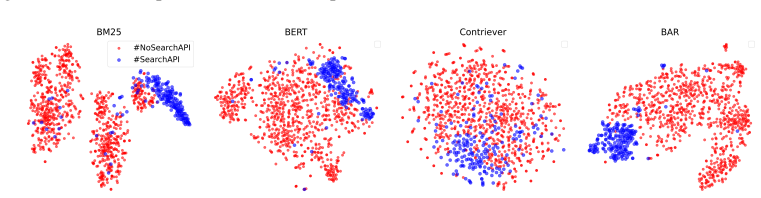
Summary. The paper proposes BAR, a behavior-aligned retriever trained with contrastive learning on binary call/no-call labels, to retrieve demonstrations that are both semantically similar and behaviorally consistent with a user query. The authors claim that supplying such demonstrations to twelve LLMs improves function-calling decisions without fine-tuning the backbone, specifically an 8.5% improvement in direct response rate on H2A and a 4.2% reduction in unnecessary API calls on ToolDEER. The manuscript includes ablations on loss functions, negative sampling, and training data size, plus t-SNE visualizations and case studies.
Significance. If the central claim holds, BAR would be a lightweight and promising alternative to LLM fine-tuning for tool-use decisions: it requires only a small BERT-scale retriever and does not alter the backbone model. The idea of using call/no-call behavior as an additional retrieval signal is well motivated, and the paper evaluates on two benchmarks with twelve models, which is a broad empirical scope. The paper also ships a code link. However, the current evidence is weakened by a transductive retrieval protocol, lack of statistical testing, and several per-model regressions, so the significance of the contribution cannot be fully assessed until these issues are addressed.
major comments (4)
- [§3.2 / §4.1] The retrieval corpus is the evaluation set itself. §3.2 states 'we use the dataset of downstream tasks as the retrieval corpus,' and §4.1 confirms that the H2A test set and the ToolDEER validation set are both evaluated and retrieved from. Unless the query is explicitly excluded from the datastore, the retriever can return the query’s own gold-labeled example, trivially inflating the behavior-consistency ratios in Table 2/Figure 3 and the downstream gains in Tables 1/3. This transductive setting does not match the deployment scenario of retrieving from a fixed, static corpus. The authors must specify whether queries are excluded, and if not, rerun with a held-out or query-excluded datastore. This is load-bearing for the main claim.
- [§4.2, Tables 1 and 3] The paper reports no variance, seeds, or significance tests, yet describes improvements as 'consistent' and 'significant.' Table 1 contains clear regressions: ToolAlign-DPO Harmlessness drops from 94.8 with BM25 to 85.6 with BAR; Llama-3.1-8B Autonomy drops from 3.0 (BM25) to 1.0 (BAR). Table 3 shows Llama-3.1-8B #SearchAPI at 61.2 for BAR versus 66.3 for BM25 and 69.7 for Contriever; Qwen2.5 #SearchAPI is 79.5 for BAR versus 83.4 for BERT. The average deltas may be positive, but without confidence intervals or paired tests the central claim of consistent improvement is not established. Please report per-model bootstrap intervals and paired significance tests, and clarify exactly which baseline the Abstract's 8.5%/4.2% figures compare against.
- [§3.3 / §6, Table 2] The positive-pair criterion (a) 'Categorical Matching' uses only binary call/no-call behavior. This makes Helpfulness and Harmlessness queries positives for each other whenever they are semantically close, since both require API calls. The Limitations section itself concedes that BAR 'struggles to distinguish them based on behavioral supervision alone.' Table 2 confirms the issue: for Harmlessness queries, BAR still retrieves 276 Helpfulness examples per 1000. Table 1 shows that this weakness is not harmless: ToolAlign-DPO’s refusal rate drops from 94.8 (BM25) to 85.6 (BAR). Since Harmlessness is one of the three headline dimensions, the safety-axis claim needs finer-grained annotations or a separate mechanism rather than binary behavior labels alone.
- [§4.2.1] The sentence 'our approach achieves an 8.5% improvement over baselines' is ambiguous: it is unclear whether the baseline is BM25, the best of BM25/BERT/Contriever per model, or the average over all baselines. The same ambiguity applies to the ToolDEER 4.2% claim. Please state the comparison protocol explicitly and preferably also report the average over baselines with a defined aggregation rule.
minor comments (6)
- [Abstract] The word 'significantly' is used despite no significance tests. Consider replacing with 'on average' or adding statistical support.
- [§4.1, Table 3] ToolDEER results include no zero-shot or random-demonstration baseline, making it hard to see the added value of retrieval for the #NoSearchAPI/#SearchAPI decision.
- [Eq. (4)] The loss notation appears as 'LDN CL' in the typeset text; it should be L_DNCL. Also Eq. (5) uses 'Ep' where a subscript for expectation over positive pairs is intended.
- [§4.3, Table 4] The 'CE' baseline is not defined or cited, and the training details for the other loss variants are not given. Please clarify what the cross-entropy loss is applied to.
- [§4.2.1] The name 'Functioncalling-20B' is used inconsistently (also 'Functioncalling' and 'granite-20b-functioncalling' in §4.1). Please standardize.
- [Figure 2] The relationship in Figure 2 is presented as a monotonic trend, but no error bars or curve-fitting details are given. Please include per-condition variance or at least state the number of LLM/retriever points per bin.
Circularity Check
No circular derivation: BAR's gains are empirical and not entailed by its training objective; retrieval/evaluation overlap is a validity risk, not circularity.
full rationale
The claimed contribution is an empirical comparison: BAR is trained on API-Bank plus general QA with a contrastive loss (Eqs. 4–6), then used to retrieve demonstrations for 12 LLMs; the downstream call/no-call accuracy is compared against BM25, BERT, and Contriever. The behavior-consistency ratio (Eq. 1) measures the same same-behavior/different-behavior separation that the loss optimizes, but this is standard supervised evaluation of a retriever, not circular: BAR is not trained on the H2A/ToolDEER labels, and the LLM's decision is not determined by the loss. The only self-citations (Wu et al. 2024a,b) are related-work surveys/fusion papers and are not load-bearing. The paper's own Limitations concede behavioral supervision alone is insufficient to separate Helpfulness from Harmlessness, which is a scope limitation, not a circular step. A non-circular correctness concern is the retrieval protocol: §3.2 says 'we use the dataset of downstream tasks as the retrieval corpus,' and §4.1 evaluates on the H2A testset and ToolDEER validation set, so retrieval and evaluation share the same queries. If self-retrieval is not excluded, a query could retrieve itself with its gold label, trivially inflating the behavior-consistency ratio and downstream gains. The paper does not state whether the query is excluded, so this is a leakage/validity risk to check in review, but it is not an equivalence between the paper's equations and its conclusions.
Assumptions & free parameters
free parameters (5)
- alpha (dual-negative balance) =
0.8
- tau (temperature) =
0.05
- positive-pair similarity threshold t =
0.7
- negative count l =
10
- number of demonstrations k =
5 (H2A), 6 (ToolDEER)
assumptions (4)
- domain assumption Retrieving behaviorally consistent demonstrations improves LLM function-calling decisions (Finding 2).
- domain assumption Binary call/no-call behavior labels (plus H2A category labels) are a sufficient supervision signal for demonstration retrieval.
- domain assumption The downstream evaluation set is an acceptable retrieval corpus for the demonstration store.
- standard math Contrastive learning framework (InfoNCE, cosine similarity, SimCSE encoder) is a sound way to embed queries for retrieval.
Cite this review
Pith. "Pith review of Beyond Semantic Similarity: Reducing Unnecessary API Calls via Behavior-Aligned Retriever." pith.science (2026). https://pith.science/paper/7WY5KTSJ
@misc{pith2026250814323,
  author       = {Pith},
  title        = {Pith review of: Beyond Semantic Similarity: Reducing Unnecessary API Calls via Behavior-Aligned Retriever},
  year         = {2026},
  howpublished = {\url{https://pith.science/paper/7WY5KTSJ}},
  note         = {Machine review of arXiv:2508.14323}
}
read the original abstract
Tool-augmented large language models (LLMs) leverage external functions to extend their capabilities, but inaccurate function calls can lead to inefficiencies and increased costs.Existing methods address this challenge by fine-tuning LLMs or using demonstration-based prompting, yet they often suffer from high training overhead and fail to account for inconsistent demonstration samples, which misguide the model's invocation behavior. In this paper, we trained a behavior-aligned retriever (BAR), which provides behaviorally consistent demonstrations to help LLMs make more accurate tool-using decisions. To train the BAR, we construct a corpus including different function-calling behaviors, i.e., calling or non-calling.We use the contrastive learning framework to train the BAR with customized positive/negative pairs and a dual-negative contrastive loss, ensuring robust retrieval of behaviorally consistent examples.Experiments demonstrate that our approach significantly reduces erroneous function calls while maintaining high task performance, offering a cost-effective and efficient solution for tool-augmented LLMs.
Figures


Figures from the paper (2 more)

Reference graph
Works this paper leans on
-
[1]
Ibrahim Abdelaziz, Kinjal Basu, Mayank Agarwal, Sadhana Kumaravel, Matthew Stallone, Rameswar Panda, Yara Rizk, GP Shrivatsa Bhargav, Maxwell Crouse, Chulaka Gunasekara, and 1 others. 2024. Granite-function calling model: Introducing function calling abilities via multi-task learning of granular tasks. In Proceedings of the 2024 Conference on Empirical Me...
work page 2024
-
[2]
Federico Bianchi, Mirac Suzgun, Giuseppe Attanasio, Paul R \"o ttger, Dan Jurafsky, Tatsunori Hashimoto, and James Zou. 2023. Safety-tuned llamas: Lessons from improving the safety of large language models that follow instructions. arXiv preprint arXiv:2309.07875
arXiv 2023
-
[3]
Zhi-Yuan Chen, Shiqi Shen, Guangyao Shen, Gong Zhi, Xu Chen, and Yankai Lin. 2024. Towards tool use alignment of large language models. In Proceedings of the 2024 Conference on Empirical Methods in Natural Language Processing, pages 1382--1400
work page 2024
-
[4]
Jacob Devlin, Ming-Wei Chang, Kenton Lee, and Kristina Toutanova. 2019. Bert: Pre-training of deep bidirectional transformers for language understanding. In Proceedings of the 2019 conference of the North American chapter of the association for computational linguistics: human language technologies, volume 1 (long and short papers), pages 4171--4186
2019
-
[5]
Tianyu Gao, Xingcheng Yao, and Danqi Chen. 2021. Simcse: Simple contrastive learning of sentence embeddings. In Proceedings of the 2021 Conference on Empirical Methods in Natural Language Processing, EMNLP 2021, Virtual Event / Punta Cana, Dominican Republic, 7-11 November, 2021 , pages 6894--6910
work page 2021
-
[6]
Aaron Grattafiori, Abhimanyu Dubey, Abhinav Jauhri, Abhinav Pandey, Abhishek Kadian, Ahmad Al-Dahle, Aiesha Letman, Akhil Mathur, Alan Schelten, Alex Vaughan, and 1 others. 2024. The llama 3 herd of models. arXiv preprint arXiv:2407.21783
arXiv 2024
-
[7]
Anchun Gui, Jian Li, Yong Dai, Nan Du, and Han Xiao. 2024. Look before you leap: Towards decision-aware and generalizable tool-usage for large language models. arXiv preprint arXiv:2402.16696
work page Pith review arXiv 2024
-
[8]
Kaiming He, Haoqi Fan, Yuxin Wu, Saining Xie, and Ross Girshick. 2020. Momentum contrast for unsupervised visual representation learning. In Proceedings of the IEEE/CVF conference on computer vision and pattern recognition, pages 9729--9738
2020
Show all 35 references
-
[9]
Yue Huang, Jiawen Shi, Yuan Li, Chenrui Fan, Siyuan Wu, Qihui Zhang, Yixin Liu, Pan Zhou, Yao Wan, Neil Zhenqiang Gong, and 1 others. 2023. Metatool benchmark for large language models: Deciding whether to use tools and which to use. arXiv preprint arXiv:2310.03128
2023 arXiv
-
[10]
Gautier Izacard, Mathilde Caron, Lucas Hosseini, Sebastian Riedel, Piotr Bojanowski, Armand Joulin, and Edouard Grave. 2021. Unsupervised dense information retrieval with contrastive learning. Transactions on Machine Learning Research
2021
-
[11]
Albert Q. Jiang, Alexandre Sablayrolles, Arthur Mensch, Chris Bamford, Devendra Singh Chaplot, Diego de las Casas, Florian Bressand, Gianna Lengyel, Guillaume Lample, Lucile Saulnier, Lélio Renard Lavaud, Marie-Anne Lachaux, Pierre Stock, Teven Le Scao, Thibaut Lavril, Thomas ...
2023 arXiv
-
[12]
Yannis Kalantidis, Mert Bulent Sariyildiz, Noe Pion, Philippe Weinzaepfel, and Diane Larlus. 2020. Hard negative mixing for contrastive learning. Advances in neural information processing systems, 33:21798--21809
2020
-
[13]
Prannay Khosla, Piotr Teterwak, Chen Wang, Aaron Sarna, Yonglong Tian, Phillip Isola, Aaron Maschinot, Ce Liu, and Dilip Krishnan. 2020. Supervised contrastive learning. Advances in neural information processing systems, 33:18661--18673
2020
-
[14]
Minghao Li, Yingxiu Zhao, Bowen Yu, Feifan Song, Hangyu Li, Haiyang Yu, Zhoujun Li, Fei Huang, and Yongbin Li. 2023. Api-bank: A comprehensive benchmark for tool-augmented llms. In Proceedings of the 2023 Conference on Empirical Methods in Natural Language Processing, pages 3102--3116
2023
-
[15]
MeetKai. 2024. Functionary-7b-v1.4: A language model for function interpretation and execution. Hugging Face Models
2024
-
[16]
Gr \'e goire Mialon, Roberto Dess \` , Maria Lomeli, Christoforos Nalmpantis, Ram Pasunuru, Roberta Raileanu, Baptiste Rozi \`e re, Timo Schick, Jane Dwivedi-Yu, Asli Celikyilmaz, and 1 others. 2023. Augmented language models: a survey. arXiv preprint arXiv:2302.07842
2023 arXiv
-
[17]
Aaron van den Oord, Yazhe Li, and Oriol Vinyals. 2018. Representation learning with contrastive predictive coding. arXiv preprint arXiv:1807.03748
2018 arXiv
-
[18]
Patil, Tianjun Zhang, Xin Wang, and Joseph E
Shishir G. Patil, Tianjun Zhang, Xin Wang, and Joseph E. Gonzalez. 2023. Gorilla: Large language model connected with massive apis. arXiv preprint arXiv:2305.15334
2023 arXiv
-
[19]
Yujia Qin, Shihao Liang, Yining Ye, Kunlun Zhu, Lan Yan, Yaxi Lu, Yankai Lin, Xin Cong, Xiangru Tang, Bill Qian, and 1 others. 2023. Toolllm: Facilitating large language models to master 16000+ real-world apis. arXiv preprint arXiv:2307.16789
2023 arXiv
-
[20]
Changle Qu, Sunhao Dai, Xiaochi Wei, Hengyi Cai, Shuaiqiang Wang, Dawei Yin, Jun Xu, and Ji-Rong Wen. 2024. Towards completeness-oriented tool retrieval for large language models. In Proceedings of the 33rd ACM International Conference on Information and Knowledge Management, ...
2024
-
[21]
Stephen Robertson, Hugo Zaragoza, and 1 others. 2009. The probabilistic relevance framework: Bm25 and beyond. Foundations and Trends in Information Retrieval , 3(4):333--389
2009
-
[22]
Joshua Robinson, Ching-Yao Chuang, Suvrit Sra, and Stefanie Jegelka. 2021. Contrastive learning with hard negative samples. In International Conference on Learning Representations (ICLR)
2021
-
[23]
Florian Schroff, Dmitry Kalenichenko, and James Philbin. 2015. Facenet: A unified embedding for face recognition and clustering. In Proceedings of the IEEE Conference on Computer Vision and Pattern Recognition, pages 815--823
2015
-
[24]
Alon Talmor, Jonathan Herzig, Nicholas Lourie, and Jonathan Berant. 2019. Commonsenseqa: A question answering challenge targeting commonsense knowledge. In Proceedings of the 2019 Conference of the North American Chapter of the Association for Computational Linguistics: Human ...
2019
-
[25]
Qiaoyu Tang, Ziliang Deng, Hongyu Lin, Xianpei Han, Qiao Liang, Boxi Cao, and Le Sun. 2023. Toolalpaca: Generalized tool learning for language models with 3000 simulated cases. arXiv preprint arXiv:2306.05301
2023 arXiv
-
[26]
Hugo Touvron, Louis Martin, Kevin Stone, Peter Albert, Amjad Almahairi, Yasmine Babaei, Nikolay Bashlykov, Soumya Batra, Prajjwal Bhargava, Shruti Bhosale, and 1 others. 2023. Llama 2: Open foundation and fine-tuned chat models. arXiv preprint arXiv:2307.09288
2023 arXiv
-
[27]
Tongzhou Wang and Phillip Isola. 2020. Understanding contrastive representation learning through alignment and uniformity on the hypersphere. In International conference on machine learning, pages 9929--9939. PMLR
2020
-
[28]
Shangyu Wu, Ying Xiong, Yufei Cui, Xue Liu, Buzhou Tang, Tei-Wei Kuo, and Chun Jason Xue. 2024 a . Refusion: Improving natural language understanding with computation-efficient retrieval representation fusion. In ICLR
2024
- [29]
-
[30]
Qiancheng Xu, Yongqi Li, Heming Xia, and Wenjie Li. 2024. Enhancing tool retrieval with iterative feedback from large language models. In Findings of the Association for Computational Linguistics: EMNLP 2024, pages 9609--9619
2024
-
[31]
An Yang, Baosong Yang, Beichen Zhang, Binyuan Hui, Bo Zheng, Bowen Yu, Chengyuan Li, Dayiheng Liu, Fei Huang, Haoran Wei, and 1 others. 2024. Qwen2. 5 technical report. arXiv preprint arXiv:2412.15115
2024 arXiv
-
[32]
Penghao Zhao, Hailin Zhang, Qinhan Yu, Zhengren Wang, Yunteng Geng, Fangcheng Fu, Ling Yang, Wentao Zhang, Jie Jiang, and Bin Cui. 2024. Retrieval-augmented generation for ai-generated content: A survey. arXiv preprint arXiv:2402.19473
2024 arXiv
-
[33]
Chunting Zhou, Pengfei Liu, Puxin Xu, Srinivasan Iyer, Jiao Sun, Yuning Mao, Xuezhe Ma, Avia Efrat, Ping Yu, Lili Yu, and 1 others. 2023. Lima: Less is more for alignment. Advances in Neural Information Processing Systems, 36:55006--55021
2023
-
[34]
online" 'onlinestring :=
ENTRY address archivePrefix author booktitle chapter edition editor eid eprint eprinttype howpublished institution journal key month note number organization pages publisher school series title type volume year doi pubmed url lastchecked label extra.label sort.label short.list...
-
[35]
write newline
" write newline "" before.all 'output.state := FUNCTION n.dashify 't := "" t empty not t #1 #1 substring "-" = t #1 #2 substring "--" = not "--" * t #2 global.max substring 't := t #1 #1 substring "-" = "-" * t #2 global.max substring 't := while if t #1 #1 substring * t #2 gl...
Reviewed August 5, 2026 · model on record in the stance chip above.
Discussion (0). Sign in to comment.