Blockade-induced exchange primitives for scalable neutral-atom QPU
Pith reviewed 2026-05-22 12:06 UTC · model grok-4.3
The pith
Rydberg blockade enables native controlled-SWAP operations in neutral-atom arrays by engineering collective resonances in target atoms.
A machine-rendered reading of the paper's core claim, the machinery that carries it, and where it could break.
Core claim
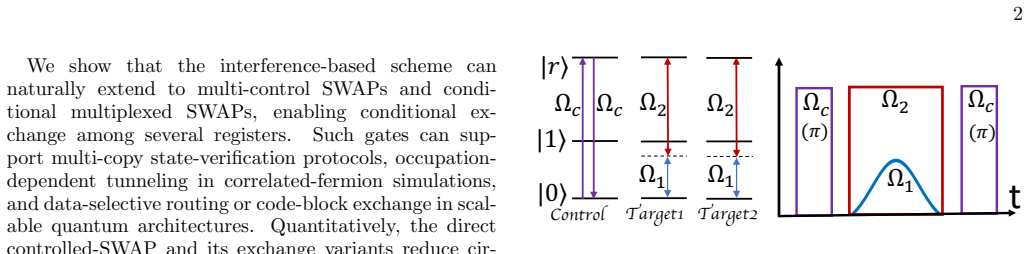
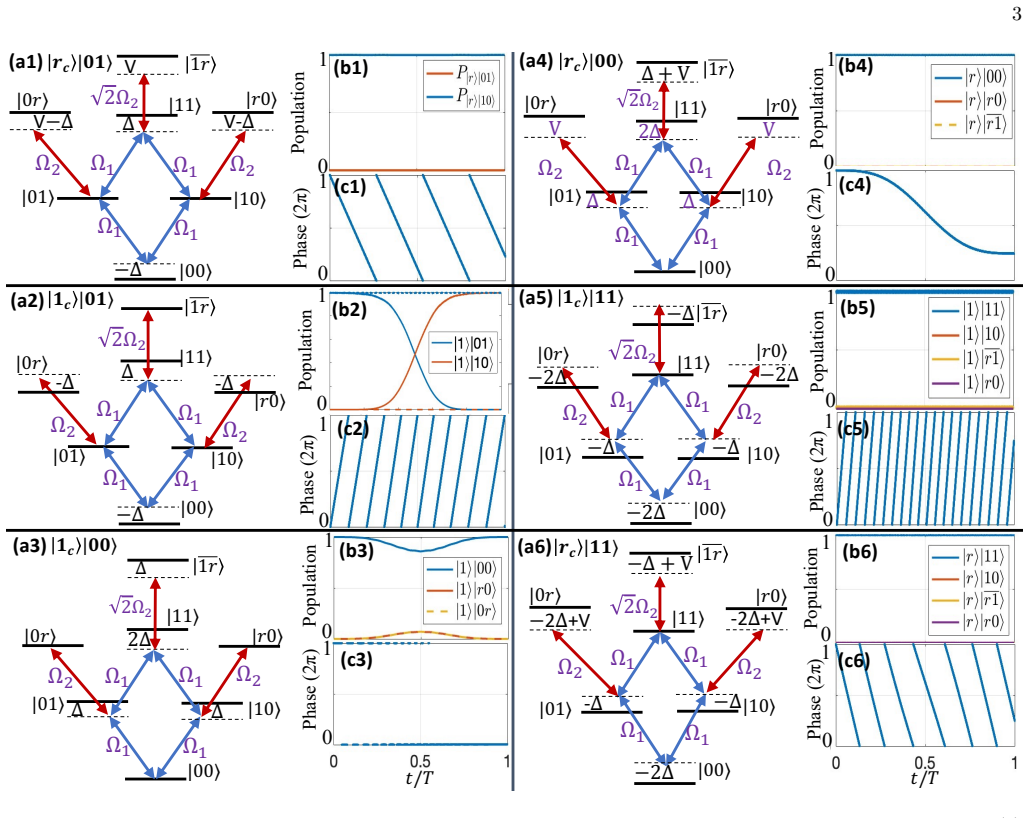
Target atoms are engineered such that two competing exchange pathways between |01> and |10> destructively interfere, while a single collective four-photon channel mediated by a symmetric Rydberg excitation remains resonant and drives a direct SWAP, with all other qubit configurations undergoing an identity action. Exchange conditionality follows from blockade: exciting a control atom to a Rydberg state shifts and blocks the target collective resonance, suppressing exchange, whereas leaving the control in the ground manifold enables exchange in a single step. Anisotropic control-target interactions give rise to selective blockade, enabling coherent programmability of exchange among specific t
What carries the argument
Blockade-programmed collective excited manifold where a resonant symmetric Rydberg-mediated four-photon channel drives direct SWAP under destructive interference of competing pathways.
Load-bearing premise
Target atoms can be precisely engineered so two competing exchange pathways destructively interfere while one collective four-photon channel stays resonant for direct SWAP under control blockade.
What would settle it
An experiment implementing the controlled-SWAP that measures process fidelity well below 99 percent or shows no substantial reduction in total gate steps and Rydberg exposure time relative to standard decomposed circuits.
Figures
read the original abstract
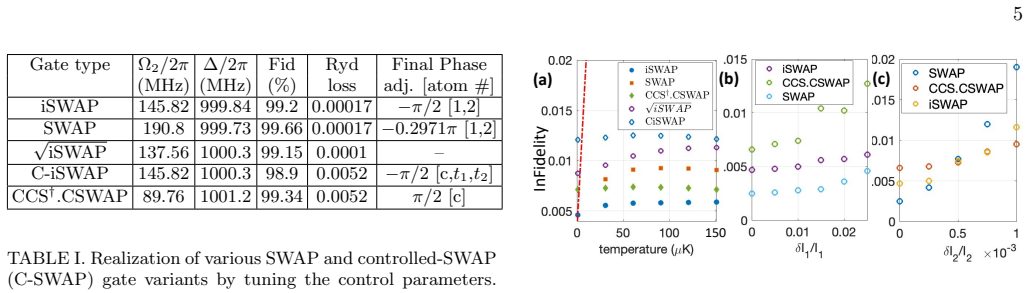
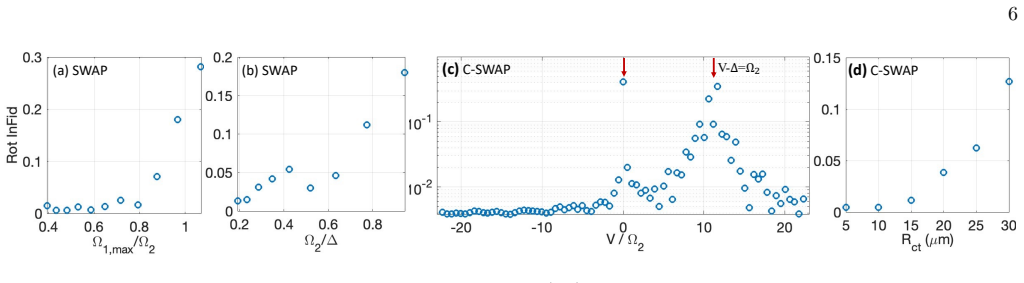
Many quantum hardware platforms natively support either phase or exchange operations, yet converting between these two forms of control typically incurs substantial overhead. Rydberg-blockade neutral-atom arrays are highly developed for phase control, while controlled exchange is usually obtained only through depth-intensive decompositions. Here, controlled exchange is realized as a native, blockade-programmed phenomenon in a collective excited manifold. Target atoms are engineered such that two competing exchange pathways between |01> and |10> destructively interfere, while a single collective four-photon channel mediated by a symmetric Rydberg excitation remains resonant and drives a direct SWAP, with all other qubit configurations undergoing an identity action. Exchange conditionality follows from blockade: exciting a control atom to a Rydberg state shifts and blocks the target collective resonance, suppressing exchange, whereas leaving the control in the ground manifold enables exchange in a single step. Anisotropic control-target interactions give rise to selective blockade, enabling coherent programmability of exchange among specific target pairs. This yields a family of controlled-SWAP primitives with process fidelities above 99% and an order-of-magnitude reduction in circuit depth and Rydberg-state exposure time compared with decomposed implementations. The same principle generalizes to multi-control and multiplexed controlled-exchange operations, providing compact hardware-level primitives for conditional information routing in extended neutral-atom arrays. More broadly, engineering interaction-tuned near-degeneracies in collective manifolds offers a route to programmable non-diagonal multiqubit operations across quantum platforms.
Editorial analysis
A structured set of objections, weighed in public.
Referee Report
Summary. The paper proposes realizing native controlled-exchange operations in Rydberg-blockade neutral-atom arrays by engineering a collective excited manifold in which two |01>↔|10> exchange pathways destructively interfere while a symmetric four-photon Rydberg channel drives a direct SWAP; blockade from a control atom suppresses the resonance, yielding conditional action. Anisotropic interactions enable selective programmability. The central claim is a family of controlled-SWAP primitives achieving >99% process fidelity with an order-of-magnitude reduction in circuit depth and Rydberg exposure time relative to decomposed implementations, with generalizations to multi-control and multiplexed variants.
Significance. If the interference-based construction and its robustness hold, the work would provide hardware-level primitives that meaningfully reduce gate overhead and decoherence exposure in neutral-atom QPUs, facilitating more efficient conditional routing and multiqubit operations. The approach of tuning near-degeneracies in collective manifolds is conceptually extensible.
major comments (2)
- [§3] §3 (collective manifold engineering): the condition that the two exchange pathways interfere destructively while the four-photon channel remains resonant is stated as an engineered point but lacks an explicit derivation or analytic expression for the required detuning window; without this, the claimed >99% fidelity cannot be assessed for robustness against the position jitter and laser inhomogeneity raised in the skeptic note.
- [§4] §4 (fidelity and error budget): no numerical simulations, perturbative error analysis, or explicit calculation of leakage into unwanted states under realistic van der Waals corrections or thermal motion are provided, making the order-of-magnitude reduction claim and the 99% fidelity assertion load-bearing yet unquantified.
minor comments (2)
- [Figure 1] Figure 1 caption: the labeling of the symmetric Rydberg state versus the interfering pathways could be clarified to distinguish the resonant channel from the blocked configurations.
- [§3.2] Notation: the definition of the collective four-photon Rabi frequency is introduced without an explicit equation number in the main text, complicating cross-reference to the interference condition.
Simulated Author's Rebuttal
We thank the referee for their thorough review and constructive comments on our manuscript. We respond to each major comment below and indicate the revisions planned for the next version.
read point-by-point responses
-
Referee: [§3] §3 (collective manifold engineering): the condition that the two exchange pathways interfere destructively while the four-photon channel remains resonant is stated as an engineered point but lacks an explicit derivation or analytic expression for the required detuning window; without this, the claimed >99% fidelity cannot be assessed for robustness against the position jitter and laser inhomogeneity raised in the skeptic note.
Authors: We agree that an explicit analytic derivation of the detuning condition would improve clarity and allow direct assessment of robustness. In the revised manuscript we will add a derivation of the required detuning window that ensures destructive interference between the two |01>↔|10> exchange pathways while preserving resonance of the symmetric four-photon channel. The derivation will be expressed in terms of the relevant interaction strengths and will include a quantitative estimate of the tolerance to position jitter and laser inhomogeneity. revision: yes
-
Referee: [§4] §4 (fidelity and error budget): no numerical simulations, perturbative error analysis, or explicit calculation of leakage into unwanted states under realistic van der Waals corrections or thermal motion are provided, making the order-of-magnitude reduction claim and the 99% fidelity assertion load-bearing yet unquantified.
Authors: The fidelity figures quoted in the manuscript follow from the ideal coherent evolution within the engineered collective manifold. We acknowledge that a more complete error budget is desirable. The revised manuscript will incorporate a perturbative analysis of leakage into unwanted states arising from van der Waals corrections and will provide estimates of the effect of thermal motion using representative experimental parameters. These additions will support the claims of high process fidelity and reduced Rydberg exposure while remaining within the scope of the present theoretical study; exhaustive numerical simulations of every imperfection are deferred to future work. revision: partial
Circularity Check
Derivation is self-contained from standard Rydberg blockade and collective excitation principles.
full rationale
The paper presents a proposal for realizing controlled-SWAP via engineered destructive interference in a collective Rydberg manifold, with exchange conditionality arising from blockade shifts. No equations, fitted parameters, or predictions are shown to reduce by construction to the inputs or to prior self-citations. The mechanism is described as following directly from anisotropic interactions, symmetric excitations, and resonance conditions without tautological redefinition or load-bearing self-references that would force the result. This is a standard first-principles construction in neutral-atom quantum optics and does not exhibit any of the enumerated circularity patterns.
Axiom & Free-Parameter Ledger
free parameters (1)
- Laser detunings and interaction strengths
axioms (1)
- domain assumption Rydberg blockade shifts and suppresses the target collective resonance when the control atom is excited.
Lean theorems connected to this paper
-
IndisputableMonolith/Cost/FunctionalEquation.leanwashburn_uniqueness_aczel unclear?
unclearRelation between the paper passage and the cited Recognition theorem.
Target atoms are engineered such that two competing exchange pathways between |01⟩ and |10⟩ destructively interfere, while a single collective four-photon channel mediated by a symmetric Rydberg excitation remains resonant and drives a direct SWAP
-
IndisputableMonolith/Foundation/AlexanderDuality.leanalexander_duality_circle_linking unclear?
unclearRelation between the paper passage and the cited Recognition theorem.
Rydberg-blockade neutral-atom arrays are highly developed for phase control, while controlled exchange is usually obtained only through depth-intensive decompositions
What do these tags mean?
- matches
- The paper's claim is directly supported by a theorem in the formal canon.
- supports
- The theorem supports part of the paper's argument, but the paper may add assumptions or extra steps.
- extends
- The paper goes beyond the formal theorem; the theorem is a base layer rather than the whole result.
- uses
- The paper appears to rely on the theorem as machinery.
- contradicts
- The paper's claim conflicts with a theorem or certificate in the canon.
- unclear
- Pith found a possible connection, but the passage is too broad, indirect, or ambiguous to say the theorem truly supports the claim.
Reference graph
Works this paper leans on
-
[1]
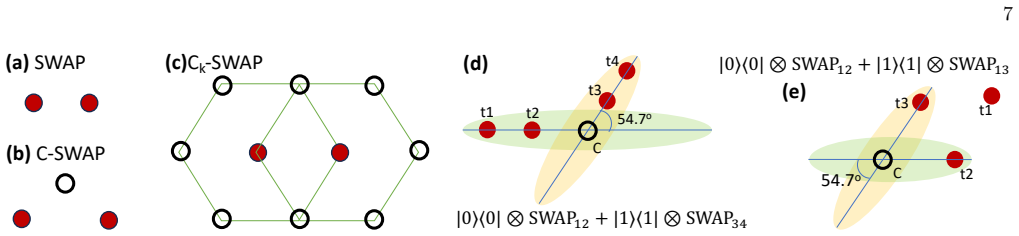
The same principle will be employed for a conditional multiplexed SWAP operation in the end of the paper. (a3) For the initial state|1⟩ c|00⟩t, the only resonant two-photon transitions are to|0r⟩and |r0⟩, which form a dark state with zero eigen energy, see text and hence generate no phase, see (c3), but it acquires a transient excited state population pro...
-
[2]
+|1⟩⟨1|⊗SWAP#$ 54.7ot1t2t3t4 C 54.7o t3 t2 t1 C |0⟩⟨0|⊗SWAP!
If either target qubit is blockaded by the Rydberg control, the intermediate single-excitation states|1r⟩or|r1⟩could not support the SWAP transition. In the four-target configuration, the control qubit thus blocks Rydberg excitation in one tar- get pair while the other, free from control-induced inter- action, would exclusively undergo the SWAP operation....
-
[3]
Unlike the four-target design, which connects two independent pairs, this ge- ometry introduces a common hub qubit that coherently couples to multiple destinations. Such a configuration acts as a coherent quantum memory port, enabling controlled transfer between two memory registers and a shared central node. In a networked setting, it provides quantum-co...
-
[4]
M. Saffman, T. G. Walker, and K. Mølmer, Quantum information with Rydberg atoms,Rev. Mod. Phys.82, 2313–2363 (2010)
work page 2010
-
[5]
Contactless nonlin- ear optics mediated by long-range Rydberg interactions,
H. Busche, P. Huillery, S. W. Ball, T. Ilieva, M. P. A. Jones, and C. S. Adams, “Contactless nonlin- ear optics mediated by long-range Rydberg interactions,” Nat. Phys.13, 655 (2017)
work page 2017
-
[6]
M. Khazali, Ultratight confinement of atoms in a 8 Rydberg-empowered optical lattice,Quantum9, 1585 (2025)
work page 2025
-
[7]
Ding, D. S., Busche, H., Shi, B. S., Guo, G. C., & Adams, C. S. Phase diagram and self-organizing dynamics in a thermal ensemble of strongly interacting Rydberg atoms. Phys. Rev. X, ]bf 10, 021023 (2020)
work page 2020
-
[8]
Stiesdal, N., Busche, H., Kleinbeck, K., Kumlin, J., G. Hansen, M., B¨ uchler, H. P., & Hofferberth, S. Controlled multi-photon subtraction with cascaded Rydberg super- atoms as single-photon absorbers. Nature Communica- tions,12, 4328 (2021)
work page 2021
-
[9]
L. Bombieri, Z. Zeng, R. Tricarico, R. Lin, S. Notarni- cola, M. Cain, M. D. Lukin, and H. Pichler, “Quantum adiabatic optimization with Rydberg arrays: Localiza- tion phenomena and encoding strategies,” PRX Quan- tum6, 020306 (2025)
work page 2025
-
[10]
N. Maskara, A. A. Michailidis, W. W. Ho, D. Bluvstein, S. Choi, M. D. Lukin, and M. Serbyn, “Discrete time- crystalline order enabled by quantum many-body scars: Entanglement steering via periodic driving,” Phys. Rev. Lett.127, 090602 (2021)
work page 2021
-
[11]
Single-photon source based on Rydberg exciton blockade
M. Khazali, K. Heshami, C. Simon “Single-photon source based on Rydberg exciton blockade”, J. Phys. B50, 215301 (2017)
work page 2017
-
[12]
Weimeret al., A Rydberg quantum simulator,Nat
H. Weimeret al., A Rydberg quantum simulator,Nat. Phys.6, 382–388 (2010)
work page 2010
-
[13]
Quantum information and computation with Rydberg atoms
M. Khazali, “Quantum information and computation with Rydberg atoms”,IJAP10, 19 (2021)
work page 2021
-
[14]
Storage and con- trol of optical photons using Rydberg polaritons,
D. Maxwell, D. J. Szwer, D. P. Barato, H. Busche, J. D. Pritchard, A. Gauguet, K. J. Weatherill, M. P. A. Jones, and C. S. Adams, “Storage and con- trol of optical photons using Rydberg polaritons,” Phys. Rev. Lett.110, 103001 (2013)
work page 2013
- [15]
-
[16]
M. Khazali, C. Murray, and T. Pohl, Polariton exchange interactions in multichannel optical networks,Phys. Rev. Lett.123, 113605 (2019)
work page 2019
-
[17]
Probing topo- logical spin liquids on a programmable quantum simula- tor,
G. Semeghini, H. Levine, A. Keesling, S. Ebadi, ..., M. Greiner, V. Vuletic, and M. D. Lukin, “Probing topo- logical spin liquids on a programmable quantum simula- tor,” Science374, 1242 (2021)
work page 2021
-
[18]
Quantum optimization of maximum in- dependent set using Rydberg atom arrays,
S. Ebadi, et. al. “Quantum optimization of maximum in- dependent set using Rydberg atom arrays,” Science376, 1209 (2022)
work page 2022
-
[19]
M. Khazali, Rydberg noisy-dressing and applications in making soliton molecules and droplet quasi-crystals, Phys. Rev. Res.3, L032033 (2021)
work page 2021
-
[20]
Z. Shi, M. Khazali, L. Qin, Y. Zhou, and Y. Zhong, Pat- tern formations and their active manipulation in a Ryd- berg noisy-dressed Bose–Einstein condensate,Opt. Lett. 49, 6517–6520 (2024)
work page 2024
-
[21]
Quantum phases of matter on a 256-atom programmable quantum simulator,
S. Ebadi, T. T. Wang, H. Levine, A. Keesling, ..., M. Greiner, V. Vuleti´ c, and M. D. Lukin, “Quantum phases of matter on a 256-atom programmable quantum simulator,” Nature595, 227 (2021)
work page 2021
-
[22]
M. Khazali, Fast multicomponent cat-state generation under resonant or strong-dressing Rydberg-Kerr interac- tion,Phys. Rev. A109, 053716 (2024)
work page 2024
-
[23]
Controlling quantum many-body dynamics in driven Rydberg atom arrays,
D. Bluvstein, A. Omran, H. Levine, ..., M. Greiner, V. Vuleti´ c, and M. D. Lukin, “Controlling quantum many-body dynamics in driven Rydberg atom arrays,” Science371, 136 (2021)
work page 2021
-
[24]
M. Khazali, Progress towards macroscopic spin and me- chanical superposition via Rydberg interaction,Phys. Rev. A98, 043836 (2018)
work page 2018
-
[25]
M. Khazali, H. W. Lau, A. Humeniuk, and C. Simon, Large energy superpositions via Rydberg dressing,Phys. Rev. A94, 023408 (2016)
work page 2016
-
[26]
Contin- uous symmetry breaking in a two-dimensional Rydberg array,
C. Chen, G. Bornet, M. Bintz, ..., A. Browaeys, “Contin- uous symmetry breaking in a two-dimensional Rydberg array,” Nature616, 691 (2023)
work page 2023
-
[27]
Quantum optimization with arbitrary connectivity using Rydberg atom arrays,
M.-T. Nguyen, J.-G. Liu, J. Wurtz, M. D. Lukin, S.- T. Wang, and H. Pichler, “Quantum optimization with arbitrary connectivity using Rydberg atom arrays,” PRX Quantum4, 010316 (2023)
work page 2023
-
[28]
Khazali, Universal terminal for cloud quantum com- puting,Sci
M. Khazali, Universal terminal for cloud quantum com- puting,Sci. Rep.14, 15412 (2024)
work page 2024
-
[29]
Fast quantum gates for neutral atoms,
D. Jaksch, J. I. Cirac, P. Zoller, S. L. Rolston, R. Cˆ ot´ e, and M. D. Lukin, “Fast quantum gates for neutral atoms,” Phys. Rev. Lett.85, 2208 (2000)
work page 2000
-
[30]
M. Khazali and K. Mølmer, Fast multi-qubit gates via adiabatic evolution in dark state manifolds of Rydberg atoms and superconducting circuits,Phys. Rev. X10, 021054 (2020)
work page 2020
-
[31]
Levine, H., Keesling, A., Semeghini, G., Omran, A., Wang, T. T., Ebadi, S., ... & Lukin, M. D. Parallel imple- mentation of high-fidelity multiqubit gates with neutral atoms.Phys. Rev. Lett.123, 170503 (2019)
work page 2019
-
[32]
Quantum gates and multiparticle entanglement by Rydberg exci- tation blockade and adiabatic passage,
D. Møller, L. B. Madsen, and K. Mølmer, “Quantum gates and multiparticle entanglement by Rydberg exci- tation blockade and adiabatic passage,” Phys. Rev. Lett. 100, 170504 (2008)
work page 2008
-
[33]
M. Khazali and W. Lechner, Scalable quantum proces- sors empowered by the Fermi scattering of Rydberg elec- trons,Commun. Phys.6, 57 (2023)
work page 2023
-
[34]
D. Bluvsteinet al., Logical quantum processor based on reconfigurable atom arrays,Nature626, 58–65 (2024)
work page 2024
-
[35]
Khazali, All-optical quantum information processing via a single-step Rydberg blockade gate,Opt
M. Khazali, All-optical quantum information processing via a single-step Rydberg blockade gate,Opt. Express 31, 13970–13980 (2023)
work page 2023
-
[36]
M. Khazali, K. Heshami, and C. Simon, Photon-photon gate via the interaction between two collective Rydberg excitations,Phys. Rev. A91, 030301(R) (2015)
work page 2015
-
[37]
High-fidelity Rydberg-blockade entangling gate using shaped, analytic pulses,
L. S. Theis, F. Motzoi, F. K. Wilhelm, and M. Saffman, “High-fidelity Rydberg-blockade entangling gate using shaped, analytic pulses,”Phys. Rev. A94, 032306 (2016)
work page 2016
-
[38]
Observation of collective excitation of two individual atoms in the Rydberg blockade regime,
A. Ga¨ etan, Y. Miroshnychenko, T. Wilk, A. Chotia, M. Viteau, D. Comparat, P. Pillet, A. Browaeys, and P. Grangier, “Observation of collective excitation of two individual atoms in the Rydberg blockade regime,” Nat. Phys.5, 115 (2009)
work page 2009
-
[39]
Obser- vation of Rydberg blockade between two atoms,
E. Urban, T. A. Johnson, T. Henage, L. Isenhower, D. D. Yavuz, T. G. Walker, and M. Saffman, “Obser- vation of Rydberg blockade between two atoms,” Nat. Phys.5, 110 (2009)
work page 2009
-
[40]
Entanglement of two individual neutral atoms using Rydberg blockade,
T. Wilk, A. Ga¨ etan, C. Evellin, J. Wolters, Y. Miroshny- chenko, P. Grangier, and A. Browaeys, “Entanglement of two individual neutral atoms using Rydberg blockade,” Phys. Rev. Lett.104, 010502 (2010)
work page 2010
-
[41]
Demonstration of a neutral atom controlled-NOT quantum gate,
L. Isenhower, E. Urban, X. L. Zhang, A. T. Gill, T. Henage, T. A. Johnson, T. G. Walker, and M. Saffman, “Demonstration of a neutral atom controlled-NOT quantum gate,” Phys. Rev. Lett.104, 010503 (2010)
work page 2010
-
[42]
Preparation of entan- 9 gled and antiferromagnetic states by dissipative Rydberg pumping,
A. W. Carr and M. Saffman, “Preparation of entan- 9 gled and antiferromagnetic states by dissipative Rydberg pumping,” Phys. Rev. Lett.111, 033607 (2013)
work page 2013
-
[43]
Demonstration of a strong Rydberg blockade in three-atom systems with anisotropic interactions,
D. Barredo, H. Labuhn, S. Ravets, T. Lahaye, A. Browaeys, and C. S. Adams, “Demonstration of a strong Rydberg blockade in three-atom systems with anisotropic interactions,” Phys. Rev. Lett.112, 183002 (2014)
work page 2014
-
[44]
A. Momtaheni, M. Khazali, “Quantum computation with longlived Rydberg-Landau atoms featuring suppressed ionization by the Magnetic Cage”, arXiv:2506.00575 (2025)
-
[45]
Rydberg-mediated entanglement in a two- dimensional neutral atom qubit array,
T. M. Graham, M. Kwon, B. Grinkemeyer, Z. Marra, X. Jiang, M. T. Lichtman, Y. Sun, M. Ebert, and M. Saffman, “Rydberg-mediated entanglement in a two- dimensional neutral atom qubit array,” Phys. Rev. Lett. 123, 230501 (2019)
work page 2019
-
[46]
M. Khazali,” Quasi-Contact Forces with Resonant Range Control in Rydberg Atoms”, arXiv:2507.17361 (2025)
-
[47]
S. Evered, et al. High-fidelity parallel entangling gates on a neutral-atom quantum computer.Nature622, 7982 (2023)
work page 2023
-
[48]
H. Buhrman, R. Cleve, J. Watrous, and R. de Wolf, “Quantum fingerprinting,”Phys. Rev. A60, 2737 (1999)
work page 1999
-
[49]
Direct estimation of lin- ear and nonlinear functionals of a density matrix,
A. K. Ekert, C. M. Alves, D. K. L. Oi, M. Horodecki, P. Horodecki, and L. C. Kwek, “Direct estimation of lin- ear and nonlinear functionals of a density matrix,”Phys. Rev. Lett.88, 217901 (2002)
work page 2002
- [50]
-
[51]
Measuring entanglement entropy in a quantum many-body system,
R. Islam, R. Ma, P. M. Preiss, M. E. Tai, A. Lukin, M. Rispoli, and M. Greiner, “Measuring entanglement entropy in a quantum many-body system,”Nature528, 77 (2015)
work page 2015
-
[52]
Learning the overlap between quantum states,
L. Cincio, Y. Suba¸ sı, A. T. Sornborger, and P. J. Coles, “Learning the overlap between quantum states,”npj Quantum Inf.7, 87 (2021)
work page 2021
-
[53]
Elementary gates for quantum compu- tation,
A. Barenco, C. H. Bennett, R. Cleve, D. P. DiVincenzo, N. Margolus, P. Shor, T. Sleator, J. A. Smolin, and H. Weinfurter, “Elementary gates for quantum compu- tation,”Phys. Rev. A52, 3457 (1995)
work page 1995
-
[54]
Spectroscopic signatures of localiza- tion with interacting photons in superconducting qubits,
P. Roushanet al., “Spectroscopic signatures of localiza- tion with interacting photons in superconducting qubits,” Nature Phys.13, 146 (2017)
work page 2017
-
[55]
Generation of multicomponent atomic Schr¨ odinger cat states of up to 20 qubits,
C. Songet al., “Generation of multicomponent atomic Schr¨ odinger cat states of up to 20 qubits,”Science364, 878 (2019)
work page 2019
-
[56]
Quantum sim- ulations with ultracold quantum gases,
I. Bloch, J. Dalibard, and S. Nascimb` ene, “Quantum sim- ulations with ultracold quantum gases,”Nature Phys.8, 267 (2012)
work page 2012
-
[57]
Experimental comparison of two quantum comput- ing architectures,
N. M. Linke, D. Maslov, M. Roetteler, S. Debnath, C. Figgatt, K. A. Landsman, K. Wright, and C. Mon- roe, “Experimental comparison of two quantum comput- ing architectures,”Proc. Natl. Acad. Sci. USA114, 3305 (2017)
work page 2017
-
[58]
Ozaydin, F., Bugu, S., Yesilyurt, C., Altintas, A. A., Tame, M. & ¨Ozdemir, S. K. Fusing multiple W states simultaneously with a Fredkin gate.Phys. Rev. A89, 042311 (2014)
work page 2014
-
[59]
Hofmann, H. F. How weak values emerge in joint mea- surements on cloned quantum systems.Phys. Rev. Lett. 109, 020408 (2012)
work page 2012
-
[60]
Rec- ognizing small-circuit structure in two-qubit operators,
V. V. Shende, S. S. Bullock, and I. L. Markov, “Rec- ognizing small-circuit structure in two-qubit operators,” Phys. Rev. A70, 012310 (2004)
work page 2004
-
[61]
An example of the difference between quantum and classical random walks,
A. M. Childs, E. Farhi, and S. Gutmann, “An example of the difference between quantum and classical random walks,”Phys. Rev. A68, 052311 (2003)
work page 2003
-
[62]
M. Khazali, “Discrete-Time Quantum-Walk & Floquet Topological Insulators via Distance-Selective Rydberg- Interaction”, Quantum 6, 664 (2022)
work page 2022
-
[63]
A quantum processor based on coherent transport of entangled atom arrays,
D. Bluvstein, H. Levine, G. Semeghini, T. T. Wang, S. Ebadi, M. Kalinowski, A. Keesling, and M. Greiner, “A quantum processor based on coherent transport of entangled atom arrays,”Nature604, 451 (2022)
work page 2022
-
[64]
Wu, J. L., Wang, Y., Han, J. X., Su, S. L., Xia, Y., Jiang, Y. & Song, J. Unselective ground-state blockade of Rydberg atoms for implementing quantum gates.Front. Phys.17, 22501 (2022)
work page 2022
-
[65]
The remaining atoms in the array stay far detuned
Although the microwave field is globally applied, only the selected target atoms are tuned to the desired transition using a focused optical laser that locally shifts their qubit transition frequencies [63]. The remaining atoms in the array stay far detuned. For the idle atoms, the residual far-off-resonant coupling produces only a small, static AC Stark ...
-
[66]
F., Cheneau, M., Schauß, P., Fukuhara, T., Bloch, I
Weitenberg, C., Endres, M., Sherson, J. F., Cheneau, M., Schauß, P., Fukuhara, T., Bloch, I. & Kuhr, S. Single- spin addressing in an atomic Mott insulator.Nature471, 319-324 (2011)
work page 2011
- [67]
-
[68]
L. H. Pedersen, N. M. Møller, and K. Mølmer, Fidelity of Quantum Operations,Phys. Lett. A367, 47 (2007)
work page 2007
- [69]
-
[70]
Gillen-Christandl, K.et al.Comparison of Gaussian and super Gaussian laser beams for addressing atomic qubits. Appl. Phys. B122, 1–20 (2016)
work page 2016
-
[71]
Solidstate Ti:Sa Laser System.https://m2lasers.com/ solstis.html
-
[72]
Legaie, R., Picken, C. J., & Pritchard, J. D. Sub- kilohertz excitation lasers for quantum information pro- cessing with Rydberg atoms.J. Opt. Soc. Am. B,35, 892 (2018)
work page 2018
-
[73]
Shi, T., Pan, D., & Chen, J. An inhibited laser.Comms. Phys.5, 208 (2022)
work page 2022
-
[74]
Quan- tum Random Access Memory,
G. Giovannetti, S. Lloyd, and L. Maccone, “Quan- tum Random Access Memory,” Phys. Rev. Lett. 100,160501(2008). 10 SWAP iSWAP √ iSWAP Rot 1 0 0 0 0 0 0.9962 0 0 0.9962 0 0 0 0 0 0.974e −i7π 1000 1 0 0 0 0 0 0.9933e i513π 1000 0 0 0.9933e i513π 1000 0 0 0 0 0 0.9973e −i9π 1000 e −iπ 1000 0 0 0 0 0.7028e −i1π 1000 0.7045e i49...
work page 2008
discussion (0)
Sign in with ORCID, Apple, or X to comment. Anyone can read and Pith papers without signing in.