AgRefactor: Self-Evolving Agentic Workflow for HLS Compatibility and Performance
Pith reviewed 2026-07-01 01:27 UTC · model grok-4.3
The pith
AgRefactor uses a self-evolving memory in a multi-agent LLM workflow to refactor software into HLS-compatible code and achieve speedups over prior tools.
A machine-rendered reading of the paper's core claim, the machinery that carries it, and where it could break.
Core claim
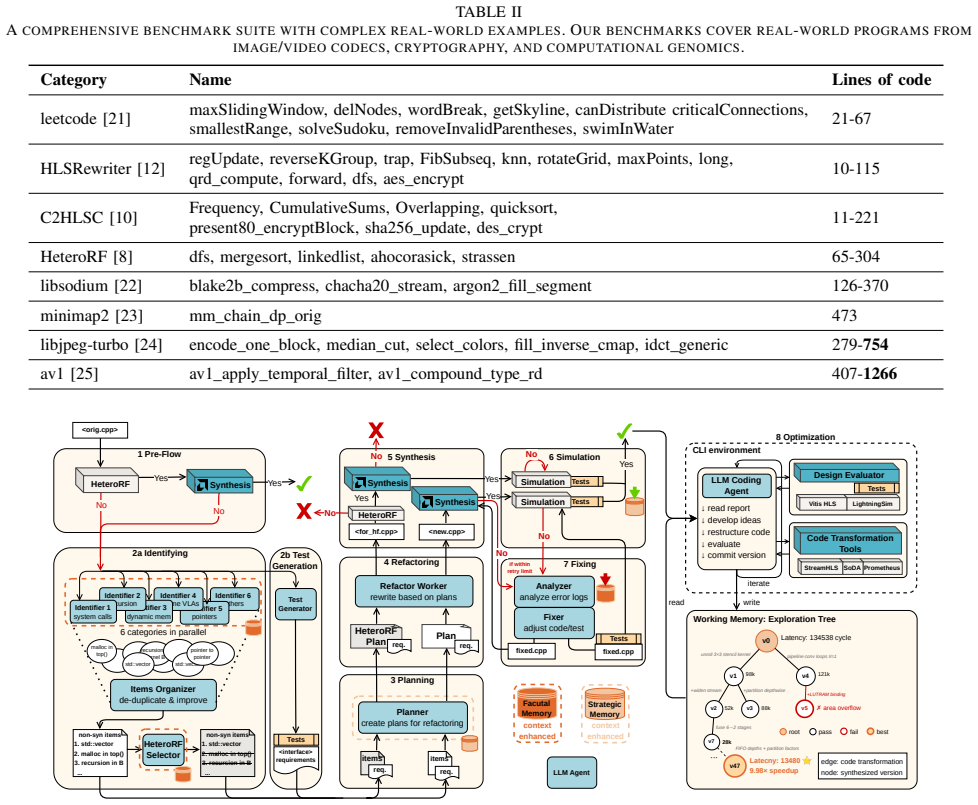
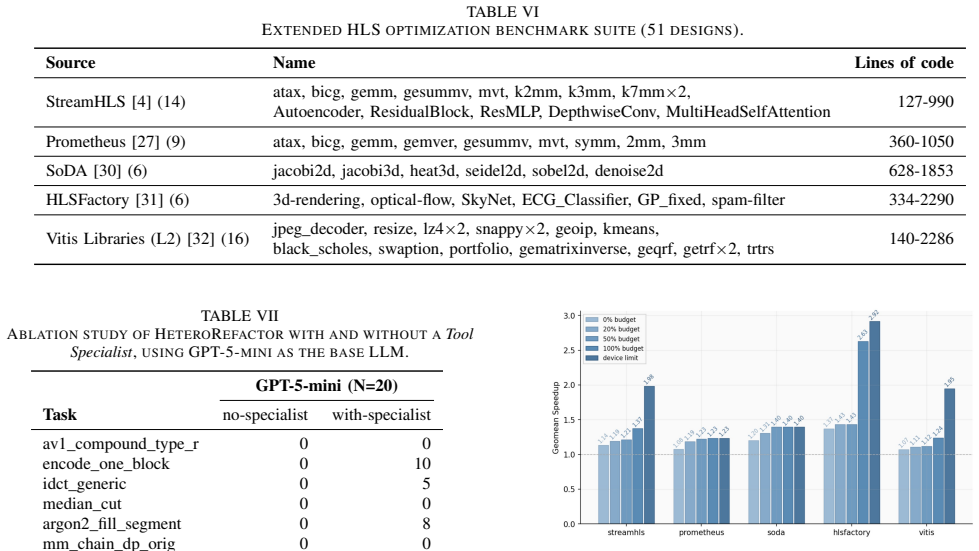
AgRefactor is an LLM-based multi-agent workflow for refactoring software into HLS-compatible programs that incorporates a self-evolving memory system accumulating factual and strategic knowledge across tasks and integrates automated refactoring tools to balance LLM-driven rewrites with efficient transformations. On 9 out of 11 challenging real-world benchmarks 5-10x longer than prior cases, it outperforms or matches state-of-the-art automated refactoring tools and a strong LLM baseline; further agentic performance optimization yields a 6.51x geometric mean speedup over the SoTA pragma tuning tool and a 1.20x speedup over optimized open-source designs with less than 20% extra resources.
What carries the argument
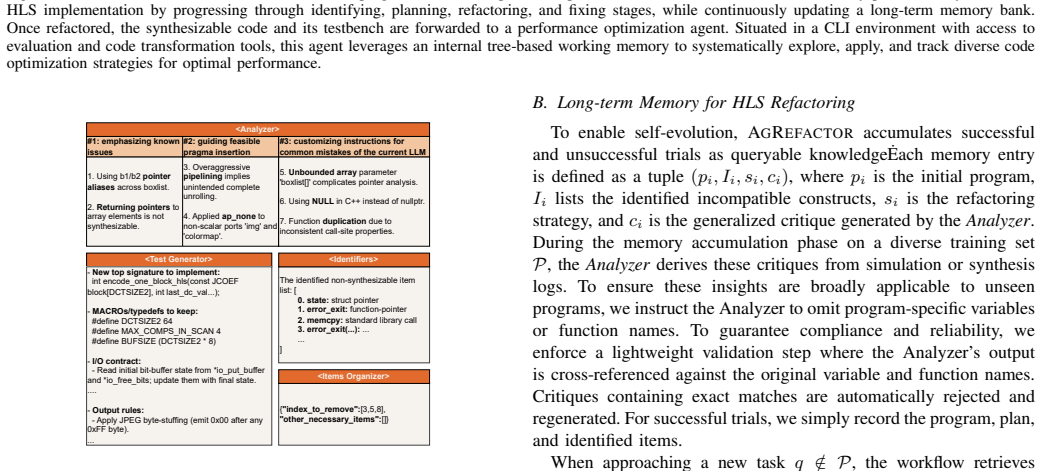
The self-evolving memory system that accumulates and retrieves factual and strategic knowledge across tasks to improve robustness and efficiency on unseen programs.
If this is right
- Refactoring becomes practical for programs five to ten times longer than those handled by earlier automated or LLM methods.
- Computational cost drops because agents can delegate many edits to existing automated refactoring tools instead of calling the LLM for every change.
- Hardware designs produced from the refactored code run substantially faster after the agents apply performance-directed transformations.
- The entire process remains fully automatic and produces designs that use under 20 percent extra resources compared with hand-optimized open-source versions.
Where Pith is reading between the lines
- The memory mechanism could be reused in other iterative code-transformation domains such as porting between different high-level languages or frameworks.
- Combining the workflow with static analysis or formal verification passes might reduce the chance that refactored code contains subtle functional errors.
- The reported speedups suggest the same agent structure could be applied to generate accelerator code for domains beyond HLS, such as GPU or FPGA kernel tuning.
Load-bearing premise
The self-evolving memory system accumulates and retrieves factual and strategic knowledge across tasks, improving robustness and efficiency on unseen programs.
What would settle it
A new collection of long real-world programs on which AgRefactor with the memory system fails to match or exceed the performance of the same workflow without memory or the prior SoTA tools.
Figures

read the original abstract
High-Level Synthesis (HLS) provides a fast path from concepts to silicon, but converting real-world software into synthesizable HLS code remains challenging due to restrictive language support and the gap between software and hardware programming practices. Existing automated and LLM-based refactoring approaches partially address this problem, yet they often lack flexibility, struggle to scale, and incur high computational costs. We introduce AgRefactor, an LLM-based multi-agent workflow for refactoring software into HLS-compatible programs. AgRefactor incorporates a self-evolving memory system that accumulates and retrieves factual and strategic knowledge across tasks, improving robustness and efficiency on unseen programs. To reduce cost and enhance scalability, it integrates automated refactoring tools, enabling agents to balance LLM-driven rewrites with efficient tool-based transformations. On 9 out of 11 challenging real-world benchmarks, which are 5-10x longer than the most complex cases studied in prior work, AgRefactor outperforms or matches the state-of-the-art automated refactoring tool and a strong LLM-based baseline built on the same framework backbone. Further agentic performance optimization yields a 6.51x geometric mean speedup over the SoTA pragma tuning tool and a 1.20x speedup over optimized open-source designs with less than 20% extra resources. AgRefactor is fully-automated and open-sourced.
Editorial analysis
A structured set of objections, weighed in public.
Referee Report
Summary. The paper introduces AgRefactor, an LLM-based multi-agent workflow for refactoring software into HLS-compatible programs. It incorporates a self-evolving memory system for accumulating and retrieving knowledge across tasks, integrates automated refactoring tools to balance LLM rewrites with tool-based transformations, and claims to outperform or match SOTA automated and LLM baselines on 9 out of 11 challenging real-world benchmarks (5-10x longer than prior work), while delivering 6.51x geometric mean speedup over SoTA pragma tuning and 1.20x over optimized open-source designs with <20% extra resources. The system is fully automated and open-sourced.
Significance. If the performance claims hold under rigorous evaluation, the work would advance automated HLS refactoring by demonstrating scalable agentic workflows that combine LLM flexibility with traditional tools and self-evolving memory, addressing key limitations in cost, scalability, and robustness for long programs. The open-sourcing supports reproducibility and community follow-up.
major comments (2)
- Abstract: the central performance claims (outperformance on 9/11 benchmarks, 6.51x and 1.20x speedups) are presented without any accompanying experimental setup, benchmark descriptions, baseline implementations, statistical details, or resource measurements, rendering the claims unverifiable from the provided material.
- Abstract: the description of the self-evolving memory system and its integration with automated tools is stated at a high level only, with no details on memory structure, retrieval mechanisms, or how they contribute to the reported robustness gains on unseen programs.
Simulated Author's Rebuttal
We thank the referee for their review and address the two major comments on the abstract below. The full manuscript provides the requested details in dedicated sections.
read point-by-point responses
-
Referee: Abstract: the central performance claims (outperformance on 9/11 benchmarks, 6.51x and 1.20x speedups) are presented without any accompanying experimental setup, benchmark descriptions, baseline implementations, statistical details, or resource measurements, rendering the claims unverifiable from the provided material.
Authors: Abstracts are intentionally concise per standard academic practice and do not contain full experimental details. The complete manuscript supplies all requested information: benchmark descriptions and lengths (5-10x longer than prior work) appear in Section 4.1, baseline implementations in Section 4.2, experimental setup and statistical details in Sections 4.3 and 5, and resource measurements in Section 5.2 plus associated tables. The claims are therefore verifiable from the full paper. We see no need to expand the abstract, as doing so would violate length conventions without adding value. revision: no
-
Referee: Abstract: the description of the self-evolving memory system and its integration with automated tools is stated at a high level only, with no details on memory structure, retrieval mechanisms, or how they contribute to the reported robustness gains on unseen programs.
Authors: The abstract summarizes contributions at the conventional high level. Full technical details are provided in the manuscript body: memory structure is described in Section 3.2, retrieval mechanisms in Section 3.3, integration with automated tools in Section 3.4, and contributions to robustness on unseen programs (including ablation studies) in Section 5.3. These sections explain knowledge accumulation across tasks and resulting efficiency/robustness gains. No abstract revision is warranted. revision: no
Circularity Check
No significant circularity detected
full rationale
The paper presents an empirical engineering system (AgRefactor multi-agent workflow with self-evolving memory) and reports benchmark performance results. No equations, derivations, predictions from first principles, or mathematical claims appear in the provided abstract or described full text. All load-bearing elements are implementation descriptions and experimental outcomes on real-world HLS benchmarks, with no self-definitional loops, fitted inputs renamed as predictions, or self-citation chains reducing a central result to its own inputs. The self-evolving memory is presented as an architectural feature whose benefits are measured empirically rather than derived tautologically. This is a standard non-circular empirical paper.
Axiom & Free-Parameter Ledger
Reference graph
Works this paper leans on
-
[1]
High-level synthesis for FPGAs: From prototyping to deployment,
J. Cong, B. Liu, S. Neuendorffer, J. Noguera, K. Vissers, and Z. Zhang, “High-level synthesis for FPGAs: From prototyping to deployment,” IEEE Transactions on Computer-Aided Design of Integrated Circuits and Systems, vol. 30, no. 4, pp. 473–491, 2011
2011
-
[2]
FPGA HLS today: successes, challenges, and opportunities,
J. Cong, J. Lau, G. Liu, S. Neuendorffer, P. Pan, K. Vissers, and Z. Zhang, “FPGA HLS today: successes, challenges, and opportunities,” ACM Transactions on Reconfigurable Technology and Systems (TRETS), vol. 15, no. 4, pp. 1–42, 2022
2022
-
[3]
ScaleHLS: A new scalable high-level synthesis framework on multi-level intermediate representation,
H. Ye, C. Hao, J. Cheng, H. Jeong, J. Huang, S. Neuendorffer, and D. Chen, “ScaleHLS: A new scalable high-level synthesis framework on multi-level intermediate representation,” in2022 IEEE Iternational Sym- posium on High-Performance Computer Architecture (HPCA). IEEE, 2022, pp. 741–755
2022
-
[4]
Stream-HLS: Towards automatic dataflow acceleration,
S. Basalama and J. Cong, “Stream-HLS: Towards automatic dataflow acceleration,”arXiv e-prints, pp. arXiv–2501, 2025
2025
-
[5]
HIDA: A hierarchical dataflow compiler for high-level synthesis,
H. Ye, H. Jun, and D. Chen, “HIDA: A hierarchical dataflow compiler for high-level synthesis,” inProceedings of the 29th ACM International Conference on Architectural Support for Programming Languages and Operating Systems, Volume 1, 2024, pp. 215–230
2024
-
[6]
A unified framework for automated code transformation and pragma insertion,
S. Pouget, L.-N. Pouchet, and J. Cong, “A unified framework for automated code transformation and pragma insertion,” inProceedings of the 2025 ACM/SIGDA International Symposium on Field Programmable Gate Arrays, 2025, pp. 187–198
2025
-
[7]
Allo: A programming model for composable accelerator design,
H. Chen, N. Zhang, S. Xiang, Z. Zeng, M. Dai, and Z. Zhang, “Allo: A programming model for composable accelerator design,”Proceedings of the ACM on Programming Languages, vol. 8, no. PLDI, pp. 593–620, 2024
2024
-
[8]
Heterorefactor: refactoring for heterogeneous computing with fpga,
J. Lau, A. Sivaraman, Q. Zhang, M. A. Gulzar, J. Cong, and M. Kim, “Heterorefactor: refactoring for heterogeneous computing with fpga,” inProceedings of the ACM/IEEE 42nd International Conference on Software Engineering, 2020, pp. 493–505
2020
-
[9]
Heterogen: transpiling c to heterogeneous hls code with automated test generation and program repair,
Q. Zhang, J. Wang, G. H. Xu, and M. Kim, “Heterogen: transpiling c to heterogeneous hls code with automated test generation and program repair,” inProceedings of the 27th ACM International Conference on Architectural Support for Programming Languages and Operating Systems, 2022, pp. 1017–1029
2022
-
[10]
C2HLSC: Can LLMs bridge the software-to-hardware design gap?
L. Collini, S. Garg, and R. Karri, “C2HLSC: Can LLMs bridge the software-to-hardware design gap?”arXiv preprint arXiv:2406.09233, 2024
-
[11]
Hard- ware acceleration of complex HEP algorithms with HLS and FPGAs: Methodology and preliminary implementation,
A. Wojenski, H. Zbroszczyk, M. Kruszewski, P. Szymanski, E. Wawrzyn, D. Wielanek, W. Zabolotny, D. Pawlowska, and T. Gniazdowski, “Hard- ware acceleration of complex HEP algorithms with HLS and FPGAs: Methodology and preliminary implementation,”Computer Physics Com- munications, vol. 295, p. 108997, 2024
2024
-
[12]
Hlsrewriter: Efficient refactoring and optimization of c/c++ code with llms for high-level synthesis,
K. Xu, G. L. Zhang, X. Yin, C. Zhuo, U. Schlichtmann, and B. Li, “Hlsrewriter: Efficient refactoring and optimization of c/c++ code with llms for high-level synthesis,”ACM Transactions on Design Automation of Electronic Systems, 2025
2025
-
[13]
Retrieval-Augmented Generation for Knowledge-Intensive NLP Tasks
P. Lewis, E. Perez, A. Piktus, F. Petroni, V . Karpukhin, N. Goyal, H. Küttler, M. Lewis, W.-t. Yih, T. Rocktäschel, S. Riedel, and D. Kiela, “Retrieval-augmented generation for knowledge-intensive NLP tasks,” arXiv preprint arXiv:2005.11401, 2020
work page internal anchor Pith review Pith/arXiv arXiv 2005
-
[14]
MemGPT: Towards LLMs as Operating Systems
C. Packer, S. Wooders, K. Lin, V . Fang, S. G. Patil, I. Stoica, and J. E. Gonzalez, “Memgpt: Towards llms as operating systems,”arXiv preprint arXiv:2310.08560, 2023
work page internal anchor Pith review Pith/arXiv arXiv 2023
-
[15]
B. Jiménez Gutiérrez, Y . Shu, Y . Gu, M. Yasunaga, and Y . Su, “Hip- porag: Neurobiologically inspired long-term memory for large language models,”arXiv preprint arXiv:2405.14831, 2024
-
[16]
Z. Z. Wang, J. Mao, D. Fried, and G. Neubig, “Agent workflow memory,” arXiv preprint arXiv:2409.07429, 2024
work page internal anchor Pith review Pith/arXiv arXiv 2024
-
[17]
MemoryLLM: Towards self-updatable large language models,
Y . Wang, Y . Gao, X. Chen, H. Jiang, S. Li, J. Yang, Q. Yin, Z. Li, X. Li, B. Yin, J. Shang, and J. McAuley, “MemoryLLM: Towards self-updatable large language models,”arXiv preprint arXiv:2402.04624, 2024
-
[18]
A-MEM: Agentic Memory for LLM Agents
W. Xu, Z. Liang, K. Mei, H. Gao, J. Tan, and Y . Zhang, “A-MEM: Agentic memory for LLM agents,”arXiv preprint arXiv:2502.12110, 2025
work page internal anchor Pith review Pith/arXiv arXiv 2025
-
[19]
AlphaEvolve: A coding agent for scientific and algorithmic discovery
A. Novikov, N. V ˜u, M. Eisenberger, E. Dupont, P.-S. Huang, A. Z. Wagner, S. Shirobokov, B. Kozlovskii, F. J. Ruiz, A. Mehrabianet al., “Alphaevolve: A coding agent for scientific and algorithmic discovery,” arXiv preprint arXiv:2506.13131, 2025
work page internal anchor Pith review Pith/arXiv arXiv 2025
-
[20]
AutoDSE: Enabling software programmers to design efficient FPGA accelerators,
A. Sohrabizadeh, C. H. Yu, M. Gao, and J. Cong, “AutoDSE: Enabling software programmers to design efficient FPGA accelerators,”ACM Trans. Des. Autom. Electron. Syst., vol. 27, no. 4, Feb. 2022. [Online]. Available: https://doi.org/10.1145/3494534
-
[21]
Leetcode,
LeetCode, “Leetcode,” 2025, accessed: 2025-10-02. [Online]. Available: https://leetcode.com/
2025
-
[22]
libsodium,
F. Denis and the libsodium contributors, “libsodium,” 2025, accessed: 2025-10-02. [Online]. Available: https://doc.libsodium.org/
2025
-
[23]
minimap2,
H. Li, “minimap2,” 2025, accessed: 2025-10-02. [Online]. Available: https://github.com/lh3/minimap2
2025
-
[24]
libjpeg-turbo,
The libjpeg-turbo Project, “libjpeg-turbo,” 2025, accessed: 2025-10-02. [Online]. Available: https://libjpeg-turbo.org/
2025
-
[25]
Av1 reference codec (libaom),
Alliance for Open Media, “Av1 reference codec (libaom),” 2025, accessed: 2025-10-02. [Online]. Available: https://aomedia. googlesource.com/aom/
2025
-
[26]
LightningSimV2: Faster and scalable simulation for high-level synthesis via graph compilation and optimization,
R. Sarkar, R. Paul, and C. C. Hao, “LightningSimV2: Faster and scalable simulation for high-level synthesis via graph compilation and optimization,” in2024 IEEE 32nd Annual International Symposium on Field-Programmable Custom Computing Machines (FCCM). IEEE, 2024, pp. 104–114
2024
-
[27]
Holistic Optimization Framework for FPGA Accelerators,
S. Pouget, M. Lo, L.-N. Pouchet, and J. Cong, “Holistic Optimization Framework for FPGA Accelerators,”ACM Transactions on Design Automation of Electronic Systems, vol. 31, no. 1, pp. 1–37, 2025
2025
-
[28]
Ag2: Open-source agentos for ai agents,
C. Wang, Q. Wu, and the AG2 Community, “Ag2: Open-source agentos for ai agents,” 2024, available at https://docs.ag2.ai/. [Online]. Available: https://github.com/ag2ai/ag2
2024
-
[29]
Sentencetransformers,
UKPLab, “Sentencetransformers,” 2025, accessed: 2025-10-02. [Online]. Available: https://github.com/UKPLab/sentence-transformers
2025
-
[30]
Soda: Stencil with optimized dataflow architecture,
Y . Chi, J. Cong, P. Wei, and P. Zhou, “Soda: Stencil with optimized dataflow architecture,” inProceedings of the International Conference on Computer-Aided Design, 2018, pp. 1–8
2018
-
[31]
HLSFactory: A framework empowering high-level synthesis datasets for machine learning and beyond,
S. Abi-Karam, R. Sarkar, A. Seigler, S. Lowe, Z. Wei, H. Chen, N. Rao, L. John, A. Arora, and C. Hao, “HLSFactory: A framework empowering high-level synthesis datasets for machine learning and beyond,” inPro- ceedings of the 2024 ACM/IEEE International Symposium on Machine Learning for CAD, 2024, pp. 1–9
2024
-
[32]
Vitis Libraries,
AMD/Xilinx, “Vitis Libraries,” https://github.com/Xilinx/Vitis\ _Libraries, 2024
2024
-
[33]
OpenAI, “GPT-5 model family,” OpenAI, 2025, accessed: 2025-2026. [Online]. Available: https://openai.com/gpt-5/ APPENDIX AGREFACTORis publicly available at https://github.com/Williamzou0123/AgRefactor This appendix presents supplementary studies that complement the main evaluation: the effect of self-accumulating memory across training epochs, the contrib...
discussion (0)
Sign in with ORCID, Apple, or X to comment. Anyone can read and Pith papers without signing in.