REVIEW 3 major objections 4 minor 81 references
DinoCompanion: An Attachment-Theory Informed Multimodal Robot for Emotionally Responsive Child-AI Interaction
T0 review · 3 major / 4 minor · reviewed 2026-08-07 · deepseek-v4-flash
Pith's one-line read DinoCompanion claims that attachment-theory training can make a child-facing robot outperform general-purpose multimodal models on emotional support, with secure-base behavior close to human expert levels.
desk verdict A well-motivated child-AI companion paper whose headline SOTA results are undermined by a possible train/test overlap and under-specified evaluation. read the letter →
The pith
A machine-rendered reading of the paper's core claim, the machinery that carries it, and where it could break.
The reading
What carries the argument
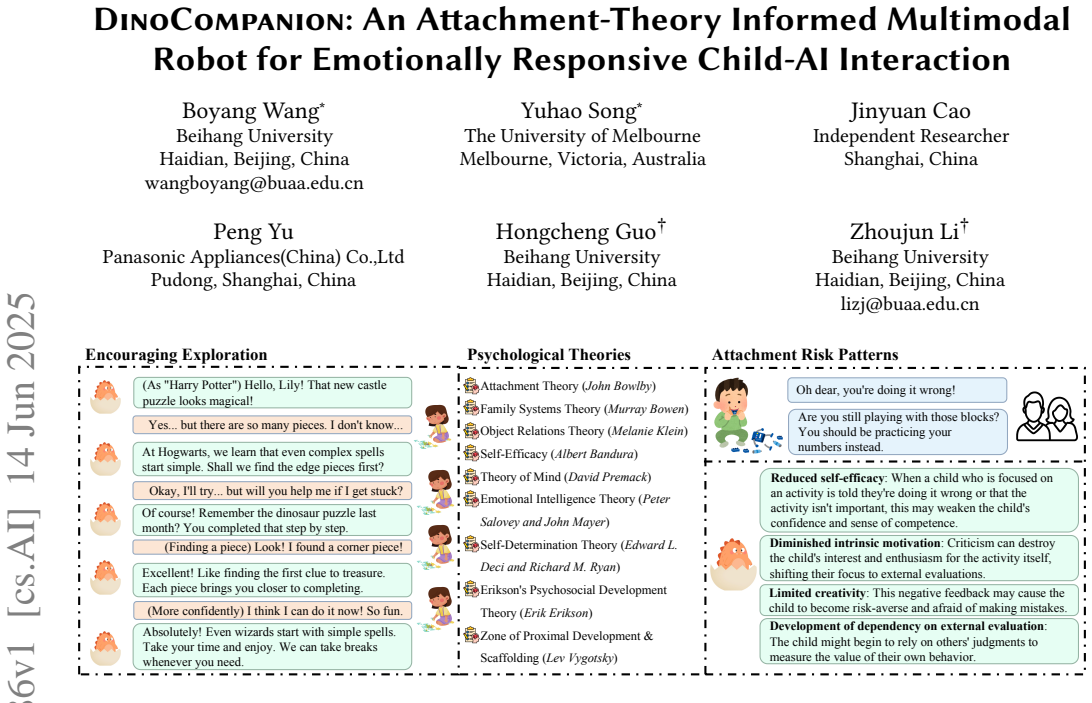
CARPO (Child-Aware Risk-calibrated Preference Optimization) is the load-bearing mechanism. It redefines the reward as a risk-aware advantage $\Delta(x,y)=r_p(x,y)-\lambda(u)\,r_s(x,y)$, where $r_p$ is a preference score, $r_s$ is a risk score, and $\lambda(u)=\lambda_0(1+u)$ up-weights the penalty when $u$ (the model's epistemic uncertainty, measured by repeated stochastic passes) is high; a KL constraint keeps the fine-tuned policy near its reference. The paired labels come from 125,382 annotated clips, and the companion AttachSecure-Bench benchmark organizes ten tasks across emotion regulation, secure-base effect, consistency, personalization, risk detection, and character-based interaction. Together they make 'fun but safe' a formal objective rather than a hand-written rule, and they make attachment competence measurable.
What would settle it
Split the 128 dyads so that DinoCompanion is trained on some and evaluated on AttachSecure-Bench clips from the remaining, unseen dyads; if the average score falls back to the level of the general-purpose baselines or the secure-base gap to human experts widens, the reported state-of-the-art result is an artifact of training-evaluation overlap. A simpler version of the same test is to check whether DinoCompanion's benchmark responses are near-duplicates of phrases that appear in its training clips.
Extended reading notes
Core claim
The central discovery claimed is that a multimodal robot can be built on attachment theory end to end: a corpus of 128 caregiver-child dyads supplies paired preference and risk labels, the CARPO objective turns the preference-risk balance into a single closed-form training loss, and AttachSecure-Bench measures ten attachment competencies with expert agreement $\kappa=0.81$. Trained on Qwen-2.5-VL-7B, DinoCompanion reaches state-of-the-art 57.15% on the benchmark, outperforming GPT-4o and Gemini-2.5-Pro, with secure-base behavior (72.99%) approaching human experts (78.4%) and attachment risk detection at 69.73%. The authors interpret this as evidence that a developmentally grounded reward signal, not raw scale, carries the improvement, and the ablations show each component (risk penalty, uncertainty weighting, KL constraint, vision, hierarchical memory) contributes to safety, stability, and emotion recognition.
Load-bearing premise
The load-bearing premise is that AttachSecure-Bench measures a skill the model did not already memorize: the benchmark and the training corpus are both built from the same 128 caregiver-child dyads, and the paper describes no held-out split or contamination check, so the reported gains over GPT-4o might reflect familiarity with the exact interaction styles rather than general attachment competence.
Editorial extensions
If this is right
- A developmentally grounded objective can be enough to beat much larger general-purpose models on attachment-relevant tasks, so scale is not the only path to competent child-facing AI.
- Secure-base support close to expert level means a robot could plausibly scaffold exploration and comfort during structured child interactions, not merely chat.
- Attachment risk detection at 69.73% suggests child-facing systems could serve as early-warning tools for caregiver-child interaction patterns that may need professional attention.
- The ablations show safety is bought explicitly: removing the risk penalty raises surface quality but collapses risk detection, while removing the KL constraint causes persona drift and instability.
Reading between the lines
- The strongest caution is distribution overlap: since AttachSecure-Bench and the training corpus both draw on the same 128 dyads and no held-out split is described, the reported advantage over GPT-4o should be read as in-distribution until a dyad-level holdout is tested.
- CARPO's engagement-versus-risk trade-off is a template for other vulnerable-user domains, such as elder care or therapeutic agents, where an AI must be warm without being reckless; the refusal-versus-leakage threshold analysis gives any deployment a concrete knob to turn.
- A testable extension would be to train the same objective on dyads from a different culture or age range; if the secure-base scores hold, attachment-based training generalizes, and if they drop, the method is partly dataset-bound.
Editorial analysis
A structured set of objections, weighed in public.
Referee Report
Summary. The paper introduces DinoCompanion, a multimodal child-AI robot reportedly grounded in attachment theory, together with a caregiver-child interaction corpus, a training objective called CARPO, and an evaluation benchmark called AttachSecure-Bench. The central empirical claim is that DinoCompanion achieves state-of-the-art average performance (57.15%) on AttachSecure-Bench, surpassing GPT-4o (50.57%), Gemini-2.5-Pro (53.43%), and other open- and closed-source multimodal LLMs, with secure-base behavior approaching human expert levels and strong attachment-risk detection. The authors also present ablations supporting the roles of multimodal fusion, uncertainty-weighted risk penalties, the KL constraint, hierarchical memory, and persona consistency.
Significance. If the empirical claims were reliably supported, the work would make a useful contribution to child-facing AI: it would provide a developmentally motivated training signal, a large annotated multimodal corpus, and a ten-competency benchmark with expert-consensus labels. The authors creditably attempt to operationalize attachment-theory constructs (secure base, safe haven, consistency, personalization) as concrete evaluation tasks, and the reported expert agreement (kappa=0.81) and the ablations of risk, uncertainty, and memory components are potentially informative. However, the current manuscript does not provide enough evidence to support the headline SOTA claim: the benchmark's independence from the training data is not established, the derivation of CARPO is internally inconsistent, and key evaluation details are missing. These issues are load-bearing for the paper's central conclusion, not merely presentational.
major comments (3)
- [§3.1 / §3.3 / Table 4] The benchmark is not shown to be independent of the training corpus. Section 3.1 describes a corpus of 128 caregiver-child dyads yielding 125,382 annotated clips, while Section 3.3 states that AttachSecure-Bench was built by recruiting 128 caregiver-child dyads and producing 47,382 multimodal clips. The paper never states that these dyad sets are disjoint, never describes a held-out split, and reports no contamination check. If the same dyads, recordings, or derived clips appear in both sets, then Table 4 compares DinoCompanion on its own training distribution against baselines evaluated zero-shot, and the reported 57.15% versus 50.57% (GPT-4o) gap measures data exposure rather than attachment competence. Because every headline comparison and every ablation in Section 5 depends on AttachSecure-Bench being an independent test set, this is a load-bearing defect that must be resolved before the central claim can be accepted.
- [§3.2, Eq. (7)] The closed-form loss in Eq. (7) is not derived from the stated objective in Eq. (2). If the reward is Delta(x,y) = r_p(x,y) - lambda(u) r_s(x,y), then the Bradley-Terry model in Eq. (6) combined with the reparameterization in Eq. (5) yields a preference probability sigma(beta log[(pi_theta(y_w) pi_ref(y_l))/(pi_theta(y_l) pi_ref(y_w))]), with the risk term absorbed into Delta and cancelling out. The loss in Eq. (7), however, appends E lambda(u) [r_s(y_w) - r_s(y_l)]_+ as an explicit extra term. That term is not part of the optimal-policy solution; it is a heuristic regularizer. The paper therefore does not support the claim that CARPO is the closed-form solution of a risk-calibrated KL-constrained objective; the risk-calibration component reduces to standard DPO plus an ad-hoc risk penalty. If the extra term is intentional, it should be presented as a regularizer rather than as part of the derivation.
- [§4.2 / §4.3 / Table 4] The evaluation protocol is underspecified, which makes the SOTA claim difficult to verify. The paper does not describe the scoring rubric, the exact prompt and multimodal input format used for each of the 22 models, the number of test items per task, or the mapping from raw model outputs to the reported percentages. Claims of bootstrapped confidence intervals and p-values below 0.05 or 0.001 are not accompanied by any intervals or test-size information. In addition, the clip counts are inconsistent: Section 3.1 reports 125,382 clips, while Section 3.3 and Table 2 report 47,382 clips, and Figure 2 states 28 dyads while the text states 128. These discrepancies must be reconciled before the benchmark composition, and hence the headline numbers, can be checked.
minor comments (4)
- [Abstract / §4.3 / Table 4] The numbers in the abstract do not match the results section: the abstract reports GPT-4o at 50.29% and Claude-3.7-Sonnet at 53.43%, while §4.3 and Table 4 report GPT-4o at 50.57%, Gemini-2.5-Pro at 53.43%, and Claude-3.7-Sonnet at 39.14%; these should be reconciled.
- [Figure 2] Figure 2 states '28 Caregiver-child dyads' while Sections 3.1 and 3.3 both state 128 dyads; this discrepancy further obscures whether the training corpus and benchmark share the same participants.
- [§3.3] The paper says scoring scripts, rubrics, and a synthetic mini-bench are 'open-sourced for reproducible', but no URL, repository name, or release plan is provided; without this material the evaluation is not reproducible.
- [Throughout] There are several typos and formatting issues: 'funyetsafe' (§3.2), 'as shwon' (§3.3), inconsistent capitalization of ATTACHSECURE/AttachSecure-Bench, and broken math such as '\k{appa}=0.81' in the abstract.
Circularity Check
AttachSecure-Bench is not shown to be independent of the CARPO training corpus: both use 128 caregiver–child dyads with no held-out split or contamination check, so the headline SOTA may reduce to an in-distribution fit; CARPO's closed-form loss also reduces to standard DPO plus an added risk penalty.
-
fitted input called prediction
[§3.1 Corpora Construction; §3.3 Data acquisition and preprocessing; results in §4.3, Table 4]
"Grounded in Bowlby's attachment theory [11], we curate a corpus of 128 caregiver–child dyads containing high-resolution multimodal clips and derive paired preference–risk annotations (§3.1). ... Data acquisition and preprocessing. We recruit 128 caregiver-child dyads (2–10 years, balanced by gender) and record high-resolution audio–video of naturalistic play, structured tasks, and caregiver interviews. Recordings are segmented into discrete scenarios using acoustic and behavioural change-point detection, producing 47,382 multimodal clips."
The benchmark is constructed with the same recruitment description (N=128, ages 2–10, same recording modalities) as the corpus used for CARPO training, and the paper never states that the benchmark dyads are disjoint from the training dyads, provides no held-out split, and reports no contamination check. If the same dyads or derived clips appear in both—which the text does not rule out—then DinoCompanion is evaluated on its training distribution while GPT-4o, Gemini-2.5-Pro, and the other baselines are zero-shot on unseen data. The reported 57.15% average and 72.99% secure-base gap would then measure data exposure rather than attachment competence, so the headline 'state-of-the-art' claim reduces to an in-distribution fit instead of an independent prediction.
-
renaming known result
[§3.2, Eq. (7), following Eqs. (1)–(6)]
"Closed-form loss. LCARPO = −E log σ( β log πθ(yw)πref(yl) / πθ(yl)πref(yw) ) (7) + E λ(u)( rs(yw) − rs(yl) )_+."
This loss is presented as the closed-form result of substituting the risk-aware advantage Δ = rp − λ(u)rs into the Bradley–Terry model, but the risk difference is not inside the logistic term; it is added outside as a separate penalty. The derivation in Eqs. (1)–(6) would put λ(u)(rs(yw)−rs(yl)) inside the σ(logit), not outside it. Thus the paper's own equations do not yield Eq. (7); what remains is the standard DPO loss plus an ad hoc risk regularizer. The claimed novelty, 'risk-calibrated preference optimization,' is therefore a renamed combination of existing DPO and a risk penalty rather than a derived first-principles objective, and the later ablations re-measure that manually inserted penalty.
full rationale
The central problem is the unshown independence of AttachSecure-Bench. Both the training corpus (§3.1) and the benchmark (§3.3) are described as involving 128 caregiver–child dyads with the same age range and similar recording/segmentation pipeline; no held-out split, disjointness statement, or contamination analysis appears anywhere in the paper. Since every headline comparison in Table 4 and every ablation depends on AttachSecure-Bench being an out-of-sample test, the reported SOTA is potentially an in-distribution score. I treat this as partial circularity (score 6), not a proven identity, because the paper does not explicitly state that the dyads are the same; the absence of the required safeguard is itself the load-bearing gap. Separately, CARPO's Eq. (7) does not follow from Eqs. (1)–(6): the risk term is moved from inside the derived logit to an additive penalty, so the 'closed-form' objective reduces to standard DPO plus a regularizer. This is a novelty/reduction issue rather than a circularity in the benchmark sense, so it supports but does not dominate the score. No self-citation chain or imported uniqueness theorem is load-bearing, and the psychological-theory grounding is external to the paper's own claims, so those are not circularity concerns.
Assumptions & free parameters
free parameters (3)
- λ0 =
0.45 initial, with per-age-group Kalman updates
- Risk decision threshold t =
1, 2, or 3; default 3, recommended 2
- β (KL coefficient) =
Not reported numerically; only β→∞ ablation
assumptions (5)
- domain assumption Attachment theory (Bowlby) applies to child-AI interaction, and a robot can serve as a secure base and safe haven for children.
- domain assumption The ten AttachSecure-Bench competencies validly operationalize attachment-based emotional support.
- domain assumption Human preference and risk annotations are reliable labels for training.
- standard math Bradley-Terry preference model and DPO identity hold for the CARPO objective.
- ad hoc to paper GPT-4o stage-1 screening with recall capped at 95% is a valid quality-control method.
Cite this review
Pith. "Pith review of DinoCompanion: An Attachment-Theory Informed Multimodal Robot for Emotionally Responsive Child-AI Interaction." pith.science (2026). https://pith.science/paper/7XFOXE2F
@misc{pith2026250612486,
  author       = {Pith},
  title        = {Pith review of: DinoCompanion: An Attachment-Theory Informed Multimodal Robot for Emotionally Responsive Child-AI Interaction},
  year         = {2026},
  howpublished = {\url{https://pith.science/paper/7XFOXE2F}},
  note         = {Machine review of arXiv:2506.12486}
}
read the original abstract
Children's emotional development fundamentally relies on secure attachment relationships, yet current AI companions lack the theoretical foundation to provide developmentally appropriate emotional support. We introduce DinoCompanion, the first attachment-theory-grounded multimodal robot for emotionally responsive child-AI interaction. We address three critical challenges in child-AI systems: the absence of developmentally-informed AI architectures, the need to balance engagement with safety, and the lack of standardized evaluation frameworks for attachment-based capabilities. Our contributions include: (i) a multimodal dataset of 128 caregiver-child dyads containing 125,382 annotated clips with paired preference-risk labels, (ii) CARPO (Child-Aware Risk-calibrated Preference Optimization), a novel training objective that maximizes engagement while applying epistemic-uncertainty-weighted risk penalties, and (iii) AttachSecure-Bench, a comprehensive evaluation benchmark covering ten attachment-centric competencies with strong expert consensus (\k{appa}=0.81). DinoCompanion achieves state-of-the-art performance (57.15%), outperforming GPT-4o (50.29%) and Claude-3.7-Sonnet (53.43%), with exceptional secure base behaviors (72.99%, approaching human expert levels of 78.4%) and superior attachment risk detection (69.73%). Ablations validate the critical importance of multimodal fusion, uncertainty-aware risk modeling, and hierarchical memory for coherent, emotionally attuned interactions.
Figures


Figures from the paper (3 more)


Reference graph
Works this paper leans on
-
[1]
Nida Itrat Abbasi, Micol Spitale, Joanna Anderson, Tamsin Ford, Peter B Jones, and Hatice Gunes. 2022. Can robots help in the evaluation of mental wellbeing in children? an empirical study. In2022 31st IEEE international conference on robot and human interactive communication (RO-MAN). IEEE, 1459–1466
2022
-
[2]
Suhaib Abdurahman, Mohammad Atari, Farzan Karimi-Malekabadi, Mona J Xue, Jackson Trager, Peter S Park, Preni Golazizian, Ali Omrani, and Morteza Dehghani
-
[3]
Maryam Amirizaniani, Elias Martin, Maryna Sivachenko, Afra Mashhadi, and Chirag Shah. 2024. Can llms reason like humans? assessing theory of mind reasoning in llms for open-ended questions. InProceedings of the 33rd ACM International Conference on Information and Knowledge Management. 34–44
work page 2024
-
[4]
Maryam Amirizaniani, Elias Martin, Maryna Sivachenko, Afra Mashhadi, and Chirag Shah. 2024. Do LLMs Exhibit Human-Like Reasoning? Evaluating Theory of Mind in LLMs for Open-Ended Responses.arXiv preprint arXiv:2406.05659 (2024)
arXiv 2024
-
[5]
Anthropic. 2025. Claude 3.7 Sonnet.Anthropic News(February 2025). https: //www.anthropic.com/news/claude-3-7-sonnet
work page 2025
-
[6]
Sinem Aslan, Lenitra M Durham, Nese Alyuz, Eda Okur, Sangita Sharma, Celal Savur, and Lama Nachman. 2024. Immersive multi-modal pedagogical conversa- tional artificial intelligence for early childhood education: An exploratory case study in the wild.Computers and Education: Artificial Intelligence6 (2024), 100220
work page 2024
-
[7]
Jinze Bai, Shuai Bai, Shusheng Yang, Shijie Wang, Sinan Tan, Peng Wang, Junyang Lin, Chang Zhou, and Jingren Zhou. 2023. Qwen-VL: A Versatile Vision-Language Model for Understanding, Localization, Text Reading, and Beyond.arXiv preprint arXiv:2308.12966(2023)
arXiv 2023
-
[8]
Shuai Bai, Keqin Chen, Xuejing Liu, Jialin Wang, Wenbin Ge, Sibo Song, Kai Dang, Peng Wang, Shijie Wang, Jun Tang, Humen Zhong, Yuanzhi Zhu, Mingkun Yang, Zhaohai Li, Jianqiang Wan, Pengfei Wang, Wei Ding, Zheren Fu, Yiheng Xu, Jiabo Ye, Xi Zhang, Tianbao Xie, Zesen Cheng, Hang Zhang, Zhibo Yang, Haiyang Xu, and Junyang Lin. 2025. Qwen2.5-VL Technical Rep...
arXiv 2025
Show all 81 references
-
[9]
Priyank Bhutani, Manu Gupta, Gagan Bajaj, Ramesh Chandra Deka, Sid- dhartha Sankar Satapathy, and Suvendra Kumar Ray. 2024. Is the screen time duration affecting children’s language development?-A scoping review.Clinical Epidemiology and Global Health25 (2024), 101457
2024
-
[10]
Valérie Brauchli, Fabio Sticca, Peter Edelsbrunner, Agnes von Wyl, and Patricia Lannen. 2024. Are screen media the new pacifiers? The role of parenting stress and parental attitudes for children’s screen time in early childhood.Computers in Human Behavior152 (2024), 108057
2024
-
[11]
Inge Bretherton. 2013. The origins of attachment theory: John Bowlby and Mary Ainsworth. InAttachment theory. Routledge, 45–84
2013
-
[12]
Mary E Brushe, Dandara G Haag, Edward C Melhuish, Sheena Reilly, and Tess Gregory. 2024. Screen time and parent-child talk when children are aged 12 to 36 months.JAMA pediatrics178, 4 (2024), 369–375
2024
-
[13]
Nicholas Buttrick. 2024. Studying large language models as compression algo- rithms for human culture.Trends in cognitive sciences28, 3 (2024), 187–189
2024
-
[14]
ByteDance. 2024. Doubao Model Series. https://www.doubao.com/. Accessed: 2025-05-14
2024
-
[15]
Alan Carr, Laura Finneran, Christine Boyd, Claire Shirey, Ciaran Canning, Owen Stafford, James Lyons, Katie Cullen, Cian Prendergast, Chris Corbett, et al. 2024. The evidence-base for positive psychology interventions: a mega-analysis of meta-analyses.The Journal of Positive P...
2024
-
[16]
Yupeng Chang, Xu Wang, Jindong Wang, Yuan Wu, Linyi Yang, Kaijie Zhu, Hao Chen, Xiaoyuan Yi, Cunxiang Wang, Yidong Wang, et al . 2024. A survey on evaluation of large language models.ACM transactions on intelligent systems and technology15, 3 (2024), 1–45
2024
-
[17]
Ching-Huei Chen and Ching-Ling Chang. 2024. Effectiveness of AI-assisted game- based learning on science learning outcomes, intrinsic motivation, cognitive load, and learning behavior.Education and Information Technologies29, 14 (2024), 18621–18642
2024
-
[18]
Liuqing Chen, Shuhong Xiao, Yunnong Chen, Yaxuan Song, Ruoyu Wu, and Lingyun Sun. 2024. ChatScratch: An AI-Augmented System Toward Autonomous Visual Programming Learning for Children Aged 6-12. InProceedings of the 2024 CHI Conference on Human Factors in Computing Systems. 1–19
2024
-
[19]
Yiming Chen, Xianghu Yue, Chen Zhang, Xiaoxue Gao, Robby T Tan, and Haizhou Li. 2024. Voicebench: Benchmarking llm-based voice assistants.arXiv preprint arXiv:2410.17196(2024)
2024 arXiv
-
[20]
Julian Coda-Forno, Marcel Binz, Jane X Wang, and Eric Schulz. 2024. CogBench: a large language model walks into a psychology lab.arXiv preprint arXiv:2402.18225 (2024)
2024 arXiv
-
[21]
OpenCompass Contributors. 2023. OpenCompass: A Universal Evaluation Plat- form for Foundation Models. https://github.com/open-compass/opencompass
2023
-
[22]
Andrea Cuadra, Maria Wang, Lynn Andrea Stein, Malte F Jung, Nicola Dell, Deborah Estrin, and James A Landay. 2024. The illusion of empathy? notes on displays of emotion in human-computer interaction. InProceedings of the 2024 CHI Conference on Human Factors in Computing Systems. 1–18
2024
-
[23]
Or Dagan, Carlo Schuengel, Marije L Verhage, Marinus H van IJzendoorn, Abra- ham Sagi-Schwartz, Sheri Madigan, Robbie Duschinsky, Glenn I Roisman, Kristin Bernard, Marian Bakermans-Kranenburg, et al. 2021. Configurations of mother- child and father-child attachment as predicto...
2021
-
[24]
Pierre Dewitte. 2024. Better alone than in bad company: Addressing the risks of companion chatbots through data protection by design.Computer Law & Security Review54 (2024), 106019
2024
-
[25]
Xiaoyi Dong, Pan Zhang, Yuhang Zang, Yuhang Cao, Bin Wang, Linke Ouyang, Xilin Wei, Songyang Zhang, Haodong Duan, Maosong Cao, Wenwei Zhang, Yin- ing Li, Hang Yan, Yang Gao, Xinyue Zhang, Wei Li, Jingwen Li, Kai Chen, Conghui He, Xingcheng Zhang, Yu Qiao, Dahua Lin, and Jiaqi ...
2024 arXiv
-
[26]
Zohar Elyoseph, Tamar Gur, Yuval Haber, Tomer Simon, Tal Angert, Yuval Navon, Amir Tal, and Oren Asman. 2024. An ethical perspective on the democratization of mental health with generative AI.JMIR Mental Health11 (2024), e58011
2024
-
[27]
David Estévez, María-José Terrón-López, Paloma J Velasco-Quintana, Rosa-María Rodríguez-Jiménez, and Valle Álvarez-Manzano. 2021. A case study of a robot- assisted speech therapy for children with language disorders.Sustainability13, 5 (2021), 2771
2021
-
[28]
Chiara Filippini, Edoardo Spadolini, Daniela Cardone, Domenico Bianchi, Maur- izio Preziuso, Christian Sciarretta, Valentina Del Cimmuto, Davide Lisciani, and Arcangelo Merla. 2021. Facilitating the child–robot interaction by endowing the robot with the capability of understan...
2021
-
[29]
Manuela Gander, Alexander Karabatsiakis, Katharina Nuderscher, Dorothee Bern- heim, Cornelia Doyen-Waldecker, and Anna Buchheim. 2022. Secure attach- ment representation in adolescence buffers heart-rate reactivity in response to attachment-related stressors.Frontiers in human...
2022
-
[30]
Team GLM, Aohan Zeng, Bin Xu, Bowen Wang, Chenhui Zhang, Da Yin, Diego Rojas, Guanyu Feng, Hanlin Zhao, Hanyu Lai, Hao Yu, Hongning Wang, Jiadai Sun, Jiajie Zhang, Jiale Cheng, Jiayi Gui, Jie Tang, Jing Zhang, Juanzi Li, Lei Zhao, Lindong Wu, Lucen Zhong, Mingdao Liu, Minlie H...
-
[31]
Brian P Godor, Frank CP van der Horst, and Ruth Van der Hallen. 2024. Unravel- ling the roots of emotional development: Examining the relationships between attachment, resilience and coping in young adolescents.The Journal of Early Adolescence44, 4 (2024), 429–457
2024
-
[32]
arXiv:2406.12793
ChatGLM: A Family of Large Language Models from GLM-130B to GLM-4 All Tools. arXiv:2406.12793
-
[33]
Juhye Ha, Hyeon Jeon, Daeun Han, Jinwook Seo, and Changhoon Oh. 2024. CloChat: Understanding how people customize, interact, and experience personas in large language models. InProceedings of the 2024 CHI Conference on Human Factors in Computing Systems. 1–24
2024
-
[34]
Aaron Grattafiori, Abhimanyu Dubey, Abhinav Jauhri, Abhinav Pandey, Abhishek Kadian, Ahmad Al-Dahle, Aiesha Letman, Akhil Mathur, Alan Schelten, Alex Vaughan, et al. 2024. The llama 3 herd of models.arXiv preprint arXiv:2407.21783 (2024)
2024 arXiv
-
[35]
2022.The Routledge Handbook of Attachment (3 Volume Set)
Paul Holmes and Steve Farnfield. 2022.The Routledge Handbook of Attachment (3 Volume Set). Taylor & Francis
2022
-
[36]
It’s Not a Replacement:
Hui-Ru Ho, Edward M Hubbard, and Bilge Mutlu. 2024. " It’s Not a Replacement:" Enabling Parent-Robot Collaboration to Support In-Home Learning Experiences of Young Children. InProceedings of the 2024 CHI Conference on Human Factors in Computing Systems. 1–18
2024
-
[37]
Luoma Ke, Song Tong, Peng Cheng, and Kaiping Peng. 2024. Exploring the frontiers of llms in psychological applications: A comprehensive review.arXiv preprint arXiv:2401.01519(2024)
2024 arXiv
-
[38]
Aaron Hurst, Adam Lerer, Adam P Goucher, Adam Perelman, Aditya Ramesh, Aidan Clark, AJ Ostrow, Akila Welihinda, Alan Hayes, Alec Radford, et al. 2024. Gpt-4o system card.arXiv preprint arXiv:2410.21276(2024)
2024 arXiv
-
[39]
Nomisha Kurian. 2024. ‘No, Alexa, no!’: designing child-safe AI and protecting children from the risks of the ‘empathy gap’in large language models.Learning, Media and Technology(2024), 1–14
2024
-
[40]
Sarika Kewalramani, Kelly-Ann Allen, Erin Leif, and Andrea Ng. 2024. A scop- ing review of the use of robotics technologies for supporting social-emotional DinoCompanion: An Attachment-Theory Informed Multimodal Robot for Emotionally Responsive Child-AI Interaction CIKM ’25, N...
2024
-
[41]
Soyang Kwon, Bridget Armstrong, Nina Wetoska, and Selin Capan. 2024. Screen time, sociodemographic factors, and psychological well-being among young children.JAMA network open7, 3 (2024), e2354488–e2354488
2024
-
[42]
Nomisha Kurian. 2025. AI’s empathy gap: The risks of conversational Artificial Intelligence for young children’s well-being and key ethical considerations for early childhood education and care.Contemporary Issues in Early Childhood26, 1 (2025), 132–139
2025
-
[43]
Amanda Lagerkvist, Matilda Tudor, Jacek Smolicki, Charles M Ess, Jenny Eriks- son Lundström, and Maria Rogg. 2024. Body stakes: an existential ethics of care in living with biometrics and AI.AI & SOCIETY39, 1 (2024), 169–181
2024
-
[44]
Valentina Lucia La Rosa, Alessandra Geraci, Alice Iacono, and Elena Commodari
-
[45]
Affective touch in preterm infant development: neurobiological mechanisms and implications for child–caregiver attachment and neonatal care.Children11, 11 (2024), 1407
2024
-
[46]
Andy Liu, Mona Diab, and Daniel Fried. 2024. Evaluating large language model biases in persona-steered generation.arXiv preprint arXiv:2405.20253(2024)
2024 arXiv
-
[47]
Yuan Li, Yue Huang, Hongyi Wang, Xiangliang Zhang, James Zou, and Lichao Sun. 2024. Quantifying ai psychology: A psychometrics benchmark for large language models.arXiv preprint arXiv:2406.17675(2024)
2024
-
[48]
Zijing Liang, Yanjie Xu, Yifan Hong, Penghui Shang, Qi Wang, Qiang Fu, and Ke Liu. 2024. A Survey of Multimodel Large Language Models. InProceedings of the 3rd International Conference on Computer, Artificial Intelligence and Control Engineering. 405–409
2024
-
[49]
Jiří Milička, Anna Marklová, Klára VanSlambrouck, Eva Pospíšilová, Jana Šimsová, Samuel Harvan, and Ondřej Drobil. 2024. Large language models are able to downplay their cognitive abilities to fit the persona they simulate.Plos one19, 3 (2024), e0298522
2024
-
[50]
Kyle Mahowald, Anna A Ivanova, Idan A Blank, Nancy Kanwisher, Joshua B Tenenbaum, and Evelina Fedorenko. 2024. Dissociating language and thought in large language models.Trends in cognitive sciences(2024)
2024
-
[51]
André Markus, Jan Pfister, Astrid Carolus, Andreas Hotho, and Carolin Wienrich
-
[52]
Effects of AI understanding-training on AI literacy, usage, self-determined interactions, and anthropomorphization with voice assistants.Computers and Education Open6 (2024), 100176
2024
-
[53]
Jessica E Opie, Jennifer E McIntosh, Timothy B Esler, Robbie Duschinsky, Carol George, Allan Schore, Emily J Kothe, Evelyn S Tan, Christopher J Greenwood, and Craig A Olsson. 2021. Early childhood attachment stability and change: A meta-analysis.Attachment & Human Development2...
2021
-
[54]
2024.Nurturing natures: Attachment and children’s emotional, sociocultural and brain development
Graham Music. 2024.Nurturing natures: Attachment and children’s emotional, sociocultural and brain development. Routledge
2024
-
[55]
Nazneen Nazeer, Jenny Parker, Lauren Cross, Sophie Epstein, Jessica Penhallow, Tamsin Newlove-Delgado, Johnny Downs, and Tamsin Ford. 2025. The extent to which child and parent report RCADS, sMFQ, SDQ and child report KIDSCREEN identify the same young people as at risk of ment...
2025
-
[56]
Jingping Nie, Hanya Shao, Yuang Fan, Qijia Shao, Haoxuan You, Matthias Preindl, and Xiaofan Jiang. 2024. LLM-based conversational AI therapist for daily func- tioning screening and psychotherapeutic intervention via everyday smart devices. arXiv preprint arXiv:2403.10779(2024)
2024 arXiv
-
[57]
Matan Rubin, Hadar Arnon, Jonathan D Huppert, Anat Perry, et al. 2024. Con- sidering the role of human empathy in AI-driven therapy.JMIR Mental Health 11, 1 (2024), e56529
2024
-
[58]
Ekaterina Pashevich. 2022. Can communication with social robots influence how children develop empathy? Best-evidence synthesis.AI & SOCIETY37, 2 (2022), 579–589
2022
-
[59]
Abigail E Pine, Mary G Baumann, Gabriella Modugno, and Bruce E Compas. 2024. Parental involvement in adolescent psychological interventions: a meta-analysis. Clinical Child and Family Psychology Review27, 3 (2024), 1–20
2024
-
[60]
Mohaimenul Azam Khan Raiaan, Md Saddam Hossain Mukta, Kaniz Fatema, Nur Mohammad Fahad, Sadman Sakib, Most Marufatul Jannat Mim, Jubaer Ah- mad, Mohammed Eunus Ali, and Sami Azam. 2024. A review on large language models: Architectures, applications, taxonomies, open issues and...
2024
-
[61]
Faruk Seyitoğlu and Stanislav Ivanov. 2024. Robots and emotional intelligence: A thematic analysis.Technology in Society77 (2024), 102512
2024
-
[62]
Vinay Samuel, Henry Peng Zou, Yue Zhou, Shreyas Chaudhari, Ashwin Kalyan, Tanmay Rajpurohit, Ameet Deshpande, Karthik Narasimhan, and Vishvak Mu- rahari. 2024. Personagym: Evaluating persona agents and llms.arXiv preprint arXiv:2407.18416(2024)
2024 arXiv
-
[63]
Carlo Schuengel, Marije L Verhage, and Robbie Duschinsky. 2021. Prospecting the attachment research field: A move to the level of engagement.Attachment & Human Development23, 4 (2021), 375–395
2021
-
[64]
Woosuk Seo, Chanmo Yang, and Young-Ho Kim. 2024. Chacha: leveraging large language models to prompt children to share their emotions about personal events. InProceedings of the 2024 CHI Conference on Human Factors in Computing Systems. 1–20
2024
-
[65]
Manyu Tang, Yongcai Chen, et al . 2024. AI and animated character design: efficiency, creativity, interactivity.The Frontiers of Society, Science and Technology 6, 1 (2024), 117–123
2024
-
[66]
Deborah Silvis, Jody Clarke-Midura, Jessica F Shumway, Victor R Lee, and Selen- dra Mullen. 2022. Children caring for robots: Expanding computational thinking frameworks to include a technological ethic of care.International Journal of Child-Computer Interaction33 (2022), 100491
2022
-
[67]
Luke Stark. 2024. Animation and Artificial Intelligence. InProceedings of the 2024 ACM Conference on Fairness, Accountability, and Transparency. 1663–1671
2024
-
[68]
Alexandra R Tabachnick, Yunqi He, Lindsay Zajac, Elizabeth A Carlson, and Mary Dozier. 2022. Secure attachment in infancy predicts context-dependent emotion expression in middle childhood.Emotion22, 2 (2022), 258
2022
-
[69]
Peng Wang, Shuai Bai, Sinan Tan, Shijie Wang, Zhihao Fan, Jinze Bai, Keqin Chen, Xuejing Liu, Jialin Wang, Wenbin Ge, Yang Fan, Kai Dang, Mengfei Du, Xuancheng Ren, Rui Men, Dayiheng Liu, Chang Zhou, Jingren Zhou, and Junyang Lin. 2024. Qwen2-VL: Enhancing Vision-Language Mode...
2024 arXiv
-
[70]
Annalisa Tanzilli, Mariagrazia Di Giuseppe, Guido Giovanardi, Tommaso Boldrini, Giorgio Caviglia, Ciro Conversano, and Vittorio Lingiardi. 2021. Mentalization, attachment, and defense mechanisms: a Psychodynamic Diagnostic Manual-2- oriented empirical investigation.Research in...
2021
-
[71]
Gemini Team, Rohan Anil, Sebastian Borgeaud, Jean-Baptiste Alayrac, Jiahui Yu, Radu Soricut, Johan Schalkwyk, Andrew M Dai, Anja Hauth, Katie Millican, et al. 2023. Gemini: a family of highly capable multimodal models.arXiv preprint arXiv:2312.11805(2023)
2023 arXiv
-
[72]
Carolina Villegas-Galaviz and Kirsten Martin. 2024. Moral distance, AI, and the ethics of care.AI & society39, 4 (2024), 1695–1706
2024
-
[73]
Chao Zhang, Xuechen Liu, Katherine Ziska, Soobin Jeon, Chi-Lin Yu, and Ying Xu. 2024. Mathemyths: leveraging large language models to teach mathematical language through Child-AI co-creative storytelling. InProceedings of the 2024 CHI Conference on Human Factors in Computing S...
2024
-
[74]
Xizheng Xu, Zhiqiang Liu, Shaoying Gong, and Yunpeng Wu. 2022. The relation- ship between empathy and attachment in children and adolescents: Three-level meta-analyses.International Journal of Environmental Research and Public Health 19, 3 (2022), 1391
2022
-
[75]
Yijia Yuan. 2024. An empirical study of the efficacy of AI chatbots for Eng- lish as a foreign language learning in primary education.Interactive Learning Environments32, 10 (2024), 6774–6789
2024
-
[76]
Yuhang Zang, Xiaoyi Dong, Pan Zhang, Yuhang Cao, Ziyu Liu, Shengyuan Ding, Shenxi Wu, Yubo Ma, Haodong Duan, Wenwei Zhang, Kai Chen, Dahua Lin, and Jiaqi Wang. 2025. InternLM-XComposer2.5-Reward: A Simple Yet Effective Multi-Modal Reward Model. InFindings of ACL
2025
-
[77]
Jinguo Zhu, Weiyun Wang, Zhe Chen, Zhaoyang Liu, Shenglong Ye, Lixin Gu, Hao Tian, Yuchen Duan, Weijie Su, Jie Shao, Zhangwei Gao, Erfei Cui, Xuehui Wang, Yue Cao, Yangzhou Liu, Xingguang Wei, Hongjie Zhang, Haomin Wang, Weiye Xu, Hao Li, Jiahao Wang, Nianchen Deng, Songze Li,...
2025 arXiv
-
[78]
Pan Zhang, Xiaoyi Dong, Yuhang Zang, Yuhang Cao, Rui Qian, Lin Chen, Qipeng Guo, Haodong Duan, Bin Wang, Linke Ouyang, Songyang Zhang, Wenwei Zhang, Yining Li, Yang Gao, Peng Sun, Xinyue Zhang, Wei Li, Jingwen Li, Wenhai Wang, Hang Yan, Conghui He, Xingcheng Zhang, Kai Chen, J...
2024 arXiv
-
[79]
Yiqun Zhang, Xiaocui Yang, Xingle Xu, Zeran Gao, Yijie Huang, Shiyi Mu, Shi Feng, Daling Wang, Yifei Zhang, Kaisong Song, et al. 2024. Affective computing in the era of large language models: A survey from the nlp perspective.arXiv preprint arXiv:2408.04638(2024)
2024 arXiv
-
[80]
Haiyan Zhao, Hanjie Chen, Fan Yang, Ninghao Liu, Huiqi Deng, Hengyi Cai, Shuaiqiang Wang, Dawei Yin, and Mengnan Du. 2024. Explainability for large lan- guage models: A survey.ACM Transactions on Intelligent Systems and Technology 15, 2 (2024), 1–38
2024
-
[2024]
Perils and opportunities in using large language models in psychological research.PNAS nexus3, 7 (2024), pgae245
2024
Reviewed August 7, 2026 · model on record in the stance chip above.
Discussion (0). Sign in to comment.