EEG Interpretation Across Chant Listening: A Single-Subject Pilot Investigation Using Spectral and Functional Connectivity Analysis
Pith reviewed 2026-06-25 21:42 UTC · model grok-4.3
The pith
Different chant-listening conditions engage distinct neural mechanisms involving cortical activation and large-scale neural synchronization.
A machine-rendered reading of the paper's core claim, the machinery that carries it, and where it could break.
Core claim
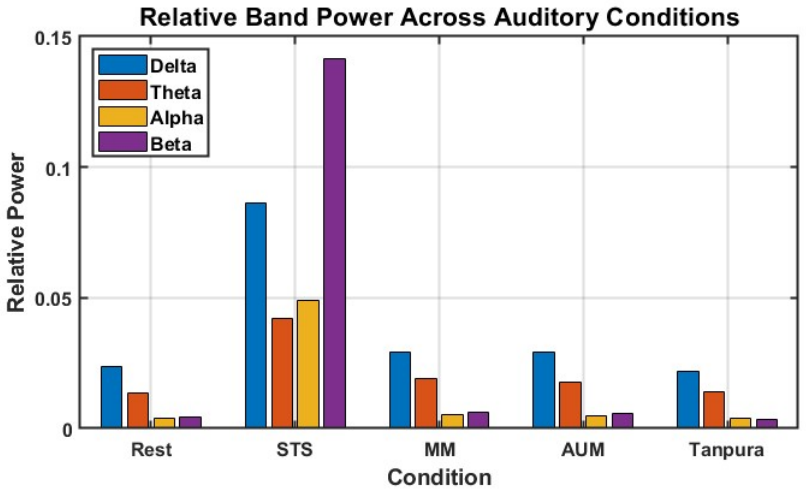
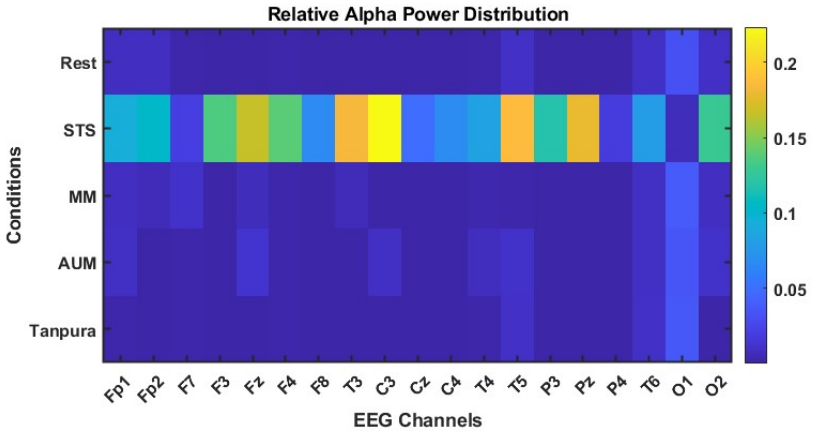
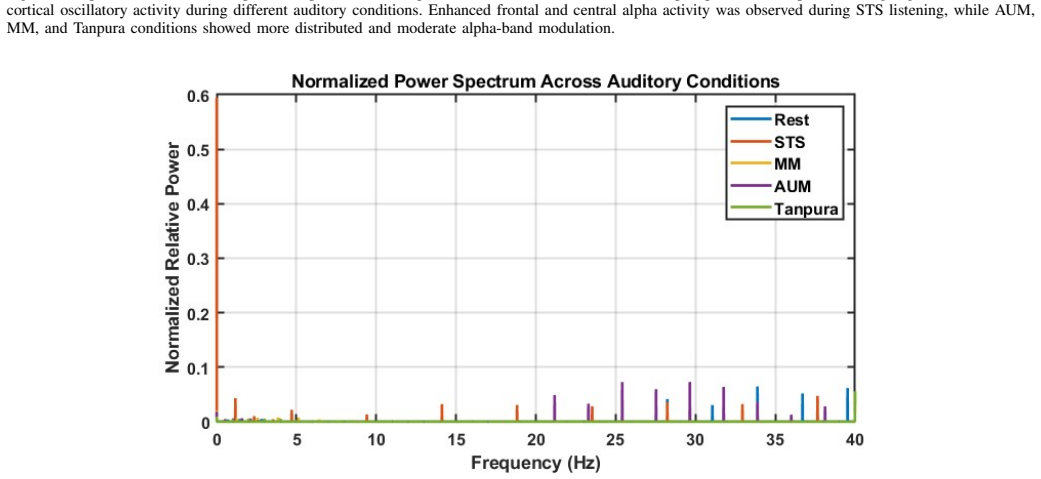
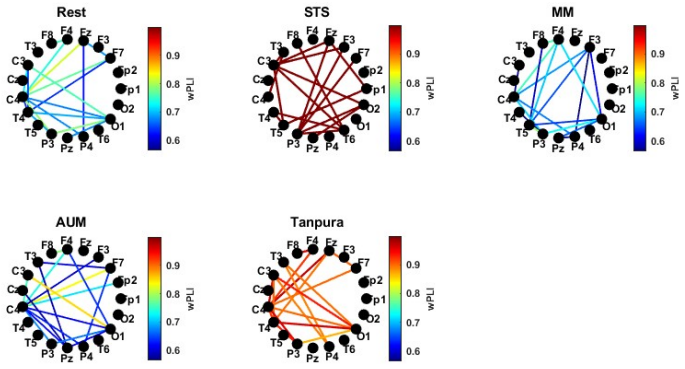
Spectral analysis revealed condition-specific modulation of neural oscillatory activity, with STS listening producing the highest relative power across multiple frequency bands, particularly within the beta range. Functional connectivity analysis demonstrated distinct network organizations across conditions. STS listening exhibited the strongest and most widespread connectivity pattern, characterized by prominent long-range interactions among frontal, temporal, parietal, and occipital regions. Tanpura listening generated a dense yet balanced connectivity network, while Aum listening showed moderate distributed connectivity. In contrast, MM and resting-state conditions displayed comparatively
What carries the argument
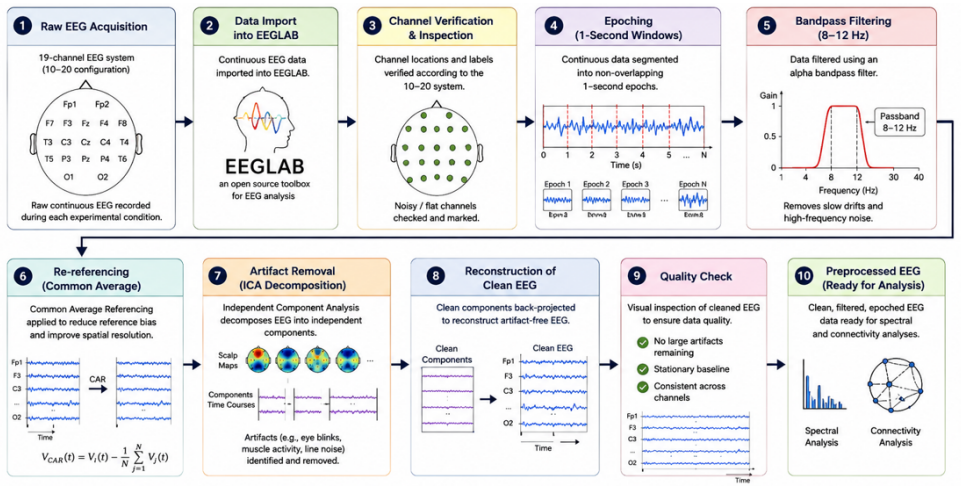
Spectral power estimation paired with weighted Phase Lag Index (wPLI) functional connectivity to quantify condition-dependent changes in oscillatory strength and inter-regional synchronization.
If this is right
- STS listening produces stronger beta-band activation and more extensive long-range connectivity than the other conditions tested.
- Tanpura listening creates a balanced but dense connectivity profile distinct from both STS and the weaker patterns seen in MM or rest.
- The observed dissociation between power increases and connectivity spread supplies a measurable signature for comparing auditory stimuli in child EEG work.
- The single-subject design supplies a concrete template that can be scaled to examine how culturally specific sounds affect developing brains.
Where Pith is reading between the lines
- The method could be extended to test whether repeated exposure to particular chants produces lasting shifts in resting-state connectivity.
- Comparing the same conditions in adults versus children would reveal whether the observed patterns are age-dependent.
- The pilot opens a route to ask whether chant-specific synchronization changes correlate with behavioral measures of attention or memory in the same session.
Load-bearing premise
Responses recorded from a single 5-year-old participant reflect general effects of the chant conditions rather than idiosyncratic traits of that individual.
What would settle it
Repeating the identical protocol on several additional children and finding no consistent differences in relative spectral power or wPLI connectivity patterns across the five conditions.
Figures
read the original abstract
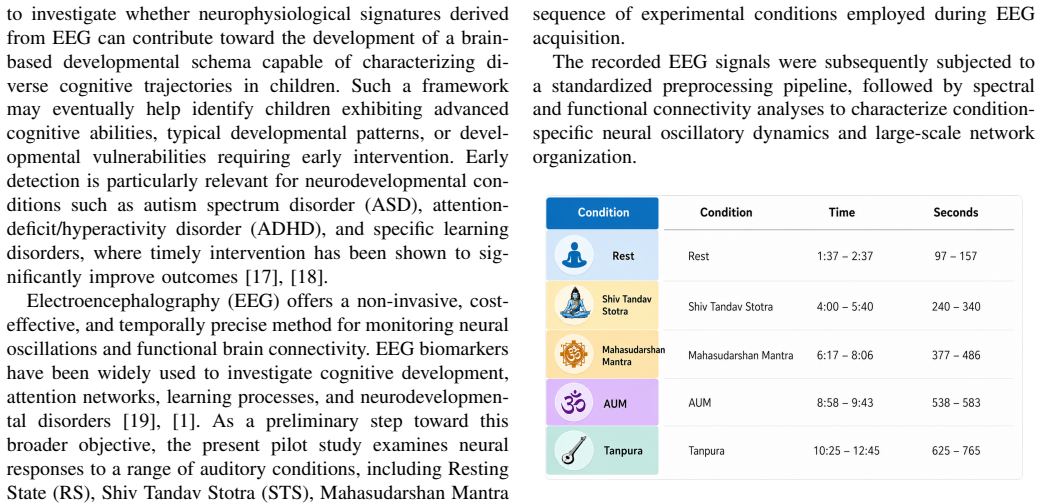
This technical report presents an EEG-based investigation of neural activity across five auditory conditions: Resting State (RS), Shiv Tandav Stotra (STS), Mahasudarshan Mantra (MM), Aum Chant, and Tanpura Listening. EEG recordings acquired from a healthy 5-year-old participant were analyzed using spectral power estimation and functional connectivity measures based on the weighted Phase Lag Index (wPLI). Spectral analysis revealed condition-specific modulation of neural oscillatory activity, with STS listening producing the highest relative power across multiple frequency bands, particularly within the beta range. Functional connectivity analysis demonstrated distinct network organizations across conditions. STS listening exhibited the strongest and most widespread connectivity pattern, characterized by prominent long-range interactions among frontal, temporal, parietal, and occipital regions. Tanpura listening generated a dense yet balanced connectivity network, while Aum listening showed moderate distributed connectivity. In contrast, MM and resting-state conditions displayed comparatively weaker and more localized network organization. These preliminary findings suggest that different chant-listening conditions engage distinct neural mechanisms involving both cortical activation and large-scale neural synchronization. The study establishes a methodological framework for future investigations examining the role of culturally relevant auditory interventions in cognitive development, neuroeducation, and child-centered neuroscience research.
Editorial analysis
A structured set of objections, weighed in public.
Referee Report
Summary. This manuscript reports results from a single-subject (N=1, 5-year-old) EEG pilot study comparing spectral power and wPLI-based functional connectivity across five auditory conditions: resting state (RS), Shiv Tandav Stotra (STS), Mahasudarshan Mantra (MM), Aum chant, and Tanpura listening. Spectral analysis is described as showing STS with the highest relative power (especially beta); connectivity analysis is described as showing STS with the strongest long-range network organization, Tanpura with dense balanced connectivity, and MM/RS with weaker localized patterns. The abstract interprets these descriptive differences as preliminary evidence that the conditions engage distinct neural mechanisms of cortical activation and large-scale synchronization, while framing the work as a methodological framework for future culturally relevant auditory studies in children.
Significance. If replicated in larger samples, the approach could supply a reproducible template for examining effects of culturally specific auditory stimuli on pediatric EEG metrics. The choice of standard, non-parametric metrics (relative power, wPLI) is a strength that would facilitate direct comparison in follow-up work.
major comments (2)
- [Abstract] Abstract: the central interpretive claim that the observed differences demonstrate 'distinct neural mechanisms' cannot be supported by the reported data. With N=1 and no statistical tests, error bars, or session-to-session variability estimates, the patterns remain descriptive and could equally reflect subject-specific factors or order effects.
- [Results] Results section (spectral and connectivity findings): absence of any inferential statistics, permutation tests, or within-subject controls means the reported rank-order differences (STS highest beta power; strongest long-range wPLI in STS) cannot be distinguished from chance fluctuations in a single recording session.
minor comments (2)
- [Abstract] Abstract: the age and health status of the single participant should be stated explicitly so readers can immediately assess developmental context.
- [Discussion] Discussion: the limitations paragraph should quantify the interpretive caution required by N=1 (e.g., 'these patterns are subject-specific and require between-subject replication before mechanism claims can be advanced').
Simulated Author's Rebuttal
We thank the referee for the constructive feedback on our single-subject pilot EEG study. We agree that the interpretive language requires tempering given the N=1 design and will revise the manuscript to emphasize its descriptive, preliminary character while retaining the methodological framework contribution.
read point-by-point responses
-
Referee: [Abstract] Abstract: the central interpretive claim that the observed differences demonstrate 'distinct neural mechanisms' cannot be supported by the reported data. With N=1 and no statistical tests, error bars, or session-to-session variability estimates, the patterns remain descriptive and could equally reflect subject-specific factors or order effects.
Authors: We accept this point. The abstract will be revised to replace the claim of demonstrating 'distinct neural mechanisms' with language stating that the observed patterns are consistent with possible condition-specific differences in cortical activation and connectivity, which require replication in larger samples to confirm. We will also add explicit caveats regarding the single-subject, single-session nature of the data and the absence of statistical inference. revision: yes
-
Referee: [Results] Results section (spectral and connectivity findings): absence of any inferential statistics, permutation tests, or within-subject controls means the reported rank-order differences (STS highest beta power; strongest long-range wPLI in STS) cannot be distinguished from chance fluctuations in a single recording session.
Authors: We agree that the results section must clearly indicate the descriptive nature of the reported patterns. We will add statements noting that no inferential statistics were applied, that rank-order observations are observational only, and that session-to-session variability cannot be assessed in this design. These changes will be made without altering the reported spectral and connectivity values themselves. revision: yes
Circularity Check
No circularity: purely descriptive single-subject pilot with no derivations or fitted predictions
full rationale
The paper reports standard spectral power and wPLI connectivity metrics computed directly from one child's EEG recordings across conditions. No equations, models, parameters, or predictions are derived; results are presented as observed differences without any reduction to inputs by construction. No self-citations, uniqueness theorems, or ansatzes are invoked. The single-subject limitation is a methodological weakness for generalization but does not create circularity in any claimed derivation chain.
Axiom & Free-Parameter Ledger
axioms (1)
- domain assumption Standard assumptions underlying spectral power estimation and weighted phase lag index as measures of oscillatory activity and functional connectivity hold for the recorded signals.
Reference graph
Works this paper leans on
-
[1]
Research on attention networks as a model for the integration of psychological science,
M. I. Posner and M. K. Rothbart, “Research on attention networks as a model for the integration of psychological science,”Annual Review of Psychology, vol. 58, pp. 1–23, 2007
2007
-
[2]
Interactive specialization: A domain-general framework for human functional brain development,
M. H. Johnson, “Interactive specialization: A domain-general framework for human functional brain development,”Developmental Cognitive Neuroscience, vol. 1, no. 1, pp. 7–21, 2011
2011
-
[3]
Annual status of education report (early years),
ASER Centre, “Annual status of education report (early years),” ASER Centre, New Delhi, Tech. Rep., 2019
2019
-
[4]
Early childhood development and cognitive outcomes,
N. Rao, J. Sun, and J. M. S. Wong, “Early childhood development and cognitive outcomes,”The Lancet, vol. 389, pp. 77–90, 2014
2014
-
[5]
Assessment of cognitive processes,
J. P. Das, J. A. Naglieri, and J. R. Kirby, “Assessment of cognitive processes,”Allyn and Bacon, 1989
1989
-
[6]
Cultural variations in socialization and development,
R. C. Mishra, “Cultural variations in socialization and development,” Psychological Studies, vol. 43, pp. 5–13, 1998
1998
-
[7]
Brain-based learning and academic achievement,
M. Varghese and S. Pandya, “Brain-based learning and academic achievement,”International Education Journal, 2016
2016
-
[8]
Brain-based learning approaches in elementary science education,
R. Sharma, “Brain-based learning approaches in elementary science education,”Journal of Educational Research, 2024
2024
-
[9]
Neurocognitive interventions for mathematics learning,
S. Devaraj, “Neurocognitive interventions for mathematics learning,” Educational Psychology Review, 2018
2018
-
[10]
Multisensory interventions for dyslexia,
M. Hada and M. Vats, “Multisensory interventions for dyslexia,”Indian Journal of Educational Psychology, 2022
2022
-
[11]
Executive function and theory of mind in children with adhd and learning disorders,
A. Singhet al., “Executive function and theory of mind in children with adhd and learning disorders,”Indian Journal of Psychiatry, 2021
2021
-
[12]
Selective neuronal entrain- ment to the beat and meter embedded in a musical rhythm,
S. Nozaradan, I. Peretz, and A. Mouraux, “Selective neuronal entrain- ment to the beat and meter embedded in a musical rhythm,”Journal of Neuroscience, vol. 32, no. 49, pp. 17 572–17 581, 2012
2012
-
[13]
A systematic review of the neurophysiology of mindfulness,
T. Lomas, I. Ivtzan, and C. H. Y . Fu, “A systematic review of the neurophysiology of mindfulness,”Mindfulness, vol. 6, no. 5, pp. 899– 915, 2015
2015
-
[14]
Meditation states and traits: Eeg, erp, and neuroimaging studies,
B. R. Cahn and J. Polich, “Meditation states and traits: Eeg, erp, and neuroimaging studies,”Psychological Bulletin, vol. 132, no. 2, pp. 180– 211, 2006
2006
-
[15]
Neurohe- modynamic correlates of ’om’ chanting,
B. G. Kalyani, G. Venkatasubramanian, R. Arasappaet al., “Neurohe- modynamic correlates of ’om’ chanting,”International Journal of Yoga, vol. 4, no. 1, pp. 3–6, 2011
2011
-
[16]
Eeg coherence during mantra meditation,
T. Hinterberger, S. Schmidt, and T. Kamei, “Eeg coherence during mantra meditation,”Consciousness and Cognition, vol. 27, pp. 1–11, 2014
2014
-
[17]
Electrophysiological biomarkers of diagnosis and outcome in neurodevelopmental disorders,
S. S. Jeste, J. Frohlich, and S. K. Loo, “Electrophysiological biomarkers of diagnosis and outcome in neurodevelopmental disorders,”Current Opinion in Neurology, vol. 28, no. 2, pp. 110–116, 2015
2015
-
[18]
Brain connectivity and the development of autism spectrum disorder,
L. Q. Uddin, D. R. Dajani, W. V oorhieset al., “Brain connectivity and the development of autism spectrum disorder,”Biological Psychiatry: Cognitive Neuroscience and Neuroimaging, vol. 2, no. 7, pp. 539–547, 2017
2017
-
[19]
Eeg alpha and theta oscillations reflect cognitive and memory performance,
W. Klimesch, “Eeg alpha and theta oscillations reflect cognitive and memory performance,”Brain Research Reviews, vol. 29, no. 2–3, pp. 169–195, 1999
1999
-
[20]
Beta-band oscillations—signalling the status quo?
A. K. Engel and P. Fries, “Beta-band oscillations—signalling the status quo?”Current Opinion in Neurobiology, vol. 20, no. 2, pp. 156–165, 2010
2010
-
[21]
The neuroscience of mindfulness meditation,
Y .-Y . Tang, B. K. Hölzel, and M. I. Posner, “The neuroscience of mindfulness meditation,”Nature Reviews Neuroscience, vol. 16, no. 4, pp. 213–225, 2015
2015
-
[22]
Increased default mode network connectivity associ- ated with meditation,
J. H. Janget al., “Increased default mode network connectivity associ- ated with meditation,”Neuroscience Letters, vol. 487, no. 3, pp. 358– 362, 2011
2011
-
[23]
The neural basis of rhythmic entrain- ment and music-based rehabilitation,
M. H. Thaut and V . Hoemberg, “The neural basis of rhythmic entrain- ment and music-based rehabilitation,”Annals of the New York Academy of Sciences, vol. 1337, no. 1, pp. 244–256, 2015
2015
-
[24]
Alterations in brain and immune function produced by mindfulness meditation,
R. J. Davidson, J. Kabat-Zinn, J. Schumacheret al., “Alterations in brain and immune function produced by mindfulness meditation,” Psychosomatic Medicine, vol. 65, no. 4, pp. 564–570, 2003
2003
-
[25]
Long-term meditators self-induce high-amplitude gamma synchrony during mental practice,
A. Lutz, L. L. Greischar, N. B. Rawlings, M. Ricard, and R. J. Davidson, “Long-term meditators self-induce high-amplitude gamma synchrony during mental practice,”Proceedings of the National Academy of Sci- ences, vol. 101, no. 46, pp. 16 369–16 373, 2004
2004
discussion (0)
Sign in with ORCID, Apple, or X to comment. Anyone can read and Pith papers without signing in.