REVIEW 3 major objections 5 minor 23 references
Multimode internal resonances in a MEMS self-sustained oscillator
T0 review · 3 major / 5 minor · reviewed 2026-08-14 · deepseek-v4-flash
Pith's one-line read A single self-oscillating MEMS mode can lock four other vibration modes—three flexural and one torsional—into a five-mode frequency-locked comb through internal resonances.
desk verdict Real experimental novelty in multimode internal resonance, but the 'five-mode frequency-locked comb' claim outruns the phase data and needs either new measurements or softer wording. read the letter →
The pith
A machine-rendered reading of the paper's core claim, the machinery that carries it, and where it could break.
The reading
What carries the argument
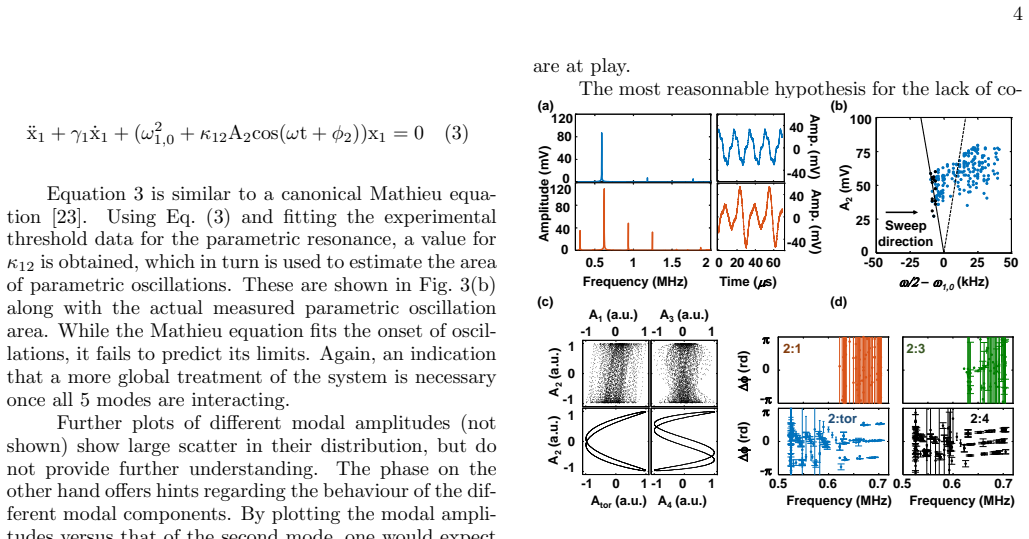
The load-bearing device is the modal-interaction Hamiltonian of Eq. (1), written $H_{jk} = \kappa_{jk} x_k^2 x_j + g_{jk} x_k^3 x_j$, together with a coupled Duffing equation per mode: the $\kappa_{jk}$ terms are three-wave mixing couplings and the $g_{jk}$ terms are four-wave mixing couplings. These coupling terms are what transfer energy between modes whose natural frequencies sit near rational ratios. On the experimental side, the feedback loop consists of a laser Doppler vibrometer readout passed through a filter-amplifier and back to the device, with the band-pass filter intended to let only the second flexural mode self-oscillate and with loop gain as the control parameter; the single-sided DC bias is what activates even-odd coupling. For the 2:1 parametric interaction, the reduced equation $\ddot{x}_1 + \gamma_1 \dot{x}_1 + (\omega_{1,0}^2 + \kappa_{12} A_2 \cos(\omega t + \varphi_2))x_1 = 0$ is a Mathieu equation, and fitting its threshold gives the value of $\kappa_{12}$ used to map the parametric-oscillation region.
What would settle it
With the loop gain held just below the self-oscillation threshold and the filter centered on the second mode, measure the four other modes: if any of them appears at measurable amplitude, direct electrical driving is contaminating the supposed internal-resonance comb.
Extended reading notes
Core claim
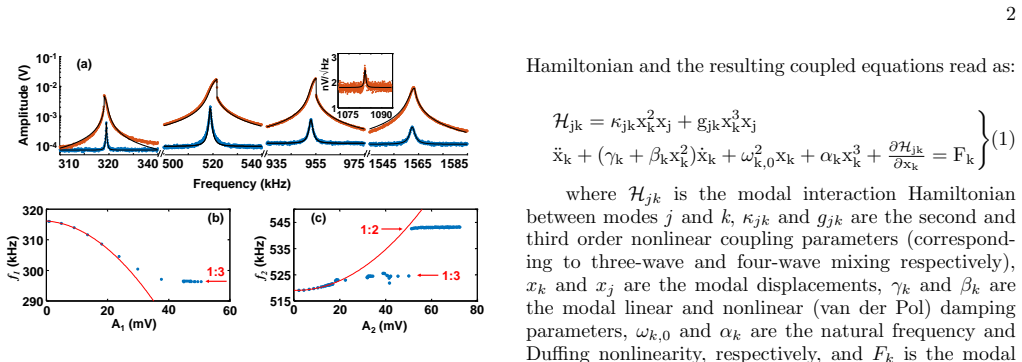
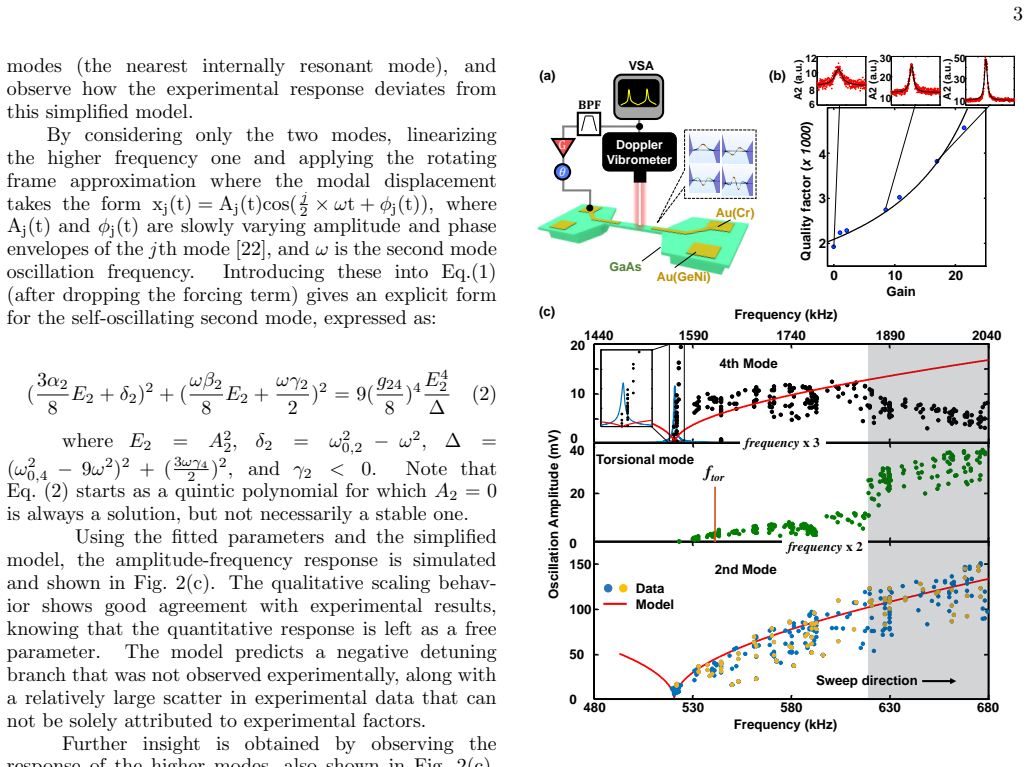
On a 150-micrometer piezoelectric clamped-clamped beam, the paper places the second flexural mode in self-oscillation through a gain-feedback loop, with a steep band-pass filter selected so that only that mode is driven directly. Under a DC bias that breaks the beam's longitudinal symmetry, the first four flexural modes (near 319, 519, 953, and 1564 kHz at low drive) and the first torsional mode (near 1083 kHz) are coupled by 1:3, 1:2, and 2:1 internal resonances. Sweeping the filter's center frequency at constant loop gain pulls the self-oscillation frequency over roughly 30% and pumps the non-driven modes through modal interactions; near 620 kHz the first mode enters parametric oscillation through the 2:1 resonance, while the fourth and torsional modes develop a tristable phase relation and the first and third modes show a time-dependent phase. The paper concludes that one feedback-driven mode can generate a five-mode frequency-locked comb purely from internal resonances.
Load-bearing premise
The band-pass filter in the feedback loop lets only the second flexural mode self-oscillate, with no electrical feedthrough or filter leakage driving the other four modes, so their oscillations must come solely from internal nonlinear coupling.
Editorial extensions
If this is right
- A mechanical frequency comb can be generated with one self-oscillating mode as the only pump, requiring no multi-tone external drive.
- The self-oscillation frequency can be tuned over about 30% at constant loop gain by sweeping the filter, which opens a wide-range, single-knob tuning method for internally resonant oscillators.
- Breaking longitudinal symmetry doubles the accessible interaction space by coupling even and odd mode families, allowing 1:2, 1:3, and 2:1 resonances to be active simultaneously.
- Within the locked comb, the fourth and torsional modes show a tristable phase that is anchored, while the first and third modes remain frequency-locked but phase-unlocked, so spectral locking and phase coherence are independent properties.
- The simplified two-mode model captures the qualitative scaling of the self-oscillating response until the 2:1 parametric onset, beyond which a full multimode treatment is needed to account for the observed dynamics.
Reading between the lines
- If the band-pass filter truly isolates the second mode, the same symmetry-breaking recipe should transfer to other multimode resonators with near-commensurate spectra, producing single-pump locked tone sets in devices beyond this particular beam.
- A decisive control experiment would be to repeat the measurement with symmetric, two-sided actuation and no DC strain bias: the even-odd couplings should vanish and the first and third modes should drop out of the locked pattern.
- The absence of sidebands next to the time-dependent phase of the odd modes suggests the phase instability is a slow drift rather than a conventional Hopf or SNIPER bifurcation; long time traces or phase-locked detection could distinguish these cases.
- The measured phase tristability of the fourth and torsional modes is a sensitive fingerprint of the coupling parameters $\kappa_{jk}$ and $g_{jk}$, and fitting it could replace the currently free quantitative amplitude parameter.
Signed reviews
Editorial analysis
A structured set of objections, weighed in public.
Referee Report
Summary. The manuscript reports a MEMS clamped-clamped beam oscillator in which a feedback loop is closed around the second flexural mode, driving it into self-oscillation. The authors observe that, as the oscillator frequency is pulled by tuning the band-pass filter, the second mode engages in a 1:3 internal resonance with the fourth flexural mode, a 2:1 parametric interaction with the first flexural mode, and a nominally 2:1 interaction with a torsional mode, while the first and third modes also interact. Plateaus in the frequency-amplitude curves, a Mathieu-type parametric threshold fit, and Lissajous figures are presented as evidence of internal resonances. The central claim, stated in the abstract and conclusion, is that this constitutes a 'five modes frequency-locked comb' generated from a single self-sustained mode. The paper also proposes a reduced two-mode analytical model for the second and fourth modes.
Significance. If fully substantiated, the demonstration of simultaneous multiple internal resonances in a self-sustained MEMS oscillator would be a useful contribution to the growing literature on mechanical frequency combs and multimodal MEMS oscillators. The paper has clear strengths: the experimental observation of amplitude plateaus indicating internal resonances, the extraction of a three-wave coupling coefficient from the parametric threshold, and the phase-anchoring behavior of the even and torsional modes. These provide credible evidence for internal-resonance-mediated energy transfer. However, the paper's headline claim of a 'frequency-locked comb' is not established by the presented data, and the analytical model is explicitly compared only after a free scaling parameter. The work is therefore of interest but requires substantially strengthened evidence before the central claim can be accepted.
major comments (3)
- [Abstract and final paragraph; Fig. 3(d)] The central claim that a 'five modes frequency-locked comb' is generated is not supported by the data and is internally inconsistent with the text's own phase analysis. In Fig. 3(d), the phase differences involving modes 1 and 3 have error bars spanning the full [−π, π] range and are described as a 'time-dependent phase difference'; the final paragraph explicitly offers only the 'additional prospect of having the even and odd modes in a constant frequency ratio, but with an unlocked phase.' Furthermore, the quoted frequencies do not by themselves establish exact commensurability: with f2 = 519 kHz and ftor = 1083 kHz, ftor/f2 ≈ 2.09, not 2.00, and f1/f2 ≈ 0.61, not 0.50. To support the abstract's claim, the authors should report measured frequency-ratio deviations over the operating interval (for example |2f1 − f2|/f2, |3f1 − f3|/f3, |2f2 − ftor|/ftor, and |3f2 − f4|/f4) together with a phase-coherence statistic. As written, the data demonstrate concurrent excitation of five modes, but not a frequency-locked comb.
- [Feedback-loop filter assumption, Section II and Fig. 2] The interpretation that modes 1, 3, 4, and the torsional mode are excited only through internal resonances and parametric pumping depends on the band-pass filter in the feedback loop rejecting direct excitation of those modes at all operating frequencies. The paper states that the filter is inserted 'to insure that only the second mode goes into self-oscillation' but does not report the filter's measured attenuation at 319, 953, 1564, and 1083 kHz, nor a control experiment with the loop open or with the filter center frequency far from the second mode. Without such data, electrical feedthrough or filter leakage could in principle contribute to the observed multimode spectra, which would weaken the internal-resonance attribution. This point should be addressed quantitatively.
- [Eq. (2) and Fig. 2(c)] The analytical model is presented as supporting the frequency-pulling behavior, but the comparison in Fig. 2(c) is made after stating that 'the quantitative response is left as a free parameter.' This means the model curve is not a parameter-free prediction and cannot quantitatively validate the mechanism. In addition, the model produces a negative-detuning branch that is not observed experimentally, and the fourth-mode data depart strongly from the model near its natural frequency. The authors should state explicitly which parameter is being used as the free scaling factor, how the model curve is normalized, and what quantitative or falsifiable statement the model is intended to support. If the model is meant only as a qualitative scaling argument, the text should say so and the analytical support for the comb claim should be downgraded accordingly.
minor comments (5)
- [Final paragraph] There is a typographical error: 'reasonnable' should be 'reasonable.'
- [Section II, text near Fig. 2] The phrase 'To use the second fluxural mode' contains a typographical error: 'fluxural' should be 'flexural.'
- [Eq. (1)] The notation in Eq. (1) is ambiguous: the Hamiltonian Hjk is defined only through the sum of a three-wave and a four-wave term, but the equation then uses ∂Hjk/∂xk without specifying the sign convention or showing how the derivative acts on both terms. Please write out the resulting coupling forces explicitly.
- [Fig. 2(b)] The insets in Fig. 2(b) are described in the caption as showing the change in the Brownian response, but the main text says the quality factor is plotted as a function of loop gain. Please clarify what quantity is shown in the insets and on which axis.
- [Fig. 1 and Section II] The torsional mode is quoted at 1083 kHz while the second flexural mode is quoted at 519 kHz; since 1083/519 ≈ 2.09, the text's statement that this corresponds to a 1:2 ratio with the second flexural mode requires an explicit detuning value or a correction, because the nominal frequencies do not satisfy the ratio.
Circularity Check
No significant circularity: the five-mode comb is an experimental observation, and the fitted models are explicitly qualitative and not used to derive the central claim.
full rationale
The central claim of the paper is an experimental observation: a self-sustained MEMS oscillator is shown to excite five modes through 1:2, 1:3, and 2:1 internal resonances, producing a multimodal response. This claim is not derived from the fitted equations; the two-mode model used for the tuning behavior is explicitly described as giving only 'qualitative scaling behavior' with the 'quantitative response left as a free parameter,' and the model even predicts a branch 'that was not observed experimentally.' Similarly, the Mathieu-type coupling parameter kappa_12 is fitted from parametric-resonance threshold data and is then used to estimate the parametric oscillation area, but the paper explicitly acknowledges that the model 'fails to predict its limits.' Thus no fitted quantity is renamed as a successful first-principles prediction, and the five-mode comb result does not reduce to the fitted parameters by construction. The self-citations, such as [12] for the fitting procedure and [19] for device details, are conventional references to the authors' prior work and are not load-bearing: they supply characterization details and a smallness assumption, not a uniqueness theorem or the central result. The paper's own phase data do raise a separate consistency concern: the abstract calls the output a 'frequency-locked comb,' while the final paragraph concedes 'the additional prospect of having the even and odd modes in a constant frequency ratio, but with an unlocked phase,' and Fig. 3(d) shows phase differences spanning [−pi, pi] for modes 1 and 3. That is a correctness/evidential weakness about whether the modes are truly phase-locked, not a circularity in the derivation, and it does not affect the circularity score.
Assumptions & free parameters
free parameters (5)
- Duffing coefficients α_k and linear damping γ_k for modes 1-4 =
See supplementary material
- Nonlinear (van der Pol) damping β_k for modes 2 and 4 =
See supplementary material
- Four-wave mixing coupling g24 between modes 2 and 4 =
Not stated in text
- Three-wave mixing coupling κ12 between modes 1 and 2 =
Fitted from parametric threshold data
- Quantitative scaling factor for the model amplitude-frequency curve =
Left as a free parameter
assumptions (4)
- domain assumption Rotating frame approximation with slowly varying amplitude and phase envelopes
- ad hoc to paper Linearization of the higher-frequency mode (mode 4) in the two-mode reduction
- domain assumption Van der Pol form of nonlinear damping (β_k x_k^2 dx_k/dt)
- ad hoc to paper Dispersive mode coupling [13] is negligibly small
Cite this review
Pith. "Pith review of Multimode internal resonances in a MEMS self-sustained oscillator." pith.science (2026). https://pith.science/paper/7Y77CWLH
@misc{pith2026190802418,
  author       = {Pith},
  title        = {Pith review of: Multimode internal resonances in a MEMS self-sustained oscillator},
  year         = {2026},
  howpublished = {\url{https://pith.science/paper/7Y77CWLH}},
  note         = {Machine review of arXiv:1908.02418}
}
read the original abstract
We investigate the dynamics of a microelectromechanical (MEMS) self-sustained oscillator supporting multiple resonating and interacting modes. In particular, the interaction of the first four flexural modes along with the first torsional mode are studied, whereby 1:2, 1:3, and 2:1 internal resonances occur. Even and odd modes are induced to couple by breaking the longitudinal symmetry of the structure. Self-oscillations are induced in the second flexural mode via a gain-feedback loop, thereafter its frequency is pulled into a commensurate frequency ratio with the other modes, enabling the oscillator to act as a driver/pump for four modes simultaneously. Thus, by leveraging multiple internal resonances, a five modes frequency-locked comb is generated.
Figures
Reference graph
Works this paper leans on
- [12]
-
[1]
R. Lifshitz and M. Cross, Review of nonlinear dynamics and complexity 1, 1 (2008)
work page 2008
- [2]
- [3]
-
[4]
S. I. Arroyo and D. H. Zanette, Eur. Phys. J. B 89, 12 (2016)
work page 2016
- [5]
-
[6]
J. G¨ uttinger, A. Noury, P. Weber, A. M. Eriksson, C. Lagoin, J. Moser, C. Eichler, A. Wallraff, A. Isacsson, and A. Bachtold, Nature Nanotechnol. 12, 631 (2017)
work page 2017
- [7]
Show all 23 references
-
[8]
Taheri-Tehrani, A
P. Taheri-Tehrani, A. Guerrieri, M. Defoort, A. Frangi, and D. A. Horsley, App. Phys. Lett. 111, 183505 (2017)
2017
-
[9]
D. H. Zanette, Eur. Phys. J. B 91, 89 (2018)
2018
-
[10]
D. A. Czaplewski, C. Chen, D. Lopez, O. Shoshani, A. M. Eriksson, S. Strachan, and S. W. Shaw, Phys. Rev. Lett. 121, 244302 (2018)
2018
-
[11]
D. A. Czaplewski, S. Strachan, O. Shoshani, S. W. Shaw, and D. L´ opez, Appl. Phys. Lett.114, 254104 (2019)
2019
-
[13]
Westra, M
H. Westra, M. Poot, H. Van Der Zant, and W. Venstra, Phys. Rev. Lett. 105, 117205 (2010)
2010
-
[14]
Ganesan, C
A. Ganesan, C. Do, and A. Seshia, Phys. Rev. Lett. 118, 033903 (2017)
2017
-
[15]
Ganesan, C
A. Ganesan, C. Do, and A. Seshia, Applied Physics Let- ters 112, 021906 (2018)
2018
-
[16]
L. Cao, D. Qi, R. Peng, M. Wang, and P. Schmelcher, Phys. Rev. Lett. 112, 075505 (2014)
2014
-
[17]
C. Chen, D. H. Zanette, D. A. Czaplewski, S. Shaw, and D. L´ opez, Nat. commun.8, 15523 (2017)
2017
-
[18]
Yamaguchi, Semicond
H. Yamaguchi, Semicond. Sci. and Tech. 32, 103003 (2017)
2017
-
[19]
Houri, R
S. Houri, R. Ohta, M. Asano, Y. M. Blanter, and H. Ya- maguchi, Jpn. J. of Appl. Phys. 58, SBBI05 (2019)
2019
-
[20]
Davidovikj, F
D. Davidovikj, F. Alijani, S. J. Cartamil-Bueno, H. Zant, M. Amabili, and P. G. Steeneken, Nat. Commun. 8, 1253 (2017)
2017
-
[21]
Anderson, S
P. Anderson, S. Hsieh, M. Wu, and T. Chuang, Nanome- chanics of materials and structures (Springer, 2006)
2006
-
[22]
Greywall, B
D. Greywall, B. Yurke, P. Busch, A. Pargellis, and R. Willett, Phys. Rev. Lett. 72, 2992 (1994)
1994
-
[23]
A. H. Nayfeh and D. T. Mook, Nonlinear oscillations (John Wiley & Sons, 2008)
2008
Reviewed August 14, 2026 · model on record in the stance chip above.
Discussion (0). Continue with ORCID to comment.